The 12:40 a.m. Calendar Move
After ten years of sound-energy research, I have learned to recognise a particular off-beat: you can run a structured product sprint and still move three calendar blocks after one electric Hinge date. I recognised it when Maya, a 28-year-old product designer in Toronto, sat across from me with her phone face-down but still warm.
At 12:40 a.m., I watched her reread a short affectionate message, open Google Calendar, and drag Thursday dinner with her friends into the following week. The phone warmed her palm; a streetcar hissed along the wet road below, and the radiator clicked in the dark. Her thumb hovered as if the next reply might decide the future.
“Why do I keep mistaking intense chemistry for relationship readiness?” she asked. “It feels this strong, so it has to mean something.” She wanted a relationship grounded in mutual intention, availability, boundaries, and consistent effort, yet after one highly charged date she had already increased the messages, rearranged her plans, and given a new connection relationship-sized access before anyone had made a second date.
I heard charged longing in the racing pulse she described, the restless hands reaching for the phone, and the sleep that would not arrive. It was like treating a flare as a lighthouse: the light was real, but it was being asked to guide her across a harbour it had never mapped. “A spark can be true without being a timeline,” I told her. “We do not have to make your desire smaller. We can make the question clearer. Let’s draw a map through this fog together.”

The Ladder Between Chemistry and Readiness
I invited Maya to place both feet on the floor, take one unforced breath, and name the question she wanted the cards to examine. Then I shuffled slowly. I treated the preparation as a change of attention, not a magical test: a few quiet seconds in which her nervous system could stop chasing the last message and allow observation to join the conversation.
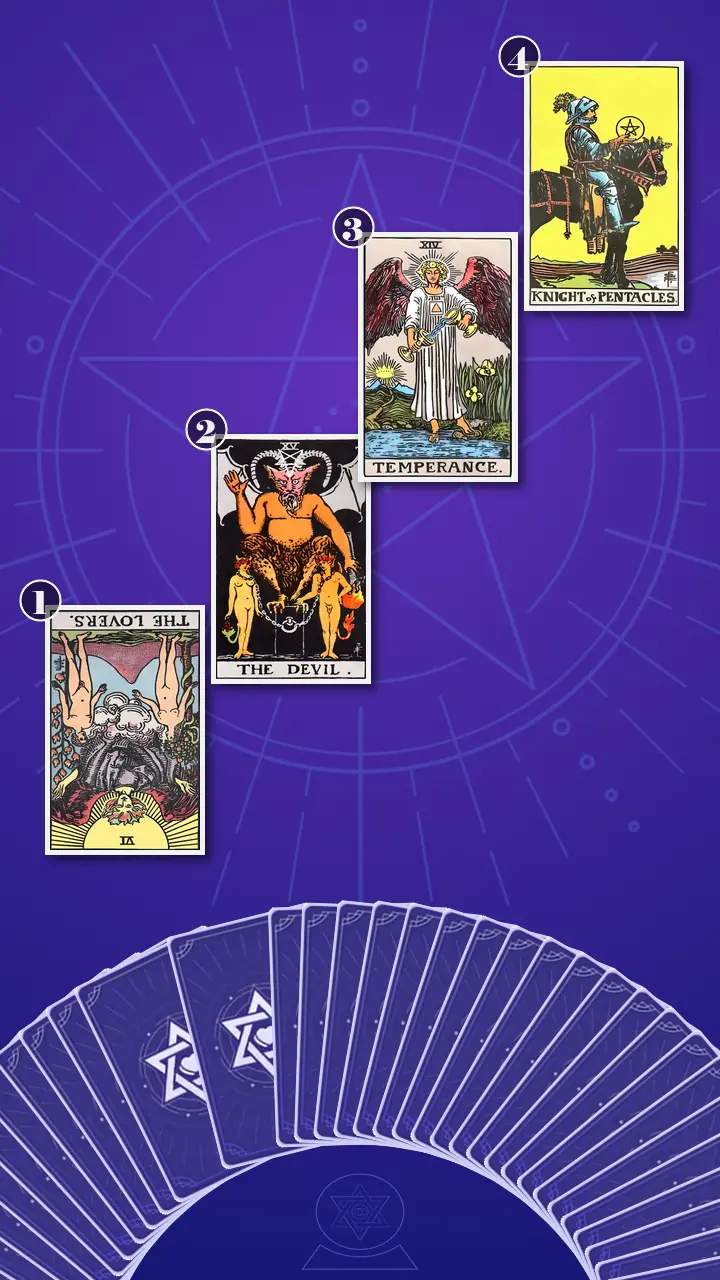
I chose the Four-Layer Insight Ladder, a classic four-card tarot spread within the F5 Inner Excavation framework. I use this structure when someone is asking why a repeated internal misreading persists, rather than asking me for a prediction or a verdict about another person. This is how tarot works here: the cards provide an organised mirror for feelings, beliefs, choices, and practical evidence.
The four positions formed the smallest complete path I could give her. The first would present the diagnosis: how contact and investment were escalating before alignment had been checked. The second would reveal the psychological root: the certainty that intense attraction temporarily supplied. The third would introduce the balancing transformation, where attraction, direct communication, regulation, and behaviour could be considered together. The final position would ground that insight in repeated reliability, realistic availability, boundaries, and follow-through.
The Mountain Between a Moment and a Choice
Position 1: The Spark Mistaken for a Decision
I turned over the card for the visible diagnosis: Maya escalates contact and investment after intense chemistry before checking aligned intentions, consistency, boundaries, or practical capacity.
The card was The Lovers, in reversed position.
I asked Maya to place the card beside the scene she had described: a five-hour date with electric eye contact, vulnerable conversation, and strong physical attraction, followed by an affectionate message she reread as though a mutual relationship decision had already been made. I watched her describe clearing Thursday evening before the next date had even been confirmed, while intentions, boundaries, realistic availability, and follow-through remained unanswered.
The Lovers reversed showed a blockage in conscious alignment, not false attraction. Fire was loud: desire, intimacy, anticipation, and the rush of imagining what might happen next. Air was faint because precise language had been postponed. The steep mountain between the two figures became practical distance—the distance that attraction cannot cross by itself. I pointed to it and said, “The feeling may be significant, but felt significance and chosen alignment are not the same thing.”
I used a split-screen comparison. On one side, I placed the candlelit Ossington date, the knee touching hers beneath the table, and the thought, “It feels this strong, so it has to mean something.” On the other, I placed the blank calendar square and the questions still waiting for an answer: What is this person hoping to make room for? Can they offer consistent time? Do they communicate limits directly? Do their actions follow their warmth?
I watched Maya give a small, bitter laugh instead of nodding. “That is too accurate,” she said. “Almost cruel.”
I answered, “I am not hearing a flaw in you. I am hearing a real signal being asked to answer more than it can. The card is not telling you to reject anyone who creates excitement. It is inviting you to make one separate list for chemistry and another for readiness before you increase access to your time.” Her fingers moved from the edge of the card to her phone, then stopped. I could see one unanswered question from a recent connection becoming harder for her to ignore.
Position 2: The Typing Bubble That Became a Tether
I turned over the card for the psychological root: intense attraction offers immediate certainty and postpones the discomfort of discovering that chemistry and readiness may not match.
The card was The Devil, in upright position.
I asked Maya to revisit the familiar Line 1 loop. A message appeared late at night: the person was passionate about seeing her again but vague about making a plan. Instead of asking what their actual week or dating capacity looked like, Maya sent another flirtatious callback to their date and reopened the thread to watch for the typing bubble. I watched her jaw tighten as she repeated the private logic beneath it: “If I slow down, I will lose the feeling; if I lose the feeling, I will lose the possibility; so I need to restore the feeling now.”
The Devil represented an excess of heat and a blockage of choice. The binding force was not attraction itself, and it was not a moral judgement about Maya. It was the interpretation loop that made momentum feel like the only available form of control. One affectionate emoji offered temporary certainty, then created another reason to check. Immediate relief became more persuasive than the slower evidence of capacity.
I drew her attention to the loose chains around the figures’ necks. They looked binding, but they were not welded shut. Maya’s calendar, reply timing, questions, and boundaries still belonged to her. When I placed The Devil beside The Lovers, the visual dialogue became clear: both cards showed intimacy and exposure, but The Lovers left the figures standing in an open landscape, while The Devil narrowed the space with chains and darkness. Chemistry can invite choice; the need to preserve intensity can quietly shrink it.
I watched the reaction move through her in three small beats. First, her thumb froze above the imaginary message. Then her eyes lost focus, as if she were replaying the disappearing typing bubble and the vague “soon” that never became a day. Finally, a long breath left her chest. “I send another message because waiting feels like losing control,” she said.
I stayed with that sentence instead of rushing to reassure her. “What if the uncertainty is not an instruction?” I asked. “What if it is information you are allowed to receive before you decide how much of yourself to invest?” Her shoulders remained tense, but she stopped trying to recreate the original high in the air between us.
When Temperance Let the Spark Stay a Spark
Position 3: The Two Cups of Feeling and Evidence
The room quieted when I reached the third card, as if even the radiator had lowered its volume.
I turned over the card for the key transformation: slowing the pace enough for attraction, direct communication, emotional regulation, and behavioural evidence to be considered together.
The card was Temperance, in upright position.
Temperance did not ask Maya to suppress desire or perform emotional distance. It offered proportion. The angel’s water moved steadily between two cups, while one foot rested on land and the other in water. I read the image as two information streams held at once: “how this feels” and “what this person repeatedly does.” Neither had to erase the other. The feeling could remain warm while reality was given time to participate.
When I saw the water passing between the cups, I had one of my familiar sound-energy flashes. Good mixing does not mute the bass; it gives every frequency a place. My signature Communication Dissonance Audit usually examines arguments not by the words spoken, but by the mismatch in emotional tempo and frequency underneath them. With Maya, I applied the same lens to the early dating conversation: her emotional BPM had risen to a full-volume high note, while direct intentions, practical capacity, and reliable follow-through were still playing quietly in the background.
The audit did not prove that the other person was unavailable, and it did not accuse Maya of being too intense. It asked a more useful question: “Is the pace of my investment matching the pace of demonstrated capacity?” The spread contained no Sword card, so plain language had to be added deliberately. One precise question could bring air into a connection currently being interpreted mostly through heat, intimacy, and momentum.
At 12:40 a.m., Maya reread one affectionate text, felt her pulse jump, and opened Google Calendar before a second date existed. The spark was real; the relationship story was still missing data, and she was trying to make a vivid moment carry a future it had not yet earned.
Chemistry is not proof of readiness; let attraction and evidence blend gradually, as Temperance passes water between two cups.
For a few seconds, I watched Maya go still: her breath paused, her thumb hovered above the phone, and her eyes widened without quite looking at me. Then her gaze lost focus, replaying the affectionate message, the unanswered question, and the friend dinner she had nearly moved. Her shoulders lowered by a fraction; the fist in her lap opened, closed, then opened again. The rims of her eyes grew pink. She gave a small, incredulous exhale, and the sound seemed to travel through the room with the streetcar bell outside. “But doesn’t this mean I was wrong before?” she asked, with a flash of anger that quickly turned into a tremor in her voice. I answered, “It means you were using a real feeling to answer a question it could not answer alone.” I saw relief arrive beside a new, delicate responsibility: the phone no longer held the whole decision, but the decision had returned to her. Now, use this new perspective to revisit last week: was there a moment when this insight could have made you feel different?
I asked Maya to imagine enjoying the memory of the date while keeping Thursday dinner with her friends. I asked her to picture opening a two-column note labelled Chemistry and Readiness, then asking one clear question and watching whether the answer was supported by behaviour over time. The transformation was not certainty. It was the first movement from chemistry-driven escalation toward grounded openness: a willingness to feel the spark without handing it the steering wheel.
Position 4: The Reliability That Arrives on an Ordinary Day
I turned over the card for the practical integration: matching emotional and logistical investment to repeated evidence of reliability, realistic availability, and follow-through.
The card was Knight of Pentacles, in upright position.
I read the stationary black horse as a deliberate pause, not passivity. The Knight held the pentacle at eye level, keeping practical capacity visible even when desire became loud. The cultivated field behind him suggested that trust grows through ordinary tending: concrete plans, honest limits, reciprocal effort, and respect for boundaries repeated across more than one cinematic night.
I asked Maya to picture a Sunday Google Calendar review. The next date was concrete. She had kept her workout and her friend dinner. She was watching whether the plan survived an ordinary workweek rather than evaluating whether the original spark could become even more intense. “One good night earns my interest,” she said slowly. “Repeated reliability earns more space.”
I saw her open the calendar on her phone and look at the evenings she had been holding open. The gesture was small, but it changed the question from “How do I keep this connection alive?” to “What has this connection actually shown me?” The Knight of Pentacles did not make attraction smaller. It gave attraction a sustainable pace to travel in.
Turning Heat Into Grounded, Actionable Clarity
I gathered the four cards into one story. The Lovers reversed showed the visible split: Maya wanted mutual readiness, yet treated a powerful emotional signal as though the relationship choice had already been made. The Devil revealed why the split felt so compelling: rapid messages, affectionate late-night words, and the hope of recreating the high supplied temporary certainty while direct questions remained uncomfortable. Temperance offered the missing rhythm, allowing desire, bodily regulation, clear language, and observed behaviour to share the same track. The Knight of Pentacles supplied the ground: let access grow only as reliable effort accumulates.
The flare-and-lighthouse metaphor named the central misunderstanding. Maya was not wrong to notice the light. Her blind spot was assuming that brightness answered direction, distance, and structural capacity. She had also been treating pacing as though it were a dating game or a punishment for caring. I wanted her to see the kinder distinction: slowing down is not playing games; it is giving reality time to join the conversation.
The key shift was clear: move from escalating investment on the strength of chemistry to matching investment only to repeated evidence of consistency, capacity, boundaries, and aligned intentions. Tarot could not tell Maya whether another person would become ready, and I would never pretend that it could. The cards gave her a reflective framework for making her own choices sooner, with less self-abandonment and more information.
The Two-Cup Readiness Check
I gave Maya small next steps rather than a grand rule for dating. The aim was not to grade another person or guarantee that she would never feel disappointed. The aim was to keep her own time, sleep, friendships, and boundaries in the room while a new connection revealed what it could actually sustain.
- Separate the signal from the story.After the next date, or after the most recent interaction this week, set a seven-minute timer in the Notes app. Under “Chemistry I experienced,” write no more than three details about what you felt. Under “Readiness I observed,” write no more than three factual behaviours. Add one thing that remains unknown. Do not send a message or make a decision while the timer is running.If two columns feel too clinical, write one bullet per column or record a 60-second voice note. This is a private check on your own time and access, not a scorecard for surveilling or grading another person.
- Ask one clear question.Before the next date, save one question in your phone and ask it by text or in person: “What are you hoping to make room for in dating right now?” or “What does your actual relationship bandwidth look like over the next few months?” Let the answer stand without immediately softening it, persuading, or filling the silence. Afterwards, write down the answer and one behaviour that could support or contradict it.A clear question is an invitation to exchange information, not an ultimatum or an interview. Lower the difficulty by drafting it first, practising it with a trusted friend, or asking only one question rather than trying to solve the entire connection in one conversation.
- Keep one piece of your existing life.When a last-minute invitation or affectionate late-night message arrives, keep one friend dinner, workout, or solo plan this week. If you are interested, offer one alternative time that genuinely works instead of clearing the whole evening or reorganising later weeks. Before replying, use my The Syncopation Pause: put both feet on the floor and make one quiet, three-second audible exhale or low hum, allowing your emotional BPM to fall before your thumb moves.I designed the Syncopation Pause for an escalating argument, but a typing bubble can create the same internal rush. The minimum version is one protected calendar block and one three-second pause. Keeping a commitment is not a tactic; it is a decision about your own availability. Match access to evidence, not adrenaline.
I reminded Maya that she could stop any exercise if it made her more agitated. She did not need to reach a conclusion in seven minutes, send the perfect message, or turn dating into product research. The purpose was simply to let two cups remain visible long enough for her to choose what to blend.

A Week Later, the Quiet Proof
A week later, Maya texted me: “I kept my workout and friend dinner, asked what they could make room for, and they suggested a real day.” She slept through the night; at breakfast, “What if I’m wrong?” still arrived first. She smiled, left one square open, and let one answer be one answer.
I did not tell Maya that the cards had fixed her pattern. I watched her practise a different relationship with uncertainty. The Four-Layer Insight Ladder had not delivered a verdict about the other person; it had helped her move from charged excitement to curiosity, from curiosity to clearer discernment, and from discernment to proportionate investment.
That is the kind of finding clarity I trust: not a sudden promise that every connection will work, but a little more room between what happens in the body and what the mind concludes. Maya still welcomed chemistry. She simply stopped asking her calendar, sleep, and friendships to carry a commitment no one had made.
The Spark, Still Warm
Whenever a connection lights up your whole body, I know the tight-chested fear that slowing down will make it disappear—and the exhausting hope that staying available can turn desire into certainty. I also know the quiet relief of discovering that a feeling can remain vivid after you stop asking it to predict the future.
Clarity is not always the final answer. Sometimes it is the first moment when the flare is still bright, the lighthouse has not yet been built, and you can see your own hands choosing what to do next.
If you let the spark stay a spark for one more beat, what small piece of consistency would you be curious to notice before offering more of your time?
This story is adapted from psychological research, written so that those in a similar struggle can see their own pattern in it — and find their next step clearly.These insights are not a substitute for professional psychological, medical, legal, or financial advice.
Learn more about our Journey to Clarity.
How did this insight land for you?
🫂 This Resonates Deeply
🌀 Living This Story
✨ Now I See Clearly
🌱 Seeing New Possibilities
🧰 Useful Framework
🔮 The Confirmation I Needed
💪 Feeling Empowered
🚀 Ready for My Next Step
Author Profile
 AI
AI“Through ten years of sound energy research, I’ve found that when we struggle, it's usually just our internal rhythm falling out of sync under pressure. I know firsthand the frustrating helplessness of wanting to move forward but feeling paralyzed. Without overwhelming theories, I want to be the soothing background track that helps you recalibrate, turning your heavy burdens back into a light, effortless, and harmonious melody.”
In this Love Tarot Reading :
Core Expertise
- Communication Dissonance Audit: Diagnosing arguments not by the words spoken, but by the fundamental mismatch in emotional tempo and frequency.
- Reactive De-escalation Mapping: Identifying the specific 'high notes' of defensive anger that shatter the emotional safety of the connection.
Service Features
- The Syncopation Pause: A 3-second acoustic grounding technique to interrupt an escalating argument, lowering the emotional BPM before permanent damage is done.
Also specializes in :
Explore Related Patterns:
Certainty SeekingA late-night message says the other person is passionate about meeting again but remains vague about making a plan. Instead of asking what they can realistically make room for, Maya sends another flirtatious callback and watches for the typing bubble. The action supplies a momentary sense that the connection is still moving and that the possibility has not been lost. Certainty Seeking is the active defence beneath that move. When you believe that slowing down could erase both the feeling and the future, restoring intensity feels more tolerable than receiving uncertain information. A warm reply can then feel like an answer, even though it only confirms warmth. The deeper shift is recognising that uncertainty is not an instruction to create more momentum; it is information to hold while readiness becomes observable.
Chemistry ChasingAt 12:40 a.m., Maya rereads one affectionate message, moves a friend dinner, and increases contact before a second date exists. Those actions are not evidence that the attraction is false. They show how a real spark becomes something you feel compelled to preserve through faster messaging, greater availability, and relationship-sized investment. Chemistry Chasing develops when maintaining intensity begins to feel safer than allowing the connection to reveal its actual capacity. Each new sign of warmth briefly revives possibility, but the relief fades because no amount of momentum can answer questions about intention, boundaries, or consistency. You can then mistake the success of restoring the feeling for evidence that the relationship itself is ready.
Emotional ReasoningMaya's sentence, “It feels this strong, so it has to mean something,” turns the intensity of her internal experience into a conclusion about the connection. The racing pulse, sleeplessness, vulnerable conversation, and physical attraction are all real, but she uses their strength to infer mutual readiness before intentions or capacity have been discussed. Emotional Reasoning appears when what you feel becomes proof of what is externally true. Because the chemistry feels unusually significant, the mind skips from “I am deeply activated and interested” to “this must be relationship potential that deserves immediate access.” The audit is not about distrusting emotion. It is about letting emotion describe your experience while requiring behaviour, communication, and time to answer the separate question of readiness.
Romantic ProjectionOne affectionate message is reread as though a mutual relationship decision has already been made, and a blank calendar square is reorganised before the next date exists. The five-hour date provides vivid material—eye contact, vulnerability, physical attraction, and warmth—but the practical future remains largely unwritten. Romantic Projection occurs when your mind fills that unwritten space with a relationship narrative drawn from the emotional force of the moment. The projection does not mean the possibility is imaginary or that the other person is necessarily unavailable. It means potential has been promoted into presumed capacity before enough evidence exists. Keeping the unknowns visible allows you to enjoy what happened without assigning the connection a future role it has not yet demonstrated it can hold.
Self-AbandonmentMaya moves a friend dinner, disrupts her sleep, and gives the new connection relationship-sized access before a second date has been made. No one is shown demanding those sacrifices. She pre-emptively reorganises herself around the possibility because staying maximally available appears to protect the spark. Self-Abandonment enters when your own time, routines, and relationships are treated as negotiable before reciprocal commitment exists. The strategy can feel generous or hopeful, but it quietly makes you pay the costs of a relationship that has not yet formed. Maya's later decision to keep her workout and friend dinner shows the alternative: you can remain interested without making your existing life disappear to prove that interest.
Urgency BiasAt 12:40 a.m., Maya moves Thursday dinner after one affectionate message, even though no second date has been confirmed. Her private logic makes the timing feel consequential: if she slows down, the feeling may fade; if the feeling fades, the possibility may disappear. Emotional activation therefore becomes a deadline. Urgency Bias compresses the distance between interest and investment. When you are inside that compressed timeline, acting now can feel protective while waiting feels like an avoidable loss. The cost is that speed removes the very observation period needed to assess readiness. A pause does not weaken the connection; it prevents adrenaline from deciding how much time, access, and meaning the connection receives before reality has participated.
Boundary DiscernmentA week later, Maya keeps her workout and friend dinner, asks what the other person can realistically make room for, and allows the suggested date to stand as one concrete data point. Her sentence—“One good night earns my interest. Repeated reliability earns more space”—turns access into a proportionate choice rather than an automatic response to intensity. Boundary Discernment is not emotional withholding or a dating tactic. It is your ability to decide how much time, availability, and vulnerability a connection has actually earned while still welcoming attraction. The boundary protects differentiation: their warmth belongs to them, your interest belongs to you, and greater access depends on what both people repeatedly choose. This creates room for intimacy without requiring your existing life to vanish first.
Compulsive CheckingMaya's phone is face-down but still warm after she rereads the message, reopens the thread, and watches for the typing bubble. An affectionate emoji briefly settles the uncertainty, yet it also creates another reason to look again. The checking is highly visible, but its psychological function matters more than the screen behaviour itself. When you check, the tension drops for a moment because the possibility feels active again. Since the action produces no durable information about intentions, bandwidth, or follow-through, uncertainty returns and the ritual repeats. Compulsive Checking can therefore keep your attention attached to signs of contact while delaying the clearer but less immediately rewarding task of asking what the connection can actually sustain.
Reality TestingMaya places chemistry and readiness in separate columns, asks what the other person can make room for, and watches whether the answer is supported by behaviour. When they suggest a real day, she does not convert that one response into a complete forecast. She lets one answer remain one answer. Reality Testing gives every claim the kind of evidence it requires. Your attraction can establish that you are interested; it cannot establish another person's availability or consistency. Their affectionate language can establish warmth; it cannot establish follow-through. Holding those distinctions does not make you suspicious or detached. It lets you preserve the emotional truth of the spark while preventing it from answering practical questions that only communication and repeated behaviour can answer.
Emotional RegulationMaya places both feet on the floor, takes one unforced breath, and lets her hovering thumb stop before it sends another message or moves another calendar block. The bodily intensity is not argued away. The pause simply creates enough space for observation to join the decision. Emotional Regulation here means allowing attraction and uncertainty to remain present without making immediate action the price of tolerating them. A week later, “What if I'm wrong?” still arrives, but Maya sleeps, keeps her plans, and leaves one square open. You do not need to eliminate the rush before choosing clearly. You need enough distance between activation and action for your values, boundaries, and available evidence to regain a vote.
Explore Related Struggles:
Activation-Attraction FusionAfter five hours of electric eye contact, vulnerable conversation, and physical attraction, Maya reread an affectionate message as though the relationship decision had already been made. When a later message expressed passion but stayed vague about a plan, she sent another flirtatious callback and watched for the typing bubble instead of asking what the person could actually make room for. The feeling was real, but it was being asked to carry a conclusion about intention and capacity that had not yet been spoken or demonstrated. You can let the spark stay vivid without allowing bodily intensity to become the only evidence that the connection is ready for more access.
Momentum-Readiness SplitMaya wanted a relationship grounded in mutual intention, availability, boundaries, and consistent effort, yet a single five-hour date led her to increase the messages and move Thursday dinner before a second date existed. Her emotional pace created a future-facing pull while the connection's practical capacity was still a blank space on the calendar. You do not have to make desire smaller to keep this distinction visible. The tension is held in allowing attraction to remain meaningful while readiness earns its own evidence through direct answers, realistic time, and repeated follow-through.
Evidence DisconnectionThe electric date and affectionate message supplied vivid information, while the blank calendar square still held unanswered questions about consistent time, direct limits, and follow-through. Maya could see both streams when they were placed side by side, but the warmth of one moment was still pulling more weight than the behavior that would show what the connection could sustain. Nothing in the story requires the feeling to be dismissed as false. You can hold what happened in your body alongside what has happened repeatedly in the other person's behavior, giving each kind of information enough room to speak before deciding how much more of your time to offer.
Accelerated Intimacy TrapOne intense date expanded into more messages, a moved friend dinner, and relationship-sized access before anyone had confirmed a second date. The new connection entered Maya's calendar and attention faster than it had shown a concrete plan, so preserving the possibility required her existing life to become more flexible around it. Each additional message could briefly recreate the original certainty while leaving the central question unanswered. You can keep interest open without handing over your whole schedule, allowing access to grow in proportion to the ordinary reliability the connection actually sustains.
Explore Related Emotions:
Ambiguity DreadThe typing bubble disappears, the affectionate promise of seeing each other "soon" never becomes a day, and Maya's jaw tightens as she waits. The connection offers enough warmth to activate possibility but not enough practical information to give that possibility a stable shape. You may experience that gap as Ambiguity Dread: an unanswered future that feels less like neutral space and more like something slipping out of your control. Recognising the feeling allows uncertainty to remain information, rather than turning it into an urgent command to message again or invest more.
Cautious ReceptivityMaya imagines enjoying the memory of the date while still keeping Thursday dinner with her friends. She allows the attraction to stay warm, offers genuine availability, and waits to see whether the connection can move through an ordinary workweek with concrete plans and reciprocal effort. You may recognise Cautious Receptivity as openness without premature surrender. It lets you welcome chemistry and remain emotionally available while preserving enough space for boundaries, capacity, and consistency to become visible before the relationship receives more of your life.
Cautious Self-TrustMaya's thumb stops above the phone, her shoulders lower, and she recognises that her calendar, reply timing, questions, and boundaries still belong to her. Later, she keeps her existing plans and leaves only one square open instead of reorganising her life around an unconfirmed possibility. You may feel Cautious Self-Trust as a quiet return of authorship rather than absolute confidence. The connection can still matter, but its intensity no longer has exclusive control over your next choice; you are allowed to decide how much access each piece of evidence has earned.
Certainty HungerWhen the other person is passionate about meeting again but vague about making a plan, Maya sends another flirtatious message and reopens the thread to watch for the typing bubble. Each warm sign briefly settles the unanswered question, but that temporary certainty quickly requires another sign to sustain it. You can feel Certainty Hunger when emotional momentum becomes more soothing than incomplete information is tolerable. The useful distinction is that reassurance can change how secure a moment feels without revealing what another person can consistently offer, leaving you free to receive warmth without treating it as settled evidence.
Grounded CuriosityA week later, Maya keeps her workout and friend dinner, asks what the other person can realistically make room for, and notices that they suggest a concrete day. She neither dismisses the original chemistry nor uses it to complete the parts of the relationship that are still unknown. You enter Grounded Curiosity when interest becomes spacious enough to observe what happens next. Instead of demanding an instant verdict from attraction, you can let direct answers, ordinary plans, limits, and follow-through gradually reveal how much room the connection can hold.
Liberating UncertaintyMaya hears the question, "What if the uncertainty is not an instruction?" and stops trying to recreate the original high. A week later, she asks what the other person can make room for, receives one concrete answer, and lets that answer remain limited to what it actually says. You can experience Liberating Uncertainty when not knowing creates observational space instead of demanding immediate repair. The future remains open, but you no longer have to secure it through intensified contact; you can allow repeated behaviour to add information at its own pace.
Limerent RushAt 12:40 a.m., Maya rereads one affectionate message, feels her pulse jump, loses sleep, and moves a friend dinner before a second date exists. The intensity is real, but her mind gives that bodily charge relationship-sized meaning before mutual choice has appeared. You may recognise the rush as a feeling too vivid to leave unacted on: attention narrows, the imagined future brightens, and slowing down seems to threaten the possibility itself. Naming Limerent Rush keeps the spark emotionally honest while separating its force from evidence of relationship readiness.
Relational UrgencyAfter one five-hour date, Maya increases her messages, moves Thursday dinner with her friends, and gives the new connection more access before another date is confirmed. Her emotional pace has accelerated beyond the pace at which shared intentions, boundaries, and availability can actually become visible. You can feel Relational Urgency as pressure to preserve momentum before it cools, making immediate availability seem necessary to protect what might develop. The feeling becomes clearer when you ask whether your investment is matching demonstrated capacity, because that question restores room for choice without requiring you to diminish attraction.
Clarity ReliefWhen Maya hears that she used a real feeling to answer a question it could not answer alone, a long breath leaves her chest, her shoulders lower, and her fist begins to open. The phone no longer holds the entire decision because chemistry and readiness have become separate questions she can examine. You may feel Clarity Relief when the task shifts from proving what a spark means to noticing what a connection repeatedly shows. The relief is not a guarantee about the relationship; it is the lighter internal space created when one intense moment no longer has to carry the whole future.
Self-Betrayal AcheMaya says she wants mutual intention, boundaries, realistic availability, and consistent effort, yet she moves her friend dinner and loses sleep before those qualities have been demonstrated. Her bitter laugh and trembling question about whether she had been wrong reveal the cost of seeing her own standards displaced by the intensity of the moment. You may recognise Self-Betrayal Ache as the pain of noticing that your time, friendships, or routines were asked to support a commitment that had not been mutually made. That recognition does not make your desire a mistake; it shows you where protecting your existing life can bring your actions back into contact with what you actually want.
Explore Related Contexts:
Premature Commitment PressureBefore anyone has made a second date, Maya drags Thursday dinner with her friends into the following week, increases her messages, and begins holding evenings open. Her calendar is carrying the practical consequences of a commitment that neither person has discussed or made. Once an undefined connection receives priority access, ordinary dating uncertainty starts reorganising established parts of life. The pressure is visible in the widening gap between the connection's actual status and the position it occupies in Maya's schedule, sleep, and social time. You can reduce that pressure by keeping existing commitments in place until new access is supported by mutual choices. Offering one genuinely available alternative preserves interest while allowing the connection to demonstrate whether it can participate in your life rather than immediately displace it.
Readiness Mismatch CycleA recent connection tells Maya they are passionate about seeing her again but remains vague about making a plan; the typing bubble disappears, and 'soon' never becomes a day. Maya keeps the message thread active while the practical questions about time, intention, and dating capacity remain unanswered. Warmth and readiness are therefore moving on separate tracks. The communication offers enough intensity to keep the connection active, but its logistical structure does not yet support the level of access Maya is providing. Because the story identifies this as a familiar loop, the mismatch is not confined to one isolated calendar move. You can locate the mismatch without deciding that the other person is deceptive or that the chemistry is false. Direct questions and ordinary follow-through reveal whether affectionate momentum is accompanied by actual room for a relationship.
Relationship Readiness CheckMaya opens a two-column note for chemistry and readiness, asks what the other person can realistically make room for, and records behaviour that could support or contradict the answer. A week later, the exchange produces a real proposed day, but that single plan is allowed to remain one piece of evidence. The check gives the connection a visible structure while its status is still unresolved. Attraction, stated intention, practical availability, boundaries, and follow-through can now be examined as separate information streams instead of being compressed into one impression. You remain free to welcome the spark while asking whether the external conditions for a relationship are appearing. Readiness becomes observable through what is communicated, scheduled, respected, and repeated, leaving your next level of investment under your control.
Capacity-First ReliabilityAfter Maya asks what the other person can make room for, they suggest a real day. She then shifts attention from recreating the intensity of the first date to whether a concrete plan can survive an ordinary workweek and be followed by further consistent effort. Readiness becomes a question of usable capacity: available time, honest limits, reciprocal planning, respect for boundaries, and follow-through. One proposed date is a meaningful first data point, but it does not have to carry the weight of a fully established pattern. You can let additional access accumulate at the same pace as reliability. That keeps the connection open while allowing ordinary behaviour, rather than one cinematic night, to determine how much space it can sustainably hold.