The Ten-Minute Compatibility Verdict Meets One More Conversation

The Sunday-Night Filter
I have met early-career Toronto professionals who can optimize a product launch but spend Sunday night adding one more deal-breaker after rereading a decent Hinge conversation. Sometimes the search they type, then delete, is high standards or fear of intimacy.
At 9:14 PM on a Sunday, Alex (name changed for privacy) sat cross-legged on her small Toronto apartment sofa, moving between Hinge and a Notes file titled 'Non-negotiables.' The radiator clicked behind her. Takeaway curry lingered in the warm air, and her phone pressed heat into her palm. A promising profile said the person was more spontaneous than scheduled. Alex imagined chronic unreliability, future resentment, and an eventual breakup before they had even spoken. Her chest tightened; she swiped left.
I watched the relief arrive first, a small loosening under her ribs, followed by the hollow quiet of another door closing. She wanted a relationship that felt safe, exceptional, and deeply mutual, yet she was using an increasingly strict filter to remove every detail that might make intimacy uncertain. She wanted intimacy enough to search carefully, but feared disappointment enough to make careful searching remove the very uncertainty through which intimacy could grow. Her apprehension moved through her like a browser with thirty tabs open and no page fully loaded: too much signal, no trustworthy way to know what mattered.
'I can usually tell within ten minutes whether this is going anywhere,' she said. 'If I have to explain the mismatch, it is probably already a no. Maybe my standards are the only reason I have not settled.'
I did not ask her to lower those standards, and I did not treat her caution as a flaw. I said, 'Your values and boundaries deserve protection. We can also look at what happens when protection starts making contact impossible. Let us use the cards as a way to separate what you observed from what fear predicted, and draw a map through this fog together.'

Choosing a Compass for the Dating Crossroads
I asked Alex to put her phone face down, take one breath that reached her lower ribs, and hold the question without forcing an answer. I shuffled slowly. The point was not to summon a verdict; it was to make a deliberate pause where the app's instant judgments usually took over.
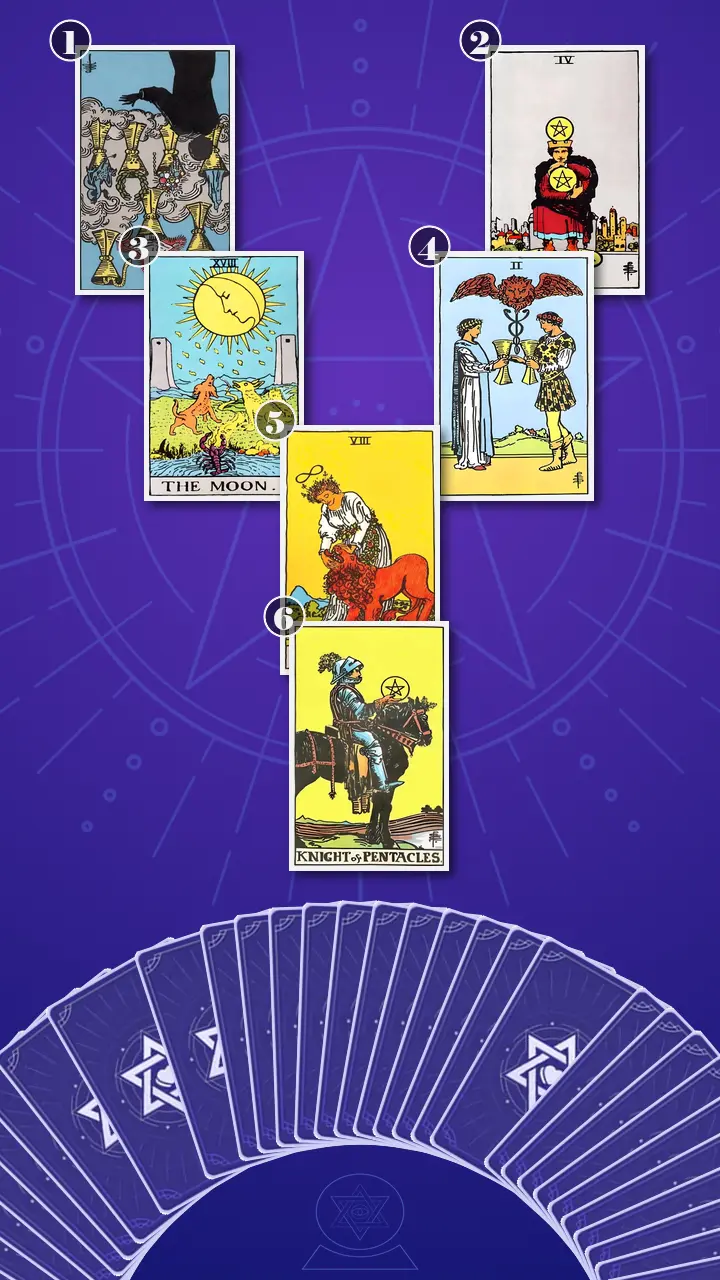
I chose the Four-Layer Insight Ladder - Context Edition, a six-card spread I designed for this kind of inner excavation. I explained to the reader why: when high dating standards may be doing double duty as emotional protection, a broad relationship spread can put the problem outside the person, while a decision spread can rush toward choosing. This layout keeps the behavior, the protective response, the hidden fear, the real relational need, the transformation, and a practical experiment distinct.
I told Alex that the first position would show the current surface pattern; the second would reveal the protective function and immediate obstacle; the third would trace the root fear beneath it; the fourth would name the authentic need. The fifth would hold the transformative principle, and the sixth would turn insight into a bounded next step. For readers wondering how tarot works in a dating question, this is card meaning in context: the images do not decide whether a person is right. They help us examine the evidence, the story added to it, and the choice still available.
Reading the Filter Without Calling It a Flaw
Position 1: The Profile That Became a Future
Now I turned to the card representing the current surface pattern: the concrete dating-filter behavior, including rapid rejection, criteria refinement, and comparison with an imagined perfect relationship.
Seven of Cups, in reversed position.
At 9:14 PM on Sunday, Alex was scrolling through several promising Hinge profiles while editing a private partner checklist. One person appeared thoughtful and values-aligned but described themselves as spontaneous, so Alex imagined chronic unreliability, future resentment, and eventual disappointment before a conversation occurred. She swiped left and called the decision clarity, even though the filter had replaced missing information with an imagined relationship outcome.
The seven covered cups became profile tiles: each one offered selected traits while concealing a whole person. The figure's distance from the cups mirrored Alex evaluating possible futures without entering enough contact to test them. In reversal, the energy was not a lack of judgment but an overcorrection. Every disappointing date added a new deal-breaker until the empty-results page began to resemble proof that nobody suitable existed.
I asked, 'When the detail says X, what future does your mind immediately write as Y? And are you protecting a value, or trying to guarantee that intimacy will never surprise you?' I wanted the question to preserve the useful part of discernment without ridiculing the filter.
Alex gave a short, bitter laugh instead of nodding. 'That is painfully accurate,' she said. Her thumb rubbed the edge of the phone case, and her eyes stayed on the reversed card. I let the recognition stand without turning it into shame. The first card had made the pattern visible; it had not made her wrong.
Position 2: The Coin Held Over the Heart
Now I read the position for the protective function: how high standards create control and emotional distance, linking the visible filter to the coping response that offers relief while restricting movement.
Four of Pentacles, in upright position.
On the Line 1 train north from Union at 8:47 PM, Alex received a warm message from someone she had genuinely enjoyed meeting: 'I had a great time. Want to do this again?' The rails shrieked through a curve, damp wool coats crowded the carriage, and white screen light crossed her hands. Her thumb hovered while her stomach braced. Instead of noticing the invitation, she audited the person's response times, career trajectory, exact wording, and emotional availability.
The seated figure clutching a pentacle against the heart became Alex's criteria list placed over emotional access. The coins under the figure's feet showed the short-term stability of control; the walled city behind her showed how that same stability could become a private perimeter. Upright, the energy was concentrated and constricted. Alex was asking another person to prove that interest was safe before offering any clear interest in return.
Her private sentence surfaced: 'I can show interest once they have made interest safe.' I told her, 'I understand why that feels protective. But relief after rejecting someone proves that uncertainty ended, not that the person was necessarily wrong. Intimacy cannot be tested if one person must risk being known while the other remains only a reviewer.'
Alex's breath caught. Her stomach tightened, then released a fraction. She looked from the coin in the illustration to the unanswered message, as if the two images had suddenly become the same object. I did not tell her to reply. I asked what she would need to observe in order to make a choice based on behavior rather than a demand for a guarantee.
Position 3: The Fog Between Fact and Forecast
Now I turned to the position for the underlying fear and blind spot: the uncertainty beneath the filter, and the moment when ordinary imperfection becomes a threat to emotional safety.
The Moon, in upright position.
At 10:22 PM on Saturday, after a promising date, Alex saw that her message had been delivered for three hours without a reply. Rain hissed against the bedroom window. The blue phone light made the duvet look gray, and the room was otherwise silent. The camera-visible fact was simple: the message had been unanswered for three hours. The future story became: this person would become inconsistent, reject her, and prove she had ignored an obvious warning.
The winding path between the two towers held the period between a promising first date and reliable knowledge. The dog and wolf faced the moon as competing pulls of social trust and protective instinct. The upright Moon did not ask Alex to distrust intuition. It asked her to notice when an instinctive caution was being turned into a complete forecast before enough evidence existed. An imperfect signal is information. Fear turns it into a verdict.
Alex's breath stopped. Her eyes lost focus, and for a few seconds I could see her mentally reopen old message threads, replaying delayed replies as if each one had been a warning she had failed to obey. Her fingers tightened around the phone. Then she swallowed, looked down at the card, and released a long breath that sounded almost like a reluctant laugh.
'But sometimes the story is true,' she said.
'It can be,' I replied. 'That is why we keep the boundary. We simply separate what happened from what the mind is trying to protect you from. The fact may tell you to gather more information, ask a direct question, or leave. It does not have to make the entire decision in the first minute.'
Position 4: The Conversation That Could Go Both Ways
Now I read the position for the authentic relational need: what genuine intimacy requires beyond perfect traits, including reciprocity, respect, openness, and evidence created through mutual participation.
Two of Cups, in upright position.
On a second coffee date near Trinity Bellwoods, the other person admitted they had felt nervous on the first date and asked what helped Alex feel comfortable when meeting someone new. Alex felt warmth rise into her face and wanted to answer honestly. Another part of her immediately began evaluating whether the nervousness signaled insecurity. I heard the old internal question underneath the silence: 'I have been asking whether they qualify, but have I let us meet?'
The two figures facing each other and exchanging cups changed the reading from a private audit to a visible exchange. The energy was balanced because both people were offering information, receiving what was offered, and making room for a response. The connection was not instantly perfect. It was giving Alex something more useful than a polished profile could provide: observable curiosity, care, and the possibility of repair.
I said, 'Reciprocity is something you observe, not something a profile can promise. The question is not whether this person already proves the whole relationship will work. It is whether both of you are participating honestly enough for compatibility to become knowable.'
Alex exhaled and allowed her answer to be less polished. She told the other person that direct communication helped her settle into new situations. When they responded with curiosity instead of dismissal, her shoulders lowered. The card did not erase her standards; it gave them a more relevant measure than status, timing, or an uninterrupted list of matching traits.
When Strength Refused to Silence Fear
Position 5: The Calm Hand at the Lion's Mouth
Now I turned to the position for the key transformation: the shift from using values as a locked gate to using them with paced vulnerability, directly challenging the pattern that ends contact before trust can form.
Strength, in upright position.
The room became quiet enough for me to hear the radiator click again. Strength was the key card and the antidote in this reading: patient emotional courage, self-trust, compassionate discernment, and the ability to remain present with manageable vulnerability while keeping clear boundaries.
Its modern scene was simple. Alex felt apprehension after a respectful first date and still sent, 'I enjoyed meeting you and I would like to learn more.' She was not claiming certainty, relaxing a real boundary, or promising a relationship. She was allowing one honest signal of interest to exist while observing how it was handled. The woman's gentle hand at the lion's mouth showed the same principle: stay in contact with the protective impulse without overpowering it or obeying it automatically.
At this point I used the diagnostic lens I call my Communication Dissonance Audit. I do not score only the words spoken; I listen for a mismatch in emotional tempo and frequency. Alex's words demanded certainty, while her hovering thumb and softened expression were asking for a small chance to know someone. Neither signal was fake. The dissonance came from giving fear a faster tempo than the evidence. The high note was not danger itself, but fear being handed the whole microphone.
The Sentence Beneath the Checklist
On Sunday night, Alex reopened Hinge, compared one promising person with the partner in her head, and felt her chest loosen when she found a reason to decline. I reminded her that relief was real, but it might measure the end of uncertainty rather than clarity about compatibility.
Stop treating every imperfect signal as a command to close the gate; practice paced vulnerability and let Strength's calm hand hold fear without allowing it to choose for you.
For a moment, Alex did not blink. Her thumb stopped above the reply field, her breath held high in her chest, and her shoulders stayed lifted as if the room had asked her to freeze. Then her gaze moved past the card to somewhere over my left shoulder; I could almost see the old scenes replaying: the delayed text, the profile closed, the clean relief after a quick no. Her fingers tightened around the phone, not in anger exactly, but in resistance to the idea that certainty had been doing the work of safety. 'But if I stop at every imperfect signal,' she said, 'how do I know I am not ignoring something important?' I pointed to the woman's gentle hand at the lion's mouth. 'You do not silence fear. You listen, check the facts, and keep the right to leave.' Her jaw loosened. A breath came out with a soft, shaky 'ah.' Her eyes reddened; one shoulder dropped, then the other. The release left a brief blankness behind, the light dizziness of having a clear path and responsibility for taking it. 'Now,' I asked, 'use this new perspective to remember last week: was there a moment when this insight might have made you feel or act differently?'
That was the first crossing from guarded certainty toward grounded clarity: not a promise to trust everyone, but a new ability to let values hold the boundary while patient courage stayed present. Strength's energy was balanced fire, not a demand to be fearless. It gave Alex a way to keep one hand on her own safety and the other on a small, honest risk.
Position 6: One More Stop, Not the Whole Route
Now I read the position for the grounded next step: a small dating experiment that observes consistency over time without predicting or deciding the outcome of a relationship.
Knight of Pentacles, in upright position.
The still horse, the carefully held pentacle, and the cultivated field made the pace practical. Alex could keep one promising conversation open for another week, schedule a 50-minute second date in a public place, and write three short notes afterward: 'Observed,' 'Story,' and 'Need.' She could evaluate respect, consistency, curiosity, attraction, and response to boundaries over two interactions instead of demanding an immediate feeling of certainty.
I told her, 'You are not choosing the relationship today. You are choosing whether one more interaction would give you useful information. A second date is one more observation, not a contract with the future.' Alex looked at the knight's unmoving horse and nodded. Deliberate pace was not stagnation. It was a way to let evidence accumulate while preserving both people's autonomy.
The Compass, the Gate, and One Small Test
When I laid the six cards together, I saw a coherent story rather than a verdict. The Seven of Cups reversed showed the earlier influence: imagined partners and polished relationship content filling in missing information. The Four of Pentacles showed the current defense: a criteria list held over the heart, granting relief by controlling access. The Moon revealed why: ordinary uncertainty had been recruited as proof of future rejection. The Two of Cups named what Alex actually wanted, mutual curiosity, respect, honesty, and responsive give-and-take. Strength supplied the resource, and the Knight of Pentacles gave it a realistic tempo. The doorway metaphor mattered: the work was not smashing the gate down, but turning a locked gate into a deliberate passage.
I named the blind spot plainly: Alex had been treating the speed of a verdict as evidence of discernment. A shrinking dating pool could then look like proof that nobody fit, even when the filter itself kept removing the contact needed to learn. The direction of change was from standards as a locked gate to standards as a compass, from imagined outcome to observed behavior, and from instant compatibility verdicts to paced vulnerability and reciprocal trust. 'Standards are a compass when they help you notice behavior; they become a gate when they demand certainty before contact,' I said.
I also made the boundary explicit. This was not an invitation to minimize red flags, romanticize risk, or give another date to someone who had been disrespectful, coercive, dishonest, bigoted, pressuring, or clearly incompatible with a genuine non-negotiable. No one owed Alex another date, and Alex owed no one access. The experiment was about choice under uncertainty, not about proving openness.
For the next week, I gave Alex three small experiments. Each one was designed to turn the insight into actionable advice without asking her to solve her entire relationship life at once.
- Three Values and Learn MoreBefore opening Hinge on Sunday night, spend five minutes creating a phone note with three headings: 'Core value,' 'Clear boundary,' and 'Learn more.' Put no more than three dignity-and-safety values in the first heading, and move lifestyle preferences or ambiguous concerns into the third.Start with one existing criterion if revising the full checklist feels too exposed. Sorting a preference into 'Learn more' is not lowering a standard; it is giving context a chance to exist.
- The Syncopation PauseWhen a respectful match sends a message or when the urge to reject rises after a date, use my three-second acoustic grounding technique before replying. Lower the emotional BPM, then set a 90-second timer and name the body sensation, the emotion, and the known fact: 'Tight chest; apprehension; they replied later than I expected.' If no boundary was crossed, decide only what information or response is needed next.The pause does not force a yes or another date. Stop immediately if you feel unsafe or pressured. The smallest version is three breaths and one camera-visible fact.
- The Two-Date Observation WindowChoose at most one promising connection this week and suggest a 45- to 60-minute second date in a public place, such as coffee or a walk along the Harbourfront, with a clear end time. Afterward, write 'Observed,' 'Story,' and 'Need' in your phone. Delay a final compatibility verdict until after the second interaction unless a clear boundary, safety issue, or non-negotiable appears.Review consistency, communication, mutual curiosity, attraction, and repair rather than waiting for certainty. A second date is one more observation, not a promise or a contract with the future.

A Week Later: The Quiet Proof
Four days later, I received a message from Alex while I was making tea. 'I used the three headings,' she wrote. 'The spontaneous-plans thing went into Learn more. I asked about it on a 50-minute coffee walk near the Harbourfront. We both asked questions. I still do not know what this is, but I know more than I did.'
She slept through the night, then woke with the familiar thought, 'What if I am wrong?' This time she smiled, not because the risk had vanished, but because the question no longer made the decision for her.
I told her that this was the first evidence of the emotional transformation: her standards were still present, but they were acting as a compass instead of a locked gate. Tarot had not guaranteed a relationship, identified a destined partner, or removed uncertainty. It had helped her hear the difference between an observed signal and the future story built around it. The choice, the boundary, and the courage to gather more evidence remained hers.
When a promising person gets close enough to matter, I know the tight-chested urge to turn one imperfect detail into an exit, because leaving first can feel safer than discovering whether we will be met. Noticing that urge is not a confession of failure; it is information, and you remain the person who decides what it means.
If you let one respectful but unresolved detail stay in the 'learn more' column for one more conversation, what might you become curious to observe?