Finding Clarity in the 8:47 Streetcar Spiral
I recognized the pattern in Jordan immediately: a 27-year-old junior communications strategist in Toronto, sitting in a peer-circle check-in with one safe sentence prepared, then adding the intimate detail when everyone else got warm. I had heard the question underneath the question: Why do I keep sharing private struggles just to belong in this group?
At 8:47 P.M., on the 504 streetcar heading east, Jordan reread the group chat beneath the blue-white glow of their phone. The rubber floor hummed under their shoes, wet coats smelled faintly of rain, and their thumb kept returning to the same messages while their throat tightened and their stomach dropped: had the painful detail created closeness, or had it paid for an invitation?
Earlier, Jordan had told me, “I want to belong, but I am scared that if I keep anything private, I will lose my place. I know I am sharing too much, but silence feels like disappearing.” That was the core contradiction: a genuine desire for belonging pressed against the fear that withholding private struggles would cost them belonging.
The feeling moved through their body like standing at the edge of a warm circle with an open diary in one hand and a receipt for their own privacy in the other. Shame, relief, and resentment had been taking turns at the same small desk inside them, each one checking the group chat for a different answer.
I did not hear manipulation or attention-seeking in that loop. I heard someone trying to make uncertain social signals stop moving. I told Jordan, “I am not going to declare this group safe or unsafe from one reading, and I am not going to tell you what fate requires. We can look at the exchange, the assumptions, and the choices available to you. Today, we will try to draw a map through the fog and hand the pen back to you.”

The Map That Could Hold a Circle
I invited Jordan to take one slow breath and place both feet on the floor. While they shuffled, I asked them to keep the question in view without trying to force an answer. For me, this small ritual is a psychological transition: it gives the mind one clear object to examine and separates the next choice from the momentum of the last conversation.
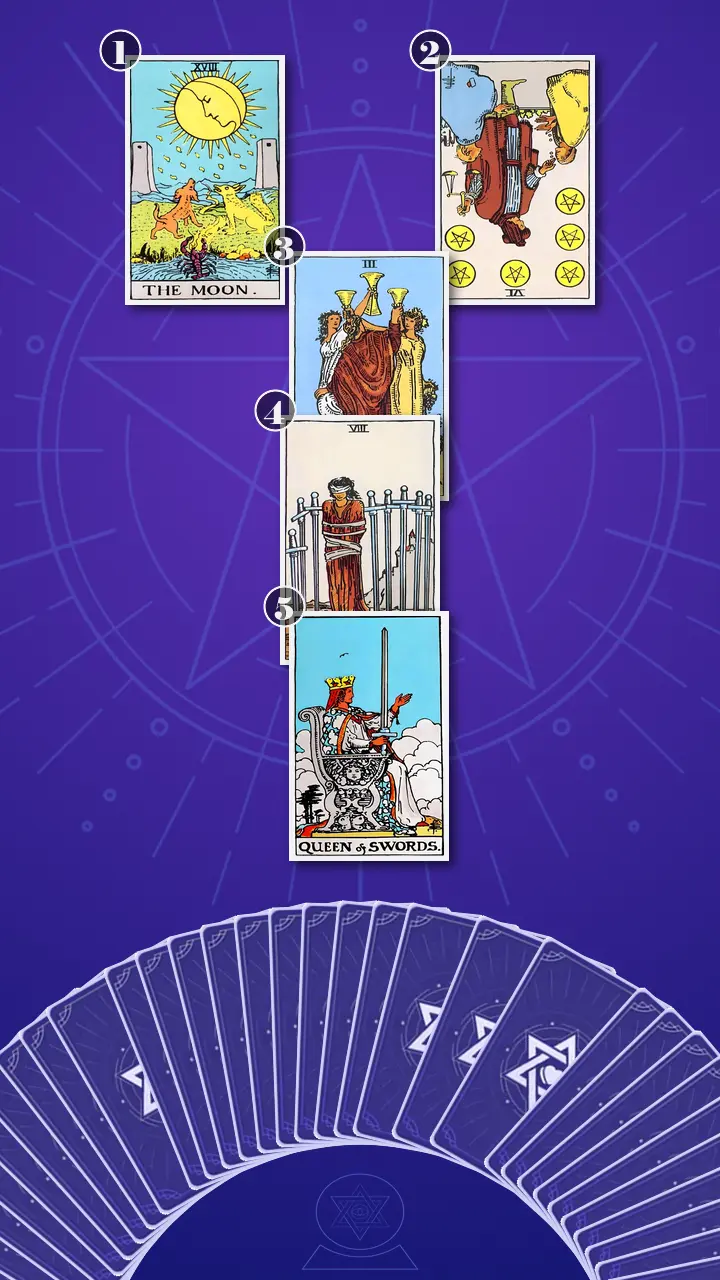
I chose the Relationship Spread · Context Edition because the question was relational at its centre. It could help us examine belonging inside a group, the boundary between a private and public self, the soft social leverage that can appear when disclosure seems to buy warmth, and the possibility of reciprocity without making assumptions about anyone's motives. This is how tarot works in a grounded consultation: the images become an organised language for noticing patterns, not a verdict delivered from outside Jordan's life.
The first position would show the observable disclosure pattern Jordan was enacting. The second would map the circle's implicit social exchange. The third would reveal what genuine community could make possible between them. The fourth would expose the internal rule turning privacy into a threat, and the fifth would offer a self-directed boundary experiment rather than a command to stay or leave.
Reading Card Meanings in Context
Position 1: The Page Added After the Safe Sentence
I placed my hand above the first card. “Now flipped is the card representing the observable disclosure pattern: what you are enacting when private struggles become a bid for belonging within the Performative Intimacy Circle.” I turned over The Moon, upright.
The Moon showed the winding path Jordan had been walking each week: drafting a candid update in the Notes app, rereading it, waiting for the exact moment when the room felt intimate enough to add the difficult detail, then riding the 504 home while every laugh, pause, reaction heart, and delayed reply became a clue about whether they belonged. The card's dog and wolf faced the same uncertain light, mirroring the tension between authentic feeling and performed openness. The crayfish rising from the water represented private material surfacing before Jordan had decided whether the setting had earned access.
Upright Moon energy is not a prediction of danger. It is an excess of interpretation and a deficiency of chosen boundary. Jordan was using ambiguous cues to manufacture certainty, but warmth, silence, and follow-up invitations could never answer the deeper question of whether they were inherently welcome. The disclosure-for-belonging loop began in that gap: reveal, scan, feel briefly reassured, regret the exposure, then reveal again when uncertainty returned.
The Character Written by the Room
I told Jordan that I use a diagnostic lens called Typecasting Analysis. It asks which social character a circle may have begun to associate with someone, and which character that person keeps auditioning for because the role once produced warmth. Jordan seemed to have been cast, perhaps partly by their own fear, as the person who made the room emotionally real by opening the hardest page. The circle had not necessarily assigned that role deliberately, but the character arc was becoming restrictive. Jordan was no longer deciding whether to share; they were trying to perform the person who would be worth keeping around.
Jordan gave a small laugh that held no amusement. “That is accurate enough to be rude,” they said.
I let the laugh remain in the room. I did not rush to turn recognition into reassurance. Jordan's thumb stopped rubbing the paper cup, but their gaze stayed on the moonlit path. I asked, “When you add the extra detail, what are you hoping the group will tell you without saying it directly?” Their shoulders lifted, then settled, as though the question had placed a hand near the mechanism instead of judging the result.
Position 2: The Emotional Cover Charge
“Now flipped is the card representing the circle's implicit social exchange: how warmth, attention, and vulnerability may function as Soft Power Strain without treating the group's motives as fixed facts.” The next card was The Six of Pentacles, reversed.
Reversed, this card translated the giver's scales into Jordan's mental tally of replies, eye contact, invitations, and reaction hearts. The coins became personal material being spent. The kneeling figures showed how an equal participant can begin to feel lower in the exchange, as if every private struggle creates a small social debt. After Jordan answered a casual check-in with a painful story, the circle responded quickly and warmly. Relief arrived like a transaction completed, and then Jordan wondered what they owed the next time.
This was an uneven energy, but it was not evidence that the group had consciously demanded payment. I said, “The important question is not whether anyone explicitly asked for your private history. It is whether you can offer humour, listening, curiosity, or an ordinary update and still experience the relationship as reciprocal.” The card asked Jordan to test the exchange rather than decide the group's intentions in advance.
Jordan looked down at their hands. Their fingers had curled around the edge of the chair, and one by one they loosened. The warmth they had received from the group was real enough to honour, but the feeling of owing more of themselves was real too. I could see the first distinction forming: emotional warmth was not automatically the same thing as unlimited emotional access.
Position 3: The Circle Beyond Confession
“Now flipped is the card representing the shared dynamic produced between your longing for closeness and the group's candid check-in culture.” I turned over The Three of Cups, upright.
The three raised cups brought a different kind of evidence. I asked Jordan to remember a Sunday brunch when the group had traded a restaurant link, a joke about work, practical help for someone's stressful week, and attentive questions. In that scene, connection had been nourished by many forms of participation. The group had remained warm while Jordan kept one private issue private, and a follow-up message arrived later. It did not prove that every gathering would respond in exactly the same way; it gave Jordan a concrete alternative to treating pain as the main entrance to community.
Upright Three of Cups energy is shared rather than transactional. The circle can hold laughter, celebration, listening, voice notes, meal plans, and the small act of remembering how someone's presentation went. I said, “Maybe I want the circle, not necessarily an audience for my hardest page.” The sentence did not reject vulnerability. It widened belonging beyond confession.
A breath moved through Jordan's chest with a soft, surprised sound. Their mouth lifted at one corner as they remembered a group-chat thread that had stayed warm through memes and dinner plans. For a moment, their private life did not have to be the centre of the bond for the bond to count.
Position 4: The Privacy Paywall
“Now flipped is the card representing the internalized rule and emotional cost keeping the cycle running: the belief that privacy could threaten belonging and the exposed aftershock that follows disclosure.” The fourth card was The Eight of Swords, upright.
The modern scene was immediate. Someone in the circle shared something intimate, and Jordan's hands hovered over the keyboard. Their shoulders rose as the thought arrived: if they said less, they would vanish. The blindfold on the card represented interpreting the group through fear rather than direct evidence. The crossed arms showed the felt lack of choice, while the loose bindings suggested that the rule could be examined instead of obeyed automatically. The surrounding swords were imagined consequences, not a direct statement from every person in the room.
Jordan spoke the inner script aloud. “If I keep this to myself, they will assume I have nothing real to offer. They will forget me. I will become peripheral.” I asked them to place a second sentence beside it: “What evidence do I actually have?” I was not trying to argue the fear away. I wanted the prediction and the observable facts to occupy separate lines.
Rewriting the Invisible Script
I used my second diagnostic lens, Group Dynamic Rewriting, to examine the invisible script that forced Jordan to match the room's emotional intensity out of fear of isolation. The script said: when one person reveals pain, everyone must answer with a more revealing page; when someone keeps a detail private, the circle will read that privacy as distance. I told Jordan, “A group can value candid conversation without requiring every person to disclose at the same depth. The script may be loud because it has been rehearsed, not because it is the only available dialogue.”
Jordan's breath paused first, and one finger remained suspended above their phone. Then their eyes went unfocused, as if the last several streetcar rides were replaying behind the blindfold: typing bubbles, a delayed reply, the sudden urge to explain more. Finally, a quiet “Oh” rose from somewhere deep in their chest. Their shoulders dropped, their jaw loosened, and the fingers pressing into their palm opened. The exposed aftershock had not meant that they had performed the disclosure badly. It had been information about the level of access they had actually wanted to give.
I said, “Privacy is not proof that you are detached. It may be the first observable sign that you are choosing rather than reacting.” Jordan did not look relieved yet. They looked tired, with the particular tiredness of someone who has found the door in a room they had assumed was sealed.
When the Queen of Swords Closed the Door Without Leaving the Circle
Position 5: The Boundary That Keeps Connection Honest
The room changed when I reached for the final card. The HVAC clicked off, leaving the faint city hush beyond the studio window. “Now flipped is the card representing guidance: the self-directed boundary experiment that lets you remain connected while choosing what is private, what is shareable, and why.” The final card was The Queen of Swords, upright.
The Queen's upright sword turned emotional ambiguity into a precise sentence. Her direct gaze modelled honest self-observation, and the clear sky behind her created room to separate a boundary from rejection. I connected the card to the next check-in: someone asks for an update, and Jordan says, “There is more going on, but I am keeping that part private today.” Then Jordan remains engaged by asking a question and listening. That is selective openness, not emotional withdrawal.
Upright Queen of Swords energy is balanced air: clear thinking, direct speech, self-trust, and a fair boundary shaped by experience rather than by denial of feeling. I told Jordan, “You can be present without being fully available. The boundary cannot control the group's response or guarantee a particular outcome. It can give you a way to gather information without immediately offering more of yourself to manage the uncertainty.”
As an artist, I have learned that a film often feels stuck because someone has stayed in a painful scene a little too long. The answer is not always to destroy the set or blame the other actors. Sometimes the next act begins when the character stops delivering the line that fear wrote for them. I could feel Jordan approaching that edit, not as a performance of confidence, but as a small act of authorship.
Jordan was still inside the familiar aftershock: 8:47 P.M. on the 504, phone warm from rereading the group chat, throat tight, stomach dropping. They were deciding whether the painful detail they had shared bought closeness or simply made them easier to keep watching.
Stop treating an open diary as the price of entry; choose each page with the Queen of Swords' clear gaze, so belonging is built through reciprocity rather than performed vulnerability.
I let the sentence settle. Then I gave the insight its plainest form.
Belonging does not require an open diary. The page you keep private is still part of your honest participation, and connection can reveal its quality without being paid for in personal pain.
Jordan froze first: their breath stopped halfway, their thumb hovering above the phone as if the next notification might decide whether the sentence was true. Then their eyes moved from the Queen's face to the empty margin beside the card. I could see the 504 again in their unfocused gaze: blue-white screen, wet window, and the replay of the group chat. Finally, a quiet “Oh” rose from their chest. Their jaw loosened; their shoulders sank a fraction, and the fingers pressing into their palm opened one by one. Their eyes shone, not with promised certainty, but with the shock of having another choice. They let out a trembling breath and looked almost lighter, then briefly blank, as if the cleared path brought its own responsibility. The relief held a thin edge of grief for all the pages they had offered too soon. “I can be present without being fully available,” they said, testing the sentence like a new key.
I asked, “Now, use this new angle to think back to last week. Was there a moment when this insight could have made you feel differently?”
Jordan remembered the 8:47 streetcar, then the exact message they had sent after the meeting to explain the story one more time. This time, they could see two facts at once: the group had replied warmly, and the extra explanation had not been required to make that warmth real. I named the shift carefully: this was a movement from fear-driven oversharing and post-disclosure social scanning toward self-trusting selective openness and reciprocal belonging. It was a first step, not a promise that uncertainty would never return.
From Insight to Action: The Recasting Exercise
I gathered the cards into a short story. The Moon showed how ambiguous cues and the repeated return to the circle made instinctive disclosure rise before Jordan had chosen it. The reversed Six of Pentacles showed the emotional cover charge: personal material felt spent in exchange for attention, even without an explicit demand. The Three of Cups restored the possibility of genuine community through humour, curiosity, listening, celebration, and practical support. The Eight of Swords revealed the old rule that converted privacy into social danger. The Queen of Swords supplied the resource already available to Jordan: precise language and the right to decide what access meant.
The cognitive blind spot was treating the discomfort of keeping something private as evidence of rejection. The transformation direction was not from vulnerability to emotional numbness. It was from automatic disclosure to selective disclosure, from counting reactions to observing reciprocity, and from asking private pain to guarantee belonging to letting the relationship show what it can hold through ordinary participation.
I offered Jordan three small next steps. None required a dramatic confrontation, a sudden exit, or certainty about the group's intentions. Each was designed as a low-stakes experiment in finding clarity.
- Make three disclosure lanesBefore the next peer-circle meeting, spend ten minutes in the Notes app under the heading "Private / Brief / Full." Place one current topic under each heading. When the check-in arrives, choose one sentence from the Brief column, such as "Work has been intense, and I am taking tonight slowly," instead of adding the backstory. Afterward, take two minutes to record only observable facts: who responded, what they said, and whether connection continued without a deeper disclosure.Choose the categories before the room gets warm. A short answer is not fake, and no one is entitled to the Private lane. Jordan can stop, change the choice, or decline the exercise at any point.
- Run The Recasting ExerciseAt one gathering within the next seven days, intentionally break the established social character of being the person who keeps the room emotionally connected by revealing more. I asked Jordan to arrive as the curious participant instead: offer a restaurant link, a work win, a funny observation, or a question before offering any private context, then stay engaged for at least twenty minutes. On the way home, name whether connection appeared through laughter, curiosity, practical help, or being remembered.Do not turn the experiment into another system for counting eye contact, emojis, or invitations. Look across two or three ordinary contributions. A quiet response is information to notice, not a verdict about worth or a reason to reveal more.
- Ask for support without handing over the archiveIf Jordan needs care during the week, choose one person and make a specific request that does not require opening the entire history: "Can you check in with me tomorrow?" or "Could you sit with me for ten minutes while I sort this out?" Jordan can keep the details they are not ready to share private while still allowing support to become observable and reciprocal.A concrete request creates connection without using personal pain as the main emotional currency. The goal is not to prove that the group is safe or unsafe in one conversation; it is to gather information gradually.

A Week Later, the Quiet Proof
Six days later, I received a message from Jordan: “I used the Brief sentence. I asked about the restaurant, and I kept the roommate part private. It felt weird, but nobody vanished.” The message was small, almost deliberately unremarkable, which was exactly why it mattered. Jordan had stayed in the circle without turning private pain into an entry fee.
That night, Jordan slept through once, but woke with the old thought: “What if I got it wrong?” The thought remained. This time, they smiled, opened the group chat, and sent a restaurant link instead of another explanation.
That was not a solved life or a guarantee of secure belonging. It was a first piece of evidence: a boundary held, an ordinary contribution made, and a little more trust placed in Jordan's own judgment. The cards had given us structure, but Jordan had made the choice. They were the one holding the pen.
For me, the Journey to Clarity was never about making Jordan less open. It was about helping them decide when openness was chosen, when it was pressure, and whether connection could remain alive without an emotional cover charge.
When I think of Jordan leaving a warm circle with a tight throat and a dropping stomach, I no longer hear a demand to reveal more. I hear the wish to belong without handing over another private page to prove they deserve to stay. Privacy is not proof that Jordan is detached; it is one honest boundary inside participation.
If closeness could include both an open cup and a closed door, what would you quietly choose to keep private the next time you enter your own circle?
This story is adapted from psychological research, written so that those in a similar struggle can see their own pattern in it — and find their next step clearly.These insights are not a substitute for professional psychological, medical, legal, or financial advice.
Learn more about our Journey to Clarity.
How did this insight land for you?
🫂 This Resonates Deeply
🌀 Living This Story
✨ Now I See Clearly
🌱 Seeing New Possibilities
🧰 Useful Framework
🔮 The Confirmation I Needed
💪 Feeling Empowered
🚀 Ready for My Next Step
Author Profile
 AI
AI“I’ve always felt our lives are films currently in production. As an artist, I know that when you feel stuck, it’s often because you’ve bravely stayed in a painful scene for just a little too long. I’m not here to coldly analyze you. I want to sit closely with you, look at those difficult moments with profound empathy, and gently hand you the pen so you have the courage to write your next beautiful act.”
In this Social Tarot Reading :
Core Expertise
- Typecasting Analysis: Identifying how your social circle has boxed you into a specific, restrictive character arc that no longer serves your growth.
- Group Dynamic Rewriting: Analyzing the invisible script that forces you to conform to groupthink out of a fear of isolation.
Service Features
- The Recasting Exercise: A creative behavioral challenge to intentionally break your established 'social character' at the next gathering, reclaiming your narrative freedom.
Also specializes in :
Explore Related Patterns:
Boundary DiffusionJordan's private material surfaces when the room becomes warm, before Jordan has decided whether the setting has earned that level of access. The group's emotional intensity begins making the disclosure decision, blurring the line between participating in a candid culture and consenting to expose a specific part of your life. When that boundary becomes diffuse, privacy can feel dishonest even though no one has established that full access is required. The exposed aftershock shows the cost of losing authorship over that line. Shame and resentment arrive because the disclosure crossed a limit that became visible only afterward. Treating that reaction as information, rather than proof that you disclosed badly, helps you identify where your preferred boundary was and choose it earlier next time.
Boundary DiscernmentJordan creates Private, Brief, and Full lanes before the next check-in, then keeps the roommate issue private while continuing to participate. The categories move the access decision to a calmer moment, before the room's warmth can turn disclosure into an automatic response. When you decide what is shareable in advance, a boundary becomes an act of discernment rather than an emergency reaction against closeness. The sentence "There is more going on, but I am keeping that part private today" preserves both honesty and separation. It does not deny the private experience, demand that the group respond in a particular way, or require you to leave the circle. This pattern restores authorship by allowing connection and privacy to coexist in the same interaction.
Conditional Self-WorthJordan fears that saying less will make the group assume they have nothing real to offer, and opening the hardest page becomes evidence that they are worth keeping around. This ties social value to a particular performance of emotional depth. When your worth inside a group feels conditional on how much pain you reveal, an ordinary update can seem insufficient even when the relationship has previously remained warm around ordinary participation. The rule creates cognitive dissonance because Jordan genuinely wants intimacy while also resenting the access they feel compelled to provide. The issue is not openness itself; it is the condition attached to it. Recognizing that condition lets you examine whether you are sharing because the disclosure represents your chosen self-expression or because you fear your unexposed self will not count.
Performative VulnerabilityJordan enters each peer-circle check-in with one safe sentence prepared, then adds the intimate detail when the room becomes warm. The disclosure is genuine, but its function changes when it becomes proof that Jordan is candid enough, emotionally useful enough, or real enough to keep inside the circle. When you feel required to display your hardest material in order to secure a social role, vulnerability stops being entirely self-directed and starts functioning as a performance of belonging. The group's warm response gives that performance short-term reinforcement, while the exposed aftershock shows that the level of access was not fully chosen. This is not evidence of manipulation or attention seeking; it is a defensive attempt to make uncertain belonging measurable. Recognizing the performance mechanism lets you ask whether you want to share this page, or whether you are presenting it because fear has assigned you a part to play.
Reassurance SeekingJordan adds the painful detail, receives quick warmth, feels a moment of relief, and then checks the group chat for confirmation that the connection is still intact. The disclosure is doing more than communicating experience: it is being recruited to obtain an answer to an unspoken question about whether Jordan still has a place. When you use another disclosure to settle that question, the response can soothe you briefly without resolving the underlying uncertainty. Because no reaction heart, invitation, or warm reply can permanently certify belonging, the reassurance expires and the urge returns. Another intimate detail or explanatory message then appears to offer the fastest route back to certainty. Seeing this loop makes it possible to distinguish a chosen request for support from a disclosure whose main job is to make social ambiguity stop moving.
Transactional IntimacyJordan wonders whether the painful detail created closeness or paid for an invitation, and the group's replies, eye contact, and warmth become entries in a mental ledger. Genuine care may be present, but Jordan experiences that care as though personal material purchased it. When you mentally price intimacy this way, receiving warmth can create debt instead of security because the next interaction seems to require another payment. The resulting resentment is important data: it suggests that the exchange exceeded the level of access you actually wanted to give. Transactional intimacy does not require anyone else to have consciously demanded the disclosure; the transaction can be an internal rule governing how belonging is earned. Testing whether humor, curiosity, listening, ordinary updates, and specific requests can also sustain connection helps reveal whether the relationship can operate without personal pain as its currency.
Uncertainty ToleranceSix days later, Jordan uses the brief sentence, keeps the roommate issue private, and notices that the choice feels strange even though nobody vanishes. The uncertainty is not eliminated before the boundary is used. When you remain present while the fear is still active, you learn that discomfort can accompany a chosen limit without requiring you to reopen it. The old thought returns that night, but Jordan sends a restaurant link instead of another explanation. That action does not claim certainty about the group's intentions; it allows the relationship to keep unfolding without using more disclosure to force an immediate answer. Uncertainty tolerance gives you room to gather relational evidence gradually while protecting the parts of your life you are not ready to share.
Emotional ReasoningJordan says that silence feels like disappearing, and the bodily discomfort of keeping something private quickly becomes evidence that exclusion is approaching. The fear is real, but the conclusion does not automatically follow from the feeling. When you treat internal alarm as proof of an external social outcome, withholding can feel dangerous before the group has actually done anything that establishes danger. That fusion between feeling and fact helps explain why another person's intimate disclosure creates immediate pressure to match it. The discomfort is interpreted as a message that action is required, so sharing more appears to be the safest available response. Separating "this feels like rejection" from "rejection is happening" does not dismiss the feeling; it restores enough distance for you to choose how much access you genuinely want to give.
Reality TestingJordan places the prediction "They will forget me" beside the question "What evidence do I actually have?" and later records what people said and whether connection continued after a brief update. This separates a feared forecast from observable social behavior. When you give both lines space, you do not have to argue the fear away before examining whether it accurately describes the relationship. The Sunday brunch and the later check-in provide concrete counterevidence: the circle remains warm through jokes, restaurant links, practical help, questions, and a private detail deliberately withheld. These moments do not prove that every future interaction will feel secure, but they prevent one anxious interpretation from becoming the entire record. Reality testing replaces premature certainty with evidence gathered across repeated, lower-cost interactions.
Relational HypervigilanceOn the 8:47 streetcar, Jordan repeatedly rereads the group chat while every laugh, pause, reaction heart, and delayed reply becomes evidence to inspect. This monitoring turns ordinary ambiguity into a field of possible relational threats. When your attention is organised around detecting whether disclosure succeeded, neutral or incomplete signals can acquire far more weight than they can realistically carry. The scan also crowds out broader evidence, including the brunch, practical help, memes, questions, and follow-up messages that sustained connection without another painful story. The mechanism keeps you alert but not clear, because it repeatedly asks unstable micro-signals to answer a larger question about belonging. Naming that process allows you to return attention to patterns of reciprocity over time instead of treating each digital cue as a verdict.
Assertive CommunicationJordan practises saying, "There is more going on, but I am keeping that part private today," and then remains engaged by asking a question and listening. The sentence communicates a real limit without inventing an excuse, minimising the underlying struggle, or withdrawing from the circle. When you state both presence and privacy directly, other people no longer have to infer that a shorter answer means detachment. The same precision appears in the option to ask one person for a specific check-in without handing over the full archive. This turns support into a clear request rather than an indirect test of whether disclosure will produce care. Assertive language cannot guarantee the response you want, but it keeps your participation aligned with the access you have actually chosen.
Explore Related Struggles:
Access-Belonging FusionJordan keeps auditioning for the role of the person who makes the room emotionally real by opening the hardest page. No one explicitly demands that access, yet the internal rule remains forceful: if they say less, they will become peripheral or disappear. You become locked when membership and access to your private life function as the same condition. Reclaiming choice starts with separating presence from full availability, allowing the relationship to demonstrate whether it can hold your humour, curiosity, listening, and ordinary updates without requiring another private page.
Privacy-Belonging SplitJordan enters each peer-circle check-in with one safe sentence prepared, then adds an intimate detail when the room becomes warm. Later, on the 504 streetcar, they reread the group chat and ask whether that exposure created closeness or paid for an invitation. You are placed between two legitimate claims: the wish to remain connected and the right to retain a private self. When those claims feel mutually exclusive, every boundary can resemble a social exit, leaving you to pursue belonging through disclosures you may later wish you had kept.
Monitoring-Safety FusionOn the 504 streetcar, Jordan's thumb keeps returning to the same messages while laughs, pauses, reaction hearts, and delayed replies become evidence to inspect. The scan follows a recurring sequence: reveal, check, feel briefly reassured, regret the exposure, and reveal again when uncertainty returns. You remain caught when external reactions must continually certify that your place is secure. Because no reply can permanently prove belonging, the monitoring system keeps demanding fresh data, while observable reciprocity and your own judgment receive less authority than the next notification.
Privacy-Consent SplitPrivate material surfaces while Jordan is still deciding whether the group has earned access to it. The immediate warmth does not erase the exposed aftershock; on the ride home, their body registers that the disclosure went further than the choice they had consciously made. You can want honest connection and still need time to decide which details are shareable. The struggle begins when the pace of the room makes disclosure happen before your own permission is clear, separating what you reveal from the level of access you actually intended to give.
Emotional Contract DriftAfter Jordan answers a casual check-in with a painful story, the circle responds quickly and warmly. Relief arrives like a completed exchange, then shifts into a private calculation about what must be offered the next time the group gathers. You can value the care you received while still noticing when gratitude turns into an imagined obligation. The contract drifts when warmth is interpreted as credit against future access, making each act of care feel less like reciprocity and more like a debt payable with another disclosure.
Explore Related Emotions:
Belonging ShameJordan gives a small laugh with no amusement when the disclosure pattern is named, then looks down at their hands. They already know they are sharing more than they want, so recognition exposes not only the private material but also the intensity of their effort to remain included. When you see how hard you have been working to earn a place, the need itself can feel humiliating. Belonging Shame captures the inward sting of believing that your unperformed presence may not be enough, while naming it without judgment helps return attention to the unmet wish beneath it: to be included without having to prove your worth through pain.
Cautious Self-TrustJordan prepares Private, Brief, and Full disclosure lanes before the next check-in, then chooses the Brief sentence when the moment arrives. Their boundary cannot control the group's response, but it gives them a way to act from a prior decision and observe what actually follows. Cautious Self-Trust is present in the willingness to let one measured choice count as evidence. You do not need total confidence or guaranteed acceptance to trust your judgment a little more; the feeling develops as you notice that you can tolerate uncertainty without immediately handing it another private page.
Certainty HungerEvery laugh, pause, reaction heart, delayed reply, and follow-up invitation becomes evidence in Jordan's private investigation of whether they belong. Because each social cue is ambiguous, no single response settles the question, and their thumb keeps returning to the chat in search of something definitive. When you ask shifting social signals to provide permanent certainty, even genuine warmth can feel incomplete. Certainty Hunger names the restless need for one final piece of proof that your place is secure, while separating observable responses from imagined conclusions allows you to gather information without turning every interaction into a verdict.
Conditional Belonging FearJordan enters the peer-circle with one safe sentence prepared, then adds the intimate detail as soon as the room grows warm. The group's response is not presented as an explicit demand, yet Jordan experiences withholding as a risk to their place, so disclosure starts carrying the emotional weight of an admission fee. When you experience belonging through that internal condition, privacy can feel less like a normal boundary and more like evidence that you are becoming forgettable. Conditional Belonging Fear names the dread that connection will disappear unless you keep proving your emotional value, while recognizing the condition as an internal rule gives you room to test whether the relationship can hold a less exposed version of your participation.
Grounded BelongingAt Sunday brunch, the group trades a restaurant link, a work joke, practical help, and attentive questions while Jordan keeps one issue private. Six days later, Jordan uses the Brief sentence, contributes normally, and discovers that nobody vanishes. Grounded Belonging grows from this ordinary evidence rather than from a promise of permanent inclusion. You can feel connected through presence, curiosity, humour, and being remembered, allowing belonging to become something you participate in without placing your most private material at its centre.
Quiet Self-RespectSix days later, Jordan keeps the roommate issue private, uses the Brief sentence, asks about the restaurant, and stays engaged. The boundary is almost deliberately unremarkable, yet it proves that they can protect one part of themselves without leaving the circle. Quiet Self-Respect appears when you treat your preferred level of access as worthy of consideration even before anyone else validates it. It is not a dramatic withdrawal or a performance of confidence; it is the steady internal sense that your presence still counts when a private page remains closed.
Reciprocal WarmthThe brunch scene contains restaurant plans, laughter, practical support, attentive questions, and a later follow-up message. Connection keeps moving through several forms of participation, including moments when Jordan does not disclose the private issue. Reciprocal Warmth feels different from attention that must be purchased with another painful detail. It allows you to give and receive care through listening, remembering, ordinary updates, and specific requests, making the relationship observable as a shared exchange rather than a performance carried by one exposed person.
Usefulness-Based Belonging FearJordan has become associated with opening the hardest page and making the circle feel emotionally real. No one is shown assigning that role deliberately, but Jordan keeps auditioning for it because revealing more has previously produced warmth and attention. When you feel most valuable while carrying the emotional intensity of a group, ordinary presence can start to seem insufficient. Usefulness-Based Belonging Fear captures the worry that you will lose your place if you stop performing that function, and noticing the role lets you explore whether humour, curiosity, listening, or simple companionship can also be enough.
Vulnerability HangoverAt 8:47 on the 504 streetcar, Jordan rereads the same group messages while their throat tightens and their stomach drops. The disclosure has already happened and the replies were warm, but their body remains caught in the exposed aftermath, searching for signs that the intimacy created closeness rather than simply making them more visible. When you revisit every reaction after sharing more than you meant to, the original moment can keep expanding long after the conversation ends. Vulnerability Hangover captures that raw, unsettled state in which warmth cannot fully soothe the loss of privacy, and the discomfort becomes useful information about how much access you actually wanted to give.
Hidden ResentmentWarm replies reach Jordan quickly after a painful disclosure, yet the relief begins to feel like a transaction completed. Their attention shifts almost immediately to what they might owe next, even though the story offers no evidence that the group explicitly requested another private page. When care feels linked to how much of yourself you surrender, a quiet protest can sit underneath gratitude. Hidden Resentment names the part of you that objects to feeling indebted for warmth, and acknowledging it can clarify where generosity ended and unwanted obligation began.
Reassurance CrashThe disclosure produces warm replies and a brief sense that the exchange has worked, but uncertainty soon returns. Even after Jordan successfully keeps one issue private and nobody vanishes, they wake with the old thought that they may have got it wrong. Reassurance Crash describes the drop that follows when external warmth temporarily quiets a deeper question but cannot resolve it for good. When you recognize that rhythm, the return of doubt no longer has to become a command to explain more; it can be observed as the fading effect of reassurance rather than fresh evidence of rejection.
Self-Betrayal AchePrivate material surfaces before Jordan has decided whether the setting has earned access, and a second explanatory message follows even though the first response was already warm. The exposed aftershock later reveals a gap between what they offered and what they had actually wanted to keep. Crossing your own preferred boundary to manage relational uncertainty can leave a specific kind of inward soreness. Self-Betrayal Ache names the pain of realizing that your choice was organised around preventing exclusion rather than protecting your own consent, and the ache can be treated as boundary information rather than proof that openness itself was wrong.
Bittersweet ReleaseJordan releases a trembling breath and looks almost lighter, then the relief catches on grief for all the pages offered too soon. The new option does not erase those disclosures; it changes how their cost can be understood. Bittersweet Release holds both the easing of pressure and the sadness that arrives when you recognize how long you believed exposure was required. The grief honours what the old strategy cost, while the release makes space for future openness to be chosen rather than driven by the need to secure your place.
Explore Related Contexts:
Access as Proof PressureAfter Jordan answers a casual check-in with a painful story, the circle responds quickly and warmly. Relief arrives, but it is followed by a question about what will be owed at the next gathering. Replies, eye contact, invitations, and reaction hearts begin operating like receipts, while private information becomes the item that appears to have purchased them. When access to your hardest material starts functioning as proof that you are sincere enough to include, privacy acquires an artificial social cost. The story does not establish a deliberate demand from the group; it shows an exchange in which access and acceptance have become tightly coupled. You can loosen that coupling by observing whether warmth survives a brief update, an ordinary contribution, or a specific request for support that does not hand over the full archive.
Performative Intimacy CircleJordan arrives at each peer-circle check-in with one safe sentence prepared, then adds the painful detail when the room becomes warm. On the streetcar home, every laugh, pause, reaction heart, and delayed reply is reviewed for evidence that the disclosure worked. Because the same act also casts Jordan as the person who makes the room emotionally real, intimacy is becoming a recurring social performance rather than a fully chosen contribution. When a circle responds most visibly to one version of you, you can start auditioning for that version even without anyone issuing a demand. The external pressure comes from the combination of a candid check-in format, ambiguous feedback, and a restrictive role that earns warmth through exposure. Recognizing that structure gives you room to test whether humour, listening, ordinary updates, and privacy are also allowed to sustain your place.
Conditional Belonging PressureJordan says directly that keeping anything private could cost them their place, and that silence feels like disappearing. That prediction follows them beyond the meeting: reactions, invitations, pauses, and delayed messages become evidence to inspect on the 504 streetcar. The group has not announced a condition of membership, but its ambiguous signals leave enough uncertainty for privacy to be treated as a social risk. When belonging appears conditional, you are pushed to manage your position by revealing more instead of letting the relationship demonstrate its capacity over time. The pressure is sustained by an unclear membership standard rather than a single rejection. Separating observable responses from predicted exclusion allows you to assess whether your place actually changes when you keep one page private.
Friendship Role RenegotiationJordan has repeatedly occupied the role of the person who makes the room emotionally real by opening the hardest page. The recasting exercise changes the observable contribution: Jordan arrives as the curious participant, offers a restaurant link or work update, asks a question, and remains engaged without supplying private context. A later group-chat message continues that shift by sending a link instead of another explanation. Changing a friendship role tests whether your social position can expand beyond the function that previously earned the clearest response. You are not leaving the circle or refusing vulnerability; you are asking the relationship to recognize more than one form of value from you. If the broader role holds, belonging can rest on sustained participation and reciprocity rather than repeated performance of the group's emotional opener.