Putting On the Running Shoes: From Replanning the Day to Entering It

Planning Paralysis at 9:10 a.m.
I sometimes describe the loop this way: you open the calendar to organise Monday, and somehow Monday becomes the thing you never enter.
At 9:10 on a hybrid Monday, Jordan (name changed for privacy) appeared on my screen from their small Toronto apartment. Three calendar tabs glowed beside an unopened Figma file. Burnt coffee cooled near the keyboard, a streetcar bell sounded through the window, and a pair of running shoes waited beside the door while Jordan moved a workout from morning to lunch, then from lunch to evening.
I watched their shoulders creep toward their ears. Each breath seemed to stop at the top of their chest, as if their body had been placed on hold until the calendar approved the next move.
“I spend more time designing the day than being in it,” they said. “I keep thinking I just need a cleaner plan before I start. Then the plan finally makes sense, and it’s basically lunchtime.”
Their frustration felt less like a sudden storm than a browser with every tab left open: restless, overheated, and carrying so many possible versions of the day that none had enough memory to run.
I knew the issue was not laziness or a lack of ambition. Jordan wanted meaningful work, movement, food they had actually prepared, and enough space to say yes when a friend suggested a patio after work. But they also felt compelled to identify the best possible use of every hour before allowing themselves to enter any of it. Actually living the day and perfectly planning the day had become opposing demands.
“I’m not going to ask the cards to predict whether tomorrow will be productive,” I told them. “I want us to examine what happens between wanting to begin and reopening the calendar. Let’s make a map of the fog, then look for one exit you can test in real life.”

Choosing the Transformation Path Grid
I asked Jordan to place both feet on the floor, take one unforced breath, and hold the question in mind: “Why do I keep planning my days instead of actually living them?” I shuffled slowly, using the rhythm as a practical transition from explaining the problem to observing it.
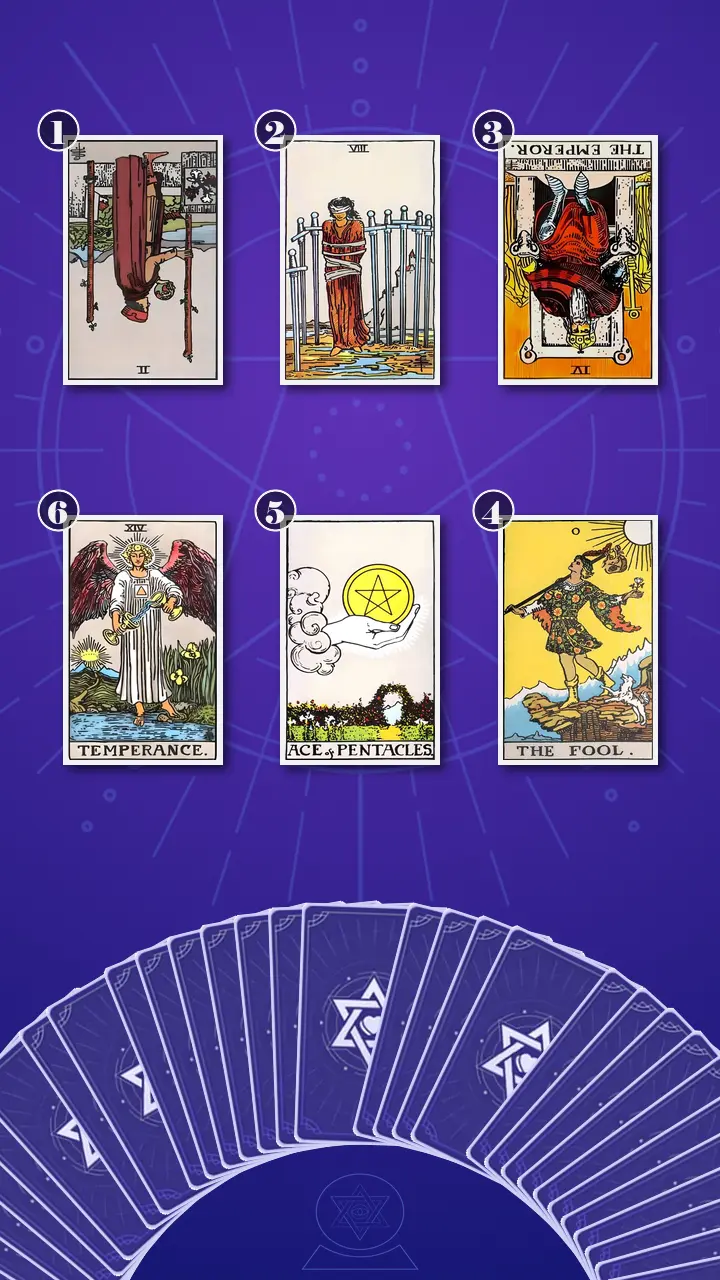
I chose the six-card Transformation Path Grid · Context Edition. I use this spread when a difficulty behaves like a self-reinforcing system rather than a single bad habit. Planning delays participation; the resulting emptiness creates guilt and existential drift; that discomfort then produces another attempt to plan more precisely.
This is how tarot works in my practice: not as an authority handing down a verdict, but as a structured way to make an invisible pattern observable. The cards give us images, positions, and contrasts. The querent supplies context, judgment, and choice.
I arranged the cards in two rows. The upper row would show the visible planning behaviour, the thought rules blocking movement, and the fear of losing control beneath those rules. The lower row would reveal the interruption, the practical test, and an integrated rhythm in which structure could support participation without controlling every hour.
I told Jordan that the spread was not asking them to choose between rigid scheduling and chaos. It was tracing how useful organisation had become planning paralysis, then identifying the smallest point at which the cycle could change direction.
Reading the Closed Circuit
The Globe Inside the Calendar
The first card I turned over represented the observable planning behaviour through which Jordan postponed entering the day. It was the Two of Wands, reversed.
I pointed to the figure holding a globe while remaining behind a wall. “This is vision without contact,” I said. “At 9:10, you have Google Calendar, Notion, and a task list open. You move the workout from morning to lunch and then to evening, but the shoes stay beside the door. The problem isn’t that you have no idea what you want. You’re trying to contain every possible route before taking the first one.”
The card showed blocked fire: initiative was present, but trapped inside rehearsal. The inner instruction sounded reasonable: “Once I place everything correctly, then I can begin.” Yet each revision consumed the energy the planned activity needed.
Jordan gave a short laugh, but there was no amusement in it. “That’s so accurate it’s almost rude.” Their fingers tightened around the mug, their gaze drifted toward the shoes, and then a long breath escaped as the recognition settled. “I keep calling it preparation because that sounds better than admitting I’m hiding in the setup.”
“I wouldn’t call it hiding as a character judgment,” I said. “I’d call it a control strategy that has become expensive. You are not short on plans; you are waiting for a plan that makes uncertainty disappear.”
The Gap Between the Swords
The next card represented the thought rules that made an imperfect or delayed start appear unavailable. I turned over the Eight of Swords, upright.
I showed Jordan the blindfold, the loose bindings, and the open gap in the ring of swords. “A meeting runs late, so your mind declares the workout, the focus block, and the evening invitation unavailable. It’s like a transit app announcing that the entire TTC network is closed because you missed one connection. The delay is real. The conclusion that no simpler route remains is a self-authored rule.”
Here, air was in excess. Analysis had hardened into restriction: “Because I missed the ideal start, the useful version is no longer available.” The card did not suggest that every obstacle was imaginary. Work deadlines, money, energy, access needs, and care commitments remained real. It suggested that the mind was placing additional swords around those realities.
“A missed ideal start is not the same as a closed day,” I said. “Which activity was still physically possible the last time you decided the whole sequence was ruined?”
Jordan’s thumb stopped rubbing the mug handle. Their eyes lost focus for a moment, as though they were replaying a Tuesday evening on the train. “A friend asked me to meet near Ossington. I said no because I’d scheduled a workout first. I didn’t do the workout. I went home and rebuilt Wednesday.”
I let the silence hold that answer without turning it into a reprimand. The useful question was not why Jordan had failed to be spontaneous. It was why the intended schedule had been granted more authority than the life still available around it.
When the Calendar Became the Manager
The third card represented the fear of losing control that had turned useful structure into a procrastination system. I revealed the Emperor, reversed.
The armoured ruler sat on a hard stone throne against barren mountains. “This is your calendar acting like a manager whose approval must be earned,” I said. “When Slack changes a priority or the morning begins late, you rebuild the whole day and treat deviation as evidence that you can’t manage your own life. One rescheduled task becomes an internal performance review.”
The Emperor’s organising energy was not absent. It was overextended and distorted into punitive control. I thought of the café tables where I had spent twenty years hearing people describe homes, inboxes, budgets, and schedules that had quietly stopped serving them. Structure often becomes harsh when it is asked to remove a fear it was never designed to solve.
Jordan pressed their lips together. Their chest lifted but did not immediately fall. Then they said, very quietly, “If I let the schedule bend, I’m scared I’ll become someone who can’t keep anything together.”
There was the root: not a devotion to colour-coded blocks, but a fear that imperfect time use would expose personal inadequacy. Rising Toronto costs had made an unproductive evening feel emotionally expensive, while polished online routines supplied endless evidence that someone else had apparently solved being human.
“Your capacity for structure is not the enemy,” I said. “We’re separating commitments that protect your life from rules that make your life report for duty. Structure should hold your life, not ask your life to report for duty.”
When the Fool Put On the Shoes
The Catalyst Beneath the Open Sky
The fourth card represented the key interruption that could shift Jordan from complete advance planning to learning through one lived step. As I turned it over, a streetcar bell rang again outside their window, clearer this time. The card was the Fool, upright.
I drew their attention to the lifted face, the lightly carried bundle, and the foot already moving into open space. The Fool did not ask Jordan to abandon deadlines, ignore safety, or let every impulse take over. Its energy was balanced beginner energy: enough trust to run a bounded experiment before demanding certainty.
At 9:10, the workout had moved from morning to lunch to evening while the shoes stayed beside the door. The calendar looked cleaner, but Jordan’s shoulders tightened as another real hour disappeared. They were still trying to solve the uncertainty of movement from inside a stationary system.
The day does not begin when the map is perfect; it begins when you take the Fool's first step with only what you can carry.
I paused. Then I added, “A day does not become yours when the plan is complete; it becomes yours when one chosen action makes contact with real life.”
Jordan’s breath stopped. Their fingers remained suspended above the mug, and their eyes widened before moving away from the card toward the door. For several seconds, I could almost see the previous week replaying behind their expression: the hovering thumb on the TTC, the untouched Figma file, the Saturday walk replaced by route research. Their jaw tightened.
“But doesn’t that mean I’ve been doing all of this wrong?” they asked, sharper than before. “I’ve spent years trying to get better at managing myself.”
“No,” I said. “It means a strategy that once gave you relief is now overperforming. You were trying to create safety. We’re updating the strategy, not putting your past self on trial.”
The tension moved through them in stages. First their shoulders held rigid, as though releasing control would cause something to fall. Then their fist slowly opened on the desk. Finally, a tremulous breath reached lower into their chest, followed by a small, almost disoriented smile. Relief had arrived, but so had responsibility: if the map was no longer the gatekeeper, Jordan would have to choose a real step without advance proof that it was the best one.
I use a lens I call Daily Clutter Deconstruction when mental noise has become fused with ordinary objects. I asked Jordan to show me the corner beside the door. Shoes, unopened mail, a tote bag, and a phone charger had accumulated there. The shoes were not merely clutter; they had become physical evidence of postponed movement. Every glance at them quietly reopened the unfinished negotiation.
“The Fool doesn’t need you to solve your whole routine,” I said. “It asks you to change the meaning of one object. The shoes stop being an accusation and become a physical anchor for a twenty-minute experiment. Keys, shoes, first pavement step. That’s all you carry.”
I invited them to use the new perspective immediately. “Now, think back to last week. Was there a moment when this insight could have changed how the hour felt?”
Jordan looked down. “Saturday. I wanted to go outside, but I checked the weather, then Strava routes, then playlists. I never went.” Their voice softened. “I didn’t need to know what the walk meant. I could have just entered it.”
That recognition marked the central emotional shift: from restless frustration and control-seeking overplanning toward experimental self-trust. It was not complete confidence. It was the smaller, more credible willingness to let direct experience provide information that another round of optimisation could not.
Leaving Evidence of a Lived Day
The Pentacle Within Reach
The fifth card represented a small, concrete action that could be completed before the schedule was revised again. I turned over the Ace of Pentacles, upright.
A hand offered one solid pentacle above a flowering garden, with a path leading through an open arch. “This is the practical test,” I said. “Before redesigning the afternoon, you draft one Figma screen, make lunch from what is already in the kitchen, or walk around the block. Not the ideal version. One material unit that did not exist twenty minutes ago.”
The Ace brought earth into a reading that had begun with trapped fire and excessive air. Its energy was available but underused: Jordan had plenty of abstract intention and too little physical evidence. The question became, “What would exist twenty minutes from now if I stopped arranging the intention?”
Jordan glanced at the unopened design file. Their hand moved from the mug to the trackpad, then stopped. I saw curiosity interrupt the familiar urge to edit the calendar.
“Leave evidence that you lived, not just instructions for how you meant to,” I said. “The evidence can be one drafted component state. It does not have to justify the whole day.”
Water That Refused to Freeze
The final card represented a flexible rhythm in which planning could protect essentials without replacing presence and participation. I revealed Temperance, upright.
I traced the water moving between two cups and the angel’s stance, with one foot on land and one in water. “You keep a genuine work deadline and an evening meal as anchors. The space between them stays lightly held. A change in energy, weather, or a friend’s invitation can alter that space without turning the day into a failure.”
Temperance showed balance through continuous adjustment, not static perfection. Planning and spontaneity were not competing moral choices. Structure could protect what mattered; responsiveness could keep the structure connected to a living person.
I framed this as an Energy Extraction Audit. The calendar itself was not necessarily draining Jordan. The repeated reopening, dragging, comparing, and mentally rehearsing were micro-habits over-extracting their baseline energy while promising relief later. The return kept being delayed. Removing one revision cycle could preserve enough energy for an actual task, meal, walk, or conversation.
Jordan’s shoulders lowered again, though this time the movement was quieter. “So I don’t have to delete every routine and become chaotic.”
“Exactly,” I said. “The plan can adjust without the day becoming a failure. Temperance keeps what helps and lets the rest remain responsive.”
The Experience-Before-Edit Rule
I read the full grid back to Jordan as one system. The Two of Wands reversed showed the visible habit: holding the whole day inside a planning app while remaining physically still. The Eight of Swords showed how a delayed start became an imaginary closure of every route. The Emperor reversed revealed why that rule felt necessary: the calendar had become protection against the fear of being unable to manage life. The Fool interrupted the circuit through one uncertain but bounded step. The Ace of Pentacles gave that step physical evidence, and Temperance preserved useful structure without freezing the day around it.
The cognitive blind spot was simple but consequential: Jordan had assumed that repeated planning meant the plan needed improvement. The spread suggested that planning was sometimes being used as a permission system. Their direction was not from organisation to disorder. It was from needing the entire map before moving to beginning one chosen activity for twenty minutes before revising the route.
I gave Jordan three small experiments. I was explicit that none was a new standard by which to grade themselves.
- Take the Twenty-Minute Fool Step.On one weekday morning, place the phone face down, put on the shoes beside the door, and walk outside for twenty minutes before opening Google Calendar. Keep genuine work, care, access, and safety commitments protected.Treat the walk as information gathering. If twenty minutes feels too large, use a two-minute minimum; stopping is valid data.
- Build a Two-Anchor Day.Choose two commitments that genuinely need fixed times, such as a work deadline and an evening meal. Leave one forty-five-minute block between them deliberately unassigned, then decide how to use it from your actual energy and circumstances.If forty-five open minutes feels impractical, begin with fifteen. Do not fill the space in advance to make the experiment look productive.
- Run the 15-Minute Physical Anchor Experiment.Within the next forty-eight hours, spend fifteen minutes clearing only the corner beside the apartment door. Put the shoes where they can be reached in one motion and move unrelated items elsewhere.Keep the boundary radical and small: one corner, one timer, no full-apartment reorganisation. The aim is to reclaim mental bandwidth, not create another perfect system.
I also asked Jordan to add two lines to their Notes app each evening: “One plan that helped me move,” and “One unplanned moment that mattered.” The review would give structure and spontaneity equal evidentiary status.
“Your planner can be a light container,” I said. “It can protect essentials while leaving enough room for weather, energy, friendship, curiosity, and ordinary human variation. You remain the person making the decisions. The cards have only helped us see where that authority was being outsourced.”

A Week Later, the Quiet Proof
Six days later, I received a message from Jordan. They had cleared the corner by the door, left their phone face down, and walked for eighteen minutes before checking the calendar. Rain had shortened the experiment. Instead of calling that a failed twenty-minute walk, they had come home, made eggs, and opened the Figma file without rebuilding the morning.
They had also accepted a last-minute coffee with a friend after checking only their real deadline and current energy. The choice still felt slightly irresponsible, they told me, but the discomfort did not require an hour of schedule repair.
That night, they slept through until morning. Their first thought was still, “What if I’m doing this wrong?” This time, they smiled, put on the kettle, and chose one thing to begin.
I did not see a person whose planning paralysis had been magically cured. I saw the first grounded evidence of a different relationship with time: less control-seeking rehearsal, more experimental self-trust, and the beginning of flexible calm. Tarot had supplied the map of the pattern. Jordan had made contact with the pavement.
When every unscheduled hour feels like evidence that control is slipping, even choosing what you want can tighten your shoulders until planning feels safer than touching the day. Noticing that exchange already puts your hand back on the door.
If one small part of tomorrow did not have to prove that you manage life perfectly, what might you feel curious enough to begin with only your keys, your shoes, and the next twenty minutes?