When Friends Change Plans: From Errand Delay Toward Self-Directed Time

The 6:18 WhatsApp Override: Errand Procrastination When Plans Change
You have your shoes on, keys in hand, and a shopping bag by the door, but you sit back down to negotiate a revised hangout and call the abandoned errand “being flexible.”
That was the pattern Jordan, a 27-year-old junior project coordinator in London, brought into my consultation room. They showed me a WhatsApp screenshot stamped 6:18 PM, then described the moment around it: trainers already on, a return parcel tucked under one arm, rain ticking against the window, and the hallway carrying the faint damp-wool smell of coats that had not quite dried.
The parcel shop would close in forty-two minutes. Jordan’s phone felt warm in one restless hand while their keys pressed into the other. Then a friend’s message appeared: “Any chance you can meet earlier?” Nobody asked Jordan to abandon the return, yet their jaw locked as if the revised time had arrived with official approval and their own plan had not.
“I typed ‘yeah, that works,’ closed the shop-hours page, and put the parcel down,” Jordan told me. “It was easier to disappoint myself later than risk disappointing them then. But why do I put off errands whenever friends change my plans?”
I heard the contradiction beneath the scheduling question: Jordan wanted to complete errands on a self-directed timetable, but protecting that timetable felt dangerously close to failing a friendship. Guilt clung to the moment like perfume sprayed too heavily into the collar of a coat, close enough to breathe in with every movement, followed by the sourer trace of resentment when the practical window disappeared.
“I’m not going to tell you that you must always choose the errand,” I said. “I want us to find the point where flexibility stops being a choice and becomes an automatic override. Let’s make a map of that moment, so your own time can stay visible while connection stays visible too.”

Choosing the Calendar Route: A Six-Card Friendship-Boundary Tarot Spread
I invited Jordan to place both feet on the floor, unclench their hands, and hold the consultation question in mind while I shuffled. I use this pause as a change of attention, not as a performance of mystery. It gives the nervous system a few seconds to stop answering the latest notification.
I told Jordan that I would use the Four-Layer Insight Ladder · Context Edition, arranged as a winding six-card grid. For anyone asking how tarot works in a situation like this, I use the cards as a structured way to separate observable facts, assumptions, emotional reflexes, and possible actions. I was not asking the deck to predict whether a friend would be disappointed or whether an invitation would succeed.
I chose this context spread because Jordan’s difficulty was not a single decision between an errand and a hangout. It was a self-reinforcing sequence: a social plan changed, anticipatory guilt appeared, Jordan accommodated before checking the cost, the errand moved into an unnamed later, and the resulting deadline pressure became evidence against their competence. A standard relationship reading would have placed too much attention on the friend’s feelings. A simple decision spread would have compared two options without showing why one option kept losing legitimacy.
The first position would reveal the visible trigger pattern. The third would uncover the internal authority script that made another person’s preference feel more official than Jordan’s own calendar. The fourth, the turning point, would identify the clarifying boundary. The final two cards would then translate that insight into practical follow-through and integration. The path would move across the top row from trigger to root, drop at the turning point, and travel back through action to completion, like a calendar route being reclaimed from whoever texted last.
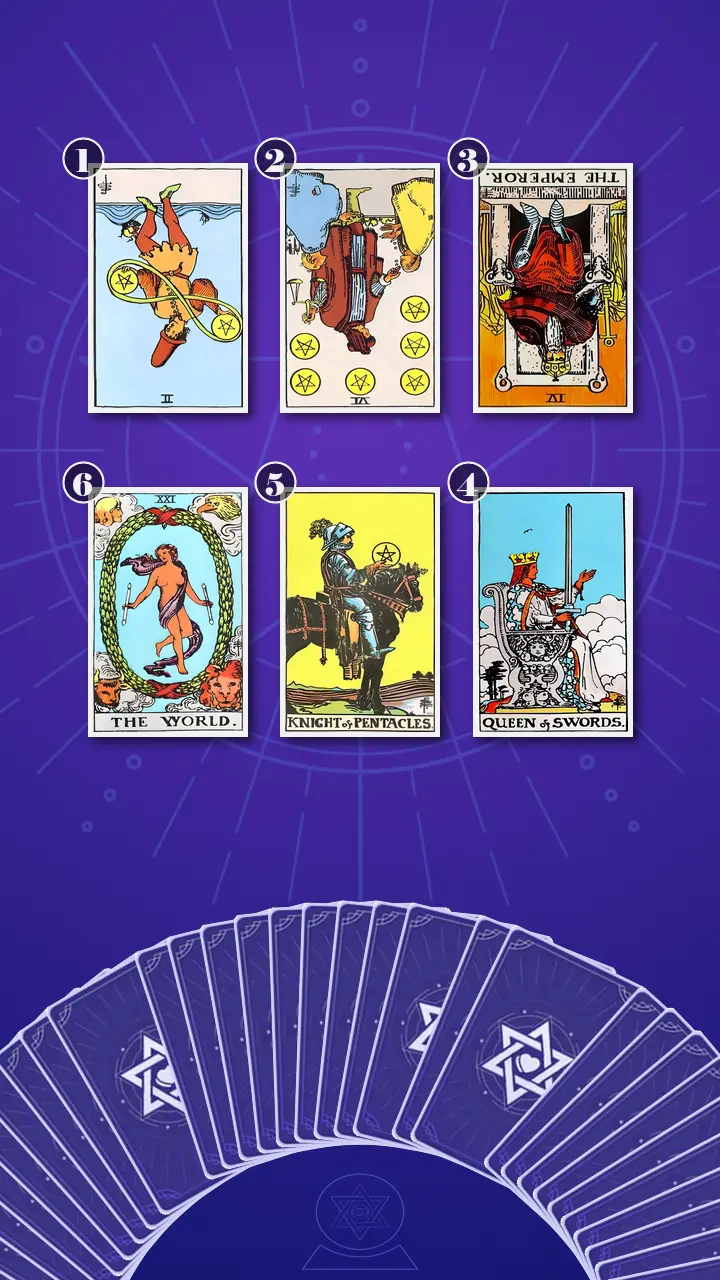
The Loop That Calls Itself Flexibility
Position 1: The Task That Falls Out of the Calendar
I began by turning the card representing the visible trigger pattern: the observable sequence in which a friend changes the plan, the errand is paused, and the practical task later becomes urgent. The card was the Two of Pentacles, reversed.
Upright, the Two of Pentacles often depicts adaptive movement between competing demands. Reversed, I read its practical earth energy here as blocked and reactive. Adaptability had tipped into excess, while deliberate prioritisation was missing. Jordan was still making a trade-off, but making it so quickly that it did not feel like a decision.
I pointed to the green infinity loop binding the two pentacles. “This is the recurring move-to-tomorrow cycle,” I said. “At 6:18, the parcel was ready and the shop-hours page was open. The message arrived, you closed the page, shifted the reminder, and left without checking whether tomorrow contained a usable window. The errand was not rescheduled. It was removed from the active calendar.”
I repeated Jordan’s doorway reasoning back to them: “It’s only a small errand, so I can move it.” Then I placed beside it the thought that arrived three days later: “Why is this still here?” The rough water and rising ships on the card mirrored the strange instability of the evening. One social adjustment had made every practical connection harder, like a transit board changing platforms after Jordan had already started walking.
“Later is not a plan until it has a time,” I said. “Chosen flexibility includes a destination. Automatic postponement only makes the current discomfort disappear.”
Jordan gave one short laugh, but there was no amusement in it. Their fingers stopped circling the edge of their phone. “That’s too accurate,” they said. “Honestly, it’s a little brutal. I keep calling it flexibility because ‘I dropped my own plan again’ sounds worse.”
“The card is not calling you unreliable,” I replied. “It is isolating the exact handoff where the task loses its place. If we can see that handoff, we do not have to turn the parcel into a verdict on your adulthood.”
Position 2: The Private Splitwise Balance for Attention
I turned the card representing boundary creep and relational pressure: the point where a casual change in a friend’s availability begins to feel like an implicit claim on Jordan’s time. The card was the Six of Pentacles, reversed.
The scales in the image made the pattern almost literal. Generosity and reciprocity can be healthy expressions of this card, but reversed, I saw giving in excess and reality-checking in deficiency. Jordan was keeping a private Splitwise balance for attention, recording debts the other person had never entered.
I described the modern version. A friend casually offered a longer hangout. Jordan translated the offer into generosity that had to be repaid through immediate availability, abandoned a grocery run, and said “no worries.” Later, resentment appeared because the whole evening had been given away, while the friend remained unaware that any sacrifice had occurred.
“They made space for me, so I should make myself available,” Jordan said quietly, recognising their own internal script.
“What did the friend actually ask for?” I asked. “And what extra sacrifice did you add without telling them?”
Jordan looked down at the reversed scales. Their thumb pressed against the side of the phone, then released. “They asked if I was free earlier. They didn’t ask me to cancel anything. I supplied that part.”
I kept the distinction precise. I was not suggesting that every friendship request was pressure-free, or that Jordan had imagined all relational risk. I was showing them that the true exchange had never been tested because the practical cost stayed silent. Flexibility is a choice, not proof that you care. A collaborative question such as “Would meeting after I finish this return work for you?” would allow the actual relationship, rather than an imaginary ledger, to answer.
Position 3: When the Office Keeps Its Hands on the Evening
I turned the card representing the internalised adult-authority script: the hidden pattern through which being treated as junior at work combined with procrastination, making somebody else’s preference feel more legitimate than Jordan’s own schedule. The card was The Emperor, reversed.
The Emperor ordinarily carries structure, boundaries, and self-command. Reversed here, self-authority was blocked while external authority had become over-amplified. Jordan had edit access to their own calendar but behaved as though each private commitment required outside approval before it could remain valid.
I asked Jordan to picture the end of a typical workday. Routine project decisions had been checked because they were the junior person in the room. At 6:54 PM, outside the office lifts, a friend’s “Could we do 7 instead?” arrived. Although the message contained a question, Jordan reread it like a manager’s Slack instruction, searched for implied disapproval, and deleted the pharmacy reminder they had made for themselves.
There was a light Severance-like echo in it: Jordan had left the office, but the authority settings had not clocked out. Their professional role continued to perfume the evening long after the physical workplace was gone.
For fifteen years as a perfumer, I have watched one atmosphere bleed into another. When two strong trials sit too close together, the louder material can occupy the air around both blotters. The quieter formula has not ceased to exist; it has lost the clean space required to be perceived accurately. I call this diagnostic lens Spatial Boundary Scenting.
Through that lens, Jordan’s problem was not simply poor time management. The atmosphere of checked decisions, sign-offs, and junior status was overlapping with home life. A friend’s preference entered that already-saturated air and acquired the scent of authority. Jordan’s own errand, carrying no external witness or deadline visible to another person, became almost impossible for them to smell as a valid commitment.
“Whose permission are you waiting for to keep the plan you made?” I asked.
Jordan’s shoulders rose before they answered. Their jaw tightened, their gaze slipped towards the window, and for several seconds I could see them replaying messages rather than looking at the card. “I keep waiting for someone to tell me my time counts,” they said. “And then I hate that I need telling.”
“You do not need to hate the adaptation,” I said. “It probably helped you stay responsive in environments where other people did hold more formal authority. We are only noticing that it now activates in a friendship before anyone has actually taken charge.”
I let the reversed Emperor sit between us for another breath. “You are making a belonging decision at the doorway, not merely an errand decision. The fear is not really that the parcel will be late. It is that keeping forty minutes for yourself might make you difficult, uncaring, or less securely included.”
When the Queen of Swords Drew One Clean Line
Position 4: The Clarifying Boundary
The room seemed to narrow around the next card. Rain traced a thin line down the window, and even the muted traffic outside briefly fell away as I turned the card representing the clarifying boundary, the cognitive and communicative move capable of interrupting the entire loop. It was the Queen of Swords, upright.
I read her upright energy as balanced air: clear perception, proportionate language, and self-authority that did not need to become hard. Her raised sword distinguished one fact from another. Her open hand kept a route towards connection available. This was not a wall against friendship. It was enough clean space to perceive both plans accurately.
I brought Jordan back to the instant before the override: shoes on, parcel by the door, shop closing in forty minutes, WhatsApp lit. They had been trying to find the perfectly caring response, as if only immediate agreement could keep competence and belonging intact.
Stop treating a friend's changed plan as an instruction and start naming your own time boundary, like the Queen of Swords drawing one clean line between an invitation and an obligation.
I did not rush to explain. Jordan’s breath stopped first, and their fingers remained suspended above the blank phone screen. Then their eyes lost focus, pupils widening slightly as if the last few months of changed plans were replaying behind them. Their jaw loosened, their shoulders descended, and the hand that had been closed around the phone opened against their knee. Moisture brightened the rims of their eyes. A long breath left their chest, but relief was followed by a startled, almost weightless pause, the brief dizziness that can come when clarity returns responsibility to the person who wanted it. Their brow tightened again. “But doesn’t that mean I’ve been doing this to myself?” they asked, their voice low and unsteady. “Doesn’t it mean all that resentment was my fault?” I shook my head. “It means you used automatic accommodation to protect connection. Seeing the pattern is not a conviction. It is the first moment you can choose differently.”
I leaned forward only after their breathing steadied. “Now, using this new perspective, think back: was there a moment last week when this insight could have made you feel different?”
Jordan remembered a Saturday coffee in Soho that had stretched towards the return desk’s 5 PM deadline. Their friend had said, “We could stay for another round if you’re free.” Jordan had heard an expectation where the actual words contained an option.
“I could have said I wasn’t free for another round yet,” they said. “I could have done the return and come back, or met them somewhere else after. I didn’t even let either of us consider that.”
“Exactly,” I said. “A changed invitation is new information, not an instruction. You can care about the friendship without making your own plan disappear.”
I returned to Spatial Boundary Scenting, this time as an intervention rather than a diagnosis. In perfumery, separation does not destroy the composition; it lets each material keep its shape before I decide how they belong together. The Queen’s sword created that sensory gap. The invitation could be warm. The errand could be valid. Neither needed to contaminate the meaning of the other.
That distinction gave Jordan a sentence they could actually use: “I’m still doing my return, but I can meet you at 7 afterward.” One fact, one limit, one available alternative. No apology essay. No argument proving that the parcel was important enough. No demand that the friend approve Jordan’s right to use forty minutes.
“I can be clear without making this a fight,” Jordan said, trying the sentence aloud. Their voice was still tentative, but it no longer disappeared at the end.
Clear does not mean cold; it means both plans stay visible. I named the emotional crossing I was witnessing: from guilt-driven automatic accommodation and deadline shame towards clear self-authority, deliberate flexibility, and practical self-trust. It was not complete confidence. It was the smaller, more credible beginning of tolerating a few uncomfortable seconds without surrendering the whole evening.
I then asked Jordan to set a five-minute timer and open a blank note on their phone. At the top, they wrote the changed invitation. Underneath, they listed three valid options: “errand first,” “errand at 6:30 PM tomorrow,” and “consciously drop it.” Then they drafted the one-line reply without sending it. The purpose was not to force the most efficient choice. It was to replace an invisible override with a visible decision.
The Parcel Starts Moving
Position 5: One Dependable Action Before the Group Chat Reopens
I turned the card representing the one-week grounded experiment: the observable action that would carry the Queen’s boundary into the body through a time limit, a completed errand, or an exact reschedule. The card was the Knight of Pentacles, upright.
I read the Knight’s earth energy as balanced and available. The still horse did not demand frantic catch-up, and the single pentacle did not propose a total productivity reboot. The card offered dependable attention to one practical commitment.
I described the scene it suggested. Jordan would send the boundary text, mute the group chat for twenty minutes, take the return parcel from beside the door, and follow the route already open on their phone. They would not need to rush, prove independence, or finish every delayed task. They would only need to keep this one task moving.
“That almost sounds too small,” Jordan said.
“Small is the point,” I replied. “The experiment is not ‘become a perfectly organised person.’ It is ‘give one conscious choice a physical form.’ Pick up the bag. Check the closing time. Walk to the first safe point on the route. If weather, energy, access needs, or timing make completion unrealistic, put an exact later slot in the calendar. A deliberate reschedule counts. Self-punishment does not.”
Jordan glanced towards the parcel they had brought, then lifted its handle an inch from the floor before setting it down again. The movement was slight, but I noticed that it came before they checked their phone.
Position 6: The Wreath Around Two Valid Parts of a Life
I turned the final card, representing self-directed integration: the ability to hold friendship and personal responsibility together without asking the reading to make the decision for Jordan. The card was The World, upright.
The World’s energy was balanced completion. Its laurel wreath closed the loop that the reversed Two of Pentacles had kept spinning. I translated the image into an ordinary evening: the return receipt arrived in Jordan’s inbox, the reminder was cleared, and Jordan joined their friend afterwards without apologising for having used their own time.
The card did not promise that every friend would accept every alternative, or that spontaneous plans would stop being complicated. I would never use it to make that prediction. It showed Jordan a more integrated definition of success: the errand could be completed, deliberately moved, or consciously dropped, while the friendship remained a relationship rather than a test of immediate availability.
“So the goal isn’t to put errands above people,” Jordan said.
“No,” I replied. “The goal is to stop making either one disappear before you have chosen. You can value spontaneity and still check its real cost. You can value a friend and still be unavailable for forty minutes. The World asks for conscious participation, not perfect independence.”
Jordan looked from the completed wreath back to the looping ribbon on the first card. Their expression held relief and a small residue of sadness. “I’ve spent so much time trying to prove I’m easy to be around,” they said. “I’m not sure I ever checked whether being easy was making me absent from my own life.”
The Named-Later Rule: Turning Clarity into a Plan
I gathered the six cards into one coherent story. The reversed Two of Pentacles showed the visible postponement loop. The reversed Six revealed the invisible debt of availability. The reversed Emperor traced that debt back to authority settings carried home from work, where Jordan’s private commitment felt provisional and another person’s suggestion felt official. The Queen of Swords separated invitation from obligation. The Knight gave that distinction a body, and The World closed the practical loop without exiling friendship from the evening.
The core metaphor was simple: Jordan had been giving the latest WhatsApp message admin access to their calendar. The friend did not necessarily request that access. Jordan granted it automatically because the brief relief of avoiding disappointment felt safer than holding a boundary whose social outcome could not be guaranteed.
The cognitive blind spot was equally important. Jordan had been treating the delayed errand as proof that they lacked competence, when the more accurate diagnosis concerned the architecture of choice. Their plan vanished before it was compared with the new invitation as an equal input. Harsh self-review then examined character instead of correcting the decision process.
I made the transformation direction explicit: move from automatic override to one clear time boundary and a deliberate trade-off. Finish the errand first, assign it an exact later time, or consciously drop it after checking the cost. None of the three options determines whether Jordan is caring, capable, or worthy of belonging.
- The Five-Minute Invitation-Not-Instruction CheckWhen one plan changes this week, pause before replying. Set a five-minute timer in Notes, write the invitation at the top, and check three facts separately: the errand’s closing time, travel time, and real deadline. List “errand first,” “errand at [exact time],” and “consciously drop it,” then draft: “I’m still doing my errand, but I can meet at [time] afterward.” Save that sentence as a phone text shortcut for the next changed-plan message.Tip: If the boundary feels dramatic, use only one factual limit and one alternative. Draft it, wait two minutes, and remember that the friend remains free to accept, decline, or suggest another option.
- The Physical Boundary Protocol and Named-Later RuleWithin 72 hours, create one sensory threshold between high-pressure work mode and self-directed personal time. At the door, put the work lanyard or laptop inside a closed drawer, then touch a textured key tag or notice a personal scent strip kept beside the errand bag. Let that cue mean: “Work has ended; my calendar no longer requires external sign-off.” Before reopening the group chat, either carry the parcel to the lift or first safe point on the route, or schedule the errand with an exact start time, location, and closing-time alert. No task moves to “later” without a date and time.Tip: The sensory trigger can be completely scent-free. If timing, weather, energy, safety, or access needs make the original errand impractical, use the exact reschedule. A named later time is follow-through, not failure.
I asked Jordan to treat these as experiments, not rules for earning adulthood. A week of data would be more useful than a rigid new identity. The key measure was not whether the errand always won. It was whether Jordan could identify what changed, what the task actually cost, what they chose, and what happened socially after both plans had been allowed to remain visible.

A Week Later, the Doorway Felt Different
Six days later, I received a message from Jordan with two screenshots. In the first, a friend had written, “Tiny change of plan, any chance you can get here earlier?” In the second, Jordan had replied, “I’m still doing my return, but I can meet you at 7 afterward.”
The friend’s response was three words: “Yep, works perfectly.”
Jordan had placed their work pass in a drawer, touched the ridged key tag beside the parcel, checked the Royal Mail closing time, and muted WhatsApp for twenty minutes. The return receipt reached their inbox at 6:47 PM. They met their friend afterwards. Nobody held a ceremony for the parcel, and nobody needed to. One ordinary commitment had received an ordinary amount of authority.
The change was not spotless. Jordan slept through the night, but their first thought the next morning was, “Did I make it weird?” The question still arrived. This time, it did not receive admin access. Jordan smiled at it, checked the friend’s latest meme, and got on the Overground.
I did not regard the successful evening as proof that the cards had predicted anything. Tarot had supplied a map, a language for the hidden exchange, and a way to test one new route. Jordan supplied the boundary, lifted the parcel, sent the message, and discovered through lived evidence that self-directed time and friendship could occupy the same calendar.
That was the real Journey to Clarity: not certainty that nobody would ever be disappointed, but tentative self-trust in the presence of that possibility. Jordan stopped asking a small errand to prove their competence and stopped asking immediate availability to prove their care.
If a friend’s message lands tonight just as your hand reaches the door, and your jaw tightens because keeping your own hour suddenly feels riskier than disappointing yourself, remember what the Queen’s open hand protected: connection remained available even after the sword drew a line.
If your errand and your friendship were both allowed to stay visible, what one Queen-of-Swords sentence might make room for them tonight?