The Drafted Roommate Text at 9:18: From Tabs to a Bounded Choice

Finding Clarity in the 9:18 p.m. Tab-Reopening Loop
Casey was a 27-year-old project coordinator in Toronto who had already done the roommate calls, checked the practical details, and found a workable candidate. Yet every time the acceptance message became real, anticipated-regret-driven roommate decision paralysis sent her back to the listings.
At 9:18 p.m. on a Tuesday, she joined my video session from her condo kitchen and shared her screen. A drafted selection text waited beside three familiar housing tabs. Her peppermint tea had gone cold; the laptop fan hummed beneath the soft click of the fridge. Blue light sharpened the tension in her raised shoulders, and her fingers seemed to gain weight whenever the cursor crossed over Send.
As an early-career project coordinator, Casey could spend a workday defining milestones and chasing approvals. After hours, though, she moved between a colour-coded Google Sheet, Roomies.ca, Toronto housing groups, and old chat threads as if her competent work self had been left behind in an episode of Severance.
"I can always find one more question to ask," she said. "What I actually want to know is: what regret keeps me re-screening roommates instead of choosing? If I choose now, I have to own whatever happens later."
I heard the practical stakes beneath that sentence. Toronto rent was not abstract, thin condo walls could make incompatibility exhausting, and references, lease details, payment reliability, safety concerns, and household boundaries all deserved attention. But anticipatory regret had turned her hands into sandbags: the closer she came to a decision, the harder even one small movement felt.
"I am not going to tell you which roommate to choose," I said. "Tarot cannot guarantee how another person will behave, and I will not pretend it can. What we can do is make a map of the loop, identify which concerns are evidence and which are forecasts, and find a process you can trust without asking it to predict the future. That is our Journey to Clarity today."

Choosing the Map: The Six-Card Transformation Path Grid
I asked Casey to place both feet on the floor, let her hands rest away from the keyboard, and say the question once without improving it. I shuffled slowly while she took one ordinary breath. The pause was not a mystical performance; it was a way to move her attention from twenty competing tabs to one defined inquiry.
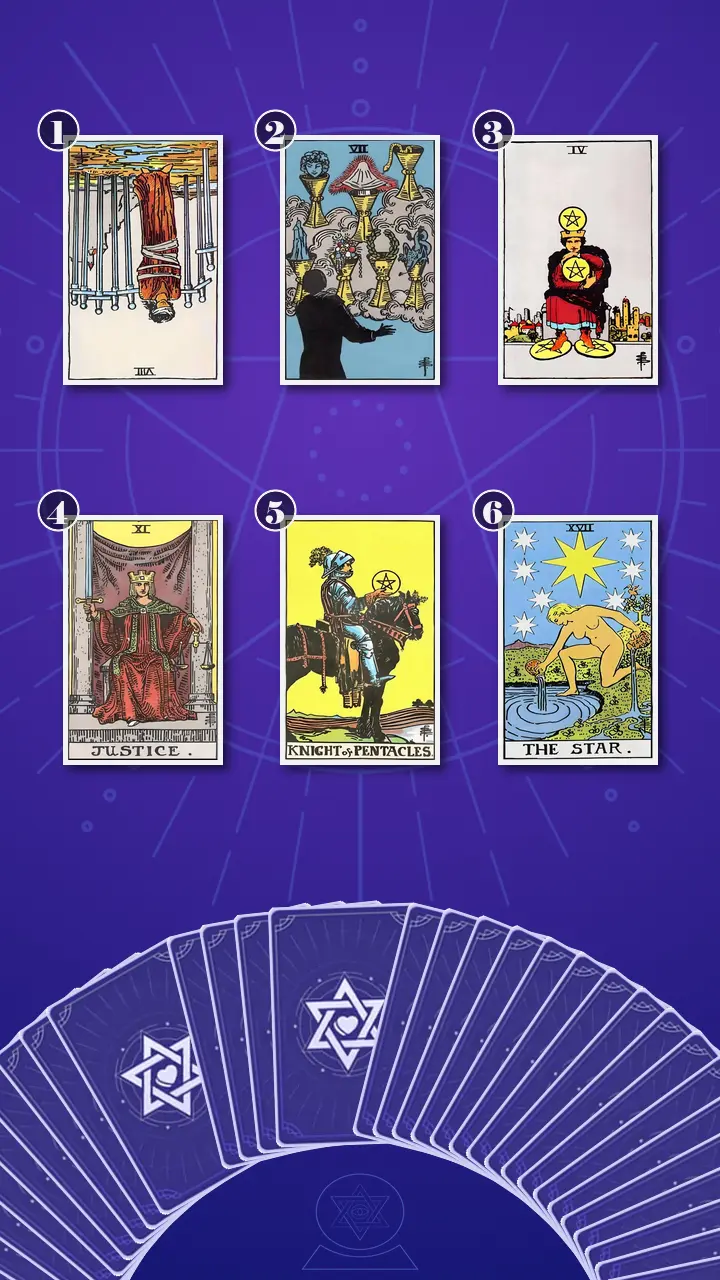
I chose the Transformation Path Grid (6) - Context Edition, a six-card, 3-by-2 RWS tarot spread for roommate decision paralysis. For anyone wondering how tarot works in a decision reading, I use the cards as structured prompts. Their symbols help separate observable behaviour, emotional assumptions, available resources, and possible next steps. They do not make the decision for the person sitting across from me.
This spread suited Casey because her problem was not simply a comparison between two candidates. It was a self-reinforcing system: anticipated regret led to another screening round; that round produced brief relief; the unresolved search then made every existing answer feel less trustworthy. A two-option spread would have compared people without fully exposing that loop, while a ten-card Celtic Cross would have introduced more context than this focused question needed.
I laid the first three cards across the top. They would show the visible re-screening behaviour, the immediate blockage created by imagined possibilities, and the control-and-safety fear beneath it. I placed the second row underneath. Justice would act as the lower-left hinge, followed by a bounded practical step and the calmer form of self-trust Casey hoped to build. The layout looked like a crowded search screen being reorganised into a short checklist.
Reading the Trap That Already Had an Exit
Position 1: Eight of Swords Reversed and the Unsent Message
I turned over the card for the position showing Casey's current re-screening behaviour and its stagnant emotional energy: the Eight of Swords, reversed.
I pointed to the blindfolded figure, the loosened bindings, and the swords forming a perimeter. In an upright reading, the card often describes perceived entrapment and narrowed attention. Reversed here, its energy was a blockage beginning to release. Casey could already see that the next step existed, but she had not yet stopped treating every hypothetical risk as another locked door.
"This is your Tuesday-night ritual," I said. "You have enough information to send a roommate decision, but your hands become heavy. You reopen old profiles, reread the same messages, and add another screening question. Part of you already knows enough to do the next thing. Another part says, 'If I check once more, I can delay being responsible for the result.'"
The card reminded me of a browser version of a self-built escape room: the exit remained visible, but every open tab was being treated as a separate puzzle that had to be solved first. Care had not disappeared. It had become difficult to distinguish from delay.
I sometimes use an Energy Extraction Audit when a client describes this kind of repetition. I do not look only at the total hours spent searching. I identify the tiny habits taking repeated withdrawals from baseline energy: reopening a profile, checking whether a candidate is still available, rereading one vague answer, or noticing the unsent draft every time the laptop wakes. Each action lasts seconds, but the decision keeps charging rent in the background.
Casey gave one short laugh, then pressed her lips together. "That is so accurate it feels a bit cruel."
"The recognition can sting," I said. "But the reversed card matters. It is not calling you trapped by nature. It is showing that the mechanism has become visible. We still keep your real non-negotiables; we simply stop letting every unknown impersonate one."
Her thumb stopped rubbing the edge of the trackpad. The next step had not become easy, but it no longer looked completely unavailable.
Position 2: Seven of Cups and Seven Competing Flatshares
I opened the card for the position revealing how anticipated regret and procrastination turned more information into another reason to postpone choosing: the Seven of Cups, upright.
Its seven visions floated in a grey cloud before a dark silhouette. The card carried an excess of imaginative Water: possibilities were multiplying faster than observable facts could be evaluated. That energy could support creativity in another context. Here, it was maintaining choice overload.
"One new profile appears after a solid call," I said, "and your mind produces a whole streaming menu of possible homes. One candidate becomes the quiet kitchen. Another becomes the perfectly clean bathroom. A third becomes the surprise partner who never leaves. A fourth becomes the effortless best friend. A fifth becomes the conflict you should somehow have predicted from one answer about guests."
Casey looked at the three listing tabs on her screen as if their thumbnails had changed. She said, "It really is like every profile has a trailer."
"Exactly. The trailer is emotionally vivid, but it is not evidence about the full film. Every new profile offers relief before it offers evidence."
I asked which concrete fact the latest listing had added. Casey thought for a moment and admitted that it had added none. It had contained polished photos, a similar work schedule, and a line about being "easygoing." Her mind had supplied the clean counters, uncomplicated friendship, respectful guests, and friction-free future.
Her chest rose sharply as she mentally replayed the alternatives. Her gaze moved from one card to the next, then settled. I watched the distinction begin to land: observable compatibility could be weighed, but seven imagined futures did not deserve seven equal votes.
"Care becomes avoidance when the finish line moves every time choosing feels real," I told her. "If one more profile reliably creates three more possibilities, more information may no longer be moving the decision forward."
Position 3: Four of Pentacles and the Home Held Still
I turned to the card naming the control and safety fear beneath the regret loop, including what Casey felt she was putting at stake in both her home and her judgment: the Four of Pentacles, upright.
The figure held one coin against the chest, pinned two beneath the feet, and balanced another on the crown. Protective Earth was in excess. Security had become so rigid a precondition for action that the attempt to protect the home was holding the entire decision still.
I asked Casey to look around her condo. She glanced toward the thin wall beside the kitchen, a stack of moving boxes, and a rent notice on the counter. Her fingers tightened around the laptop trackpad.
"Keeping the search open feels like keeping control," I said. "Underneath the screening questions is a more painful sentence: 'If I have not chosen yet, I have not yet failed to protect my home.'"
She did not answer immediately. Her grip tightened, her eyes moved out of focus as if she were replaying an old household disagreement, and then a long breath left her chest. "Yes," she said quietly. "If it goes badly three months from now, I will think I should have known."
In that moment, I thought of the kitchen tables I had sat beside during twenty years of readings. I had seen mugs, bills, chargers, receipts, and open laptops become physical placeholders for decisions their owners were frightened to finish. The objects were rarely the cause. They were often a map of where attention had been left on permanent standby.
"This card does not ask you to ignore material risk," I said. "A payment problem, unsafe behaviour, dishonesty, a lease issue, or a boundary violation remains significant. The question is whether every unresolved detail is a red flag, or whether some are simply parts of shared living that no screening call can guarantee in advance."
Casey's shoulders remained high, but the defensiveness had gone out of them. The fear beneath the research project had acquired a name: later regret might feel like proof that she had failed to keep both her home and her judgment under control.
When Justice Cleared the Crowded Screen
Position 4: Justice as the Turning Point
The room became quieter as I reached the lower-left hinge of the spread. Even the fridge behind Casey seemed to pause between cycles. I turned over the card for the clarity test that could separate relevant roommate evidence from imagined future regret: Justice, upright.
The scales were level. The sword stood vertical. Between two grey pillars, Justice did not look hurried, comforting, or omniscient. The energy was balanced Air: explicit standards, proportionate evidence, clear boundaries, and accountability without self-punishment.
I contrasted the image with the cards above it. The Eight of Swords had shown attention enclosed by hypothetical risks. The Seven of Cups had filled the field with projections. The Four of Pentacles had gripped security until movement stopped. Justice did not promise to remove uncertainty. It gave uncertainty a fair amount of weight instead of handing it the entire decision.
This was where I used the diagnostic lens I call Daily Clutter Deconstruction. I asked Casey to show me the decision space, not because a messy desk reveals a person's character, but because physical and digital disorder can record unfinished demands on attention. The cold mug, duplicate notes, expanding spreadsheet, reopened chats, and visible tabs were all carrying the same message: "This concern still has veto power."
I pictured Justice clearing that space into three rows: payment reliability; schedule and noise compatibility; communication and boundary fit. Beside each row, I placed three categories: observed evidence, relevant unknown, and future forecast. The method was simple, but it changed the job. Casey no longer had to make the future confess. She had to apply the same relevant questions to each person.
At 9:18 p.m., the tea had gone cold beside a drafted roommate message while three familiar listing tabs glowed on the laptop. Casey's shoulders had risen as the cursor hovered over Send because another search felt safer than an imperfect choice. Justice asked her to stop confusing that temporary relief with better judgment.
I put the central insight plainly:
A responsible choice does not have to be regret-proof. It needs clear criteria, proportionate evidence, and your willingness to let the decision be yours.
Then I gave her the sentence I wanted the scales to hold:
You do not need to eliminate every possible regret before choosing; weigh the evidence, name your non-negotiables, and let Justice's scales hold uncertainty without handing it the decision.
Casey's breath stopped first. Her fingers remained suspended above the keyboard, perfectly still. Then her gaze slipped away from the screen, and I could see her replaying weeks of calls, rewritten questions, and late-night searches. Her eyebrows drew together before any relief arrived.
"But doesn't that mean I have been doing it wrong this whole time?" she asked. The anger in her voice was brief but real. "I thought I was being responsible."
"No," I said. "It means a protective strategy kept working after it stopped being useful. The early screening gave you necessary information. The later rounds gave you temporary distance from choosing. Recognising the difference does not invalidate your care."
Her jaw loosened. One hand closed, opened, and came to rest flat on the counter. Her shoulders descended by a fraction, followed by a shaky exhale that sounded partly relieved and partly bereaved. Her eyes shone, and for a few seconds she looked almost disoriented. The path was clearer now, but clarity had returned responsibility to her hands. "Oh," she said. "So I can make a fair choice and still dislike something later."
"Now, with this new perspective, think back to last week," I said. "Was there a moment when this insight could have made you feel different?"
Casey remembered a candidate answering clearly about rent, quiet hours, guests, and direct communication. She had felt her body soften during the call. Ten minutes later, she had opened a new listing because the candidate had said "probably" rather than giving a precise answer about weekend routines.
"I turned an unknown into evidence against her," Casey said. "Then I treated the new person as safer even though I knew nothing about them."
That recognition marked the central emotional shift: from anticipatory regret and comparison fatigue toward process-based self-trust, with uncertainty still present. Regret-proof was not the same as responsible. Her process could be defensible without her future being predictable.
Position 5: The Knight of Pentacles and the Visible Finish Line
I turned over the card for the bounded screening and decision process Casey could try without outsourcing her choice to another friend, another opinion, or another search cycle: the Knight of Pentacles, upright.
The horse stood still, but it was not trapped. The knight held one pentacle carefully while cultivated fields stretched behind him. The card showed balanced Earth: patient attention converted into reliable follow-through.
"This is not a dramatic leap," I said. "It is one scheduled twenty-minute review with a visible finish line. You use the same three criteria for each shortlisted person. You record only answers tied to those criteria. Then you complete one communication step before opening another listing."
The image reminded me of a project board with a work-in-progress limit. Casey did not need to pull another candidate into the workflow every time discomfort appeared. Care could look like completing the process she had chosen, not expanding its scope whenever the decision became personally attributable.
I also pointed out the absence of Wands in the spread. Nothing here demanded a burst of heroic confidence. Casey did not need to feel fired up, certain, or fearless before acting. The Knight offered a quieter form of agency: one deliberate review, one completed message, and no performance of certainty.
Her shoulders dropped another fraction. "Twenty minutes sounds almost suspiciously normal," she said.
"Good," I replied. "The alternative to avoidance does not need to be impulsivity. The reversed Eight of Swords warned against choosing the first available person merely to prove you are unstuck. The Knight keeps discernment intact and gives it an ending."
Position 6: The Star and Trust After the Choice
I opened the final card for the self-trust and calmer relationship with uncertainty Casey could integrate after choosing with the available evidence and maintaining clear boundaries: The Star, upright.
The figure poured water into both the pool and the land. I read those two streams as emotional openness and practical household structure. The energy was balanced, renewing Water. Openness did not mean naivety, and hope did not mean forecasting a friction-free flatshare.
"After sending a deliberate roommate message," I said, "you can still state expectations about rent timing, quiet hours, guests, cleaning, and how concerns will be raised. You can suggest a check-in during the first two weeks. Trust can grow through actual participation instead of another round of prediction."
I asked her to imagine a disagreement occurring three months later. This time, I did not ask how she could have prevented it through better screening. I asked what boundary, conversation, documentation, or housing resource she could use in response.
Casey looked at the two streams. "One is trusting the person," she said. "The other is trusting that I can deal with information when it is real."
"That is The Star in this reading," I told her. "Self-trust is not knowing the ending; it is knowing how you made the call and how you can respond. An imperfect interaction would become information to work with, not an automatic verdict on your judgment."
She leaned back. Her face still held the tiredness of an expensive, consequential housing search, but her hands no longer hovered over the tabs. The reading had not promised her a perfect roommate. It had returned a more realistic source of safety: fair evaluation, explicit boundaries, and the ability to respond after choosing.
From a Housing Algorithm to a Bounded Choice
I gathered the six cards into one story. Casey's original screening had been sensible, but the Eight of Swords reversed showed a useful decision tool becoming a visible enclosure. The Seven of Cups explained why: each new profile launched several vivid futures, and possibility overload made postponement look like research. The Four of Pentacles named the emotional root. She was not only choosing a person; she was trying to prevent later regret from becoming evidence that she had failed to protect her home.
The search had begun to behave like a housing algorithm trained on hesitation. Every pause meant "show me more," so another polished listing arrived before the last candidate could be evaluated. Justice changed the input by fixing the criteria in advance. The Knight of Pentacles limited the review to one pass and one completed communication. The Star widened safety beyond prediction by including household agreements, check-ins, boundaries, and Casey's capacity to respond.
I named the cognitive blind spot directly: Casey had been giving an unknown and a real red flag the same veto power. She had also been treating possible future regret as retroactive proof of a bad decision. The transformation was not from caution to recklessness. It was from endless re-screening to a bounded choice based on three non-negotiables, proportionate evidence, and a decision time.
"But what if I archive the tabs and then realise I missed a genuine warning?" Casey asked.
"Then the process has an exit mechanism," I said. "A new material fact about safety, finances, honesty, lease terms, or a stated non-negotiable can pause the decision. A deadline never requires you to override evidence. It only stops discomfort from quietly rewriting the scope."
The Three Small Experiments
- Clear one decision corner and build the Justice sheet.Within the next 48 hours, set a 15-minute timer and radically reorganise one minimal corner where the search happens. Remove the cold mugs and duplicate notes, archive visible listing tabs into one retrievable folder, and open a blank Google Sheet. Set an eight-minute timer and write only three non-negotiables: reliable rent payment, compatible quiet hours, and direct communication about guests or boundaries. Add columns for "Observed evidence," "Still unknown," and "Fact or forecast?"Minimum version: clear enough space for the laptop, then write one non-negotiable and one fact. Stop immediately for a genuine safety or financial concern; do not turn three criteria into eight.
- Run one twenty-minute shortlist review.On Wednesday at 7:00 p.m., compare the existing shortlist once using the same three criteria for every candidate. When the timer ends, send one message from an existing chat thread: a clear yes, a clear no, or one final question tied directly to a non-negotiable. Keep new listings archived for a 48-hour decision window.Responsibility means finishing the scope chosen before the anxiety spike. If a new material fact appears, record it and ask whether it changes a non-negotiable; otherwise, do not expand the search during the review.
- Prepare trust for after Send.Before confirming the arrangement, draft five concise household expectations covering rent timing, quiet hours, guests, shared cleaning, and how either person can raise a concern. Propose a voluntary check-in during the first two weeks. Then write two phone notes: "The process I followed was..." and "If a concern appears, the first boundary or resource I can use is..."Start with three bullets if a full note feels formal. Boundaries are part of managing a shared home; they are not proof that nothing difficult will happen.
I called the first exercise a 15-Minute Physical Anchor Experiment. Its purpose was not to make Casey's kitchen aesthetically perfect. By clearing one small, heavily used corner, she could stop the physical environment from displaying twenty simultaneous instructions. The cleared counter became a boundary she could see: one decision, three criteria, one review window.
"The cards have offered a structure," I told her. "They have not selected the roommate. You decide which evidence matters, whether a red flag is material, when more information is justified, and whether you are ready to send the message. The authority stays with you."

Three Days Later: The Quiet Proof
Three days later, I received a message from Casey. She had cleared the kitchen corner, made the three-row Justice sheet, and completed the twenty-minute review. One concern had been labelled a real unknown, not a red flag. Two others had gone under future forecast.
She sent the acceptance message to the candidate who met her non-negotiables. Then she stared at the archived listings folder for three minutes. The urge to reopen it remained, but she let the folder stay closed and made fresh peppermint tea.
Her note to me read: "I slept through the night. My first thought this morning was still, 'What if I am wrong?' But it did not feel like an instruction. I knew why I made the choice, and I knew what I could do next if something changed."
I did not take that message as proof that the housing arrangement would be perfect. No tarot reading could provide that proof. I took it as the first concrete movement from anticipatory regret and comparison fatigue toward process-based self-trust with uncertainty still present. Casey had not solved her entire future; she had stopped asking one roommate decision to certify her judgment forever.
That was the value of this Journey to Clarity. The cards made a hidden mechanism objective enough to examine, but Casey supplied the criteria, respected the stakes, cleared the corner, completed the review, and pressed Send. The change belonged to her.
If your cursor also hovers over a roommate message while your hands turn heavy, I know choosing can feel like staking both your home's safety and your judgment on a future no screening call can fully reveal. Simply noticing when due diligence turns into another temporary escape means you are no longer standing at the beginning of the loop.
If you let Justice's three-row scale carry just a little of the uncertainty, what is the smallest choice you can make this week without asking it to prove your judgment forever?