The Self-Help Consumption Loop, Redirected by One Small Experiment

The 6:18 PM Commute and the Self-Help Consumption Loop
If you are a 27-year-old communications coordinator in Toronto who keeps saving productivity videos during the ride home while your evening remains unchanged, you may know the self-help consumption loop better than you want to admit.
I met Jordan after one of those commutes. At 6:18 PM on the TTC Line 1, she had one earbud in while the carriage brakes squealed and fluorescent light flickered across the window. Her phone was warm in her hand. She opened a video called How to Reset Your Evening, saved three related recommendations, and arrived at her stop with dry eyes, a full Watch Later queue, and the same body still sitting heavily in the same seat.
When Jordan joined me, she held her phone face down for nearly ten seconds before turning it over again. She told me, 'I know what to do, so why am I still watching?' Her workday demanded quick thinking, clean follow-ups, and constant adaptability, yet the transition from work to evening had become a corridor lined with unopened doors. She kept watching tutorials about how to choose one instead of turning a handle.
The contradiction was plain: she wanted to change her day, but kept choosing another explanation instead of testing one ordinary change. Her ambivalence moved through her like a cursor blinking on an empty document: her eyes kept searching, her thumb stayed ready, and the rest of her body remained still. Frustration heated her face. Guilt sat low in her stomach. Underneath both, hope kept whispering that the next video might finally make action feel simple.
I did not call this laziness or a discipline problem. I said, 'More advice can be a very polished way to keep the day hypothetical. We can respect the relief it gives you and still look honestly at what it is postponing. Our work today is not to find a magical answer. It is to make a clear map of the loop, then let you choose what happens next.'

A Six-Card Grid for Finding Clarity in the Gap Between Knowing and Doing
I invited Jordan to put both feet on the floor, take one slow breath, and hold the question without trying to improve it. I shuffled gradually, treating the pause as a way to gather attention rather than summon certainty. The cards would be a structured mirror, not an authority over her life.
I explained to Jordan, and to anyone reading this, that I would use the Transformation Path Grid (6) · Context Edition. This six-card tarot spread is designed for a self-reinforcing knowledge-action loop. It follows the visible symptom, the immediate blockage, the hidden bargain beneath it, the first interrupting spark, the repeatable practice, and the perspective that gathers everything into usable agency.
A Celtic Cross could have offered a much broader portrait, but it would have given this focused problem more positions than it needed. A simple line would have shown sequence without separating the restless pause from the deeper attachment to preparation. This two-row grid lets me trace how one trigger becomes content consumption, how consumption creates brief relief, and how one small action can begin changing the sequence.
I told Jordan that the top row would show the old corridor: the visible pattern, the immediate blockage, and the underlying mechanism. The lower row would return through the catalyst, the actionable practice, and the integrated lesson. In other words, I would read from the crowded upper corridor into a grounded path back across the grid.
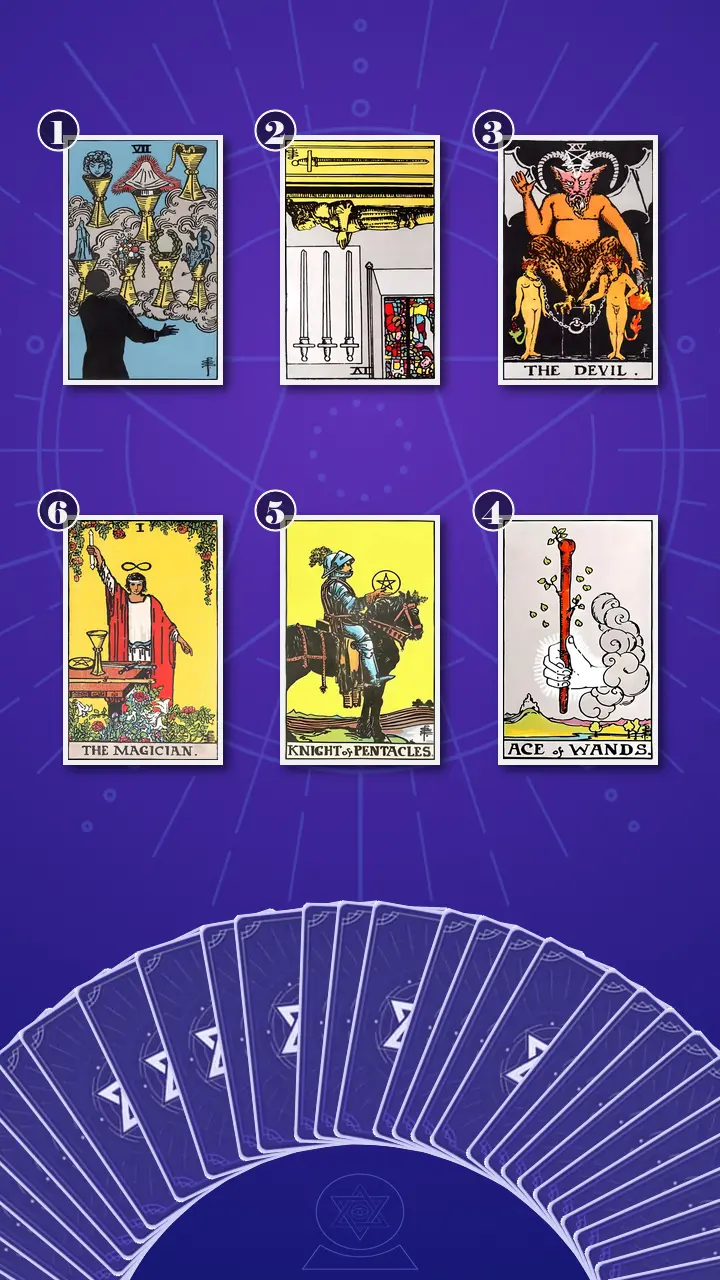
Reading the Crowded Upper Corridor
Position 1: The Seven Cups on a Bright Screen
I turned over the card for the visible pattern: the observable self-help consumption that replaces a change in the day. It was the Seven of Cups, upright.
In the card's cloudy field, seven cups float before a figure seen from behind. For Jordan, those cups became the seven attractive options crossing her screen during the 6:18 PM Toronto commute: a productivity reset, a habit tracker, a mindset lesson, a career pivot video, and several saved routines promising a better version of the evening. Each thumbnail offered an imagined future self. None of them had yet become a physical action.
This is water in excess. Possibility is flowing faster than selection. The issue is not that Jordan lacks intelligence, effort, or useful ideas. The issue is that abundance has become another form of consumption. She can feel briefly prepared without having to discover which method actually works in her real kitchen, at her real desk, after a real workday.
I pointed to the figure's back. 'You are looking at many possible selves,' I said, 'but the important question is which single cup contains a step you can test today. The rest can remain unopened for now.' This is how I read card meanings in context: I let the symbol meet the behaviour, rather than attaching a prediction to a person.
Jordan gave a small, bitter laugh. 'That is too accurate. Almost rude,' she said. She looked down at her phone, then at the untouched notebook beside it. Her lips tightened with recognition, and the laugh left behind a little space where she could see that choice overload was not proof that she had failed to try.
Position 2: The Reversed Four of Swords and the Pause Without an Exit
Now I turned over the card for the immediate blockage: the pause, mental holding pattern, or restless withdrawal that keeps Jordan consuming instead of moving. It was the Four of Swords, reversed.
The image holds a motionless figure beneath three swords, with one sword resting beneath the body. Reversed, the pause has lost its restorative edge. I saw Jordan on her sofa at 9:42 PM after work, a reset video playing above the coffee table while the refrigerator hummed and the autoplay chime waited between clips. Her body was heavy and still. Her attention kept scanning for the next instruction.
The air of thought is blocked here. Reflection has not become recovery, and preparation has not become movement. Jordan told me, 'I am taking a break so I can act properly later, even though later keeps moving.' The single sword beneath the figure became the action waiting beneath all the mental activity: one small task, already known, with no need for another explanation.
This is where I used my Compensatory Routine Decoding lens. I asked what the habit was doing for her before asking why she could not stop it. The video was not simply a failed attempt at discipline. It was a compensation for an overfull day, a way to stay mentally occupied while avoiding the discomfort of an uncertain result. Like revenge bedtime procrastination, the pattern offered a few minutes that felt protected, even while it quietly consumed the time she had hoped to reclaim.
When I suggested that every pause needed a gentle exit, Jordan's fingers stopped moving across the screen. She drew her hand back into her lap and stared at the carpet. Her body had heard the distinction before her mind was ready to accept it: rest and postponement can look similar from the outside, but they leave very different traces afterward.
Position 3: The Devil and the Relief of One More Explanation
I turned over the card for the underlying mechanism: the attachment and core fear that make preparation feel safer than action. The Devil appeared upright.
I named the card carefully. The Devil here was not a moral label, a prediction, or a sentence. In the image, the two figures wear loose chains around their necks. The pattern has force, but the chain is visible and not welded into an identity. For Jordan, it was the bargain made at the first hint of uncertainty: more information gave her immediate relief from having to test herself.
At 7:03 PM, after closing her work laptop, she might feel a small wave of discomfort about the email, habit, or career change she had postponed. Before the feeling could become specific, she opened another video. Blue light caught her face. Her jaw tightened. The pressure eased for a few minutes. The content gave her the feeling of being a learner again, and learning protected the possibility that the right method was still ahead.
I asked her to complete the sentence, 'The content gives me something now, so I do not have to face something yet.' She looked at the card for a long time, then said, 'It gives me relief now, so I do not have to find out yet whether I can actually change.'
That was the emotional bargain. Preparation feels like control when it postpones the answer. If Jordan acted and her day remained the same, she feared it would prove she lacked control. If she kept researching, the result stayed hypothetical and her hope remained intact. The unchanged day then appeared to justify another video, widening the gap between knowing and doing.
I watched her shoulders rise as she listened, then lower by a fraction. She did not need to break a chain through force. She needed to notice the exact second when the chain appeared, name what relief it offered, and choose whether that relief was worth delaying one small experiment.
When the Ace of Wands Lit the First Flame
Position 4: The Catalyst in One Living Spark
The room grew quiet before I turned the card for the key trigger: the smallest spark that interrupts the knowledge-action loop and challenges the belief that more content must come first. The Ace of Wands appeared upright.
The single wand, offered by one hand emerging from a cloud, stood in direct contrast to the seven floating cups. I used my Psychological Bandwidth Audit at that moment. I was not counting how many ideas Jordan had collected. I was noticing how much daily energy her subconscious spent keeping every possible solution open. Her eyes were paying for seven imagined futures, leaving very little bandwidth for one present action.
I asked her to picture 6:18 PM on the TTC Line 1: her phone warm, the carriage lights buzzing, and one reset video saved while her shoulders stayed fixed. She wanted the evening to change, yet another explanation kept the first ordinary move safely hypothetical. I let the silence hold the familiar wish to be certain before beginning.
More self-help will not create the change you are waiting for; choose one small act and let it become the Ace of Wands' first flame.
Jordan's breath stopped halfway, and her thumb stayed suspended above the phone. For a second, her eyes went unfocused, as if the TTC lights and every saved thumbnail had started replaying behind her face. A streetcar bell sounded faintly beyond my window. She tightened her jaw and said, 'But doesn't that mean I have been choosing not to change?' I told her it meant preparation had been protecting her from an uncertain result, not that she had failed a character test. Her fingers closed around the phone, then opened. A long breath moved through her chest. Her shoulders dropped, but her face kept a trace of alarm, the lightness of setting down a bag before realizing how much it had weighed. She looked at the single wand again and whispered, 'I could try one thing and still not know if it works.' I said, 'Exactly. One small action is evidence, not a verdict.'
Now I asked her, 'With this new perspective, think back to last week. Was there a moment when this insight might have let you feel differently?'
She remembered the campaign brief she had rewritten three times instead of sending, and the evening she had watched twelve minutes about focus before arranging a timer app. The memory did not become an accusation. It became a place where another choice could have existed.
I gave her a ten-minute experiment for later that night: choose one saved suggestion, write its smallest physical action on paper, put the phone face down, and do the action where it belonged for two minutes. She could stop after thirty seconds if the pressure rose. She could record Done, Partly done, or Not today. The result would be information, not a verdict, and she would remain free to continue, change the method, or leave it for another day.
This was the first movement from restless, guilt-tinged information seeking toward grounded self-trust. The Ace of Wands did not promise that one action would transform Jordan's life. It offered something more honest: a way to let direct experience teach her what another polished explanation could not.
Position 5: The Knight of Pentacles and the Boring Return
I turned over the card for the actionable practice: the modest, repeatable behaviour that could carry the key shift into Jordan's ordinary day. The Knight of Pentacles appeared upright.
The knight holds one pentacle carefully at eye level. His horse stands still. Behind him, the fields have been ploughed in patient lines. This is earth after fire. The Ace provides initiative, but the Knight asks what happens when the first spark has to return on an ordinary Tuesday, beside a tired body and an unfinished inbox.
For Jordan, the modern translation was deliberately unglamorous. She would attach one two-minute action to a transition that already happened, such as closing her work laptop at 6:00 PM or arriving home from the TTC. She would repeat the same practice on three separate days before changing the method. The point was not speed, motivation, or a complete reset. It was enough repetition to produce honest information.
I told her, 'Let repetition teach what another video cannot.' A recurring Google Calendar reminder could name the action in plain language. A sticky note could keep it visible. The practice had to be small enough to survive a low-energy evening, because a method that only works on an ideal day cannot teach her much about her actual life.
Jordan ran her thumb along the edge of the card. She looked less dazzled than she had by the possibility of a perfect framework, and that was useful. Her face showed a faint disappointment at how ordinary the next step was, followed by the first hint of relief that ordinary might be enough.
Position 6: The Magician and the Tools Already on the Desk
Finally, I turned over the card for cognitive integration: the perspective that helps Jordan recognize existing knowledge as usable agency rather than another reason to consume more content. The Magician appeared upright.
The Magician's table holds a cup, pentacle, sword, and wand. One hand rises while the other points down, connecting intention with embodied reality. For Jordan, the table was already waiting: Apple Notes, a phone timer, Google Calendar, one sticky note, one useful principle, her body, and the physical task in front of her.
While I studied the four tools, I remembered a lesson I had carried from working across cultures: translation is not collecting more dictionaries. It is carrying one meaning into a situation where someone can use it. I saw the same movement in Jordan. Her knowledge did not need to become more impressive before it could become useful. It needed to cross the short distance from an idea in her mind to a task on her desk.
I told her, 'You are not waiting for the answer; you are waiting to let one answer become real.' The Magician did not ask her to become a different person. It asked her to coordinate what was already available, select one principle, and let the day answer back.
Jordan placed her phone beside the cards instead of holding it. She looked at the notebook, then wrote down one sentence she already knew: Make tomorrow's first task visible. Her handwriting was small, but it was no longer a collection of possibilities. It was an instruction with a location.
The One-Page Map for the Next 48 Hours
I laid the six cards in their serpentine route and told Jordan the story I saw. The Seven of Cups flooded her with imagined improvement. The reversed Four of Swords kept her physically still while her mind searched for a clean exit. The Devil revealed the bargain beneath both: immediate relief in exchange for postponing the uncertain answer. The Ace of Wands returned fire as one initiating act. The Knight of Pentacles grounded that fire in repetition, and The Magician gathered the tools she already possessed into deliberate use.
Her attention had become an algorithm that kept recommending a better answer because selecting one would end the pleasant uncertainty of browsing. The algorithm was not her identity. It was a system that had once helped her manage pressure and could now be redesigned by placing a small, usable action directly after the trigger.
The blind spot was not simply that Jordan watched too much content. It was that she treated the discomfort of an uncertain result as proof that she needed more information. She also treated an imperfect outcome as evidence about her control and worth. That made every small action feel much larger than it was.
I named the direction clearly: stop treating more self-help content as the automatic next step and complete one small change from what she already knew before consuming anything else. This was the movement from imagined improvement to practical agency, from the advice collector to the active experimenter. It was small enough to begin and open enough to remain hers.
I also introduced my Ego Unplugging Protocol. Before looking at the result of an experiment, Jordan would mentally separate her worth from the day's productivity metric. She could say, 'This is data about a practice, not a measurement of me.' That boundary would keep one missed attempt from becoming a new reason to build a more elaborate system.
- The First-Flame RuleBefore watching any new self-help video this week, write one sentence in Apple Notes naming the action it is meant to support, such as Put tomorrow's first task on the desk. After closing the video, set a two-minute timer and complete the smallest physical version of that action at the actual location where it belongs. Record Done, Partly done, or Not today, plus one factual observation.If the urge to save one more video appears, reduce the task instead of continuing to scroll. Use paper if opening your phone creates more browsing. Thirty seconds still counts as an experiment.
- Same Cue, Tiny PracticeChoose one transition that already happens this week, such as closing the work laptop at 6:00 PM or arriving home from the TTC, and attach the same two-minute practice to it on three separate days. Put a plain-language reminder in Google Calendar, then note whether the cue occurred, whether the action happened, and what made it easier or harder.Do not upgrade the method after one imperfect attempt. Use the Ego Unplugging Protocol and review the three notes on Sunday for information, not a score. If the planned cue is missed, use the next natural transition instead of declaring the week ruined.
I reminded her that a two-minute action was not a promise to solve her routine, career, or relationship with productivity. It was a way to make one idea observable. Self-trust would not arrive as a feeling she had to wait for. It could be built through small evidence gathered without turning each result into a judgment.

A Small Proof on a Toronto Wednesday
Four days later, I received a message from Jordan. She had closed a video after writing Make tomorrow's first task visible, placed the campaign brief beside her laptop, and set a two-minute timer. She stopped when it rang and marked Partly done. Her factual note said, 'I kept reaching for my phone after forty seconds, but the task felt less vague once it was on the desk.'
She repeated the same practice when she arrived home from the TTC on two more evenings. Nothing became cinematic. She did not suddenly become a perfectly organized person, and she still wanted to watch another video when the day felt heavy.
Her plan was clear but fragile: she slept well, then woke with the familiar thought, 'What if this does not last?' She smiled, made coffee, and let the question remain unanswered for one morning.
That was the first proof of the journey to clarity. The change was not certainty. It was Jordan allowing one small action to become evidence while refusing to make the evidence a verdict. Her restless information seeking had begun to loosen into grounded self-trust built through experiments and repetition.
I told her that the cards had never been the ones in charge. They had helped us see the old pattern, name the relief inside it, and locate a choice small enough to belong to her. She was the person who turned the handle, tested the method, and decided what the result meant.
When your eyes are tired from another promising video but your body is still on the sofa, it can feel safer to keep preparing than to risk learning that knowledge alone cannot control the day.
If you let one idea stay unfinished and gave one two-minute action a place in tonight's routine, what would you be curious to notice without turning the result into a verdict?