The 11:43 p.m. Draft: A Celtic Cross from Rescue to Reciprocal Care

The 11:43 p.m. Emergency Desk
If you work in product operations in Toronto and answer a coworker's quick favor before checking your own calendar, I suspect you already know people pleasing as a physical experience, not just an internet phrase.
I met Jordan, a 28-year-old product operations coordinator, over a video call from her shared apartment. At 11:43 p.m., she sat on the edge of her bed with her phone still warm in her palm. The radiator clicked behind her, blue light sharpened the tired lines around her eyes, and one shoulder remained lifted as if another notification might physically land there.
She had just sent a friend a detailed plan for handling a workplace conflict. Before that, she had drafted a message about her own difficult week, read it twice, and deleted it. An early alarm was already set so she could recover the work and rest she had given away during the call.
"I don't mind helping until I realize nobody asked how I was doing," she told me. "It feels easier to fix their problem than explain what I need. Then I get resentful, which makes me feel awful, so I help somebody else."
What she called exhaustion looked to me like wearing a rain-soaked winter coat indoors while still holding everyone else's bags: heavy shoulders, a locked jaw, and a hand that kept checking the phone before her mind had decided anything.
I heard the contradiction clearly. Jordan genuinely valued being dependable, and her care created real connection. At the same time, some quieter part of her feared that a request, a delay, or a limit would make people withdraw and label her selfish. She wanted mutual care, but she kept presenting herself as someone who needed almost nothing.
I said, "You can genuinely care about people and still be tired of being the infrastructure of every relationship. I am not going to use tarot to tell you who is good, who is bad, or what anyone will do next. I want us to make the pattern visible, so you can decide how you participate in it. Let us draw a map through the questions underneath this one: Why do I feel responsible for everyone's feelings? Why am I always the strong friend and still lonely? How do I stop rescuing people without becoming cold?"
Her jaw loosened by a fraction. That was enough of an opening for our journey toward clarity to begin.

Choosing the Map for Unequal Care
I invited Jordan to place her phone face down, feel both feet against the floor, and take one unforced breath while holding the question in mind. I shuffled slowly. I use that small ritual as a transition from reacting to observing, not as a performance of certainty.
I chose the Celtic Cross · Context Edition, a contextualized Celtic Cross tarot spread for people pleasing, caretaker burnout, relationship boundaries, and unequal giving and receiving. This is how tarot works in my practice: the spread separates parts of an experience that have become tangled, and the card meanings in context give us images through which intuition and evidence can speak to each other.
The central cross would show the visible rescue pattern, the decision Jordan avoided, the fear beneath it, the familiar reward that reinforced it, the mutual connection she actually wanted, and one immediate boundary experiment. The vertical staff would then distinguish her self-image from other people's learned expectations, separate feared rejection from actual feedback, and finish with a framework for fair reciprocity.
I explained the adjustment I make to the traditional spread. I do not treat the sixth card as a prediction or the tenth as a fixed outcome. Here, the sixth position offers a practice Jordan can test, while the final position shows a way to integrate what she learns. The ten-card structure mattered because the person Jordan believed herself to be, the habits around her, and the consequences she imagined were not necessarily the same thing.
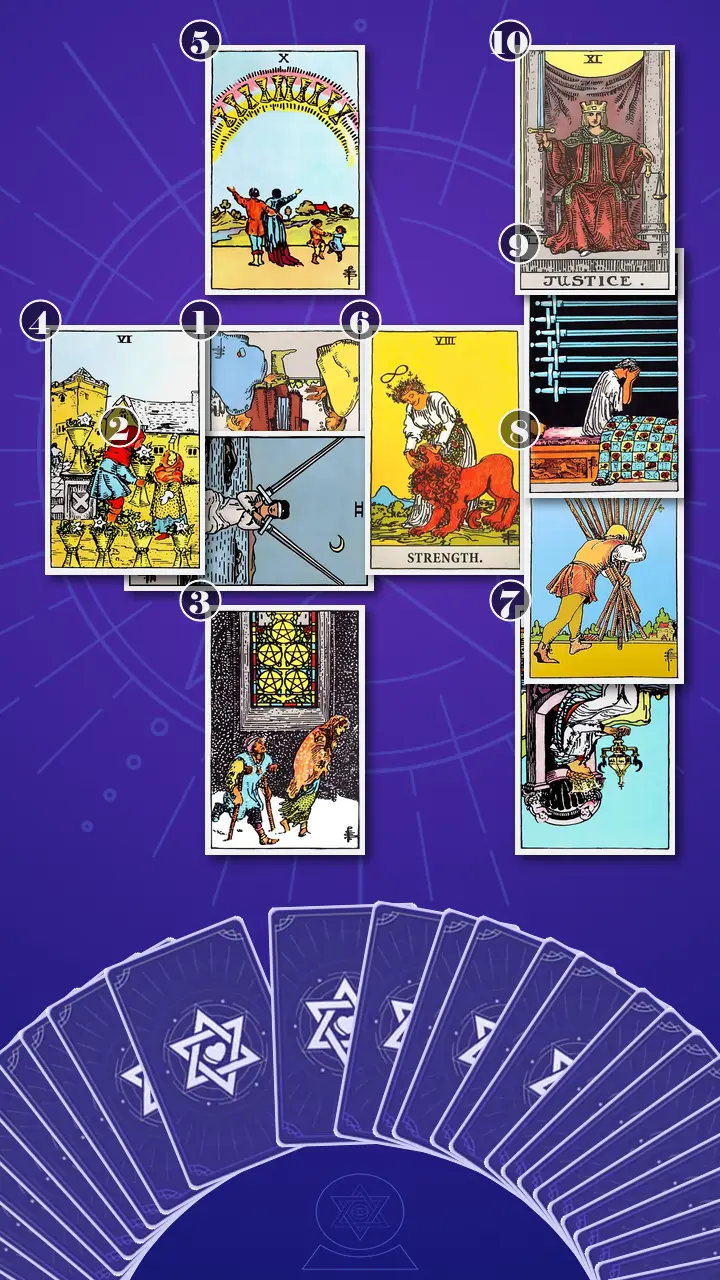
Where the Scales Tilted Before Anyone Asked
Position 1: The Calendar That Never Counted Her
I turned the card representing Jordan's present diagnosis, the observable rescuing behavior and unequal flow of support: the Six of Pentacles, reversed.
I directed her attention to the scales suspended above the exchange. In Jordan's life, this was the Slack request she answered before opening Google Calendar. At 4:56 p.m., while finishing her own launch checklist, she could type "I can take this" before checking who owned the task, whether the deadline was real, or what taking it would erase from her evening. Cold coffee, lifted shoulders, and a vanished dinner appeared only after the brief relief of being needed.
The reversal showed an excess of outward giving combined with a blockage in receiving. Her generosity was real, but it had become automatic. Everyone else's urgency entered the calculation while her sleep, workload, and need for support stayed off the scale. Her capacity had begun to function like a public Google Doc that anyone could edit.
Jordan gave a small, bitter laugh. "That is so accurate it feels a little brutal."
I did not rush to soften the recognition. I said, "The card is not calling your generosity a flaw. It is showing us the exchange before we assign blame. The question is not how much more you can give. It is why your capacity is the only resource that never gets counted."
Her thumb stopped rubbing the edge of her phone. For the first time that evening, she looked at the empty space beside the card rather than at the screen.
Position 2: The Ten-Minute Sentence She Kept Deleting
I turned the card representing the immediate challenge, the conflict Jordan avoided between automatic availability and an honest limit: the Two of Swords, upright.
The blindfold did not suggest ignorance. It showed a known choice that felt too uncomfortable to face. I connected it to the moment Jordan saw "Can you talk?" on the TTC ride home, knew she was depleted, typed "I only have ten minutes," deleted it, and replaced it with "Of course. What happened?"
The crossed swords held two truths over the heart: "I care about you" and "I cannot take this on tonight." The blockage came from keeping those truths apart. Jordan's nervous system treated a pause as a relationship referendum, so a full yes seemed like the only compassionate answer before anyone had even reacted.
I asked, "If brief disappointment were uncomfortable but survivable, what would you choose differently?"
Jordan inhaled through her nose and held it. "I would ask how urgent it actually is. Or what they want from me. I usually skip that and start fixing."
I nodded. "A ten-minute pause is not a withdrawal; it is where your capacity gets a vote."
Position 3: The Glowing Window Outside the Group Chat
I turned the card representing the unconscious foundation, the fear that reduced usefulness could lead to exclusion or loss of worth: the Five of Pentacles, upright.
I showed Jordan the two figures moving through snow beneath an illuminated window. In modern life, that window could be an Instagram Story from a rooftop dinner, a workplace channel moving without her, or a group chat in which everybody seemed close while nobody had asked how her week had gone.
I reminded her of the Saturday when she saw friends together, felt a hollow pressure under her ribs, and nearly wrote that she needed company. Before she sent it, another friend messaged about a breakup. Jordan offered snacks, travel time, and a plan. Being needed gave her a route back toward the warmth without requiring her to say she felt outside it.
The card held an excess of scarcity-based fear and a deficiency of trust in present evidence. The feeling of exclusion was powerful, but the feared outcome was not yet a confirmed fact. No one in that interaction had said, "Your place depends on solving this." Her body had supplied that sentence before the relationship did.
"When you last considered declining a favor," I asked, "what did you imagine would happen to your place in the relationship?"
Jordan looked away from the camera. "I imagined they would remember. Like there would be a quiet mark against my name, and next time they would call someone else."
"And would being called less feel like having less work, or like having less worth?"
Her fingers tightened, then released. "Less worth," she said.
Position 4: The Gift That Became a Job Description
I turned the card representing past reinforcement, the familiar gratitude and closeness that had repeatedly rewarded Jordan's helper role: the Six of Cups, upright.
The offered flower-filled cup carried sincere kindness. I did not impose a childhood story on Jordan or suggest that every generous act concealed a motive. I stayed with what she knew: somebody said, "I don't know what I would do without you," and warmth arrived quickly. The helper role was familiar, praised, and easy to perform. Revealing an unmet need felt much less scripted.
I thought briefly of kitchens and shared tables I had encountered while travelling, places where offering food, time, or practical help was a genuine language of affection. A gift can be sincere and still become the only role a person feels permitted to occupy. That is where balanced care can tip into overreliance on one route to closeness.
I mentioned Luisa in Encanto, not as a personality label but as a recognizable behavioral metaphor. Carrying impossible loads creates admiration and belonging, yet it can quietly bind identity to the carrying. Jordan smiled with the pained recognition of someone who already knew the song.
"Being useful may create contact," I told her, "but it cannot be the price of being known."
Position 5: The Relationship She Was Actually Trying to Build
I turned the card representing Jordan's conscious aim, mutual emotional belonging in which generosity and personal needs could coexist: the Ten of Cups, upright.
This card clarified that Jordan did not want to become unavailable. She did not want to punish friends, ignore coworkers, or make people prove their love. She wanted an ordinary shared scene: someone noticing her quietness, asking about the difficult week, helping with a practical task, and hearing a no without disappearing.
The Water energy here was balanced, but not yet fully lived. The two figures raising their arms together showed participation rather than a fixed giver and recipient. Both people could ask, listen, receive, disappoint each other briefly, repair when needed, and remain in the relationship.
I asked her to make reciprocity observable. "In one ordinary week, how would you know mutual care was happening?"
"Someone would check in without needing something first," she said. "I could ask for a call and not make it sound like a joke. At work, somebody else could own the follow-up instead of waiting for me to turn it into a plan."
Those were not unreasonable fantasies. They were behaviors that could be requested and observed. The Ten of Cups had turned a vague wish to feel cared for into criteria Jordan could actually use.
When Strength Placed a Hand on the Lion
Position 6: Warmth Without Takeover
The room seemed to quiet before I turned the key card. Even the radiator behind Jordan stopped clicking. I revealed the position representing an immediate boundary experiment, the quality she could practice while remaining warm: Strength, upright.
I centered the calm hand resting on the lion. Strength did not defeat urgency, guilt, or the desire to be needed. It held those forces without attacking them and without surrendering the decision to them. Its Fire was balanced: present enough to act, regulated enough not to burn the relationship or Jordan's remaining energy.
In Jordan's life, the image became one specific text: "I can listen for fifteen minutes, but I cannot troubleshoot tonight. Would listening help?" The stomach flutter could remain. The urge to apologize could remain. The difference was that neither impulse automatically controlled her hands.
I used my Inner-Critic Neutralization lens to expose the loop that had been masquerading as self-discipline. An incoming crisis triggered the verdict, "A good friend would answer fully." The verdict prompted immediate labor, which erased Jordan's capacity. Her later resentment then became evidence for a second verdict, "You are selfish for feeling this way," and she tried to repair that shame by helping again. This was not reliable moral guidance. It was an old fear wearing the badge of productivity.
I named the trap beneath the image. At 11:43 p.m., Jordan could send a complete solution, delete her own request, and set an early alarm because being useful felt safer than being visible. She was trying to make the perfectly caring choice before allowing her capacity into the room.
You do not have to tame every crisis to earn closeness; place a gentle hand on your own limits, as Strength meets the lion with steadiness rather than force.
Jordan's breath stopped. Her fingers stayed suspended above the phone, and her gaze lost focus as if the last week were replaying behind the screen. Then her brow tightened. "But doesn't that mean I have been doing all of this wrong? Was the help fake?"
I kept my voice level. "No. Your care was real, and the cost was real. Integration does not put your past on trial. It gives your future more than one option."
Her pupils widened; moisture brightened the rims of her eyes. Her raised shoulders slowly descended, and the fist pressed against her thigh opened one finger at a time. "Oh," she breathed, the word trembling between relief and grief. The release left a brief, almost dizzy blankness. Clarity had removed the fiction that she had no choice, which also meant the next choice would belong to her.
I asked, "Now, with this new perspective, think back to last week. Was there a moment when this insight could have changed how the situation felt?"
She remembered rinsing a mug while a friend's workplace voice note played beside her half-finished dinner. "I could have listened without opening my laptop," she said. "I could have offered fifteen minutes and stopped there."
I told her this was the bridge: not from caring to detachment, but from automatic rescue and guilt-driven over-functioning toward compassionate self-trust and observable, reciprocal care. Her care did not become less loving when it acquired a limit. A calm boundary gave care a chance to become sustainable and mutual.
For the next ten minutes, I invited her to choose one non-urgent request and draft a warm limit. She did not have to send it. She could make the offer smaller, stop if her body felt flooded, or return later. The exercise was not a test of courage; it was the first moment her need and capacity appeared before the rescue began.
The Closed Cup Behind the Full Calendar
Position 7: Push Notifications for Everyone Else's Feelings
I turned the card representing Jordan's self-perception, her identity as emotionally capable, low-maintenance, and responsible for keeping other people steady: the Queen of Cups, reversed.
The Queen's ornate cup was closed. In Jordan's life, that was the unsent sentence, "I have had a hard week and need someone to listen." She could hear strain in a friend's punctuation within seconds, detect disappointment in a coworker's short reply, and anticipate a group-chat conflict before anyone named it. When someone asked about her, she said, "I'm fine," then redirected the conversation.
The reversal showed an excess of outward emotional attunement and a deficiency of inward inclusion. Jordan had push notifications enabled for everyone else's moods while her own inner status remained on Do Not Disturb. Emotional intelligence was not missing; it was pointed so consistently outward that it bypassed her.
I brought in my Shadow Integration Audit, a Jungian mapping tool I use to examine emotions that have been pushed out of acceptable self-image. I did not assign Jordan a hidden feeling. I asked what fit. Anger might signal repeatedly crossed capacity. Shame might guard the belief that having needs made her difficult. Grief might belong to the years of being appreciated for carrying while remaining personally unknown.
"What can you detect in them?" I asked. "And what will you not name in yourself?"
Jordan's jaw tightened first. Her eyes shifted toward the deleted-message folder on her phone as if she could see every unsent request at once. Then a long breath left her chest. "I can detect disappointment in a period at the end of a text," she said, "but I call myself tired when I am actually lonely. And angry."
I told her resentment was not evidence that she was uncaring, nor automatic proof that everyone around her intended to exploit her. It was unentered data. Once mapped without judgment, it could stop draining her psychological bandwidth in the background and begin informing a conscious response.
Position 8: The Work Everyone Learned to Hand Her
I turned the card representing the relational environment, the habits friends and coworkers had developed around Jordan's repeated availability: the Ten of Wands, upright.
The figure's bundle blocked the destination from view. Jordan's equivalent was a calendar packed with work, favors, calls, follow-ups, and emotional admin. Coworkers routed loose ends toward her because she reliably made unclear requests usable. Friends expected her to organize the plan, absorb the feelings, and keep the conversation moving because that arrangement had worked before.
This was an excess of burdened Fire: action without containment. I was careful not to turn the card into an accusation against everyone in Jordan's life. Some people might be entitled or inattentive; others might simply be responding to a precedent they had never been asked to reconsider. The spread could not decide that in advance.
"Which burdens were assigned to you?" I asked. "Which did you volunteer for? Which one could return to its actual owner?"
Jordan named a product-launch follow-up that belonged to another team member. As she said the name aloud, her expression shifted from dread to mild disbelief. The task had felt like part of her identity, yet it was not part of her role.
Position 9: The Trial That Began After Midnight
I turned the card representing Jordan's hopes and fears, her wish for reciprocal care beside the fear that one limit would be interpreted as selfishness or abandonment: the Nine of Swords, upright.
The swords hung above the bed rather than moving through the scene. I connected them to the late-night replay after Jordan sent, "I cannot talk tonight." She would reread the message, inspect a last-seen status, imagine the recipient quietly revising their opinion of her, and begin drafting an apology before any new evidence had arrived.
This was Air in excess. Thought had stopped evaluating information and started prosecuting her. The phone glow, tight chest, and silence after a message made an imagined verdict feel immediate, but the card showed suspended thoughts, not confirmed events.
I asked her to separate two records: what actually happened and what her mind predicted. A delayed reply belonged in the first record. "They have decided I am uncaring" belonged in the second unless repeated behavior supported it.
Jordan pressed her lips together, then nodded slowly. "I usually react to the second record before the first one exists."
"Exactly," I said. "You compose a rescue for a trial that may only be happening in your head."
When Justice Put Her Name on the Scale
Position 10: Evidence Instead of Mind Reading
I turned the final card representing cognitive integration, a fair and evidence-based approach to requests, limits, and reciprocity: Justice, upright.
The level scales looked directly back toward the reversed scales at the center of the spread. The upright sword added what the first exchange had lacked: explicit language, discernment, and accountability. Jordan's capacity could not affect the agreement while it remained hidden. Fairness had to become speakable.
The energy here was balanced Air working with practical Earth. Jordan could state what she could take on, make one direct request, and observe what happened over time. A short reciprocity audit could record three things: what she gave, what she asked for, and what happened next. That was not a courtroom case against a friend or coworker. It was a way to replace imagined tone and read receipts with usable information.
I said, "A fair relationship is not a perfect 50/50 spreadsheet every day. It is a system in which both people are allowed to enter their needs. Their response to a clear limit is information about reciprocity, not a verdict on your worth."
Justice did not promise that every person would welcome a boundary. Some might negotiate respectfully, some might need time, and some might reveal that they preferred Jordan's labor to her full participation. Tarot could not choose Jordan's response for her. It could help her distinguish those observable outcomes from the old assumption that any disappointment meant she had failed.
I asked, "What direct sentence would put you on the scale?"
Jordan looked at the cards, then at me. "I have had a hard week. Could you call me tomorrow and just listen for a bit?"
There was no joke attached, no offer of help first, and no three-paragraph explanation of why the request was reasonable. The sentence stood upright on its own.
Capacity Before Care Becomes a Practice
I gathered the cards into one coherent story. At the root, the Five of Pentacles held an image of exclusion, so familiar gratitude in the Six of Cups became a reliable route back toward belonging. In the present, the reversed Six of Pentacles showed support leaving Jordan's hands before her capacity entered the calculation. The Two of Swords kept the necessary choice suspended, while the reversed Queen of Cups hid her own emotional contents. The environment then adapted, placing Ten of Wands responsibilities in the arms she repeatedly extended. At night, the Nine of Swords converted any proposed limit into an imagined relational punishment.
The spread also showed resources. The Ten of Cups clarified that Jordan wanted mutual belonging, not isolation. Strength gave her warmth without takeover. Justice gave that warmth a repeatable structure: pause, name capacity, make a direct request, and evaluate the observable response.
The cognitive blind spot was not simply that Jordan helped too much. She had been trying to measure reciprocity while keeping her needs invisible. Gratitude for what she provided felt like evidence that she was known, while disappointment that nobody noticed her hidden need felt like evidence that she was not. Neither conclusion had been tested through a clear request.
I told her the transformation was not "stop caring." It was a shift from automatically solving the problem to asking what support was actually wanted, checking her own capacity, and naming one need or limit before agreeing. Care could become a conscious offer rather than proof of worth.
To keep the pause from becoming another self-improvement project, I adapted my Active Imagination Protocol into a four-minute phone note. I asked Jordan to let two inner voices write one sentence each. The Rescuer would answer, "What do I fear will happen if I pause?" The Unheard Need would answer, "What can I honestly offer without borrowing from tomorrow?" She did not need to argue with either voice or force a positive conclusion. She only needed to let both appear before choosing.
"But some days I genuinely cannot find ten minutes," Jordan said. "Slack already feels like triage."
I adjusted the practice immediately. "Then take three breaths and write one capacity number: zero, fifteen minutes, or one task. A useful boundary practice has to fit inside the life where you need it."
- Capacity Before Care.For three clearly non-urgent requests this week, wait ten minutes before replying. In a phone note, write what is being asked, how much time or energy you genuinely have, and what support you are willing to offer. Then ask, "Do you want me to listen, help you think through options, or take one practical task?"If ten minutes feels impossible, take three breaths and record only a capacity number. Mute the notification during the pause if needed.
- The Warm Fifteen-Minute Boundary.Choose one conversation this week and set the limit before it begins: "I can listen for fifteen minutes, but I cannot troubleshoot tonight." If the person asks for more, repeat the limit once and end the call or chat when the time is complete.Do not add repeated apologies, a new task, or a promise to solve everything tomorrow. Warmth can remain in the sentence without extra labor.
- The Justice Reciprocity Log.For one friendship or work channel, create three brief columns: what I gave, what I asked for, and what happened next. Make one direct request by Friday, such as "Could you check in with me tomorrow?" or "Can you own the follow-up on this task?"Keep the record factual and review it once at a calm time. One delayed reply is not a final judgment; repeated behavior is more useful evidence.
I reminded Jordan that these were experiments, not obligations and not tests other people had to pass perfectly. She remained free to make an offer smaller, revise a request, leave a conversation, or decide that a particular relationship could not hold the reciprocity she wanted. Tarot had supplied a map. She retained authority over every next step.

A Week Later, the Reply Did Not Become a Rescue
Six days later, I received a message from Jordan. A friend had sent a voice note about another work conflict while Jordan was rinsing a mug beside a half-finished dinner. Her first impulse had been to open the laptop. Instead, she noticed the pressure behind her eyes, wrote "15 minutes, listening only" in her Capacity Before Care note, and sent the boundary we had drafted.
Her friend replied, "Listening would help. Fifteen is okay." Jordan listened, stayed warm, and stopped when the time ended. Her stomach still fluttered after the call, but she did not send an apology or a rescue plan.
That night she slept through until morning. Her first thought was still, "What if I got it wrong?" This time, she gave a tired half-smile, checked the actual reply once, and made coffee before checking for another crisis.
I did not read that message as proof that every boundary would go smoothly or that Jordan had solved the pattern in a week. I read it as a small, credible shift: an automatic yes had become an intentional offer. The change did not come from Strength predicting her future. It came from Jordan practicing Strength with her own hands.
That was the quiet proof of our Journey to Clarity. She had begun moving from being needed to being known, from boundary guilt toward self-trust, and from one-way support toward connection in which reciprocity could finally become visible.
If you keep answering everyone else's urgency with a tight jaw and heavy shoulders, I want you to remember this: the part of you still waiting to learn whether it can be loved in the room without carrying the whole room is not selfish. Simply noticing that part means your capacity has already begun to enter the conversation.
If care included your actual capacity for one small moment, what is the gentlest request or limit you could imagine placing on the scale, without deciding yet what it has to mean?