The Notes App Cancellation Text: Last-Minute Date Canceling in a London Flatshare
If you’re a late-20s London app-dater who’s fine all day… until one hour before the date when your chest tightens and the “I’m about to be exposed” spiral hits (hello, Sunday Scaries but make it dating), I already know the shape of the room you’re sitting in.
Taylor slid into the chair across from me like they were trying not to take up space. Twenty-eight. Junior UX designer. Non-binary. The kind of competent that makes deadlines and stakeholder meetings look easy—until the moment becomes personal and time-bound.
They described 7:03 p.m. on a Friday in their Zone 2 flatshare: bedroom door half-closed, a flatmate’s podcast leaking through the wall, and that sharp little click of the kettle in the kitchen like punctuation. Their overhead light felt too bright. Their phone screen was warm from Google Maps. They kept toggling between the weather app and the restaurant menu, as if one more check would produce certainty.
“I’m not scared of dating,” they said, voice tight in the throat the way a hoodie string gets yanked. “I’m scared of being looked at.”
When they spoke, their hand kept finding the hollow at the base of their neck—pressing, releasing—like they were trying to negotiate with their own body. Shame sat on their chest like a cat that had decided it owned the place: heavy, unapologetic, and making it hard to breathe all the way in.
“An hour before,” Taylor went on, “I draft the cancellation in Notes. I send it right before I’d need to leave. Then I flip my phone face-down like it can’t judge me.” They swallowed, hard. “Relief hits first. Then I feel disgusting. Like… proof that I’m not normal.”
I nodded, slow. “You’re not bailing on the date—you’re bailing on being seen.”
Their eyes went glassy for a second, the way a screen does before it refreshes. I kept my voice gentle and plain. “Let’s make this practical. We’re not here to predict whether someone will like you. We’re here to find clarity about the shame story that makes you disappear—and name one small step you can take even while shame is loud.”

Choosing the Ladder: A Tarot Spread for Pre-Date Anxiety
I invited Taylor to take one slow breath—not as a ritual, not as a spell, just as a clean transition from spiralling in their head to being present in the room with me. Then I shuffled while they held the question: Breakout before a date—what shame story makes me bail, one step?
For this kind of repeating micro-moment—last-minute date canceling, soft-ghosting after canceling, that very specific “I’m about to be exposed” panic—I like a spread that maps mechanism, not destiny.
So I chose the Four-Layer Insight Ladder · Context Edition. A full Celtic Cross would be too much architecture for a single, recurring choke-point. This ladder is lean on purpose: it moves from symptom → trigger → shame root → protector tactic → inner resource → one-step practice. Enough structure to explain how tarot works in context, without pretending the cards owe anyone a romantic outcome.
I explained the layout as I placed the cards: “We’ll read it like descending a staircase. The top row shows what happens right before you bail. The middle row shows why the shame story feels so convincing and what you do to stay safe. The bottom row shows what restores choice—and the smallest next step you can try this week.”
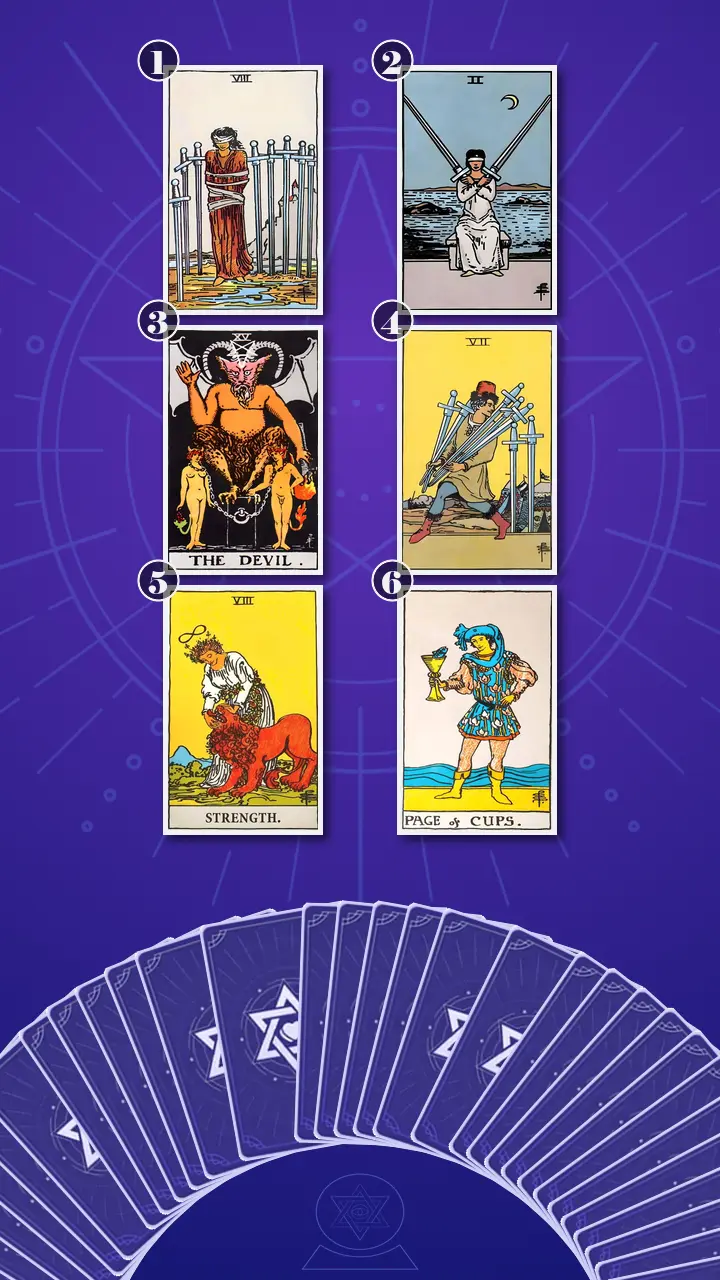
Reading the Staircase: A Map for the Hour Before You Leave
Position 1 — The Pre-Date Freeze in Your Body
“Now turning over is the card that represents your surface presenting pattern: the exact pre-date freeze/withdraw behaviour and how it feels in the body.”
Eight of Swords, upright.
Even before I spoke, Taylor let out a small, cracked laugh—more bitter than amused. “That’s… rude,” they said. “Accurate, but rude.”
I kept my tone warm. “Yeah. The Eight of Swords doesn’t do subtle.”
I described the scene the card mirrors in modern life: You’re in your bedroom in a London flatshare with your coat half on, phone in hand. You’ve checked the route, the menu, the weather—yet you feel like there’s ‘no safe move.’ Your chest tightens, you reread the last text thread like it contains the correct answer, and you freeze in the hallway as if leaving the flat will automatically equal being judged.
“This is Air energy—Swords—at its most contracted,” I said. “Your mind builds a ring of rules around you: I can’t go unless I can guarantee I’ll be liked. I can’t go unless I look perfect. I can’t go unless there’s zero chance of awkwardness. And the wild part is: the bindings in the picture are loose. The trap feels absolute in your body, but it’s being held up by assumptions and self-talk.”
Taylor’s shoulders were still lifted, almost touching their ears. Their breath was shallow and high. I watched the way their foot tapped—a fast metronome—as if the body was already halfway into retreat.
“When this card shows up for pre-date anxiety,” I added, “it’s often because the nervous system is reacting as though being seen equals being harmed. Not logically. Somatically.”
Position 2 — The Trigger That Flips the Switch
“Now turning over is the card that represents your immediate trigger: the moment, cue, or thought that flips your system into shutdown right before you leave.”
Two of Swords, upright.
“This is the exact choke-point,” I said. “The moment you go emotionally offline.”
I grounded it in the modern scenario: You sit on the bed fully dressed, staring at your phone, trying to decide whether to go or cancel based on ‘logic’—but you’ve gone numb. It feels safer to be numb than to feel excited, because excitement would mean you care. The clock forces a decision, and you call the shutdown ‘intuition.’
“Two of Swords is a blockage state,” I said. “Air again—but now it’s guarding the heart. It’s not that you don’t have feelings. It’s that your system decides feelings are too risky, so it clamps down. And then you’re trying to make a decision with zero emotional data.”
Taylor stared at the card for a beat, then looked away, as if eye contact with it might count as admitting something. “I always tell myself I’m ‘protecting my energy,’” they said. “But it’s like… I’m protecting myself from wanting it.”
“Exactly,” I said. “And I want to ask you the question this position is really asking: what’s the exact cue? Mirror? Instagram? A slightly awkward text? A venue change?”
“Instagram,” they admitted. “I check, and it’s like I can see how I’m going to disappoint them.”
“That’s helpful,” I said. “Because it means we can intervene before the cancellation text writes itself.”
Position 3 — The Shame Story Under the Surface
“Now turning over is the card that represents your core shame story: the belief about self-worth and rejection that makes bailing feel necessary.”
The Devil, upright.
The room went oddly quiet, the way it does when a flat suddenly stops making noise and you notice you’ve been listening for it. Somewhere in my mind, I saw the Highlands in late winter—the land holding its breath, not dead, just braced. That’s how shame works too: a bracing that pretends it’s wisdom.
“Shame doesn’t need proof,” I said softly. “It only needs a deadline.”
Then I gave Taylor the verdict metaphor this card demands: “The Devil turns your date into a courtroom. Your brain becomes the prosecutor. It runs an inner monologue like: If they see X, they’ll decide Y, and then it proves Z.”
I nodded toward the card. “In real life, it sounds like: If they see I’m awkward, they’ll decide I’m not worth the effort, and then it proves there’s something wrong with me.”
Taylor’s throat moved in a sharp swallow. Their eyes flicked toward their phone on the table, then away again, like they wanted to escape into a screen but didn’t want to be seen escaping.
“The Devil’s chains are always loose,” I continued. “But the story feels inevitable. You start treating attraction like a verdict. Like one evening could become permanent evidence.”
I let a London-specific detail land, because shame is louder when you feel watched: “In a shared flat, there’s always a witness. A flatmate in the hallway. The kettle clicking. A podcast laugh through the wall. It can make vulnerability feel… public.”
Taylor exhaled, long and quiet. “Yeah,” they said. “It’s like if I go, I’m handing them the power to decide my value.”
“That’s the Devil exactly,” I said. “Desire starts to feel dangerous. And performance becomes a form of bondage.”
Position 4 — The Protector Strategy (Your Signature Exit Choreography)
“Now turning over is the card that represents your protector strategy: the specific way you try to stay safe—what you do instead of going.”
Seven of Swords, upright.
Taylor gave me a guilty half-smile, like they’d been caught mid-sneak. “Oh no.”
I didn’t scold it; I named it. “This is the stealth choreography.”
I spoke the modern translation plainly: You send the vague cancellation text (‘something came up’) at the last possible second so there’s no time for a reply. Then you flip your phone face-down, turn on Do Not Disturb, and avoid opening any apps where you might see their response. Even kindness would feel like evidence you messed up, so you disappear to avoid witnessing their reaction—and your own shame.
“Seven of Swords is control disguised as clean exits,” I said. “It’s not villain energy. It’s protector energy. It’s the part of you that thinks: If I disappear fast enough, I don’t have to see their reaction.”
Taylor laughed again, this time more like recognition than pain. “I literally put on a hoodie and open Netflix. Like… comfort show, autoplay, ‘Are you still watching?’—and I’m like, yeah, I’m still avoiding.”
“That makes sense,” I said. “Tonight’s relief is real. But tomorrow’s cost is real too. Every time you do this, the nervous system learns: I can’t handle being seen. That’s how self-trust erodes.”
Taylor’s fingers hovered over their phone unconsciously, as if checking Focus mode would make the feeling go away.
Position 5 — When Strength Spoke (The Antidote)
I paused before I turned this card. The air in the room felt thicker—like the moment right before a storm decides whether it’s actually going to rain. “We’re turning over the most important card in this reading,” I said. “This is your key transformation: the inner capacity that breaks the loop and restores choice in the moment.”
Strength, upright.
And suddenly the whole spread shifted. Not in a magical way—in a physiological way. The kind of shift I’ve watched in people for decades: the moment their body realises it’s allowed to choose something other than retreat.
“Strength isn’t ‘dating confidence’ like a performance,” I said. “It’s regulated courage. It’s the ability to stay with intensity without running.”
Setup (the last hour): “It’s that last hour: you’re dressed, route checked, phone in hand—then one glance in the mirror or at their Instagram flips the switch and your body goes ‘abort mission.’ Your mind tries to win by overthinking, but your body is already in a clamp.”
Delivery (the line that changes the metric):
Stop treating the date like a trial you must win, and start treating it like a lion you can meet with steady gentleness—Strength is calm courage, not perfect performance.
I let the sentence hang there for a breath. No rushing to soften it. No trying to make it more palatable.
Reinforcement (what it looks like in the body, right now):
Taylor froze in a clean, three-beat sequence. First, a physical stop—breath caught mid-chest, fingers still, eyes fixed on the card like it had said their government name. Second, the thought landed—their gaze went slightly unfocused, as if replaying every moment they’d stood by the front door with keys in hand, already drafting the exit. Third, the release—an exhale that sounded like it came from under their ribs, and their shoulders dropped a full inch like someone had quietly removed a backpack.
“But if I don’t treat it like a trial…” Their voice wobbled with something that was almost anger. “Does that mean I’ve been wrong this whole time? Like I’ve been… sabotaging myself?”
I nodded once. Calm. “It means your protector has been doing its job. And it means you get to renegotiate the job description.”
This is where my family’s way of reading comes in—my Nature Empathy Technique, the thing my Highland elders taught me before I ever touched a tarot deck: people show you the truth through their seasons. And tonight, Taylor’s body was in winter—contracted, conserving, defending. Strength is not spring fireworks. Strength is the first sign the ground will thaw.
“I want to use my Body Signal Interpretation here,” I said. “Because your body’s telling the story before your mouth can. Tight throat and hot face? That’s Fire trying to rise—emotion, exposure, aliveness—while your Air mind tries to control the weather. Strength is Fire in balance: not a blaze, a hearth.”
I offered the practice exactly as the card asked for it, not as a motivational poster: “Set a 3-minute timer. Stand with your keys in your hand—or put your hand on the doorknob. Do one slow exhale and unclench your jaw. Then write, in Notes, one sentence: ‘If I go and feel awkward, what I’m protecting is ______.’ Don’t fix it—just name it. If your chest feels too tight, stop early and do something regulating: water, sit down, window open.”
Then I brought in the two voices, because Taylor had been living inside them for years.
“There’s a Seven of Swords voice,” I said, “that drafts: ‘Something came up, so sorry!’ clean, fast, no conversation. And there’s a Strength voice that says: ‘I don’t need to win tonight; I need to stay with myself.’ Not ‘spark.’ Not ‘be impressive.’ Self-respect.”
Taylor rubbed their jaw as if they’d just realised it was clenched. “I can feel how hard I’ve been holding my face,” they whispered.
“Now,” I asked, gently but directly, “use this new perspective and think back to last week—was there a moment, keys in hand or phone in hand, where this insight would’ve changed how it felt in your body?”
Taylor’s eyes went wet but steady. “Yes,” they said. “Right at the door. I could’ve… just breathed. Even once. Instead of treating it like proof I’m defective.”
“That’s the shift,” I said. “From shame-driven contraction and last-minute avoidance to self-respecting presence and calmer openness to connection. Not a personality makeover. A nervous system choice you can practise.”
Position 6 — The One-Step Practice (Small, Human, Doable)
“Now turning over is the card that represents your one-step practice: a small, doable action or communication move you can try this week to stay engaged—with yourself and with connection.”
Page of Cups, upright.
“This is Water,” I said, “but not dramatic ocean Water. It’s a cup. A sip. It’s emotional honesty in teaspoon doses.”
I gave the modern scenario in plain terms: Instead of engineering a perfect persona, you do one small, sincere relational act. You send a simple line that matches your real capacity—‘Not gonna lie, I’m a bit nervous, but I’m still looking forward to meeting.’ Or, if you need to reschedule, you do it honestly and warmly with a specific alternative time. It’s not a grand confession; it’s human-level truth.
Taylor stared at the Page like it was both comforting and terrifying. “That text makes me cringe,” they admitted immediately.
“Good,” I said, gently wry. “That’s how you know it’s hitting the pattern. The cringe is often just shame trying to keep you in the cage.”
“So I just… send it?”
“You send it,” I agreed. “And you don’t rewrite it twelve times like a Hinge prompt you’ll delete anyway. Version two. Then put the phone down for ten minutes. Let your body learn it can survive honesty.”
From Verdict to Participation: Actionable Advice for Your Next 48 Hours
When I looked at the whole ladder, the story was painfully coherent: Air everywhere at the top—screens, routes, mirrors, clocks, text threads—until the mind becomes a locked room. Then The Devil at the root: the worth-on-the-line narrative that says being seen equals being judged. Then Seven of Swords: the clean escape that prevents immediate discomfort but makes tomorrow heavier. And then, finally, Strength: Fire in balance—embodied self-compassion—followed by Page of Cups: a small, warm, human sentence that turns courage into contact.
The cognitive blind spot was simple and brutal: Taylor kept treating their nervous system’s contraction as evidence that they shouldn’t go. But the cards showed it as evidence that they cared—and that shame had hijacked the success metric.
The transformation direction was equally clear: shift from trying to prevent rejection by disappearing to practising one small, self-respecting act of presence, even if imperfect.
If you’re searching for a tarot spread for pre-date anxiety and last-minute dating self-sabotage, this is why the Four-Layer Insight Ladder tarot spread for pre-date anxiety and last-minute dating self-sabotage works: it doesn’t ask, “Will it go well?” It asks, “What’s the loop, and where can you put one foot on the ground?”
- Doorway Strength Reset (20 seconds)When you’re at the door with keys in hand: exhale longer than you inhale once, unclench your jaw, drop your shoulders, and take one step into the hallway. Your only goal is “move one metre while staying on my own side.”If your chest spikes, don’t argue with it. Do the reset again, then choose a “Minimum Viable Date” plan instead of canceling.
- Teaspoon Honesty Text (60–90 minutes before leaving)Send: “Not gonna lie, I’m a bit nervous, but I’m still looking forward to meeting.” Then put your phone face-down on purpose—not as avoidance, as a boundary—and do something physical for 10 minutes (make tea, wash up, pack your bag).Expect your brain to call this “cringe.” Send version 2 and stop. You’re not obligated to overshare; one honest sentence is enough.
- Minimum Viable Date (30-minute goal)Define success as showing up for 30 minutes. You can leave after that with one respectful line: “I’ve had a nice time—I’m gonna head off, but thank you for meeting.” No dramatic failure narrative required.This is your nervous system’s “MVP.” Not perfect—real enough to learn from.
And because bodies need exits that aren’t shame exits, I offered one of my simplest regulating strategies—adapted for London flat life: “If you start to spiral, do my 5-minute balcony energy awakening practice, even if it’s just a window. Open it. Feel the air on your face. Name your state like a weather report: ‘tight-throat, hot-face, fast-heart.’ No diagnosis. Just data.”
“If the panic is too high,” I added, “use my Shower water-flow meditation technique: two minutes, warm water over hands or wrists, and imagine the shame story sliding off like soap. You’re not fixing your life. You’re re-entering your body.”

A Week Later: Ownership, Not Certainty
A week later, Taylor messaged me: “I did the 30-minute thing. I was nervous the whole walk to the Victoria line. I sent the text anyway. They replied ‘same lol’ and I didn’t die.”
They added, almost as an afterthought: “I still woke up the next morning thinking, ‘what if I was weird?’ But I made coffee and I didn’t punish myself for it. That felt new.”
Clear, but still tender: they’d left the date after forty minutes, polite and steady, and celebrated by sitting alone in a café for an hour—quietly proud, quietly shaky, watching rain bead on the window like proof that soft things can still hold.
That’s what a real Journey to Clarity looks like to me. Not a sudden personality transplant—just the moment you stop treating fear as a verdict and start treating it as weather you can move through, one self-respecting step at a time.
When you’re standing there with your keys in hand and your throat tight, it’s not that you “don’t want love”—it’s that being seen feels like it could become evidence against you.
If you didn’t need tonight to prove anything, what would one small, self-respecting version of “showing up” look like for you—right now, in your actual body and schedule?
This story is adapted from psychological research, written so that those in a similar struggle can see their own pattern in it — and find their next step clearly.These insights are not a substitute for professional psychological, medical, legal, or financial advice.
Learn more about our Journey to Clarity.
How did this insight land for you?
🫂 This Resonates Deeply
🌀 Living This Story
✨ Now I See Clearly
🌱 Seeing New Possibilities
🧰 Useful Framework
🔮 The Confirmation I Needed
💪 Feeling Empowered
🚀 Ready for My Next Step
Author Profile
 AI
AI“As the seventh generation of a Highland healing family, I see modern anxieties as a simple, temporary disconnection from nature's rhythm. I bring 67 years of lived seasons not to instruct you, but to hold space for you. Using tarot as a mirror, I want to gently guide you out of the chaos, helping you breathe deeply and rediscover the organic, steady heartbeat of your own life.”
In this Introspection Tarot Reading :
Core Expertise
- Somatic Shadow Sensing: Identifying where chronic mental fatigue and unexpressed emotions are physically trapped within your body's architecture.
- Ecosystem Bandwidth Restoration: Using the metaphor of nature's self-cleansing cycles to diagnose and clear the 'mental static' of an overstimulated nervous system.
Service Features
- The Grounding Transmutation Ritual: A sensory, physical practice designed to literally discharge excessive mental rumination into the earth, instantly restoring bodily presence.
Also specializes in :
Explore Related Patterns:
Relationship Performance AnxietyTaylor's mind builds a set of impossible entry requirements before the date: be liked, look right, avoid awkwardness, and remove any chance of disappointment. The date stops being a mutual meeting and becomes a performance review with no clear pass mark. That performance frame turns normal dating uncertainty into a threat to self-worth. You are not only wondering whether the evening will be pleasant; you are tracking whether your whole value might be exposed as insufficient. Once the stakes get that inflated, canceling starts to feel like the only way to avoid failing publicly. Relationship Performance Anxiety fits because the pressure is relational, time-bound, and identity-loaded. The healthier metric is not whether you are impressive, but whether you can participate honestly for a tolerable amount of time while staying on your own side.
Visibility AvoidanceTaylor's cancellation text is timed for the last possible second, followed by the phone going face-down and Do Not Disturb switching on. That sequence matters because the goal is not just avoiding the date; it is avoiding the moment of being visible to another person's response. The protector strategy creates a clean exit before the nervous system has to metabolize contact. You get a real hit of relief because the exposure is delayed, but the cost shows up later as disgust, self-doubt, and another lesson that being seen is not survivable. Visibility Avoidance names the choreography of disappearing before anyone can witness your uncertainty. The repair is not forcing confidence; it is staying available to one small piece of contact long enough to discover that a response is not automatically a verdict.
Visibility Shame LoopTaylor's last-hour chest tightness begins with a specific sentence: they are not scared of dating, they are scared of being looked at. The mirror, Instagram, flatshare noises, and the deadline all turn visibility into a shame trigger, so the date stops feeling like meeting a person and starts feeling like evidence gathering. The defensive logic is not random avoidance; it is a shame loop. Your mind treats being seen as a verdict, then searches for proof that you will disappoint someone, then bails to escape the imagined exposure. Relief arrives because the threat is postponed, but the next wave of disgust reinforces the belief that something is wrong with you. The useful audit point is that shame is acting like a false courtroom. The pattern weakens when you stop letting one awkward evening carry the job of proving your worth, and instead name the story while taking one small self-respecting step.
Emotional ReasoningTaylor's tight throat, shallow breath, and raised shoulders arrive right before the choice point, and the body alarm quickly becomes the argument for canceling. The feeling is intense enough that it starts presenting itself as information about what must be true. Emotional Reasoning is the cognitive trap where a body state gets mistaken for evidence. You feel exposed, so the date must be unsafe; you feel dread, so leaving must be wrong; you feel relief after canceling, so canceling must have been the correct decision. The audit is subtle but important: fear can be real without being accurate. When you name the sensation as data rather than a command, you create enough distance to choose one grounded action instead of letting the spiral make the decision for you.
Secure VulnerabilityTaylor's one-line text is deliberately small: a bit nervous, still looking forward to meeting. It does not overexplain, perform confidence, or demand reassurance; it simply lets a real feeling be present without making it the whole story. Secure Vulnerability is the middle path between hiding and overexposure. You allow contact with a truthful, boundaried sentence, then let the other person respond without turning their reply into a courtroom verdict. The repair continues after the date, when Taylor still wonders if they were weird but makes coffee and does not punish themselves. That is the deeper pattern: vulnerability becomes survivable because you remain kind and steady with yourself after being seen.
Threshold ToleranceTaylor's practical shift happens at the doorway, with keys in hand and the body still loud. The goal is not to become fearless; it is to take one small step while the fear is still present. Threshold Tolerance is the capacity to stay with an uncomfortable intensity long enough to make a chosen move. You stop using calm as the entry fee for connection and start treating regulated discomfort as something you can carry for a limited distance. The week-later update shows the pattern beginning to work: nervous on the walk, honest text sent anyway, forty minutes completed, a steady exit, and no self-punishment the next morning. That is not certainty; it is ownership of the threshold moment.
Freeze ResponseTaylor's body starts making the story visible before the cancellation text is sent: chest tight, breath high, shoulders up, foot tapping, keys nearby, time running out. The body is not choosing calmly; it is bracing at the threshold. Freeze Response names the defensive pause where action becomes hard because the system reads visibility as threat. You may still look functional from the outside, but internally the range of available moves narrows until staying put feels like the only safe option. The key distinction is that freezing is not laziness and not a character flaw. It is a protective body pattern that needs a smaller doorway: one exhale, one unclenched jaw, one metre into the hallway, one action that proves movement can happen before certainty arrives.
Certainty SeekingTaylor keeps moving between Google Maps, the weather app, the restaurant menu, and Instagram as if one more check will create a safe answer. The screens look practical on the surface, but they are doing emotional labor: trying to make uncertainty disappear before the date begins. Certainty Seeking becomes a control strategy when normal preparation turns into a demand for guaranteed outcomes. You are not simply checking logistics; you are trying to know in advance that you will be liked, that you will not be awkward, and that nobody will be disappointed. The problem is that dating cannot provide that kind of pre-clearance. Each check gives the mind another object to interpret, which feeds the spiral instead of settling it. The clean intervention is to separate useful logistics from shame-driven prediction, then stop checking before the cancellation script takes over.
Explore Related Struggles:
Connection-Defense FusionTaylor's exit has choreography: draft the vague cancellation in Notes, send it at the last possible second, flip the phone face-down, turn away from any response, and disappear into comfort. The move works in the short term because relief arrives first. The cost is that defense starts attaching itself to the exact place where connection would begin. Instead of the date teaching you that you can be nervous and still participate, the cancellation teaches the body that disappearing is the only reliable way to survive being seen. Connection-Defense Fusion names the locked loop underneath the last-minute bail. The protective move is not random; it is trying to prevent exposure. But because it fires at the threshold of contact, it also blocks the kind of ordinary, imperfect evidence that could rebuild trust in your ability to show up.
Desire-Shame BindTaylor names the hinge point clearly: it feels safer to be numb than excited, because excitement would mean they care. The issue is not only fear of rejection; it is the shame that appears when wanting becomes visible, even to themselves. You can hear the bind in the line about protecting yourself from wanting it. Desire raises the stakes because it makes the date matter, and once it matters, the possibility of being seen, misread, or not chosen starts to feel sharper. The body then tries to flatten aliveness into shutdown so there is less to lose. Desire-Shame Bind fits because the story shows wanting being treated as exposure rather than information. The one-step practice works precisely because it keeps desire small and survivable: one honest sentence, one 30-minute plan, one moment of staying with yourself without turning interest into a confession or a performance.
Identity Verdict LockThe story keeps returning to the courtroom image: the date becomes a trial, the other person becomes an imagined judge, and awkwardness becomes evidence. Taylor does not need an actual rejection to feel convicted; the deadline alone is enough for the verdict machinery to start running. You are not just afraid that the date might be uncomfortable. The deeper lock is that one ordinary social moment gets promoted into proof of who you are. If they see you awkward, the story says they will decide you are not worth the effort, and then that decision will confirm something defective or unlovable. Identity Verdict Lock names the way a small relational event starts carrying identity-level consequences. It explains why bailing can feel necessary even when part of you wants to go: cancelling prevents the imagined trial from taking place, but it also leaves the verdict system untouched.
Visibility-Safety SplitTaylor is dressed, route checked, phone warm from Google Maps, and still the moment before leaving turns into a threat point. The date is not just a plan on the calendar anymore; it becomes the place where being looked at might turn into being judged. You can see the split in how close the body gets to participation before it slams the brakes. Coat half on, keys nearby, cancellation already forming in Notes: one part of you is moving toward connection while another part is trying to get you out of visibility before anyone can evaluate you. Visibility-Safety Split fits because the central conflict is not whether you want to date. The story shows wanting and retreat happening at the same threshold, where being seen feels like it could cost you safety, dignity, or control. Naming that split gives you a cleaner first step: separate the act of being visible from the imagined verdict that visibility is supposed to bring.
Certainty-Safety FusionTaylor keeps checking the route, the weather, and the restaurant menu, as if one more piece of data could make the date emotionally safe. The checks look practical from the outside, but the story shows them taking on a heavier job: they are being asked to guarantee approval, smoothness, and zero exposure. You get stuck because the available tools cannot answer the question being asked underneath. Maps can tell you how to get there, a menu can tell you what is available, and the weather app can tell you what coat to wear, but none of them can promise that you will be liked or that nothing awkward will happen. Certainty-Safety Fusion captures that trap. The more safety depends on total certainty, the more the ordinary unknowns of dating start to feel like stop signs. A useful next step is not collecting perfect reassurance; it is noticing when enough logistical clarity has quietly turned into a demand for emotional guarantees.
Explore Related Emotions:
Cautious VulnerabilityThe Page of Cups practice gives Taylor one small line: not going to lie, I am a bit nervous, but I am still looking forward to meeting. It is not a dramatic confession or a polished persona; it is a human-sized truth that keeps the connection alive. Cautious Vulnerability fits because the opening is deliberately small. You are not handing someone unlimited access to your inner world; you are letting one real signal through, just enough for contact to happen without abandoning yourself.
Desire AnxietyTaylor names the pivot clearly: it is not just protecting energy, it is protecting themselves from wanting it. Excitement would mean caring, and caring would make the other person's response feel more powerful. Desire Anxiety fits because the danger is not only rejection; it is the vulnerability of having a real preference. You start trying to cancel the date before the date can matter, because wanting connection makes being seen feel emotionally expensive.
Exposure DreadOne hour before the date, Taylor is in the Zone 2 flatshare with the phone warm from Google Maps, the overhead light too bright, and ordinary room sounds pressing in from the walls. Your body is not reacting only to logistics; it is reacting to the possibility of being looked at before you can control how you are perceived. The tightened chest, throat pressure, raised shoulders, and phone-flip ritual turn the date into an exposure chamber. Exposure Dread fits because the fear is not simply that the night might be awkward, but that visibility itself could become evidence against you before you have had a chance to be human.
Quiet Self-RespectA week later, Taylor walks to the Victoria line nervous, sends the text anyway, stays for forty minutes, and leaves politely. The next morning still brings the thought that maybe they were weird, but they make coffee and do not punish themselves for it. Quiet Self-Respect fits because the shift is not certainty about being liked. It is the steadier choice to stop making your body response into evidence against you, to show up within your limits, and to let the aftermath be tender without becoming cruel.
Regulated CourageStrength arrives when Taylor's breath catches, their shoulders drop, and the body realizes it is allowed to choose something other than retreat. The moment is not loud confidence; it is a quieter capacity to stay present while the intensity is still there. Regulated Courage fits because the one-step practice does not ask you to become fearless. It asks you to keep enough contact with your body to move one metre, send one honest sentence, or stay for thirty minutes without turning fear into a verdict.
Verdict DreadThe date becomes a courtroom in the reading: if they see awkwardness, they decide Taylor is not worth the effort, and then it proves there is something wrong. Your inner metric stops asking whether you want to meet someone and starts treating one evening as a trial of value. Verdict Dread names the fear that another person's reaction will become a ruling you have to carry. It is why leaving the flat feels so loaded; the actual date is only one small meeting, but the shame story makes it feel like a permanent assessment of desirability, normality, and worth.
Performance FreezeTaylor is dressed, route checked, phone in hand, and still stuck at the threshold as if the hallway has become the hardest part of the date. The body is prepared to move, but the mind keeps demanding one more check, one more certainty cue, one more reason it will be safe. Performance Freeze fits because the pressure is not about choosing a restaurant or catching the train. Your system treats showing up as a performance that must be controlled in advance, so movement stalls until the only action that feels possible is the cancellation text.
Shame ReliefThe Notes app cancellation goes out right before Taylor would need to leave, and the phone is flipped face-down before the response can arrive. Relief comes first because the exposure cue has been removed from the room. Shame Relief captures the mixed weather of that moment: the body gets a fast exit, but the exit carries a cost. You are soothed for a few minutes because the date can no longer see you, then the shame returns as the story that you disappeared because you could not be normal.
Explore Related Contexts:
Dating Performance LoopTaylor can handle deadlines and stakeholder meetings, but the date becomes destabilising when the situation turns personal, visible, and time-bound. The story keeps returning to performance cues: the mirror, Instagram, the restaurant menu, the last text thread, the imagined reaction of the person waiting on the other side. The pressure is not coming from dating in the abstract. It comes from the date being converted into an evaluation stage, where awkwardness, appearance, and desirability are treated as things that can be judged in one sitting. You are placed inside an external scorecard where the other person's look, reply, or silence starts to feel like evidence. That is why the loop has such force: every attempt to prepare creates more material to be measured against. Checking the profile, the weather, the route, and the menu does not create safety; it keeps feeding the performance frame. This context is central to the case because Taylor is not only avoiding a person, but trying to step out of a social test that has become too high-stakes to enter calmly.
Last-Minute Dating PatternTaylor is dressed, route checked, phone warm from Google Maps, and still ends up drafting the cancellation in Notes right before the moment they would need to leave. The pattern is anchored in timing: the date stays manageable while it is abstract, then becomes intolerable when it requires a real step through the door. That makes this more than a one-off flake or a simple scheduling issue. The external structure is a recurring final-hour pressure point where apps, clocks, transport logistics, and the expectation of being seen all converge at once. You are not just deciding whether to attend a date; you are being pushed through a narrow social threshold with no room to gradually warm up. The clearest part of the loop is that the cancellation brings immediate relief and then leaves a heavier aftermath. That sequence gives the situation its grip: the exit works in the short term, but it also trains the next date to feel even more loaded. The label fits because the story repeatedly shows dating becoming unmanageable at the last possible moment, exactly when participation has to become physical and visible.
Safe Visibility TrialTaylor's one workable shift is concrete: send one honest text, define the date as a 30-minute plan, and leave after forty minutes polite and steady. The story does not ask for a personality overhaul; it builds a small public experiment where being seen is limited, chosen, and time-bounded. That structure matters because visibility has been functioning like an all-or-nothing exposure test. A short date with a clear exit creates a different external container: enough participation to stay in contact, enough boundary to prevent the evening from becoming a total verdict. You get to practise showing up without handing the whole measure of self-worth to one meeting. The week-later update confirms that this context is active, not theoretical. Taylor is nervous on the way to the Victoria line, sends the text anyway, completes the meeting, and does not turn the next morning's doubt into punishment. Safe visibility is the right label because the story's answer is a controlled trial of being seen, not forced confidence.
Direct Communication TrialTaylor's old message is vague, late, and designed to end the exchange quickly. The new move is smaller but cleaner: one sentence that names real capacity without asking the other person to manage the whole inner experience. That makes the situation a communication trial rather than a confession scene. You are not required to overexplain, perform emotional transparency, or guarantee the date will go well. The external task is to keep the relational channel open with enough honesty that the other person is not left in a fog. The story shows this working in practice when Taylor sends the text, receives a simple 'same lol,' and still attends for a bounded window. The label fits because the one step is not about solving dating; it is about replacing a disappearing exit with a direct, human, low-dose communication move.
Dating App Performance LoopTaylor's phone becomes the command centre for the whole spiral: Google Maps, weather, the restaurant menu, text threads, and then Instagram. Each check looks practical on the surface, but the sequence keeps adding new ways to measure the date before it has happened. The app environment changes the social field. Instead of walking into a meeting with one real person, you are dealing with profile comparison, message interpretation, venue expectations, route timing, and imagined disappointment all at once. The pressure comes from a digital dating setup where preparation easily turns into self-surveillance. This context is not the deepest answer to the shame story, but it explains why the hour before the date becomes so combustible. The phone offers endless micro-checks, and each one promises certainty while raising the stakes. In Taylor's case, the Instagram check is the clearest switch: it turns curiosity into a performance forecast.