Finding Clarity in the 11:47 p.m. Glow
If your week feels like Slack + dating texts + “I should work out” all running in the background at the same time, like you’re never fully off—come a little closer. I know that hum.
Jordan sank into the chair across from me with the careful posture of someone trying not to spill anything. Not coffee, not tears, not the whole week.
She told me it had been 11:47 p.m. the night before—Tuesday, Toronto condo quiet except for the refrigerator’s thin motor and the tiny electric taps of Slack pings. Her laptop glowed on a half-finished slide deck. Her phone was warm from scrolling. Three unread texts sat at the top of her screen from someone she actually liked.
“And I opened a ‘quick healthy meal’ video,” she said, like she was confessing to a spell. “Because tomorrow-me is supposed to magically become… more disciplined. More responsive. More on top of it.”
When she spoke, I watched the micro-movements: jaw set as if it was holding a hinge in place, shoulders slightly lifted like she was bracing for impact. Overwhelm doesn’t always look like panic. Sometimes it looks like someone trying to keep the zipper from splitting.
“My suitcase won’t zip,” she said. “Work, dating, health. I keep forcing it and hoping it holds. I just need one step. One thing to take out. But if I drop something… it feels like it means I’m not capable.”
That line—wanting to be competent in work, love, and health vs fearing that dropping even one thing will prove you lack control and value—sat between us like a heavy carry-on. And her overwhelm felt, to me, like trying to swim through gray syrup while someone keeps handing you more bags to hold above the water.
“You’re not failing—you’re overpacked,” I told her, gently and plainly. “Let’s make this a Journey to Clarity. Not a makeover. Not a new system. A map. We’ll find what’s jammed, and we’ll choose one thing to remove on purpose.”

Choosing the Compass: The Energy Diagnostic Map (7)
I invited Jordan to take one slow breath—nothing mystical, just a clean transition from “performing the week” to noticing it. I shuffled the deck the way I used to on transoceanic voyages, when a person would sit across from me on a cruise ship at midnight, the sea doing its steady work outside the porthole. Back then, I learned quickly: clarity isn’t drama. Clarity is regulation.
“Today, we’re using a spread I call the Energy Diagnostic Map (7) · Context Edition,” I said, laying space on the table as if I were clearing a channel in a Venetian canal—making room for movement.
For the reader: this spread works especially well when life is structurally multi-focus—work + dating + health—and the problem is a self-reinforcing loop. A simple past/present/future timeline under-diagnoses the system. This map separates the visible overload, the inner juggling pattern, the external pressure, the core blockage that jams everything, and then—crucially—shows a usable resource, a key transformation, and one concrete next step. It’s how tarot works at its most practical: card meanings in context, not vague vibes.
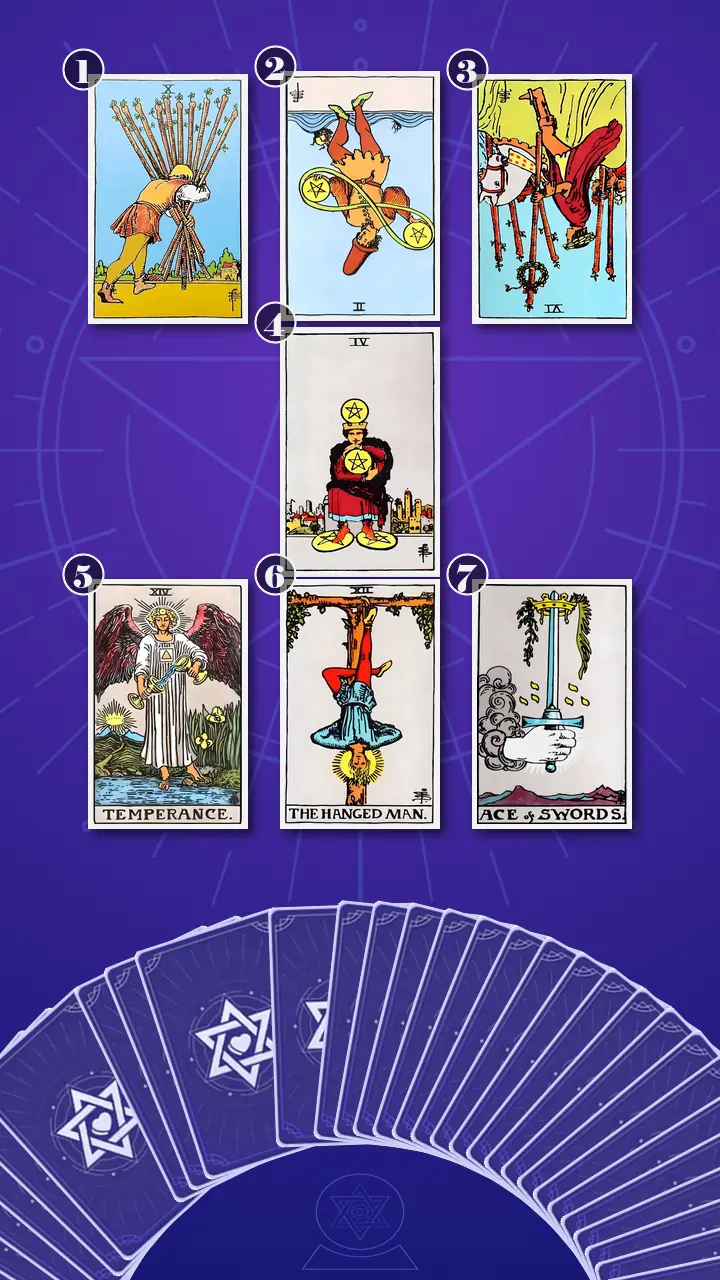
I placed the seven cards like a suitcase with a zipper line: the center card as the “zipper jam,” three cards above it (surface load → inner juggle → external pressure), and three below (resource → transformation → one-step action). I told Jordan, “Card 4 is our choke point. Card 6 is the pivot. Card 7 is the one move you can make this week.”
Reading the Map: What’s Actually in the Suitcase
Position 1: Surface overload—what’s most visibly overpacked
“Now flipped over,” I said, “is the card representing Surface overload: the most visible way life is ‘overpacked’ right now across work, love, and health.”
Ten of Wands, upright.
The image is unmistakable: a figure bent forward, arms full, vision blocked by the very things he’s carrying.
And the modern translation hit immediately: You’re walking home from work with your shoulders literally rounded forward, phone buzzing, mentally reciting everything you still need to do. You’ve got a slide deck due, a ‘quick check-in’ message you haven’t replied to, and a plan to squeeze a workout into a 20-minute gap like it’s a loophole.
“This card is overload as a lifestyle,” I told her. “Not because you’re weak—because you’re holding more than one person can hold sustainably. The energy here is excess: too many responsibilities, too much carrying, too little perspective.”
Jordan let out a sound that was half laugh, half flinch. “Okay,” she said, eyes narrowing like the card had offended her personally. “Rude. This is literally my week—and I hate how accurate that feels.”
I nodded. “That reaction is a good sign. It means we’re looking at the real thing, not a story about the thing.”
As a Jungian psychologist, I’m always listening for the moment a person stops defending and starts recognizing. The Ten of Wands isn’t just ‘busy.’ It’s the belief that carrying everything proves your worth.
Position 2: Inner tug-of-war—the juggling pattern that keeps everything in motion
“Now flipped over is the card representing Inner tug-of-war: the unstable prioritization pattern that keeps everything in motion but nothing resolved.”
Two of Pentacles, reversed.
In the original image, the ribbon looks like infinity—adaptability, flow. Reversed, that loop becomes a tangle.
I grounded it in the scenario the card demanded: You’re alt-tabbing between Slack, Google Calendar, and iMessage like it’s a sport—responding to a coworker, then the person you’re dating, then checking your step count, then back to work.
“The energy here is blockage,” I said. “Not because you can’t juggle—because the juggling never resolves into a hierarchy. Everything stays ‘in progress,’ so your nervous system stays in a wired-but-tired buzz.”
Her fingers tapped once on her thigh, like her body was still trying to keep tempo. “I keep thinking if I find the right routine—like the perfect Notion setup—I’ll finally be okay,” she admitted.
“If it needs perfect balance to work,” I said, “it won’t work.”
Position 3: External pressure—the crowd you’re performing for
“Now flipped over is the card representing External pressure: what in the environment adds weight to the suitcase.”
Six of Wands, reversed.
I softened my voice, because this card is tender in a very modern way. “This isn’t just workload. It’s visibility. It’s the feeling that you must look like you’re winning.”
I used the mirror the card offered: You open LinkedIn or Instagram after a long day ‘just for a minute,’ see someone’s milestone, and instantly feel behind… so you add something to your week—not because it matters to you, but because you don’t want to look like you’re falling off.
“The energy here is deficiency,” I said, “in real support. And excess in optics. It makes you overcommit so no one questions you.”
Jordan’s mouth twisted into a recognizing wince. “I literally do that on the TTC,” she said. “Line 1. Fluorescent buzzing. And I’m like… cool, I’ll just add a certification. Sure.”
“Exactly,” I replied. “Real support vs applause. Help vs a highlight reel.”
Position 4: Core blockage—the zipper jam
“Now flipped over,” I said, and I slowed down, “is the card representing Core blockage: the belief or attachment that keeps the zipper from closing.”
Four of Pentacles, upright.
This is the clench card: pentacle to the chest, crown on the head, two pinned under the feet. Control in heart, control in mindset, control in movement.
I translated it directly into her life: Your calendar feels like a vault: tight blocks, tight standards, tight expectations of yourself. You keep your work responsiveness high, your relationship responsiveness high, and your health rules strict—because loosening any of them feels like losing control.
“The energy here is grip,” I said. “It’s not strategy. It’s a coping habit.”
And then I brought in the echo technique, because this card is where people stop intellectualizing: “It’s like keeping your schedule locked like a phone screen—Face ID tight, notifications on, always reachable. You’re protecting the plan more than you’re protecting your energy.”
Jordan froze in a three-step chain I’ve seen a thousand times: her breath paused; her eyes unfocused like she was replaying a week in fast-forward; then her jaw loosened by a millimeter, the smallest surrender.
“If I let one thing drop,” she said quietly, “it’ll prove I’m not… capable. Or… I don’t know. Not lovable. Not disciplined.”
“That’s the zipper jam,” I said. “Forcing the zipper isn’t a plan. And your body has been telling you that.”
Here’s where my own work always comes in—not as medical diagnosis, but as energy literacy. “I’m going to name what I’m seeing,” I said, keeping it non-medical and grounded. “Your shoulders are up and forward, and your jaw is braced. In my Energy Flow Diagnosis, that pattern usually shows up when someone is carrying responsibility overload and trying to hold the whole world with their neck.”
She blinked. “That’s… literally how I feel. Like I’m holding everything here,” she said, touching the base of her neck.
“Right,” I told her. “So the question isn’t ‘how do I carry more?’ It’s ‘what are you holding that you can set down without losing who you are?’”
Position 5: Usable resource—the calm that doesn’t require a personality transplant
“Now flipped over is the card representing Usable resource: the stabilizing capacity you can access without needing to become a different person.”
Temperance, upright.
The angel pours between two cups—steady, patient, regulated. One foot in water, one on land: emotional reality plus practical reality, at the same time.
I let the modern life scenario do what it does best: Instead of a dramatic Monday reset, you build a tiny rhythm that helps all three areas at once: a short walk before you answer texts, a device-free dinner that actually lets your nervous system come down, or a 10-minute stretch that makes sleep easier.
“This is the opposite of a hard cut,” I said, and I felt her attention sharpen. “Temperance is a crossfade. Like mixing a playlist transition instead of slamming into a new track and calling it a ‘new era.’”
The energy here is balance—not perfect balance, but repeatable regulation. “It’s not willpower sprints,” I said. “It’s steady mixing.”
Jordan’s shoulders dropped on an exhale she didn’t know she was holding. “That sounds… doable,” she whispered, and the word sounded like permission.
I thought of Venice then—how water doesn’t force itself through a blocked canal. It reroutes, it circulates, it makes room. That’s the wisdom I trust most: flow, not force.
When The Hanged Man Turned the Suitcase Upside Down
Position 6: Key transformation—the pivot that makes “one step” possible
I paused before turning the next card. The room felt suddenly quieter, like even the city outside our window had lowered its volume. “We’re flipping the key transformation now,” I told Jordan. “This is the turning point.”
The Hanged Man, upright.
I said it plainly: “This card is voluntary pause. New perspective. Chosen trade-off.”
And I used the split-screen technique the moment demanded. “On the left,” I said, “you’re literally forcing a suitcase zipper with your knee. On the right, you’re forcing your life: late-night emails, fast replies to prove you care, skipping meals, skipping rest. And then—cut to you sitting on the floor, turning the suitcase upside down, and removing items one by one. Not because you failed. Because you finally chose the trip you’re actually taking.”
Setup. I could see her mind trying to sprint ahead—trying to solve the whole year in one sitting. The late-night version of her was right there: laptop still open, unread texts from someone she actually liked, watching “quick healthy meal” videos like a spell—because tomorrow-you is supposed to magically be a more disciplined person than tonight-you.
Delivery.
Not “push harder to close the zipper,” but “pause, turn the suitcase upside down, and repack from a new angle”—that’s The Hanged Man’s power.
I let the sentence hang in the air for a beat, the way a bell rings once and then you can hear your own breath again.
Reinforcement. Jordan’s reaction came in layers. First: a blink, slower than normal, like her brain had to buffer. Then her mouth opened slightly—no words yet, just the recognition landing. Her shoulders, which had been hovering by her ears all session, dropped in two increments: one small, one larger, like a heavy bag sliding off a hook. Her hands unclasped without her noticing. She looked down at the card and then away, eyes glossy but steady, as if she was realizing she’d been treating rest like a moral failure.
“But if I pause,” she said, and there was a flash of resistance—almost anger—“doesn’t that mean I’ve been doing it wrong? Like… I should have been able to handle it.”
“No,” I said, direct and kind. “It means your current packing logic doesn’t match your real capacity. That’s not a character flaw. That’s a model that needs updating.”
I drew on my other diagnostic lens—Modern Fatigue Analysis—because this is where people think they need more discipline when they actually need less stimulation. “Also,” I added, “your screen-induced exhaustion is part of this. When you’re switching contexts all day—Slack, calendar, texts, wellness content—your nervous system doesn’t ever get the message that it’s safe to stop. The Hanged Man is literally safety through chosen stillness.”
Then I offered the 10-minute Repack Test—a tiny experiment instead of a life overhaul. “Set a timer for 10 minutes,” I said. “Open Notes and write three lines: (1) ‘This week, the one thing I’m taking OUT is ___.’ (2) ‘The boundary sentence is ___.’ (3) ‘The proof I’m safe even if I choose less is ___.’ If your chest tightens, you downshift: fill in blank one and close the app. Done is enough.”
I watched her swallow. Her eyes softened, and I saw the new inner monologue forming: not “I should be able to handle this,” but “What if spaciousness is part of competence?”
“Now,” I said, “with this new angle—think back to last week. Was there a moment where this would have changed how you felt?”
Jordan stared at a spot just to the right of my shoulder. Breath paused. Eyes replaying. Then: release. “Friday,” she said. “4:47. My manager asked for ‘one quick thing.’ I said yes before I even checked. My heart rate jumped. If I had paused for five seconds… I could’ve asked what was actually priority.”
That was the shift: from frantic control toward steadier self-trust. From overwhelm to the first clean inch of calm, sustainable presence.
Position 7: One-step action—the clearest boundary that reduces load this week
“Now flipped over is the card representing One-step action: the single clearest boundary or decision that reduces load across work, love, and health this week.”
Ace of Swords, upright.
The sword is one line. One cut. One truth you can stand on without decorating it.
I anchored it in the modern scenario: You write one sentence and send it. Not a long explanation, not a perfectly crafted message—one clear boundary that matches your real capacity.
“The energy here is precision,” I said. “Not more planning. Not another system. Clarity.”
Jordan’s eyes lit with the kind of relief people get when they realize they’re allowed to be simple. “I could do one sentence,” she said. “I can’t do… a whole negotiation.”
“Perfect,” I replied. “One sentence beats one more system.”
I gave her a template, because the Ace of Swords is practical like that:
“Work: ‘I’m at capacity, so I can take X or Y this week—not both. Which is higher priority?’”
“Dating: ‘I’m slammed this week—can we do a low-key plan on Thursday, and I’ll be slower on texts?’”
“Health: ‘This week, my non-negotiable is sleep. Everything else is optional.’”
She nodded, then immediately frowned. “But I don’t even have time to write it,” she said, a real-world obstacle snapping into place. “Like, truly. I’m in back-to-back meetings. And then I’m commuting. And then I’m trying to be a person.”
That’s when I brought in a tool I’ve taught to travelers between ports and to corporate teams between meetings—my Quick Recovery Techniques. “Then we make it a three-minute action,” I said. “Not more force. Just a reset that creates enough space to choose.”
“Here’s the version you can do in an elevator or before you get off the TTC,” I continued. “Drop your shoulders on the exhale. Unclench your jaw. Feel both feet. One hand on the sternum, one on the belly. Inhale for four, exhale for six, three rounds. Then type the one-sentence boundary as a draft—don’t send yet if you’re not ready. That’s still repacking.”
She stared at me for a second, then laughed—lighter this time. “That’s… actually possible.”
The Repack Rule: Actionable Advice You Can Start This Week
I leaned back and stitched the whole spread into one coherent story, the way I’d chart a route across open water when weather changed mid-voyage.
“Here’s what the cards are saying,” I told her. “You’re carrying too much (Ten of Wands), and the load keeps shifting because you’re juggling without hierarchy (Two of Pentacles reversed). External pressure—LinkedIn, performance culture, the fear of looking like you’re slipping—adds hidden weight (Six of Wands reversed). The real jam is the Four of Pentacles: calendar clutching, tight standards, tight identity. But you have a resource that doesn’t require a reinvention: regulation and integration (Temperance). The key shift is The Hanged Man: pause on purpose, choose one trade-off, and treat spaciousness as proof of competence. Then the Ace of Swords turns it into reality: one boundary sentence, sent within 24 hours.”
Her cognitive blind spot became clear in one line: she’d been treating choosing less as evidence of failure, instead of as a skillful capacity decision. That’s the transformation direction: from forcing everything to fit to intentionally removing one non-essential load-bearing item and building a sustainable packing rule.
I offered her next steps—small, specific, and designed for a real Toronto week, not an imaginary “perfect routine.” And I wrapped them in my Venetian Aqua Wisdom: when water can’t circulate, it stagnates; when your energy can’t circulate, it aches. We don’t need you to become more water. We need you to unblock the canal.
- The 7-Day Anchor (Temperance)Pick one daily anchor for 7 days: 10 minutes of movement (walk around the block), or one no-phone meal, or one honest check-in text to someone you care about. Pair it to a stable cue: right after morning coffee or right after you close your laptop.Expect the resistance voice calling it “not enough.” Treat that as noise. If you miss a day, don’t restart—just return.
- The Pause Appointment + One Trade-Off (The Hanged Man)Schedule one 15-minute pause appointment this week. Sit somewhere neutral (kitchen table, park bench). Look at your calendar for 5 minutes without editing. Notice where your body tightens. Then choose one non-essential item to remove or downgrade (one meeting, one social plan, or one extra health rule).If canceling spikes guilt, do a “soft drop”: shorter, later, simpler—still counts. You’re testing capacity, not proving worth.
- The One-Sentence Boundary (Ace of Swords)Write and send one boundary sentence within 24 hours. Work: “I’m at capacity, so I can take X or Y—not both. Which is higher priority?” Dating: “I’m slammed this week—can we do low-key Thursday, and I’ll be slower on texts?” Health: “This week, my non-negotiable is sleep; everything else is optional.”Keep it one sentence—no essay, no defending. If you start drafting paragraph two, you’re back in forcing-the-zipper mode.
Before we wrapped, I added one more non-medical, body-based note—because her shoulders had been part of the story all along. “If you catch your shoulders creeping up tomorrow,” I said, “treat it like a notification. Not a failure. It’s your system telling you the canal is getting blocked again. Do the three-minute reset, then choose.”

A Week Later: The Quiet Proof
Six days later, Jordan messaged me a screenshot: a single Slack sentence she’d sent to her manager. I’m at capacity, so I can take X or Y this week—not both. Which is higher priority?
Under it she wrote: “They picked Y. Nothing exploded. I ate lunch at 12:30 like a regular human. Also I told the guy I’m seeing I’m slower on texts this week and he said ‘thanks for telling me.’ I feel… weirdly calm?”
It wasn’t a total transformation. It was the first proof. Clear, small, real.
She described sleeping through the night for the first time in weeks—then waking up with the familiar flicker of “What if I messed up?” and, instead of spiraling, placing a hand on her chest and exhaling like she remembered she had options.
That’s the Journey to Clarity I trust: not certainty, but ownership. Not a tighter routine, but a kinder packing logic.
And if you’re forcing the week to zip shut—jaw tight, shoulders up, replying fast, working late—the scariest part isn’t the workload; it’s the fear that choosing less will look like you’re losing control.
If you treated spaciousness as proof of competence (not a reward you earn), what’s the one small thing you’d let out of the suitcase first?
This story is adapted from psychological research, written so that those in a similar struggle can see their own pattern in it — and find their next step clearly.These insights are not a substitute for professional psychological, medical, legal, or financial advice.
Learn more about our Journey to Clarity.
How did this insight land for you?
🫂 This Resonates Deeply
🌀 Living This Story
✨ Now I See Clearly
🌱 Seeing New Possibilities
🧰 Useful Framework
🔮 The Confirmation I Needed
💪 Feeling Empowered
🚀 Ready for My Next Step
Author Profile
 AI
AI“Having traveled across cultures... I've learned that what we often lack isn't a simple answer, but a moment of being truly understood. I use a Jungian psychological lens to help you deconstruct your subconscious patterns—not to prove anything, but to be the gentle companion who helps you unravel your knots, free of judgment, so you can reconnect with your inner wisdom.”
In this Introspection Tarot Reading :
Core Expertise
- Shadow Integration Audit: Objectively mapping suppressed emotions (anger, shame, grief) that are covertly draining your psychological bandwidth.
- Inner-Critic Neutralization: Deconstructing the harsh, subconscious self-judgment loop that masquerades as 'self-discipline'.
Service Features
- The Active Imagination Protocol: A structured psychological journaling technique to safely dialogue with your 'Shadow', turning internal friction into deep self-compassion.
Also specializes in :
Explore Related Patterns:
Achievement FusionJordan's line about dropping one thing proving she is not capable, not lovable, or not disciplined is the psychological hinge of the whole story. You can hear how a practical limit has become fused with identity, so removing a task no longer feels like a capacity decision; it feels like evidence against the self. Achievement Fusion turns performance into a mirror for worth. When you treat carrying work, love, and health at full intensity as proof that you are okay, choosing less can feel morally loaded even when it is objectively reasonable. The repair begins when spaciousness becomes evidence of discernment rather than failure.
Boundary DiffusionJordan's quick yes to her manager, her pressure to answer dating texts, and her strict health rules all blur into one demand to stay available. You can see how the line between what others ask for and what she can actually carry becomes hard to locate in real time. Boundary Diffusion is not a lack of caring; it is caring without a clear edge. When every ping, plan, and expectation enters your system as equally important, your capacity stops being a boundary and becomes a shared public resource. The one-sentence limit matters because it restores the missing distinction between request and responsibility.
Boundary DiscernmentJordan's Slack sentence to her manager and her slower-texting message to the person she is dating show the first clean inch of psychological space. You can see the difference between defending a limit and simply naming it, then allowing the other person to respond inside reality. Boundary Discernment turns capacity into information instead of apology. When you say X or Y, not both, you stop treating every request as a test of worth and start letting priorities become visible. The relief afterward matters because it gives your system evidence that a boundary can reduce load without ending connection.
Defensive OverfunctioningJordan's automatic yes to the manager at 4:47, the late laptop, the unread texts, and the health content running in the background all point to one overloaded reflex. You can see her absorbing every demand first and asking about capacity later, as if being available is the only way to stay safe, competent, and cared for. Defensive Overfunctioning shows up when doing more becomes a shield against the discomfort of choosing. The exhaustion is not just busyness; it is a coping loop where you carry the work of prioritizing, reassuring, responding, and improving before anyone has even asked whether you have room.
Control CopingJordan's calendar-as-vault, late-night Slack glow, and strict rules around work, dating, and health show a nervous system trying to make control feel like safety. You can see the defense in how loosening any block, reply standard, or wellness rule starts to feel less like a practical adjustment and more like losing the whole plot. The pattern is Control Coping because the plan becomes protected more fiercely than your energy. When you make capacity limits mean danger, you keep tightening the schedule even when the schedule is the thing squeezing you, and clarity begins when control is audited rather than obeyed.
Compulsive Self-ImprovementJordan's quick healthy meal video, perfect Notion fantasy, and impulse to add a certification all share the same logic. You can see her trying to solve overload by becoming a more optimized version of herself, even though the real problem is not a lack of tools but a lack of space. Compulsive Self-Improvement turns growth into another demand. Instead of asking what can be removed, the pattern asks what system, rule, credential, or future self might finally make the impossible load manageable. The result is a cleaner-looking suitcase that is still overpacked.
Explore Related Struggles:
Boundary Control StrainAt 4:47 on Friday, Jordan says yes to her manager's quick request before checking what is already in her week. The same reflex shows up around dating replies and health rules, where responsiveness and discipline feel like things she has to prove in real time. You are watching a boundary form under pressure, not a simple refusal problem. Boundary Control Strain names the tension between needing a clean limit and fearing that the limit will make her look less reliable, less caring, or less in control. That is why the one-sentence boundary matters. It gives the strain a precise shape, turning a vague overload into a concrete choice that other people can respond to without requiring her to defend her entire worth.
Capacity-Identity FusionJordan keeps trying to zip work, dating, and health into the same week while saying that dropping one thing would prove she is not capable, not lovable, or not disciplined. The load is not just a list of tasks; it has become a live test of identity, where every unanswered text, missed workout, or refused request feels like evidence against her. You can feel the friction in the way she asks for one thing to take out but immediately fears what removal would say about her. Capacity-Identity Fusion names that bind, where the practical question of what fits gets fused with the deeper question of whether you are enough. The shift begins when she can treat choosing less as a capacity decision, not an identity verdict. Her Slack boundary, lunch, and slower dating text become small proofs that reducing the load does not reduce her value.
Performance-Worth FusionJordan scrolls LinkedIn or Instagram after a long day, sees someone else's milestone, and adds a certification to her week so she will not look like she is falling off. The outside signal does not stay outside; it becomes another demand inside the suitcase. You are seeing performance become a value meter. Performance-Worth Fusion names the bind where looking capable, responsive, healthy, and romantically available starts to feel inseparable from being worthy of respect or care. The relief comes when applause and support are no longer treated as the same thing. Choosing one clear boundary lets her stop using public competence as proof that she deserves space, lunch, sleep, or a slower reply pace.
Control LockJordan's calendar feels like a vault, with tight blocks, tight standards, and tight expectations of herself. She keeps work responsiveness high, relationship responsiveness high, and health rules strict because loosening any one of them feels like losing control. You see the lock in her body before she fully names it: jaw braced, shoulders lifted, breath pausing as if the plan has to be held together physically. Control Lock captures the moment when structure stops serving energy and starts guarding against the fear of collapse. The practical opening is not a bigger system. It is the tiny act of letting the plan become adjustable again, as when she asks her manager to choose X or Y instead of silently absorbing both.
Rest-Permission SplitJordan looks at the idea of pausing and immediately asks whether it means she has been doing everything wrong. Rest is not absent from the story because she dislikes it; it has been placed behind a gate where she has to earn it by first being disciplined enough, responsive enough, and caught up enough. You can feel the split when sleep, lunch, and stillness become optional while late-night work, fast replies, and health rules stay mandatory. Rest-Permission Split names the moment when recovery is treated as a reward for perfect performance instead of a condition for staying present. The Hanged Man pivot gives her a different permission structure. Pausing on purpose becomes a competent capacity choice, which is why one calmer lunch, one slower text, and one night of sleep become evidence that space can be built before everything is finished.
Mental Bandwidth DepletionSlack pings, a half-finished slide deck, dating texts, step counts, and wellness videos all stay lit in Jordan's late-night field of attention. Nothing is fully finished, nothing is fully off, and every channel keeps asking for a small slice of her next response. You can read the depletion in the loop itself. Mental Bandwidth Depletion is not just being busy; it is the way constant context switching turns work, love, and health into simultaneous background processes that never release the mind. The useful move is small because the bandwidth is already taxed. A ten-minute repack test or a drafted boundary sentence works precisely because it reduces the number of active loops instead of asking her to manage them with even more tracking.
Explore Related Emotions:
Boundary GuiltAt 4:47 on Friday, Jordan says yes to her manager’s quick thing before she even checks what is possible. The same pattern shows up in dating, where fast replies start carrying the weight of proving she cares. Boundary Guilt fits because the boundary is technically simple but emotionally expensive. You can name the sentence, yet saying it risks disappointing someone, slowing the performance, or letting another person see your real capacity. The guilt is the residue of treating availability as proof of worth.
Cautious Self-TrustSix days later, Jordan sends the screenshot: the manager chose Y, nothing exploded, lunch happened, and the person she is seeing responded with thanks instead of punishment. The proof is small, but it is real. Cautious Self-Trust fits because the old worry still flickers when she wakes up, yet it no longer takes over the whole room. You have evidence that choosing less can still preserve connection and competence. Trust here is not loud certainty; it is the quiet ability to exhale and remember you have options.
Clarity ReliefThe Slack sentence is simple: at capacity, X or Y, not both. When the week narrows from a full-life overhaul into one clear line, Jordan’s body responds before the outcome is even known. Clarity Relief fits because the relief does not come from solving every domain at once. It comes from making the load readable enough to act on. You stop forcing the zipper and finally see the one place where a clean choice can create room.
Grounded AgencyJordan does not fix the whole suitcase; she sends one sentence that matches her real capacity. The manager chooses, the dating conversation stays intact, and the week becomes slightly more navigable. Grounded Agency fits because the power in the story is practical, relational, and testable. You are not waiting to become a perfectly disciplined person before acting. You are using one clear boundary to prove that a smaller choice can still change the shape of the week.
Not-Enough PanicWhen Jordan says that dropping one thing might prove she is not capable, not lovable, or not disciplined, the workload stops being only a workload. One removed task becomes a verdict on whether she is enough. Not-Enough Panic fits the moment where work, love, and health collapse into a single identity test. You are not just deciding whether to answer a message, take on a request, or follow a health rule; you are bracing against the fear that any dropped item will expose a personal deficit. That is why the body locks before the mind can calmly choose.
Scattered OverwhelmThe 11:47 p.m. laptop glow, Slack pings, unread dating texts, and quick healthy meal video all occupy the same mental screen before Jordan has even recovered from the day. You can see the pressure in the way every domain keeps asking for a response at the same time. Scattered Overwhelm fits because the strain is not contained in one task. It spreads across work, love, and health until attention has nowhere steady to land. The suitcase will not zip because the load is fragmented and simultaneous, so the first clean move is not doing more; it is naming one item that can come out on purpose.
Control FatigueJordan’s calendar is described like a vault: tight blocks, tight standards, tight expectations of herself. Her jaw is set, her shoulders are lifted, and the suitcase image keeps returning because the week is being held closed by force. Control Fatigue names the cost of protecting the plan more fiercely than protecting your actual energy. You keep responsiveness high at work, in dating, and around health because loosening any one piece feels like the whole structure might come apart. The tiredness comes from the grip itself, not from a lack of capability.
Optimization FatigueThe quick healthy meal video, the imagined perfect Notion setup, the step count, and the strict health rules all promise a cleaner version of tomorrow. Instead of creating relief, they add another layer of monitoring to an already crowded night. Optimization Fatigue fits because the tools meant to help have become extra luggage. You are not refusing growth; you are worn down by turning every need into a system, every tired moment into a discipline problem, and every attempt at care into another standard to maintain.
Rest GuiltThe voluntary pause meets immediate resistance when Jordan asks whether stopping means she has been doing it wrong. Her reaction shows how rest has become tangled with moral accounting, as if a pause is only allowed after flawless carrying. Rest Guilt names the inner squeeze that appears when choosing less feels less like care and more like confession. You are trying to make space, but the old rule says space has to be earned. In this story, the repair begins when rest becomes part of competence instead of evidence against it.
Guilt-Free RestJordan names sleep as the non-negotiable, eats lunch at 12:30, and sleeps through the night for the first time in weeks. These are not dramatic wins; they are signs that the body is finally being included in the plan. Guilt-Free Rest fits because spaciousness is reframed as competence, not a reward waiting at the end of perfect performance. You are allowed to protect recovery before every message is answered, every task is accepted, and every health rule is obeyed. The rest becomes part of the structure that lets you keep choosing clearly.
Explore Related Contexts:
Always On AvailabilityJordan is still inside Slack at 11:47 p.m., with a half-finished slide deck open, dating texts unread, and wellness content queued up as if the day has not been allowed to close. The pressure is not coming from one dramatic emergency; it comes from every channel staying active at the same time, each one carrying a small claim on her attention. That is why Always On Availability fits the story so tightly. Work, love, and health are not separate rooms for Jordan right now. They are stacked into the same glowing interface, where Slack pings, iMessage, calendar blocks, step counts, and self-improvement videos all compete for immediate response. For you, this context names the external setup that makes the suitcase feel impossible to zip: the world keeps treating your attention as open inventory. The first point of agency is not becoming more disciplined; it is seeing which systems have been allowed to reach you at all hours and choosing one boundary that makes availability finite again.
Overcommitment SpiralJordan describes the suitcase that will not zip because work, dating, and health have all become items she is trying to keep packed at full size. The slide deck, the quick work request, the unread texts, the workout expectation, and the healthy meal video are not random details; they show a week that keeps expanding without a matching increase in space or support. Overcommitment Spiral captures the external pattern where every new pressure produces another promise, another rule, or another task. Seeing someone else's milestone leads to adding a certification. A manager's small request gets accepted before priority is checked. Dating responsiveness and health discipline become additional proof points instead of flexible parts of a real week. For you, the key is that the overload is self-reinforcing once every domain becomes a test of capability. The one-step question becomes sharper: which commitment is not essential to the trip you are actually taking this week, and what can be removed before the zipper splits?
Strategic Pause WindowJordan's turning point comes when the answer stops being 'push harder to close the zipper' and becomes a 10-minute Repack Test. The story narrows the whole overload field into three lines: one thing to take out, one boundary sentence, and one piece of proof that choosing less does not make her unsafe. Strategic Pause Window names the practical opening created by that pause. It is not passive avoidance or a vague break; it is a bounded interval where the external system can be re-sorted before another automatic yes locks in. For you, this is the cleanest one-step context in the reading. A pause becomes strategic when it changes the next action: checking priority before accepting work, drafting one sentence before overexplaining, or removing one non-essential item before the week becomes unmanageable again.
Upward Management TrialJordan's screenshot a week later shows one sentence sent to her manager: 'I'm at capacity, so I can take X or Y this week, not both. Which is higher priority?' The response is concrete: they pick Y, nothing explodes, and her workday becomes more legible. Upward Management Trial fits because the story does not present Jordan as rejecting responsibility. She is testing a more adult work exchange, where capacity is named and authority is asked to prioritise instead of quietly letting every request become equal. For you, this context turns the work portion of the suitcase into a negotiable structure. The step is small, but it changes the power flow: you stop absorbing ambiguity alone and make the person assigning work participate in the trade-off.
Wellness Optimization TrapJordan opens a 'quick healthy meal' video late at night while work is unfinished and texts are waiting. The health cue should be supportive, but in this scene it becomes another standard for tomorrow's self to meet: more disciplined, more responsive, more on top of everything. Wellness Optimization Trap fits because health has become another performance track rather than a recovery channel. The step count, squeezed workout, strict sleep rule, and content-driven meal planning all sit beside Slack and dating texts as demands competing for limited capacity. For you, this context reframes the health part of the suitcase. The issue is not whether movement, sleep, or food matter; it is whether wellness has been packaged as one more proof of control. A smaller anchor can restore agency because it supports the body without turning care into another audit.
Work Life Boundary CreepJordan's Toronto condo is quiet, but the scene is not actually private: Slack pings cut through the room, the laptop is still glowing, and a manager's 'one quick thing' has already trained her to say yes before checking capacity. Home is physically separate from work, yet the workday keeps entering through notifications, unfinished decks, and priority-less requests. Work Life Boundary Creep is the right label because the pressure arrives in small, plausible increments. Nothing in the story requires a single villain or a single blowup. The boundary erodes through late messages, fast replies, extra asks, and the expectation that Jordan will absorb the friction herself. For you, this context points to the part of the suitcase packed by other people's timing. The useful move is not a dramatic exit from responsibility; it is one clean sentence that makes priority visible before another task quietly becomes yours.
LinkedIn Performance LoopJordan opens LinkedIn or Instagram after a long day, sees someone else's milestone, and suddenly another certification starts to look necessary. The story is precise here: the added item does not come from a grounded goal; it comes from the public scoreboard effect of watching other people appear further ahead. LinkedIn Performance Loop names the external comparison machine that adds hidden weight to her suitcase. The feed turns achievement into ambient pressure, and ambient pressure becomes another obligation inserted into a week that was already full. For you, this context matters because not every item in the suitcase came from your actual priorities. Some of it may be platform-shaped pressure wearing the costume of ambition, and the next step is to separate useful growth from optics that only keep you performing capacity you do not have.