Purity Shame and Spiritual Bypassing: Naming the Rule, Choosing Now

The Notes App at 10:42: Facing Purity Shame Without Spiritual Bypassing
When Alex, a 28-year-old junior communications coordinator in Toronto, sat across from me, I heard the recognition trigger in the way she described it: after a difficult date, she got home, opened Apple Notes, and drafted what the shame was teaching her before she wrote what had actually hurt.
At 10:42 p.m. on a Tuesday, she had been sitting in her apartment with the blue light from her phone spread across an untouched mug of tea. The fridge hummed beside her, the phone felt warm in her palm, and the cursor hovered over the sentence she wanted to write. She had typed, I am angry, then changed it to, I am being invited to grow.
Her question was direct: how could she face purity shame without calling it a lesson? She wanted to acknowledge the pain purity culture had left behind, but she feared that leaving the pain without a useful meaning would prove she was failing to heal. The old rule no longer had her intellectual agreement, yet her body still seemed to wait for its verdict whenever desire, intimacy, or bodily autonomy came into view.
She called the feeling shame. I saw it as something more physical: a hot filter sliding over an ordinary desire, flagging it before consent, safety, or genuine preference had a chance to speak. Her throat tightened when she talked about anger, her cheeks warmed, and one hand pressed lightly against her chest as though she were holding a door shut from the inside.
I told her I would not ask her to make the wound meaningful before we acknowledged it. The struggle was not a permanent fate, and it did not need to become another personal growth assignment. I invited her to sit with me in the ruins of the old rulebook while we dusted off what was still hers. Our Journey to Clarity would begin with a simple distinction: what had been taught, what was being felt, and what she wanted to choose now.
The Old Rulebook and a Four-Card Shadow Map
I asked Alex to place both feet on the floor, take one slow breath, and hold the question without trying to improve its wording. I shuffled at an unhurried pace. For me, this small ritual is a psychological threshold: it gives the mind a clear container and lets the question become something we can examine from a little distance.
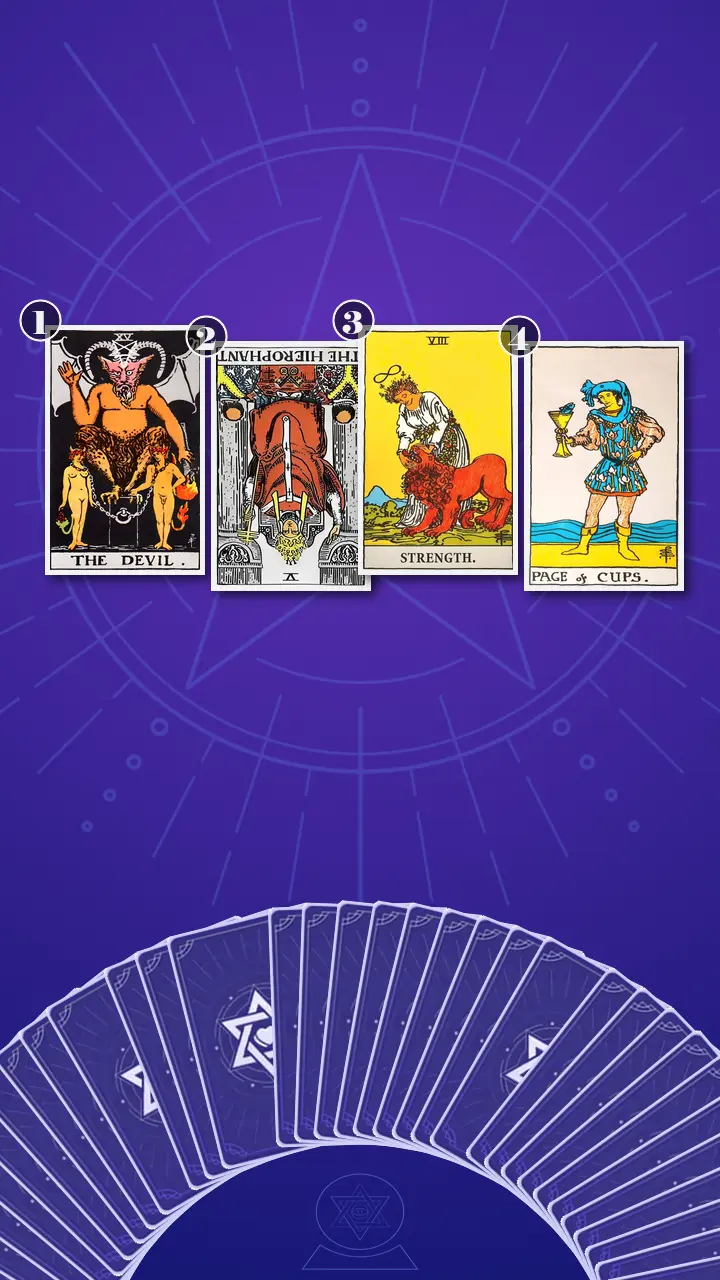
I chose The Shadow Spread, a four-card tarot spread for focused inner exploration. For anyone wondering how tarot works in this setting, I use the cards as an external cognitive map rather than a prediction or a verdict. The images give us a sequence we can look at together, so a private reaction can meet both intuition and observable life patterns.
The first position would show the visible shadow: what purity shame looked like in the first minutes after it was activated. The second would reveal the hidden root, including the inherited authority and lesson-making defense beneath it. The third would be the integration point, the quality capable of meeting the feeling without suppressing it or turning it into a performance. The fourth would translate that quality into a grounded next step involving consent, present-day values, desire, or a boundary.
The horizontal line mattered. I placed the cards from left to right, leaving a consistent space between them. I wanted the eye to travel from an old chain, through crossed keys, toward open hands and finally an open cup: a path from the visible bind to a practice of present-day self-trust.
Where the Old Scorecard Still Speaks
The Devil and the Loose Chain
I turned the first card and explained its role before naming it. This was the visible shadow: the specific shame response and the observable meaning-making behavior that appeared in the first few minutes after a trigger. The card was The Devil, upright.
In the card, the chained figures are beneath a powerful image of attachment and judgment, but the chains around their necks are loose. That detail became important. After a date, Alex could lie awake with a warm phone in her hand, checking whether wanting more intimacy made her less good. She might open Notes to compose a spiritual explanation, yet the old purity scorecard had already shaped the question before consent, safety, and genuine desire were allowed into the room.
The energy here was excess and blockage. The excess was not desire; it was moral self-monitoring. Every bodily choice was being run through an internal grading system, as if a private feeling needed to receive a passing mark before it could be trusted. The blockage was agency: not because Alex had none, but because the inherited verdict arrived so quickly that her own present-day response was forced to wait.
I was careful to say that The Devil did not describe Alex's identity or predict her future. It showed a bond that had been internalized, and the loose chain showed influence without inevitability. A pattern can be visible without being permanent. The first useful act was simply noticing the chain before mistaking it for proof.
Alex gave a short, bitter laugh. “That is too accurate. I know the right spiritual answer, but I still feel dirty.” I let the sentence remain blunt. A lesson is not the admission price for your pain.
Her smile disappeared. Her thumb stopped moving over the phone, and she looked from the card to the floor as though a familiar memory had surfaced without asking permission. Then she rubbed the rim of her mug once and nodded, not with relief, but with the wary recognition of someone seeing the loop in real time.
The Hierophant and the Crossed Keys
I turned the second card and named its role first. This was the hidden root: the inherited purity rule, spiritual authority, and defensive lesson-making process that maintained the cycle and kept the fear of failing to heal alive. The card was The Hierophant, reversed.
I brought in the familiar scene of the TTC ride to work. I asked Alex to imagine rereading a dating message about taking intimacy slowly while the streetcar doors hissed and wet coats brushed past her. Instead of asking what felt mutual and safe, she might search for the correct spiritual interpretation of the shame wave. The reversed Hierophant exposed the inner teacher still holding the keys to the words good, desirable, and safe.
I described the loop as I heard it in her story: I feel this. I need to explain it. I need to sound grateful. I still have not said what hurt. The old authority had lost its formal power, but its language continued to assign meaning inside her private decisions. Instant spiritual meaning-making brought a brief sense of order and moral reassurance, then left the grief, anger, and boundary need untouched. The relief faded, so she searched for a better lesson, and the search itself began to look like evidence that she was not healing correctly.
The reversed position showed a blocked relationship with authority and an overused need for explanation. I did not suggest that Alex reject every spiritual practice or framework. I offered a narrower, more useful question: whose definition of goodness was still grading her emotion, and did she choose that definition today?
Her hand moved toward the phone, then stopped. She took a longer breath than before and left the screen dark. “I can question the teacher without needing to reject every value,” she said slowly. “I can choose which rules still belong to me.” I watched the automatic loop develop its first interruption: not a dramatic rejection, just a pause long enough for the old rule to become visible.
When Strength Put a Hand on the Lion
The Gentle Bridge Between Feeling and Verdict
When I reached the third position, the room seemed to quiet around us. Rain had been ticking against my window, but it softened just as I placed the card down, leaving the white border and calm figure on the table with unusual clarity.
I explained the role before the title: this was the integration point, the inner quality that could let Alex face shame, grief, and anger without punishing them, obeying them, or converting them into a spiritual lesson. The card was Strength, upright.
Strength's open hands resting gently on the lion's muzzle gave me the exact contrast I wanted. The task was not to overpower the body's alarm, and it was not to perform gratitude until the alarm disappeared. It was to stay close enough to the feeling to separate an emotion from the inherited verdict attached to it. When Alex's cheeks burned and her stomach knotted after an intimate conversation, she could name, This hurts, without allowing the pain to decide her worth or dictate her choice.
I use a signature diagnostic lens called Cognitive Stratigraphy. When a sudden emotional trigger feels disproportionate, I treat the first surge as a surface artifact and examine the layers beneath it. For Alex, the hot cheeks and tight throat were the visible layer; beneath them sat the old purity rule connecting desire with moral worth; below that was the fear that unresolved shame meant she lacked worth or had failed at healing. I do not excavate to prove a predetermined origin. I examine the layers so the present can stop carrying material that belongs to an earlier epoch.
I have spent years at Cambridge and on archaeological digs, and I know that a broken wall is not the same thing as a failed civilization. Sometimes a fracture reveals which structure was carrying too much weight. My Ruins Restoration Thinking asks a similarly practical question: what can be repaired, what should be removed, and what enduring value can be rebuilt by the person who actually lives there?
At 10:42 p.m., I could see the scene she had brought into the room: a warm phone in one hand and a half-edited Notes entry in the other. The anger had already been rewritten as gratitude, but her throat remained tight because the old rule still wanted a verdict, and part of her believed a clean answer would prove that healing was happening.
You do not have to turn purity shame into a lesson before you are allowed to call it painful. Naming the old rule and feeling its impact is already an honest step toward choosing from present-day values.
Stop using a polished spiritual takeaway to prove that healing is happening; meet the shame with Strength's gentle hand, name the old rule, and let self-trust grow through feeling before meaning.
First, Alex's breathing stopped; her fingers stayed curled around the phone, and her eyes fixed on the Strength card. Then her gaze went slightly unfocused, as though she were replaying the last dating conversation and every old phrase that had made desire sound like evidence. Her jaw trembled once. Finally, she let out a low, uneven breath. Her shoulders lowered, her hand opened, and the heat in her cheeks gave way to a thin shine of tears. She looked relieved, but not finished. Beneath the relief was anger, and beneath the anger was a small, dizzying space where no lesson was waiting. “So I can feel this without agreeing with it?” she asked. “Yes,” I said. “The feeling can be real without becoming your identity, your timeline, or your next assignment.”
I asked, “Now, use this new perspective to think back: was there a moment last week when this insight might have allowed you to feel differently?”
She remembered a conversation on the TTC after someone asked what she wanted from intimacy. She had mentally run her possible answers through the old scorecard, searching for the response that sounded neither too eager nor too guarded, neither too permissive nor too morally uncertain. With the Strength card between us, she could imagine answering a different question: Do I feel safe, consenting, and genuinely willing right now?
This was the key shift: from instant spiritual meaning-making and purity-scorecard self-monitoring toward compassionate emotional honesty, present-day values, consent, and self-trust. The shame had not vanished. The relationship to it had changed. She could feel the heat, name the rule, and still remain the person making the decision.
The Page of Cups and the Unedited Message
I turned the fourth card and named its role before interpreting it. This was the grounded next step: the ordinary practice that could translate honest emotional contact into self-trust, a chosen value, a desire, or a clear boundary. The card was The Page of Cups, upright.
The fish rising from the cup looked like an unexpected message arriving before its explanation. I told Alex that a feeling could be received like an unread message: opened first, categorized later. Anger, grief, desire, uncertainty, or the wish to slow down did not need an immediate moral label. The Page's surprised, receptive gaze gave her permission to be a beginner with her own emotional life.
In daily life, this could look like writing three separate lines after a late-night trigger: I feel angry and sad.The old rule says desire makes me less worthy.I want more time before I decide. The separation mattered. If the lines were merged into one polished paragraph, the internal editor could quietly turn the anger into gratitude again.
The energy of the Page was balanced water returning to a reading that had begun with dense attachment and overactive explanation. The card did not demand certainty or a particular intimate choice. It suggested curiosity. A feeling can be information without becoming a verdict.
Alex looked at the card for a long moment, then opened a blank note. Her fingers hesitated above the keyboard, but this time she did not begin with a lesson. She typed, “I feel angry that I was taught to treat desire like a character test.” She read it once and left it alone.
From the Old Rulebook to Present-Day Self-Trust
When I read the four cards as one story, the sequence became clear. The Devil showed the visible bind: a purity-related trigger turned desire into a moral scorecard. The reversed Hierophant showed the older authority beneath it: even after Alex questioned the doctrine, its crossed keys still appeared to control access to goodness and acceptable emotion. Strength offered a different kind of power, one that could stay near shame without obeying it or making it useful. The Page of Cups carried that change into ordinary life through one unedited feeling and one present-day choice.
The cognitive blind spot was not a lack of insight. Alex had plenty of insight, and she could write a polished communications brief about harmful messaging at work. The blind spot was treating polished language as proof that healing was happening. Meaning-making gave her control, but it also let the original sentence go unanswered: That rule hurt me. The change was not from confusion to a perfect answer. It was from asking what shame was teaching before feeling it to naming the inherited message, allowing grief and anger to remain unfinished, and choosing from consent, present values, and self-trust.
I told her that healing stagnation did not necessarily mean she needed a better framework, a cleaner journal entry, or more hours of spiritual content. It might mean that interpretation had been standing between her and direct contact. Some pages need to be named as harmful before anyone asks what they taught. That was the practical historical perspective: a former authority can be acknowledged without being allowed to govern the rebuilt structure.
For the next week, I offered my Trigger Excavation Exercise. It is a logical way to trace a current, disproportionate reaction back to its original epoch, separate past instructions from present circumstances, and return the final choice to the person living now. I made the exercise deliberately small. It was not a demand for disclosure, confrontation, forgiveness, or closure.
These were the actionable next steps I wrote down with her:
- Name the inherited layerAfter one purity-related trigger this week, open a private Notes entry and write one plain sentence beginning, “The old rule I heard was...” Underline the words that define goodness, such as clean, worthy, controlled, or good, then wait at least five minutes before searching for a spiritual interpretation.Use only the minimum version if resistance appears: one sentence is enough. You may use initials, keep the note general, or stop immediately if the memory feels too activating.
- Run the Trigger Excavation ExerciseOnce this week, set a 10-minute timer, keep both feet on the floor, and write three separate lines: “What I feel in my body is...” “The old rule says...” and “What I want or need today is...” Add one body cue and one emotion without explaining either one.Do not edit anger into gratitude or force a takeaway. When the timer ends, make tea, take the TTC home, or text a trusted friend about an ordinary subject; the exercise has permission to end unfinished.
- Make a Consent-First Self-Trust CheckIn one dating, intimacy, or body-choice moment, use the final line to record a present-day desire, boundary, request for more information, or simply “I do not know yet.” Read the three lines once without scoring the choice as healthy, unhealthy, spiritual, behind, or good.Consent and safety are present-day checks, not new purity tests. The result can be a yes, a no, a slower pace, or no action at all; the point is to let current values speak before the old scorecard does.
I reminded her that these practices were invitations, not tests. The person who chose whether to continue dating, pause intimacy, set a boundary, seek support, or do nothing for the moment was Alex. The cards organized the conversation, but they did not own the decision.

The Quiet Proof That Healing Need Not Look Clean
Five days later, I received a text from Alex: “I used the three lines after a Hinge conversation. I wrote, ‘I want to slow down,’ and sent it.” She had slept through the night, but woke with the old question, What if I am wrong? This time, she smiled, left it unanswered, and made tea.
I kept that small report in mind because it held the whole Journey to Clarity. The fear had not been erased, and the old rule had not been magically destroyed. Alex had simply recognized its voice, checked the present-day facts of consent and safety, and made a choice that belonged to her. That is how the cards served as a cognitive tool: they made a pattern visible, then returned authorship to the person who could act on what she saw.
When desire or anger makes your throat close and your cheeks burn, it can feel safer to turn the moment into wisdom than to admit that an old rule still has you asking whether you are worthy. If you let the feeling stay unfinished for one minute, what present-day value, desire, or boundary might you notice inside that old permission system without having to defend it?