Career Drift Disguised as Personal Growth: A Bounded Test

When Sunday Night Calls a Career Mismatch a Lesson
I recognize the Career Mismatch Cycle before I ever call it that: a reliable operations coordinator in Toronto spending Sunday evening turning next week's dread into a journal prompt about personal growth. Alex had brought that exact contradiction to my session. They could explain the value of their work in polished, transferable-skills language, but they could not explain why they were still choosing the same kind of work five years later.
At 9:40 p.m. on Sunday, Alex had sat in their Toronto apartment with a job listing open beside a journal page titled "What is this role trying to teach me?" They described the laptop fan humming against the radiator's occasional click, while the phone cast a pale rectangle across the table. After forty minutes of rewriting the lesson, they bookmarked the listing, closed the lid, and felt their shoulders drop toward the desk as their stomach sank.
"I can explain why this job matters more easily than I can explain why I am still here," Alex told me. They had moved through adjacent roles at a software company, changing titles and teams while keeping the same status updates, process maintenance, and urgent requests. Toronto rent made an abrupt exit a real financial risk, so they wanted evidence before making a larger career change. They also feared that admitting the mismatch needed a concrete response would prove they had lost control of their direction.
Their restless emptiness seemed to sit beneath the ribs like a TTC train stopped between stations: the announcements kept promising movement, but every tunnel light showed the same platform. I told Alex that I would not turn their work into a warning, a destiny, or a reason to quit on the spot. I wanted to help them see what the pattern had already taught them, then find one small way to let that knowledge move. Our Journey to Clarity would begin with a map, not a verdict.

Choosing the Shadow Spread at the Career Crossroads
I asked Alex to place both feet on the floor, take three ordinary breaths, and hold the question in its plainest form: "What am I avoiding by calling this career mismatch a lesson?" I shuffled slowly. The pause was a psychological transition, a way to move from the fast loop of tabs and explanations into one focused conversation.
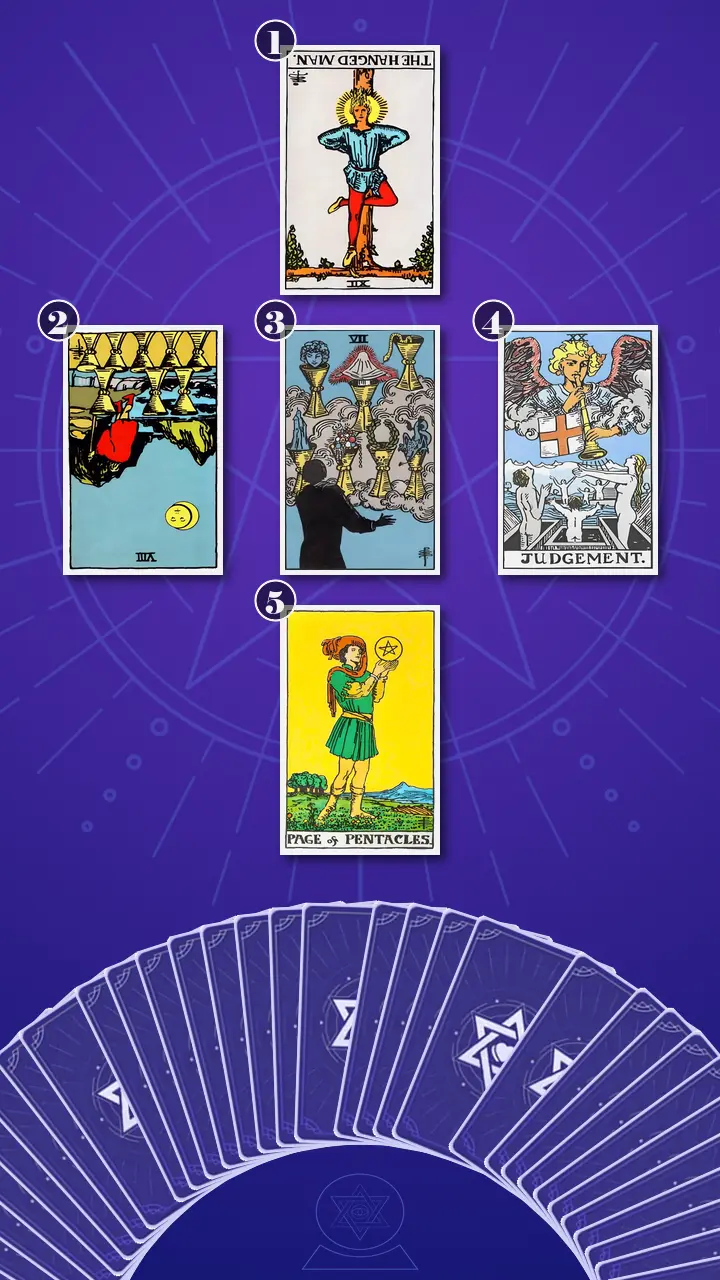
For this reading, I used a five-position Shadow Spread. The consultation question asks what is being avoided, and this spread is designed to uncover the story that makes the pattern acceptable, the feeling beneath that story, the defense that keeps the feeling at a distance, the truth that wants an honest response, and the practical step that can bring insight into ordinary life. A ten-position spread would have added context without improving this particular investigation.
This is one way I explain how tarot works through a Jungian psychological lens. The cards do not make an objective decision for Alex or predict an inevitable future. They give us external images with enough structure to examine the subconscious pattern without treating it as a personal flaw. Card meanings in context become a cognitive tool: I observe the symbols, Alex supplies the lived evidence, and together we test which interpretation actually fits.
I placed the first position above, the second to the left, the third in the center, the fourth to the right, and the fifth below. I told Alex that the top card would show the conscious story making the mismatch look purposeful; the left card would approach the feeling and practical cost being avoided; the center would expose the protective possibility cloud; the right card would name the unacknowledged need for a candid reckoning; and the bottom card would turn that reckoning into a grounded career experiment.
The Halo Around the Holding Pattern
Position 1: The Story That Keeps Suspension Meaningful
The first position represented the conscious story that framed the recurring career mismatch as a lesson and made continued suspension appear purposeful. I turned over The Hanged Man, in reversed position.
In the Rider-Waite-Smith image, the figure hangs by one foot beneath a calm halo. The picture looks contemplative, even sacred, but the body is not moving forward. In Alex's life, the card looked like another draining workday becoming an elegant reflection about patience, surrender, or growth. The halo was the brief relief of having a meaningful explanation. The bound foot was the exploratory email left in drafts.
The reversed energy was a blockage, with an excess of interpretation and a deficiency of response. Alex could write a page called "What This Role Is Teaching Me" and feel temporarily less trapped, but Monday still brought the same dashboard, the same urgent requests, and the same heavy shoulders. I asked the question the card was pressing: what observable behavior has the supposed lesson changed? A lesson that changes nothing in your next week may be a holding pattern with better vocabulary.
I used the scene Alex had described directly: the thoughtful journal page, the untouched job listing, and the closed laptop becoming a visual image of suspension. I could hear the inner operating system underneath it: "If I can explain why this is happening, I can postpone responding to it." The contrast was not between insight and ignorance. It was insight on the page versus movement in the week.
Alex gave a short, bitter laugh. "That is too accurate," they said. "Almost rude." Their fingers stopped rubbing the corner of the journal, then returned to it with smaller movements.
I did not ask them to nod their way into agreement. I asked, "What is one message, conversation, or experiment that your explanation has repeatedly postponed?" The point was to let recognition become specific without turning it into shame. Alex glanced at the draft email on their phone, and the polished story began to lose some of its authority.
Position 2: The Cups They Keep Returning To
The second position represented the feeling and practical implication Alex avoided when acknowledging that the role might be emotionally insufficient and might eventually need to be left or changed. I turned over the Eight of Cups, in reversed position.
The cloaked figure in the card is meant to walk away from a familiar arrangement of cups and toward a steep, uncertain path. Reversed, the departure is interrupted. I connected it to Alex reopening the same job board on the TTC Line 1 ride home. They would read three descriptions, notice that none could guarantee a better fit, and return to the familiar role while calling the return "waiting for clarity."
The reversed energy showed emotional backtracking and a blockage around leaving. The grief was real: grief for time spent, for energy that had gone into roles Alex had tried to make meaningful, and for the possibility that competence could not turn the work into a fit. The financial apprehension was real too. When Toronto rent appeared in the conversation, I did not treat it as an excuse to mock or overcome. I treated it as a constraint that deserved an evidence-based plan.
Alex looked down at the card and said quietly, "I am not waiting for clarity; I am waiting for a departure that carries no grief." Their jaw tightened. Then their hand flattened over the table, as if they needed to feel the surface before allowing the sentence to stay in the room.
I told them the Eight of Cups reversed was not instructing them to resign tomorrow. It was making the emotional cost of never testing departure visible. Freedom and financial safety did not have to be enemies, but they had been fused together in Alex's mind: if leaving could not be completely safe, no low-risk information-gathering step seemed legitimate. I asked what it would look like to gather direct information without asking that information to deliver a guarantee.
Position 3: Seven Tabs and Seven Possible Selves
The third position represented the Spiritual Bypassing mechanism that maintained Existential Drift by multiplying meanings, possible identities, and imagined paths instead of testing one. I turned over the Seven of Cups, in upright position.
The silhouetted figure in the card faces seven cups floating in gray clouds. Each cup offers a compelling image, but none can reveal an ordinary Tuesday. In Alex's modern translation, the cups were browser tabs and carefully labelled Notion folders for strategy, design, coaching, research, and product work. The career-change algorithm kept serving a new identity because Alex kept clicking, saving, and comparing instead of trying one task.
The upright energy was an excess of possibility and projection, paired with a deficiency of discrimination. Inspiration was abundant. Evidence was scarce. Alex could describe the symbolic appeal of five different careers, but not yet say what they wanted to spend two hours doing at 2:30 p.m. on an ordinary workday. Their inner operating system said, "Every option feels important, so choosing one feels like destroying the others." The cloud protected them from the vulnerable information that only contact with one direction could provide.
I asked Alex to look at the saved-listing folder and imagine a column that said, "What does this work actually require on a normal Tuesday?" The question changed the scale of the problem. It moved from identity, purpose, and the perfect future to a meeting, a task, a deadline, a person, and a constraint.
Alex counted the open career paths on their fingers. Their eyes went slightly unfocused, as though they were watching a dozen saved videos play at once. "I keep finding new language for the same lack of direction," they said. After a pause, they closed two imaginary tabs with their hands and left the others untouched. The possibility cloud was still there, but Alex had begun to see it as a protective distance rather than proof of unlimited choice.
When Judgement Called the Pattern by Its Name
Position 4: The Trumpet of Accumulated Evidence
I did not rush the fourth card. The room became unusually quiet as I moved to the right side of the spread. Even the Toronto traffic outside seemed to recede for a moment, leaving only the soft scrape of cardstock against the table.
The fourth position represented the unacknowledged need for a candid career reckoning that could convert repeated evidence into a clear statement and responsive choice. I turned over Judgement, in upright position.
In the image, the figures rise with open arms in response to a trumpet. I read that trumpet as accumulated evidence, not a supernatural command. Five years of adjacent job titles had preserved the same process maintenance, status reporting, and urgent requests. Alex was reliable under pressure, and managers kept rewarding that reliability, but the praise had not created any desire to become more senior in the same function. Competence is evidence that you can do the work, not proof that the work fits you.
This was where I used my signature tool, Authentic Desire Decoding. I asked Alex to strip away the inherited societal and parental pseudo-expectations from the macro confusion: the prestige of a more senior title, the appearance of a coherent LinkedIn story, the safety of being impressive at something familiar, and the idea that a stable paycheque should automatically produce gratitude. Then I asked what would remain if no one else could see the choice. Which tasks would Alex willingly practise? Which kind of pace would leave room for their attention? Which desire had been dismissed because it sounded less respectable than being dependable?
I paired that with my Shadow Path Analysis. We traced the fear-based logic without turning it into a diagnosis: discomfort appears, complete meaning becomes a requirement, action is delayed, short-term relief arrives, no new evidence is collected, and the absence of evidence is then used to justify more reflection. The fear was not irrational. It was trying to preserve control. It had simply become the decision-maker.
By then, Alex was trying to turn five years of adjacent titles into a verdict they could live with. They could not decide whether naming the mismatch would free them or expose a failure of control. The familiar question, "What is this experience teaching me?", was ready to replace the plain evidence again.
You do not need another elevated story about why you are suspended; answer Judgement's trumpet by naming the mismatch and taking one testable step.
I let the sentence rest between us, then added the distinction underneath it: "A mismatch can be instructive without becoming a reason to stay. A lesson is doing its job only when it changes what you are willing to test next; otherwise, it may be giving the same status quo a more flattering name."
Alex's breath stopped first. Their fingers hovered above the journal, frozen over the phrase they had been about to rewrite. Then their gaze slipped past the Judgement card and seemed to replay five years of recurring duties: the same urgent requests, the same polished thank-you messages, the same drained body at the end of the day. Their pupils widened slightly. The recognition moved through their face before it reached their voice. Their jaw loosened, their shoulders lowered, and the hand that had been clenched around the pen opened one finger at a time. When they finally spoke, their voice was quiet and rough. "The past choice was not proof that I failed. The repeated pattern is information about what I need to test now." Relief arrived with a flicker of vertigo. Without the old story, there was no instant certainty waiting to replace it, only a clear path and the responsibility to choose where to place their attention. I stayed silent long enough for both truths to remain.
I asked, "Now, use this new perspective to remember last week. Was there a moment when this insight could have made you feel or act differently?"
I named what had happened carefully. This was not a sudden answer to a career crossroads. It was a first crossing from recursive meaning-making toward candid self-accountability, from fear of leaving toward grounded career testing, and from career drift disguised as personal growth toward evidence-based self-trust. The past remained complicated. It simply no longer had to be put on trial before Alex could respond to it.
Position 5: The Ground Where Curiosity Can Begin
The fifth position represented the grounded action that could turn the supposed lesson into a bounded career experiment and begin interrupting the mismatch cycle. I turned over the Page of Pentacles, in upright position.
The Page holds a pentacle at eye level in a cultivated landscape, studying something tangible with patient attention. This was not the image of a dramatic reinvention. It was the image of a careful beginner. I connected it to one representative task, one 20-minute conversation, or one small project through which Alex could observe what felt engaging, draining, easy, difficult, or worth practising.
The upright energy brought balance and grounding after the water-heavy loop of grief, attachment, fantasy, and possibility. It supplied the air and fire that the spread had lacked by asking for one clear criterion and one initiated test. The Page did not require Alex to announce a new identity or abandon a stable income. It asked them to replace a mood board with a prototype. You do not need a perfect destination to collect one honest piece of road data.
Alex leaned forward and picked up the pen again. Their posture was still tired, and I could see the apprehension had not vanished, but their attention had become more precise. "One task feels less terrifying than choosing a whole future," they said. I agreed. The card was offering curiosity with a stopping point, not certainty dressed up as a plan.
The Lesson-to-Evidence Pivot
I laid the five cards together and told Alex the short story they made. The Hanged Man reversed showed the conscious narrative that made delay look wise. The reversed Eight of Cups revealed the grief, financial risk, and fear of an uncertain departure beneath that narrative. The Seven of Cups showed how more identities and more research kept the decision safely in the clouds. Judgement gathered five years of repetition into one candid sentence. The Page of Pentacles gave that sentence somewhere material to land.
The spread's bodily sequence made the same point: a foot bound in suspension, a departure interrupted, bodies rising in response, and a figure standing securely while studying a tangible coin. Alex's central problem was not a lack of insight. It was the break between recognition and movement. The water in the middle had been circulating, but there had been no structured criteria for separating evidence from interpretation and no deliberate spark of initiation.
The cognitive blind spot was treating complete understanding as a prerequisite for legitimate change. Alex had also been treating competence as evidence of fit and financial prudence as a reason for total inaction. Those beliefs made the situation feel morally and practically sealed. I reframed the pattern without blaming the person who had built it: a career lesson can be real, and still be finished.
The key shift was from extracting one more meaning from the mismatch to running one bounded career experiment that could confirm or challenge what the mismatch was already showing. This five-position Shadow Spread tarot reading for career avoidance and grounded evidence did not hand Alex a destination. It turned reflection into a set of testable criteria, people, tasks, and constraints.
To keep the next steps from becoming another Notion career dashboard, a museum of well-labelled intentions, I introduced my Persona Detox Protocol. For three days, Alex would spend ten minutes journaling without making a resignation plan. On the first day, they would list what they believed they should want and identify the voices behind each expectation: parents, peers, managers, salary culture, or career content. On the second, they would describe what they actually desired through ordinary details such as pace, autonomy, collaboration, problem-solving, and the kind of tiredness they could live with. On the third, they would mark each statement as direct evidence, an open question, or a fantasy, then choose one desire to investigate in the actions below. The protocol would recalibrate the inner compass before the compass had to guide a larger move.
- Build the Career Evidence, Not Lessons logOn Tuesday after work, open a note with that title and spend 10 minutes listing three tasks from the last week that drained your energy and three that gave or preserved energy. Circle one concrete task, such as facilitating a meeting, analysing data, building a process, or handling urgent requests, and write: "Would I want more of this if the context, pace, or autonomy changed?"Keep the timer firm. If you feel the urge to turn the note into a full career audit, write only one question and stop. The goal is evidence, not a verdict.
- Ask for one ordinary-Tuesday conversationBy Wednesday, send one short LinkedIn or email message to someone whose daily work includes the task you circled: "I am exploring how this work actually feels day to day. Would you be open to a 20-minute conversation next week? I am looking for perspective, not a referral." Ask what fills a normal Tuesday, what part is more draining than expected, and what a beginner might misunderstand.Choose a weak tie or a friend-of-a-friend if a close contact feels loaded. You are gathering information, not asking for a job lead, and you can leave if the conversation becomes pressure or recruitment.
- Run one one-criterion career testOn Thursday, choose one plausible direction from your saved folder and one criterion that matters, such as fewer urgent interruptions or more open-ended problem-solving. Spend 30 to 45 minutes on a realistic case prompt, a small task sample, or a detailed shadow conversation. Rate the experience from 1 to 5 for interest, energy afterward, difficulty, and willingness to practise it again.Use the 30-minute version when energy is low. Treat the result as one data point, not an identity test, public announcement, or demand to resign from a stable job.
I reminded Alex that these were next steps, not commandments. A bounded career experiment respects rent, savings, identity, energy, and the right to change one's mind. It also gives the mind something better than another abstract lesson to work with: contact.

A Week Later, the Quiet Proof
A week later, I received a message from Alex. They had completed the ten-minute energy-drain and energy-gain log, circled facilitating cross-team meetings, and sent a 20-minute informational interview request to someone in user research. The person replied. Alex wrote, "The work sounds less shiny than the videos, which is actually helpful. I want to find out how the task feels, not whether the title saves me."
They also tried a short case exercise. It did not produce a perfect calling. It did produce a useful distinction: the open-ended investigation held their attention, while the constant escalation loop left them depleted. That was the first evidence Alex had gathered from contact with another kind of work rather than from imagining another version of themself.
The next morning, Alex slept through the night, then woke with the old thought, "What if I am wrong?" It still had a pulse, but it no longer ran the meeting; Alex made coffee, opened the evidence log, and added a second question.
That was the quiet proof I was looking for. The Judgement card had not chosen a career, and the Page of Pentacles had not promised a perfect outcome. Alex had chosen to let lived experience count. The Journey to Clarity was a move from recursive meaning-making, fear of leaving, and career drift disguised as personal growth toward candid self-accountability, grounded career testing, and evidence-based self-trust.
When you stand at your own career crossroads, tarot can offer a structured mirror and a kinder vocabulary, but you remain the person with the hands, the calendar, the boundaries, and the final say. A mismatch may have taught you something without earning the right to keep your future unchanged.
If Sunday night puts weight in your shoulders and you catch yourself explaining your job instead of admitting that something needs to change, calling the mismatch a lesson may feel safer than meeting the grief and uncertainty beneath it. Yet the moment you notice that protection, you are no longer at the exact place where the cycle began.
If one small, bounded encounter with another kind of work could count as information rather than a verdict on your past, what ordinary-Tuesday detail would you be quietly curious to notice?