Deleting "I Want" at 10:47 p.m., Then Letting the Tab Stay Open

The Night Gratitude Became a Security Guard
“You have the decent salary, hybrid schedule, and emergency fund, so why are you saving career-pivot posts at midnight?” That was the question I heard beneath everything Maya said as she settled into the chair across from me.
She gave me one scene in precise detail. At 10:47 p.m. on a wet Tuesday in Toronto, a product strategy course glowed on her laptop while the fan whirred beneath it. A streetcar hissed along the rain-slick rails outside, and her phone felt warm in her palm as she opened her gratitude app. She typed, “I want more creative ownership.” Pressure spread across her chest. She deleted the sentence, listed her flexible hours instead, and closed the syllabus before reading it.
“I know I am lucky, so why does lucky feel this flat?” she asked me. “What am I calling gratitude when comfort keeps me from wanting more?”
Her muted restlessness did not sound like an alarm. It felt more like living beneath a low ceiling that pressed gently against her shoulders every evening: never enough force to cause a crisis, but enough to make a full breath difficult. She appreciated her salary, apartment near transit, reliable benefits, and manageable workload. But whenever she noticed that she wanted greater creative ownership, she used that appreciation to close the door.
I told her, “I do not hear someone failing at gratitude. I hear someone who has assigned gratitude a second job as a security guard. A good life can still have an unopened door. Let us make a map of the room, the guard, the door, and one way to look outside without dismantling your life.”

Choosing the Ladder Out of the Padded Room
I asked Maya to put both feet on the floor and take one unforced breath while holding a single question: “What would change if gratitude did not have to cancel desire?” I shuffled slowly. The pause was not a mystical performance; it was a way to let her attention leave Slack, LinkedIn, rent calculations, and tomorrow’s dashboards long enough to stay with the actual question.
I chose the Four-Layer Insight Ladder · Context Edition, an original four-position systemic deconstruction tarot spread. I use this structure when a person is not yet choosing between two clear options, but is caught in a loop that prevents any option from becoming testable. A Decision Cross would have created a false binary between staying and quitting. A Celtic Cross would have added complexity to a problem whose mechanism was already specific.
This is how tarot works in my practice: not as a prediction engine, but as an objective visual framework for examining a pattern. Card meanings in context help me separate what is visible from what is protecting it, identify the energy that could interrupt the loop, and translate the insight into next steps. The cards would not decide whether Maya should change careers. They would help her see how she had been preventing herself from gathering the evidence needed to decide anything at all.
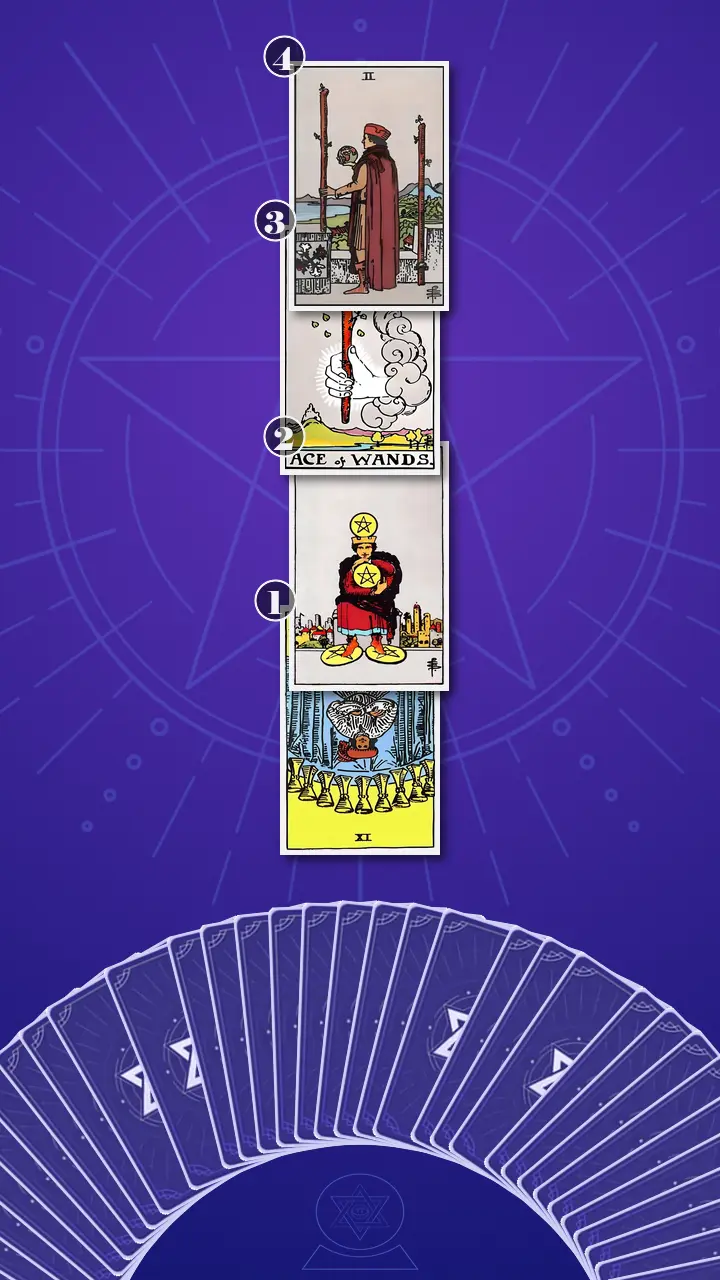
I arranged four cards as a vertical ladder. The bottom card would show the observable expression of her fulfillment stasis. The second would reveal the protective root beneath it. A wider space led to the third card, the catalyst that could change her response. The final card would show how to ground that change in a bounded, reviewable career experiment.
The spread looked like a ladder rising out of a well-appointed padded room: every rung remained connected to the ground, but each one offered a wider view.
Comfort on Display, Aliveness Out of Frame
Position One: Nine of Cups Reversed and the Official Record
I turned the card representing the observable expression of Maya’s fulfillment stasis: the way she inventoried her comforts, corrected her desires, and closed opportunity tabs. It was the Nine of Cups, reversed.
I drew her attention to the formal row of golden cups and the seated figure beneath them. The abundance was visible, but his arms were folded and the blue drape behind him formed a barrier. Reversed, the Water energy was blocked. Maya had real appreciation, but its emotional flow had been interrupted by an excess of self-correction. Every honest wish was being cross-examined before it could enter the official record of her life.
“This is your 10:47 p.m. ritual,” I said. “The course page is open. You list your stable salary, flexible schedule, and apartment near transit. Then you delete ‘I want more creative ownership’ and close the course before reading the syllabus. The cups are real. The problem is that you are using them as evidence that nothing else is allowed to matter.”
I compared the ritual to using a gratitude app as an automatic pop-up blocker. Each time desire opened a new tab, her internal system closed it before she could read the page. Like the protected world in The Truman Show, the arrangement looked complete until authentic curiosity made the enclosure visible.
Maya gave a short laugh that held no amusement. Her thumb pressed into the side of her mug, her eyes dropped to the folded arms on the card, and then her mouth tightened.
“Okay, that is so accurate it feels a little brutal,” she said. “My life is objectively good, so why do I keep looking? Then I tell myself I cannot complain.”
I did not rush to soften the recognition until it became meaningless. I said, “The card is not calling your gratitude fake, and I am not calling you spoiled. It is separating appreciation from performed contentment. One can be sincere while the other keeps you silent. Gratitude is a base, not a ceiling.”
I asked what happened in her body immediately after she closed a tab. She said her shoulders dropped for a few minutes, but the pressure returned later when she opened career-pivot videos and watched other people make choices she would not let herself test.
“Then the closing gives you relief,” I said, “but relief after closing the tab is not the same as clarity.”
Position Two: Four of Pentacles and the Untouchable Bundle
I turned the card representing the protective root of the pattern: Maya’s fear that acknowledging a larger desire could disturb her material security, familiar routine, and identity as a competent professional. It was the Four of Pentacles, upright.
The figure held one pentacle over his heart, balanced another above his head, and pinned two beneath his feet. Upright Earth usually preserves, contains, and stabilizes. Here that energy had moved into excess. The resources designed to support Maya’s movement had become conditions she believed must remain completely untouched.
“Your salary, benefits, emergency fund, predictable schedule, and reputation as a safe pair of hands have become one sealed package,” I told her. “A free information session feels like the first move in a chain that ends with lost income, unstable housing, and regret. So your mind says, ‘If I let myself explore this, then maybe I will discover I need to leave; if I leave, I could lose the safety I worked for.’”
Her shoulders lifted toward her ears before she noticed and lowered them. “That is exactly the chain,” she said. “I know a twenty-minute call cannot take away my apartment. But it feels like curiosity creates momentum, and then I will be forced to follow it.”
“It makes sense that security matters in Toronto, especially when friends are dealing with layoffs and unstable freelance income,” I said. “This card does not shame the grip. It asks whether safety has quietly been redefined as total control. Preservation supports you; immobilization prevents you from learning what is actually safe.”
I also recognized what I call Persona Fatigue. Maya had maintained the social character of the grateful, reliable employee for so long that even private curiosity felt like breaking character. Her manager’s praise, “You are such a safe pair of hands,” validated the role while making its psychological weight heavier. The competent persona was authentic, but it was not complete.
As an artist, I have seen technically flawless compositions lose all movement because every object is protected from disturbing the frame. Looking at the Four of Pentacles, I thought of that kind of picture: balanced, controlled, and almost impossible to inhabit.
Maya traced the edge of the card without touching it. Her fingers tightened, her gaze drifted toward the window as if replaying her last performance review, and then a long breath left her chest. I could see recognition arriving alongside grief. She had not merely stayed comfortable; she had spent years making one version of herself look effortless.
When the Ace of Wands Changed the Genre
Position Three: The Living Shoot Beyond the Cloud
A streetcar bell sounded once beyond the window, clean and distinct, and then the room seemed to become unusually still. I turned the card representing the catalytic insight that could interrupt gratitude-as-self-silencing. It was the Ace of Wands, upright.
An open hand emerged from a cloud holding a wand alive with green shoots. This was Fire in an available, balanced state: not a command to burn down the established life, but permission for energy to move before a destination had been guaranteed. The card offered potential, initiative, and beginner’s curiosity. It did not promise an outcome.
I brought Maya back to 10:47 p.m.: the course tab glowing, the gratitude app waiting, the phone warm in her hand, and the familiar pressure gathering across her chest. She knew the sequence by heart: list what was good, close the possibility, and wonder why being lucky still felt so flat.
“The Ace changes only one moment in that sequence,” I said. “Instead of asking whether product strategy, further study, or a creative project justifies a full career pivot, you choose the idea that still creates a flicker of energy. You give it one small form: an open calendar invitation, a twenty-minute conversation, or the roughest possible prototype.”
I told her I was running an Internal Monologue Audit. Her subconscious had edited the situation into a punitive courtroom drama: desire entered as the defendant, gratitude became the prosecutor, and financial security was presented as evidence that curiosity had bad character. No wonder every spark arrived already preparing its defense.
The Ace offered a different genre. We could turn the courtroom drama into a field documentary. Instead of demanding a verdict about her entire career, Maya could observe what happened when one interest met twenty-five minutes of reality. Judgment could become curiosity. Certainty could be replaced by evidence. The spark did not need to win a case; it needed a small container in which to remain visible.
I said, “Gratitude can tell you what is worth keeping without deciding what you are allowed to want next.”
You do not have to extinguish ambition to prove you are grateful; give one honest desire a small trial, following the Ace of Wands' living shoot beyond the cloud.
For one beat, Maya stopped breathing. Her fingers remained suspended above the mug, and her pupils widened as though the sentence had interrupted footage she had watched for years. Her gaze slipped away from me and fixed on the middle distance. I could almost see the deleted course sentence, the LinkedIn posts, and the private Notion pages moving through her mind. Then her shoulders dropped, but relief did not arrive cleanly. Colour rose along her cheeks, her jaw tightened, and she looked suddenly angry. “But does that mean I have been wrong this whole time?” she asked, her voice sharper and less polished than before. I let the question have room. Then I said, “It means protection worked so well that it began protecting you from information. You were not wrong to build safety. You are allowed to update the method now.” Her hand slowly opened. Her eyes reddened, and a shaky breath left her chest. For a moment she looked almost light-headed, as if setting down a familiar weight had revealed both freedom and the responsibility to choose.
I asked, “Now, using this new perspective, can you think of a moment last week when this insight could have made you feel different?”
She thought about a former colleague’s LinkedIn announcement. Her first response had been a hot flash of envy; her second had been guilt; her third had been a supportive comment that concealed the question she wanted to ask.
“I could have messaged her,” Maya said. “Not to ask for a referral. Just to ask what the work is actually like.”
“Exactly,” I said. “Desire is information before it is a decision. Envy may be showing you an unlived preference before guilt turns it into a character verdict.”
I set a ten-minute timer and divided a note into two columns: Worth Keeping and Still Wanted. Under the first, Maya wrote, “My income, flexibility, and emergency fund.” Under the second, she wrote, “Work where I shape the idea, not only maintain the process.” She did not justify it. She did not turn it into a resignation plan. She circled one low-cost possibility: ask for a twenty-minute conversation.
I named the shift while it was still small enough to be honest. This was not a sudden transformation into fearless certainty. It was one step from guilt-driven gratitude and security-based immobilization toward grounded curiosity, lived evidence, and gratitude that could coexist with forward movement.
One Wand Anchored, One Wand Moving
Position Four: Two of Wands and the Bounded Horizon
I turned the card representing grounded integration: the practical method through which Maya could protect what genuinely mattered while giving one possible future a defined trial. It was the Two of Wands, upright.
The figure stood rather than sat. One wand remained fixed to the wall while the other rested in his hand, and a globe gave scale to a world not yet entered. The Fire energy of the Ace had developed into directed, balanced exploration. Inspiration now had boundaries, a review point, and a relationship with reality.
“This card does not ask you to quit,” I said. “It asks you to keep one wand anchored while using the other to explore. In your life, that means keeping your current job and essential financial commitments outside the risk boundary while creating a thirty-day experiment with a time budget, spending cap, review date, and exit option.”
I showed her how the modern-life scenario could look: a calendar block called “Prototype, not decision,” one conversation with someone in product strategy, and three ratings after each test: energy before, energy after, and curiosity about repeating it. The goal was not to prove that a new direction would succeed. It was to discover what direct experience could show that another evening of research could not.
Maya looked at the fixed wand, then at the one held for movement. “I can keep my job while testing whether creative ownership actually gives me energy,” she said.
Her breathing slowed. She sat farther back in the chair, not because the question had disappeared, but because it no longer occupied her whole body. I told her, “You do not need a new life to collect new evidence.”
The Director's Cut: Evidence Before Overhaul
I gathered the four cards into one coherent story. Maya had built real stability in response to an expensive city and an uncertain job market. In the present, the Nine of Cups reversed showed her using a polished inventory of comfort to overwrite flatness. Beneath that, the Four of Pentacles showed the protective grip that treated salary, housing, routine, and competence as one untouchable bundle. The Ace of Wands restored desire as usable information, and the Two of Wands converted that information into bounded exploration.
The maintenance loop was clear: desire appeared, gratitude prosecuted it, closing the tab produced immediate relief, and the absence of direct evidence made staying completely still seem like the only responsible option. She kept rearranging a well-appointed room whose door was already unlocked.
I named her cognitive blind spot: she had mistaken the first frame of exploration for a binding contract with its most frightening possible ending. A conversation was not a resignation. Reading a syllabus was not enrolment. A rough prototype was not a public career announcement. Her direction of change was not from gratitude to recklessness; it was from certainty before evidence to evidence before overhaul.
Before we wrote her next steps, I gave her The Director's Cut of Self-Compassion. Whenever the punitive internal narration began with, “A grateful person would not want this,” she would pause the scene and describe only what an objective, supportive director could observe: “I value my current stability, and I am gathering information about work that may feel more alive.” The edit removed the character verdict without removing practical caution.
- Keep + Explore for seven days Each evening at home, place one uncensored sentence beginning with “I want” directly beneath one genuine gratitude entry in the same phone note. On Wednesday, set a five-minute timer and highlight any desire that has appeared more than once. Record it without an apology, justification, or action plan. If the exercise becomes punitive or pressure spikes, stop. The minimum version is one paired entry on one day. A recorded desire is information, not a commitment.
- Run one twenty-minute curiosity conversation Before Friday, send Maya’s former colleague a short LinkedIn message: “I am curious about how you moved into product strategy. Would you be open to a twenty-minute chat next week? No worries if not.” The purpose is to hear what the work is actually like, not to ask for a job or announce a pivot. If sending feels too exposed, draft the message and leave it unsent for twenty-four hours. One conversation creates no obligation to quit, apply, enrol, or spend money.
- Create a thirty-day Stability-Anchor Experiment On Saturday morning, make one calendar or Notion card with four fields: the test, a weekly time budget, a money cap, and a review date. Put “I am not leaving my current role during this test” at the top. Begin with one twenty-five-minute block titled “Prototype, not decision,” using a familiar tool such as Figma, Notion, or Google Docs. After each session, rate energy before, energy after, and curiosity about repeating it from one to five. At the review date, ask only, “What did direct experience show me that thinking could not?”
The Four-Layer Insight Ladder had not supplied an answer from outside Maya. It had made the system visible enough for her to interrupt it. The actionable advice was deliberately small because her task was not to perform bravery; it was to gather honest evidence while remaining the author of what happened next.

A Week Later, the Tab Stayed Open
Seven days later, I received a message from Maya. “Creative ownership” had appeared four times in her Keep + Explore note. She had sent the LinkedIn message, completed a twenty-minute conversation, and placed her first “Prototype, not decision” block on Saturday’s calendar. She had not quit her job. She had not announced a reinvention. She had simply allowed one living interest to survive contact with reality.
She slept through the night after sending the message. The next morning her first thought was, “What if this goes nowhere?” Then, she told me, she smiled. The message was already sent, and her job, apartment, and emergency fund were still intact.
I did not see the reading as a prediction fulfilled. The cards were a storyboard, not a director. Maya had taken the pen herself, moving from a flat but protected scene into one where gratitude and ambition could occupy the same frame.
When a life looks good on paper but your chest still goes heavy at the thought of another identical week, the hardest part may not be the flatness itself. It may be the fear that admitting it will make you ungrateful and unsafe. Simply seeing that fear as the security guard, rather than the final authority, means you are no longer standing exactly where you began.
If gratitude could keep one wand anchored without closing the door on the Ace’s living shoot, which small possibility would you let remain visible this week?