After Slack Praise: An Open Tracker, Three Review Lines, Then an RSVP

The Checkmark and the Quiet Weight of Achievement-Backed Stagnation
You close Jira with every ticket complete, receive the Slack praise you worked for, and then open another Notion planning page because post-achievement emptiness feels harder to face than another measurable task. You did the thing, everyone agrees it counts, and yet your first move is to build somewhere new to hide.
That was the pattern Jordan, a 28-year-old product designer in Toronto, brought into our reading. They described standing on a crowded King streetcar at 6:18 on a wet Tuesday evening, their phone warm in one hand as their manager praised the completed launch in Slack. The brakes squealed. Damp coats carried the faint mineral smell of rain. Jordan closed Jira and immediately opened a Notion page called “Next Quarter.”
Their shoulders released for two seconds. Then the familiar weight returned to their chest, as if the streetcar had stopped but their body was still being pulled forward along the tracks.
“I did what I said I would do,” Jordan told me. “So why would changing anything be rational? The system worked. Maybe the next goal will make the answer obvious.”
I heard relief in the first sentence, apprehension in the second, and something flatter beneath both. Their ambivalence felt like standing with one foot on a subway platform and the other inside a train whose route still worked perfectly, even though its destination no longer felt entirely theirs.
“I’m not going to use the cards to tell you to quit, stay, pivot, or be more grateful,” I said. “I want us to understand why the checkmark has acquired so much authority. Let’s make a map of the loop, then look for one place where you can choose differently without turning your life into another high-stakes deliverable.”

Choosing the Workbench: The Transformation Path Grid
I asked Jordan to place both feet on the floor, take one slow breath, and hold the question without trying to solve it. I shuffled while they focused on the moment immediately after a completed goal. The pause was not a mystical performance; it was a way to stop the next automatic task from speaking first.
I chose the Transformation Path Grid (6) · Context Edition, arranged in two rows of three cards. For anyone wondering how tarot works in a reading like this, I use the cards as an external cognitive map. Their images make a repeating pattern visible enough to examine, while the card meanings in context give us language for what ordinary productivity language may be concealing.
This was not a simple stay-or-leave decision. It was a circular system in which the apparent solution, hitting another goal, kept reinforcing the problem. A larger spread would have introduced more information without necessarily isolating the loop. This six-card Transformation Path Grid was the smallest structure that could show the visible post-goal pattern, the maintenance behavior blocking reflection, the hidden attachment, the catalytic reframe, the next experiment, and the practice that could hold everything together.
I placed the first three cards close together across the upper row: preservation, blockage, and root. Beneath them, I left more breathing room for the catalyst, the experiment, and the integration. The layout looked like a workbench being rearranged. We were not throwing away the completed goal. We were placing it down, turning it over, and asking what it could and could not tell us.
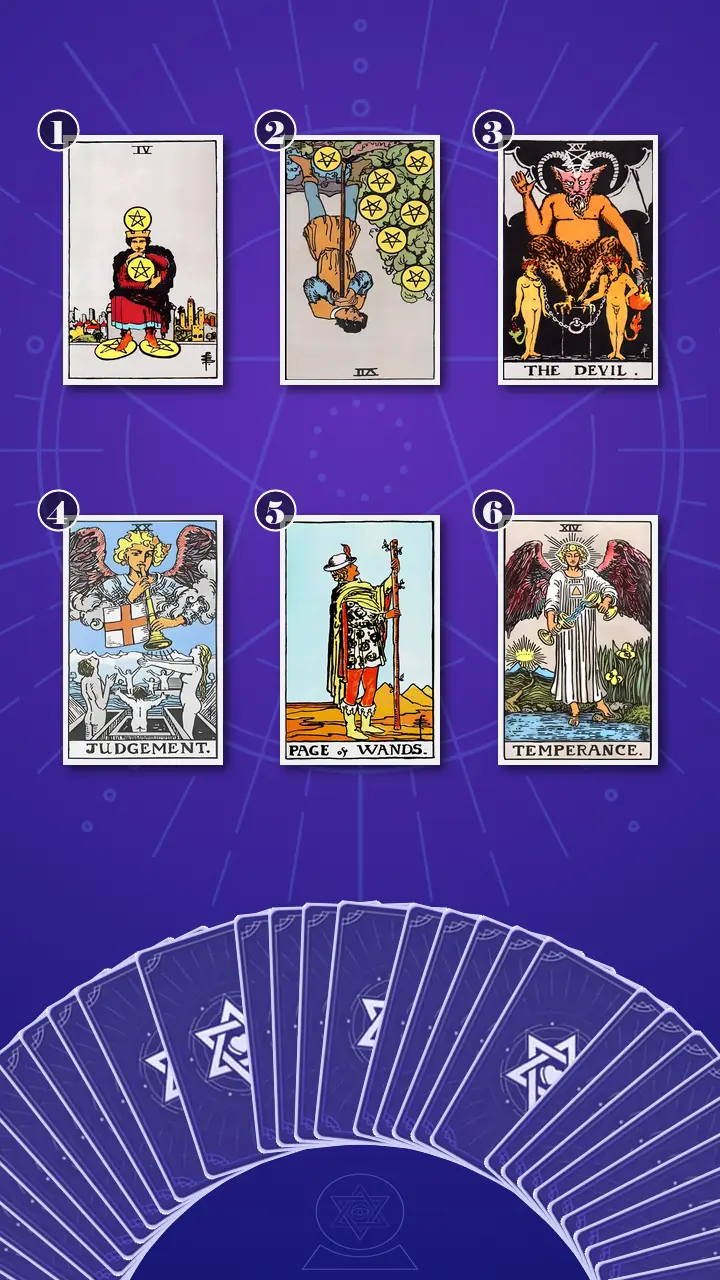
The Upper Row: How a Win Hardens Into a Loop
Position One: The Win Held Against the Chest
“Now I’m turning over the card that represents the visible post-goal pattern: how completion is being used to preserve your current position and conceal continued immobility,” I said.
The card was the Four of Pentacles, upright.
The figure clutched one pentacle against his chest, balanced another above his head, and planted both feet on two more. I pointed to the physical grip before explaining the traditional meaning. This card can describe useful conservation, but here its energy had moved into excess. Protection had become preservation for its own sake.
I brought the image directly back to Jordan’s work life. They had received strong quarterly feedback, pinned the completed metric to their career dashboard, and accepted another familiar project before asking whether the role still felt chosen. The achievement was useful evidence. Gripping it as proof that the entire arrangement was right kept both feet planted while curiosity remained outside the frame.
“Because this worked, keeping everything the same must be sensible,” I said. “But there is a difference between holding a result and being held by it.”
Jordan gave one short, bitter laugh. Their fingers tightened around their mug before loosening again. “That’s so accurate it’s almost rude,” they said. “I literally volunteered for another version of the same launch during the meeting.”
I let the laugh settle without turning it into a confession. Stability was not the enemy, and I did not want Jordan shamed out of valuing it. “The question is not whether the achievement matters,” I said. “It does. The question is whether it gets to decide what you want next.”
Position Two: The Retrospective With a Missing Question
“Now I’m turning over the card that represents the immediate blockage: the defense that replaces open-ended reflection with familiar, measurable maintenance.”
The card was the Seven of Pentacles, reversed.
Upright, the gardener pauses to assess what the labor has produced. Reversed, that assessment can become blocked, impatient, or so narrow that it measures yield without evaluating direction. The pause is still present, but the deeper question has been deleted from the retrospective.
I asked Jordan to picture opening a Friday project review after a launch. They could record delivery time, stakeholder approval, output quality, and the number of tickets closed. Then, instead of writing what the work changed or left unanswered, they could reorganize the dashboard, adjust categories, and create a new progress bar. The visible yield received a careful review; the direction of the garden did not.
“The checkmark answers whether you did it. It cannot answer whether you still want it,” I said.
The reversed energy was a blockage of honest assessment. Jordan was not failing to reflect because they lacked insight. They were turning reflection into a format that only allowed measurable answers. It was like reorganizing a Notion database so thoroughly that the open question began to look managed, even though it had never been answered.
Jordan looked away from the cards and rubbed their jaw. “Our retrospectives have a ‘what went well’ section,” they said, “but I’ve never written, ‘I was good at this and bored by it.’ That sounds unprofessional.”
“It might be inappropriate for a team document,” I said. “It is still valid information for your private review. Capability and interest are separate data points. You are allowed to collect both.”
Position Three: The Access Badge You Keep Renewing
“Now I’m turning over the card that represents the hidden attachment: the fear and limiting belief that make staying stuck feel sensible.”
The card was The Devil, upright.
I named the card calmly because its imagery can be dramatic, while its practical meaning here was not a prediction or a sign of danger. The Devil describes attachment, compulsive bargains, and structures that feel inevitable because familiarity keeps rewarding our participation. Its energy was excessive: measurable achievement had expanded from a useful tool into a condition for worth, control, and permission.
I asked Jordan about a recent night in their condo. They told me about moving between LinkedIn, a salary spreadsheet, and a half-written note titled “What do I want next?” The radiator had clicked beside the window. Blue light had filled the room. The note remained blank while another skills roadmap became more detailed.
“One more piece of proof, then I can choose,” I said, giving the bargain its simplest form. “The performance tracker began as a tool and quietly became an access badge you believe you must keep renewing before you’re allowed to choose freely.”
I pointed to the loose chains around the figures’ necks. “Loose does not mean imaginary. It means revisable. This pattern is restrictive, but it is not fate. Staying busy can preserve a success story while postponing a desire.”
The gap between Jordan’s highly functional work identity and the quieter self asking what that competence was serving reminded me of Severance. I also thought of my own work as an artist: a scene can be beautifully executed and still remain in the film only because no one has been willing to question the old cut.
Jordan’s thumb stopped moving along the mug’s rim. Their gaze went unfocused for a moment, as though they were replaying the apartment scene. Then they exhaled through their nose and said, “If I had no target for a month, I think I’d be scared there was nothing impressive underneath.”
“That fear deserves care, not obedience,” I said. “A target can display your effort. It cannot manufacture your worth.”
When Judgement Refused the Final Cut
Position Four: The Trumpet Behind the Congratulatory Message
The room became noticeably quieter when I reached the lower row. Even the soft city noise beyond the window seemed to recede.
“Now I’m turning over the card that represents the catalytic reframe: the shift that treats achievement as information for review rather than proof that nothing should change.”
The card was Judgement, upright.
The angel’s trumpet sounded above figures rising from open coffins, their faces turned toward something newly audible. The card’s energy was balanced awakening: not a command to make a dramatic career pivot, but an invitation to stop using the old success story as a closed verdict.
I reflected the loop back to Jordan. “You close the tracker, read the congratulatory Slack message, and feel the familiar two-second lift. Then your chest gets heavy, your hand opens another planning document, and the next target starts forming before the unfinished question can speak.”
This was where I used a lens I call Workplace Typecasting Analysis. Jordan’s office ecosystem had repeatedly rewarded them as the reliable finisher: the safe pair of hands who could take an approved direction, smooth the edges, and bring it over the line. That role was valuable, but repetition had quietly turned praise into casting. Each successful delivery seemed to confirm that they should keep playing the same supporting part.
“Typecasting can be flattering and still be limiting,” I said. “Your review proved that you are excellent at this role. It did not prove that this is the only professional story in which your abilities belong.”
I then brought in Leadership Narrative Construction, not as a demand to become louder or more dominant, but as a way to restore authorship. Jordan’s old script was: “I demonstrate value by reliably executing the work placed in front of me.” A more spacious script could be: “I demonstrate value by delivering well, naming consequential questions, and generating evidence about which directions deserve attention.”
Hitting the goal is not a verdict that you must stay where you are; let Judgement's trumpet turn completion into an honest review of what changed and what still calls for movement.
I paused, then gave Jordan the sentence at the center of the reading.
The goal proved you can succeed inside this pattern. It did not prove that the pattern still deserves the final say.
Jordan’s breath stopped first. Their fingers hovered above the table, half-curled, as if they had been about to reach for the card and forgotten the movement. Then their eyes shifted away from me and lost focus. I could almost see the recent performance review replaying behind them: the praise, the question about what came next, the quick answer that had returned everyone to familiar ground.
The recognition did not arrive as immediate relief. Jordan’s eyebrows drew together, and a flash of anger sharpened their voice. “But doesn’t that mean I was wrong?” they asked. “I spent years building this. If I question it now, was all of that just avoidance?”
Their shoulders remained high for another beat. Then one hand opened on the table. Their next exhale came from deeper in the chest, shaky and longer than the ones before it. The anger softened into something more vulnerable: the slight dizziness of realizing that clarity restores responsibility as well as freedom.
“No,” I said. “It means the goal gave you real evidence, and now you have more evidence than you had when you chose it. Honest review does not invalidate the chapter. It prevents a completed chapter from writing every chapter that follows.”
I invited them to look back. “Now, with this new perspective, think about last week. Was there a moment when this insight could have made you feel different?”
Jordan returned to the meeting room where their lead had asked what they wanted next. They remembered the cold air on their hands, the dry-erase marker in the room, and the instant stomach drop before they named another familiar project.
“I thought the discomfort meant I didn’t have a good answer,” they said. “Maybe it meant I had an unanswered question.”
I slid a notebook toward them and set a ten-minute timer. I asked for only three lines: “This goal proved…,” “This goal did not prove…,” and “One reversible way to test the unanswered part is….” I made it clear that they could leave the third line blank, stop when the timer rang, or keep the note entirely private. The purpose was not to force a conclusion. It was to let restlessness count as information the metric could not capture.
This was the reading’s central movement: from proof-driven maintenance and rationalized immobility toward curiosity-led movement and self-trust built through lived evidence. Jordan did not need certainty yet. They needed the right to interpret their own success honestly.
The Spark and the Two-Cup Rhythm
Position Five: A Prototype Instead of a New Identity
“Now I’m turning over the card that represents the next experiment: a small, curiosity-led action that tests what remains unanswered without demanding a total decision.”
The card was the Page of Wands, upright.
The Page held a sprouting wand in an open landscape and looked at it with attention rather than certainty. The energy here was an emerging, balanced form of fire: enough initiative to move, but not so much that movement had to become reinvention.
I brought Jordan back to the Saturday café near Ossington where they had opened tabs for a design meetup, an adjacent role, a course, and a portfolio template. The espresso grinder had cut through the room while wet pavement flashed beyond the window. For forty minutes, they had color-coded the options without booking anything.
“The Page changes one detail in that scene,” I said. “Instead of preparing to move, you take one visible action. RSVP to the Toronto design meetup. Send a twenty-minute message to someone in service design. Make one rough Figma prototype outside your usual product area. The experiment does not have to become your new identity. It only has to teach you something.”
The Page’s curiosity corrected the earth-heavy blockage above it. Research had been producing theoretical information; an experiment could produce lived evidence.
“You do not need a new identity; you need one new piece of lived evidence,” I said.
Jordan picked up their phone, opened a saved event, and then stopped with their thumb above the RSVP button. Their mouth tilted into a small, uncertain smile. “I can do ninety minutes,” they said. “I just don’t want ninety minutes to become a referendum on my entire career.”
“Then we will not let it,” I said. “The experiment succeeds if you learn that your curiosity rises, falls, or changes. Disinterest is useful evidence too.”
Position Six: Structure Without the Final Say
“Now I’m turning over the card that represents the integrated practice: how achievement, self-trust, and continued movement can coexist without recreating the rigid loop.”
The card was Temperance, upright.
The angel stood with one foot on land and one in water, pouring carefully between two cups. Temperance brought balance, pacing, and integration. Its message was not to abandon the planning habits that helped Jordan work reliably. It was to change what those habits were allowed to serve.
I pictured a weekly calendar with one maintenance block, one exploratory block, and one short review. Jordan could keep the structure that supported their role while protecting forty-five minutes, or ten on a crowded week, for something with no immediate performance payoff. Achievement could remain part of their life without monopolizing the definition of progress.
“Keep the structure that supports you. Retire the rule that structure gets the final say,” I said.
Jordan’s shoulders softened. I watched them picture a week in which curiosity did not have to compete with every existing responsibility or justify its place through instant results. Temperance was not promising permanent balance. It was showing a repeatable adjustment: one foot in practical stability, one in felt experience, and neither pretending the other did not exist.
The Capability-Not-Verdict Review
When I read the grid as one story, its logic was clear. The Four of Pentacles showed Jordan holding the completed goal so tightly that preservation looked like wisdom. The Seven of Pentacles reversed showed the post-goal review collapsing into a metric check. The Devil revealed the hidden bargain beneath both: continued proof bought temporary relief from the fear of having no measurable basis for worth or direction.
Judgement interrupted that bargain by turning completion from a verdict into a review. The Page of Wands gave the unanswered question a low-risk way to gather evidence, and Temperance made room for exploration without sacrificing stability, rest, or useful discipline.
The cognitive blind spot was the assumption that success within a strategy proves the permanent correctness of that strategy. It proves capability. It may prove that the system can produce a result. It does not prove that the same result is still meaningful, that the role still fits, or that every future choice must preserve the story that earned the praise.
As an artist, I think of a finished scene as something real but not sovereign. It can be well acted, beautifully lit, and worth keeping. It still cannot decide the entire film. Jordan’s transformation direction was not from achievement to recklessness. It was from treating measurable proof as an instruction to treating it as information, then writing the next small scene from lived evidence.
- Run the three-line Completion Review.Immediately after your next completed task, and before opening a new tracker, set a ten-minute timer. Write: “This proved…,” “This changed…,” and “This left unanswered….” Keep the entire note to six sentences or fewer.Stop when the timer rings, even if the note is incomplete. The minimum version is one sentence naming what the goal did not prove.
- Create one low-fidelity direction experiment.Choose one repeatedly saved interest and test it for fifteen to ninety minutes this week: attend a Toronto design event, ask someone in an adjacent role three questions, or make one rough prototype. In a cross-departmental meeting, you can use my Protagonist Reframe Directive: “Before I take on another version of this task, I’d like to test one question I think could improve the direction. Can I prototype that angle and bring back what I learn?”Set limits on time, money, and visibility before you begin. The test succeeds by producing information, not praise, polish, or a new job title.
- Build the Maintenance-and-Mystery Rhythm.At the start of next week, schedule one necessary maintenance task, one protected exploratory task, and one five-minute review of what each taught you. Keep the experiment beside your responsibilities rather than making it compete with rest or essential work.If tracking becomes another scorecard, replace the list with one recurring calendar block. Missing a week creates no debt.
I told Jordan that the Protagonist Reframe Directive was not about demanding the spotlight. It was a micro-behavioral disruption of the reliable supporting-role script. Instead of automatically proving value by absorbing familiar work, they could name a worthwhile question, request a bounded test, and return with evidence. Leadership, in this frame, was not dominance. It was authorship with practical limits.

A Week Later: The RSVP That Counted Differently
Six days later, I received a short message from Jordan. They had completed another work task, opened Notion by reflex, and then stopped. They wrote the three review lines before creating anything new.
The goal had proved that they could manage a difficult launch. It had changed how their team trusted them. It had not proved that they wanted to spend the next year refining the same kind of product work.
For the third line, Jordan chose a design meetup they had saved three times and pressed RSVP. They did not announce a career pivot, redesign their portfolio, or build a new five-year plan. They simply gave one evening to a question that had previously existed only as a browser tab.
The next morning, their first thought was still, “What if this goes nowhere?” They told me they smiled at the thought, not because the uncertainty had disappeared, but because uncertainty no longer sounded like an emergency requiring another progress bar.
That was the quiet proof I trusted. The cards had not chosen a direction for Jordan. They had helped us separate capability from direction, achievement from instruction, and planning from movement. Jordan supplied the courage by taking one small action that could answer back.
When the congratulations fade and your chest grows heavy over an open tracker, it can feel safer to defend the path that proved your worth than to admit the win left you wanting something you cannot yet name. But noticing that unfinished question is already a shift: the successful scene can remain part of your story without becoming its permanent final cut.
If this win were allowed to be information rather than an instruction, what tiny, reversible, low-fidelity prototype of your next direction are you curious enough to try?