Oversharing With New Friends; One Detail, One Question, One Pause

The 9:12 P.M. Voice Note
I recognized the question before Jordan finished asking it. At 27, they were a non-binary junior product designer in Toronto who could leave one unusually easy dinner, send a six-minute voice note about family history, and end the night searching, “Why do I overshare with new friends?”
As Jordan described the previous Tuesday, I pictured the exact frame: 9:12 P.M. in their small apartment near Dundas West, an unfinished design file glowing on the laptop and the refrigerator humming behind it. Their phone felt warm in their palm as they recorded a story about family conflict and an old insecurity. Their chest still held the bright, fizzy lift of being understood when they pressed send.
Ten minutes later, the phone was face-up beside the laptop. A rent-payment notification had appeared. The voice-note thread remained quiet. Jordan tried to work, but their fingers kept leaving the trackpad to wake the screen, and the warmth beneath their ribs had tightened into something like a drawstring being pulled through their stomach.
“I don’t want to play games,” Jordan told me. “If it feels easy, holding anything back seems fake. But then I’m sitting there thinking, I’m being real, but what if I’m actually trying to secure the friendship?”
That was the contradiction I wanted us to hold without judging either side. Jordan genuinely wanted honest connection. They were also using private disclosure to turn an early click into certainty before care, consistency, and discretion had time to become visible.
“The rush is real; it just is not the same thing as proof,” I said. “I’m not here to tell you to become guarded. I want us to understand why openness accelerates, what happens after it does, and how you can keep the warmth without surrendering your ability to choose. Let’s draw a map through this fog.”

A Five-Card Bridge from Chemistry to Trust
I asked Jordan to place both feet on the floor, take one ordinary breath, and hold the question in its simplest form: “How can I open up without asking one conversation to prove that I belong?” I shuffled slowly, using the movement as a transition from replaying the chat to observing the pattern. Nothing about the preparation was meant to be mystical or performative. It was a way to focus attention.
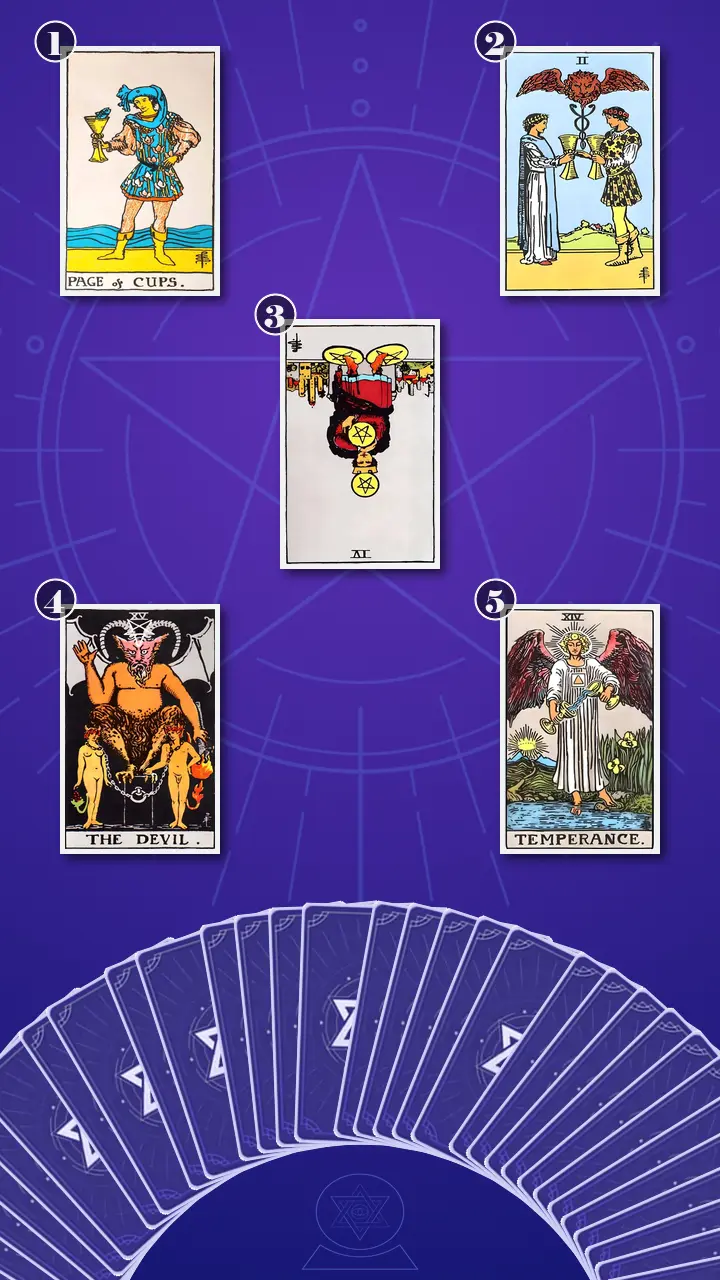
I chose the Relationship Spread · Context Edition, a five-card tarot spread for friendship boundaries, mutuality, and paced trust. A broader spread would have introduced life areas Jordan had not asked about. This one could stay close to the actual problem: the first emotional impulse, the new friend’s observable contribution, the disclosure loop, the fear beneath that loop, and one practical way forward.
I arranged the cards as a shallow bridge. The first card would show Jordan’s observable impulse when a friendship clicked. Opposite it, the second would test mutuality through behavior rather than pretending I could read another person’s private thoughts. The center card would map the loop from disclosure to relief to exposure. Beneath it, the fourth would reveal why waiting felt dangerous. The fifth would offer a pacing practice that preserved both openness and privacy.
This is how tarot works best in my practice: not as a verdict and not as surveillance of somebody else’s intentions, but as a structured cognitive mirror. The images give an uncertain experience visible parts. Jordan would remain the person deciding what those parts meant and what, if anything, to do next.
Reading the First Spark
The Page and the Feeling That Escaped the Drafts
I began with the card representing Jordan’s presenting pattern: the observable impulse to open up quickly and the replay that followed. I turned over the Page of Cups, upright.
The Page held a cup at chest height while a fish emerged unexpectedly from it. I told Jordan that the image captured the moment after an effortless coffee, dinner, or creative meetup when an emotional message surfaced before they had interpreted it. In modern terms, the open cup looked like a phone held close to the chest, and the fish was the sudden thought: “I can tell them the real stuff.”
I connected it directly to the voice note. Jordan had experienced warmth from a new friend and treated that warmth as an invitation to share a private story immediately, even though the friendship had not yet shown how it handled ordinary time, uneven availability, or confidential information. Like a Fleabag-style jump from sharp banter into an intimate confession, the truth could be sincere while still arriving faster than the relationship’s context.
The Page’s upright energy was open, receptive, and emotionally alive. I did not call that a flaw. The imbalance appeared when availability tipped into excess interpretation: every strong feeling seemed to require immediate expression, and every easy conversation was assigned a future before the present had finished happening.
“After that dinner, what were you hoping the voice note would make true?” I asked.
Jordan let out one short laugh, but it landed with a bitter edge. Their thumb rubbed the side of their mug. “That’s so accurate it feels a little cruel. I think I wanted it to mean we weren’t going to become another vague ‘we should hang out’ plan.”
“Then we’ll keep the accuracy and remove the cruelty,” I said. “The disclosure had a protective logic. You were trying to keep something promising from dissolving. Seeing that logic gives you more choice; it does not make you foolish for wanting closeness.”
The Two Cups and the Evidence That Has Not Arrived Yet
I turned the card representing the new friend’s observable contribution and our mutuality check. It was the Two of Cups, upright.
The two figures held their cups at equal height. I kept my reading grounded in what Jordan could actually observe: Did the friend ask a thoughtful follow-up? Did they remember a detail later? Did they share at a proportionate pace, initiate another plan, and handle what Jordan had disclosed with discretion? One warm reply could be real and meaningful without answering all of those questions.
The card’s energy was balance, but balance did not require matching confessions line for line. It meant attention moving in both directions across more than one interaction. A two-way iMessage thread was not reciprocal merely because both names appeared on the screen; reciprocity emerged when both people kept bringing curiosity, care, and effort to the shared space.
The equal cups triggered a restrained flashback from my years on Wall Street. On a trading desk, one promising price movement was information, not a track record. No serious decision survived by asking a single data point to carry the whole thesis. I saw the same distinction here, only with much more tenderness at stake.
“Chemistry is a signal. Trust is a pattern,” I told Jordan. “The signal tells you that something felt good. The pattern tells you what this particular person can hold.”
Jordan’s gaze moved from the card to the dark window. Their shoulders lowered a fraction. “So I’m not imagining the click. I’m just promoting it too quickly.”
“Exactly,” I said. “You do not have to invalidate the feeling in order to wait for more evidence.”
The Privacy Gate That Swung Fully Open
I turned the center card, representing the reinforcing interaction loop: quick disclosure, immediate closeness, exposure, and renewed urgency. It was the Four of Pentacles, reversed.
Upright, the figure clutched a pentacle against the chest and pinned two beneath the feet. Reversed, the image suggested containment giving way too quickly. I brought Jordan back to 9:12 P.M.: one great dinner, the full family story, a temporary drop in uncertainty, and then restless fingers checking whether the new friend could be trusted after access had already been granted.
In Jordan’s product-design language, it resembled giving somebody the full Notion workspace after they had handled one shared page well. The issue was not generosity. Permissions had outrun the relationship. Private information had become a fast claim on closeness before Jordan knew whether the other person would treat that access with care.
I read the reversed energy as a blockage in healthy containment and an excess release of personal material. The loop sounded like this: “I shared this to feel safer; now I need their reply to tell me whether I am safe.” The first disclosure quieted uncertainty for a moment. When uncertainty returned, another disclosure or another check of the chat promised the same brief relief.
“Sometimes the second disclosure is not intimacy; it is uncertainty asking for another hit of reassurance,” I said. “And when that feels too exposing, you may slam the gate shut, leave an ordinary message unanswered, or act less interested than you are. Both movements let uncertainty choose the privacy setting.”
Jordan’s reaction came in three quiet stages. Their fingers stopped against the mug. Their eyes lost focus as if the apartment scene were replaying behind the cards. Then a long breath left their chest, and their hand opened flat on the table.
“I can tell them everything and still not know whether they can hold it,” they said. “Then I get embarrassed and decide I should tell them nothing.”
“You can be honest without handing over the whole archive,” I replied. “Privacy is not a performance of distance. It is your right to decide who receives which layer, and when.”
The Loose Chain Behind the Typing Indicator
I turned the fourth card, representing the core fear and boundary blind spot beneath the pattern. It was The Devil, upright.
I told Jordan immediately that I did not read this card as danger, punishment, or evidence that the new friend was harmful. I kept our attention on the loose chains around the figures. The card showed a rule that felt compulsory without being an absolute condition: “If I slow down, they will decide we are not actually close.”
In Jordan’s daily life, the rule worked like autoplay. A new friend replied, “I totally get that,” and the warmth of recognition started the next disclosure before Jordan consciously chose whether the next episode belonged in this friendship. The phone glow became the card’s downward torch, pulling attention toward read receipts, typing indicators, reaction emojis, and imagined subtext while the rest of the evening disappeared beyond the screen.
The Devil’s energy showed excess attachment to immediate relief and a blockage in tolerating the unknown. The card did not say Jordan lacked boundaries as a fixed trait. It showed that one belief was repeatedly making the choice on their behalf.
“If you waited before sharing the next layer, what are you afraid would happen?” I asked.
Jordan pressed their lips together. Their hands tightened once, then loosened. “They’d think I was guarded. Or boring. Or that the connection wasn’t as special as it felt. I guess I’m scared they’ll forget me if I don’t keep the warmth going.”
“That is the loose chain,” I said. “It feels like a law, but it is a prediction. A pause gives you the chance to notice the prediction before deciding whether you agree with it.”
When Temperance Slowed the Pour
One Honest Detail at a Time
The room grew noticeably quieter before I turned the final card. Rain that had been ticking against the glass softened to an occasional drop, and the radiator clicked once beneath the window. I revealed the card representing the paced trust practice and constructive route forward: Temperance, upright.
The angel poured water between two cups, with one foot in the pool and one on land. I read that stance as balance: emotion could keep moving while grounded observation supplied a container. Jordan did not have to choose between total access and total withdrawal. At the next coffee near Queen Street West, they could share one honest but non-confidential detail, ask a reciprocal question, and leave one deeper layer for another interaction.
I brought in a light version of a framework I call Reciprocity ROI Analysis. I normally use it to measure emotional give-and-take in established friendships and identify relationships where one person’s care is being consumed without meaningful return. Here, I used it as an early observation tool, not a verdict on the new friend and not a demand for transactional equality.
I asked Jordan to track three things over time: what access they offered, what observable care came back, and what remained untested. A meaningful return did not have to be an equally vulnerable confession. It could be a thoughtful question, discretion, remembered context, a kept plan, or steady effort after the exciting first conversation. Temperance made the analysis humane: there was no need to calculate the whole friendship tonight. Jordan only needed enough evidence to decide whether the next layer felt chosen.
Jordan had been treating every pause as a deadline: either send the fuller story now or risk watching the connection cool. Even while looking at Temperance, they seemed ready to turn moderation into another rule they could fail, another correct way to perform friendship.
Do not use immediate disclosure to prove a friendship is real; practice one honest detail at a time, letting Temperance's blended cups hold openness and privacy together.
For one beat, Jordan did not breathe. Their fingertips froze above the edge of the card, and their pupils widened before their gaze drifted past me, as though every voice note and late-night thread had begun replaying at once. Their jaw tightened.
“But doesn’t that mean I was doing friendship wrong this whole time?” they asked. The words arrived sharper than anything they had said earlier. Their shoulders stayed high, and one hand closed into a fist against their thigh.
“No,” I said. “It means you found a strategy that gave you a fast moment of relief when belonging felt uncertain. It worked briefly, and then it charged too much in exposure. Understanding the cost does not erase the sincerity behind it. It lets you choose a better term.”
Jordan blinked twice. The anger did not vanish; it thinned into grief, and their eyes shone at the edges. Then their fist slowly opened. Their shoulders dropped on a trembling exhale, followed by a brief, almost dizzy stillness. I watched the release meet a new vulnerability: if the cards were not choosing for them, Jordan would have to tolerate the open space of choosing for themselves.
“Now, using this new perspective, think back to last week,” I said. “Was there a moment when this insight could have made you feel different?”
“Tuesday,” Jordan answered after a pause. Their voice was lower now. “I could have sent the two-sentence version. I could have asked how they deal with family expectations instead of sending my whole history. I could have let the next interaction carry part of the meaning.”
“And what would you have been allowed to keep?” I asked.
Jordan looked down at the two painted cups. “The part involving my sibling. That wasn’t only my story to give away. And maybe the oldest insecurity. I didn’t need to decide what the friendship meant that night.”
I named the shift as clearly as I could. This was not a move from openness to guardedness. It was the first step from urgency-driven oversharing and post-conversation exposure toward paced reciprocity, clearer judgment, and steadier belonging.
I turned over a blank sheet and set a ten-minute timer. Jordan wrote one meaningful detail they might share, one reciprocal question they could ask, and one part of the story they were choosing to keep private for now. I asked them to put the phone out of reach afterward and return to one ordinary task. I also made the boundary explicit: if the exercise created more discomfort than they wanted to hold, they could stop immediately. They remained in charge of whether, when, and with whom anything was shared.
The Measured Access Experiment
I traced the spread from left to right and gave Jordan the story in one piece. The Page of Cups showed sincere feeling arriving quickly. The Two of Cups validated the click while asking for observable mutuality. The reversed Four of Pentacles revealed why private access had become a security deposit on belonging. The Devil exposed the rule that slowing down meant being forgotten. Temperance supplied the resource Jordan had not been using: the ability to let feeling move while time, privacy, and evidence held the container.
The cognitive blind spot was not simply “bad boundaries.” Jordan had been treating chemistry as earned trust and treating smaller disclosure as dishonesty. That made a complete confession feel more authentic than a measured truth. The direction of change was precise: replace the rule that chemistry requires immediate access with a paced experiment. Share one meaningful detail, ask one reciprocal question, and allow later interactions to provide more information.
I translated the reading into two small practices. Neither required Jordan to act cold, delay ordinary kindness, or manipulate a response. Both were designed to restore choice at the exact moment emotional momentum usually took over.
- One Detail, One Question, One PauseBefore the next coffee, walk, or dinner with a new friend, spend ten minutes in the Notes app writing a two-sentence version of one meaningful but non-confidential detail, one reciprocal question, and one part of the story that will remain private for now. During the conversation, share the small version and ask the question before adding another layer.If the moment becomes intense, say, “There is more to that, but I want to take my time telling it.” Put the phone out of reach and do one ordinary task afterward. Stop the exercise if it feels like forced restraint; the goal is choice.
- The Warmth and Evidence CheckAfter a promising interaction, create a three-line note: what I actually observed, what I am imagining, and what I can learn only through another interaction. Unless a practical reply is needed, wait until the next day before sending an additional vulnerable message. Keep ordinary conversation warm and normal.The pause is observation time, not a test or punishment. If 24 hours feels impossible, begin with ten minutes or one completed design task. Track curiosity, discretion, remembered details, and follow-through rather than response length alone.
I called this a staged trust rollout, borrowing Jordan’s own professional language. Release one meaningful feature, observe how the system handles it, and decide what belongs in the next version. That metaphor made them smile because it removed the false choice between exporting the whole private archive and shutting the project down.
“This feels less like playing games,” Jordan said. “It feels like I’m finally staying in the room long enough to notice what the other person is actually doing.”

Five Days Later, the Phone Stayed Face Down
Five days later, I received a message from Jordan. At a quiet cafe near Queen Street West, they had shared the two-sentence version of feeling overwhelmed during their first year in product design. Then they asked, “What has been taking up most of your headspace lately?” They left the family backstory unsaid.
The new friend answered thoughtfully and remembered a detail from their earlier dinner. Jordan noticed those signs without upgrading the friendship into a guarantee. Afterward, they put the phone face-down, made dinner, and slept through the night. Their first thought the next morning was still, “What if I got it wrong?” They told me they smiled, then made coffee.
I did not see that as a perfect ending, and I would not trust one if the cards tried to sell me one. I saw a small, credible proof: Jordan had stayed warm, retained their privacy, and allowed another person’s care to become observable. The cards had not made the decision. Jordan had.
That was the quiet result of our Journey to Clarity. The five-card Relationship Spread had turned an indistinct fear into a visible sequence, but ownership remained where it belonged. Jordan could feel a spark without demanding a forecast from it. They could offer honesty without making their whole inner life the admission price for belonging.
If a new friendship makes your chest feel warm and your phone impossible to put down, I want you to remember that longing to belong and fearing the closeness will disappear can occupy the same cup. Noticing both does not make the connection less real; it means you have already begun to slow the pour.
If you let the next connection stay one honest detail at a time, what small sign of mutual care will you be curious to notice before you tilt Temperance’s cup again?