When Overextending for Friends' Destination Bachelorette Trips Feels Like Love
I recognized the pattern at once: Jordan (name changed for privacy) was a 29-year-old early-career client-services coordinator in Toronto, replying "I'm in" to a destination bachelorette chat before checking her budget, then feeling her jaw lock when the hotel upgrade appeared.
At 8:47 p.m. on a Tuesday, she was riding the TTC Line 1 home from work. Her phone felt warm in her palm; the brakes squealed overhead while Instagram Stories showed her friends beneath rooftop lights, raising glasses and voting on matching outfits. Jordan moved money between accounts, then typed, "I can make it work," even as the flight, accommodation, activities, and shared costs climbed past the number she had planned for.
When she sat across from me, she described the sequence plainly. She agreed first, volunteered to track payments or transportation, and only later opened her banking app and calendar. She rearranged personal plans, hid the fatigue behind cheerful messages, and wondered why supporting people she loved kept turning into a second job she had to finance and emotionally manage.
Her guilt was not an abstract feeling. I could see it as a locked fist behind her sternum, tightening whenever she imagined asking for a cheaper room or skipping an upgrade. Underneath it sat resentment, fear of exclusion, and the question she was almost embarrassed to say aloud: "If I make the trip harder for everyone, will they remember that?"
I told her, "I don't hear a lack of generosity. I hear someone trying to purchase belonging with money, logistics, and stamina. We can look at the pattern without shaming you, and we can let the cards help us draw a map back to your own capacity. The reading will not decide whether you attend. You remain the person making that choice."

Choosing the Compass: The Four-Layer Insight Ladder
I invited Jordan to put both feet on the floor and take one slow breath before opening the group chat again. I shuffled steadily while she held the question in mind, using the pause as a transition from reacting to observing. For me, tarot works best here as a structured reflection tool: the images give shape to information that guilt has been blurring.
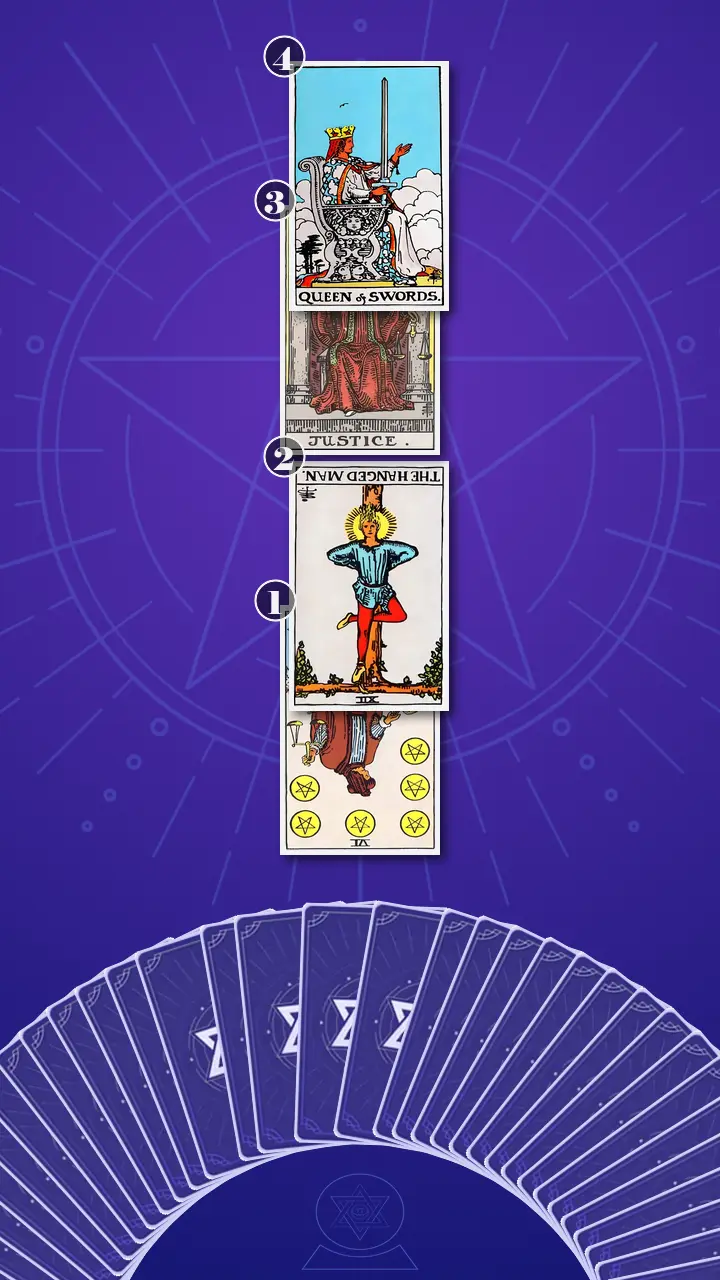
I chose the Four-Layer Insight Ladder, Context Edition. Its rationale was deliberately practical. Jordan was not asking for a prediction about a wedding or a verdict on her friends; she was asking why the same overgiving loop kept repeating. This four-position tarot spread for friendship boundaries moves from the visible behavior to the sacrifice script beneath it, then to the fairness reset and one grounded boundary action.
I explained the ladder to her, and to anyone reading this who has ever experienced bachelorette trip budget anxiety. The bottom card would show the presenting loop: the expenses, planning tasks, and hidden depletion. Above it, the second card would reveal the repeated script that made a total yes feel safer than a limited one. The third would identify the transformation lever, and the top card would turn that insight into language Jordan could actually use.
Reading the Map: The Weight Hidden in the Yes
Position 1: The Unequal Split
Now turning over is the card representing the presenting loop: the observable way Jordan overextends for destination bachelorette trips, including the costs, planning tasks, and hidden depletion described in the question.
The card is the Six of Pentacles, in reversed position.
In the image, the giver holds the scales while distributing coins to two kneeling figures. Reversed, the scales no longer suggest a freely balanced exchange. The energy is blocked and uneven: generosity has become a performance Jordan feels required to keep repeating. She says yes to the destination, the hotel, the activities, and the spreadsheet before asking whether her own resources can remain visible.
I connected it directly to the life she had described. The first destination-trip proposal arrives in the group chat, and Jordan sends an enthusiastic response before opening her budget app. She offers to track the hotel and activities because being useful feels safer than saying the trip is too much. Then the total expands, and she quietly moves money between accounts to absorb the difference. The reversed Six of Pentacles makes the hidden personal cost visible. Her giving is real, but the agreement is not allowing her to be a participant with limits; it is turning her into the person who absorbs whatever the plan leaves behind.
In energetic terms, this is excess in giving and a deficiency in receiving. There is plenty of willingness, but not enough consent from the rest of her life: not enough attention to her monthly budget, schedule, recovery time, or actual desire. The card does not accuse her of being naive or her friends of being exploitative. It asks a more useful question: who controls the terms of generosity, and does the exchange leave room for Jordan's own needs to count?
Jordan gave a short, bitter laugh. "That is almost rude. It is exactly what I do."
I let the recognition stand without rushing to soften it. "The card is naming a role, not judging your character. A contribution can be loving and still be too expensive, too labor-intensive, or too hard to sustain. Before the next request, write down the maximum you can spend and one task you genuinely want to do. That is information, not an apology."
Her thumb stopped above the group chat. She did not nod; she stared at the scales, then rubbed the hinge of her jaw as if checking whether it had really been clenched all evening. The first layer had done its job: the pattern was no longer a vague sense of being bad at friendship. It had a material shape.
Position 2: The Calendar Commitment That Never Gets Reopened
Now turning over is the card representing the repeated script: the Martyr Complex and Repetition Compulsion that make self-sacrifice feel like the safest way to preserve belonging.
The card is The Hanged Man, in reversed position.
The bound foot is the detail I asked Jordan to notice. The figure is suspended from a living tree, but the reversed energy suggests that the pause has stopped creating perspective. It has become attachment to suspension. In Jordan's modern life, this looks like a Google Calendar invitation accepted months ago and quietly dragged from day to day instead of being renegotiated. When someone asks who can manage transportation or payment tracking, she says yes again, then waits in private discomfort for the pressure to pass.
Her defense is not simply that she wants to help. It is that she fears what a pause might reveal. She can imagine a cheaper hotel or a shared planning task, but a twenty-four-hour delay feels more dangerous than another week of exhaustion. The repeated inner sentence is: "I could ask for a change, but it feels safer to keep carrying it." That is the suspended sacrifice the reversed Hanged Man is showing.
I told her, "A chosen pause gives you information. Staying suspended in the indispensable-friend role only gives the group a smooth itinerary and gives you less room to tell the truth. You do not have to make an abrupt exit or refuse every shared expense. You can pause long enough to find out what a limited yes would look like."
Jordan stopped breathing halfway through an inhale. Her fingers tightened around the edge of her phone; her eyes went unfocused, as if she were replaying the last three planning chats. Then a long breath left her chest, and her shoulders dropped a fraction.
"If I pause, I might lose my place here," she said.
"That fear deserves attention," I replied, "but it is not the same thing as evidence. Let's separate what you know from what you are predicting. For the next request, a pause can be as simple as, 'Let me check my schedule and budget before I confirm.'"
When Justice Put Her Capacity on the Scales
Position 3: The Fairness Reset
The room grew quieter when I reached the third card. Even the traffic outside seemed to recede behind the window glass. Now turning over is the card representing the fairness reset: the key cognitive and relational shift from proving support through exhaustion to assessing contribution, capacity, and reciprocity directly.
The card is Justice, in upright position.
Justice brought the upright scales, the vertical sword, and a composed gaze. Its energy is balanced and clear. It does not ask Jordan to stop caring; it asks her to put care beside evidence. The full trip cost belongs on the table: flight, accommodation, upgrades, activities, planning time, work commitments, and recovery time. So do her actual budget, schedule, energy, willingness, and consent.
Here I used one of my own diagnostic lenses, Orbital Drift Recognition. I explained that when a person upgrades the way she makes decisions, her new internal frequency may stop matching an old social role. Jordan was not necessarily outgrowing her friends. She was outgrowing the version of friendship in which she had to be the easy one, the organizer, and the quiet shock absorber. That mismatch can feel like guilt because the old role once helped her feel secure. It is not proof that she has betrayed anyone.
I also applied my Gravity De-linking Analysis to the group dynamic. I asked whether the friction came from different life phases or from trying to force every person into the same financial and logistical orbit. Wedding season, polished Instagram weekends, and group-chat momentum can create a strong pull, but they do not make everyone's budget identical. The work was to release the false gravity that says enthusiasm must look the same from every person.
Jordan was still caught in the old equation: if she made the trip harder, she would be remembered as difficult; if she absorbed the cost, nobody would know how much it hurt. Her body waited for a verdict, as if a budget limit were evidence against her love.
Stop treating exhaustion as proof of friendship; let Justice measure support through honest reciprocity, including what you can give and what you cannot.
For a second, Jordan's face went completely still. Her pupils widened slightly, and the hand holding her phone hovered above the screen. Her first response was not relief. "But doesn't this mean I got it wrong?" she asked. "I've already said yes to so many things." Her jaw tightened again, then her gaze moved from the sword to the scales, as if the image were asking her to count a different kind of evidence.
I watched the anger lose its edge before it became another accusation against herself. Her fingers, which had been curled around the phone, opened one at a time. A shallow breath caught in her throat; the next one reached lower. Her shoulders settled, but the new ease brought a brief, almost dizzying blankness. Without the old obligation telling her what to do, she had to choose. Her eyes grew bright, and she gave a small, unsteady laugh. "My capacity is part of the facts too," she said.
I asked her to open her Notes app and write three lines: the maximum amount she could spend, one task she genuinely wanted to take, and one part she could not carry. She did not have to send anything immediately. She only had to let the number, the willingness, and the limit exist together. The insight became practical before it became comfortable.
"Now, use this new perspective to think back to last week," I said. "Was there a moment when this insight could have made you feel different?"
She remembered the instant she had typed "I can coordinate the hotel" between client calls. She had experienced that reply as kindness, but also as temporary protection from being the person who slowed the group down. Justice gave her another interpretation: she had been allowed to ask for the full cost before agreeing.
This was the emotional shift from guilt-driven self-sacrifice and fear of exclusion toward reciprocal participation with clear limits and self-trust. Not a grand transformation, and not a promise that every response would be easy. It was the first moment in which Jordan placed herself inside the friendship's shared reality.
Position 4: The Boundary That Keeps the Conversation Open
Now turning over is the card representing the boundary in practice: one small, direct way Jordan can communicate a budget, task, or energy limit while still participating as a friend.
The card is the Queen of Swords, in upright position.
The Queen holds her sword upright in one hand and extends the other in an open gesture. I read the pairing as precision without punishment. She does not disappear from the conversation, and she does not bury a simple limit under five paragraphs of justification. Her modern-life sentence could be: "I can attend the main weekend up to $___, and I can handle the dinner reservation, but I cannot coordinate all transportation or cover the upgrade."
The upright energy is clear and available. It does not require Jordan to become emotionally cold or to decide that her friends have behaved badly. It asks her to communicate before resentment has to do the speaking for her. A boundary can keep her in the conversation. The open hand leaves room for the group to respond, redistribute a task, or revise the plan.
Jordan typed a draft, then deleted the apology at the beginning. She left the facts: what she could afford, what she could own, and what she could not take on. The sentence looked almost too short to protect her. That was part of the practice.
The Fair-Share Yes: From Insight to Action
When I placed the four cards together, they told a coherent story. The reversed Six of Pentacles showed the concrete cost: Jordan had been distributing money, time, and practical labor from a shrinking private supply. The reversed Hanged Man explained why the pattern kept returning: she accepted the calendar commitment, then treated it as fixed because remaining the indispensable friend felt safer than reopening the agreement. Justice supplied the reset by placing her capacity alongside the group's preferred itinerary. The Queen of Swords gave that reset a voice.
The blind spot was not that Jordan cared too much. It was that she had confused a smooth group experience with a successful friendship, then treated her own discomfort as a private inconvenience to solve alone. She was measuring support by how much inconvenience she could absorb. The direction of change was clear: move from proving friendship through self-sacrifice to showing up through explicit, reciprocal contribution.
I told her, "These are not instructions to attend or decline. They are small experiments that make the real choice visible. You can be generous without becoming the trip's unpaid infrastructure. Exhaustion is not a receipt for belonging, and a limited yes is still a yes."
- The 15-Minute Trip Capacity CheckWithin the next twenty-four hours, use your banking app or a Notes page to write the maximum amount you can spend on the entire bachelorette trip, including flights, accommodation, food, activities, upgrades, and recovery costs. Do this before confirming another expense.Start with one number. A budget is information, not an apology, and you can choose not to join any part that exceeds it.
- The 24-Hour Pause Before Saying YesFor the next trip request, wait twenty-four hours before committing. If the group chat is moving quickly, reply only: "Let me check my schedule and budget before I confirm." In a private note, finish: "If I give a limited yes instead of a total yes, I am afraid that ___."Mute notifications if needed, but do not disappear to punish anyone. Use the pause to gather facts about your money, time, energy, and fear.
- The One-Task Contribution LimitSet a ten-minute timer and make three columns: "money I can give," "time I can give," and "task I want to own." Before the next planning call, send: "I can do X within Y budget; I cannot take on Z. Can we confirm the full cost and divide the remaining tasks before anyone books?"Keep the message concise. If your body wants to add a long defence, read the original sentence once and let the facts stand.
I noticed that the practice had a second purpose. It did not force Jordan to stop orbiting with her friends; it allowed her to remain connected without making her the only source of gravity. Her place in the group could become something the relationship responded to honestly, rather than something she had to earn in advance.

A Week Later, the Quiet Proof
Three days after our session, I received a message from Jordan. She had posted her maximum budget before anyone booked the accommodation and said she could manage the dinner reservation but not the full itinerary. One friend asked which room rate worked for her; another volunteered to coordinate transportation. The group did not become a perfect model of reciprocity in a single chat, but Jordan no longer had to hide the information that would help them plan.
A week later, she slept through the night. In the morning, her first thought was still, "What if I'm wrong?" She smiled, checked the message she had sent, and left it exactly as written.
I call that a quiet proof. The trip was not magically free, and the fear did not vanish on command. But Jordan had moved from automatic agreement and guilt into a difficult pause, honest self-accounting, and a fair-share contribution. The cards had not rescued her or predicted her friends' reactions. They had helped her notice what was already true: she was the person who could choose the terms of her support.
When the bachelorette total keeps climbing and your jaw tightens, moving money around can feel safer than finding out whether your place in the friendship survives an honest limit. I want to leave that feeling with the same care I offered Jordan: being understood does not require you to keep carrying what has become too heavy.
If one clear, limited yes could still count as real support, what is the smallest part of the celebration in front of you that you would genuinely choose, place beside your own capacity on Justice's scales, and name without apology?
Every reading at AceTarot is a journey to connect with inner wisdom and empower the path ahead. This reading shared here is a psychological mirror, not a private record—crafted to reflect universal emotional loops and help restore personal clarity. Please note that these insights do not replace professional psychological, medical, legal, or financial advice, and should not serve as the sole basis for major life decisions.
Learn more about our Journey to Clarity.
How did this insight land for you?
🫂 This Resonates Deeply
🌀 Living This Story
✨ Now I See Clearly
🌱 Seeing New Possibilities
🧰 Useful Framework
🔮 The Confirmation I Needed
💪 Feeling Empowered
🚀 Ready for My Next Step
Author Profile
 AI
AI Laila Hoshino
829 readings | 533 reviews
“After a decade of guiding people through the stars, I’ve come to see life much like the orbits of planets: everything has its inevitable cycles. When you feel lost, please don't blame yourself; you might just be in a natural low tide. I’m here to sit under the night sky with you, offering a gentle cosmic perspective to distinguish temporary pain from the beautiful breakthroughs just around the corner.”
In this Friendship Tarot Reading :
Core Expertise
- Orbital Drift Recognition: Objectively mapping how personal cognitive upgrades naturally lead to mismatched frequencies with old friends, removing the guilt of outgrowing them.
- Gravity De-linking Analysis: Identifying the painful friction that occurs when two friends try to force an alignment despite moving into completely different life phases.
Service Features
- The Constellation Release Protocol: A psychological closure technique to peacefully accept the natural fading of a friendship, leaving them in their orbit while you transition to your next.
Also specializes in :
Explore Related Patterns:
Boundary DiffusionJordan agrees to the destination, hotel, activities, and shared costs before asking whether her own resources can remain visible. You are allowing the group plan to define the edge of your participation, while your budget, schedule, recovery time, and actual desire are treated as details to manage later rather than facts that belong in the decision from the beginning. That boundary becomes diffuse when asking for a cheaper room feels more threatening than absorbing the difference. A clear limit does not remove you from the friendship; it separates what you are choosing from what the group is choosing, giving everyone enough information to redistribute costs and tasks before resentment has to speak for you.
Friendship OverfunctioningJordan volunteers to track payments or transportation, rearranges personal plans, and moves money when the total expands. You are taking on the role of the group's practical and emotional shock absorber, turning friendship into a second job that you finance and manage so other people can experience the trip without having to feel its friction. That effort can look generous while quietly concentrating responsibility in one person. When you become the one who absorbs whatever the itinerary leaves behind, the group loses access to information about your actual capacity and you lose the chance to participate on equal terms. Naming one contribution you genuinely choose is a way to stay involved without becoming the trip's unpaid infrastructure.
Guilt-Driven People-PleasingJordan agrees before checking her money or schedule, then feels guilt at the idea of asking for a cheaper room or skipping an upgrade. You are watching the quick yes function as relief from anticipated guilt and exclusion: saying yes immediately protects the relationship in the moment, while the practical and emotional cost is postponed until you are alone with it. Because the cheerful message keeps the group moving smoothly, your limits remain unspoken and the short-term relief reinforces the next total yes. The question is not whether you care about your friends; it is whether guilt is being allowed to make the decision before you have gathered the facts that would let your care remain voluntary.
People-Pleasing Resentment CycleJordan says yes, watches the costs expand, hides her fatigue behind cheerful messages, and later feels her jaw lock as resentment builds. You are seeing a self-reinforcing loop: immediate compliance reduces the fear of disappointing the group, but the unspoken strain remains in your body and private experience rather than becoming information that can change the agreement. The accepted calendar invitation then feels fixed, even when the plan is no longer sustainable, so the next planning request receives another familiar yes. Resentment is not proof that your care was false; it is evidence that the contribution was made without enough choice, reciprocity, or room for renegotiation.
Performance-Based BelongingJordan replies that she is in before checking her budget, moves money between accounts, and experiences a cheaper room as a possible threat to her place in the group. You are seeing a decision rule in which support has to be demonstrated through visible sacrifice, so the cost of belonging gets paid in money, logistics, and stamina before your own capacity enters the conversation. That rule turns a friendship choice into a test of whether you are easy, useful, and remembered in the right way. When you ask whether friends will remember you for making the trip harder, anticipated social judgment keeps the old role in charge; separating affection from proof lets a limited contribution count without requiring another round of self-erasure.
Boundary DiscernmentJordan writes down the maximum amount she can spend, the task she genuinely wants to own, and the part she cannot carry, then posts that information before the accommodation is booked. You are using a boundary as decision data: it clarifies where your participation begins and ends without turning the conversation into a withdrawal or accusation. When one friend asks which room rate works and another volunteers to coordinate transportation, the relationship has more accurate information to work with. This is what discernment looks like in practice: you can remain generous while choosing the form of support that fits your resources, values, and willingness instead of offering a total yes by reflex.
Rejection SensitivityJordan asks whether her friends will remember her if she makes the trip harder, and later says that pausing might make her lose her place. You are treating a possible moment of disappointment as a warning of social loss, so overgiving becomes a safety behavior that protects you from testing what the relationship can actually hold. The prediction feels urgent because belonging matters, but it is still a prediction rather than evidence about your friends' response. Separating the feared outcome from the observable facts about money, time, and shared responsibilities gives you a way to negotiate without prepaying for acceptance through exhaustion.
Explore Related Struggles:
Capacity-Obligation FusionJordan moved money between accounts, rearranged personal plans, and kept the cheerful messages going as flights, rooms, upgrades, activities, and shared costs climbed. You are treating your budget, calendar, and recovery time as adjustable in order to keep the group's plan stable, while the obligation to keep it smooth stays fixed. That is why a limit arrives as an accusation against your care. The trip can remain loving, but your actual capacity has been removed from the terms of participation until the cost is already attached to you. The result is a durable bind between what you can give and what you believe you must carry.
Invitation-Obligation FusionJordan typed "I'm in" before checking her budget, and the first reply turned a trip invitation into a commitment before cost or schedule could enter the conversation. You are then asked to treat a pause, a cheaper room, or a skipped upgrade as a social risk, while carrying the larger plan feels like the safer way to stay included. That fusion keeps the choice hidden inside the greeting. By the time the hotel total rises, you are not only deciding whether to travel; you are trying to protect your place by agreeing to terms you have not examined. The struggle is the loss of a middle position in which you can want the friendship and still negotiate the trip.
Sacrifice-Agency SplitJordan accepted the calendar commitment and kept it from being reopened, even when a twenty-four-hour check might have shown a cheaper room or a smaller role. You move first through sacrifice and only later through choice, so the facts that should guide consent arrive after the social commitment feels settled. The pause therefore carries more danger in your internal equation than another week of fatigue. You can imagine a limited yes, but the indispensable-friend role makes renegotiation feel like losing your place. The split leaves agency technically available while the earlier sacrifice controls the decision.
Utility-Belonging FusionJordan volunteered to track payments and transportation, said "I can make it work," and described usefulness as safer than saying the trip was too much. You are not simply giving help; money, logistics, and stamina begin to act as evidence that you belong in the celebration. When the work expands into a second job, pulling back can feel like withdrawing care rather than changing your contribution. The bind keeps belonging attached to what you absorb, so showing up starts to require making yourself useful enough to protect the group's experience.
Unseen Cost BindJordan said yes before opening her banking app or calendar, then discovered the full burden in the rising total, the shifted plans, and the fatigue she had hidden behind cheerful messages. You are seeing the public price of the trip before you count the private price of planning labor, recovery time, and the effort required to keep resentment out of the chat. Because those costs remain outside the decision at the moment of agreement, "I can make it work" sounds like a simple contribution instead of a commitment drawn from a shrinking supply. The bind is not that you cannot calculate the total; it is that the choice is made before every fact that defines its impact is allowed to count.
Explore Related Emotions:
Boundary GuiltJordan's jaw locks when the hotel upgrade appears, and she feels guilty imagining a cheaper room or a skipped upgrade. You can trace the pressure from a bodily tightening to a private rule that a limit will make the celebration harder and make your care look smaller. She later deletes the apology from her boundary draft, leaving only what she can afford, own, and decline. That movement gives the guilt a clear shape, showing how quickly a normal budget fact has been made to carry the weight of a verdict about friendship.
Usefulness-Based Belonging FearJordan replies "I'm in" before checking her budget, volunteers to track payments or transportation, and moves money between accounts after the total rises. You can see how usefulness becomes the quickest way to stay securely included, because saying the trip is too much would require you to risk being less easy for the group. Her later question, "If I pause, I might lose my place here," exposes the emotional logic beneath the overgiving. You are not being asked to judge the generosity; the pattern becomes visible when belonging is treated as something that must be purchased with money, logistics, and stamina instead of shared through a contribution that includes your limits.
Fear of Being ForgottenJordan asks, "If I make the trip harder for everyone, will they remember that?" and later says, "If I pause, I might lose my place here." You can hear how the imagined future reaction arrives before you have checked the actual budget or asked what the group can adjust. The result is an agreement made to protect a place in the friendship rather than to express what you genuinely choose. Naming this feeling separates the possibility of being remembered as difficult from the evidence available in the group's later response, where friends ask about a workable room rate and volunteer for transportation.
Grounded AgencyJordan puts the maximum amount, the task she wants, and the part she cannot carry into her Notes app before sending another message. You then see her post the budget before booking, stay available for the dinner reservation, and let the group answer with a different room rate and shared transportation. Her capacity becomes part of the shared facts rather than a private obstacle she must override. The choice remains yours, and the friendship is given a chance to respond to an honest contribution instead of to an invisible reserve of money, time, and stamina.
Resentful ExhaustionJordan rearranges personal plans, hides fatigue behind cheerful messages, and describes support as a second job she has to finance and emotionally manage. You can hear the resentment in the bitter laugh and in the image of a private supply that keeps shrinking while the group experience stays smooth. That combination makes the exhaustion more than tiredness after one weekend. It is the accumulated cost of repeatedly turning care into planning, financial absorption, and emotional smoothing, until generosity carries a sharp aftertaste.
Explore Related Contexts:
Designated Organizer BurdenJordan volunteers to track payments, coordinate transportation, manage the hotel, and keep the itinerary moving while also paying for her own place on the trip. She rearranges personal plans and contains the practical fallout privately, making friendship support operate like a second job alongside her paid work. Designated Organizer Burden appears when a group's smooth experience depends disproportionately on one person's administrative labor. The burden is not only the number of tasks; it is the expectation created when the same person repeatedly notices, claims, and resolves every unfinished detail. If you recognize yourself in that position, the useful distinction is between a task you genuinely choose and responsibility for the entire system. Making the remaining work visible to the group creates a real opportunity for redistribution before your reliability becomes the default infrastructure.
Destination Bachelorette PressureJordan types "I'm in" before opening her budget, then watches the commitment expand across flights, accommodation, activities, matching outfits, upgrades, and shared costs. By the time she moves money between accounts, the invitation is no longer a single social decision; it has become an interconnected package of financial, logistical, and time demands. Destination Bachelorette Pressure describes the external format surrounding that sequence. Fast group-chat decisions and a polished wedding-weekend standard can make the full cost visible only after public enthusiasm has already been registered. When you encounter this structure, separating the invitation into individual cost and participation decisions can show where a freely chosen contribution ends and automatic accommodation begins.
Friend Group Money PressureJordan watches the total climb beyond the number she planned, moves money between accounts, and still avoids asking for a cheaper room. Meanwhile, decisions about upgrades, matching outfits, activities, and shared costs continue moving through the group chat without her maximum budget being part of the shared information. Friend Group Money Pressure emerges when a collective plan develops around one apparent spending level even though individual financial capacities differ. You are then left choosing privately between absorbing the gap and becoming the person who interrupts a socially valued celebration. The pressure becomes easier to audit when your total ceiling is stated before booking rather than after each added charge. That number does not determine whether anyone else is spending appropriately; it gives the group accurate information about the terms under which you can participate.
Friendship Role Lock-InJordan repeatedly becomes the easy friend, the organizer, and the quiet shock absorber. She agrees before checking her resources, makes herself useful through coordination, and then treats the accepted calendar commitment as fixed even when her position has expanded far beyond ordinary participation. An informal friendship role can become structurally sticky without anyone explicitly assigning it. Repetition teaches the group that Jordan will handle the unfinished details, while each smooth trip gives her fewer visible reasons to reopen a role that appears to be working for everyone else. Friendship Role Lock-In explains why the next request does not arrive on neutral ground. You are responding from a position already reinforced by earlier plans, and changing that position requires making a different contribution pattern visible long enough for the relationship to respond to it.
Wedding Party Scope CreepJordan's initial RSVP expands into an upgraded hotel, coordinated outfits, activities, payment tracking, transportation, and management of the wider itinerary. These additions arrive after the first agreement, yet she treats them as obligations already covered by that original yes. The structural problem is that each new expense or task enters the plan without becoming a fresh consent point. You may appear to be honoring one commitment while actually absorbing a chain of separate commitments whose combined cost was never assessed. Wedding Party Scope Creep makes those additions individually visible. Naming the expansion allows you to reconsider an upgrade, expense, or planning assignment on its own terms without turning the entire friendship or celebration into a single all-or-nothing decision.
Friendship Reciprocity GapJordan contributes money, payment tracking, transportation planning, schedule changes, and the labor of keeping every message cheerful. Before she states a limit, the arrangement contains no visible mechanism for comparing those contributions with what she can sustainably provide or for redistributing the excess. The gap lies in the structure of the exchange rather than in a claim that her friends deliberately exploit her. When one participant privately absorbs whatever the plan leaves behind, the group cannot respond to limits it has never been shown, and the exchange can remain materially unequal even among people who care about one another. You can make reciprocity observable by naming the full contribution, not only the expense. Jordan's later message changes the information available to everyone, and the resulting room-rate discussion and transportation handoff show how an unequal arrangement can begin to move once capacity is no longer hidden.