The Default Designated Driver Gives Way to a Shared Transport Plan

The Auto-Renewing Designated-Driver Burden
I recognized Jordan (name changed for privacy) as the Toronto communications coordinator who opened Friday's group chat, typed "I can drive" before checking her own plans, and then carried the familiar guilt of designated-driver duty into the rest of the night.
At 6:18 PM in the kitchen of her apartment, I watched the chat fill with drink emojis and a Queen West venue pin. The blue phone light lay across a cooling mug of coffee while the fridge hummed behind her, and her jaw tightened before she had even made a decision. She wanted to be part of the night, yet she was already volunteering to serve it from the edges.
She looked up at me and said, "Why am I always the designated driver? I want shared responsibility, but I keep agreeing before anyone asks. I organize the pickups, stay sober, and usually absorb the parking or fuel cost. I want a fair split without having to build a legal case for it."
I could hear the resentment in her voice as a small stone held under the tongue: not loud enough to interrupt the conversation, but impossible to stop noticing. Beneath it were heavy shoulders, a clenched jaw, the fatigue of staying alert, and the quick jolt that arrived whenever the group chat began arranging transport. I told her that a favor stops feeling like a favor when everyone plans around it. We did not need to decide whether her friends were good or bad. We needed to make the invisible agreement visible, so she could choose whether to participate without carrying the entire night.
![An abstract traffic light symbolizes resentment from carrying a group's transport responsibilities0]](https://static.acetarot.com/image/article/202608/1794-1-25190027-800x450.webp "Signal Collapse")
Choosing a Map for Shared Responsibility
I asked Jordan to place her phone face down, take three slow breaths, and hold one question in mind: what would fair responsibility actually look like before the venue, drinks, and pickup times were settled? I shuffled slowly. For me, this is a focusing practice and a psychological transition, not a supernatural verdict.
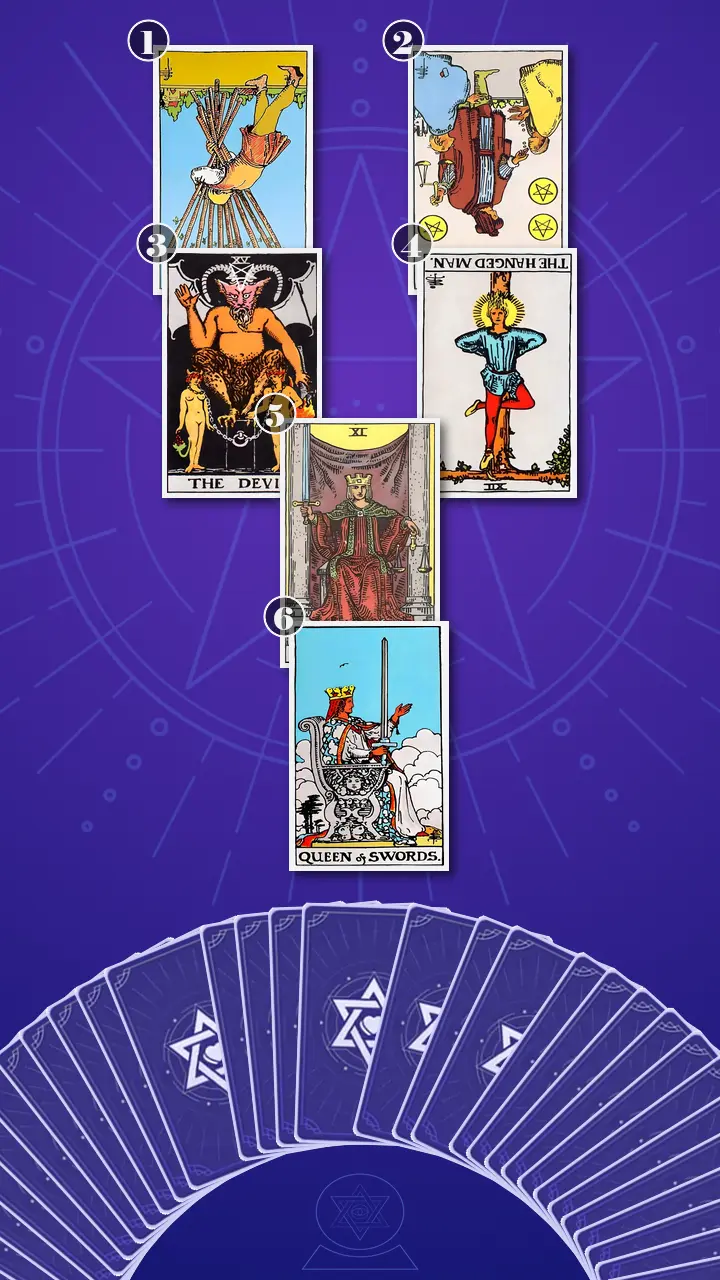
Today I used the Relationship Spread · Context Edition, a six-card Relationship Spread for examining friendship boundaries, unequal effort, and repeating dynamics. It fits this question because the problem is not simply which option Jordan should choose. It is a recurring interpersonal arrangement: what she contributes, what the group assumes, what keeps the exchange uneven, what blocks a boundary, what fairness could look like, and how to communicate it.
For anyone wondering how tarot works in a practical reading, I use the cards as structured prompts. Their images give us a shared visual language for details that often remain blurred inside a familiar habit. The first card would show Jordan's observable contribution. The second would show the group's expectations. The third and fourth would expose the repeating loop and its central blockage. Justice would identify a fair, observable standard, and the Queen of Swords would turn that standard into a small communication experiment.
I reminded Jordan that the cards could not make her friends rotate drivers, split a rideshare, or respond well to a boundary. They could help her notice the choice before the automatic yes, and that distinction mattered. The reading was a map, not a set of orders. Jordan remained the person deciding which road to take.
The Load That Blocked the Road
The Staffs That Hid Her Consent
"The first position shows the observable designated-driver behavior," I said. "It shows what you contribute, what you take responsibility for, and what you may be carrying without explicit consent. In traditional terms, this is the querent's position and contribution within the group."
I turned over the Ten of Wands, in reversed position.
In the Rider-Waite-Smith image, the figure bends beneath ten bundled staffs, and the load blocks his view of the road ahead. In Jordan's modern translation, the staffs were routes, pickup times, fuel, parking, sobriety, and every last-minute change that she solved before asking whether the assignment was hers. At 6:18 PM on Friday, she typed "I can drive" into the Toronto group chat before checking whether she wanted a drink, an early night, or any evening that was not organized around other people's timing. By the end of the night, her own preference had disappeared behind the transport plan.
Reversed, the Ten of Wands showed burden as excess and blockage. Helpfulness had been stretched past the point where it remained freely chosen. Jordan volunteered first, felt the short-term relief of making the plan work, and then wondered why the same solution kept producing resentment. The group chat had turned her availability into an auto-renewing subscription: everyone received the benefit because nobody had paused to cancel the default.
Jordan gave a small, bitter laugh. "That is too accurate. A little rude, honestly."
I smiled, but I did not soften the point into a prediction. "The card is not accusing you. It is showing the load blocking your view of the first question: do you actually consent to driving this time? You do not have to refuse every plan. You can wait ten minutes before volunteering and ask what task can be redistributed."
I watched her hand move from the phone to the mug and back again. Her mouth still held the trace of the joke, but her shoulders had lowered by a fraction. The first card had not made her feel rescued. It had made the automatic yes easier to see.
The Favor Everyone Receives
"The second position shows how the group receives your reliability and which expectations are sustaining the unequal transport arrangement," I said. "It is the other side's position and expectation, not a claim that I can read anyone's private motives."
I turned over the Six of Pentacles, in reversed position.
The upright Six of Pentacles speaks of giving, receiving, and the distribution of resources. Reversed, its energy becomes an unequal exchange, with reciprocity unclear or lopsided. At 8:47 PM outside a Queen West venue, Jordan had provided the car, stayed sober, advanced the parking cost, and monitored the pickup thread while her friends enjoyed the night. The imbalance was not hidden in some dramatic betrayal. It sat plainly in what had never been agreed: no driver rotation, no shared ride budget, no direct question about whether Jordan's time and flexibility were genuinely available.
I placed my fingertips beside the card's small scales. "This is where I use what I call Boundary Permeability Diagnosis," I told her. "As a perfumer, I have learned that a scent is not wrong because it is strong. It becomes suffocating when it fills a room without anyone choosing how much space it should occupy. I look for the point where an unspoken expectation begins bleeding into your space until your own consent is hard to detect."
I made the distinction carefully. "That does not mean your friends are automatically careless or malicious. It means the arrangement keeps working for them, so your practical labor has become part of the background. A fair transport plan should look more like a Splitwise balance agreed before dinner than a surprise charge discovered after midnight."
Jordan looked down at her phone as if the old parking receipt might still be there. Her fingers opened the calculator, hovered over the screen, and then went still. "They thank me for being reliable," she said. "But the praise feels hollow because the same burden comes back next weekend."
I nodded. "Appreciation and reciprocity are not the same thing. The question is not whether they appreciate you. The question is whether driving, money, time, sobriety, and inconvenience are shared by an agreement everyone can see."
The Chain That Called Itself Reliability
"The third position maps the Repetition Compulsion as an interaction loop: the trigger, your automatic response, the short-term reward, and the long-term cost," I said. "This is the relationship's current dynamic."
The next card was The Devil, upright position.
I did not present the Devil as a threat. I presented it as a picture of attachment and compulsive repetition. In the image, two figures are linked to a pedestal by loose chains. The chains are real, but they are not necessarily unremovable. For Jordan, the chain sounded like, "I might as well drive; that is what I always do." Her answer arrived before the question, giving her a quick sense of belonging and control while making an unequal arrangement feel like the price of being a good friend.
The energy here was attachment in excess. The role felt chosen because Jordan kept choosing it, yet guilt and familiarity had narrowed the moment in which she could notice the choice. She volunteered, organized the pickups, and absorbed the practical cost. The plan worked. That immediate relief taught the group and Jordan the same lesson again: Jordan will handle it. Later, the fatigue and private scorekeeping confirmed the belief that carrying the burden was simply what belonging required.
I used another lens from my work with scent, what I call Vibe Contamination Auditing. I was not labeling a friend as toxic. I was separating Jordan's own preference from the atmosphere surrounding the decision: urgency in the chat, praise for being dependable, the imagined disappointment, and the guilt that arrived before anyone had objected. Those emotional residues had polluted the air around a simple practical question.
I remembered my perfumer's table, where one strong note can drown out a dozen quieter ones. I thought about how often a person mistakes the loudest note for the whole composition. "Being reliable is a quality," I said. "Being permanently available is an arrangement. They are not the same identity."
Jordan's eyes moved from the loose chains to the card's raised platform. She exhaled through her nose and said, "I keep treating the role like something they imposed, but I have never actually asked for a different arrangement." I let the admission stand without turning it into blame. Seeing participation in a pattern was not the same as accepting responsibility for everyone's behavior.
The Pause That Preserved the Pattern
"The fourth position reveals the Martyr Complex mechanism that blocks fairness: the postponed boundary, the guilt about inconveniencing other adults, and the identity built around being needed," I said. "This is the central challenge or tension in the relationship."
I turned over The Hanged Man, in reversed position.
The card's inverted figure suggested a pause that had stopped producing perspective. The bound ankle, crossed leg, and calm face could represent a chosen suspension when upright, but reversed they showed Jordan remaining in the same posture without changing the terms. She kept calling the delay mature or convenient, while the delayed conversation kept the sacrifice in place.
I brought the 12:36 AM scene back into the room. Jordan was still waiting in her car outside a Toronto concert venue, watching the blue Share ETA dot move for the third pickup. Exhaust fumes mixed with the smell of fries from the corner. The heater clicked on and off, and her fingers clamped around the steering wheel while she silently promised to bring up the driver rotation next time.
"I am calling this patience," I said, "but am I only keeping the same arrangement intact?"
I watched her breath pause. Her eyes lost focus as though the pickup screen had become a replay of every previous Friday. Then she gave a long, quiet exhale and loosened one finger from the mug. "After this one," she murmured. "I have said that so many times."
I told her that the answer was not a dramatic cancellation or a punitive rupture. "The perspective-changing act is smaller and earlier: I can join, but I am not available to drive this time. You are allowed to state that before the route is built. You do not have to wait until resentment becomes the only evidence that something is wrong."
When Justice Put the Scales on the Table
The Standard That Made the Cost Visible
The room became unusually quiet when I reached the fifth position, the place that identifies the observable standard and mutual agreement that could make driving, money, time, and inconvenience proportionately shared. The fridge motor clicked off. From the street came the faint bell of a passing streetcar, clear enough to make the silence feel measured.
I turned over Justice, in upright position.
Justice was the spread's strength and its antidote. Her balanced scales asked for facts, not guilt. Her upright sword asked for a decision, not another private rehearsal. I told Jordan that fairness could be written in plain columns: who drives, who pays, who waits, who gives up flexibility, who stays sober, and whether each person agreed before the night began.
I re-staged the 8:47 PM Queen West parking scene and contrasted Jordan's private cost ledger with Justice's level scales. If she could calculate the fuel, the parking, the lost flexibility, the extra hour of pickup time, and the decision not to drink, I asked her to consider the question she had avoided: "If I can calculate the cost, why am I still treating it as mine?"
I reminded her of the Friday-night moment in her Toronto kitchen: the chat filling with drink orders, the phone warm in her hand, and her typing "I can drive" before anyone asked. She had solved the route, but she had not checked whether she consented to carrying it.
You do not have to prove belonging by carrying the transport burden again; set a visible shared standard, like Justice weighing both sides before anyone agrees to the plan.
Fairness is not measured by how much inconvenience you can absorb. It begins when responsibility is named, agreed to, and shared before the night starts.
Jordan's breath stopped first. Her fingers hovered above the phone, suspended between opening the group chat and protecting herself from it. Then her eyes went slightly unfocused as she mentally replayed the parking receipt, the sober hours, the route changes, the third pickup, and the way she had smiled in the Instagram Story while watching the clock. Her mouth parted on a quiet, disbelieving exhale. I saw her shoulders descend, her jaw unclench, and the fist she had made beside her knee slowly open. For one second, relief crossed her face, followed by a faint flush of fear. A fair standard meant she could no longer hide behind the question of whether she was allowed to want fairness. It also meant the next response would belong to other adults. "Oh," she said, almost under her breath. "I thought being fair meant absorbing the inconvenience."
I let the silence remain long enough for the insight to land. "Now use this new lens to revisit last week," I said. "Was there a moment when seeing the burden as shared responsibility would have made your choice feel different?"
She nodded, then looked uncertain again. I welcomed that uncertainty. The movement from anticipatory people-pleasing and silent resentment to explicit reciprocity, self-respect, and shared responsibility was not a magical switch. It was the first step from treating usefulness as the admission price for belonging toward treating herself as a participant whose terms mattered too.
The Sword That Became a Road Sign
"The sixth position turns the fairness standard into a small boundary and communication experiment before the next social plan is finalized," I said. "It is guidance: the part of the relationship where you can make one clear choice and leave other adults responsible for their response."
I turned over the Queen of Swords, in upright position.
The Queen's upright sword, open sky, and alert posture gave Justice a voice. Her energy was balanced Air: direct thought, discernment, and self-respect without punishment. The modern scene was simple. Before the route was set, Jordan could send, "I can join, but I am not available to drive this time. Can we choose another driver or agree on a shared ride cost?" She could remain connected to the group without continuing to run the unseen backend of the night.
"A clear boundary text is a road sign, not a courtroom closing argument," I told her. "It marks what is available without requiring everyone to take the same route. You do not need a joke, three apologies, or a legal case built from every past parking receipt. Name the transport terms early, and let the response give you information about the arrangement rather than a verdict on your worth."
Jordan typed the sentence into her Notes app. I watched her read it twice, waiting for the old urge to add an explanation. Her thumb moved toward the delete key, stopped, and then returned to her lap. "I could say that without making it funny," she said. The fear had not vanished, but it was no longer holding the pen.
The Fair-Share Transport Standard
When I placed the six cards together, the story became practical. The reversed Ten of Wands showed Jordan carrying the routes and pickups before checking consent. The reversed Six of Pentacles showed the material exchange hidden inside the favor: a car, sobriety, fuel, parking, time, and flexibility flowing in one direction without a clear rotation. The Devil showed why the role kept repeating: being indispensable brought a brief sense of safety and belonging. The reversed Hanged Man showed the postponed boundary that preserved the pattern. Justice supplied an observable standard, and the Queen of Swords supplied the sentence that could bring it into the group chat.
The cognitive blind spot was not that Jordan cared too much. It was that she had been treating her ability to absorb inconvenience as proof that the inconvenience was hers. She had also been treating possible discomfort from the group as evidence that her request was selfish. I named the key shift plainly: replace automatic volunteering with an early, explicit request for a shared driving rotation before plans are finalized.
No card promised that every friend would respond perfectly. The reading did not ask Jordan to stop caring, abandon the group, or make her relationships pass a moral test. It asked her to move transportation from an invisible personal sacrifice into a shared agreement. The Fair-Share Transport Standard could include rotating drivers, sharing rideshare costs, splitting fuel and parking, choosing a TTC-friendly venue, or agreeing on pickup time and flexibility before anyone commits.
I then introduced my Space Calibration Ritual. In perfumery, I cannot evaluate a scent properly when every note is crowded into the same small space. I create room, let the air move, and then decide what belongs in the final composition. Jordan could do the same with the group chat: create a digital blank space before replying, and a physical blank space by putting the phone down, feeling both feet on the floor, and checking her own availability before absorbing everyone else's.
- Take the Ten-Minute No-Auto-Yes Pause.At the next Friday or weekend plan, mute the group chat and wait ten minutes before mentioning driving. In the pause, write three notes: whether you want to drink, whether you need to leave at a fixed time, and whether driving is genuinely available to you. Then return with one neutral question: "What is our plan for rotating drivers or sharing a ride cost?"Set a ten-minute timer if the uncertainty feels loud. The minimum version is simply waiting before volunteering; no one is entitled to an immediate answer.
- Make the Fair-Share Columns Visible.Before the venue is confirmed, open a Notes page and list driving, sobriety, fuel, parking, pickup time, and flexibility. Offer two or three workable options: rotate drivers, split a rideshare, or choose a location reachable by transit. Ask the group to confirm one option before agreeing to the transport role.Do not itemize every past favor to prove the point. Keep the request concrete, and let a vague response provide information without making it a personal verdict.
- Use One Queen of Swords Sentence.Send the message early, before the route and drink plans are settled: "I can join, but I am not available to drive this time. Can we choose another driver or agree on a shared ride cost?" If someone asks why, repeat the practical limit rather than building a case.Do not soften the message with a joke or apology, and do not monitor the typing indicators continuously. You may draft it first and decide for yourself whether, when, and with whom to send it.
These were small steps, not a demand to solve the friendship in one night. Jordan could choose a rotation, a shared-cost plan, a transit-friendly venue, or simply a pause long enough to discover what she wanted. The cards had offered actionable advice, but the authority remained with her.

A Smaller Role in a Brighter Night
Five days later, I received a message from Jordan while I was at my perfume studio, surrounded by blotter strips drying in the clean afternoon air. She had used the Space Calibration Ritual before the next group plan. She muted the chat, waited ten minutes, checked her own preference, and sent the Queen of Swords sentence without a joke.
She told me that one friend volunteered to drive and the others agreed to split the rideshare cost if the plan changed. Jordan went to dinner, left when she wanted, and did not spend the evening running pickup logistics from the edge of the room. She sent the message, then watched the typing indicators for three minutes, expecting a verdict. The group answered, and the old fear still sat lightly in her chest, but it no longer chose for her.
I told Jordan that this was the first proof of clarity: not that the friendship had become perfectly balanced, but that she had entered the night as a person rather than as its infrastructure. She had moved from carrying the burden by default toward explicit reciprocity, self-respect, and room to choose.
When you are sitting in the parked car after the last pickup, jaw clenched and shoulders heavy, it is possible to want shared responsibility and still keep carrying it because being needed feels safer than risking being called selfish.
If fairness could enter your group chat before the route is set, what is the smallest sentence you would want to let exist there?