The 10:48 p.m. Voice Note
I first met Maya, a 27-year-old junior product designer in Toronto, during a video reading she had booked after searching some version of, “Why do I keep absorbing my friend’s emotions when I need space?” She had already closed Figma for the day. What she could not seem to close was the emotional support shift that began whenever her friend sounded upset.
At 10:48 the previous night, Maya had placed her phone face down beside an open novel and reached for a mug of peppermint tea. The radiator clicked against the quiet, the book felt cool beneath her fingertips, and then a voice-note notification lit the room. She turned the phone over, felt its stored warmth in her palm, listened twice, and began drafting reassurance before checking whether she had anything left to give.
As Maya demonstrated that motion for me, her shoulders rose toward her ears. She described emotional overwhelm as pressure behind her ribs, almost like a shared inbox had been installed inside her chest and every new feeling arrived marked urgent. Her own evening could remain unread indefinitely.
“I need space, but taking it makes me feel like a bad friend,” she said. “I keep waiting for their mood to settle before I let myself switch off. By the time I set a boundary, I’m already resentful.”
I heard the contradiction clearly: Maya wanted enough space to remain connected to her own needs, yet she felt pulled to absorb and regulate her friend’s emotions before rest was permitted. The visible problem was another late-night voice note. Underneath it sat a more painful equation: if Maya became separate while her friend was struggling, perhaps she would no longer count as caring, dependable, or securely connected.
“Nothing about this makes you a bad friend,” I told her. “You have a strong capacity for emotional attunement. We’re going to examine what happens when that capacity loses its container. I’m not here to predict what your friend will do or tell you whether this relationship should continue. I’m here to help us draw a map through the fog, so you can decide how you want to respond.”

Choosing a Boundary Map, Not a Verdict
I asked Maya to place both feet on the floor, lower her shoulders as far as they would comfortably go, and hold one question in mind: “How can I care without carrying the whole feeling home?” I shuffled slowly. The pause was not a mystical performance; it was a deliberate transition from reacting to observing.
I chose the Relationship Spread · Context Edition, a contextualized seven-card relationship tarot spread for friendship boundaries. I use this layout when a question lives in the space between two people but the reading must remain anchored in what the querent can actually observe and choose. A shorter spread might collapse perceived emotional cues, established habits, and present-day exchange into one vague diagnosis. A broader spread would add life areas Maya had not asked about.
The upper cards would show Maya’s emotional absorption and the meanings she assigned to her friend’s cues. The middle row would expose the exchange pattern, current misattunement, and boundary fatigue. The lower pair would translate the reading into a constructive response and a nonpredictive marker of healthier contact. I made one point explicit: no card would claim access to her friend’s private thoughts. The spread was a cognitive map, not surveillance and not fate.
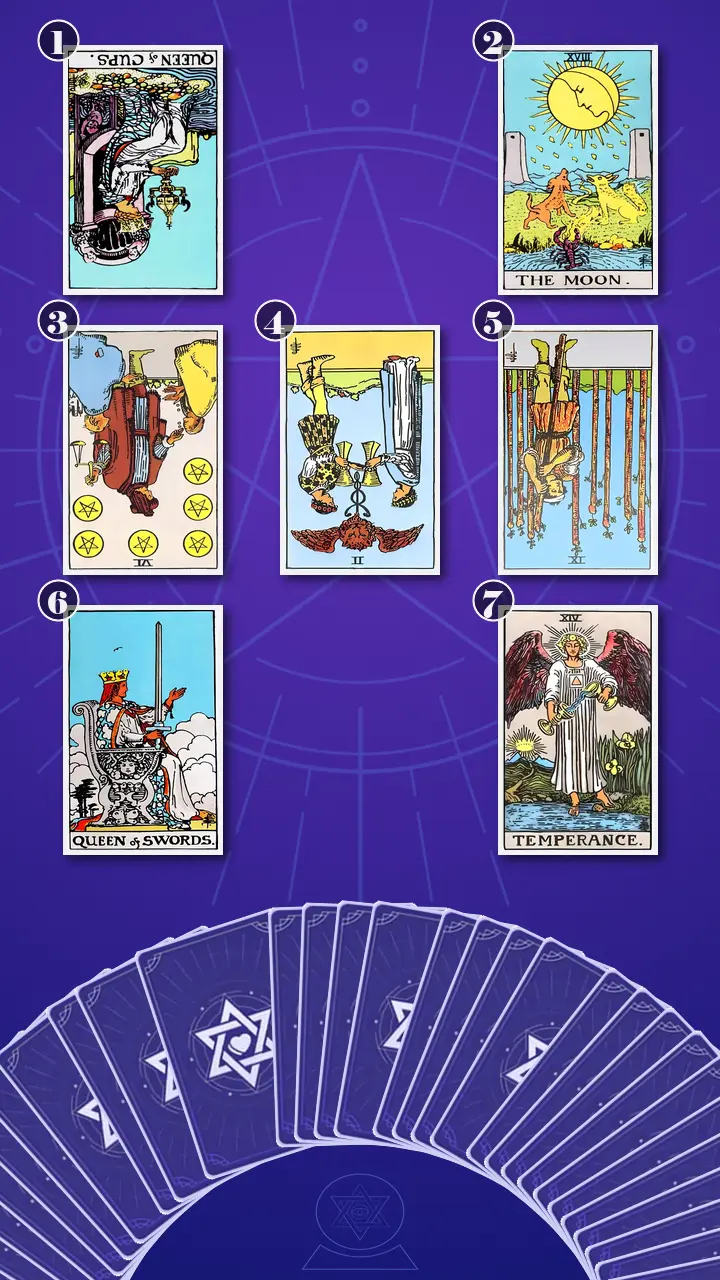
Reading the Waterline of the Friendship
Position 1: The Cup That Never Gets Put Down
I turned the card representing Maya’s present pattern of emotional absorption, including the place where empathy had begun to feel like responsibility. It was the Queen of Cups, reversed.
I showed Maya the Queen studying her ornate, lidded cup while sitting close to the sea. In Maya’s life, that closed cup had become the message thread at 10:48 p.m.: a sealed emotional problem she believed she had to study and resolve before returning to her novel. She listened twice, tracked the tremble in her friend’s voice, and began writing reassurance before asking, “What am I already feeling, and what can I realistically offer?”
The reversed energy showed excess receptivity and blocked differentiation. The problem was not that Maya felt too much or cared too deeply. The problem was that no reliable inner boundary decided what entered, what belonged to her, and how long it stayed. Emotional cues were becoming instructions.
“Before you open the next intense message,” I said, “what happens in your shoulders, jaw, and chest?”
Maya gave a short, bitter laugh. “That is so accurate it feels a little brutal. My shoulders go up before I even press play.” Her fingers tightened around her mug, then released. “It’s like my body has already agreed to help.”
“Then that body response is useful information, not a character flaw,” I replied. “It can become the moment when you check capacity, rather than proof that you must proceed.”
Position 2: The Moonlit Tunnel of Guesses
I turned the card representing the emotional cues Maya noticed and the meanings she assigned to them. It was The Moon, upright. I reminded her that this position could examine her available information, but it could not define her friend’s unspoken state.
I pointed to the dog and wolf responding differently beneath the same moon. One unclear signal could activate Maya’s social, caring self and her instinctive fear of relational rupture at the same time. On the TTC ride home, a short “okay,” a long pause, or a missing heart reaction could send her through a tunnel of possible explanations. Before confirming anything, she might offer extra reassurance, change her evening, and begin monitoring the typing indicator.
Here, uncertainty was real, but the energy became excess projection when a possibility hardened into a forecast. The friend’s meaning remained partly unknown; Maya’s prediction nevertheless began directing her attention, schedule, and body.
I drew two columns on a page and labelled them Fact and Forecast. Under Fact, I wrote: “They replied, ‘okay.’” Under Forecast, I wrote: “They feel rejected, the friendship is in danger, and I must repair it tonight.”
“Which column has been making your decisions?” I asked.
Maya’s gaze moved away from the cards as though she were replaying several train rides. Her lips parted, then closed. “The forecast. Every time.” The answer came quietly, with recognition and a small amount of grief.
Position 3: The Resource Budget With One Person Missing
I turned the card representing the established exchange pattern beneath Maya’s over-availability, especially the belief that closeness had to be maintained through usefulness. It was the Six of Pentacles, reversed.
The figure on the card held scales in one hand while distributing coins with the other. I described a Sunday cafe near Queen Street West: Maya agreeing to one more call while the espresso machine hissed, her laptop flashed a low-battery warning, and her stomach reminded her that dinner had already been delayed. She counted how distressed her friend sounded, but not the concentration, sleep, commute time, or recovery she was spending.
The reversal showed a deficiency in mutual accounting. Giving was not inherently the problem. The distortion appeared when only one person’s need entered the calculation. Maya’s own finite resources remained outside the scale, so support offered from guilt looked identical to support offered freely.
“If you count your capacity, what are you afraid it says about your care?” I asked.
“That I’m making friendship transactional,” she said. Her thumb rubbed slowly over the cup’s rim. “Or that I’m looking for a reason not to show up.”
“Capacity tracking is not a debt ledger,” I said. “It does not score your friend. It reveals whether your yes is chosen. Generosity needs choice if it is going to remain generosity.”
Position 4: Two Cups, One Hidden Capacity
I turned the card representing how Maya’s unspoken need for space interacted with the friendship’s emotional momentum. It was the Two of Cups, reversed.
I returned to the two raised cups that ordinarily meet in mutual recognition. In Maya’s recent conversations, both people were technically present, but Maya often brought agreement and availability instead of her actual capacity. She accepted a call while wanting solitude, said she was fine when asked, and later sounded clipped because the unspoken mismatch had fermented into resentment.
The reversed energy showed a blockage in reciprocity, not an absence of care. Two people could not make a mutual agreement when one person’s limit remained hidden. Maya was silently replacing exchange with regulation: “If I can just get them calm, then I can rest.” The phone became the Queen of Cups’ sealed problem again, and the whole evening disappeared into the effort to solve it.
“What would support look like if both people’s capacity mattered at the same time?” I asked.
Maya’s breath paused. Her eyes remained on the two cups while her fingers loosened around the mug. “They would get an honest answer,” she said. “Not the answer I think will keep everything smooth.”
Position 5: The Boundary That Arrives as an Emergency
I turned the card representing the central obstacle of boundary fatigue, including Maya’s habit of delaying a limit until care had already become depletion. It was the Nine of Wands, reversed.
I showed her the bandaged figure leaning on the final staff. By 11:37 p.m., Maya had often said yes so many times that one more notification felt unbearable. Only then did she mute the thread or send a terse “I can’t do this tonight,” after which she lay awake revising the message in her head.
The reversal showed depleted fire and collapsing stamina. Persistence had stopped functioning as resilience. Exhaustion had become the only evidence Maya trusted when deciding whether she was allowed to stop. The boundary therefore arrived as an emergency barricade instead of an early, sustainable threshold.
“A boundary is a time and amount of contact, not a verdict on the friendship,” I told her. “If it appears only after your jaw hurts and your attention is scraped thin, it is reporting that capacity has already been spent.”
Maya sat back. A long exhale left her chest. “I keep calling it a scheduling issue because admitting I crossed my own limit feels worse.”
“That admission does not require blame,” I said. “It gives you an earlier intervention point.”
When the Queen of Swords Raised One Clean Line
Position 6: Capacity Before Contact
The room seemed to quiet before I turned the card representing Maya’s most constructive response: communicating her capacity clearly, early, and without a paragraph of justification. It was the Queen of Swords, upright.
I traced the Queen’s vertical sword and then her open, extended hand. The sword was not a weapon aimed at the friendship. It was one complete sentence: “I care about this, but I cannot process a long voice note tonight. I can check in tomorrow after work.” The open hand was the support Maya genuinely chose to offer. Together they held clarity and warmth without making either one cancel the other.
The card introduced the missing air of language and discernment. Its energy was balanced: empathy could notice another person’s feelings, while responsibility no longer had to take over the entire system. The message did not need a courtroom-length defence of Maya’s character.
For a moment, I thought of the charts I had drawn across a decade of guiding people through life’s cycles. A difficult alignment does not automatically mean either body is wrong. Sometimes the pain comes from forcing two different rhythms to behave as one.
I call that diagnostic lens Gravity De-linking Analysis. I used it here without claiming that Maya had outgrown her friend or that the friendship needed to end. I asked a narrower question: where was Maya forcing her recovery cycle to align with someone else’s emotional urgency? Her friend’s feelings could exert a pull without being granted control of Maya’s orbit. Different needs were information, not betrayal.
I brought Maya back to 10:48 p.m.: the phone beside the novel, the warm screen, the clicking radiator, and her shoulders already lifting before she pressed play. I could see the old equation still running: a caring decision must leave both people calm, or it does not count as care.
I said, “Capacity before contact. Your friend’s feelings can be real without becoming your next task.”
You do not need to feel what your friend feels in order to care. Name your capacity before offering support: a clear limit can protect genuine connection without making you responsible for regulating another adult’s emotional state.
I let the silence hold for a moment. Then I gave her the Queen’s central message exactly as I saw it.
Caring is not emotional merging; choose a clear limit and hold it like the Queen's upright sword, with an open hand for the support you can genuinely offer.
I watched Maya inhale and stop. Her fingers hovered above the table as if a reply box had opened beneath them. Her pupils widened, and her gaze lost focus while I could almost see old conversations replaying behind her eyes. Then her eyebrows pulled together. “But doesn’t that mean I’ve been doing it wrong this whole time?” she asked, her voice suddenly sharper. “I thought being available was the good part of me.” For a few seconds, clarity looked less like relief than anger at the cost of her old strategy. Her eyes reddened. One hand closed into a fist, then slowly opened. Her shoulders dropped, and a breath came out with a faint tremor. After the release, she looked briefly unsteady, as though putting down the responsibility had left an unfamiliar blank space where certainty used to be.
“It means availability became the method you used to create safety,” I replied. “That method helped you feel useful and connected for a while. We don’t need to shame it. We only need to notice that it now charges too much for the relief it gives you. The Queen is not taking away your sensitivity. She is returning your authority over how you use it.”
I leaned closer to the screen. “Now, with this new perspective, think back to last week. Was there a moment when this insight could have changed how you felt?”
Maya remembered a hybrid-work afternoon when a long voice note arrived beside Figma, Slack, and Google Calendar. She had closed the prototype and drafted three soothing replies before checking whether support had even been requested. “I had maybe three out of ten capacity,” she said. “If I’d named that first, I could have finished the design and still offered tomorrow.”
I heard the first step of the deeper transformation in that sentence. Maya had not moved from emotional vigilance to perfect confidence. She had moved from automatic responsibility to initial discernment, from “How do I make them okay?” to “What can I honestly offer?” That was a small but decisive crossing toward protected space and reciprocal connection.
Position 7: Temperance and the Measured Pour
I turned the final card, representing a nonpredictive marker Maya could use to recognize balanced empathy in her own behaviour. It was Temperance, upright.
The angel poured water deliberately between two separate cups while keeping one foot on land and one in water. I asked Maya to imagine a defined 20-minute call. She could name the time available, listen without trying to resolve every feeling, notice what arose in her own body, close warmly when the time ended, and return to making tea or reading one page without continuing the conversation internally.
Temperance showed balanced emotional flow. It did not promise a particular response from her friend or guarantee the future of the relationship. It offered Maya observable evidence: paced contact, separate emotional ownership, protected recovery time, and a real return point. She did not need to delete the entire playlist; she needed control of the volume.
“You can hold the cup without drinking the whole tide,” I said. “The aim is not to become less sensitive. It is to decide the rate and amount of contact that allows sensitivity to remain sustainable.”
Maya nodded slowly. This time, I saw neither the quick agreement of people-pleasing nor the hard shutdown of exhaustion. I saw her considering proportion.
The Boundary Becomes a Time, Not a Verdict
I gathered the seven cards into one coherent story. The reversed Queen of Cups showed Maya absorbing emotional cues before locating herself. The Moon showed incomplete information becoming a fear-based forecast. The reversed Six of Pentacles revealed the older exchange pattern: closeness was being measured through usefulness while Maya’s time and recovery stayed off the scale. The reversed Two of Cups and Nine of Wands showed the present consequence: an unspoken need for space turned into misattunement, depletion, and a boundary delivered too late. The Queen of Swords restored language; Temperance gave that language a sustainable rhythm.
The central blind spot was not simply “poor scheduling.” Maya had been treating her friend’s calm as the permission slip for her own rest. That made every emotionally intense message feel like an open support ticket and every pause feel like a threat to belonging. The transformation direction was specific: move from responding to intensity immediately toward naming capacity first and offering a clear time to reconnect.
I also made clear what the reading had not established. It had not diagnosed her friend, proved the relationship unhealthy, or ordered Maya to withdraw. Tarot was helping us separate facts, predictions, resource costs, and available choices. Maya remained the person deciding what happened next.
For the practical work, I adapted my Constellation Release Protocol. I often use this approach to help people accept peaceful transitions without trying to drag another person into the same orbit. Here, I applied it on a smaller scale: Maya was not releasing the friendship. She was releasing responsibility for controlling one emotional moment, allowing the interaction to pause while both people remained in their own lives.
- The 90-Second Open-Hand BoundaryWhen the first emotionally intense message arrives this week, pause for 90 seconds before opening the reply box. Rate capacity from zero to ten. If it is below five, send one complete sentence: “I care about this, but I can’t stay present tonight. I can check in tomorrow after work.” Then place the phone face down and return to one chosen activity for ten minutes.Tip: Set a timer before reopening the thread. Do not add a second paragraph to manage the reaction. If sending feels overwhelming, draft the sentence without sending it, or choose not to engage until capacity returns.
- The Two-Cup Check-InChoose one check-in window that fits the real week, such as a 20-minute call on Wednesday at 7:30 p.m. At the beginning, state the available time. When it ends, close with a warm sentence and move directly into one physical activity such as making tea, showering, stretching, or reading one page.Tip: Start with five minutes if 20 feels too demanding, and use a calendar reminder so the ending does not depend on last-minute courage. A time window structures connection; it does not test the friendship.
I asked Maya to treat both practices as experiments, not moral exams. A friend’s discomfort would not automatically mean a boundary was wrong, just as Maya’s guilt would not automatically mean she had caused harm. The useful data would be whether she had spoken truthfully, acted within capacity, and remained able to return to her work, body, sleep, and other relationships.

A Week Later: Four Pages and a Quiet Morning
A week later, I received a message from Maya. Another long voice note had arrived during her quiet evening. She had noticed her raised shoulders, rated her capacity at three, and sent the Queen of Swords sentence with a specific time to reconnect. The guilt had appeared immediately, but she had not mistaken it for an instruction.
That night she sent the sentence, set ten minutes, and read four pages. She slept through, although her first morning thought was, What if they are hurt? This time, she told me, she smiled at the thought, checked her own shoulders, and made coffee first.
Her friend’s feelings had not vanished, and Maya had not solved every question in the friendship. That was precisely why I trusted the change. The proof was not that the boundary produced a perfectly comfortable outcome. The proof was that Maya could feel care, guilt, uncertainty, and relief without surrendering her entire evening to any one of them.
I did not credit the cards with creating that choice. The cards gave us an objective structure for seeing the emotional flood, the fearful forecast, the missing resource count, and the clean line that could interrupt the cycle. Maya supplied the honesty, sent the message, and held the limit. She remained the author of what came next.
That was our Journey to Clarity: not emotional silence, not certainty about another person, but a movement from vigilance and guilt-driven availability toward discerning compassion, protected space, and measured contact. A contextualized seven-card Relationship Spread can illuminate the pattern, but clarity becomes real only when someone chooses one grounded action inside ordinary life.
If a friend’s message makes your shoulders rise and your evening disappear, it may feel safer to carry their feelings than to risk discovering that you can be separate and still belong. Noticing that pull already places one hand back on the controls.
If care could begin with an honest capacity check and still include a clear return point, what small window of space could you hold this week between the Queen’s upright sword and her open hand?
This story is adapted from psychological research, written so that those in a similar struggle can see their own pattern in it — and find their next step clearly.These insights are not a substitute for professional psychological, medical, legal, or financial advice.
Learn more about our Journey to Clarity.
How did this insight land for you?
🫂 This Resonates Deeply
🌀 Living This Story
✨ Now I See Clearly
🌱 Seeing New Possibilities
🧰 Useful Framework
🔮 The Confirmation I Needed
💪 Feeling Empowered
🚀 Ready for My Next Step
Author Profile
 AI
AI“After a decade of guiding people through the stars, I’ve come to see life much like the orbits of planets: everything has its inevitable cycles. When you feel lost, please don't blame yourself; you might just be in a natural low tide. I’m here to sit under the night sky with you, offering a gentle cosmic perspective to distinguish temporary pain from the beautiful breakthroughs just around the corner.”
In this Friendship Tarot Reading :
Core Expertise
- Orbital Drift Recognition: Objectively mapping how personal cognitive upgrades naturally lead to mismatched frequencies with old friends, removing the guilt of outgrowing them.
- Gravity De-linking Analysis: Identifying the painful friction that occurs when two friends try to force an alignment despite moving into completely different life phases.
Service Features
- The Constellation Release Protocol: A psychological closure technique to peacefully accept the natural fading of a friendship, leaving them in their orbit while you transition to your next.
Also specializes in :
Explore Related Patterns:
Boundary DiffusionYour shoulders rise before you press play, and the incoming emotion lands like an urgent item in a shared inbox inside your chest. Because you accept contact while wanting solitude and hide your actual capacity, the boundary between noticing another person's feeling and carrying it into your own evening becomes difficult to locate. Boundary Diffusion describes that loss of differentiation: an emotional cue crosses directly into your body, schedule, and sense of obligation before you consciously choose a response. Rebuilding the boundary does not require emotional distance; it means deciding what belongs to you, what belongs to your friend, and what amount of contact you can consent to now.
Boundary DiscernmentBefore answering the next long voice note, you notice your raised shoulders, rate your capacity at three, and state that you can reconnect tomorrow after work. Your friend's feelings remain real, but the bodily cue now triggers a check of your own position instead of automatic agreement. Boundary Discernment turns separation into a conscious allocation of time, attention, and emotional ownership rather than a verdict on the friendship. Holding the limit while guilt is present shows that the boundary is guided by observed capacity, not by the demand to eliminate every uncomfortable feeling before you are allowed space.
Emotional Hyper-ResponsibilityAt 10:48 p.m., you listen twice and start drafting reassurance before asking what you still have available. Waiting for your friend's mood to settle before allowing yourself to switch off turns empathy into an internal duty: their distress becomes a task that must be completed before rest can begin. That sequence reflects Emotional Hyper-Responsibility because care is measured by whether you can regulate another person's state, rather than by whether your offer is freely chosen and sustainable. The key audit point is the moment emotional information becomes an instruction; separating concern from responsibility lets you remain caring without making someone else's calm the price of your recovery.
Friendship OverfunctioningWhenever your friend sounds upset, an emotional support shift begins, even when you have already closed work or need quiet. During the hybrid-work afternoon, you close the prototype and draft three soothing replies before checking whether support has been requested, placing yourself in the regulator role automatically. Friendship Overfunctioning appears when usefulness becomes the main method for maintaining closeness and you perform more emotional work than the situation has explicitly asked for. The corrective question is not whether you care enough; it is whether the support role was requested, chosen, and proportionate to what you can realistically give.
Guilt-Driven People-PleasingYou say that taking space makes you feel like a bad friend, then accept contact while wanting solitude and begin reassuring before checking your capacity. The immediate yes reduces the threat of guilt and possible disconnection, but it replaces an honest choice with the answer most likely to keep the relationship smooth in the moment. Guilt-Driven People-Pleasing is operating when guilt functions as pressure to perform care, rather than as one feeling to consider alongside your actual resources. The pattern becomes visible when support offered to escape guilt looks identical to support you genuinely want to give; naming capacity first restores the difference between care and compliance.
Mind ReadingA short 'okay,' a delayed reply, or a missing heart reaction sends you into predictions that your friend feels rejected and the friendship may be in danger. Before confirming what the cue means, you offer extra reassurance, change your evening, and monitor the typing indicator as though the forecast were already a fact. Mind Reading turns missing information into a confident relational story, usually one shaped by the outcome you most want to prevent. Separating the observed cue from the meaning added to it interrupts the mechanism: uncertainty can remain unresolved without automatically becoming evidence that repair is required tonight.
People-Pleasing Resentment CycleYou accept a call while wanting solitude, say you are fine, and postpone the limit until one more notification feels unbearable. The concealed no does not disappear; it accumulates until your response becomes clipped or abrupt, after which you lie awake reviewing the boundary and questioning how it landed. The People-Pleasing Resentment Cycle protects short-term harmony by hiding your capacity, then charges that decision back as depletion and anger. An earlier, smaller limit interrupts the cycle before resentment has to perform the boundary-setting work that direct communication was not allowed to do.
Resource AlignmentYou rate your capacity at three out of ten, decline the long conversation for that evening, and offer a specific time after work instead. The decision now includes concentration, sleep, recovery, and the ability to return to reading, rather than measuring only how distressed your friend sounds. Resource Alignment matches the timing and amount of support to what is genuinely available. Because the offer has a defined shape and return point, generosity becomes a chosen use of finite resources instead of an open-ended response to guilt or urgency.
Self-AbandonmentYour novel remains open and unread while your friend's feelings receive urgent attention, and the same exchange displaces work, dinner, sleep, and recovery. You count how distressed your friend sounds but leave your own concentration, bodily state, and need for solitude outside the decision. Self-Abandonment is present when preserving connection requires your internal data to disappear from the calculation. Restoring that data is not a withdrawal of care; it means treating your capacity as relevant evidence so that support no longer depends on repeatedly leaving yourself out.
Reality TestingYou place 'They replied, okay' under Fact and the predicted rejection and friendship danger under Forecast. A week later, the thought 'What if they are hurt?' still appears, but you recognize it as a possibility rather than confirmed information and make coffee before checking. Reality Testing protects the distinction between an observable cue and the meaning fear assigns to it. That distinction does not promise certainty about your friend; it gives you enough cognitive distance to choose from available facts instead of organizing your evening around an unverified prediction.
Relational HypervigilanceYour shoulders rise before you press play, while your attention tracks a tremble in your friend's voice, a pause, a missing reaction, and the typing indicator. The same scanning appears across late-night messages, train rides, and workday interruptions, preparing your body for relational repair before a clear problem has been established. Relational Hypervigilance keeps connection under continuous observation so that a possible rupture can be detected and managed early. The cost is that neutral or incomplete cues receive urgent attention while your own body and plans become secondary; using the shoulder response as a capacity signal redirects the scan toward information you can actually act on.
Uncertainty ToleranceAfter sending the boundary, you feel guilt and wake with the thought that your friend may be hurt, yet you do not reopen the conversation to force immediate reassurance. You check your shoulders and make coffee first, allowing the other person's possible reaction to remain unknown for a while. Uncertainty Tolerance means care no longer depends on producing a perfectly comfortable outcome for both people. By allowing guilt, concern, and incomplete information to exist without surrendering your evening, you make room for connection that does not require control of another adult's emotional response.
Explore Related Struggles:
Availability-Worth FusionWhen you say that taking space makes you a bad friend, and that being separate might mean no longer counting as caring, dependable, or securely connected, availability stops being one way of helping and becomes evidence of who you are. On the Sunday call, you counted how distressed your friend sounded while your low battery, delayed dinner, concentration, sleep, commute, and recovery remained outside the scale. A yes offered from guilt could therefore feel more reliable than an honest capacity check. The capacity-three evening beside your design work exposed the same equation. Sending a clear return time did not erase care, but it separated care from constant access. The bind is between needing availability to prove connection and needing space to remain a whole person; once those are fused, another person's distress can claim your time before you decide what you genuinely offer.
Boundary CollapseAt 10:48 p.m., you put your phone beside an open novel, then turned it over, listened twice, and drafted reassurance before asking what you had left to give. Your shoulders lifted before the message even played, so another person's cue entered your body as an instruction before you had located your own limit. By 11:37 p.m., the boundary arrived as an emergency mute or terse message rather than a chosen amount of contact. The same sequence reappeared beside Figma, Slack, and Google Calendar, when you closed the prototype and wrote three soothing replies before checking whether support had been requested, even with capacity at three out of ten. The structural difficulty is not a lack of care; it is the loss of a separate place from which care can be chosen. Your friend's feeling, your body's alarm, and your next action occupy the same channel, leaving your own evening unread.
Rest-Belonging SplitYou say you need space, yet waiting for your friend's mood to settle has become the permission slip for turning off. Accepting a call while wanting solitude and saying you are fine keeps the connection smooth in the moment, but the unspoken limit later comes out as a clipped voice and resentment. Protected recovery and continued belonging remain active at the same time, with neither need fully allowed to set the pace. The sentence you identified, 'I care about this, but I cannot process a long voice note tonight. I can check in tomorrow after work,' gives both needs a place. It does not make the friendship a verdict or require you to become less sensitive. It makes contact a time and amount you can choose, so space no longer depends on pretending that the other person's emotional state has already settled.
Projection-Connection SplitA short 'okay,' a long pause, or a missing heart reaction can send you into a tunnel of explanations while the only confirmed fact is that the message arrived. You then offer reassurance, change your evening, or monitor the typing indicator before your friend's meaning is known. The uncertainty is real, but the forecast starts making decisions on behalf of the relationship. Writing 'They replied, okay' beside 'They feel rejected, the friendship is in danger, and I must repair it tonight' separates the signal from the story your action has been serving. The difficulty is that protecting connection begins to depend on treating a possibility as a present obligation. When the forecast loses its automatic authority, you can stay attentive to your friend without making an unconfirmed meaning responsible for your body, schedule, and rest.
Explore Related Emotions:
Boundary GuiltWhen you said, "I need space, but taking it makes me feel like a bad friend," the limit had already been turned into a judgment about your character. You waited for your friend's mood to settle before permitting yourself to switch off, so rest became something you had to earn through emotional availability. That guilt explains why the boundary arrives late and sharply. You are not only deciding whether to answer a message. You are trying to avoid the feeling that protecting your evening makes you less caring. Naming a time and amount of contact gives the limit a practical shape, so it no longer has to carry the weight of a verdict about who you are.
Cautious Self-TrustDuring the hybrid-work afternoon, you noticed that you had three out of ten capacity, named it, and recognized that you could finish the design while still offering a time to reconnect. You did not need to become perfectly certain before making a clear choice. The capacity check gave your own experience a place in the decision. A week later, guilt appeared immediately after you sent the boundary, but you did not mistake that feeling for an instruction. You read four pages, slept through the night, and made coffee before responding to the morning worry that your friend might be hurt. That is the shape of cautious self-trust here, allowing uncertainty to exist while your own limit still counts as real information.
Usefulness-Based Belonging FearWhen you said that becoming separate while your friend was struggling might mean you no longer counted as caring, dependable, or securely connected, usefulness had become tied to belonging. Your availability was doing more than offering support. It was trying to secure the relationship and protect you from the possibility of being seen as uncaring. That is why the voice note feels larger than one request. If regulating the other person's mood becomes proof that you still belong, your own need for space starts to look like a threat rather than a normal part of connection. The fear is not evidence that separation will destroy the friendship. It shows how heavily the friendship's sense of safety has been placed on what you can provide in the moment.
Emotional FloodingAt 10:48 p.m., you turned the phone over, listened twice, and began drafting reassurance before checking whether you had anything left to give. Your shoulders rose before you pressed play, while the next feeling arrived as if it belonged in an urgent shared inbox inside your chest. That sequence lets another person's cue take over the room before you have decided whether you can receive it. Your novel, tea, and own evening become unread material while your attention is pulled toward containment. The pressure is not proof that you care too much. It is information about how quickly contact is entering your body and occupying space that has not yet been consciously offered.
Relational AnxietyOn the TTC ride home, a short "okay," a long pause, or a missing heart reaction could send you through a tunnel of possible explanations. You began offering reassurance, changing your evening, and monitoring the typing indicator before the friend's meaning had been confirmed. The unknown signal then became an internal forecast about rejection and the safety of the friendship. Once that forecast directs your attention and body, absorbing the other person's feelings can feel like the fastest way to prevent a rupture that has not actually been established. Separating fact from forecast gives you room to care without letting an unverified possibility decide the entire night.
Resentful ExhaustionAt the Sunday cafe, you counted how distressed your friend sounded while your low battery, delayed dinner, concentration, commute, and recovery stayed outside the calculation. By 11:37 p.m., one more notification felt unbearable because the earlier yeses had already spent the resources you were not allowing yourself to name. The clipped tone and late boundary are signals from an overdrawn system, not proof that care was false. When stopping is permitted only after your jaw hurts and your attention is scraped thin, resentment becomes the first clear evidence that a limit was needed. Counting capacity earlier gives generosity a choice again instead of asking exhaustion to make the decision for you.
Explore Related Contexts:
Emotional Labor ImbalanceAt 10:48 p.m., Maya listens to the voice note twice and starts drafting reassurance before checking her capacity. At the cafe, she counts how distressed her friend sounds while her delayed dinner, low laptop battery, concentration, sleep, and recovery remain outside the calculation. The imbalance is visible in how the friendship's resources are counted. One person's immediate need becomes legible and urgent, while the other person's finite attention is treated as an invisible supply. Support given under pressure therefore looks identical to support chosen freely, even though the personal cost is materially different. When your care repeatedly consumes work, rest, and private time without those resources entering the exchange, the issue is larger than one inconvenient message. Naming your available capacity restores your resources to the scale and lets you assess whether the friendship can hold support that is both caring and sustainable.
Fixer Friend DynamicA short "okay," a long pause, or a missing heart reaction sends Maya into possible explanations before she has confirmed what the cue means. She offers extra reassurance, monitors the typing indicator, and acts as though getting her friend calm is the task that must be completed before she can rest. Those repeated actions place Maya in a specific friendship role: interpreter, stabiliser, and repair person. Her usefulness becomes the practical evidence that she is caring and dependable, so an unclear emotional cue is converted into an assignment even when the friend has not explicitly requested regulation. When you occupy the fixer position, another person's feelings can be real without every feeling becoming your job. Separating a cue from an assignment lets you ask what was actually requested, what you can genuinely offer, and whether the friendship can continue without your constant management.
Friendship Boundary CreepThe friend's messages reach Maya beside an open novel, on the TTC, next to Figma and Slack, and during a cafe visit when dinner is already late. A boundary appears only after repeated contact has consumed the space she meant to use for work, solitude, or sleep. Repeated digital access allows the friendship to expand across settings without a clearly marked edge. Because Maya communicates availability instead of her actual capacity, the external shape of the relationship gives each emotional cue permission to enter whichever part of the day it reaches. You can recognise boundary creep when contact does not remain inside a chosen time or place and your limit arrives only after the intrusion has already accumulated. An earlier time boundary does not judge the friendship; it establishes where contact can occur without erasing the rest of your life.
Always On AvailabilityWhenever Maya's friend sounds upset, an emotional support shift begins. The 10:48 p.m. notification interrupts her novel, ambiguous replies follow her through the TTC, and a long voice note beside Figma can close the prototype before Maya has checked whether any support was requested. A phone-based friendship becomes an always-on environment when emotional intensity automatically receives priority and no stopping rule is established. The message does not need to contain an explicit deadline for Maya's evening to operate as though one exists; she waits for the other person's mood to settle before allowing herself to switch off. If your availability is measured by how quickly you respond and how completely you regulate the interaction, space will keep appearing like a failure of care. You regain practical control by making reliability observable through an honest reply window rather than treating uninterrupted access as the price of connection.
Friendship Boundary ResetMaya replaces the late emergency cutoff with an earlier sentence: she cannot process a long voice note tonight, and she can check in tomorrow after work. The new limit names both the unavailable space and the support she still chooses to offer. The reset changes the operating structure of the friendship. Contact receives a defined time, Maya's work and recovery become legitimate parts of the arrangement, and her role shifts from full-time regulator to a friend with separate capacity. The relationship does not need to end for its access rules to change. When you reset a friendship boundary, the useful evidence is not whether every limit produces immediate comfort. It is whether you can communicate accurately, protect the stated space, and return by choice rather than waiting until depletion forces you to disappear or respond sharply.
Measured Reciprocity TrialMaya identifies a defined 20-minute call, states the available time at the beginning, listens without trying to resolve every feeling, and closes warmly when the window ends. She also names a specific time to reconnect after declining a late-night voice note. Reciprocity becomes observable when both the friend's need and Maya's capacity remain present in the same exchange. Support has a measurable amount, a chosen pace, and an ending; neither person has to disappear, and one person's emotional state does not determine the entire timetable. You are not measuring whether both people contribute identical minutes or identical feelings. You are testing whether the friendship can accommodate honest limits, chosen support, and separate ownership without converting care into an unlimited service role.