When a Vague Post Felt Like Proof: Three Lines Opened Dialogue

Why a Vague Instagram Story Felt Like Proof the Friendship Was Fake
When Jordan (name changed for privacy), a 25-year-old junior communications coordinator in Toronto, sat down with me, I learned they could write clear, measured copy all day. One cryptic Instagram Story from a close friend made every professional communication skill disappear.
They told me that at 11:40 p.m. the previous night, they had been lying under a half-twisted duvet with the Story glowing above their face. The radiator hissed beside the bed. Their phone felt hot in their palm as they switched between Instagram, their iMessage thread, and a screenshot already sent to the group chat with: “Be honest, am I reaching?”
“I know the post doesn't name me,” Jordan said, their jaw set, “but it came right after our awkward conversation. It was about fake friendships. The timing was too specific to be random. And if I ask directly, I'll look needy.” They wanted to trust the friendship's history, but they were terrified that trusting it would make them the last person to realise the bond had never been real.
The fear moved through them like a smoke alarm wired directly to the phone: loud, bodily, impossible to ignore, and unable to tell them whether the danger was current, imagined, or remembered. Their chest was tight, their breath shallow, and one thumb kept drifting toward the screen as if another refresh might finally produce certainty.
“I would rather know the friendship is fake than keep wondering,” they admitted. Then, more quietly: “Why do I keep reading a vague post as proof?”
I did not tell Jordan they were being dramatic, and I did not offer the equally careless reassurance that the post was definitely harmless. Both responses would have replaced their uncertainty with someone else's unsupported certainty.
“A vague post can trigger a real fear without becoming real evidence,” I said. “I believe the alarm is real. I just don't yet believe it knows the whole story. Let's make a map of what happened between the post and the verdict.”
Choosing a Bridge Instead of a Verdict
I invited Jordan to put both feet on the floor and take one slow breath before I shuffled. There was nothing supernatural about that pause. It marked a transition from reacting inside the moment to examining it with a little more space.
I chose the Relationship Spread · Context Edition, a six-card relationship tarot spread for friendship ambiguity and direct communication. For me, this is how tarot works at its most useful: it does not claim access to a friend's hidden thoughts. It gives visible structure to perception, relational evidence, fear, communication, and choice.
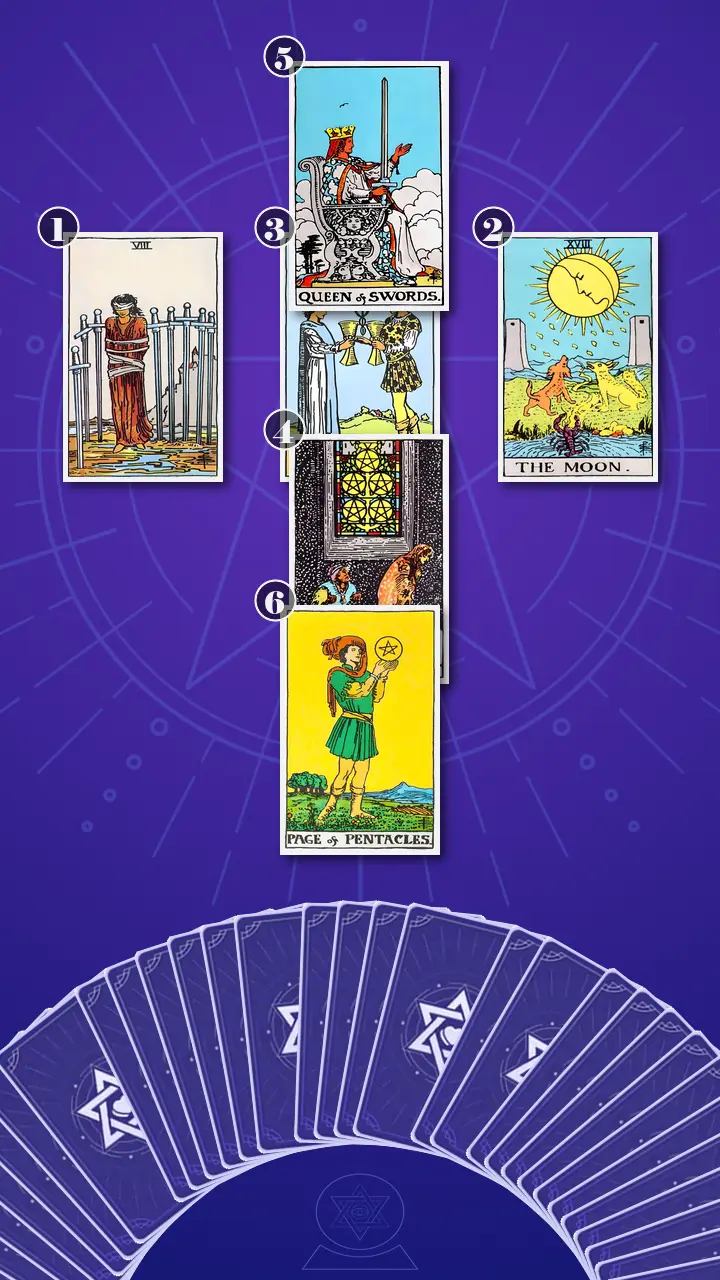
I arranged the cards like a bridge crossed by a vertical plumb line. The first card would show what happened to Jordan's attention after seeing the Story. The second would examine the ambiguous public signal as Jordan perceived it, without pretending to reveal the poster's intention. The central card would hold the friendship's direct evidence. Beneath it, another card would reveal the fear giving the post so much weight. Above it, the clarity card would show what needed to be separated or said. The final card would ground everything in one manageable next step.
“We are not asking the deck to decide whether your friend is good, bad, honest, or fake,” I told Jordan. “We are asking what information you have, what your fear added, and what remains yours to choose.”
Reading the Crop, the Fog, and the Bond
Position 1: The Screenshot Crop That Became the Whole Picture
The first card I turned over represented Jordan's current stance: their constricted attention, repeated checking, and inability to hold more than one explanation after seeing the post. It was the Eight of Swords, upright.
Its modern meaning was already open on Jordan's phone. They had the vague Story, the last conversation, and the screenshot group chat visible at once. Each new check narrowed the frame further until suspicion and withdrawal felt like the only available responses, even though the post named no one and Jordan still had several choices about what to do next.
I described the card's Air energy as blocked by its own excess. Thought was not absent; there was too much thought moving through too small a frame. The blindfolded figure stood inside an incomplete ring of swords, with bindings loose enough to interrupt. The image did not blame Jordan for feeling trapped. It showed how a phone camera zoomed so far into one alarming sentence could make everything outside the crop disappear.
“Your inner instruction seems to be, ‘I have to work this out before I can respond normally,’” I said. “But even without knowing what the post means, you can still pause. You can keep Saturday's plan. You can avoid posting something indirect. You can ask a question. Those openings are already here.”
Jordan gave a short laugh that landed somewhere between recognition and pain. “That is so accurate it feels kind of brutal.”
“The card isn't calling you irrational,” I replied. “It is showing how a protective behaviour can start feeling compulsory. Protection deserves understanding, but it also deserves an exit when it is no longer helping.”
Position 2: The Moonlit Gap Between Timing and Proof
The next card represented the vague post as Jordan experienced it, including its uncertainty and the meaning projected into that uncertainty. I turned over The Moon, upright.
I asked Jordan to return to the actual scene. A post about betrayal had appeared after midnight, following a mildly awkward exchange. Its wording, timing, and mood felt intensely personal. Yet it did not identify Jordan, quote their conversation, or describe a verifiable event. An older fear of exclusion had risen into that informational gap and started speaking as though it knew the friend's intention.
The Moon's Water energy had saturated the Eight of Swords' Air. Feeling selected the most threatening thoughts, and those thoughts intensified the feeling. Jordan's personal algorithm had been trained on rejection cues, so Instagram was no longer just a feed. It had become a DIY friendship-status dashboard where timing, likes, Story viewers, and read receipts were treated as live relationship analytics.
“Maybe it isn't about me,” Jordan said, repeating the thought they had carried all night, “but what if the timing is the part that proves it?”
As an artist, I thought of an editing room. Put two unrelated shots beside each other and the audience will instinctively invent cause and effect. A tense conversation followed by a vague Story creates a persuasive sequence, but sequence alone is not confirmation.
“The Moon doesn't tell me your instinct is worthless,” I said. “It tells me intuition, memory, atmosphere, and fear are all speaking at once. We need to respect the reaction without promoting it into knowledge of someone else's intention.”
Jordan's fingers stopped rubbing the edge of their phone. Their chest rose on a careful breath, then stayed guarded. I could see the distinction landing even before it felt comforting: this feels personal was not the same statement as this is confirmed to be personal.
Position 3: The Friendship's Direct Evidence Ledger
The central card represented what the friendship was actually built on: direct experiences, reciprocal moments, and observable interactions. I turned over the Two of Cups, upright.
I asked Jordan to close the public feed in their mind and review the relationship through private contact. They remembered a plan the friend had kept despite a brutal workweek, a check-in after Jordan's presentation, an apology that had been offered without prompting, and several evenings when both people had made room for the other.
The Two of Cups showed Water in balance. The figures faced one another and exchanged their cups at equal height. That mutual orientation mattered. A direct conversation is two-way evidence; a public broadcast interpreted alone is not.
“Before the post appeared, what did you believe those interactions showed you?” I asked.
“That we cared about each other,” Jordan said. “That we could be awkward sometimes and still be fine.”
“The card does not guarantee the friendship's future or tell us what the other person feels today,” I said. “It restores proportion. One public sentence does not automatically outrank a history of direct exchange.”
Jordan looked at the two figures on the card for a long moment. Their shoulders lowered by perhaps half an inch. It was not relief yet, but one erased piece of relational evidence had returned to the room.
Beneath the Bridge, the Fear of Being Last to Know
Position 4: The Five of Pentacles and the Locked Door in Jordan's Mind
The fourth position revealed the attachment-based fear beneath the meaning collapse, especially the fear that ambiguity meant exclusion or loss of belonging. The card was the Five of Pentacles, upright.
Jordan had described an office-kitchenette moment from earlier that week. Their direct message remained unanswered while the friend liked two other people's posts. The microwave beeped. Burnt coffee hung in the air. Jordan barely registered either because the question had already changed from “Why haven't they replied?” to “Am I the only person who doesn't know I've been pushed out?”
The Five showed Earth as unstable and belonging as blocked. Two figures moved through snow beneath a warm stained-glass window. The card did not prove Jordan was outside the friendship. It showed how quickly they began experiencing themselves as outside, even while routes to clarification, support, and direct contact remained unconsulted.
“The post hurts this much because it is carrying a larger question,” I said. “Not only, ‘Was that Story about me?’ but, ‘Did I ever securely belong, or was everyone else seeing something I missed?’”
Jordan's breathing paused. Their gaze slipped past the cards as if an old set of scenes had started replaying somewhere behind me. Their fingers tightened once around the phone, loosened, and then settled flat on the table.
“I hate the idea of looking stupid for trusting someone,” they said. Their voice was smaller now. “If I decide it's fake first, at least nobody gets to surprise me.”
“That makes emotional sense,” I replied. “A negative conclusion can feel safer than an open question because it ends the waiting. But the certainty is soothing the uncertainty, not confirming the story.”
I made the distinction carefully. The Five of Pentacles did not require Jordan to trust the friendship blindly. If direct behaviour later revealed repeated exclusion, contempt, or indifference, Jordan's boundaries would matter. The card simply showed that hidden rejection had been accepted as fact before the relevant evidence had been gathered.
When the Queen of Swords Made the Clean Edit
Position 5: The Blade Between Fact and Attachment-Driven Interpretation
The fifth card represented what needed to be understood, separated, and possibly expressed. As I turned it over, the heating clicked off and the room became unexpectedly quiet. Winter light moved across the table and caught the card's raised blade.
It was the Queen of Swords, upright, the reading's catalyst and antidote. Her Air was no longer trapped inside rumination. It had become balanced discernment: emotionally honest, proportionate, precise, and open to dialogue without surrendering boundaries.
At 11:40 p.m., with the Story, message thread, and group chat all open, Jordan had stopped asking what the post could mean. They were building a case for the one meaning that felt safest to expect: rejection before surprise.
A vague post can activate the fear of rejection, but it cannot verify rejection; your next task is to separate what you saw from what the fear supplied.
You do not need to turn ambiguity into a verdict; name the fact, ask the question, and let the Queen of Swords' upright blade separate evidence from attachment-driven interpretation.
I let the words rest without rushing to soften them.
Jordan did not immediately relax. First, their thumb froze above the dark phone screen. Then their eyes lost focus, as if they were mentally scrolling through every cold reply and cancelled plan that had followed an ambiguous post. Their eyebrows drew together, not with relief but with a flash of anger. “But doesn't that mean I've been wrong all along?” they asked. The sentence came out sharper than anything they had said that afternoon. A second later, the sharpness broke. Their jaw trembled once; their eyes shone; their shoulders finally dropped. They exhaled from deep in the chest, then stared at the Queen as if the removal of one wall had exposed an uncomfortable responsibility on the other side. Clarity had not made them instantly confident. It had left a brief, vulnerable blank where the old automatic conclusion used to be.
“No,” I said. “It means your feelings have been real and your conclusions have sometimes arrived before verification. That is not a moral failure. It is a process you can change. You also do not owe anyone automatic trust. The Queen asks for standards, not self-abandonment.”
This was where I used my Clique Power Dynamics lens. Real exclusion within close friend groups can hide in patterns: repeated invitations withheld, private warmth paired with public diminishment, inside jokes used to reinforce status, jealousy expressed through small digs, or one person continually expected to absorb micro-aggressions. I look for repetition, direct behaviour, and relational consequences.
“That lens protects us from two opposite mistakes,” I explained. “We don't dismiss a real hierarchy as anxiety, and we don't promote one ambiguous Story into proof of a hierarchy. The Queen's questions are clean: What was done? How often? Who was directly affected? What happened when the issue was named?”
I opened a blank note and drew three headings: Fact, Story, and Question.
Under Fact, Jordan wrote: “My friend posted a quote after our awkward conversation.”
Under Story, they wrote: “It proves our bond is fake and everyone else knows I have been excluded.”
Under Question, they wrote: “Is anything unresolved between us?”
“My feeling is real; my conclusion is not verified,” Jordan read aloud. Their voice caught slightly on not verified, but they did not delete it.
“Now, with this new perspective, think back to last week,” I said. “Was there a moment when this distinction could have changed how you felt or what you did next?”
Jordan remembered the message confirming Saturday plans. Instead of replying warmly, they had typed, deleted, and replaced several indirect lines before sending a flat “Maybe.” They had believed they were protecting themselves. From the Queen's viewpoint, they could see that the response had changed the relationship before any clarification occurred.
“Clear is not the same as needy, and direct is not the same as demanding,” I said. “This is the first movement from rejection-based certainty and protective withdrawal toward evidence-based curiosity, direct communication, and steadier self-trust. You are not promising that the answer will feel good. You are choosing not to manufacture the answer alone.”
Position 6: The Page of Pentacles' One-Message Reality Test
The final card represented a small, self-directed experiment Jordan could take without predicting the friendship's outcome or deciding for the other person. I turned over the Page of Pentacles, upright.
The Page held one pentacle at eye level while distant mountains remained in the background. Its Earth energy was balanced, practical, and available. Jordan did not need to solve the authenticity of the entire friendship that night. They could wait until their breathing settled, write a neutral two-sentence message, send it once, and observe the actual interaction instead of continuing to investigate the post.
“I am testing a better process, not deciding the whole friendship today,” Jordan said, trying the sentence out slowly.
“Exactly. You do not have to solve the friendship; you only have to choose a cleaner next step.”
The Page also protected Jordan's autonomy. A direct question could produce reassurance, discomfort, no answer, or evidence that firmer boundaries were needed. The experiment could not control the friend's response. It could show Jordan that self-trust was a skill built through observable choices, not a prize awarded only after perfect certainty.
Jordan turned their phone face down. This time the movement was not avoidance. It was a decision to stop refreshing long enough to hear their own judgement return.
The Three-Line Edit: Actionable Next Steps
I gathered the spread into one coherent story. The Eight of Swords showed Jordan treating a cropped piece of information as a sealed case. The Moon revealed why timing and atmosphere felt more authoritative than they were. The Two of Cups returned the friendship's direct record to the centre. The Five of Pentacles exposed the older fear that Jordan might be outside the bond and simply be the last to know. The Queen of Swords separated observation from inference, and the Page of Pentacles translated that insight into one real-world test.
In film terms, the vague post was a blurry ten-second clip. Attachment fear supplied the ominous soundtrack. Repeated checking edited out alternative scenes. Protective withdrawal then directed the next act, creating new distance that could later be mistaken for confirmation.
Jordan's cognitive blind spot was not simply overthinking. It was treating the relief of reaching a conclusion as evidence that the conclusion was accurate. A second blind spot was assuming withdrawal merely observed the friendship, when it was also changing the interaction being observed.
The spread contained no strong Fire energy, so I saw no invitation to confront impulsively, demand an explanation, or post a counter-message. The direction was from digital surveillance to proportionate interpretation, then from protective distance to cautious, voluntary communication.
- Run the Fact-Story-Question CheckWhen a vague post activates the rejection alarm, open Notes before checking likes or timestamps. Write one sentence under each heading: “Observed fact,” “My interpretation,” and “Direct question.” Stop after five minutes.Tip: Do not force a positive explanation. The goal is only to stop calling an interpretation a fact. If three lines feel like too much, write one fact and one unknown.
- Take a Ten-Minute No-Verdict PauseBefore cooling a reply, cancelling a plan, sending the screenshot elsewhere, or posting indirectly, set a ten-minute timer. Put the phone face down, notice the jaw, chest, and breathing, then list three pieces of direct friendship evidence from the last month. Likes, views, and vague public posts do not count.Tip: A twenty-minute or full-evening boundary is optional. Start with ten minutes, and stop the exercise if it increases distress rather than creating space.
- Use the Role Resignation ActJordan had effectively become the group's silent subtext analyst, whether or not anyone had consciously cast them that way. I invited them to resign from that character with one daytime message: “Hey, our last chat felt a little off to me. Is there anything unresolved between us?” If a longer boundary becomes necessary, they can say: “I don't want to guess through Stories. If something between us needs attention, I'd rather talk directly, and I'll do the same.”Tip: Read the message once for accusation, then send it once or leave it as a draft. Resigning from the role can begin simply by not posting an indirect reply. Jordan controls whether and when contact happens.
I reminded Jordan that direct communication was not an obligation to preserve the friendship at any cost. If the response was repeatedly dismissive, hostile, or absent, that would be new direct evidence they could use when setting boundaries. The point was not to guarantee safety. It was to let reality, rather than attachment-driven mind-reading, inform the next choice.

A Week Later, the Quiet Proof
Six days later, Jordan sent me a message: “I used the three lines and sent the question in daylight. The Story wasn't about me, but our last conversation had felt off to them too. We're talking Saturday. I still wanted to check the likes afterward, but I didn't.”
That night, Jordan slept through. Their first morning thought was still, “What if I missed something?” They noticed it, smiled without fully believing the smile, and made coffee before opening Instagram.
I did not consider the friend's reassuring clarification the most important result. The deeper proof was that Jordan had felt the alarm, allowed uncertainty to exist, gathered direct evidence, and chosen a response consistent with their self-respect. The cards had not repaired the friendship or predicted its future. Jordan had written the next scene.
This six-card contextual relationship tarot spread had carried us from a late-night verdict to cautious curiosity. Clarity did not arrive as perfect certainty. It arrived as Jordan's ability to distinguish the frame they had seen from the film their fear was trying to complete.
When a vague post makes your chest tighten, it can feel safer to decide the bond was never real than to remain inside the exposed possibility that someone you value may not value you in the same way. I would still ask you to remember what Jordan learned: the alarm can deserve compassion without being promoted to director.
If you let the post remain only a post for the next ten minutes, what single frame can you name as fact, and what gentle question could help you stay connected to your own judgement?