Finding Clarity in the 10:43 p.m. Group Chat Laugh
If you’ve ever been called “low-maintenance” in a group chat and everyone laughed while you went weirdly silent—welcome to the part where a “compliment” hits like a ranking.
Alex sat down across from me with their phone face-down on the table like it was still warm from the moment. They’re 27, Toronto, early-career marketing coordinator—someone who can make a spreadsheet feel friendly, who can hold space for a friend’s messy breakup, and somehow still apologize for taking up five minutes.
They described it like a time-stamped memory: sweatpants, Sunday night, a shoebox apartment with the CN Tower glow leaking through a narrow window. The radiator clicked on and off like it had opinions. Their group chat was open, and the message was still there: “Alex is so low-maintenance lol.” The chat moved on in 0.3 seconds, reactions stacking like confetti.
“I laughed,” they told me, and I watched their throat work like they were trying to swallow the laugh back retroactively. “Like—did the little ‘haha’ reaction. Because what else do you do?”
Then came the part that sounded painfully familiar in 2026: the Notes app draft titled something like text??, the careful paragraph typed with two thumbs, deleted, retyped, deleted again. And finally, the meme—sent like emotional camouflage.
“I know they probably meant it as a compliment,” Alex said. “But it felt like a summary of why I don’t get chosen.”
Under that one label, I could feel the core contradiction tighten like a drawstring: Alex wanted to be seen as easygoing and lovable—while fearing that having needs would make them “too much,” and therefore not worth showing up for.
The feeling in their body wasn’t abstract. It lived in the tight chest and dry throat they kept touching without noticing, like words were getting stuck at customs on the way out. Shame-tinged hurt, yes—but specifically the kind that feels like you’re standing in a crowded room holding a paper cup that’s quietly cracking in your hand, trying to smile like nothing’s leaking.
I leaned forward, keeping my voice gentle and grounded. “You’re not dramatic for noticing what your nervous system noticed. Let’s make a map of this—so it stops living only as a spiral in your phone. Today is about finding clarity, not proving you’re ‘chill enough’ to deserve care.”

Choosing the Compass: The Four-Layer Insight Ladder Spread
I asked Alex to take one slow breath in through the nose, out through the mouth—nothing mystical, just a clean transition from reacting to observing. Then I shuffled, the soft riffle of the cards sounding a bit like rain against a window on a ship at night—familiar, steady, not here to judge you.
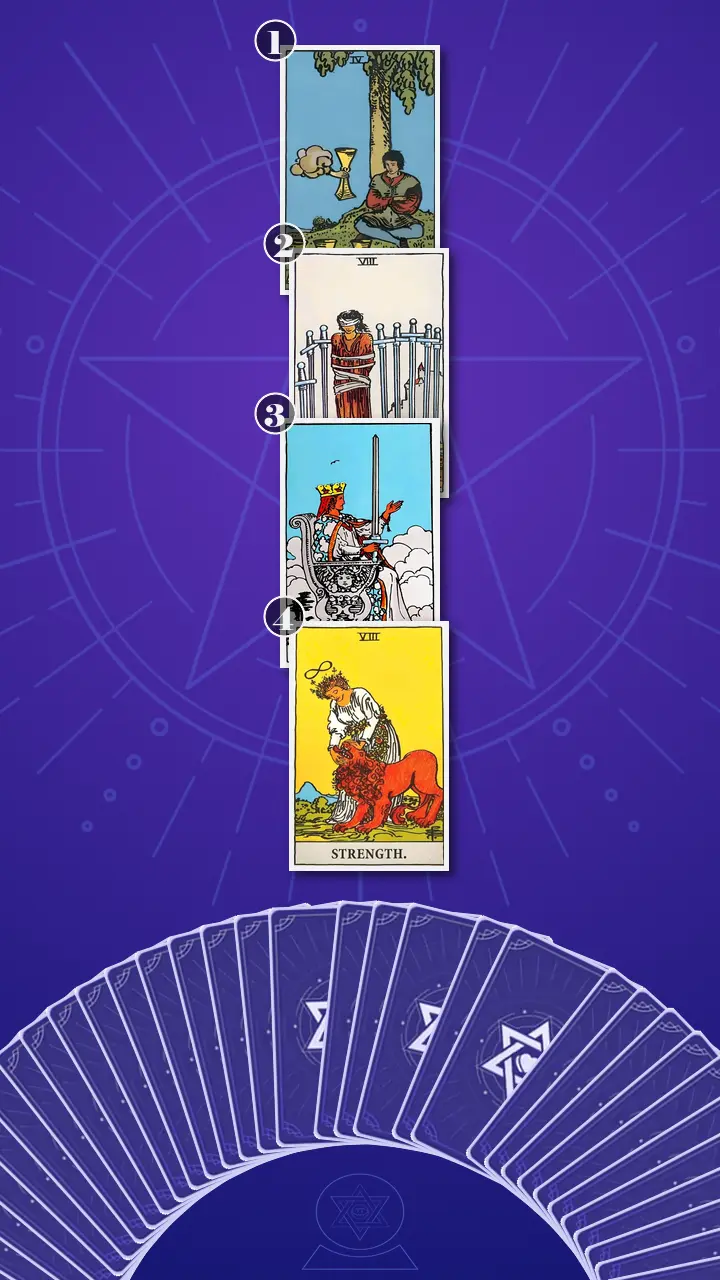
“For this,” I said, “I’m going to use a spread called the Four-Layer Insight Ladder · Context Edition—a four-card tarot spread for relationship self-worth and clean communication.”
To you reading this: the reason I choose it is simple and practical. This situation isn’t really about predicting what the friend “meant.” It’s about tracking how one word triggered a fast drop in self-worth, locating the hidden belief underneath, and turning that insight into one small, doable next step. The ladder layout mirrors real life: a comment lands (surface), a story activates (root), clarity is chosen (shift), and self-respect is practiced (action).
I pointed to the invisible structure we were about to build together:
“The first card is the presenting moment—what you did on the outside and what you swallowed on the inside. The second card goes underneath that: the root belief that turns a casual comment into a verdict. The third is the key reframe and the exact boundary language—two sentences, not a thesis. And the fourth is integration: the embodied posture and the tiny action that helps self-worth become steadier, regardless of the response.”
Reading the Map: Four Cards, No More Hiding
Position 1 — The Presenting Moment You Played Cool: Four of Cups (upright)
“Now we’re opening the card that represents the presenting moment: the immediate emotional/behavioral reaction to being called ‘low-maintenance,’ captured in observable relational cues,” I said, and turned the first card over.
The Four of Cups, upright.
I tapped the image lightly. “Crossed arms. Averted gaze. It’s the ‘I’m fine’ posture.”
And because tarot is only useful when it touches the real world, I translated it into the exact modern-life scene: It’s the moment in the group chat when “low-maintenance” gets said, you give a polite laugh, and you instantly switch into neutral mode—then later you realize you weren’t craving ‘more attention,’ you were craving one specific form of care (a check-in, a plan made in advance, a little consideration) that you trained yourself not to ask for.
“Being easy to be around isn’t the same as being okay with less,” I added, watching Alex’s eyes flick down to their hands.
Energetically, the Four of Cups here isn’t dramatic. It’s blocked Water: feelings are present, but withheld. Not because you don’t care—because caring feels risky. You shut the lid fast, so nobody sees what’s inside.
I did a scene-close-up the way I do on cruise decks when someone smiles too hard at a joke that stung: “Out loud, it’s ‘haha, totally.’ In your head, it’s ‘why do I suddenly feel rejected?’ And later—because the moment has passed—you replay it like a clip you can’t stop scrubbing.”
Alex let out a small laugh that didn’t reach their eyes. “Yeah,” they said, voice a little flat. “That’s… honestly a bit brutal. But also exactly it.”
That reaction mattered. It told me we’d hit recognition without shaming—same-frequency resonance. The reading could go deeper.
Position 2 — The Hidden Rule That Turned It Into a Verdict: Eight of Swords (upright)
“Now we’re opening the card that represents the root belief and core fear: the inner rule that makes a casual comment convert into a self-worth verdict.”
The Eight of Swords, upright.
The blindfold. The loose bindings. The swords like a fence you can’t quite see a gate in—until you notice there’s a gap.
I used the phone-screen metaphor because it’s literally how this plays out: You’re staring at a drafted message like it’s a cliff edge: asking feels risky, so you decide silence is safer. You tell yourself you’re being “mature” by not needing anything—when really you’re trying to avoid the one thing you can’t control: a response that might prove you’re not prioritized.
This is Air energy in deficiency-and-excess at once: not enough clear information, but too many thoughts. A mind that turns one label into a full spreadsheet of proof. The Eight of Swords doesn’t say “you are trapped.” It says “you are obeying a rule that feels like truth.”
“Unsent drafts are a form of self-protection—and a slow leak of closeness,” I said softly, not as a scold, but as a description of the mechanism.
Alex’s throat bobbed with a tight swallow. Their shoulders rose a fraction, then held there. “My Notes app is… embarrassing,” they admitted. “It’s like version control. I keep ‘fixing’ it. But I never push the change live.”
That was the bind in one clean sentence: belonging vs dignity. If they speak, they risk being “too much.” If they stay silent, they keep the belonging—on the condition of disappearing.
I let a small piece of my own background surface, the way an honest compass needle shows itself: on transoceanic voyages, I used to train crew in social dynamics—how a single offhand comment at a crowded cocktail hour could ripple for days if nobody repaired it plainly. People thought the ocean was the stressor. It wasn’t. It was the unspoken rules. Here too, the water isn’t the problem. The unspoken rule is.
Position 3 — The Sentence That Protects Your Dignity: Queen of Swords (upright)
“Now we’re opening the card that represents the key reframe and boundary language: how to translate feelings into clarity without self-abandonment or over-explaining.”
The Queen of Swords, upright.
Her direct gaze always changes the room. Even when the room is just a kitchen table and a phone screen that’s been running too hot.
Here’s the modern translation we needed: Instead of a paragraph of softening and disclaimers, you send a clean two-to-three sentence text: you name impact, assume reasonable intent, and make one specific request. You stop auditioning for the ‘cool, easy friend’ role and speak like your feelings are valid enough to take up a line of text.
Energetically, this is balanced Air: thoughts become a tool, not a cage. The Queen doesn’t mind-read. She doesn’t build a case. She states what’s true.
“Clarity is not aggression,” I told Alex. “It’s kindness with edges.”
And I showed them the before/after script, because language is the first lever:
Before (the Notes-app paragraph): a long, careful explanation with escape hatches—“sorry,” “maybe I’m overthinking,” “it’s not a big deal,” “ignore me.”
After (Queen of Swords): “When you called me low-maintenance, it landed like my needs don’t matter. I know you might’ve meant it nicely. Can you check in with me mid-week this week?”
As I read the short version out loud, I noticed the tiniest environmental co-conspiracy: the radiator that had been clicking went quiet for a beat, like the apartment itself paused to listen.
Alex exhaled, slow and surprised. “Wait,” they said. “I could just… say it like that?”
“Yes,” I said. “Two sentences. No courtroom. No audition.”
And this was where I brought in one of my signature tools—not as branding, but as a way to make it immediately usable. “On ships,” I taught what I now call Social Role Switching. Not fake personas—just choosing the right mode for the moment. You’ve been stuck in ‘Easygoing Mode’ so long it’s become a survival reflex. The Queen of Swords is Assertive Mode: clean eye contact, slow speech, one point. You can still be warm. You just stop being vague.”
Alex nodded, but their eyes were shiny with that specific fear: okay, but can I survive the moment after I send it?
When Strength Put a Quiet Hand on the Lion
Position 4 — The Embodied Integration: Strength (upright)
I let my palm rest on the deck for a second. “This next one,” I said, “is the heart of the ladder—the part that makes the insight sustainable.”
“Now we’re opening the card that represents integration and action: the inner posture to practice and the next concrete step you can take this week to rebuild self-worth and relational reciprocity.”
Strength, upright.
In the card, the hands on the lion aren’t fighting it. They’re steady. They’re saying: I can hold this.
Here’s the modern-life scenario in plain language: You make the ask—and then you don’t immediately backtrack. You feel the heat of vulnerability (the urge to add “but it’s fine!”) and you breathe through it. Your self-worth stops being negotiated via silence and starts being protected through calm courage, regardless of whether they respond perfectly.
And I saw Alex’s familiar moment arriving—the one described in their body: the throat tightening like a scarf pulled too snug, the chest bracing for impact as if the “send” button were a trapdoor.
Setup: This is the moment you know too well: the chat moves on, everyone reacts with “lol,” and you’re staring at your screen thinking, “Why did that compliment feel like a verdict?” Meanwhile your throat tightens like you can’t quite find the words without sounding ‘needy.’
Delivery:
Stop trying to earn love by being ‘easy’ and practice gentle courage, like Strength’s quiet hand on the lion.
I let the sentence hang there, the way foghorns hang in sea air—low, unavoidable, meant to keep you from crashing into your own silence.
Reinforcement: Alex’s reaction came in a three-part wave. First, a brief physiological freeze: their breath paused mid-inhale, fingers hovering over the edge of their phone as if they’d been caught doing something forbidden. Second, the cognitive seep-in: their eyes unfocused slightly, like they were replaying a recent moment—thumb hovering over “Send,” the exact second they chose the meme instead. Third, the emotional release: a sound that was half laugh, half ache, followed by their shoulders dropping as if they’d been carrying a backpack they forgot they were wearing.
“But if I stop doing that,” they said, and there was a flash of anger under the vulnerability, honest and sharp, “doesn’t it mean I’ve been… wrong? Like I’ve been playing myself?”
I didn’t rush to soothe it away. “It means you’ve been surviving with the tools you had,” I said. “Strength isn’t about being hard on yourself. It’s about being loyal to yourself. The lion here is your vulnerability. Not your weakness—your aliveness.”
I asked, “Now, with that new lens: can you think of one moment last week when this could’ve changed the outcome—not dramatically, just internally? Like a moment you could’ve said one true sentence instead of disappearing?”
Alex stared at the card, then nodded once. “Friday,” they said. “Outside that bar on Queen Street. They texted ‘we’re already inside—come through!’ And I typed ‘no worries!’ even though I wanted… a plan. A heads-up. I could’ve said it.”
“Exactly,” I said. “This is the shift from your starting state—shame-tinged hurt and self-silencing—to the desired state: self-respecting clarity and gentle courage in asking for care. Not because you can control them. Because you can stop measuring your worth by how little space you take.”
From Insight to Action: The One-Need, One-Ask Experiment
I gathered the four cards into one story, because integration is where tarot becomes actionable advice instead of an aesthetic moment.
“Here’s what your ladder says,” I told Alex. “On the surface, you went neutral and polite (Four of Cups) to avoid the risk of being seen wanting something. Underneath, your mind turned that word into a rule—if I ask for effort, I’ll be too much—and you trapped yourself in unsent drafts (Eight of Swords). The exit isn’t a bigger performance. It’s one clean sentence that treats your needs as reasonable (Queen of Swords). And the practice is Strength: staying soft with the feeling while staying firm in self-respect, especially in the minutes after you ask.”
The cognitive blind spot was clear: Alex had been treating “easy” as the price of belonging—so the moment they felt hurt, they assumed the problem was their sensitivity, not the lack of clear communication. The transformation direction, the key shift, was equally clear: shift from earning closeness by being “easy” to building closeness by naming one specific need and making one specific request.
“Let’s give you a micro-plan,” I said, “so this doesn’t turn into another draft you keep private.” Then I brought in my other toolbox—something I call Maritime Social Protocol, adapted from years of watching tiny social ruptures on cruise ships either dissolve into awkwardness or become stronger bonds through simple repair. On a ship, you don’t get infinite space to avoid people. So you learn: short, calm, direct, kind. No speeches in the buffet line. Just truth with good posture.
- The “One-Need, One-Ask” Draft (10 minutes max)Open Notes. Write: “When you said ____, it landed like ____.” Then add one ask that takes them under 10 minutes: “Can you check in with me mid-week?” or “Can we pick a day/time for plans instead of last-minute?” Read it out loud once—slower than you want.If your chest tightens, pause and do 3 slow exhales. This is practice, not a performance. You don’t have to send it today; the win is naming it cleanly.
- The Queen of Swords “No-Paragraph Rule” (60 seconds)Before you hit send, delete any sentence that starts with “Sorry,” “I might be overthinking,” or “It’s not a big deal.” Keep only: impact + one specific ask. Two to three sentences total.If it feels “cringe,” make the ask smaller, not longer. Time-bounded requests are easier for both nervous systems.
- Strength Breath + 20-Minute No-Checking WindowRight before you send or say the ask: inhale for 4, exhale for 6, twice. After you send it, set a timer for 20 minutes: no rereading the thread, no counting effort, no scrolling back months of messages.Do one grounding action for five minutes (tea, shower, short walk). Teach your body: asking is survivable, even when the outcome is unknown.
- A Ready-to-Use Script for When Someone OverstepsUse Assertive Mode: make eye contact, slow your speech, and say: “I need you to not label me like that. When you said ‘low-maintenance,’ it landed like my needs don’t matter. Please check in with me mid-week.”If you worry you’ll sound harsh, soften the tone—not the message. Kindness with edges is still kindness.
I watched Alex take a breath that actually moved their shoulders down instead of up. That was Strength showing up—not as confidence, but as capacity.

A Week Later: Ownership, Not Certainty
Six days later, Alex messaged me a screenshot—not of a perfect friendship outcome, not of a dramatic apology. Just proof of action.
Their text was short. Queen of Swords short. “When you called me low-maintenance, it landed like my needs don’t matter. I know you didn’t mean it badly. Can you check in with me mid-week this week?”
Underneath, Alex had typed: “I did the Strength breath. I wanted to add ‘lol’ so bad. I didn’t.”
They told me they’d sent it, then made tea, then took a five-minute walk around the block in the cold. It was bright in that Toronto way—winter sunlight like clean glass. They didn’t celebrate with anyone. They just stood in the convenience store aisle for a second, staring at gum, feeling their jaw unclench and thinking, if they respond weird, I’ll still be glad I didn’t disappear. (Clear, but still a little tender.)
That’s the real Journey to Clarity: not a guarantee of how someone else will behave, but a shift in where your self-worth lives—from other people’s convenience to your own self-respect.
When being called “low-maintenance” makes your chest tighten, it’s because part of you has been trying to earn closeness by needing less—so you never have to risk finding out you weren’t worth the effort.
If you didn’t have to prove you’re “easy” to deserve care, what’s one small, specific thing you’d let yourself ask for this week—just to see what self-respect feels like in real time?
This story is adapted from psychological research, written so that those in a similar struggle can see their own pattern in it — and find their next step clearly.These insights are not a substitute for professional psychological, medical, legal, or financial advice.
Learn more about our Journey to Clarity.
How did this insight land for you?
🫂 This Resonates Deeply
🌀 Living This Story
✨ Now I See Clearly
🌱 Seeing New Possibilities
🧰 Useful Framework
🔮 The Confirmation I Needed
💪 Feeling Empowered
🚀 Ready for My Next Step
Author Profile
 AI
AI“Having traveled across cultures... I've learned that what we often lack isn't a simple answer, but a moment of being truly understood. I use a Jungian psychological lens to help you deconstruct your subconscious patterns—not to prove anything, but to be the gentle companion who helps you unravel your knots, free of judgment, so you can reconnect with your inner wisdom.”
In this Friendship Tarot Reading :
Core Expertise
- Guilt-Trip Deconstruction: Uncovering the subconscious codependency that forces you to act as an unpaid 'emotional dumping ground' for friends.
- Savior Complex Auditing: Identifying whether your inability to set boundaries stems from a deeply ingrained psychological need to 'fix' others.
Service Features
- The Compassionate Detachment Protocol: A psychological boundary script to validate a friend's emotions while firmly refusing to absorb their psychological toxic waste.
Also specializes in :
Explore Related Patterns:
People-PleasingAlex is described as someone who can hold space for a friend's messy breakup and still apologize for taking up five minutes. When the group chat calls them 'low-maintenance,' the label hits an existing social role: the friend who stays agreeable, low-demand, and easy to keep around. People-Pleasing shows up here as a relational safety strategy. Alex tries to keep the room comfortable by laughing along, softening the impact, and avoiding the direct ask. The psychological bargain is clear: if you make your needs small enough, you reduce the risk of being dismissed as too much. That bargain is exactly why the comment tanks self-worth. It names the role Alex has been using to stay connected, then turns that role into a verdict. You are not reacting to one word alone; you are reacting to the fear that your lovability has been quietly measured by your convenience.
Rejection SensitivityAlex can logically recognize that the friend may have meant 'low-maintenance' as a compliment, yet their nervous system registers it as evidence that they are not chosen. The public group chat laugh matters because the comment is not processed in isolation; it lands in front of witnesses, with reactions stacking while Alex goes quiet. Rejection Sensitivity is the pattern where ambiguous social signals get filtered through a threat-to-belonging lens. The mind does not simply ask, 'What did they mean?' It jumps toward, 'What does this prove about my place here?' That is why one casual label can become a self-worth verdict before there is time to reality-check it. In this story, the pain is not about wanting constant attention. It is about a fast internal collapse from 'they called me easygoing' to 'maybe I only matter when I need nothing.' The pattern becomes visible in the replaying, the tight body response, and the urgency to decode whether the comment exposed something socially true.
Self-SilencingAlex's polite 'haha' reaction, sudden silence, deleted Notes app draft, and final meme all point to the same protective move: the hurt gets managed privately so the relationship does not have to absorb it publicly. The comment lands as a social ranking, but instead of saying that it hurt, Alex makes themself easier to handle. That is the core mechanism of Self-Silencing in this story. The defense is not random passivity; it is a strategy for keeping belonging intact by reducing visible need. You can see the cost in the body cues, the throat tightening, the chest bracing, and the repeated attempt to swallow the response before it becomes a request. The self-worth crash happens because silence turns the friend's label into an internal contract: if you are low-maintenance enough, maybe you will still be chosen. Once that rule is active, being called 'low-maintenance' no longer sounds like a compliment. It sounds like confirmation that your value depends on how little space you take.
Assertive CommunicationAlex's later text is short and exact: the label landed like their needs do not matter, the friend's intent is not assumed to be cruel, and the request is specific enough to act on. That is a clean move from emotional camouflage into contact. Assertive Communication functions here as the corrective pattern. It does not require Alex to perform confidence or build a courtroom case. It simply turns the private impact into observable language, then attaches one realistic ask. This is directly tied to why the original comment hurt. If Alex's self-worth has been organized around being easy, then assertiveness is not just a communication skill; it is a re-training of the belief that having needs makes you less lovable. The two-sentence text gives dignity a practical form.
Boundary DiffusionAlex does have a boundary in the story: the label landed badly, and they wanted a form of care that was more specific than generic attention. The problem is that the boundary initially stays internal, while the group only sees the laugh, the silence, and the meme. Boundary Diffusion is not the absence of needs. It is the blurring of where your inner no, hurt, or request becomes visible to other people. Alex's body knows something crossed a line, but the social performance says nothing happened. That gap is why self-worth becomes unstable. When you do not mark where the comment lands, the group dynamic stays intact while your inner experience absorbs the cost. The later two-sentence ask matters because it turns a private wound into a clear relational edge.
Secure VulnerabilityAlex's final shift is not certainty about the friend's response. It is the thought, 'if they respond weird, I'll still be glad I didn't disappear.' That sentence captures the new posture: exposed, still tender, but no longer organized around hiding. Secure Vulnerability is the ability to let a real need be visible without using that visibility to negotiate your entire worth. In the story, Alex practices this by making one specific ask, resisting the urge to backtrack, and allowing the outcome to remain unknown. This pattern answers the core question at the deepest level. Being called 'low-maintenance' hurt because Alex had been trying to earn closeness by needing less. Secure Vulnerability offers the counter-pattern: you can ask for care and still belong to yourself while you wait for the answer.
Emotional RegulationAlex's body reacts before the message is ever sent: tight chest, dry throat, bracing around the send button, and the urge to add 'lol' to soften the ask. The later practice gives that body response somewhere to go besides silence. Emotional Regulation shows up through the breath, the no-checking window, the tea, the short walk, and the decision not to reread the thread for immediate proof of safety. The mechanism is simple but psychologically significant: Alex learns to tolerate the vulnerability spike without undoing the request. That matters because self-worth cannot stabilize if every uncomfortable response window becomes evidence about your value. In this story, regulation is what helps Alex hold the ask after making it, so their dignity is not instantly handed back to the group chat for approval.
Explore Related Struggles:
Dignity-Belonging SplitAlex types the text, deletes it, retypes it, deletes it again, then sends a meme because the real sentence would expose a need. The friendship is still desired, but the price of staying smooth in the group chat is swallowing the part that wants to say, "that hurt." You are caught between two live claims on you: belonging asks you to stay easy, while dignity asks you to name impact without apologizing for having one. Neither side is fake, which is why the moment feels bigger than the comment itself. The split tanks self-worth because silence protects access to the group while quietly confirming the fear that your needs have to stay offscreen. Clarity begins when the need is allowed to exist in the relationship, not only in the Notes app.
Earned Love BindAlex's body reacts before their script catches up: tight chest, dry throat, the urge to add "lol," the old reflex of making the ask smaller until it almost disappears. By Friday outside the bar, the same rule appears again when "no worries!" gets typed even though Alex wanted a plan and a heads-up. You are not simply being considerate; you are negotiating closeness through self-reduction. The hidden contract says that if you stay flexible, undemanding, and quick to smooth things over, you might remain easy to love. That contract becomes a bind because it makes care feel earned through absence. The moment you want something specific, self-worth drops as if the request has broken the deal, even when the request is ordinary and human.
Low-Maintenance Worth LockThe phrase "Alex is so low-maintenance lol" lands in the group chat as a joke, but Alex receives it like a ranking of how little effort they cost. The laugh reaction, the silence, and the meme all keep the room moving, while the private meaning hardens into the fear that being easy is the only reason they are kept around. You can feel the lock in the way one label turns into a self-worth verdict. If needing a plan, a check-in, or a little consideration might make you less convenient, then care starts to feel like something you only deserve when you require almost nothing. The struggle is not that you want too much attention. It is that your worth has been quietly routed through your low demand, so a "compliment" about being easy touches the exact place where you wonder whether anyone would choose you if you took up more space.
Self-Erasure ReliabilityAlex is the friend who can hold space for someone else's messy breakup and still apologizes for taking five minutes. In the group chat, that same reliability shows up as the quick laugh, the neutral mode, and the emotional camouflage that keeps everyone else comfortable. The dependable role works only because your own signal gets muted. You become easy to include because you rarely interrupt the flow with your own needs, but the cost is that people may learn the version of you that requires the least care. The wound here is structural: being valued for low friction can start to feel indistinguishable from being valued as a person. Self-worth drops when the role is named out loud because it reveals how much of you has been quietly edited out to keep the connection stable.
Explore Related Emotions:
Conditional Belonging FearAlex types the real message, deletes it, types it again, deletes it again, and sends a meme instead. That small substitution shows the whole relational contract they are afraid they signed without noticing: stay funny, stay light, stay uncomplicated, and maybe the group will keep you close. The fear underneath is not only that one friend might react badly. It is that belonging itself may be conditional on Alex not asking for too much evidence of care. The group chat laugh becomes threatening because it seems to reward the version of Alex who has no needs, no friction, and no request that would interrupt the vibe. Conditional Belonging Fear explains why the comment tanks their self-worth so sharply. When connection feels available only on the condition of self-erasure, even a casual label can sound like a warning: keep being easy, or risk finding out you were not as chosen as you hoped.
Low-Maintenance ShameAlex hits the little 'haha' reaction while their body goes quiet, and the chat keeps moving as if nothing has happened. The word 'low-maintenance' is framed as a compliment, but it lands in them like a public ranking of how little care they are expected to need. That is why the self-worth drop feels so fast. The label presses directly on the rule Alex has been living under: be easy, be lovable, do not require too much, do not make anyone prove they will show up. You can feel the cost in the tight chest, the dry throat, and the meme sent where the honest sentence should have been. Low-Maintenance Shame names the specific sting of being valued for your smallness. It is not just embarrassment; it is the inward collapse that happens when being 'easy' starts to feel like the only reason you are still included.
Verdict DreadThe group chat moves on in 0.3 seconds, but Alex stays caught on the line: 'Alex is so low-maintenance lol.' A throwaway phrase starts behaving like evidence, and the memory becomes time-stamped in their body as if the room had quietly announced where they stand. The dread comes from how quickly the mind turns one social cue into a final judgment. Alex is not simply wondering whether the joke was rude; they are watching the phrase expand into a larger story about not being chosen, not being prioritized, and not being worth the effort of a real check-in. Verdict Dread captures that stomach-drop moment when a casual comment stops feeling casual. You are not reading the words only as words; you are hearing them as a ruling on your value, and the silence afterward becomes the place where that ruling echoes.
Courageous VulnerabilityAlex eventually sends the short text and resists the urge to cushion it with 'lol.' The sentence is not dramatic, but it is exposed: it names the impact, gives the friend room for reasonable intent, and asks for one concrete form of care. That matters because vulnerability here is not a performance of rawness. It is the steadier choice to let a need exist without immediately apologizing for it. The body still reacts, the outcome is still unknown, and Alex still has to breathe through the heat after pressing send. Courageous Vulnerability names the part of Alex that can stay soft without vanishing. It connects directly to the self-worth question because the repair begins when they stop proving they deserve care by needing less and start practicing the dignity of asking clearly.
Message DreadAlex's Notes app becomes the holding room for everything they cannot say in the group chat. The careful paragraph appears, disappears, comes back, disappears again, and the meme steps in as a socially acceptable cover for the request underneath. That hesitation carries the charge of the whole question. Sending the message would mean letting the need become visible, and visible needs feel risky when Alex already suspects that being easy is what makes them acceptable. The phone face-down on the table keeps the conflict close: the words exist, but they have not been allowed into the relationship yet. Message Dread names the fear that gathers around the send button when a text is no longer just a text. It becomes the threshold between being liked for needing nothing and asking whether the relationship can hold one honest sentence.
Self-Betrayal AcheAlex knows the truer sentence before they send the meme. The ache starts there, in the gap between what they wanted to name and what they made socially palatable enough to survive the moment. The story keeps returning to that split: the laugh that does not reach the eyes, the paragraph with escape hatches, the urge to add 'lol' after finally making the ask. Each detail shows Alex trying to protect the relationship by lowering the volume on their own experience. Self-Betrayal Ache is the pain of realizing you have been disappearing before anyone directly asked you to. It does not accuse you of weakness; it names the tender cost of repeatedly choosing safety-through-silence over the self-respect of saying one true thing.
Grounded AgencyAfter sending the message, Alex makes tea, walks around the block, and lets the response remain unknown for a while. The important change is not that the friendship becomes perfectly secure; it is that Alex no longer hands the entire verdict on their worth to the next notification. The body shows the shift in small, concrete ways: the jaw unclenches, the shoulders drop, the breath starts moving again. Instead of rereading the thread for proof, Alex lets one clear action become proof of something closer to home. Grounded Agency fits because the story ends with ownership rather than certainty. You can still care about the response, but your self-worth begins moving back into your own hands when you stop disappearing as the first condition of staying connected.
Explore Related Contexts:
Conditional Belonging PressureThe group chat laughs, Alex reacts with "haha," and the moment closes before the impact can be named. The visible behavior is small, but the social rule underneath is much larger: stay chill, do not interrupt the vibe, and do not make the group account for a joke that landed badly. Conditional Belonging Pressure fits because the story repeatedly frames belonging as something maintained through low demand. Alex is not only deciding whether to send a text; they are navigating the risk that asking for effort might move them out of the valued category of easygoing friend and into the feared category of "too much." That pressure explains the self-worth drop with precision. When belonging feels conditional on needing less, a casual label can hit like a verdict. The useful clarity here is that You can audit the condition itself instead of accepting it as a measure of your value.
Emotional Labor ImbalanceAlex is described as someone who can hold space for a friend's messy breakup and still apologize for taking up five minutes. That detail matters because the group chat incident does not happen in a vacuum; it sits inside a friendship pattern where Alex seems available for other people's emotional mess, but heavily edits their own request for care. Emotional Labor Imbalance names the external relational setup where care flows more easily outward than back toward the person providing it. The imbalance is visible in the contrast between Alex's capacity to support others and the amount of internal preparation required before asking for something small, like a mid-week check-in or a plan made ahead of time. This context helps explain why the "low-maintenance" label tanks self-worth so quickly. It sounds like praise only if the exchange of care is already balanced; inside an uneven friendship economy, it can feel like confirmation that You are valued most when You require the least.
Low-Maintenance Friendship PressureAlex is called "low-maintenance" in a group chat, gives the safe little laugh, and then goes silent while everyone else keeps reacting. The label lands as more than a casual joke because the social setting turns it into a public role: the easy friend, the one who does not need much, the one whose comfort is assumed rather than checked. That is the external pressure inside Low-Maintenance Friendship Pressure. The friendship system appears to reward low friction, quick recovery, and emotional convenience, while any direct request for care risks being read as a breach of the role Alex has been assigned. You are not just dealing with one phrase; you are dealing with a social economy where being easy can start to function like the price of staying included. The story becomes especially sharp because Alex does have a concrete need: a check-in, a plan made in advance, a little consideration. The pain-point stage is the gap between the care they want to ask for and the group norm that makes asking feel like becoming "too much." Naming that structure gives You a way to separate personal worth from the convenience role other people may have grown used to.
Care Reciprocity TestAlex can hold space for a friend's messy breakup, yet when their own need surfaces, it has to fight its way through drafts, deletions, and a meme. The contrast shows a friendship system where care is available in one direction more easily than the other. Care Reciprocity Test names the external question the story is actually putting on the table. Can this friendship return care when Alex asks for it plainly, or does the bond only function smoothly when Alex remains convenient and undemanding? That is why the label carries so much weight. Being called "low-maintenance" touches the fear that You are appreciated for not needing reciprocity. The test is not whether the friend responds perfectly; it is whether the relationship can make room for a specific need without treating it as a problem.