Searching an Ex’s Chat for “Special,” Then Trusting the Full Record

Finding Clarity in the 11:47 p.m. Chat
I recognized the pattern when Jordan reopened the message where her ex called their connection special while ignoring the later conversation they left unanswered. At 11:47 p.m. on a Tuesday in her one-bedroom Toronto apartment, she had just seen an Apple Photos anniversary memory and was still wearing her coat. Her phone was warm against her palm, the radiator clicked beside the dark window, and her thumb searched the archived iMessage thread for one exact word: special.
She reread the affectionate paragraph until it lifted her out of the quiet room, then scrolled past the question about readiness that had received no answer. The message glowed; the missing reply sat beneath it. When she looked up, her shoulders had drawn toward her ears.
Why do I keep idealizing an ex who was never ready? Jordan asked me. I know they were not ready, but what if timing was the only problem? The good moments felt too real to mean nothing. If I accept that they were never going to meet me there, I have to admit I waited for something that was not available.
Her longing was not an abstract feeling. It was a tight band across her chest and a restless pull toward the phone whenever loneliness, a couple's anniversary post, or an ordinary quiet evening made the old connection feel close again. She wanted the relationship's potential to have been real, while fearing that accepting the ex's unreadiness would mean she had not been worth becoming ready for.
I told her that I would not ask her to call the tenderness fake or force herself to move on on command. I wanted to help her see the entire pattern without turning either person into a villain. Our work that evening was simple and exact: to make a map through the fog, so that Jordan could decide where her attention went next.

Choosing a Compass for an Unfinished Relationship
I asked Jordan to put both feet on the floor, take one slow breath, and name the question she wanted answered. Then I shuffled slowly. The ritual was not a performance of mystery. It gave her nervous system a small change of pace and gave both of us a clean boundary between replaying the old conversation and examining it.
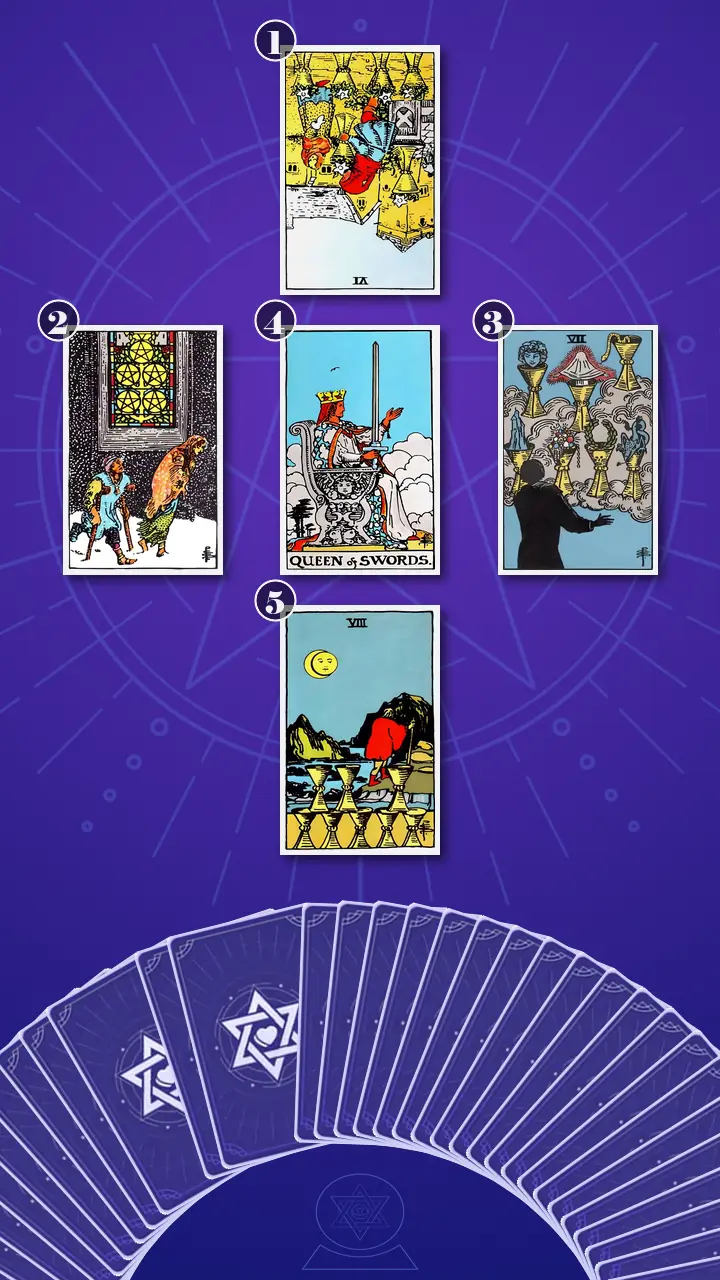
Today, I told her, I am using a five-card spread called The Shadow Spread, an F5 Inner Excavation method. For anyone wondering how tarot works in a focused relationship reading, this spread does not predict what an ex will do. It examines why a pattern keeps returning, what fear it protects, what story distorts the evidence, what quality restores choice, and what small boundary can support integration.
The first position reveals the observable symptom: the affectionate fragments Jordan keeps promoting to the front page of memory. The second reveals the hidden worth-and-belonging fear beneath it. The third exposes the projection, the imagined versions of the ex that make possibility feel like evidence. The fourth is the central pivot, where the Queen of Swords offers compassionate discernment. The fifth turns that clarity into a self-directed response.
I chose this spread because Jordan was not asking me to forecast the ex's behaviour. She was asking why idealization persisted after the facts had become familiar. Five cards were enough to follow the whole chain from selective nostalgia to fear, from fear to fantasy, and from fantasy toward a boundary that would leave room for grief and present-day reciprocity.
The Cups Behind the Relationship Highlight Reel
Position 1: The Memory That Made the Cut
Now I turn over the card representing the observable symptom in this case: selectively revisiting affectionate memories and using them to idealize an ex whose lack of readiness was consistent. It is the Six of Cups, in reversed position.
On the card, a child offers a flower-filled cup. Turned upside down, that innocent-looking gift becomes a memory Jordan has handled so many times that its context has disappeared. The card mirrors her archived iMessage search: one warm text is lifted out of the relationship and offered back to her as proof that the whole future was real. The enclosed courtyard becomes a protected memory loop where the sweetest fragments are allowed inside and the unanswered readiness conversation remains outside the gate.
The reversed energy is a blockage in memory rather than a lack of feeling. Nostalgia is doing too much of the evidentiary work. Jordan remembers the softness of one evening and edits out the repeated uncertainty that followed. The best moment is part of the record, not the whole record. That distinction does not insult the moment; it gives the rest of the relationship permission to exist beside it.
Jordan gave a short, bitter laugh. Her breath paused, her thumb hovered over the edge of her phone, and her eyes moved from the card to the imaginary thread on the table. Then the recognition reached her. She looked down and said, That is almost cruelly accurate. I know exactly which message I search for.
I answered gently, I am not asking you to delete the message or punish yourself for loving it. I am asking what gets removed from the frame when that message becomes the official record. Reversed Six of Cups can tempt someone into an opposite performance too, such as deleting every trace or going on several dates just to prove they are over it. I wanted Jordan to choose a fuller memory, not a harsher one.
She rubbed the warm place on her palm where the phone had been and let out a longer breath. The defense had not vanished, but it had become visible enough for us to work with.
Position 2: The Window She Thought Was Closed to Her
Now I turn over the card representing the underlying worth-and-belonging fear that accepting the ex's unreadiness will feel like proof that Jordan was unchosen. It is the Five of Pentacles, in upright position.
Two figures move through snow beneath an illuminated stained-glass window. One carries crutches; bandages show through the cold. I connected the scene to a Sunday evening Jordan had described, when an old university acquaintance posted an engagement announcement and the comments filled with finally. The TTC rumbled outside her apartment. Jordan checked the ex's profile, checked her rent balance, and felt a hollow drop in her stomach.
The window looked to her like a secure relationship everyone else had been invited into. The Five of Pentacles shows the hidden wound beneath the conscious habit: another person's limited readiness has been translated into a personal exclusion notice. The Earth energy is contracted into scarcity. It makes the familiar ex feel safer than an uncertain present because at least the old connection supplies a known place to stand, even if that place is outside the warmth she wants.
I asked her, When you see someone else being chosen clearly, what sentence arrives before you open the old chat?
Jordan stared at the lit pentacles. Her jaw tightened first. Then her fingers pressed into her knee as if she were holding herself in place. Finally, she said, Other people get certainty. Maybe I was not worth that kind of effort.
I told her that the card did not validate that conclusion. It showed the pain of carrying it. A connection can be meaningful and still not be viable. The ex's lack of capacity belongs in the relationship's evidence; it does not become a measurement of Jordan's value. I saw the distinction land slowly, less like a dramatic answer and more like warmth returning to fingers after a cold walk.
Position 3: The Seven Open Tabs of Potential
Now I turn over the card representing the projection or shadow narrative through which imagined potential, alternate timing, and isolated moments are placed onto the ex. It is the Seven of Cups, in upright position.
A silhouetted figure faces seven cups floating in clouds. One contains a castle, another a treasure, another something veiled and uncertain. I translated the image into Jordan's modern life: a browser with seven tabs open, each one holding a version of the ex who might have become ready with more time, fewer work pressures, better self-awareness, or one final honest conversation.
The water energy is overflowing rather than moving. Possibility has become so emotionally persuasive that it competes with observable behaviour. After a kind but low-key Hinge date near Ossington, Jordan walks home and tells herself the new person feels flat. Then she opens her Notes app and builds alternate timelines for the ex. Her shoulders lift toward her ears as she thinks, I am not choosing a fantasy; I am just considering all the possibilities.
I said the sentence back to her without judgment. That is how the loop protects itself. Each imagined version briefly softens the finality of grief, so the mind calls the activity research instead of recognising that it is keeping the bond emotionally active. Potential can explain the attachment without proving the relationship was available.
Jordan's eyes stayed on the floating cups. Her face tightened as if she had tasted something sharp; then her gaze went unfocused, replaying the version of the ex who would have returned after one more conversation. She did not defend the fantasy. She only whispered, I keep comparing real people to the person I built in my head.
I told her that this was the central blockage in the spread, not because imagination was foolish, but because imagined capacity had been promoted above repeated follow-through. The question was no longer whether one of those seven versions could theoretically exist. The useful question was which version had actually shown up, communicated clearly, and stayed available.
When the Queen Raised One Clear Blade
Position 4: The Standard That Can Hold Two Truths
The room became very quiet as I reached for the central card. I turned over the card representing the transformation from measuring the relationship by intensity and potential to evaluating repeated availability, communication, and follow-through. It was the Queen of Swords, in upright position.
The Queen sits with one sword held vertically and one hand open. Her sword is not a weapon against tenderness. It is a clean standard of evidence. Her open hand allows affection to remain in the room while her judgment separates what was said from what was repeatedly made available.
I used my Communication Dissonance Audit here, the diagnostic lens I have developed through ten years of sound energy research. I listen to arguments and relationships not only through their words, but through the mismatch in emotional tempo and frequency underneath them. In Jordan's record, the affectionate message was a high note. The unanswered readiness conversation was the tempo. Warmth appeared in bursts, but dependable availability never kept time with it.
That difference mattered. I did not need to diagnose the ex or decide whether the ex had bad intentions. I only needed to ask whether the relationship's communication and follow-through formed a rhythm Jordan could safely build on. The Queen's clarity was like a content audit for the relationship: emotional impressions mattered, but repeated delivery determined what the campaign actually offered. I thought of Dorothy looking behind the curtain, not to expose a villain, but to see the mechanism behind an image that had gathered too much authority.
I returned to the 11:47 p.m. chat. The word special was still true as a memory. It was simply not a contract. I asked Jordan to imagine opening a private Notes page with two columns: what the ex said, and what the ex repeatedly made available. The pattern is allowed to answer before the fantasy does.
The Sentence Above the Clouds
At 11:47 p.m. in a Toronto apartment, the phone was warm in Jordan's hand. She could find the tenderness immediately, but the evidence of limited readiness was sitting in the same thread. Her mind was trying to make the vivid memory outrank the full record and was asking which version deserved to be called real.
You do not need to preserve potential to prove the connection mattered; choose the facts that protect your present, like the Queen of Swords holding one clear blade above the clouds.
For three seconds, Jordan did not blink. Her breath stopped halfway in, and the fingers around her phone tightened as if the screen might slide away. Then her eyes lost focus; I could see the old thread replaying behind them: special, a warm night, the unanswered question, the weeks of explaining. Her mouth opened and closed. The first response was anger, quiet but clean. But does that mean I got it wrong? Her voice cracked on wrong, not because she had been foolish, but because facts seemed to threaten the tenderness she had worked to protect. I let the silence stay. She looked down at the Queen's open hand, inhaled through her nose, and released a breath that trembled on the way out. Her shoulders lowered. One fist uncurled. A tear gathered and did not need to become a verdict. The relief was real, and so was the brief dizziness of having a clear path with no one else to blame or wait for. I watched sadness make room for self-trust.
Now, use this new angle to remember whether there was a moment last week when this distinction could have made you feel different: what you felt was real, and what was available was still limited.
Jordan looked at the two imaginary columns. The sentence she finally offered was small enough to hold: I can miss what happened without turning it into proof that it was going to become something else.
This was the key shift from protective longing toward grief without self-blame, clearer standards for reciprocity, and calm openness to present-day connection. The Queen of Swords did not take the story away from Jordan. She gave Jordan back the authority to decide which evidence deserved weight.
The Moonlit Path That Did Not Erase the Cups
Position 5: A Boundary for the Missing Cup
Now I turn over the card representing the conscious response or practical action through which discernment becomes a self-directed boundary. It is the Eight of Cups, in upright position.
A cloaked figure walks away from eight carefully stacked cups beneath a watchful moon. The cups are not smashed. The traveler does not pretend they meant nothing. There is simply a visible gap, and the figure no longer organises the present around trying to fill it with interpretation.
For Jordan, this could mean moving archived screenshots away from the first screen of her phone, muting the ex's Instagram stories for seven days, or choosing not to search the old chat when a quiet room makes the past feel urgent. The upright energy is deliberate movement rather than dramatic rejection. It makes room for grief and present-day reciprocity without demanding that Jordan date immediately, contact the ex, or declare the relationship meaningless.
I told her that moving on does not require calling the tenderness fake. The Eight of Cups asks for a pause in investment, not an erasure of history. Jordan looked at the visible gap on the card, then placed her phone face down. The gesture was modest, but it was the first action that did not ask the old connection to provide another explanation.
From Potential to Pattern: A Clearer Next Step
When I laid the five cards together, the story became coherent. The reversed Six of Cups showed Jordan promoting one flower-filled message while leaving the unanswered conversation outside the frame. The Five of Pentacles revealed why: if the ex was never ready, the loss threatened to become a verdict about Jordan's belonging. The Seven of Cups then multiplied alternate timelines until a future-ready version of the ex felt as substantial as the person who had actually been present. The Queen of Swords introduced Air into a water-heavy reading, separating tenderness from evidence. The Eight of Cups returned feeling to movement by giving Jordan a boundary she could choose herself.
The cognitive blind spot was not that Jordan still cared. It was treating intensity as proof of viability and another person's unreadiness as proof of her own unworthiness. The transformation direction was more practical: move from peak moments and imagined potential to repeated availability, clear communication, and follow-through. The relationship could remain meaningful without being rewritten as viable.
I called this the potential-to-pattern shift. It did not require a dramatic burst of willpower, because the spread contained no Wands. Jordan needed a clean standard and modest repetition, not a performance of being over the past. I offered her two low-pressure experiments.
- Make a said-versus-available recordOn Tuesday, open Apple Notes for ten minutes and create two columns titled What they said and What they repeatedly made available. Add three concrete examples to each, including one affectionate moment and one unclear or unanswered conversation. When a warm memory appears this week, pair it with one observable fact from the same period and write: This mattered to me, and the full pattern also included...Keep the note private and use facts rather than explanations of the ex's motives. If your chest tightens, stop at one example, close the note, and return to a neutral task. A two-minute version still counts.
- Choose a seven-day attention boundaryMute the ex's Instagram stories and move the chat shortcut or saved screenshots away from your phone's first screen for seven days. When the urge to check rises, use my Syncopation Pause: place both feet on the floor, take one slow exhale, and wait for three seconds while noticing one sound in the room before setting a ten-minute timer and choosing an available activity such as making tea, showering, calling a friend, or walking outside.This is a small boundary, not a permanent deletion or a message to the ex. You do not need to download a dating app or explain yourself. If muting feels too intense, remove only story notifications or wait twenty minutes before checking.
The Syncopation Pause is usually something I teach for escalating arguments: three seconds of acoustic grounding to lower the emotional BPM before a permanent sentence is spoken. For Jordan, I adapted it to the argument happening inside the phone. It interrupted the high note without demanding that she stop feeling. That was the point of every next step: to support emotion with structure, not to argue emotion away.
The Shadow Spread had not given Jordan a command. It had given her a way to ask better questions: What is the full record? What is another person's capacity, and what is my worth? Which future is supported by behaviour? What small boundary would let the present become audible again?

A Week Later, the Quiet Proof
Four days later, I received a message from Jordan. She had made the two-column note, muted the stories, and used the Syncopation Pause when her hand reached for the old chat. She did not report a miracle. She reported ten minutes in which she made tea instead of investigating an Instagram like.
On Sunday morning, she slept a full night, but her first thought was still the familiar what if. This time, she smiled, made coffee, and did not open the chat. The question remained; it simply no longer held the phone.
I saw that as the first evidence of her emotional transformation: not a perfectly closed chapter, but a relationship remembered as meaningful without being used to direct every present choice. The Journey to Clarity had moved from protective longing to a little more room for grief, self-respect, and curiosity about calm connection. Jordan was becoming the author of the pattern she followed next.
When a warm memory tightens your chest at 11:47 p.m. and your thumb opens the old chat, keeping the potential alive can feel safer than facing that someone else's unreadiness was never a verdict on your worth.
If repeated availability could matter as much as intensity, what small present-day connection, conversation, or moment of calm might you notice this week without asking it to recreate the old story?