The Sunday Table and the Family-Role Regression Loop
You can challenge a weak assumption in a Figma review at work, then hear an old nickname at your family's Sunday lunch and end your own sentence with, "It does not matter." That was the pattern Maya brought to my studio in Toronto.
At 12:18 PM on a Sunday in North York, I watched Maya begin describing a product decision from Friday's design review. A relative laughed, used the nickname she had outgrown in high school, and retold the childhood version of the story before Maya could finish. Forks scraped ceramic, gravy smelled warm and salty, and the overhead light gave off a faint electric buzz as Maya smiled, said, "It is not important," and started stacking plates.
She told me, "I know exactly who I am until my family starts telling the story for me." At work, her colleagues relied on her to explain decisions and challenge weak assumptions; at the family table, she edited her opinions, accepted interruptions, and became useful before anyone could ask what she thought. Her question was not whether she loved her family. It was why family gatherings kept pulling an autonomous adult back into a childhood role.
I heard the frustration as a drawstring pulled tight beneath her collarbone: every old joke cinched it, every swallowed correction made her body smaller, and every unsent boundary text tightened it again on the ride home. Underneath the resentment and shame was a quieter longing to be recognized as current. I told her I understood the wish for connection and room to be herself at the same time. We could look at the pattern without blaming anyone or treating it as fate. Our Journey to Clarity would begin by giving the fog a map.

Choosing a Compass for a Family Pattern
I asked Maya to put her phone face down, take one slow breath, and focus on the question rather than on rehearsing the family conversation. I shuffled at an even pace. The purpose was not to summon a verdict; it was to create a clean pause between the familiar story and the next piece of information.
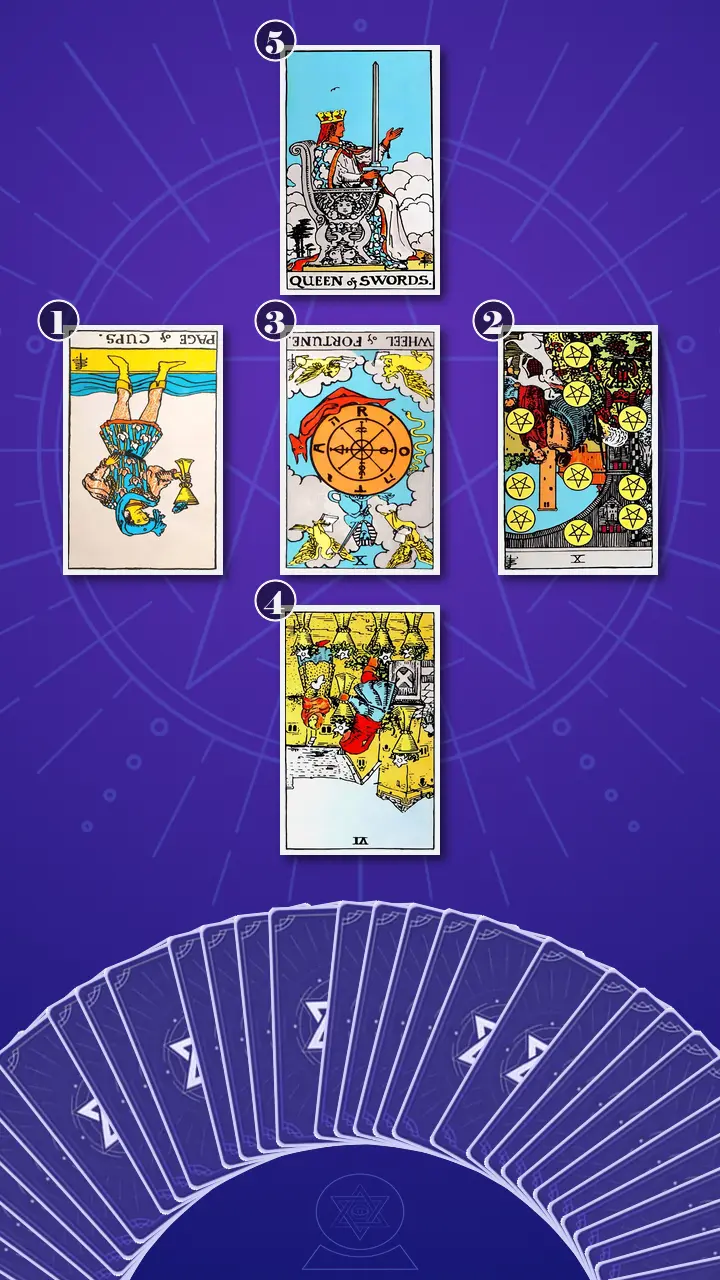
For this reading, I chose a five-card Relationship Spread. It is a small, direct structure for questions about family patterns, belonging fears, adult boundaries, and the way two people keep activating one another. A larger spread might add predictive-looking layers that would distract from the practical question. This relationship tarot spread was enough to show the present regression, the family energy Maya encountered, the shared feedback loop, the childhood-rooted block, and the adult communication practice available to her.
I explained the map to Maya and to anyone reading along: position 1 would show what happened to her voice and posture when the gathering activated the old role. Position 2 would surface the observable family habits and inherited conventions around her, without pretending to know any relative's private intentions. Position 3 would reveal the cue, automatic response, and confirming family response that made the loop repeat. Position 4 would touch the belonging fear underneath it. Position 5 would point toward a proportionate boundary she could choose for herself.
I placed the third card at the center of the cross, with the first and second cards forming a horizontal pair, the fourth beneath it, and the fifth above it. The layout looked like a compass whose center kept pulling the eye into an old orbit until the upper card offered a new direction. Tarot works best here as an objective cognitive tool: the symbols give shape to something Maya already knows in her body, while the positions help us test that recognition against observable life.
The Old Script Starts With a Fish
The Voice That Vanishes Mid-Sentence
I began with position 1, which shows the concrete regression behavior in the diagnosis: how Maya edits an opinion, changes her tone, and performs a childhood role when a family gathering activates it. I turned over the Page of Cups, in reversed position.
The traditional Page of Cups carries an emotional message, sensitivity, openness, and a youthful responsiveness. Reversed, that Water energy is blocked or turned inward. The fish rising unexpectedly from the cup became the exact moment an old label produced a jolt before Maya had chosen her words. At Sunday lunch, the nickname arrived just as she was explaining a product decision. Her prepared adult language disappeared, her voice dropped, and she reached for the plates while saying, "It does not matter."
I told her that the card was not saying her adult self had vanished. It was showing an emotional notification arriving before her adult language could load. The first change in tone, the raised shoulders, or the impulse to become helpful could be information: an old route had opened. Reversed Water did not mean weakness; it meant the signal needed a pause and translation.
Here I used my Family Casting Analysis. I asked what forced role Maya was being invited to play, based on what she actually did rather than on a judgment about her relatives. The role looked like The Peacemaker: keep the table smooth, soften the disagreement, make herself useful, and avoid becoming the difficult one. That role was a learned costume, not Maya's essence, and it did not prove anyone had consciously cast her. It simply explained why collecting plates could feel safer than finishing a sentence.
Maya gave a small, bitter laugh. Her thumb stopped moving against the rim of her mug; for a moment her breath froze and her eyes stayed fixed on the fish. Then I saw her mentally replay the lunch, and finally her shoulders lowered on a long exhale. "That is accurate," she said. "Almost rude, honestly."
I smiled gently. "Let us treat the discomfort as data, not as a verdict. An old nickname is a cue, not a command. You do not need a twelve-minute correction to prove that you have grown. First, you need to notice the instant your voice begins negotiating with the room."
The Family Profile That Never Updated
Position 2 surfaces the observable family-level cues and inherited conventions that sustain the Family Stagnation Loop. In the relationship spread, it traditionally describes the energy encountered from the other side. I turned over the Ten of Pentacles, in reversed position.
The multigenerational group beneath the stone arch looked to me like a shared family profile that everyone kept opening even though the personal details had not been updated in years. The table, the group chat, and the recurring Sunday rituals created continuity through efficient old stories. A relative could use one childhood anecdote as shorthand for familiarity, yet that shortcut answered for Maya before anyone asked what had changed.
Reversed Earth showed continuity becoming rigid while present-day recognition remained deficient. The family structure was preserving an arrangement, not necessarily because anyone intended harm, but because familiar roles made conversation move quickly. Family familiarity is not the same thing as current accuracy. Maya could still accept a family custom because it genuinely suited her and decline an expectation that made the old identity the price of entry.
I asked her to notice the difference between an inherited habit and a present-day agreement. She looked down at her hands, then rubbed the faint indentation left by her ring. "They are so certain about the old story," she said. "Sometimes I think their confidence is evidence that I am the one being unreasonable."
"Their certainty tells us how practiced the story is," I said. "It does not establish that the story is complete. The card asks you to separate belonging from automatic access to an outdated version of you."
The Same Meeting Keeps Generating
Position 3 maps the shared feedback mechanism of Repetition Compulsion: the cue, Maya's familiar response, and the family's confirming response. I placed the Wheel of Fortune, in reversed position, at the center of the cross.
The old joke landed. Maya's shoulders tightened. She shortened her answer into a smile or a joke, and someone followed with the same correction or laugh that usually came next. The event felt spontaneous because everyone was speaking naturally, but it had recognizable stages. This was not one mysterious family mood; it was the same sequence reaching the same next line.
Reversed, the Wheel's energy was a cycle running on automatic. It resembled a recurring calendar event that kept generating the same meeting because nobody had changed the agenda. I emphasized that Maya did not need to control the guest list, seating plan, conversation topics, arrival time, exit time, or every relative's reaction. She only needed to identify one link where choice could enter before the familiar sequence completed.
As an artist, I have learned that a repeated shot can look like destiny when it is really the same edit left in the timeline. I felt that recognition in my own hands as I traced the cards. The point was not to blame the actors or demand that the whole film change in one take. The point was to cut the automatic edit at one precise frame.
Maya reached for her phone and opened Notes. She wrote three words, then expanded them: old joke, small answer, family correction. Her mouth tightened as though she were watching a familiar scene from outside it. "It is not that they all plan it," she said. "It is just that I know exactly what happens next."
"That knowledge can become leverage," I said. "The loop needs a new sentence, not a perfect speech. We can locate the earliest signal you can realistically notice, even if it is only the first shoulder lift."
The Courtyard She Enters Before She Arrives
Position 4 reveals the Inner Child Fixation and the belonging fear beneath the loop. It is the central challenge, the hidden block, and the unresolved pattern that makes the familiar role feel safer than an untested adult response. I turned over the Six of Cups, in reversed position.
The smaller figure receiving a flower-filled cup, enclosed by the old courtyard, mirrored an earlier arrangement of size, authority, and emotional exchange that Maya carried into a present-day room. Reversed Water placed childhood memory in an overactive channel. Before a gathering, she mentally rehearsed old incidents and arrived already braced for the past. An ambiguous comment could then feel like proof that nothing had changed, even while her work, home, friendships, and judgment offered current evidence every day.
I told her, "The courtyard is the family room you enter in your imagination before you enter it with your body. You are carrying an old map of who you are allowed to be. The memory is real, but it is not a live location signal." I gave her the inner sentence that seemed to sit beneath the card: "I have not checked what is happening now; I have already decided what this means." Then I placed one remembered expectation beside one present-day fact in the air between us.
Maya's breathing paused. Her fingers curled against her palm, and her eyes went unfocused as if a dozen Sunday lunches had opened at once. She swallowed, leaned forward to retrieve herself, and then let out a low, unsteady "Ah." "I plan the boundary on the way there and lose it by dessert," she said. "I do not want distance from them. I want room to be current."
I heard the fear clearly: naming an adult boundary might disrupt connection, invite rejection, or confirm that she did not belong. The reversed Six of Cups did not tell her to avoid family forever, and it did not turn childhood into a weapon. It showed why the old response offered immediate safety. Becoming quiet, agreeable, defensive, or overly helpful lowered the tension for a moment. The cost arrived later, on the train, when the smooth room left her feeling unseen and resentful.
When the Queen of Swords Opened a Door in the Old Script
The room became noticeably quieter when I placed the fifth card above the Wheel. Position 5 identifies the self-directed boundary and communication practice that can replace one automatic childhood response without requiring Maya to control the family. I turned over the Queen of Swords, in upright position.
The Queen's upright sword offered clear-eyed self-definition, emotional steadiness, and precise communication. Her open hand kept connection possible while the blade kept the current fact from being overwritten. I connected her immediately to Maya's product-design voice: at work, she could name a weak assumption, explain a constraint, and leave space for a colleague to respond without handing over the edit access to her judgment. The family table did not need a more eloquent Maya. It needed the same adult capacity in a shorter sentence.
The Sentence That Did Not Need Permission
I asked Maya to picture the 8:47 PM Line 1 ride home: her phone warm in her palm, shoulders raised, the unsent boundary message beneath the family group chat. She had been clear at work that morning. The room had not erased that adult; it had activated an older script.
You do not have to win the family's agreement to outgrow the old role; name one present-day truth and hold it as steadily as the Queen holds her upright sword.
For three seconds, Maya did not blink. Her breath stopped high in her chest, and her fingers held the edge of her sleeve. Then her gaze lost focus, as if the old nickname had started playing again: the laugh, the shortened reply, the plates. Her pupils widened; a thin shine gathered at the rims of her eyes. Her jaw released before the rest of her face did. The fist in her lap opened finger by finger, and her shoulders dropped enough for the chair to take their weight. When she spoke, her voice was low and rough. "But they can remember me wrong, and I can still be here." The breath that followed shook on the way out and ended in a startled laugh. Relief came with a brief, dizzy blankness: no family member had been assigned to certify her adulthood, and no perfect explanation was waiting to earn it. I kept the silence unhurried. "Now," I said, "use this new lens to remember whether there was a moment last week when this insight could have made you feel different."
I did not turn the realization into a demand for confrontation. I offered a contained rehearsal instead: within ten minutes, write one recurring cue, such as an old nickname, and one present-tense sentence such as, "That story is not how I see myself now." Read it aloud once, notice the throat and shoulders, and stop if the exercise feels too activating. Maya would decide whether, when, or with whom to use it. Choice was part of the reading.
This was the key shift from contracted anticipation and post-gathering rumination toward clear-eyed adult self-definition. The Queen did not promise that relatives would immediately agree. She showed Maya that connection could remain available without self-erasure, and that her adult voice was not gone. It was waiting for a sentence short enough to survive the first five seconds of the old script.
The Loop Needs a New Sentence
When I read the five cards together, the story became coherent. The Page of Cups reversed showed the sudden emotional cue that made Maya's present message awkward or silent. The reversed Ten of Pentacles showed a family structure that preserved familiarity through an outdated shared profile. The reversed Wheel turned those two conditions into a repeatable cue-response-family follow-up loop. The reversed Six of Cups revealed the deeper root: Maya entered current rooms carrying an old map and feared that changing the route would cost her belonging. The Queen of Swords supplied the resource the other cards had blocked: one accurate statement from the adult she already was.
I use a tool called Narrative Enmeshment Diagnosis as a storytelling lens, not a clinical label or a verdict about Maya's relatives. It helps me notice when a personal life story has been hijacked to keep an older family plotline moving, including a parent's unfinished hopes or assumptions. I could not use tarot to declare what anyone intended. I did not need to. I could ask whether Maya's current scene was still being edited around a role that the room knew how to recognize, and whether she was helping the old edit continue by protecting everyone from the discomfort of meeting her as current.
Her cognitive blind spot was treating an immediately smooth gathering as proof of connection and the family's unchanged perception as proof that authentic adulthood threatened belonging. The short-term reduction in tension was real, but it was not the same as being accurately seen. The transformation direction was equally specific: at the next gathering, replace one automatic childhood response with one calm adult preference or boundary stated without apology.
The elemental movement made the practical lesson plain. Water remembers. Earth preserves. Air names. Fire is absent from the spread, so momentum will not arrive as a dramatic burst of confidence. Maya must introduce that spark deliberately through one small, repeatable behavior. That is the useful function of a five-card Relationship Spread tarot reading for family patterns: it can turn a vague question such as why family gatherings make me feel like a child again into an observable pattern and a manageable next step.
Three Small Next Steps for Connection Without Self-Erasure
- Make the Then / Now check.Two minutes before the next family gathering, open a note titled Then / Now. Write one old family description beside one present-day fact, then choose one low-stakes sentence for the table: "I want to finish this thought," or "That story is not how I see myself now." Keep the sentence under twelve words.If preparation starts to feel like a confrontation, make the note optional. It is a reference point, not a promise that you must speak.
- Interrupt one link in the loop.On paper, map one recent sequence as old cue -> automatic response -> family follow-up. Circle the earliest link you can notice, such as the first shoulder lift or the first "It does not matter." At a low-stakes family text or call, take a five-second pause before answering with one present-tense preference.If five seconds feels impossible, take one sip of water or put both feet on the floor. The practice is noticing choice, not performing bravery.
- Try the Script-Flipping Rehearsal.With a trusted friend, partner, or an empty kitchen chair, role-play the old nickname or anecdote for five minutes. Deliberately give an out-of-character response such as "That story no longer describes me, so let's talk about what I am doing now," then stop speaking and let the sentence stand.The goal is not to win or permanently change the family dynamic in one visit. You can redirect, stay quiet, shorten the visit, or leave whenever that best supports you.
I reminded Maya that these were experiments, not tests of maturity. She could accept one family expectation and decline another, take her own transit home after ninety minutes, involve a trusted person, or choose not to use the sentence yet. A boundary was not a moral duty, and preserving the mood was not more important than her autonomy. The point was to give the relationship current information while keeping her choices hers.

A Week Later, the Quiet Proof
Six days later, I received a message from Maya while I was trimming a scene in my studio. She had used "I want to finish this thought" at lunch, then told me that nobody applauded and nobody dramatically changed, either. Her cousin asked about the product decision. Maya answered in three sentences and did not start clearing plates.
She had not solved the family system. She had added a new piece of evidence to it: the adult voice could enter the room, remain connected, and survive an ordinary pause.
Six days later, Maya texted me from the Line 1: she had used "I want to finish this thought" at lunch. She slept a full night afterward, but woke thinking, "What if I am wrong?" Then she smiled and made coffee. The question remained; it no longer drove the whole morning.
I think of that as a real Journey to Clarity. The cards did not rewrite Maya's family or guarantee recognition. They helped her observe the old cue, separate memory from present evidence, and choose a sentence that belonged to her. She was the one who supplied the missing Fire. She was the one who took the pen back.
When an old joke lands and your throat tightens, you may start making your body smaller and your answer easier to swallow, because some part of you still fears that being current will cost you a place at the table. You do not have to shame that fear in order to stop letting it write the whole scene.
If you could let one present-day preference exist in that room without turning it into a verdict on anyone, what might you notice yourself wanting to say?
This story is adapted from psychological research, written so that those in a similar struggle can see their own pattern in it — and find their next step clearly.These insights are not a substitute for professional psychological, medical, legal, or financial advice.
Learn more about our Journey to Clarity.
How did this insight land for you?
🫂 This Resonates Deeply
🌀 Living This Story
✨ Now I See Clearly
🌱 Seeing New Possibilities
🧰 Useful Framework
🔮 The Confirmation I Needed
💪 Feeling Empowered
🚀 Ready for My Next Step
Author Profile
 AI
AI“I’ve always felt our lives are films currently in production. As an artist, I know that when you feel stuck, it’s often because you’ve bravely stayed in a painful scene for just a little too long. I’m not here to coldly analyze you. I want to sit closely with you, look at those difficult moments with profound empathy, and gently hand you the pen so you have the courage to write your next beautiful act.”
In this Family Tarot Reading :
Core Expertise
- Family Casting Analysis: Identifying your forced role (e.g., The Scapegoat, The Golden Child, The Peacemaker) within a toxic family script.
- Narrative Enmeshment Diagnosis: Recognizing when your personal life story has been hijacked to fulfill your parents' unfulfilled plotlines.
Service Features
- The Script-Flipping Rehearsal: A role-play directive to deliberately deliver an 'out-of-character' response at the next family gathering, permanently disrupting the established power dynamic.
Also specializes in :
Explore Related Patterns:
Approval-Driven Self-SilencingMaya says, "It is not important," even though she was in the middle of explaining something that mattered enough to discuss confidently at work. She edits her opinion, accepts the interruption, and leaves the boundary message unsent because a smooth gathering has become linked with continued belonging. When you silence yourself to reduce the chance of disapproval, the immediate calm can make the strategy look relationally successful. The longer-term result is cognitive dissonance between the adult you know yourself to be and the smaller version you perform for acceptance. Approval-Driven Self-Silencing names that trade clearly, making it possible to notice when preserving agreement begins to cost you accurate self-expression.
Assertive CommunicationMaya already explains decisions and challenges weak assumptions at work, so the family intervention does not require inventing a new personality. She carries that existing capacity into lunch through the short sentence, "I want to finish this thought," and then lets the sentence stand without overexplaining or apologising. When you state a present-tense need clearly while leaving the other person free to respond, communication becomes assertive rather than controlling. Assertive Communication gives your adult perspective conversational space without turning every interruption into a major confrontation. Its effectiveness here is visible in the modest outcome that matters most, as Maya finishes her explanation, her cousin asks a current question, and the relationship survives the pause.
Boundary DiscernmentMaya says she does not want distance from her family and wants room to be current. She chooses a boundary that protects one unfinished thought without demanding that every relative update their view, apologise, or react in a particular way. When you separate your own choice from the response you cannot control, a boundary stops being a referendum on the relationship. Boundary Discernment allows you to accept a family custom that genuinely suits you while declining an expectation that requires self-erasure. The later lunch provides concrete evidence that connection, difference, and an ordinary pause can occupy the same room.
Family Role RegressionMaya can challenge a weak assumption at work, yet an old nickname at Sunday lunch makes her lower her voice, abandon her sentence, and start stacking plates. That sharp context shift shows that her adult capacity has not disappeared. A familiar relational cue is activating a learned role in which being smaller, quieter, and more useful once made the interaction easier to navigate. When a family setting repeatedly changes your posture, tone, and access to your own opinions before you consciously decide what to do, the response can feel like proof that you have somehow become your younger self again. Family Role Regression identifies the automatic route without turning it into your identity. It also locates the point of leverage in the first bodily or conversational cue, where the adult choices you use elsewhere can begin to re-enter the room.
Fawning ResponseMaya smiles, shortens her answer, and begins collecting plates as soon as the old nickname disrupts her adult explanation. Becoming helpful before anyone asks allows her to manage the room through service, replacing the risk of disagreement with a familiar role that produces immediate social ease. When you respond to relational tension by making yourself agreeable, useful, or emotionally undemanding, appeasement functions as a defense mechanism. It lowers discomfort in the moment but can also teach the relationship that your preferences will disappear whenever tension appears. The Fawning Response explains why resentment arrives later even though the gathering looked smooth from the outside.
Repetition CompulsionThe family interaction repeatedly follows the same observable sequence. An old joke lands, Maya's shoulders tighten, her answer becomes smaller, and someone supplies the familiar correction or childhood story. Each person's ordinary next move recreates the outcome without requiring anyone to plan it. When you know the next line so well that your automatic response helps produce it, a repetition loop can start to resemble fate. Repetition Compulsion reframes the gathering as a cue-response-feedback cycle that is being maintained in real time. You do not need to control the whole family system to change the cycle because introducing one different response at one reliable link gives the interaction new information.
Self-GaslightingMaya says that she knows exactly who she is until her family starts telling the story for her. Their certainty about the outdated version makes her question whether she is unreasonable, and even after a calm, successful boundary she wakes asking, "What if I am wrong?" When you repeatedly give another person's practiced interpretation more authority than your own observable experience, self-doubt becomes a form of internal invalidation. Self-Gaslighting describes the mechanism without claiming that every outside perspective is false. It asks you to stop treating confidence as proof and to include your current actions, values, and direct knowledge in the evidence base before overruling yourself.
Confirmation BiasMaya rehearses old incidents before arriving and interprets an ambiguous comment as evidence that nothing has changed. Her relatives' confidence in the old story then feels like evidence that their version is accurate, while her competence at work, independent home, friendships, and present-day judgment become less psychologically available. When you enter a familiar setting expecting an old identity to be imposed, selective attention naturally detects cues that confirm the expectation. Confirmation Bias does not make the cues imaginary, but it can make them appear more complete and decisive than they are. Comparing the remembered prediction with current evidence creates enough cognitive flexibility to ask what is happening now before assigning the scene its usual meaning.
Internal ValidationMaya's statement, "They can remember me wrong, and I can still be here," removes the family from the role of certifying her adulthood. At the next lunch, she finishes her thought and does not begin clearing plates, even though no one offers dramatic recognition or reassurance. When you ground self-trust in current values, choices, and lived evidence, other people's outdated perceptions can remain uncomfortable without becoming definitive. Internal Validation does not make feedback irrelevant or eliminate the wish to be accurately seen. It prevents that wish from becoming a permission system in which your adult identity only counts after everyone else agrees to update their version of you.
Reality TestingMaya initially treats her relatives' certainty as evidence that she may be unreasonable, then begins placing the remembered expectation beside present-day facts from work, home, friendships, and her own judgment. The old memory remains real, but it stops functioning as a live location signal that automatically defines the current room. When you test a familiar interpretation against observable evidence, you create distance between an emotional cue and the conclusion it usually triggers. Reality Testing does not require you to deny the family's behavior or force an optimistic reading. It restores a fuller evidence base so that the past can inform your response without monopolising it.
Explore Related Struggles:
Belonging-Authenticity SplitMaya says she does not want distance from her family; she wants room to be current while remaining connected. Yet when a relative uses the old nickname and retells her childhood story, she abandons the adult account she was giving and starts clearing plates. You can be pulled toward honest self-expression and continued belonging at the same moment. If the room appears easier to keep when you minimize yourself, authenticity starts to carry a relational cost even when nobody explicitly asks you to pay it. The struggle is not a choice between loving your family and rejecting them. It is the unresolved question of whether connection can make room for who you are now without requiring you to perform the version of yourself the room already knows.
Inherited Role LockA relative uses Maya's old nickname and retells the childhood version of her story before she can finish speaking. Maya supplies the familiar next move by smiling, shortening her answer, and shifting from participant to plate collector. The role persists because the room provides practiced cues and her body provides a practiced response. By the time you recognize what is happening, the exchange can already be moving along a route in which everyone knows your function but nobody has to ask whether it still fits. That is what makes the inherited position feel locked rather than merely remembered. Maya's later sentence, "I want to finish this thought," does not erase the family history; it places one present-day action inside a sequence that previously allowed only the old response.
Voice-Safety FusionThe nickname lands while Maya is explaining a current product decision, and her voice drops before she can finish. She says the point does not matter, reaches for the plates, and lets the conversation proceed without her full answer. In that sequence, using your voice is no longer only an act of communication. It becomes entangled with the risk of disrupting the room, while silence offers immediate protection from being treated as difficult or from discovering how the family will respond to a boundary. Your capacity to speak has not disappeared; Maya's colleagues rely on that capacity every week. The struggle lies in the family setting making safety seem conditional on withholding the same judgment that remains available everywhere else.
Nostalgic Belonging LockThe Sunday rituals, family group chat, old nickname, and recycled anecdotes give Maya's relatives a familiar way to recognize her. Before she arrives, she is already rehearsing earlier incidents and preparing for the historical version of the room. When belonging travels through familiar stories, correcting an outdated story can feel larger than correcting a factual error. You may experience the current self as a disruption to continuity, while accepting the old version offers an immediate route back into the family atmosphere. Maya's later three-sentence answer adds current information without demanding that the gathering abandon its entire history. The deeper task is recognizing that continuity and accuracy do not have to be enemies, even when the old route has made historical recognizability feel like the price of entry.
Utility-Belonging FusionMaya starts stacking plates immediately after her product story is interrupted. Instead of asking for the conversational space to finish, she becomes useful before anyone can ask what she thinks. Helpfulness then carries two functions at once: it contributes something real to the gathering, and it moves her away from the exposed position of stating a current opinion. You can remain visibly valuable to the room while the part of you seeking recognition receives no space at all. The structural bind appears when usefulness starts operating like an admission ticket to connection. Distinguishing freely chosen care from service performed to secure your place makes it possible to see where generosity ends and self-removal begins.
Internal Authority CollapseMaya says she knows exactly who she is until her family starts telling the story for her. Their confidence in the old account can become evidence that she is unreasonable, even though her work, home, friendships, and daily judgment continually provide present-day evidence of who she has become. The friction is not a simple absence of confidence. You can trust your judgment in most settings and still enter one relationship field where other people's certainty is granted more authority than your direct knowledge of your own life. After Maya speaks at the next lunch, the thought "What if I am wrong?" still appears, but it no longer controls the whole morning. Her current action creates evidence that self-authority can remain present without waiting for the family to certify it.
Explore Related Emotions:
Adult Child PanicAn old nickname interrupts Maya's product-design story before she can finish it. Her shoulders rise, her breath stops, her voice drops, and her hands reach for the plates, creating a rapid physical shift from autonomous colleague to the smaller role the family already recognizes. You can remain fully aware of your adult competence and still feel your body react as though the old hierarchy has returned. Adult Child Panic names that sudden internal alarm without treating the childhood role as your identity; noticing the first bodily switch restores a point at which your present-day judgment can re-enter.
Agency ReliefMaya's fist opens when she realizes that her relatives can remember her inaccurately and she can still remain present. Six days later, she says, 'I want to finish this thought,' answers her cousin in three sentences, and leaves the plates where they are. You do not need universal agreement before your adult perspective becomes valid. Agency Relief is the bodily and emotional release that arrives when choice no longer depends on controlling the family's response; one present-day sentence becomes enough to prove that the old cue is not a command.
Conditional Belonging FearMaya plans a boundary on the way to lunch and loses it by dessert because becoming quiet and helpful lowers the table's tension immediately. She explicitly worries that an adult boundary could disrupt connection, invite rejection, or prove that she no longer belongs. You can love your family and still feel that your place in the room depends on remaining familiar to them. Conditional Belonging Fear is the pressure created when current self-expression seems to carry a relational price; naming that condition makes it possible to test whether connection truly requires self-erasure.
Invalidation AcheThe Sunday table offers warm food, recurring rituals, and familiar stories, yet those stories answer for Maya before anyone asks what has changed. The family knows a real earlier version of her, but that familiarity repeatedly occupies the space where current recognition could occur. You can be surrounded by people who remember you and still ache from not being met in the present tense. Invalidation Ache describes the painful gap between historical familiarity and current accuracy, keeping the focus on the missing recognition rather than turning anyone's private intention into a verdict.
Pattern Recognition CalmMaya writes the family sequence in Notes as 'old joke, small answer, family correction.' What had felt like a total family atmosphere becomes a series of observable stages, and her knowledge of what usually happens next identifies the earliest place where a pause can enter. You can feel less engulfed when repetition becomes legible. Pattern Recognition Calm is the steadiness created by seeing the loop clearly enough to separate cue from command, giving you a map without demanding that you control the entire gathering.
Usefulness-Based Belonging FearThe moment Maya's opinion is interrupted, she becomes useful before anyone has asked for help. Collecting plates keeps the table moving and removes the immediate risk of being seen as difficult, but it also replaces her present-day voice with a familiar service role. You may feel more secure when contributing labor than when asking the room to hold your full perspective. Usefulness-Based Belonging Fear names the quiet concern that being helpful is what protects your place, allowing you to distinguish freely chosen care from care used as the admission price for connection.
Voice Erasure DreadMaya begins explaining a current product decision, but a relative inserts the old nickname and finishes the childhood version of the story for her. She says the subject does not matter and starts stacking plates, allowing service to occupy the space where her unfinished sentence had been. You may begin anticipating erasure before anyone has fully dismissed you because the sequence has repeated often enough to feel predictable. Voice Erasure Dread captures the expectation that your present account will vanish inside a more familiar family narrative, while the eventual sentence, 'I want to finish this thought,' shows that the expectation can be observed without being obeyed.
Cautious BelongingMaya finishes her thought, her cousin asks about the product decision, and the lunch continues without applause, rupture, or a dramatic family transformation. Her adult voice enters the exchange and survives an ordinary pause. You may discover belonging through small evidence rather than a sweeping guarantee. Cautious Belonging names the tentative sense that connection can remain available while you provide current information about yourself, even when the room has not yet fully updated its understanding.
Cautious Self-TrustMaya uses the sentence she rehearsed, completes her explanation, and still wakes the next day wondering whether she was wrong. She smiles, makes coffee, and continues with the morning instead of allowing that question to take over. You can trust your judgment without requiring uncertainty to disappear first. Cautious Self-Trust describes a present-tense confidence that remains open to reflection but no longer hands final authority to the family's practiced version of you.
Anticipatory DreadBefore Maya enters the family room, she mentally rehearses earlier incidents and arrives braced for the old joke, the smaller answer, and the correction that usually follows. The gathering begins internally before the actual conversation provides current evidence. You may experience the next event as a replay while it is still only approaching, making every ambiguous remark feel preloaded with an old conclusion. Anticipatory Dread names that future-facing pressure and clarifies why a present-moment check can matter: it creates room to observe what is happening now before memory supplies the entire meaning.
Suppressed ResentmentMaya swallows the correction, smiles, and clears plates, producing a smoother lunch at the exact moment her own account is being displaced. The unspoken response then follows her onto the train as a tightening boundary message that remains unsent. You can reduce conflict in the room without resolving what the interruption cost you. Suppressed Resentment is the pressure left behind when objection has no usable channel; recognizing it as information can reveal where a preference or limit was edited out before it had a chance to be heard.
Hard-Won ComposureAt the next lunch, Maya uses one short sentence, completes the product explanation, and does not begin clearing plates. The moment remains ordinary because her steadiness comes from precision and rehearsal rather than from overpowering the room. You may still feel the old cue in your throat and shoulders while choosing not to disappear inside it. Hard-Won Composure captures the regulated steadiness required to let a present-day truth stand without apology, over-explanation, or a demand that everyone immediately agree.
Explore Related Contexts:
Designated Peacekeeper RoleAt the family table, Maya shortens her opinion, accepts the interruption, and starts clearing plates while her unfinished point disappears from the conversation. The gathering receives immediate benefits from that sequence: disagreement is softened, practical work gets done, and nobody has to adjust to a more current account of Maya. This designates a peacekeeping function through the interaction's reward structure, whether or not any relative consciously appointed her to it. You can recognize the role by tracking what the room repeatedly receives from your self-editing and usefulness. That perspective creates room to choose which acts of care are genuinely yours and which ones are keeping an inherited social assignment in place.
Family InfantilizationA relative uses a nickname Maya outgrew in high school, laughs, and retells the childhood version of her story before she can finish describing a current product decision. That sequence gives the family archive more conversational authority than Maya's present-day account. When an adult's current knowledge is repeatedly displaced by other people's childhood memories, the gathering recreates an age hierarchy without needing an explicit instruction to behave like a child. You may enter the room with an established adult life and still be addressed through an older, smaller position. Naming Family Infantilization separates the family's practiced framing from your actual standing, allowing you to identify where one current fact or completed sentence can re-enter the interaction.
Inherited Family Role Lock-InMaya edits her opinions, accepts interruptions, says her point does not matter, and begins stacking plates before anyone asks what she thinks. These actions keep a familiar family function running: she softens disagreement, preserves the table's ease, and supplies practical usefulness. The role persists because recurring rituals and practiced responses make it efficient for the group, even though it no longer represents the adult position Maya occupies elsewhere. You can be highly capable in current life while an inherited family setting continues to offer only an outdated function. Seeing the lock-in as a maintained social arrangement helps you distinguish the role the gathering expects from the role you are actually willing to perform now.