An Interac Transfer Came Before the Terms; Two Hours Changed the Reply

The Transfer That Arrived Before the Terms
The Interac e-Transfer arrived at 10:45 p.m., just as our video call opened. Jordan (name changed for privacy), a 29-year-old product designer in Toronto, sat at their kitchen table with the notification glowing beside a rental listing. I could hear the refrigerator hum through their microphone and the thin electrical buzz of the overhead light. Their phone was warm in one hand; the other hovered over a laptop draft that read, “Thank you, but I need the housing decision to remain mine.”
I watched Jordan delete the second half. It was the sixth version they had erased that night. The money relieved some of the pressure around a deposit, but the person sending it had already asked which neighbourhood and lease option Jordan planned to choose. Their ambivalence felt like an elevator stalled between floors: relief lifting through the body while the jaw locked around the possibility that accepting support might cost them a say.
“This is exactly what happens,” Jordan told me. “I say thank you, then quietly give up the part that mattered to me. I can accept the help, but I’m not sure I can keep the decision.”
I let the sentence rest without rushing to make it sound easier. “Wanting help does not make you weak, and wanting a voice does not make you ungrateful,” I said. “I’m not going to use tarot to tell you whether to take the money or reject your family. I want us to see the arrangement clearly enough that your answer can actually belong to you. Let’s draw a map of the fog between support, obligation, and choice.”

Choosing a Ladder Out of the Bargain
I invited Jordan to place both feet on the floor and take one unforced breath while holding one question in mind: “What happens between receiving help and losing my say?” I shuffled slowly, not as a supernatural performance, but as a deliberate transition away from six rewritten messages and toward one focused inquiry.
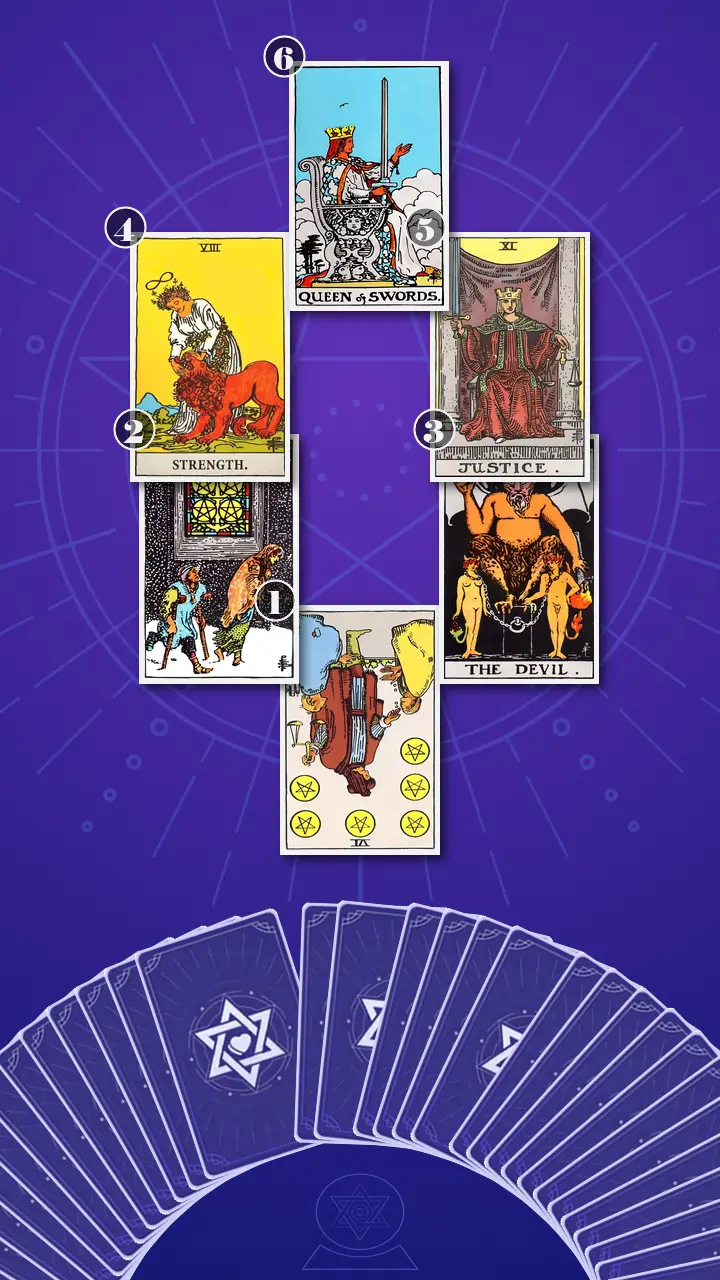
I chose the Four-Layer Insight Ladder · Context Edition, a six-card tarot spread for family financial boundaries and adult agency. I chose it because Jordan’s problem was not a simple choice between accepting money and refusing it. A relationship spread would show two perspectives, but it would not fully expose the repeating system: an offer brings relief, an unspoken expectation appears later, guilt makes disagreement expensive, and the next offer renews the pattern.
For anyone wondering how tarot works in my practice, I treat a spread like a visual systems map. The cards do not predict that Jordan will be abandoned, financially secure, or proven right. They separate the moving parts of the situation so intuition can be tested against observable facts.
The first card would show the visible bargain. Two root cards would reveal the feared loss and the mechanism binding help to compliance. Strength and Justice would identify the inner capacity and fair standard capable of changing the arrangement. The final card would translate that standard into a boundary Jordan could actually say aloud. I laid the cards like an ascending ladder, beginning with the exchange already happening and ending with a voice that could remain present inside the relationship.
Reading the Lower Rungs
Position One: The Scale Held by the Giver
I began by turning over the card representing the visible bargain: accepting family help before clarifying how it may affect later decisions. It was the Six of Pentacles, reversed.
In the Rider-Waite-Smith image, one standing figure distributes coins while two people kneel beneath him. He also holds the scales. Reversed, the card asked a precise question: what happens when the person controlling a needed resource also gets to define what counts as a fair exchange?
I connected it directly to the transfer on Jordan’s phone. A family member had sent money toward a Toronto housing cost and described it as uncomplicated help. The transfer cleared before Jordan asked whether it was a gift, a loan, or a contribution that included updates or influence. The immediate bill became lighter, but the sender now expected a view on the apartment, neighbourhood, and lease.
“The problem is not that help was offered,” I said. “The problem is that the acceptance criteria arrived after you had already clicked accept. It’s like a product-design brief whose invisible requirements are revealed only at the final review.”
In energy terms, I read reciprocity as being in Blockage and giver-side authority as being in Excess. The exchange could contain genuine care, but Jordan had not been given enough information to consent to its relational cost. The reversed card also warned against an overcorrection: refusing every offer and withholding every ordinary update could turn one necessary boundary into avoidable isolation.
Jordan gave a short laugh, but there was no humour in it. Their thumb pressed into the edge of the phone. “That’s so accurate it’s almost cruel.”
“The card is not calling you foolish,” I replied. “It’s showing us an arrangement whose terms are hard to evaluate after the resource has already arrived. Think of the last offer you accepted. What did you receive, and what decision later became harder to make freely?”
“The deposit,” Jordan said. “Then the neighbourhood somehow became a family discussion.”
Position Two: The Warm Window in the Snow
I next turned over the card representing the feared loss beneath acceptance: the safety or belonging fear that makes refusal feel more costly than the expense itself. It was the Five of Pentacles, upright.
I pointed to the two figures moving through snow beneath an illuminated stained-glass window. I was careful with this card because it can be mishandled as a prediction of poverty or rejection. I did not see it forecasting either. I saw Jordan’s mind placing every feared consequence into one image before any of those consequences had been tested.
When Jordan imagined declining a contribution, they did not picture losing one deposit payment. They pictured an empty savings account, another Toronto rent increase, every future emergency handled alone, and a colder place in the family. Refusal felt like leaving a warm apartment lobby and stepping straight into a February snowstorm, even before Jordan had checked what other doors might be available.
I described the card’s energy as a scarcity alarm running in Excess, while confidence in alternative support felt stuck in Deficiency. That did not mean the practical risk was imaginary. Toronto housing costs were real. It meant the practical facts and the anticipated loss of belonging had fused into one overwhelming consequence.
“When you imagine saying no,” I asked, “what do you picture losing first: the money, the backup, or the feeling that you are still welcome?”
Jordan’s shoulders rose slightly. Their eyes left the cards and fixed on a dark corner of the kitchen. “Being welcome,” they said. “The money is what everyone would talk about, but being welcome is the actual thing.”
I nodded. “That distinction matters. We can respect the real financial pressure without allowing the fear of relational exile to impersonate a confirmed fact.”
Position Three: The Subscription Nobody Remembers Starting
I moved to the card representing the mechanism that binds help to compliance: the belief and defensive pattern that turn a temporary offer into recurring influence. It was The Devil, upright.
I drew Jordan’s attention to the loose chains around the figures’ necks. The image did not tell me that Jordan was literally powerless, nor did it prove malicious intent on anyone else’s part. It showed a negotiable arrangement experienced as fixed because the emotional exit cost felt unbearable.
In Jordan’s daily life, no written rule gave relatives final authority. Still, anticipated disappointment seemed to remove the option to disagree. Each contribution brought relief and then renewed the same internal contract: accept the help, provide the updates, soften the decision, and avoid testing what might happen if the answer were no.
“This is like a subscription with invisible auto-renewal,” I said. “The transfer solves this month’s problem, while guilt quietly renews access to the next decision. The visible choice is yes or no. The hidden line running underneath it is: ‘If I say no, I may lose support; if I say yes, I may lose my say.’”
The Devil concentrated the pattern into Blockage: relief, belonging, and obedience had been bundled together, while the perceived cost of unbundling them had grown to Excess. The chain felt fixed because Jordan had been treating discomfort as evidence that resistance was impossible.
I used a lens I call Narrative Enmeshment Diagnosis. I do not use it to declare that a family has hijacked someone’s life. I use it to test which personal plotline has quietly been recruited to fulfil a family story. “If your housing decision has become evidence in someone else’s story,” I asked, “what is that story trying to prove?”
Jordan’s breathing paused. Their fingers stopped rubbing the phone case, their gaze unfocused as if an old conversation had begun replaying behind their eyes, and then a low exhale left their chest. “That they have to protect me from making impulsive choices,” they said. “If I choose differently, it makes the help look like a mistake.”
“Then the chain is not only money,” I said. “It is the role of proving that their support produced the version of you they expected. Naming that role does not force you to reject the relationship. It gives you a chance to decide whether you still consent to performing it.”
The Pause Between Pressure and Reply
Position Four: Strength Without a Showdown
I then turned over the card representing the internal capacity that can interrupt automatic agreement: the ability to tolerate guilt, pressure, and relational discomfort without immediately yielding. It was Strength, upright.
I asked Jordan to look at the woman’s gentle hands resting near the lion’s jaws. She was not crushing the animal, running from it, or pretending it had no teeth. Her influence came through calm contact. I read that image as Balance: intense feeling was present, but it was no longer in charge of the first response.
I brought Jordan back to the familiar family call. The silence sharpens. Their jaw clenches. A relative asks for an answer. Their hand hovers over the send button, and immediate agreement promises to make the pressure stop. Strength does not demand a confrontation in that moment. It makes room for one sentence: “I appreciate the offer. I need time to think about it.”
“The pressure may still be loud,” I said. “But loud is not the same as authoritative. You can feel it without letting it write the reply. That pause is already a different behaviour from surrendering.”
Jordan pulled one hand away from the phone and placed it flat on the table. “But the calls move so fast,” they said. “By the time I realise what happened, I’ve already agreed.”
I appreciated the practical objection. “Then we do not begin with perfect awareness or a twenty-four-hour pause. We begin with a prewritten holding sentence and two hours. Strength is not measured by how calm you feel. It is measured by whether the feeling gets to make the decision before you do.”
Jordan read the sentence aloud once. Their voice caught on the word “time,” then steadied on the second attempt. Outside their window, wet snow began drawing pale diagonal lines through the city light. This time, I did not read the snow as exclusion. I read it as weather Jordan could notice without immediately stepping into it.
When Justice Moved the Scales
Position Five: The New Rule for Receiving Support
I turned over the card representing the new rule for receiving support: the principle that can separate gratitude from surrendering personal authority. It was Justice, upright, the central bridge in the reading.
The room seemed to become quieter around the card. Even the fluorescent buzz from Jordan’s kitchen dropped out for a moment when their microphone adjusted. I saw the balanced scales first, then the upright sword. The scales assessed reciprocity; the sword required the conclusion to be stated plainly.
I placed Justice beside the reversed Six of Pentacles. Both cards carried scales, but the first scale belonged to the person distributing the resource inside a hierarchy. Justice moved the scale to the centre, where the giver’s intention was not the only measure of fairness. The question changed from “Was the help generous?” to “Were the expectations visible and freely accepted?”
I watched Jordan stare at the two cards. Their thoughts still seemed to rotate around finding the one morally correct answer: accept and prove gratitude, or refuse and prove independence. In both versions, the family’s reaction remained the judge, while Jordan’s own consent entered the scene too late.
You do not have to trade your voice for support; weigh the terms openly and let Justice's balanced scales hold both gratitude and agency.
For one beat, Jordan did not move. Their breath stopped halfway in, and two fingers remained suspended above the phone as though the old draft were still waiting beneath them. Their eyes lost focus, replaying something I could not see. Then their mouth tightened. “But doesn’t that mean I’ve been doing it wrong this whole time?” they asked, sharper than before. I heard anger arrive ahead of relief.
“No,” I said. “It means immediate agreement helped you survive pressure quickly. We are examining the cost now because you have enough awareness to choose another response. That is not a verdict on your past self.” Jordan’s pupils widened, then their eyes shone at the edges. Their raised shoulders lowered by degrees. The hand curled beside the laptop opened, and a trembling breath left them with a soft, surprised sound. Relief crossed their face, followed by a brief blankness: the lightheaded moment when a familiar burden lifts and the responsibility to choose becomes real. I asked, “Now, with this new perspective, think back: was there a moment last week when this insight might have made you feel different?”
“The deposit conversation,” Jordan said after a pause. “I kept trying to work out whether I was allowed to disagree. I never asked what the money actually meant.”
“That is Justice’s opening,” I replied. “A contribution toward a deposit can be appreciated while the neighbourhood, lease, or move date remains your decision. You can be thankful and still ask for terms. You can accept help and still retain the connected choice. Family help can be generous without purchasing decision-making power.”
At this point, I brought in my Family Casting Analysis. I use it to identify the role a family system rewards, not to flatten anyone into a villain. Jordan recognised their role as The Peacemaker: the person who kept the family scene calm by accepting help, softening direct lines, and absorbing the resentment off-camera.
“The Peacemaker’s hidden job has been to make the exchange look uncomplicated,” I said. “Justice is not asking you to leave the cast. It is asking you to stop letting a role write the contract. Gratitude can be real without becoming a transfer of authority. Help is not a silent proxy vote.”
I described Justice as energy in Balance. It did not erase affection, risk, or practical interdependence. It placed four questions on the scales: What is offered? What is expected? What decision must remain mine? Is declining genuinely possible? If refusal could not be questioned, paused, renegotiated, or declined, then consent was not fully visible.
I invited Jordan to open a note and write those four lines. I made the permission equally explicit: they did not have to send anything that night. If their chest tightened further, they could close the note and return later. The pause belonged to them.
I named the emotional movement I could see. This was not instant certainty. It was one step from relief-driven compliance and fear of losing family support toward explicit consent, steadier self-respect, and connection without surrendering personal authority. Jordan was beginning to tolerate guilt without treating it as proof that they had done something wrong.
The Voice at the Top of the Ladder
Position Six: An Open Hand and an Upright Sword
At the top of the spread, I turned over the card representing the boundary in practice: one clear communication Jordan could use before accepting, renegotiating, or declining help. It was the Queen of Swords, upright.
I showed Jordan the Queen’s vertical sword and extended open hand. The sword was precise; the open hand allowed conversation to continue. I read that combination as direct language without hostility, and discernment without emotional exile.
In practical terms, the card sounded like this: “I appreciate the help, and I can accept it only if the housing decision remains mine. If that does not work for you, I understand, and I will look at another option.” The sentence did not guarantee agreement. It did not control the family’s feelings. It made the available choices and Jordan’s boundary visible before the exchange went forward.
The Queen restored Balance to an area where direct speech had been in Deficiency. She did not ask Jordan to build a courtroom argument or explain every reason their boundary was reasonable. She asked for one accurate sentence, followed by enough silence for the other person to make an informed choice.
As an artist, I thought briefly of The Little Mermaid, not as a judgement about Jordan’s family but as a familiar image of access purchased with a voice. The Queen of Swords offered a different scene: Jordan could discuss the price of entry while their voice was still present. The story did not have to choose between complete self-sufficiency and silence.
Jordan read the boundary once, then tried to add three explanations. They caught themselves on the fourth sentence and smiled with a trace of embarrassment. Their jaw was still tight, but their shoulders were no longer pulled toward their ears. “One sentence first,” they said.
“Exactly,” I replied. “The Queen’s open hand allows the conversation. Her sword keeps the conversation from editing away the truth.”
Turning the Reading Into Visible Terms
I read the six cards back as one coherent story. The past influence was not a single event but a repeated sequence: family help had arrived during real practical pressure, Jordan had accepted before asking about conditions, and previous contributions later became reasons for relatives to influence housing or career decisions. The reversed Six showed the visible imbalance. The Five revealed the fear that losing one offer might mean losing warmth and backup altogether. The Devil exposed the internal contract that tied relief to compliance.
Strength then placed a pause between pressure and reply. Justice supplied a fair standard. The Queen of Swords turned that standard into language. The spread moved from Pentacles, the hard facts of rent and resources, toward Swords, the clarity of terms and decision rights. With no Cups or Wands in the layout, I did not expect emotion or initiative to organise itself automatically. Jordan would need to name the guilt and deliberately schedule one small action.
The cognitive blind spot was the belief that gratitude proved the arrangement was fair, and that guilt proved disagreement was wrong. A second blind spot made the options look binary: take the help and comply, or refuse it and risk a family rupture. Justice opened a wider range of choices. Jordan could ask, pause, accept with conditions, renegotiate, decline, or seek a smaller contribution. The transformation was not from dependence to total self-sufficiency. It was from accepting first and negotiating later to making consent part of the offer itself.
I framed the next steps as a rewrite of one scene, not a demand to resolve the whole family story at once.
The Terms-Before-Thanks Plan
- Use the Two-Hour Consent Pause At the next offer of family money or practical help, whether it arrives on a call, by text, or through Interac, say: “Thank you for offering. I want to look at the details before I answer.” Set a phone reminder for at least two hours later. Before the reminder ends, open a note titled “Before I Accept” and write: What is offered? What is expected? What information or access is requested? Which decision remains mine? Label the offer as a gift, loan, or shared arrangement based only on what has actually been stated. If two hours feels difficult, begin with ten minutes. The purpose is not to feel calm; it is to prevent immediate agreement from acting as pressure relief.
- Run the Script-Flipping Rehearsal Before the next family call, spend five minutes recording a voice memo of this deliberately out-of-character response: “I appreciate the offer, and I can accept it only if the housing decision remains mine. If that does not work for you, I understand, and I will look at another option.” Then rehearse one realistic pushback, such as “After everything we’ve done, why are you making this transactional?” Reply by repeating the condition once, without adding more than one explanation. The goal is not to dominate the conversation or guarantee agreement. It is to make clear speech familiar enough that surprise does not automatically return you to the Peacemaker script.
I reminded Jordan that either exercise could be stopped if it became too activating. Actionable advice should increase choice, not become another standard they have to obey perfectly.

A Week Later, the First Reply Changed
Six days later, I received a message from Jordan. A relative had offered to add more money to the deposit and asked for an answer during the same call. Jordan had felt their chest tighten and heard the old yes forming, but they used the holding sentence instead. They set a two-hour timer, opened the Justice note, and asked whether the contribution was a gift or whether it came with involvement in the neighbourhood and lease decision.
The first response was not perfectly reassuring. The relative said, “We thought you’d want our input,” and Jordan felt the familiar pull to overexplain. They used the rehearsed line once. The conversation remained unfinished, but the expectation was no longer invisible. Jordan had not solved the housing market, settled every family boundary, or guaranteed that the offer would remain available. They had simply kept their voice in the room long enough to learn what was being offered.
That night, Jordan slept through until morning. Their first thought was still, “What if they pull the offer?” This time, they noticed it, breathed once, and did not reopen the message.
I think of that as the quiet proof of our Journey to Clarity. The cards did not reclaim Jordan’s authority for them. They helped make the hidden arrangement visible, and Jordan chose the first different line. Tarot offered the map; Jordan remained the author, editor, and decision-maker.
If help has ever landed in your account and loosened your chest for one minute before tightening your jaw at the thought of owing someone a vote, I want you to know that the contradiction makes sense. Wanting support and protecting the belonging that makes refusal feel dangerous can occupy the same set of scales. Noticing both means the old script is already visible enough to question.
When the next offer lights your screen, what is the one condition you would place in your own Justice note before deciding what that help means to you?