When Parenthood Planning Hid Desire: Writing Before the Social Clock

When Parenthood Timing Keeps Personal Desire Off the Page
You can answer "When would it be practical?" with six tabs and a forecast, but "Would I want the daily role?" makes you close the laptop. I recognized that pattern before Jordan finished her first sentence.
At 11:37 p.m. on a Wednesday, Jordan sat at the small kitchen table in her Toronto rental and dragged a target parenthood year in a Google Sheet from 2027 to 2028. The laptop fan hummed beside a mug of cold tea. Outside, a streetcar ground around the wet corner, and one of her heels bounced beneath the chair. The new date made her shoulders drop for one brief second. Then the journal prompt beside the laptop asked what she would choose without a deadline, and she closed both windows.
Jordan was a capable product operations manager. She could map a launch across three teams, track dependencies, and turn uncertainty into a tidy risk register. But when I asked what she wanted parenthood to mean in her own life, she gave me a schedule instead.
"I keep saying it is not the right time," she told me, "but I do not know what the right time is supposed to solve. I can make a plan for everything except how I actually feel about this."
I could see the unease in the tightness of her jaw and the shallow rise of her chest. It was like sitting in a color-coded station with a perfect transit map while every platform sign pointed to "later." Beneath the social-clock anxiety, the question was not simply whether she could arrange housing, leave, money, or work. It was whether she genuinely wanted the role, and what it would say about her identity if her answer did not fit the adulthood script around her.
"You are not failing because the answer is not arriving on schedule," I said. "We can look at the pattern without forcing a yes or no. Today, our Journey to Clarity is simply to find out what the timing explanation may be helping you avoid, and to give your own response enough room to speak."

Choosing the Shadow Spread for a Social-Clock Question
I invited Jordan to put both feet on the floor, take one unhurried breath, and hold the question in its plainest form: "What am I avoiding by calling parenthood pressure a timing issue?" I shuffled slowly. The point was not to summon a verdict. It was to move from mental overdrive into focused observation, the same kind of transition that happens when a scattered meeting finally gets a clear agenda.
For this reading, I used the five-card Shadow Spread. It is a precise tarot reflection for parenthood ambivalence because it follows a symptom into the hidden values conflict beneath it, identifies the defense protecting that conflict, finds an integrating resource, and ends with a bounded action. It does not predict whether Jordan will become a parent or decide a date for her. It helps show how the current story is working.
The cards formed a compact cross. Card one sat above the center and revealed the visible timing problem. Card two occupied the heart of the spread and asked what values-and-identity question the schedule was concealing. Card three sat to the left and showed the protective function of perfect alignment. Card four sat to the right as the resource that could separate an authentic call from the social clock. Card five rested below everything, translating insight into one honest next step.
That structure matters for anyone exploring how tarot works in a real decision. The cards are not replacing practical information, medical advice, financial planning, relationship conversations, or personal consent. They are putting card meanings in context so that useful logistics do not become a hiding place for a more vulnerable question.
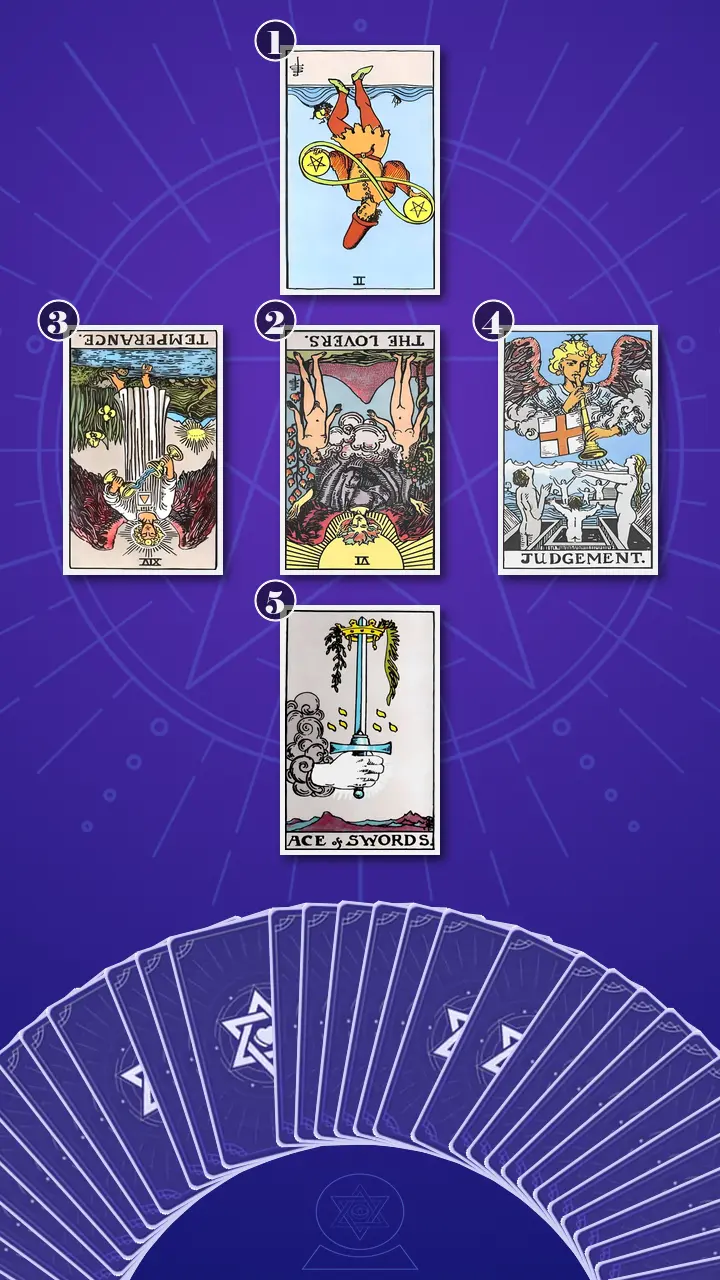
The Infinite Ribbon in the Spreadsheet
The Present Symptom: Two of Pentacles Reversed
Now I turned over the card representing the present symptom: repeatedly juggling dates, resources, and readiness criteria instead of answering the parenthood question directly. It was the Two of Pentacles, in reversed position.
The image showed a figure keeping two pentacles moving inside an infinity-shaped ribbon while ships rose and fell behind him. I connected it to Jordan's familiar late-night scene: changing 2027 to 2028 after checking Toronto rent, childcare estimates, parental leave, and a possible promotion cycle. The practical variables were real. The problem was that every new variable gave the date another reason to move.
Reversed, this card showed an excess of adaptation and a deficiency of direction. Jordan's planning competence had become a closed loop. Moving the date created temporary control, but it did not create clarity. The spreadsheet kept asking, "Can all conditions be balanced?" while quietly avoiding, "Do I want this role, and why?"
I heard the thought beneath the formulas: "If I solve one more variable, then I will be allowed to know how I feel." A movable date can create control without creating clarity. The infinity ribbon was not a warning about the future; it was a remarkably accurate picture of a plan that could be adjusted forever without naming its destination.
Jordan did not nod. She gave a short, humorless laugh and said, "That is painfully accurate. It is almost rude." Then she exhaled sharply, rubbed the hinge of her jaw, and glanced at the closed laptop as if it had just been caught speaking.
"Planning is not the enemy here," I told her. "The useful question is which variable genuinely affects your life, and which one is being asked to carry an emotional question it cannot answer."
The Mountain Between Two Futures
The Avoided Values Question: The Lovers Reversed
Now I turned over the card representing the values-and-identity question being avoided, including the fear that an honest answer might not match the expected parenthood timeline. It was The Lovers, in reversed position.
The card showed two exposed figures separated by a steep mountain. I asked Jordan to imagine two uncensored documents open side by side: one titled "What parenting could offer me," and the other titled "What a life without parenting could protect or create." Before either page could become personal, she wanted to open a childcare-cost calculator.
The Lovers reversed was not a hidden "no," and it was not a prediction of any kind. It showed divided values that had not yet been allowed to stand in the same room. One possible life might contain intimacy, care, continuity, or belonging. Another might contain autonomy, creativity, spaciousness, or a different form of contribution. Moving a date could not reconcile those possibilities. They needed to be seen without being edited into a socially legible answer.
This was where I used my Authentic Desire Decoding lens. I was not trying to excavate a secret preference and announce it for her. I was stripping away inherited shoulds, parental or cultural expectations, and the polished language of responsible adulthood long enough for Jordan to notice which motives were actually hers.
The inner sentence was harder to say: "Both answers contain something true, and I am scared that one of them makes me less understandable." Jordan's breath caught. Her fingers tightened around the edge of the chair, and she looked at the mountain between the figures instead of at me.
"You do not have to choose an identity tonight," I said. "Could you let both possible lives reveal their values before asking either one to become a final decision?"
The Loading Screen Called Alignment
The Protective Delay: Temperance Reversed
Now I turned over the card representing how spiritualized timing language and perpetual preparation protect Jordan from uncertainty, possible nonconformity, and loss of belonging. It was Temperance, in reversed position.
Temperance usually shows water flowing between two cups, one foot on land and one in water, and a distant path toward a crown. In Jordan's life, the interrupted flow looked like a Notion dashboard called "Alignment," with tabs for career, housing, money, relationship, health, emotional readiness, and intuition. She kept waiting for every category to turn green on the same day.
Reversed, the energy was blocked integration. Jordan was not merely being patient. She had made perfect internal harmony an entry requirement for honesty. After a wellness podcast about trusting divine timing, she could tell herself that the answer would arrive when everything felt aligned. Each partial insight was then rejected because one part of life remained uncertain.
Perfect alignment can be a polished form of postponement. I said that gently because spiritual practice itself was not the problem. The question was whether the language was helping her stay present with mixed feelings or giving her a beautiful waiting room in which she never had to meet them.
My mind went to the work I have done across cultures. Words such as alignment, readiness, and the right time can sound universal while carrying very different inherited expectations. My Shadow Path Analysis looks for the fear-based logic beneath the phrase: if I am not completely aligned, I might choose wrong; if I choose differently, I might no longer belong.
Jordan winced at the phrase "perfect alignment." Her hand went to her phone, then stopped before opening another saved article. "I am not avoiding the answer," she said slowly. "I am waiting to become the version of me who can answer correctly."
"That is a protective strategy, not a character flaw," I replied. "It gives you a few minutes of relief. It also keeps the answer permanently out of reach. We can respect what it has protected without letting it run the whole reading."
When Judgement Asked for an Unedited Voice
The Inner Resource: Judgement Upright
The room became very quiet before I turned the next card. Even the radiator seemed to pause between its clicks. Now I turned over the card representing the inner resource needed to separate a personally meaningful call from social-clock pressure and perform an honest self-review. It was Judgement, upright.
Judgement brought the angel's trumpet, the rising figures with open arms, and stark mountains in the distance. Its invoked energy was honest self-appraisal, self-authorship, and the willingness to hear an answer before making it acceptable to family, friends, a partner, or an imagined audience.
This was not a command to become a parent. It was an invitation to review the life already lived, the values currently present, and the expectations Jordan had inherited without deciding whether to keep them. I returned to my Authentic Desire Decoding lens here: the work was not to uncover a destiny, but to hear which parts of her explanation belonged to her and which parts were answering the clock.
At 11:30 p.m., Jordan moves the parenthood date one more year, feels her shoulders drop, and then closes the laptop when the journal asks what she would choose without the deadline. She is caught between the relief of postponement and the blankness that appears when postponement is no longer available.
She was still trying to solve the question as if it were a product launch, waiting for work, money, housing, emotion, intuition, and every risk indicator to turn green before she could begin. I let the silence stay long enough for the old logic to become visible.
You do not need a perfect timeline to deserve clarity; answer your own call before answering the clock, like the figures who rise openly to Judgement's trumpet.
For a beat, Jordan did not breathe. Her index finger hovered over the edge of the card, and the muscles around her mouth held. Then her eyes lost focus; I watched her replay the spreadsheet, the group-chat announcement, and the birthday dinner where she had offered a date instead of a feeling. Her chest rose quickly. She looked at me and said, "But if I answer honestly now, does that mean I have been wrong all along?" A flash of anger crossed her face before it softened into fear. The tightness in her jaw loosened first, almost reluctantly. Her shoulders dropped, and she pressed both feet to the floor. Her hands opened from fists. A long breath came out, shaky and not quite relief. She reread the sentence, then asked, "I can hear this without turning it into a decision tonight?" I said, "Yes. You can tell the truth without turning it into a lifetime contract."
I asked, "Now, use this new perspective to recall: was there a moment last week when this insight could have made you feel different?"
That was the first movement from pressured uncertainty toward grounded curiosity. The release was real, but it carried a small vulnerability with it. Once the social clock stopped speaking for her, Jordan had to hear her own voice in the quiet. Judgement did not give her a final answer. It gave her back authorship of the question.
The Sword That Made Room for Today
The Bounded Integration: Ace of Swords Upright
Now I turned over the card representing the practical act through which new awareness could enter conscious life. It was the Ace of Swords, upright.
The card's single vertical blade interrupted the infinity loop of the Two of Pentacles. A hand emerged from a clearing cloud, holding something precise and graspable. I connected it to one blank page beginning, "What I know about parenthood today is..." No formulas, dates, audience management, or forecast columns could be added until the sentence had been allowed to exist on its own.
Upright, the Ace of Swords brought focused Air: clarity, direct language, and a mental breakthrough. It did not promise permanent certainty. Its balance was the willingness to say one accurate thing now while leaving the future open. Jordan could write, "I am not ready to call my uncertainty a yes, a no, or merely bad timing," and let that be information rather than a verdict.
"The sword is not here to cut away one future," I said. "It cuts through the demand that you solve the whole future before you are allowed one honest sentence."
Jordan's shoulders lowered again, this time without the quick rebound I had seen after the spreadsheet changed. She took out her phone and opened a blank note. The cursor blinked beneath the title. "What I know today is..." she typed, then stopped. She did not fill the silence with a qualifier.
The Ace completed Judgement's movement: first hear the internally authored response, then give it clean present-tense language. Clarity does not have to be a verdict; it can be one honest sentence about today.
From a Moving Date to a Chosen Sentence
When I placed the five cards together, I could see a coherent story. The reversed Two of Pentacles showed social-clock pressure converted into an endlessly adjustable logistics loop. The reversed Lovers revealed the values-and-identity conflict beneath it, including the fear that two legitimate futures might make Jordan harder to place. The reversed Temperance showed how perfect alignment kept the conflict suspended. Judgement offered the missing capacity: an unedited, accountable response. The Ace of Swords gave that response a bounded form.
The cognitive blind spot was not a lack of information. It was the assumption that more information would eventually reveal a desire that only direct reflection could reveal. The calendar was carrying a values question it could not answer. The transformation direction was from socially pressured, logistics-driven parenthood uncertainty and belonging fear toward honest self-appraisal, grounded curiosity, and self-authored clarity about what felt true today.
This five-card Shadow Spread tarot reflection did not decide whether Jordan should have children. It showed why repeatedly revising a parenthood timeline left her feeling stuck: each revision restored control, but the returning pressure was evidence that the underlying question remained unnamed. Practical realities still mattered. They simply no longer had to impersonate desire.
I gave Jordan two small pieces of actionable advice. They were deliberately private, bounded, and easy to stop. No partner, friend, or family member was entitled to see the page, and no exercise was a substitute for medical, financial, or relationship guidance.
The Persona Detox Protocol
- Three evenings without an audienceAt home, spend eight minutes on each of three evenings. On day one, open a blank note titled "No Verdict" and write under two headings: "What draws me toward parenting" and "What draws me toward a life without parenting." On day two, record a private two-minute voice note about what the daily role evokes, then label phrases as "mine," "inherited," or "still unknown." On day three, write one sentence under 30 words beginning, "What I know about parenthood today is..."Keep dates, costs, scoring, and rebuttals off the page. If you feel activated, put both feet on the floor, pause, and return only if you choose. Mixed answers are allowed.
- One consent-based conversationWithin the next week, if you want company, text one trusted person: "Could you listen for ten minutes without helping me decide? I want to practise saying what is true today." If someone asks for a timeline before you are ready, use: "I am reflecting on what I want, and I am not discussing dates right now."Share only the sentence you choose to share. If the conversation starts lobbying you toward either outcome, keep the rest private and return to your own wording.

A Small Proof, Not a Final Answer
Five days later, I received a message from Jordan. She had completed the three-day experiment and written: "I do not know yet whether I want parenthood, but I know I do not want to use a moving date to avoid learning what I feel." It was not a declaration. It was a sentence she could actually stand behind.
The next morning, she slept a full night but woke with the familiar thought, "What if I am wrong?" This time, she smiled, made coffee, and left the spreadsheet unopened. The uncertainty had not disappeared. It had stopped pretending to be an emergency.
I smiled at her message because this was the real proof of the reading. The cards had not chosen a future for her. They had functioned as an objective map of a repeating pattern, and Jordan had used the map to make one self-authored move. The querent remained the author of her life, not the calendar, not the group chat, and not the tarot.
That is what finding clarity looked like here: not certainty, not a socially approved answer, but the first grounded curiosity strong enough to meet an honest present-tense truth. The journey had moved from logistics-driven pressure and belonging fear toward a clearer relationship with her own values.
When another announcement lands and your jaw tightens, moving a date may feel safer than admitting that your honest answer might not fit the version of adulthood that once promised belonging. You do not have to punish yourself for that reflex. You can notice it, breathe, and leave the page open.
If no timeline or audience were watching, what is one sentence you might let yourself say about parenthood today, before the spreadsheet and the social clock edit it?