An Unchosen Career Kept Taking Family Time: Naming the Real Cost

When an Unchosen Career Path Kept Taking Family Time
If you are a twenty-something junior coordinator in a high-rent city who opens the work calendar before the family chat every Sunday, I suspect your Sunday Scaries may be less about Monday itself and more about watching family time become the week's overflow space. That was the pattern I heard when Alex, a 29-year-old project coordinator in Toronto, came to me asking why they kept sacrificing family time to preserve an unchosen career path.
At 9:14 on a Sunday night, I could see their small condo kitchen through our video call. A mug of tea had gone cold beside the laptop. The radiator clicked beneath the steady electric hum of the room, and blue screen light flattened the colour from Alex's face as they opened Google Calendar before the family group chat. With one movement of the trackpad, they dragged Tuesday's family call into an unnamed gap.
“I just need this week to be manageable,” they said. Then their shoulders rose toward their ears. “Except I say that every week. I keep calling it temporary, but temporary keeps eating the same hours.”
The conflict was painfully clear. Alex wanted unhurried time with people they loved, but every evening request at work seemed to arrive carrying a hidden test of loyalty and competence. Saying yes left resentment behind the sternum; saying no made guilt pull across the chest like a seatbelt locked one notch too tight. They could explain the salary, Toronto rent, and promotion route perfectly. They could not explain why the route felt like theirs.
“Everyone says I have a direction,” Alex told me, their jaw tightening, “so why does it feel like I'm disappearing from my own life? If I question this path, I look ungrateful or unreliable. But if I keep going, my family gets whatever is left.”
I told them I would not use tarot to declare that work was bad, family was automatically right, or a dramatic career exit was waiting around the corner. Rent, workplace power, and actual deadlines do not vanish because a card appears. I use tarot as an objective reflective tool: a way to separate what is happening, what is feared, and what is still available to choose.
“Let's make the trade-off visible,” I said. “We don't need to solve your entire life tonight. We only need a clear map of the scene you're in and enough authorship to write the next honest beat.”

Choosing the Workbench for a Tangled Week
I asked Alex to close both the work calendar and the family chat for one slow breath. I shuffled while they held the consultation question in mind. The pause was not a mystical performance; it was a deliberate transition from reacting to observing.
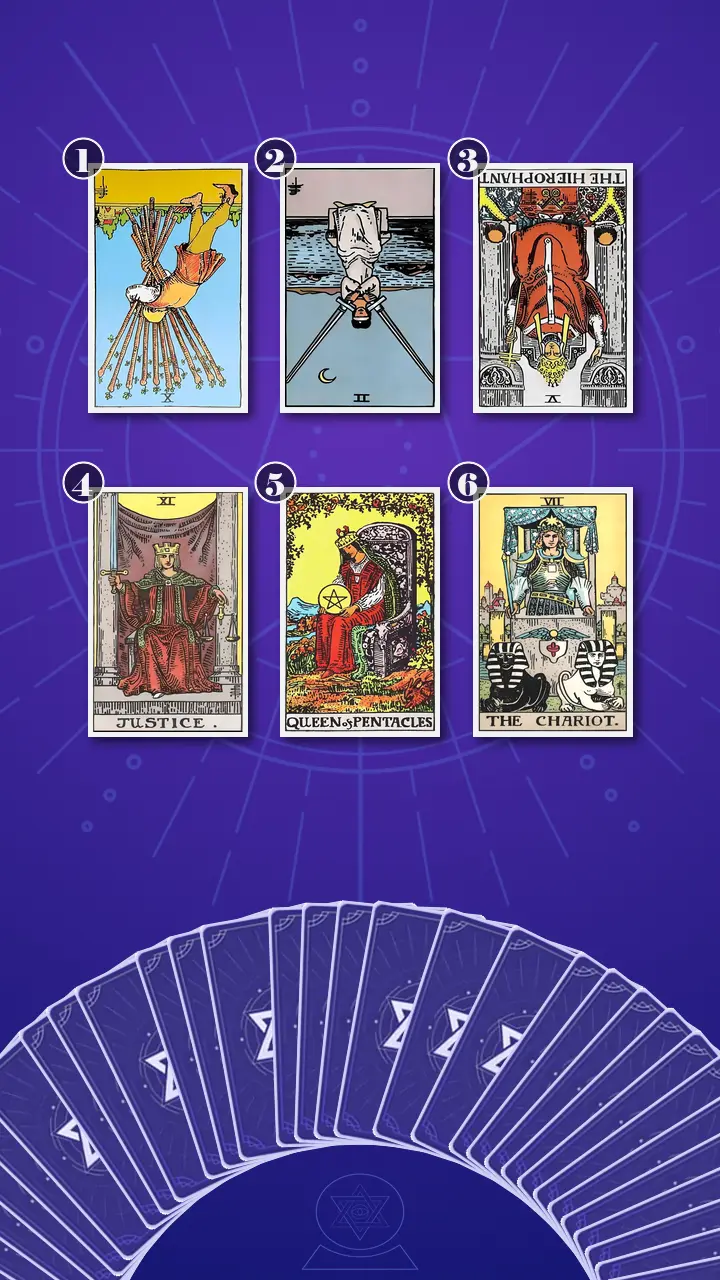
I chose the Transformation Path Grid (6) · Context Edition, a six-card tarot spread for career autopilot, boundary guilt, and family-time conflict. When readers ask me how tarot works in a situation like this, I explain that card meanings in context matter more than isolated definitions. The spread needed to show a repeating system, not reduce Alex's life to a simplistic work-versus-family choice.
I placed the cards in a two-by-three grid. The top row would diagnose the visible sacrifice, the blocked decision, and the rule underneath it. The bottom row would show the clarifying bridge, one grounded action, and the internal stance Alex could practise when competing demands returned. I described it as a workbench: the upper row held the tangled material; the lower row would help us turn it into a deliberate route.
The first position would show how family time became the flexible cost. The second would expose the inner conflict that let urgency choose by default. The third would ask where the definition of responsibility came from. The fourth, our turning point, would identify a clarity practice. The fifth would bring that clarity into the calendar. The sixth would describe integration, not a fixed prediction.
I reminded Alex that every conclusion would remain provisional until it connected with their lived evidence. The cards could illuminate the production, but Alex retained the pen, the budget, and final approval over the next scene.
Reading What the Calendar Had Hidden
Position One: The Burden That Blocked the Road
I turned over the card representing the observable sacrifice pattern: accepting obligations attached to a path Alex did not choose while family time became the easiest cost to move. It was The Ten of Wands, reversed.
I pointed to the figure bent beneath ten bundled wands. The load did more than strain the body; it blocked the road and obscured the destination. In Alex's modern life, the image was almost literal. They stayed online after dinner to finish one more routine task, shifted a planned family call into an unscheduled gap, and folded their body towards the laptop. The workload was heavy, but the deeper issue was that carrying it left no clear line of sight to why it was being carried.
“The inner line sounds like this,” I said. “It is only one more task, and I'll make the time back later.”
The reversed card showed Excess turning into Blockage. Responsibility had accumulated past the point where additional effort produced meaningful direction. Alex kept proving short-term competence by making everything move, but the long-term result was their own gradual disappearance from the parts of life they claimed to value.
“Temporary is still a decision when it keeps taking the same hour,” I said. “That isn't a moral judgment. Overload narrows perception. But once the pattern is visible, we can ask which commitment might be released or renegotiated before another family hour is automatically offered up.”
Alex gave a short laugh that carried no amusement. Their fingers stopped on the rim of the cold mug. “That's so accurate it feels a little cruel.”
I let the reaction breathe. “I hear the sting. The card isn't calling you careless. It is showing how hard you've worked to keep the system functioning. The question is whether that system has quietly made your presence the expendable resource.”
The laugh disappeared. Alex exhaled sharply and named a dinner they had shortened the previous week. Recognition had arrived, but it came with grief rather than instant relief.
Position Two: Two Notifications and No Neutral Choice
I turned over the card representing the Sacrifice-Agency Split and the inner conflict that made questioning the path feel riskier than repeating it. It was The Two of Swords, reversed.
The blindfolded figure held two swords crossed tightly over the chest while still water waited behind them. I translated that suspended image into a Tuesday commute on Line 1: Alex sitting with a late Teams request and a family dinner confirmation on the same phone screen. They reread both messages as the carriage brakes screeched and a damp coat brushed their arm. The phone warmed in their palm; their jaw tightened; neither message received an honest answer.
“If I answer either one honestly, someone may be disappointed,” I said, voicing the loop I heard, “so maybe I can wait.”
The reversal showed Blockage in discernment. Waiting looked neutral, but the two requests did not have equal relationships with time. The work demand gained force as its deadline approached. The family plan became unworkable. Urgency made the decision that Alex had postponed, allowing work to remain while family time disappeared without a clear choice ever being spoken.
“Your calendar is not neutral; it records what pressure was allowed to decide,” I told them. “Avoiding conflict may reduce the discomfort for twenty minutes, but it also gives the fastest consequence control over the whole evening.”
Alex's breath caught. Their eyes moved away from the card as if replaying the train ride. One hand closed around the other, then loosened. “I always think I'm waiting for more information,” they said. “But most of the time I already know what the messages mean. I'm waiting for one option to disappear so I don't have to own the choice.”
I nodded. “That doesn't mean every work request can be declined or every family plan must win. It means the trade-off deserves to be named before timing disguises it as inevitability.”
Position Three: The Respectable Script on Auto-Renew
I turned over the card representing the inherited rule, received expectation, or practical story that gave the unchosen career path authority. It was The Hierophant, reversed.
I studied the central teacher, the raised hand, the crossed keys, and the two kneeling acolytes. Upright, the Hierophant can hold tradition, institutional knowledge, and established systems. Reversed in this root position, its energy showed a Blockage in personal authorship: a rule had been accepted as legitimate before its source or present usefulness had been examined.
I asked Alex to imagine the Tuesday performance review they had described. They could repeat the approved script about stability, promotion, and Toronto rent. They could explain the credible LinkedIn ladder without missing a beat. But when I asked, “Would you choose this path today if outside approval were removed?” the polished explanation stalled.
The split reminded me of Severance, not because Alex had a secret workplace self, but because their credible corporate identity had become oddly disconnected from the person living inside it. It was like leaving a subscription on auto-renew because cancelling would force an admission that it no longer served the life currently being lived.
“This is the sensible route,” I said, reflecting the inherited monologue. “So questioning it must mean I'm ungrateful.”
Alex looked down. “My family didn't actually tell me I had to stay in this job.”
“That distinction matters,” I replied. “An inherited rule doesn't require a villain. It may come from school, workplace culture, financial reality, an earlier life stage, or your own attempt to stay recognisable as a responsible person. Some parts of the path may still be practically necessary. The problem begins when chosen values, inherited expectations, and current constraints are treated as one unquestionable command.”
The card's invitation was not rebellion for its own sake. I asked Alex to sort the rule into three columns: chosen, inherited, and practically necessary. Before changing anything, they only had to place each obligation where the evidence said it belonged.
Alex went still. Their thumb pressed into the side of the mug, their gaze lost focus, and then a long breath left their chest. “I've been afraid that if I question the route, all the missed dinners become meaningless.”
“Responsibility without a values check can become a burden you keep trying to justify,” I said. “A past sacrifice does not need to purchase another one.”
When Justice Put the Lost Hours on the Scales
Position Four: The Bridge from Guilt to Evidence
The radiator clicked once and then fell quiet. Even through the call, I felt the room settle as I turned over the card representing the clarity practice that could separate chosen responsibility from automatic sacrifice. Our key card was Justice, upright.
I saw the level scales in one hand and the upright sword in the other. My artist's mind flashed not to a courtroom verdict, but to an editing suite: two versions of the same sequence placed side by side, stripped of dramatic music, so the actual continuity could finally be checked. Justice was not here to prosecute Alex. It was here to restore Balance through discernment, proportion, and honest self-accountability.
I asked Alex to picture the previous four weeks arranged in two columns like the scales. On one side: actual deadlines, explicit job requirements, rent, team coverage, and the consequences of delaying specific tasks. On the other: family hours already lost, plans compressed into logistical check-ins, feared judgments, and the values Alex said they wanted their calendar to hold.
The sword asked for one clear sentence: “This is what the request requires, this is what I fear it means, and this is what accepting it will replace.”
I used one of my core practices, Macro-Narrative Arc Auditing, to examine the shape of Alex's story. I asked whether every 6 p.m. request had been framed as a climax where their entire identity as a reliable person would be proved or ruined. The evidence suggested something less dramatic and more freeing: Alex was in the messy middle of a transition, not at a final verdict. A bounded work response was not the ending of the career film. It was one editable scene.
I also named the possible turning point. The apparent dead end of “either disappoint work or betray family” could become the inciting incident for a more self-authored act. Justice did not offer permission from outside. It invited Alex to accept authorship of one proportionate boundary.
I put the Sunday loop back in front of them: “On Sunday night, you open the work calendar before the family chat, move the call to sometime later, and feel your shoulders rise as another temporary task takes the hour. By Friday, the task is done, but that hour is not coming back.”
Stop treating repeated sacrifice as proof of responsibility; let Justice's scales weigh the real cost of the unchosen path, then use its upright sword to name and renegotiate one boundary.
I paused long enough for the sentence to remain in the quiet room. Then I brought the message even closer to the fear beneath the calendar: “You do not have to keep paying for an unchosen path with family time just to prove you are responsible. Agency begins when the cost becomes visible and one commitment becomes negotiable.”
Alex's breathing stopped so completely that the radiator's silence seemed to widen around them. Their fingers hovered above the mug without touching it, and their pupils widened as though an old week were replaying frame by frame: the accepted meeting, the shortened dinner, the unread voice note. Then their mouth tightened. A flash of anger crossed their face before the grief arrived. “But doesn't that mean I got all of this wrong?” they asked, their voice suddenly sharp. “That I missed all that time for nothing?” Their shoulders stayed rigid for another second, then descended as if a strap had been loosened. Their fist opened on the counter. Their eyes reddened, and the next breath came out low and unsteady, carrying both relief and the dizziness of realising that clarity now asked something of them.
“No,” I said. “Justice is not retroactive punishment. You made earlier choices with the constraints, fears, and information you had. Honest accounting does not declare those choices worthless. It stops the past from automatically invoicing the future. You can respect what those decisions protected without forcing yourself to repeat their cost forever.”
I asked, “Now, using this new perspective, can you think of a moment last week when this insight might have changed how it felt?”
Alex remembered a 6 p.m. meeting invitation arriving over a family dinner block. Their cursor had hovered over Accept. “I assumed they needed the whole evening,” they said. “I didn't ask what was actually required.”
“There is the ten-second interruption,” I replied. “Instead of instant compliance, you can ask what the meeting displaces and whether the response can be proportionate. Agency can look like one honest reschedule, not a dramatic exit.”
I named the breakthrough carefully. This was not instant confidence or a solved career crossroads. It was movement from guilt-driven availability and resentful family-time loss to grounded agency over work and connection. The first crossing was small: Alex had stopped treating fear as identical to evidence.
The Garden, the Calendar, and the Driver's Seat
Position Five: Care with a Start Time and an End Time
I turned over the card representing the bounded behaviour that could protect one piece of family time without deciding anyone else's priorities. It was The Queen of Pentacles, upright.
The Queen held a large pentacle securely in her lap, surrounded by a cultivated garden. I read her energy as Balance made practical. She did not romanticise care or pretend material responsibility was optional. She gave attention structure so that what mattered could survive ordinary pressures.
For Alex, the modern translation was precise: agree with one family member on a recurring dinner, walk, or call; place it in the same calendar used for work; give it a clear start and end; quit Teams for that block; and prepare a smaller backup if illness, travel, or a genuinely immovable work need changed the week.
“Family time is not the prize at the end of an empty inbox,” I said. “Care does not have to wait for every task to disappear. It can have infrastructure.”
I was careful to distinguish protected time from obligation. Alex's relatives were not required to accept a proposed slot, and family connection did not mean unlimited access. The Queen's care was mutual, bounded, and responsive. A 30-minute call agreed by both people was more grounded than an indefinite promise to make up for everything later.
Alex's posture changed almost imperceptibly. Their elbows moved away from their ribs, and they looked back at the calendar without opening it. “That sounds almost too ordinary,” they said.
“Ordinary is useful,” I replied. “A sustainable boundary should not require a heroic mood every time you practise it.”
Position Six: Setting the Destination Before the Next Alert
I turned over the final card, representing the internal integration Alex could practise when family time and career demands competed. It was The Chariot, upright.
The black and white sphinxes pulled in different directions while the Charioteer stood beneath a canopy of stars. I read the card as directed Fire in Balance: not the overloaded fire of the reversed Ten of Wands, but effort coordinated by a consciously named direction.
In Alex's week, one sphinx represented practical career needs: income, credible deadlines, role expectations, and financial stability. The other represented family presence, rest, and the desire to live inside relationships rather than maintain them through reactions and logistical texts. The Chariot did not erase either force. It placed Alex in the role authorised to set the pace.
I compared it to choosing a TTC destination before reacting to every service alert. Delays and constraints still matter, but they do not get to select the destination. Alex could name one work requirement that truly could not move and one family commitment they consciously wanted to keep, then coordinate the week around both. The result would not be perfect balance. It would be a chosen sequence.
“This card isn't forecasting a promotion, resignation, or flawless new routine,” I said. “It shows a capacity you can practise. The two forces may remain different. Your agency lies in deciding which direction they serve and how quickly you move.”
Alex looked across the full grid: obscured vision in the Ten of Wands, a blindfold in the Two of Swords, an inherited gatekeeper in the reversed Hierophant, then Justice facing forward, the Queen cultivating what mattered, and the Charioteer taking responsibility for direction.
“I thought taking the reins meant knowing my entire career plan,” they said.
“Sometimes it means knowing what tonight is for,” I replied.
The Director's Cut of the Next Seven Days
I gathered the cards into one coherent story. Accumulated work had narrowed Alex's vision until family plans looked like the easiest movable block. Avoiding explicit trade-offs then let urgency decide. Beneath that avoidance sat an inherited equation: constant availability meant responsibility, and responsibility protected belonging. Justice interrupted the loop by comparing actual consequences with feared judgments. The Queen of Pentacles gave care a practical container. The Chariot returned direction without demanding that Alex solve the entire career question at once.
The cognitive blind spot was not simply poor time management. Alex had been treating availability as neutral and every question about the career path as evidence of unreliability. The colour-coded schedule organised the pressure while preserving its central rule: work stayed fixed, family stayed flexible. The transformation direction was therefore not “prioritise family at any cost.” It was a weekly values check that named one obligation as chosen, inherited, or practically necessary, renegotiated one proportionate item, and protected one mutually agreed family commitment.
I framed the next steps as small production tests rather than permanent declarations. Each one could generate evidence. None required Alex to overshare, disregard workplace policy, or promise family availability they could not sustain.
Three Small Experiments in Authorship
- Run the seven-minute Visible Cost Check. On Sunday evening, place the coming week's work calendar beside the family chat or shared calendar and circle one collision. Write three lines in Notes: “What is actually required,” “What I fear will happen,” and “What I am choosing this week.” Label the obligation chosen, inherited, or practically necessary. Before replying to an evening request, add: “If I say yes, this replaces ___.” Tip: Do the audit before trying to solve it. If renegotiation could affect employment or safety, record the trade-off first and gather information about the deadline, coverage, contract, or policy.
- Protect one family block with a backup plan. Ask one family member whether a specific 30- to 45-minute call, meal, or walk works, offering two time options. Once mutually agreed, put it in the work calendar with a defined start and end. Close Slack or Teams and use Focus mode for that block. Prepare a five-minute voice note as a backup if a genuinely unavoidable change occurs. Tip: If 45 minutes feels exposed or unrealistic, begin with 15. The block is infrastructure for connection, not a test of love, and the other person remains free to suggest another time.
- Draft the six-month Director's Cut logline. Set a ten-minute timer and write one objective sentence: “For the next six months, I am coordinating ___ practical work need with ___ chosen family rhythm while gathering evidence about ___.” Then choose one evening this week to end work at a stated time and schedule a ten-minute review two weeks later. Rate agency, guilt, and practical disruption from 0 to 10. Tip: The logline is not a resignation plan or a perfect ending. It is my Director's Cut Reframe: a way to reclaim authorial voice over the next act while keeping real financial and career constraints in the frame.
I asked Alex which experiment felt small enough to begin without requiring a burst of courage. They chose the Visible Cost Check and a 35-minute call with their sibling. They also drafted a bounded work response: “I can finish this by 10 a.m. tomorrow, but I have a prior commitment tonight.” Sending it would remain their choice.
The cards had not ordered Alex to choose family over work. They had shown where choice had been disappearing. That difference mattered. The task was no longer to become fearless; it was to notice the ten seconds before Accept and give evidence, values, and practical constraints a place in the decision.

A Week Later, One Evening Returned to the Frame
Six days later, I received a message from Alex. A routine deck revision had landed over the family call. They ran the seven-minute check, asked what the actual deadline was, and sent the bounded alternative. Their manager replied, “Tomorrow at ten is fine.”
Alex kept the 35-minute call. Teams was closed. Instead of compressing the conversation into updates about schedules, they listened while their sibling told a long story that had no productive outcome at all. Late sunlight rested against the kitchen wall where blue laptop light had dominated the week before.
They slept through the night after sending the reschedule, but their first thought the next morning was, “What if I got it wrong?” They told me they smiled, noticed the thought, and waited until breakfast before opening Teams.
I did not call that a solved career or a transformed family relationship. I called it evidence. Alex had moved one evening from inherited duty towards chosen stewardship. The six-card Transformation Path Grid offered the map, but Alex created the change by asking one question, naming one cost, and making one proportionate request.
For me, that is the real Journey to Clarity. Clarity is not always a final answer about whether to stay or leave. Sometimes it is the moment the fog thins enough for me to see someone recognise their own hand on the pen.
I know that when a work notification lands in the middle of a family plan and the chest tightens, the part that wants to be present can seem to be arguing with the part afraid that one honest no could cost belonging. But noticing who has been directing that scene means the script is no longer running entirely on autopilot.
If your calendar could hold one scene chosen by you rather than inherited, which small piece of family time would you place on Justice's scales and feel curious about protecting this week?