Typing “I Can Handle It” Before Coffee—Then Auditing the Stretch Role

The 7:12 A.M. Slack Laurel: When Praise Drives a Risky Stretch-Role Yes
I recognized the pattern before the full story arrived: a Toronto operations coordinator types “I can handle it” in Slack before checking the scope, then feels their chest lift when a director says the entire high-stakes launch depends on them. That is career-pivot anxiety wearing a laurel wreath.
When Alex, a 28-year-old non-binary operations coordinator, appeared in my video window, they held the timestamped screenshot up to the camera. At 7:12 that morning, blue phone light had washed across their Toronto apartment while the radiator clicked and the untouched coffee machine waited in the kitchen. They had replied before getting out of bed. Their posture had lifted at “We need you on this,” then their jaw had tightened when they noticed the message contained no scope, backup person, decision rights, or end date.
“Why does being essential make this risky role feel so flattering?” Alex asked me. “I don’t want praise to be the only reason I’m saying yes, but it’s definitely part of the reason.”
The offer was a visible stretch assignment attached to a high-stakes launch. It could provide useful experience, but a supposedly temporary coordination task was already drifting toward ongoing incident coverage. Alex had given an instinctive yes in Slack, yet the formal terms were still open. Their Google Calendar was filling with launch check-ins that had never been part of the original description, and their manager’s appreciative messages kept arriving faster than any written clarification.
Being chosen had struck like a stage light switched on inside Alex’s rib cage: warm, elevating, almost cinematic. Thinking about the actual risk felt different—more like someone slowly tightening a wire coat hanger across their shoulders. They wanted the praise to mean the role was a doorway, but their body was already noticing that the doorway had no visible frame.
“Wanting recognition doesn’t make you shallow,” I told them. “It means being seen matters to you. We’re not going to shame that, and I’m not going to use tarot to tell you whether to accept or reject the role. Let’s find out why the applause has been allowed to do the risk assessment. Then we can hand the decision back to you with clearer terms.”
As an artist, I often experience a stuck life as a film that has remained in one difficult scene for too long. I explained that our Journey to Clarity would not erase the scene or pretend it had been meaningless. I wanted to help Alex see where the script had fused ambition with self-sacrifice—and gently return the pen.

Choosing the Compass for a Career Crossroads
I invited Alex to place both feet on the floor, turn the Slack screenshot face down, and take one unforced breath. I shuffled slowly while they held the question in mind. The pause was not a mystical performance; it was a way to let their nervous system arrive before urgency answered for them again.
I chose The Shadow Spread, a five-card tarot spread suited to examining why being essential can make career risk feel validating. A decision spread could have compared “accept” with “decline,” but that would have started with the external options before understanding the emotional charge beneath them. A larger Celtic Cross would have introduced more material than this focused question needed.
For anyone wondering how tarot works in a career reading like this, I treat the cards as a structured cognitive map, not a forecast or an order. The images place assumptions on the table where I can examine them with the querent. Card meanings in context help separate an intuitive body signal, an old identity story, and the observable facts of a workplace arrangement. The cards do not become the decision-maker; they make hidden parts of the decision easier to see.
I placed five cards in a straight line, a bridge from applause to grounded choice. The first position would show the surface appeal and presenting problem: the visible rush of being chosen. The second would uncover the root attachment and underlying fear. The third, at the visual center, would expose the hidden bargain and blind spot keeping Alex suspended. The fourth would offer the transformative boundary and key shift. The fifth would translate the reading into grounded integration and action.
“Nothing here will declare you doomed, reckless, or secretly unambitious,” I said. “We’re looking for structure. You remain free to accept, negotiate, request a smaller trial, or walk away.”
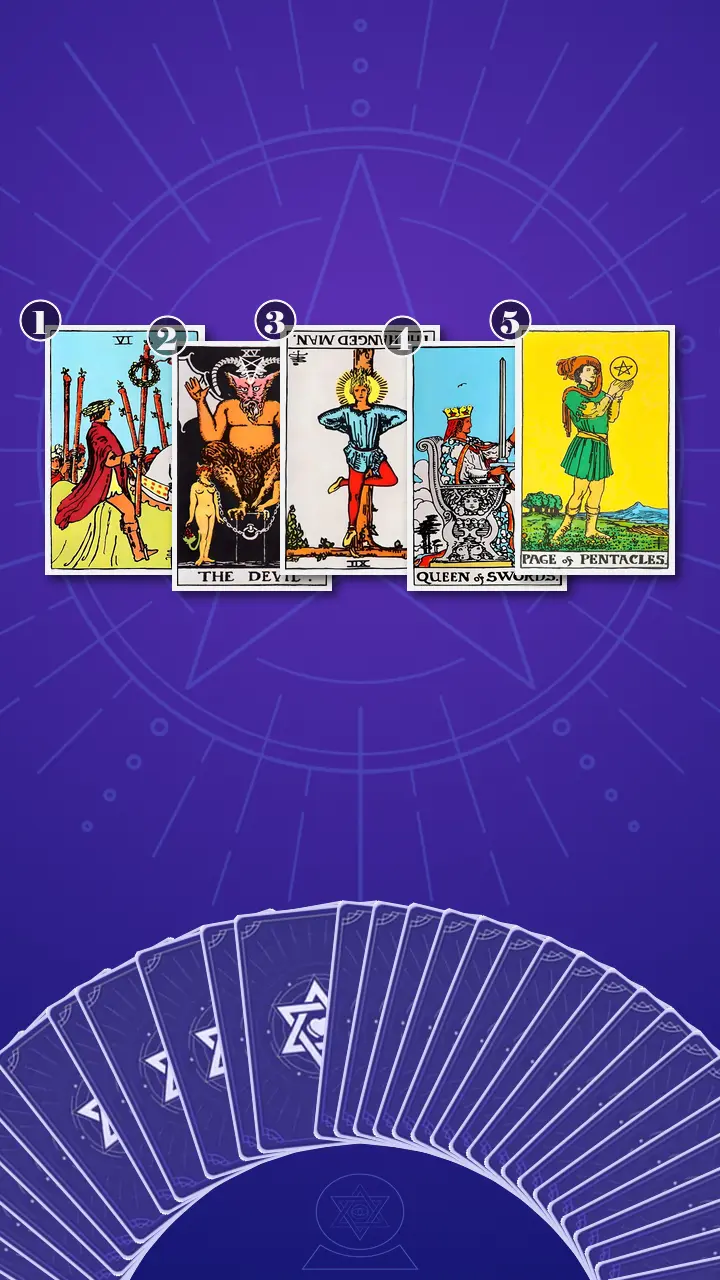
Reading the Bridge from Applause to Choice
Position One: The Laurel Arrives Before the Job Description
Now I turned over the card representing surface appeal and the presenting problem—the rush of being chosen, praised, and made essential inside a risky role. It was the Six of Wands, upright.
The rider sat above the crowd with a laurel wreath on their head and another tied to the raised wand. I watched Alex look at the elevated figure, and I could see the resemblance to the screenshot without needing to dramatize it. A director had named Alex in a Slack thread and said the assignment depended on them. The notification had landed like a public promotion before the role had a written scope.
In modern workplace terms, this was the first five minutes after “We need you.” Alex’s posture lifted, they reread the praise on the TTC, and being singled out began to make the exposure itself feel meaningful. An office algorithm was serving them the same message over and over: bold responsibility is visible; ordinary, well-supported progress is not content-worthy.
Recognition is healthy Six of Wands energy when it acknowledges real contribution. Here, however, the balance was tipping into excess. The applause was no longer merely pleasant information; it was being asked to certify the design of the role. I drew a distinction for Alex: Praise is evidence that you are visible, not evidence that the risk is well designed.
“If nobody praised you for taking this,” I asked, “which part of the opportunity would still matter?”
Alex did not nod. They gave a short laugh with a bitter edge and looked away from the screen. “That’s too accurate—almost rude,” they said. Their thumb rubbed the corner of the phone case. “The learning would still matter. But without the praise, I don’t know if I’d agree to the after-hours part.”
“That answer isn’t an accusation,” I replied. “It’s useful data. The card isn’t asking you to stop enjoying recognition. It’s asking recognition to stay in its own lane.”
Position Two: The Auto-Renewing Subscription to Urgency
Now I turned over the card representing the root attachment and underlying fear—why being essential carries so much emotional value and what a safer alternative seems to threaten. It was The Devil, upright.
I directed Alex’s attention to the loose chains around the two figures. The card did not tell me that their employer was evil, nor did it predict that Alex was trapped. It showed an attachment that remained partly in place because it supplied a reward. Alex could ask for help, renegotiate, or decline, but becoming one contributor among many felt less flattering than remaining the person everyone contacted when the system failed.
I described it as an auto-renewing subscription to urgency. Every message saying “Only you can handle this” renewed the membership. The fee was late-night availability, restless hands, and plans made provisionally because work might interrupt. The benefit was immediate access to a powerful professional identity: the indispensable fixer.
It carried a familiar Severance-style tension. One part of Alex wanted evenings, friendships, sleep, and a body that did not brace at every notification. Their work identity treated constant availability as proof that they belonged. The loose chain mattered because Alex was not physically forced to keep every notification route open; the harder question was why closing one route felt like surrendering value.
In energy terms, The Devil revealed excess attachment: obligation, access, and validation had become densely fused. Feeling needed temporarily quieted the fear of being replaceable. That relief then made the cost easier to minimize, which created more overextension, which made safer work feel even less validating.
“Imagine taking the safer operations role for six months,” I said. “What arrives first: relief, boredom, or the fear that people will forget you?”
Alex’s mouth tightened before they answered. “Replaceable,” they said. “I see people announcing promotions on LinkedIn, and ordinary progress looks like standing still. If nobody is waiting for my answer, I start wondering whether I’m useful.”
I let the admission settle without rushing to correct it. “Then the offer isn’t only offering experience,” I said. “It’s offering temporary protection from that fear. That doesn’t automatically make the role wrong. It does mean the emotional reward belongs in the assessment beside the workload—not disguised as evidence about the workload.”
Position Three: The Temporary Task That Refused to End
Now I turned over the card representing the hidden bargain and blind spot—where self-sacrifice, continued exposure, or delay is being mistaken for meaningful commitment. It was The Hanged Man, reversed.
The upright Hanged Man can describe an intentional pause that produces a new perspective. Reversed, that pause becomes blocked. The body remains suspended, but the insight does not arrive because the person resists releasing the identity attached to the position. Sacrifice runs in excess while perspective is kept in deficiency.
Alex had already given me the card’s modern scene. At 4:18 on a Friday, in a glass meeting room near King Street West, they had watched a two-week coordination task become ongoing incident coverage. The air conditioner clicked on, the whiteboard marker smelled sharp, and their foot pressed hard into the floor. A colleague suggested pausing to clarify ownership. Alex smiled and said they could keep things moving.
I translated the tied ankle into the sentence operating underneath that moment: “If I pause, they’ll think I’m not committed, so I’ll call staying late leadership.” The project remained open like a browser tab stuck on a loading screen. Alex kept refreshing through effort instead of asking whether the page had ever been designed to load.
“The question is not whether you can carry it,” I told them. “It is whether you agreed to carry it on these terms.”
Alex’s fingers stopped moving. Their eyes drifted past the cards as if the meeting-room scene had begun replaying on the wall behind me. Then a low breath left their chest, and the raised shoulder I had noticed since the call began dropped half an inch.
“I’ve been calling it patience,” they said. “I keep telling myself I’ll ask after the next deadline. Then there’s another deadline. I think I’m scared that if I stop solving the immediate problem, everyone will realize they can route it somewhere else.”
“That is the hidden bargain,” I said. “Staying suspended protects the identity of being essential, but it prevents you from seeing whether the responsibility was ever a fair measure of your ability. A 24-hour pause would not make you unreliable. It would reveal what urgency has been deciding on your behalf.”
When the Queen’s Sword Cut Through the Slack Thread
Position Four: The Boundary That Does Not Apologize for Ambition
The room seemed to grow quieter as I reached for the fourth card. Outside my window, a thin break appeared in the cloud cover, and a line of pale light caught the edge of the deck. The environment felt like a collaborator: after the compressed images of chains and suspension, there was suddenly air around the table.
Now I turned over the card representing the transformative boundary and key shift—the clear judgment and self-trust required to separate recognition from obligation. It was the Queen of Swords, upright.
The Queen held an upright sword in one hand and extended the other with an open palm. I saw discernment without hostility: the sword separated what had been fused, while the open hand kept communication available. In a workplace scene, this was Alex opening a document before answering and asking for scope, decision rights, support, expected availability, and an exit date in writing.
Before I went further, I asked Alex to return to 7:12 a.m.: the phone lit with “We need you on this,” they typed “I can handle it” before coffee, their chest lifted, and then their shoulders tightened at the missing scope, backup, and end date.
Being essential can feel flattering because it gives you immediate recognition and temporary proof of worth. But praise can tell you how you are being seen; it cannot decide whether the risk is wise. Clear boundaries separate being recognized from being obligated.
I then used a lens I call Workplace Typecasting Analysis. Alex’s office ecosystem had learned to route unresolved work through the same reliable account: theirs. Over time, “reliable” had become casting. Alex was treated as an undervalued supporting-role fixer—the person who kept every scene running—while the stretch assignment offered protagonist lighting without protagonist authority.
That distinction mattered. A heroic Slack message could make the role look like a promotion in the film of Alex’s career, but if they received accountability without decision rights, visibility without backup, and urgency without an exit date, the underlying part had not changed. It was still supporting-role labor framed as a hero shot.
Looking at the Queen’s sword, I thought not of punishment but of an editor’s blade. Two scenes had been spliced together: “They value me” and “Therefore I should accept undefined risk.” The Queen did not destroy the first scene. She made a clean cut before the second.
Do not treat being essential as proof that the risk is wise; use the Queen of Swords' raised blade to separate praise from obligation and name the boundaries that make a conscious choice possible.
I let the silence hold. Alex’s inhale stopped halfway. Their index finger, which had been tracing the card’s border, hovered above the table. For two beats they stared at the sword; then their eyes lost focus, and I could almost see Friday’s meeting replaying behind them—the smile, the expanding task, the unasked question. Their pupils widened. Colour rose along their cheekbones. “But doesn’t that mean I was wrong to say yes?” they asked, sharper than before. “Like I built this whole thing on the wrong reason?” The anger arrived first, clean and protective; beneath it, their mouth trembled. I kept my voice level. “No. The original yes was made with the information and needs you had then. Clarity isn’t a retroactive conviction. It’s permission to negotiate the next scene.” Their clenched hand opened one finger at a time. Their shoulders dropped, but the release left them briefly unsteady, as if a heavy backpack had come off faster than their balance could adjust. A breath came out with a small shake. “Oh,” they said. “So being chosen can still be real. It just can’t do the risk assessment for me.”
I asked, “Now, using this new perspective, think back: was there a moment last week when this insight might have made you feel different?”
Alex remembered the Friday meeting, just before they had volunteered to cover incidents indefinitely. “I could have said, ‘I can coordinate the rollout if someone else owns approvals and after-hours escalation,’” they said. “I thought saying that would make me look less senior. Now it sounds more like leadership than silently compensating for missing structure.”
That opened the second part of my work, Leadership Narrative Construction. I helped Alex replace the line “I prove I belong by absorbing ambiguity” with “I lead by making ownership, authority, and limits visible.” The revised narrative did not turn them into a colder person. It gave their care a structure sturdy enough to survive outside applause.
I opened a blank shared document and invited Alex to spend ten minutes writing four headings: support, authority, time limit, and exit boundary. I asked them to fill in what they knew, mark one missing term, and draft one question. They did not have to send it that day. If the exercise made their chest feel crowded again, they could stop and return when the choice felt like theirs.
“The message tells you that they value you,” I said. “The terms tell you what they are asking you to carry. Being trusted is not the same as being endlessly available. A boundary does not cancel ambition; it gives ambition terms.”
I named the crossing I was witnessing: Alex was moving from praise-triggered urgency and fear of being replaceable toward grounded self-trust and boundary-led career judgment. It was not a completed transformation or a guarantee of comfort. It was the first moment in which discomfort no longer had to trigger an automatic yes.
Position Five: The Opportunity Held at Eye Level
Now I turned over the card representing grounded integration and action—the practical way to assess responsibility without using risk to prove worth. It was the Page of Pentacles, upright.
The Page studied a single pentacle held carefully at eye level. Beyond the figure, cultivated ground and distant mountains suggested that meaningful development could be steady, measurable, and imperfectly paced. The card moved the reading out of symbolic intensity and into evidence.
Its modern-life translation was simple: Alex could turn the exciting assignment into a one-page audit of responsibilities, resources, learning value, time cost, and review date. They could examine the opportunity as a bounded experiment rather than a verdict on whether they belonged. The answer might still be yes. It could be yes with different terms, a smaller pilot, or no. None of those outcomes had the authority to define Alex’s worth.
The Page brought balanced earth energy into a spread that had begun with the heat of recognition. Instead of asking whether the role felt dramatic enough to prove ambition, the Page asked what could actually be built and sustained. It treated ordinary facts—calendar hours, backup coverage, financial stability, decision rights—as worthy of attention.
“What skill would this role teach you if nobody posted about it and nobody called you indispensable?” I asked.
Alex looked down at the blank document. “Cross-functional launch leadership,” they said. “But I’d only learn leadership if I had actual authority and feedback. Otherwise I’d mostly learn how long I can tolerate being interrupted.”
I smiled. “That is Page of Pentacles clarity. The opportunity has to survive contact with a spreadsheet. You can be valuable without standing at the edge.”
From Hero Shot to Actionable Terms
I gathered the five cards into one continuous professional story. Alex’s history of being rewarded as the reliable fixer had made the Six of Wands applause especially potent. The Devil showed how that applause became an attachment to being needed. The reversed Hanged Man revealed why pausing felt like disloyalty and why expanding work could be renamed commitment. The Queen of Swords restored language, judgment, and boundaries. The Page of Pentacles asked for a practical test instead of another dramatic proof of worth.
The core metaphor was a raised platform where applause made the edge look like a prize. Alex had not failed to notice the edge; their tightened shoulders had registered it immediately. Their cognitive blind spot was subtler: they had confused evidence of personal capacity with evidence that the role was structurally wise. Because they probably could carry the workload for a while, they had treated that capacity as proof that they should carry it under undefined terms.
The transformation direction was not “be less ambitious,” “avoid all risk,” or “stop caring what people think.” It was to separate recognition from obligation by assessing scope, support, authority, time limits, and exit boundaries before agreeing. That boundary-first appraisal would let ambition remain alive without requiring danger to certify it.
Two Small Tests Before Any Big Yes
I offered Alex two next steps. I kept them deliberately small because actionable advice should create information, not manufacture pressure.
- The Protagonist Reframe Directive Before the next cross-departmental meeting, take five minutes to place this sentence at the top of your notes: “I can own coordination if approval authority and after-hours coverage are defined; I cannot be the default owner for every unresolved issue.” Say it within the first ten minutes, before volunteering to absorb another gap, and ask who will confirm the terms in writing. If an urgent request arrives first, reply: “I’ve seen this. I’ll review the scope and come back to you tomorrow.” Tip: Keep the script visible and say it once without adding an apology. The holding reply creates a 24-hour high-stakes pause; it does not commit you to a yes or a no.
- The 15-Minute Page of Pentacles Role Audit Open Notion, Google Sheets, or a sheet of paper and create four rows: responsibilities, resources, learning value, and time cost. Write no more than three facts in each row. Mark every assumption that depends on personal availability, unclear authority, or an unspoken expectation with “needs clarification.” Review the page once before discussing the role again. Tip: Use rough estimates rather than researching every possible outcome. The audit is allowed to support a yes, a negotiated pilot, a smaller assignment, or a no; its job is to return attention to evidence.
“These are not tests of whether you are brave enough,” I told Alex. “They are tests of whether the role can meet you as a conscious participant. If the decision-maker answers clearly, that is useful information. If they avoid the questions, that is useful information too. Either way, you remain the person who decides what happens next.”

Five Days Later: The Quiet Proof
Five days later, I received a message from Alex. It did not announce a perfect career decision. It said: “I used the holding line instead of answering from bed. I asked who had approval authority and who covered after hours. They admitted there wasn’t a backup plan. We’re now discussing an eight-week pilot, and I haven’t agreed until the authority piece is clear.”
After sending the clarification email, Alex sat alone in a café near Union Station with their phone face down. The choice was still open, and the old rush had not vanished.
They told me their first thought the next morning was still, “What if they choose someone else?” But this time they noticed the thought before opening Slack. They made coffee, read the role document, and let the unanswered authority line remain unanswered instead of filling the gap with their own availability.
I saw that as the real proof of the reading’s value. The five-card Shadow Spread had not selected Alex’s future for them. It had helped them distinguish a compliment from a contract, a capability from an obligation, and a visible opportunity from a well-designed one. The agency had never lived in the cards. It lived in Alex’s willingness to ask one clear question before offering another heroic yes.
If being chosen makes your chest lift while your shoulders tighten at the same time, you may be trying to use a risky yes to prove that you are worth choosing. Noticing both sensations does not mean you have already made the wrong decision. It means the applause is no longer the only voice in the room.
If being recognized did not require an immediate yes, which blank on your own Queen of Swords page—support, authority, time limit, or exit boundary—would you look at first?