Career Decision Paralysis: Turning One Email Into Real-World Data

The 11:40 p.m. Loop Where Every Career Choice Feels Wrong
If you are a late-twenties city renter with a stable-but-stagnant job, career pivot anxiety may look less like planning a dramatic exit and more like leaving one low-commitment email unanswered because you can already picture every way a reply could backfire. That was the pattern Jordan, a 28-year-old customer operations coordinator in Toronto, brought into my late online session.
At 11:40 p.m. on a Tuesday, Jordan sat at their kitchen table with a colour-coded decision matrix glowing behind our video window. Three advice threads lit their phone, an unanswered email remained minimized in the corner of the laptop, and the fridge supplied the room's low mechanical hum. Jordan shifted the warm phone between their palms while their jaw held tight and their arms seemed too heavy for the two-line reply waiting on-screen.
“I want a direction that could actually change something,” they told me. “But every option seems to charge a price I can't afford. I keep looking for the choice that doesn't make anything worse.”
I could see the contradiction clearly: Jordan wanted meaningful movement, but whenever one option became viable, they changed the criteria or searched for another downside because an imperfect result felt irreversible. The powerlessness sat in their body like gravity had doubled around the table, making a simple click feel as consequential as stepping off a roof.
“You're not failing at decision-making,” I said. “You're trying to make one small action answer for an entire future. Tonight, I won't tell you which career path fate has selected. I want us to map what turns every direction into a no-win choice, find what is genuinely fixed, and identify one place where your influence is still real.”
Choosing a Map for the No-Win Choice Loop
I asked Jordan to place both feet on the floor, loosen their hands, and hold the unanswered email in mind without forcing an answer. I shuffled slowly within view of the camera. The pause was not a mystical performance; it was a practical transition from reacting inside the problem to observing its structure.
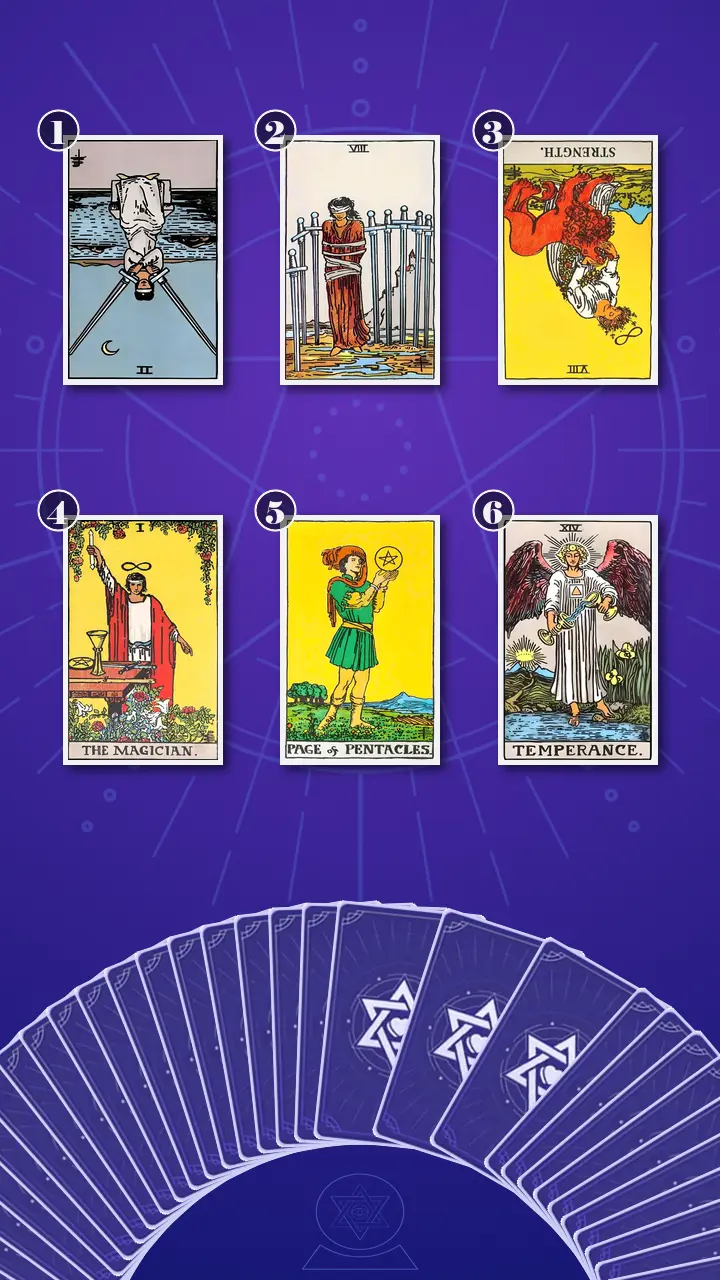
“I'm using the six-card Transformation Path Grid · Context Edition,” I explained. “It is designed to follow a stuck pattern from visible behaviour, through the blockage and its root, into a catalyst, a reversible action, and a way to integrate what the action teaches.”
I chose this spread because Jordan had not brought two clearly defined alternatives for a conventional Two Paths reading. Inventing Option A and Option B would have made the issue look like an external comparison problem. The real question was why every possible direction acquired the same no-win shape. This grid lets me examine that self-reinforcing system without pretending tarot can predict which employer, salary, or career will work out.
I arranged the cards in two rows of three beneath my overhead camera. The upper row would show the surface stalemate, the central cognitive blockage, and the weakened self-trust underneath it. The lower row would build a parallel route: the smallest leverage point, a measurable next step, and an integrated process for moving, observing, and recalibrating. Position two would distinguish real limits from assumed impossibility; position four would locate usable agency; positions five and six would turn insight into evidence.
This is how tarot works best for me: not as a verdict delivered from outside, but as a visual cognition tool. Card meanings in context can make an invisible loop concrete enough to question, test, and revise. Jordan would remain the person deciding what to do, what not to do, and when to stop.
Reading the Upper Route of the Grid
Position 1: Two of Swords Reversed and the Spreadsheet That Never Ends
I turned over the card representing the observable decision behaviour and stagnant emotional state through which Jordan experienced every direction as no-win. It was the Two of Swords, in the reversed position.
I held the image closer to the camera. The traditional blindfold and crossed swords describe a strategy for suspending conflict while more information is gathered. Reversed, that containment is slipping. The pause has become overloaded with competing criteria, opinions, and forecasts.
“At 11:40 p.m., you reopen the same colour-coded matrix,” I said. “One direction begins to score higher, and instead of letting that result lead to a test, you change the weighting. Then another column appears. The inner promise is, ‘If I can find the missing criterion, I will finally know which option cannot hurt me.’”
The reversed energy showed Excess. Jordan's Air energy, the realm of thought and comparison, was doing far more work than the decision could use. Every new perspective cancelled the confidence produced by the last one. Their Google Sheet and Notion page kept the choice active, but they prevented it from making contact with reality.
“The last time an option started to look viable,” I asked, “which criterion did you add or reweight before you could act?”
Jordan's breath caught. Their eyes moved toward the matrix behind our call, then their mouth pulled into a short, bitter laugh. “That's so accurate it feels kind of brutal,” they said. “I added ‘five-year downside.’ At nearly midnight. To a decision about whether to have a conversation.”
“It would be brutal if I were calling this a character flaw,” I replied. “I'm not. Delaying the decision has probably protected you from immediate pressure more than once. I am showing you where that protection now creates the very uncertainty it was meant to reduce.”
I wrote one sentence beside the card: Research becomes a cage when it is only allowed to confirm that movement is dangerous.
Position 2: Eight of Swords and the Wall Built from Different Risks
I turned over the card representing the central cognitive blockage that converted difficult trade-offs into a perception of total powerlessness. It was the Eight of Swords, upright.
The figure on the card is genuinely constrained, so I did not use the image to dismiss Toronto rent, financial pressure, rejection, or emotional fatigue. Yet the bindings are loose, and open ground remains between the swords. The card asks a precise question: where have separate concerns been visually and mentally merged into one solid wall?
“Your mind is combining rent, possible rejection, discomfort, retraining costs, regret, and long-term uncertainty,” I said. “Then an informational call is treated as if it already includes resignation, tuition, public commitment, and an irreversible loss of income. The immediate action does not contain those later decisions, but your body responds as though they have all happened at once.”
The energy here was Blockage. Thought was no longer analysing constraints individually; it was enclosing Jordan inside the conclusion, Because I cannot remove every constraint, I must have no room to move. It resembled a risk dashboard that labelled uncertainty, discomfort, and actual danger with the same red alert.
“Let's separate the swords,” I said. “Toronto rent is a real constraint. A conversation automatically forcing you to accept a role is an assumption. Whether the role offers more ownership is unknown, and a conversation could test it. Real difficulty and limited room can exist at the same time.”
Jordan pressed a palm against the centre of their chest and went quiet. After several seconds, they said, “I've been treating asking a question like signing a contract.” Their fingers moved to the minimized email, but they did not open it yet.
“Exactly,” I said. “An option can carry a cost without being a trap. Tarot is not asking you to ignore the swords. It is helping you find the gap that does not require pretending the swords are absent.”
Position 3: Strength Reversed and the Confidence Requirement
I turned over the card representing the weakened self-trust beneath the learned powerlessness, the root that made Jordan expect effort to be ineffective. It was Strength, in the reversed position.
On the upright card, the woman's hands rest gently on the lion. Her influence comes through steady contact, not domination. Reversed, that relationship is disrupted. Jordan had been trying to overpower uncertainty through harsher analysis, stricter deadlines, and the demand to feel completely confident before acting.
“Suppose you send one networking message and nobody replies by the next afternoon,” I said. “The observable fact is that one person has not replied. But the internal sentence becomes, ‘I knew people in that field wouldn't take me seriously,’ or, ‘If I were capable, this would already feel easier.’ One incomplete result is made to speak for your entire future.”
The energy showed Deficiency in compassionate self-command and an overuse of force in its place. Jordan did not literally lack capacity. Their adaptive self-trust had been underfed because they demanded confidence before experience, while confidence usually grows after a manageable action has been attempted, observed, and survived.
“When the last small obstacle appeared,” I asked, “what did you immediately conclude about your ability to handle the larger decision?”
Jordan rubbed the heel of one hand along their jaw. “That I should have known better than to try,” they said. The words came out quietly, followed by a long exhale. Their hand dropped to the table, and the tendons in their neck softened.
“That harsh voice may sound realistic because it speaks in warnings,” I said. “But realism describes what happened before it declares what you are capable of. Strength here is not asking you to become fearless. It is asking whether you can stay in a working relationship with uncertainty after the first inconvenience arrives.”
When the Magician Changed the Scale of the Decision
Position 4: One Tool, One Variable, One Observable Result
Before I turned the fourth card, the refrigerator compressor stopped on Jordan's side of the call. The sudden quiet made the room feel wider. I revealed the card representing the smallest leverage point capable of restoring evidence-based agency without requiring certainty about the whole decision. It was The Magician, upright.
The four suit tools on the Magician's table are often described as unlimited potential. I read them more carefully. For Jordan, they were a practical inventory: one lunch break, one trusted contact, one unfinished draft, emotional bandwidth, and a budget boundary. The raised wand and the hand pointing downward showed intention being translated into one result that could exist outside the imagination.
In daily life, this meant Jordan could stop modelling every possible career future and ask whether one 20-minute conversation could clarify the actual working day in another role. One hour, one person, and three factual questions would not control the outcome. They could, however, create evidence that another evening of negative forecasting could not produce.
The Magician's energy was Balance expressed through focus. Fire supplied initiative, Air formed the question, Water acknowledged the emotional stakes, and Earth respected material limits. None of those elements had to erase the others. They only had to cooperate long enough to produce one observable data point.
Looking at the card, my mind returned to the years I have spent watching planetary charts. A body can appear almost motionless from one viewpoint while continuing through a much larger cycle. I use a framework called Macro-Orbital Projection when someone has mistaken a low-visibility moment for a permanent identity. I widen the timeline just enough to separate “I cannot see movement tonight” from “I am incapable of creating movement.”
I also identified Jordan's current period as a Void Phase: the familiar career orbit no longer felt alive, but a new trajectory had not yet collected enough evidence to become visible. I was careful with that metaphor. A void phase does not guarantee that a perfect breakthrough is waiting nearby. It removes misplaced guilt and shows why a transitional interval can feel empty before the next direction has been tested.
“Think of the Magician's action as a small orbital correction,” I said. “A precise adjustment does not require proof of the entire route. It changes one controllable variable, and the resulting position tells you what adjustment is available next. The card is not promising a better orbit. It is showing you the controls you can actually reach.”
I brought Jordan back to the exact setup maintaining the no-win loop. At 11:40 p.m., the unanswered email was still minimized while they added another column to the decision matrix. The laptop hummed, their jaw tightened, and research felt safer than discovering whether one small move could change anything.
The whole road does not need to be proven before you move; use the Magician's tools to test one controllable step and let evidence replace the belief that nothing can change.
I let the sentence remain in the quiet between us.
The first reaction was stillness. Jordan's breath stopped midway in, and their index finger hovered above the trackpad. Their gaze slipped out of focus as if the manager's email were replaying behind the screen; then their pupils widened and their jaw shifted once to the side. A flush rose across their cheeks. Their shoulders lowered by perhaps an inch, but the release brought a flash of anger rather than relief. “But doesn't that mean I've been doing this wrong for years?” they asked, their voice thin and rough. “Like I wasted all that time?” I kept my voice level. “No. It means a strategy that once protected you from costly mistakes has kept running after its useful limit. We are updating a process, not prosecuting your past self.” Their eyes shone; their fist loosened, one finger at a time, and a long breath left their chest with a tremor.
“Now, using this new perspective, think back to last week,” I invited. “Was there a moment when this insight might have made the situation feel different?”
Jordan looked at the minimized window. “Thursday morning,” they said. “My manager asked if I wanted to discuss an internal opportunity. I treated replying yes like I was already accepting it.”
“You do not need control over the whole road to influence the next ten minutes,” I said. “A reply can produce a conversation. A conversation can produce information. You still control every later yes or no.”
I set an eight-minute timer and asked Jordan to open a blank note. They wrote three headings: “One reversible action,” “One resource I already have,” and “One result I can observe.” Under them, they chose: draft two lines accepting a conversation; use the manager's existing invitation; observe whether the discussion revealed concrete differences in ownership, hours, and pay. I reminded them that they could stop when the timer ended, save the draft, discard it, or close the note if the exercise became too activating. The choice to continue remained theirs.
This was the reading's central emotional crossing: from powerless over-analysis and no-win forecasting toward grounded self-trust through a reversible, evidence-producing choice. It was not total confidence. It was the first willingness to let local influence exist without demanding global control.
The Magician had not predicted that the internal role would be right. The card had done something more useful: it had shown Jordan that their next action and the final outcome were not the same event. Tarot provided the scale change; Jordan supplied the decision.
From the Magician's Table to Solid Ground
Position 5: The Page of Pentacles Treats the Next Step as Data
I turned over the card representing the reversible, measurable action through which renewed agency could interrupt postponement. It was the Page of Pentacles, upright.
The Page studies one pentacle with complete attention while the larger landscape remains in the distance. I read that concentration as an antidote to Jordan's sprawling model of the future. One application draft, informational interview, or sample budget could become a learning task with a defined endpoint. It did not have to prove the correct career direction, and it did not commit Jordan to leaving their current role.
The energy here was grounded Balance, with Earth returning after the Sword-heavy opening. Progress would be measured by what Jordan completed and learned, not by whether one task solved their career decision paralysis. The Page invited Jordan to become a practical apprentice rather than a defendant trying to prove competence through one flawless choice.
“Which action could you finish this week with the written option to stop afterward?” I asked. “A draft, a factual call, a low-commitment application, or a sample budget?”
Jordan looked down at the three headings in their note. “The manager reply,” they said. “And I want the exit condition written above it: ‘This conversation creates no obligation.’” Their voice still carried caution, but it no longer had the flat weight I had heard at the beginning.
“Good,” I said. “Treat the next step as data, not a verdict. The purpose is to learn something specific, not to put your whole future on trial.”
Position 6: Temperance Makes Revision Part of the Process
I turned over the final card, representing the integrated mindset in which Jordan could combine risk, desire, and new evidence while adjusting direction over time. It was Temperance, upright.
Water moves carefully between two cups on this card, while one foot rests on land and the other in water. For Jordan, the image held practical limits and emotional truth in the same frame: Toronto rent mattered, and so did the shrinking sense of ownership in their current work. Neither truth needed to erase the other.
In daily life, Temperance looked like completing one small trial, reviewing its actual financial cost, noting the body's response, recording what became known, and adjusting the next step. The energy was Balance in motion. It was not a static state in which doubt disappeared; it was a repeatable feedback loop of move, observe, recalibrate, and then continue, revise, or stop.
“If the conversation reveals that the role is wrong for you,” I said, “that does not mean the experiment failed. It means the experiment produced usable information. Revision is not proof that the first move failed; it is how an adjustable choice works.”
Jordan glanced between the Page and Temperance on the screen. Their eyebrows lifted, then drew together as they considered the implication. Finally, they nodded once. “So I don't have to find the train I will ride for the rest of my life,” they said. “I can transfer lines when I have better information.”
“Exactly,” I replied. “And you can decide not to board at all. Finding clarity is not surrendering your right to revise. It is learning which decision belongs to today and which decisions still belong to a later version of you.”
Building an Evidence-Before-Verdict Orbit
I drew the six cards together into one story. Repeated experiences of effort carrying a cost had trained Jordan to forecast loss before contact with reality. In the present, the Two of Swords reversed kept comparison running long after it stopped serving clarity. The Eight of Swords fused real constraints with predicted consequences, and Strength reversed converted each small obstacle into a judgment about personal capacity. The lower row answered that upper route without denying its difficulty: the Magician narrowed the scale to one controllable variable, the Page gave that variable a practical test, and Temperance made revision an expected part of learning.
I described the pattern as a recommendation algorithm trained almost exclusively on examples of choices going wrong. Every promising result triggered a new search for danger, so the system kept serving more evidence that movement was unsafe. Research brought temporary relief, but postponement prevented new evidence of influence. The unchanged situation then appeared to prove that effort made no difference.
Jordan's cognitive blind spot was not simple pessimism. It was the hidden equation between exploration and commitment. A reply had become an acceptance; an application had become a resignation; a sample budget had become a purchase; changing direction after new evidence had become failure. Once those events were separated, an imperfect option could remain costly without becoming a trap.
The transformation direction was therefore specific: stop demanding certainty about an entire direction and test one reversible action within a fixed period. Then observe what actually changes. The aim was not to manufacture optimism. It was to replace selective prediction with evidence, practical boundaries, and permission to revise.
Two Small Experiments for the Next Seven Days
I gave Jordan two pieces of actionable advice and asked them to begin with only one. Neither exercise required quitting, spending money, disclosing anything they wanted to keep private, or making a final announcement.
- Run the Eight-Minute Controllable-Variable NoteDuring one lunch break, open a phone note and write three headings: “One reversible action,” “One resource I already have,” and “One result I can observe.” Set an eight-minute timer. Use one existing resource, such as a manager's invitation or a trusted contact, to produce one bounded output, such as a subject line and the first two sentences of an email.Stop when the timer ends. Save, send, discard, or revisit the draft later. If even drafting feels too activating, list the three items without acting; that still counts as completing the minimum version.
- Use Cosmic Redshift Observation for One WeekFor two minutes after work each day, log one “redshift” signal, something whose interest, energy, or relevance appears to be fading, and one “blueshift” signal, something approaching through curiosity, useful feedback, or renewed energy. Keep three criteria fixed for the week: financial viability, daily energy, and learning value. On Sunday, hold a 15-minute “Move, Observe, Recalibrate” review and answer: What did I do? What changed? What remains unknown?Keep this deliberately small. A redshift is not an order to leave, and a blueshift is not a cosmic guarantee. They are observations. One sentence per day is enough, and the review may lead to continuing, adjusting, or stopping.
The Cosmic Redshift exercise translated Temperance into Jordan's real week. Instead of asking, “Which future can never hurt me?” they could watch for changes in energy, material facts, and available information. The point was to notice a trajectory without mistaking it for destiny.
“These exercises will not make Toronto cheaper or remove every trade-off,” I said. “They will show you where a real boundary ends and an untested forecast begins. That distinction is where influence becomes visible again.”

A Week Later, the Quiet Proof
Seven days later, I received a message from Jordan. They had completed the eight-minute note, saved the manager reply overnight, and sent it the next morning. The resulting conversation lasted 20 minutes. Jordan learned that the internal opportunity offered more project ownership but included a rotating evening commitment they disliked. The information did not make the role an obvious yes. It made the choice more accurate.
Jordan also sent me a screenshot of the redshift log. “Routine ticket work with no ownership” appeared three times in the fading column. “Asking operational questions,” “building a process,” and “talking to someone before researching alone” appeared under approaching signals. The list was modest and incomplete, but it had been produced by lived evidence instead of a midnight forecast.
Jordan told me they slept through that night. Their first thought at dawn was still, “What if I'm wrong?” They smiled anyway, opened the redshift note, and wrote, “The conversation gave me data; it did not take away my choices.”
I did not consider that a solved life, and neither did Jordan. I considered it the first grounded proof that discomfort could accompany action without erasing agency. The cards had not moved the email, scheduled the conversation, or protected Jordan from every consequence. Jordan had done the moving, while retaining the right to pause, decline, and revise.
That is the value I saw in this Journey to Clarity and in the six-card Transformation Path Grid: not certainty imposed from above, but a visible path from powerless over-analysis to cautious curiosity, evidence-based agency, and patient self-trust. Jordan remained the author of every next step. Tarot simply helped them see that the next step was smaller than the whole road.
If tonight every direction feels as though it could take one more piece of control away, while an unanswered email glows beside the safer spreadsheet and your jaw tightens before your hand can move, I hope you remember Jordan's quiet orbital correction. Recognizing the no-win loop does not solve everything, but it means you are no longer entirely inside it. Clarity can begin before certainty.
Over the next seven days, which one reversible signal could you send from the Magician's table, then observe with enough curiosity to let evidence, rather than fear, guide your next small adjustment?