The “Sure, That Works” Reflex—and the 11:30 p.m. Calendar Tetris
If you’re the kind of person who replies “Sure, that works” to a Slack ping before you even open your calendar—then ends up double-booked anyway—this is probably your overcommitment loop.
Jordan sat across from me on a video call from their Toronto condo living room, lit mostly by laptop glow and the faint streetlamp stripes through the blinds. It was late enough that the city sounded softened—just the distant hush of traffic—and yet their trackpad clicks were sharp, almost accusatory. They kept dragging color-coded Google Calendar blocks for what sounded like the fourth time, phone still warm in their hand as if it had been clutched through the whole reshuffle.
“I don’t know why I keep doing this to myself,” they said. “I say yes and then I’m trapped by my own calendar.”
I watched their jaw work—tight, then tighter—like they were trying to bite down on the week itself. The overwhelm wasn’t an abstract feeling; it was more like standing under a flickering subway light while someone keeps stacking boxes into your arms and asking you to smile like it’s fine.
“You want to be the dependable one,” I said gently, “but every ‘yes’ keeps costing you the one person you can’t reschedule: you. Let’s use the cards to draw a map through this—something that gives you clarity and a next step you can actually try this week.”

Choosing the Compass: The Transformation Path Grid for Overcommitment
I asked Jordan to take one slow breath and to hold a single, plain question in mind: What loop is running when I overcommit—and what’s my next step out? While they exhaled, I shuffled—not as theater, but as a transition. A way of stopping the autopilot long enough for something truer to speak.
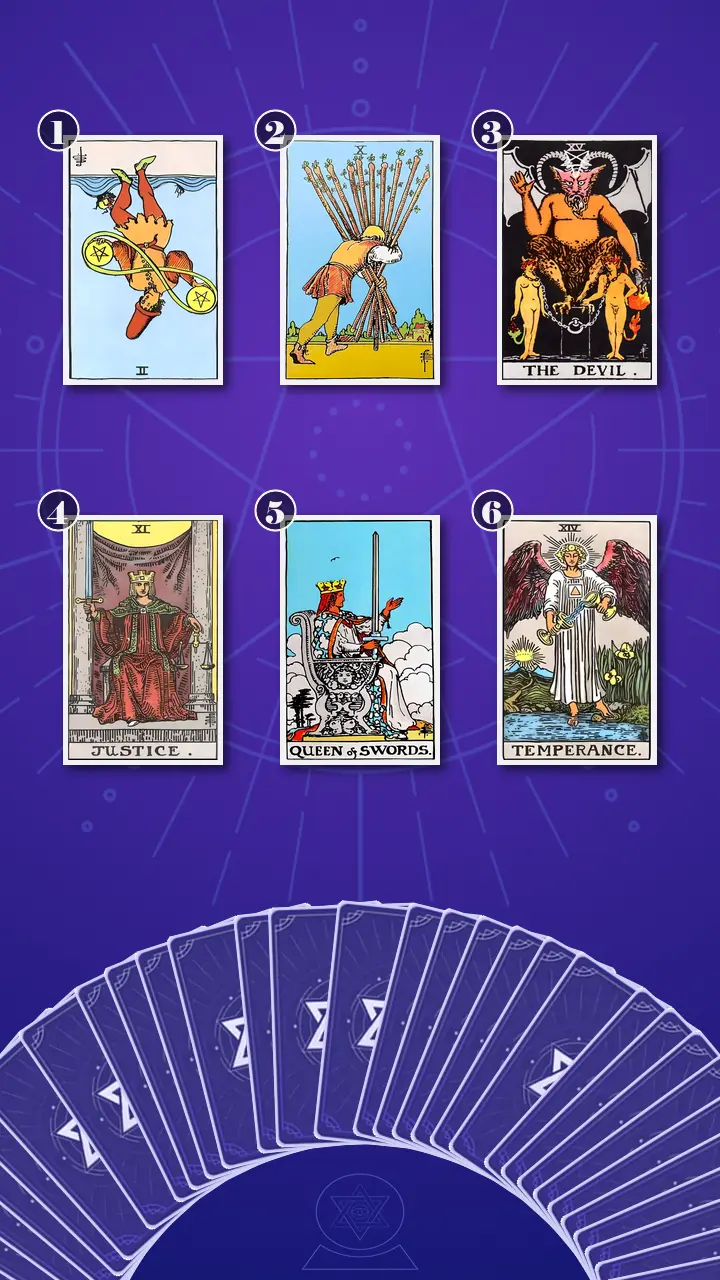
“Today,” I told them, “we’ll use a spread I call the Transformation Path Grid (6) · Context Edition.”
For you, the reader: this is the spread I use when the problem isn’t a lack of tools, but a repeating inner loop—impulse yes, later scramble. It’s compact on purpose: present symptom → main blockage → root driver → pivot → next step → integration. It answers “what loop is this?” and “what do I do next?” without drifting into vague prediction.
I pointed to the layout as I placed the cards into a simple 2x3 grid. “The top row names the loop: what you’re doing, what’s blocking you, what’s underneath it. The bottom row shows the pivot and the practice—how we break the pattern in real time and what balance looks like when it starts to stick.”
Reading the Map: Card Meanings in Context
Position 1 — The Observable Symptom: What double-booking looks like right now
“Now flipped,” I said, “is the card that represents the observable overcommitment symptom: what your double-booking behavior looks like in real life right now.”
Two of Pentacles, reversed.
In the old image, the juggler tries to keep two coins spinning inside an infinity loop while rough waves rise behind him. Reversed, that motion turns unstable—less ‘nimble,’ more ‘about to drop everything.’
“This is you accepting a meeting invite while walking back from coffee,” I said, tying it directly to their week. “Then later realizing it overlaps with another call. Instead of renegotiating, you start playing calendar Tetris—moving lunch, pushing a workout, squeezing errands into late night. The week stays in motion so you can avoid the tiny discomfort of saying, ‘I need to check first.’”
Energetically, it’s a blockage of Earth energy: time and resources can’t settle into a stable container because the container keeps getting edited. Like a shared doc anyone can change—then being shocked the final version is chaos.
Jordan let out a short laugh that had a bitter edge. “That’s… way too accurate,” they said. “Like, kind of brutal.”
“Brutal,” I agreed, “but also clarifying. It tells us the issue isn’t your calendar app. It’s what happens before the calendar even gets a vote.”
Position 2 — The Main Friction Point: What makes it hard to slow down and check capacity
“Now flipped,” I said, “is the card that represents the main friction point: what makes it hard to slow down, check capacity, and keep commitments realistic.”
Ten of Wands, upright.
“This card always makes me think of carrying too many tote bags through Union Station,” I told them. “Your phone keeps buzzing, and every new ping feels like it has to be balanced on top because your hands are already full.”
I kept the translation simple and concrete: “Your calendar looks packed in a way that could read as impressive, but it feels like you’re carrying the whole team’s weight. You’re so loaded you can’t see ahead—so conflicts don’t feel planned, they feel like they appear out of nowhere.”
This is Fire in excess: effort used to keep everything held up, even when it blocks your view. The dependable image stays intact; the depleted reality gets hidden behind late nights and skipped meals.
Jordan’s shoulders dropped a fraction. A slow exhale. Then a small nod—more resignation than drama. “I can handle it,” they murmured, as if quoting their own inner script. “I should handle it. Why can’t I handle it?”
“Fast yeses feel kind in the moment,” I said. “They don’t always feel kind on Thursday night.”
Position 3 — The Underlying Hook: The belief that keeps the loop running
“Now flipped,” I said, “is the card that represents the underlying hook: the belief or fear that keeps the overcommitment loop running.”
The Devil, upright.
I’ve excavated sites where a small, unseen constraint—one collapsed wall, one hidden void—dictated the whole shape of what could be built above it. This card is like that. It isn’t ‘evil.’ It’s a binding mechanism.
“This is the moment you hover over ‘Decline’ on a Google invite,” I said, “and your thumb freezes like it’s wired directly to other people’s opinions. Your nervous system treats a request like a belonging test. You say yes to stay safe—liked, included, competent. Later, when the schedule collapses, you feel trapped by your own yes… but the trap isn’t the calendar. It’s the belief that disappointing someone proves you don’t belong.”
Energetically, it’s attachment in excess—approval as safety. The chains in the image are loose, but they feel tight.
Jordan’s face went still in a three-step sequence I’ve learned to respect: first a tiny breath-hold, then their eyes unfocused as if replaying a dozen Slack moments, then a swallow that made the throat move like a hard truth passing through. “If I don’t answer fast,” they said quietly, “what story will they tell about me?”
“Exactly,” I replied. “And that’s why a better Notion template won’t fix it. We need a new standard—something that interrupts the loop in the moment.”
When Justice Spoke: Fairness to Capacity, Not Faster Yeses
Position 4 — The Turning Mechanism: The standard that interrupts the loop
“We’re turning over the pivot,” I said. “This card represents the turning mechanism: the mindset or standard that can interrupt the loop in the moment you’re about to say yes.”
The room felt quieter—like even the background hum of Toronto paused to listen.
Justice, upright.
In one hand, scales. In the other, a sword held straight—not threatening, just clean. I felt my old academic reflex spark: in ancient cities, Justice wasn’t a vibe. It was architecture—weights and measures in the marketplace, inscriptions that made agreements visible. Fairness wasn’t wished for; it was structured.
Setup: Jordan had been trapped in a belief that reliability meant instant agreement. Say yes now, feel relief now. Pay for it later—in missed meals, cramped shoulders, apology texts, and the private shame-flush of overlapping blocks at 11:30 p.m.
Delivery:
Not “I can make anything work,” but “I choose what’s fair”—let the scales of Justice set the standard and the sword make the decision clean.
I let the sentence sit between us the way an inscription sits on stone—unchanged by mood, readable in any weather.
Reinforcement: Jordan reacted in layers. First, their jaw loosened like a muscle that had forgotten it could. Then they blinked, a little too slowly, and their eyes got bright—not full tears, but the glassy edge of recognition. Their shoulders sank down and back, and for a second they looked almost dizzy, as if the idea of a fair rule had rearranged gravity.
“But… if I do that,” they said, and their voice tightened with a flash of anger, “doesn’t it mean I’ve been doing it wrong this whole time?”
“It means you’ve been doing what worked to keep belonging,” I said carefully. “That’s not ‘wrong.’ It’s just expensive. Justice doesn’t scold—Justice recalibrates.”
I leaned in with my own diagnostic lens—what I call Ancient Reflection: the way historians review a collapse without contempt, just cause-and-effect. “Let’s audit the pattern like an archaeologist,” I said. “Trigger: ping. Reflex: yes. Relief: immediate. Cost: later chaos. If we change only one piece—insert a pause—the whole ruin stops repeating.”
“Now,” I asked them, “with this new lens—fairness to capacity—can you remember a moment last week when this would have changed how you felt?”
Jordan stared at the card, then looked off to the side like they were seeing their calendar in their mind. “Thursday,” they said. “Someone asked for a ‘quick sync.’ I felt my chest drop, like… like I had no choice. I could’ve said I’d confirm. I could’ve checked what it would replace.”
“That’s the shift,” I told them. “From overwhelm-and-guilt reflexes toward values-based boundaries. Not a personality transplant—just a new rule.”
Position 5 — The Next Doable Step: Boundary communication you can practice this week
“Now flipped,” I said, “is the card that represents the next doable step: the communication or boundary behavior you can practice this week.”
Queen of Swords, upright.
“This is the two-line message,” I said, smiling a little. “You reply with two clean sentences instead of a paragraph. No over-apology, no backstory, no ‘I can maybe…’ that invites bargaining. You sound calm because you’re not trying to prove you’re nice—you’re being clear.”
Energetically, it’s Air in balance: truth with steadiness. Clarity without cruelty.
I gave them a before/after contrast, because it matters. “Before: nine lines of ‘so sorry, totally understand, my bad.’ After: ‘I can’t make that time. I can do Thursday at 2.’”
Jordan rolled their shoulders once, like unclenching a strap. “I… weirdly want to copy/paste that,” they admitted.
“Good,” I said. “That’s your body recognizing a lower-cost path.”
Position 6 — Integration: What a healthier rhythm looks and feels like
“Now flipped,” I said, “is the card that represents integration: what a healthier rhythm looks and feels like when the new standard is applied consistently.”
Temperance, upright.
“This isn’t a dramatic overhaul,” I told them. “It’s sustainable balance built through small, repeated adjustments.”
I translated the imagery into modern sensory reality: “Think of your week like a playlist crossfade instead of abrupt track cuts. Commute, food, decompression—those are the fade. When you protect transitions, you stop treating your nervous system like a disposable resource.”
Energetically, it’s blending—Water and Earth in balance. A repeatable rhythm instead of crisis-mode scheduling.
The One-Note “Fairness Rule” and the Weigh–Speak–Stabilize Cadence
I threaded the whole grid into one story for Jordan: “You’re not ‘bad at scheduling.’ You’re in a loop where a fast yes buys short-term safety, and then your calendar collects the debt—double-booking, late-night reshuffling, apology texts. Ten of Wands shows the overload that blocks your view. The Devil shows the hook: approval mistaken for belonging. Justice replaces that hook with a fair standard. The Queen of Swords turns the standard into clean language. Temperance is what happens when you repeat it long enough to feel steady.”
“Here’s the blind spot,” I added. “You keep trying to solve an identity fear with a system upgrade. More color-coding. More rules. More reshuffling. But the transformation direction is simpler: from instant agreement to a default pause that treats your calendar as a boundary you can trust.”
Then I gave them actionable advice—small, specific, and designed for real life, not fantasy weeks. I also used one of my own interventions—Inscription Affirmations—because Justice works best when the rule is written like a carving, not negotiated like a mood.
- Install the 30-minute confirmation ruleCreate a text shortcut on your phone for: “Let me check my calendar and I’ll confirm in 30.” Use it for every new request this week—Slack pings, meeting invites, friend texts.Expect resistance; if someone pushes, repeat once. If your chest tightens, step away for 60 seconds before replying—the win is creating the pause.
- Write a one-line Fairness Rule (your Justice inscription)In your Notes app, title a note “Fairness Rule.” Write one sentence you can remember under pressure, like: “If it replaces rest, meals, or deep work, it’s a no—or it needs a trade.” Before you confirm anything, say the trade out loud: “If I say yes, I’m moving ___.”Keep it simple enough to use on the TTC with Slack buzzing. Consistency matters more than perfection.
- Pin two Queen of Swords scriptsDraft and pin two replies: (1) “I can’t make that time.” (2) “I can’t do this week, but I can do Thursday at 2.” Use one once this week without adding a paragraph afterward.If “no apology” feels too edgy, allow one softener—then stop. Clarity is not cruelty—especially when it saves your follow-through.

A Week Later: The Quiet Proof of Finding Clarity
Six days later, Jordan messaged me a screenshot—not of a perfect calendar, but of a single moment. A Slack thread where someone asked for a “quick sync,” and Jordan’s reply was clean: “Let me check my calendar and I’ll confirm in 30.” Beneath it, they’d typed: “I didn’t die. No one hated me. And I didn’t have to move lunch.”
It was almost comically small. And that’s why it mattered. Reliability wasn’t being proven by speed anymore. It was being proven by realism—and a fairness standard they could repeat.
When your calendar double-books, it’s not just logistics—you can feel your chest drop because somewhere in you, “no” still sounds like losing belonging.
If you gave yourself permission to pause before the next yes—just long enough to check what it would cost you—what would you want your calendar to protect first?
This story is adapted from psychological research, written so that those in a similar struggle can see their own pattern in it — and find their next step clearly.These insights are not a substitute for professional psychological, medical, legal, or financial advice.
Learn more about our Journey to Clarity.
How did this insight land for you?
🫂 This Resonates Deeply
🌀 Living This Story
✨ Now I See Clearly
🌱 Seeing New Possibilities
🧰 Useful Framework
🔮 The Confirmation I Needed
💪 Feeling Empowered
🚀 Ready for My Next Step
Author Profile
 AI
AI“Having spent a lifetime at Cambridge and on archaeological digs, I’ve witnessed the rise and fall of countless civilizations. Please know that your current struggles are not a permanent fate, but merely a necessary fracture before rebuilding. I won't lecture you; instead, I invite you to sit with me in the ruins, using a patient, historical perspective to gently dust off the true, enduring value hidden beneath your temporary doubts.”
In this Personal Growth Tarot Reading :
Core Expertise
- Cognitive Paradigm Excavation: Treating your current growth bottleneck as the necessary collapse of an obsolete intellectual era.
- Core Philosophy Stratigraphy: Identifying which foundational beliefs must be carried forward to your next life stage and which must be left in the past.
Service Features
- The Paradigm Shift Manifesto: A rigorous intellectual exercise to definitively articulate the new governing laws and core values of your next life chapter.
Also specializes in :
Explore Related Patterns:
Approval SeekingJordan's question, "If I don't answer fast, what story will they tell about me?" makes the cognitive hook explicit. A neutral delay starts to feel like evidence other people may judge their competence, commitment, or value, so the mind fills the silence with imagined criticism before reality has confirmed anything. Approval Seeking is the pattern because the calendar conflict is being filtered through anticipated social evaluation. You are not simply deciding whether a time slot is open; you are trying to secure a sense of being liked, included, and dependable through the speed of your response. Once approval becomes the safety signal, the calendar stops being a capacity tool and becomes a reputation-management tool. The next step in the story works because it changes the signal: reliability is proven by realistic confirmation, not instant agreement.
Boundary DiffusionJordan's calendar keeps getting edited after the yes, which shows that the boundary is arriving too late. The conflict is not a lack of planning knowledge; it is that the request enters the week before capacity has been checked and before a clear answer has been chosen. Boundary Diffusion fits because other people's pings, meeting invites, and "quick syncs" temporarily override the distinction between what is requested and what is actually available. You can feel the boundary dissolve in the split second where pausing seems rude, declining seems risky, and agreement seems easier. The story's repair is precise: treating the calendar as a boundary you can trust. The 30-minute confirmation rule creates a clean space between stimulus and answer, so your time is no longer negotiated entirely by urgency, guilt, or other people's expectations.
Boundary DiscernmentJordan's clean reply, "Let me check my calendar and I'll confirm in 30," turns the whole pattern at the exact point where the old reflex used to take over. Instead of giving an instant yes to manage discomfort, the pause creates room for capacity to become part of the decision. Boundary Discernment fits because the story does not push Jordan toward harsh refusal or total withdrawal. You are learning to separate the request from the answer, the other person's preference from your actual availability, and short-term relief from sustainable follow-through. This is the upright version of the same mechanism: the boundary becomes structured rather than reactive. The calendar stops being a place where guilt gets rearranged at 11:30 p.m. and starts becoming a trusted container for what is actually fair to carry.
People-PleasingJordan's automatic "Sure, that works" before checking the calendar shows a response pattern built around reducing social friction fast. The yes is not just a scheduling choice; it functions like a micro-defense against the discomfort of making someone wait, disagreeing, or risking a less agreeable image. That is why the loop feels so sticky. You get immediate relief from being easy to work with, then pay for it later through double-booking, late-night calendar Tetris, skipped meals, and apology texts. The behavior keeps proving short-term safety while quietly draining the person who has to absorb the cost. People-Pleasing fits because the story repeatedly links overcommitment to approval, belonging, and the fear of disappointing others. The pattern is not a character flaw; it is a learned strategy where being accommodating becomes a way to stay included, even when your actual capacity has already said no.
Assertive CommunicationJordan's two-line script, "I can't make that time. I can do Thursday at 2," gives the boundary a usable form. The message is brief enough to send under pressure and clear enough that the answer does not get buried under apology, explanation, or bargaining. Assertive Communication fits because the story's next step is not just an attitude shift; it is a practiced language pattern. You are replacing defensive overexplaining with direct availability, which lets the relationship receive real information instead of a performance of being endlessly flexible. The emotional change is subtle but important. Clear speech lowers the cost of honesty, so the body no longer has to choose between being kind and being accurate.
Productivity as SafetyJordan keeps moving calendar blocks, color-coding, pushing meals, and squeezing errands into late night, even after the double-booking has already revealed the problem. The system keeps getting more active, but the pressure point stays untouched. Productivity as Safety fits because the scheduling activity becomes a way to feel temporarily in control of an approval fear. You are trying to solve the discomfort of disappointing people with a better system, more motion, and more self-management, even though the decisive moment happened before the calendar was opened. The story names the blind spot directly: a better template will not fix a fast yes that is protecting belonging. The healthier move is not more optimization; it is pausing early enough that the calendar can represent reality instead of absorbing the emotional cost later.
Urgency BiasJordan's loop starts with speed: ping, reflex, yes, relief. The calendar chaos appears later, but the pattern begins in the first few seconds when answering quickly feels more responsible than checking capacity. Urgency Bias fits because the request is treated as if it requires an immediate response, even when the actual situation allows a pause. You move into action before the decision has been evaluated, and that speed creates the illusion of competence while quietly increasing the chance of conflict. The 30-minute confirmation rule interrupts the bias at the right location. It does not ask you to become less reliable; it asks you to stop confusing fast response with fair response.
Values-Based Decision MakingJordan's fairness rule gives the decision a standard before social pressure can rewrite it: if a commitment replaces rest, meals, or deep work, it is a no or it needs a trade. That sentence makes capacity visible instead of leaving it to be sacrificed quietly later. Values-Based Decision Making fits because the story moves from mood-driven agreement to principle-based choice. You are not deciding from guilt, fear of judgment, or the need to look dependable; you are deciding from a defined value: fairness to the actual resources you have. This matters because the old loop confused self-erasure with reliability. The new rule lets reliability become realistic, repeatable, and aligned with the week you can actually live.
Explore Related Struggles:
Approval-Safety FusionJordan freezes at the smallest point of refusal: the hover over “Decline,” the Slack ping, the quick sync request, the moment before a calendar check. The request is not handled as neutral logistics. It lands like a social test, and the safest answer feels like the fastest yes. That is why the double-booking loop keeps surviving better tools. You are not only managing time; you are managing the fear that a slower answer will make people revise their story about you. Approval starts functioning like safety, so the body chooses immediate relief even when the calendar will collect the cost later. Approval-Safety Fusion names the binding mechanism underneath the overcommitment. The struggle is the way belonging gets tied to compliance in real time, until a pause feels risky even when it is the exact thing that would protect your follow-through.
Availability-Worth FusionJordan answers before the calendar gets a vote because speed has become part of the proof. A fast yes says, “I am responsive, useful, easy to work with,” while the delayed cost shows up later as overlapping blocks, apology texts, moved meals, and another late-night rebuild. You can feel the bind in the line between reliability and realism. Availability is being used as evidence of worth, so protecting capacity can feel like withdrawing value from other people. That makes even a simple “Let me check” feel heavier than it should. Availability-Worth Fusion captures the way being reachable and agreeable turns into a measure of whether you are dependable enough to keep your place. The next step matters because it separates worth from instant access: you can be reliable without letting every request become a claim on your time.
Self-Erasure ReliabilityJordan keeps other people’s requests intact by making the self the easiest thing to move. Lunch shifts, workouts disappear, errands slide into late night, and decompression becomes something to recover only after everyone else’s time has been protected. The cost is quiet because the calendar still looks functional. Nothing dramatic has to happen for self-erasure to take hold; it happens through small edits that repeatedly tell your own needs to wait, shrink, or become invisible. Self-Erasure Reliability fits this story because dependability is being funded by the parts of life that keep Jordan stable. The struggle is not caring too much about commitments. It is letting reliability require the removal of the person who has to live inside the schedule.
Capacity-Identity FusionJordan’s packed calendar can almost pass as competence from the outside. The color-coded blocks, the quick replies, and the ability to reshuffle everything at 11:30 p.m. create the image of someone who can carry a lot, even when the lived experience is a week with no clear sightline ahead. The pressure sharpens when capacity stops being treated as a resource and starts being treated as a character verdict. “I can handle it” becomes less like a practical assessment and more like an identity script, so a conflict on the calendar can feel like proof of personal failure. Capacity-Identity Fusion names that collapse between what your week can realistically hold and what you believe you must be. The work is not to become endlessly capable; it is to stop letting capacity limits decide whether you are competent, dependable, or allowed to take up space.
False Recovery LoopJordan’s calendar keeps moving, but the movement is not the same as repair. Each reshuffle saves the original yes by displacing something quieter, so the schedule looks actively managed while the same pressure point remains untouched. That is the trap inside the late-night Calendar Tetris. The fix creates temporary order, yet it also teaches the loop that there will always be another meal, workout, errand, or recovery window available to sacrifice. The system gets better at absorbing overload instead of questioning it. False Recovery Loop names the moment when coping starts impersonating progress. You are doing a lot, but the real exit begins earlier: at the first request, before the calendar has to become an emergency room for every automatic yes.
Explore Related Emotions:
Approval AnxietyThe Slack ping lands before the calendar is even open, and the reflexive answer is already forming: 'Sure, that works.' In that tiny gap, the request stops being only about time. It becomes a live test of whether you will still be seen as dependable, easy, competent, and worth keeping close. Approval Anxiety fits because the body reacts to a scheduling request as if it were a social verdict. The frozen thumb over 'Decline,' the question of what story people will tell, and the fast yes all point to the same inner weather: you are not just managing appointments, you are trying to secure belonging through immediate agreement. The practical pivot is not to become less caring. It is to separate responsiveness from self-erasure long enough for capacity to be checked. Once the pause exists, approval no longer gets to make the decision before your calendar does.
Boundary GuiltThe moment Jordan considers not agreeing immediately, the calendar stops being the only issue. A simple pause begins to feel loaded, as if checking capacity might disappoint someone, create friction, or prove they are less generous than people expect. Boundary Guilt is the inner cost of treating every limit like a small social harm. It shows up when saying 'Let me check first' feels heavier than moving lunch, losing a workout, or editing the week late at night. The guilt makes self-protection feel rude, so the body chooses the softer short-term answer and absorbs the harder long-term consequence. The cleaner rule in the story gives this emotion somewhere to go. If a yes replaces rest, meals, or deep work, it needs a trade. That standard lets you stop treating your own capacity as the least important person in the room.
Grounded AgencyThe new reply is almost comically small: 'Let me check my calendar and I'll confirm in 30.' Yet that single sentence changes the whole power structure of the moment. You are still responsive, still connected, still professional, but the request no longer gets to bypass your capacity. Grounded Agency appears here as a practical sensation rather than a grand transformation. You check what a yes would replace, name the trade, and answer from reality instead of reflex. The calendar becomes a tool for self-governance, not a place where other people's urgency quietly outranks your own needs. The screenshot six days later matters because it gives the body evidence. No one hated Jordan. Lunch stayed in place. The connection survived a pause. That is how agency starts to feel believable: one clean interruption of the old loop at a time.
Obligation DreadSomeone asks for a 'quick sync,' and Jordan describes the chest-drop of feeling like there is no choice. Before the calendar is checked, the request has already landed in the body as something that must be carried. Obligation Dread names that sinking moment when an ask feels pre-approved by the role you think you have to play. The dread is not loud or dramatic; it is the heavy click of another item being added to a system that is already full. You anticipate the cost before you can even name it. The next step works because it interrupts the automatic conversion of request into duty. 'Let me check my calendar and I'll confirm in 30' creates a small but real gap where a request can remain a request instead of becoming an obligation by reflex.
Clarity ReliefJordan's jaw loosens when the pattern is translated from 'I am bad at scheduling' into 'I am saying yes before the calendar gets a vote.' The relief comes through the body first: shoulders drop, breath moves, and the problem becomes smaller because it is finally specific. Clarity Relief fits because the story stops treating the double-booking as a vague personal flaw. The loop has parts: trigger, fast yes, immediate social ease, later calendar debt. Once those parts are visible, the next step is no longer mysterious. The relief is not passive comfort. It gives you a usable standard: if saying yes replaces rest, meals, or deep work, it is a no or it needs a trade. Clarity becomes stabilizing because it turns pressure into a decision you can actually practice this week.
Quiet Self-RespectThe two-line message is clean: 'I can't make that time. I can do Thursday at 2.' There is no nine-line apology, no over-explaining, and no nervous paragraph trying to prove that the limit is morally acceptable. Quiet Self-Respect fits because the strength here is not aggressive. It is a steady refusal to overpay emotionally for a normal boundary. You can still offer an alternative, keep the relationship intact, and speak without turning your capacity into a courtroom case. This matters for the overcommitment loop because clarity lowers the cost of honesty. When the message is short enough to use under pressure, self-respect stops being an abstract value and becomes a sentence you can send before the old reflex takes over.
Scattered OverwhelmJordan is still dragging color-coded blocks around at 11:30 p.m., moving lunch, pushing a workout, squeezing errands into the corners, and trying to make overlapping commitments look survivable. The body is not calm in that scene; the jaw tightens, the clicks get sharp, and the phone stays warm from being held through the whole scramble. Scattered Overwhelm names the way the pressure breaks into fragments. Nothing gets one clean container. Work, meals, movement, replies, apologies, and recovery all start competing in the same shrinking space, so the week keeps moving without ever becoming stable. This emotion matters because the double-booking is not random chaos. It is the visible surface of too many micro-permissions granted before you have checked what each one will displace. The next step has to restore sequence: pause, check, trade, answer.
Self-Betrayal AcheEvery fast yes in the story takes payment from somewhere private: lunch gets moved, workouts disappear, errands get pushed late, shoulders stay cramped, and apology texts become part of the cleanup. The outside world sees reliability. You feel the quiet loss of the parts of the week that were supposed to keep you intact. Self-Betrayal Ache fits because the pain is not only that other people ask too much. It is that the first thing sacrificed is repeatedly you. Your rest, your meals, your transitions, and your breathing room become negotiable before anyone else has even noticed they were on the table. The repair begins when the calendar is treated as a boundary you can trust. Checking what a yes would replace turns the ache into information: the cost is visible before you agree, not discovered after you are already trapped inside the commitment.
Quiet ShameJordan laughs with a bitter edge when the pattern is named, then later asks, 'Why can't I handle it?' The shame in the story is not theatrical. It sits behind the packed calendar, the late-night edits, the skipped meals, and the private flush of seeing overlapping blocks at 11:30 p.m. Quiet Shame fits because the loop turns logistics into a character judgment. A double-booked week starts to feel like proof that you are failing at being capable, even though the actual pattern began much earlier, in the pressure to agree before checking capacity. Naming this emotion removes some of its grip. The problem is not that you are secretly defective at adulthood. The pattern is visible, repeatable, and interruptible: ping, reflex yes, immediate relief, later cost. Once it can be mapped, it does not have to stay hidden as a private verdict.
Explore Related Contexts:
Capacity-First ReliabilityJordan's turning point comes when reliability is separated from instant agreement. The new reply, 'Let me check my calendar and I'll confirm in 30,' creates a small delay where the calendar, meals, rest, and existing commitments are allowed to have a vote. That changes the social contract around being dependable. Instead of proving reliability through speed, Jordan begins proving it through realistic commitments that do not require late-night repair work or hidden personal tradeoffs. Capacity-First Reliability fits the next-step part of the question because it gives You a standard that can be used in the exact moment the loop usually starts. The goal is not to become less dependable; it is to make dependability honest enough that your schedule can actually support it.
Clean Boundary PracticeJordan's next behavior is deliberately small: two clean sentences instead of a long apology, backstory, or flexible maybe. The script gives the boundary a simple public form: one unavailable time, one workable alternative. That matters because the old pattern leaves too much room for bargaining before capacity is clear. A clean sentence makes the exchange easier to understand, reduces the social noise around the no, and keeps the calendar from being negotiated through guilt or over-explanation. Clean Boundary Practice is the practical bridge between insight and behavior. You are not being asked to defend your entire life; you are practicing a repeatable line that lets the schedule hold its shape under pressure.
Conditional Belonging PressureJordan names the sharpest part of the loop when they ask what story people will tell if they do not answer fast. A meeting request is no longer just a meeting request; it becomes a test of whether they are still seen as dependable, included, and easy to work with. That makes the pressure external as well as internal. The workplace and social field around the calendar has trained speed and agreement to look like belonging, so a clean no or a simple pause feels heavier than the logistics should require. Conditional Belonging Pressure explains why better color-coding cannot solve the loop by itself. You are trying to protect your place in the group through instant availability, and the calendar ends up carrying the cost of that social bargain.
Overcommitment SpiralJordan says yes to a Slack ping before opening the calendar, accepts meetings while moving through the day, and then spends late-night time dragging color-coded blocks around to make the week technically fit. The double-booking is not presented as a random mistake; it repeats through fast agreement, later conflict, and private repair work after the schedule has already broken. That pattern creates an external loop where every new commitment borrows capacity from somewhere else. Lunch, workouts, errands, meals, and rest become the overflow budget for promises made too quickly, so the calendar turns into a pressure system rather than a planning tool. This is why the overcommitment has weight as a real-life context: You are not just managing too many tasks, you are living inside a structure where agreement happens before capacity is checked. The next step has to interrupt the loop before the yes, because once the calendar is already double-booked, the cost has simply moved downstream.
Protected Rest BlockJordan's rule names rest, meals, and deep work as things a new request has to account for, not invisible empty space. The later Slack screenshot matters because one small pause protected lunch from being moved again. That turns recovery time into a recognized resource inside the calendar. A request can still be accepted, but only after its real replacement cost is named: if this goes in, something else has to move, and that trade has to be fair. Protected Rest Block fits because the story's repair is not only about meetings. It is about giving basic capacity a legitimate place in the schedule, so You stop treating the parts that keep you functional as optional padding.
Response Time PressureJordan's reflex starts at the moment a Slack request arrives and the reply wants to happen before the calendar has been checked. The story makes the timing concrete: the pressure is not just to answer, but to answer fast enough that the other person never has to wait. That speed standard turns ordinary scheduling into a social performance. A pause begins to feel exposed, as if a slower reply could change how people read Jordan's competence, warmth, or reliability. Response Time Pressure fits because the visible conflict is created by an external communication rhythm. You need a reply structure that protects the gap between being asked and being available, so speed stops making decisions that capacity should be making.
Work Life Boundary CreepJordan keeps the commitments alive by moving lunch, pushing a workout, squeezing errands into late night, and absorbing the cost privately after the day should have had edges. The calendar is still full of blocks, but those blocks no longer protect the basic parts of life that make the week sustainable. The structural issue is that work-adjacent requests are allowed to expand into personal recovery time without a clean tradeoff being named. Once that happens, the boundary does not disappear dramatically; it gets quietly edited, one quick sync and one moved meal at a time. Work Life Boundary Creep captures the reality that You are not only overbooked. Your calendar has started treating rest, food, movement, and decompression as flexible filler instead of legitimate commitments. The repair has to make those blocks count as real again.