Before Couples Therapy: Six Tabs, One Unsent Message, One Step

The Six Tabs That Made Couples Therapy Feel Like a Verdict
I first met Jordan as the kind of thirtysomething hybrid professional in a high-rent city who could compare six couples therapists like a product shortlist, yet freeze at sending one actual inquiry.
She described the previous Tuesday at 11:20 p.m. in her rented downtown Toronto apartment. Her laptop bag was still zipped beside her on the sofa. Six therapist profiles lit the phone warming her palm while the refrigerator hummed and a streetcar bell sounded faintly beyond the window. She saved two names in Notes, reread an unsent message to her partner, and pressed the lock button.
"I want clarity," she told me when we met over video, "but I am scared clarity will make the decision for us. I am not against therapy. I just do not want to open something we cannot close."
I could see the conflict in the way she held herself: her shoulders angled forward, her breath stopping high in her chest whenever she said the word consultation. What sat in her body was like a seat belt locked across her sternum before the car had even moved. She wanted couples therapy to make the next conversation less circular, but she feared that beginning would set the relationship on a track she could no longer stop.
So she researched, drafted, compared, and postponed. Closing the tabs gave her a few minutes of relief, but the same disagreement returned later with more accumulated weight.
"I do not think the delay necessarily means you are against getting help," I said. "It may mean you are afraid therapy will decide before you do. I am not here to predict whether you should stay, leave, or book anything. I want to help you separate what is known, what is being forecast, and which choice is actually available now. Let us give this fog a map."

Choosing a Map Small Enough for the Question
I asked Jordan to place both feet on the floor and take one unforced breath before bringing the question to mind: What belief keeps me stuck before trying couples therapy? I shuffled slowly, using the pause as a transition out of the six-tab research loop rather than presenting it as a mystical test she could pass or fail.
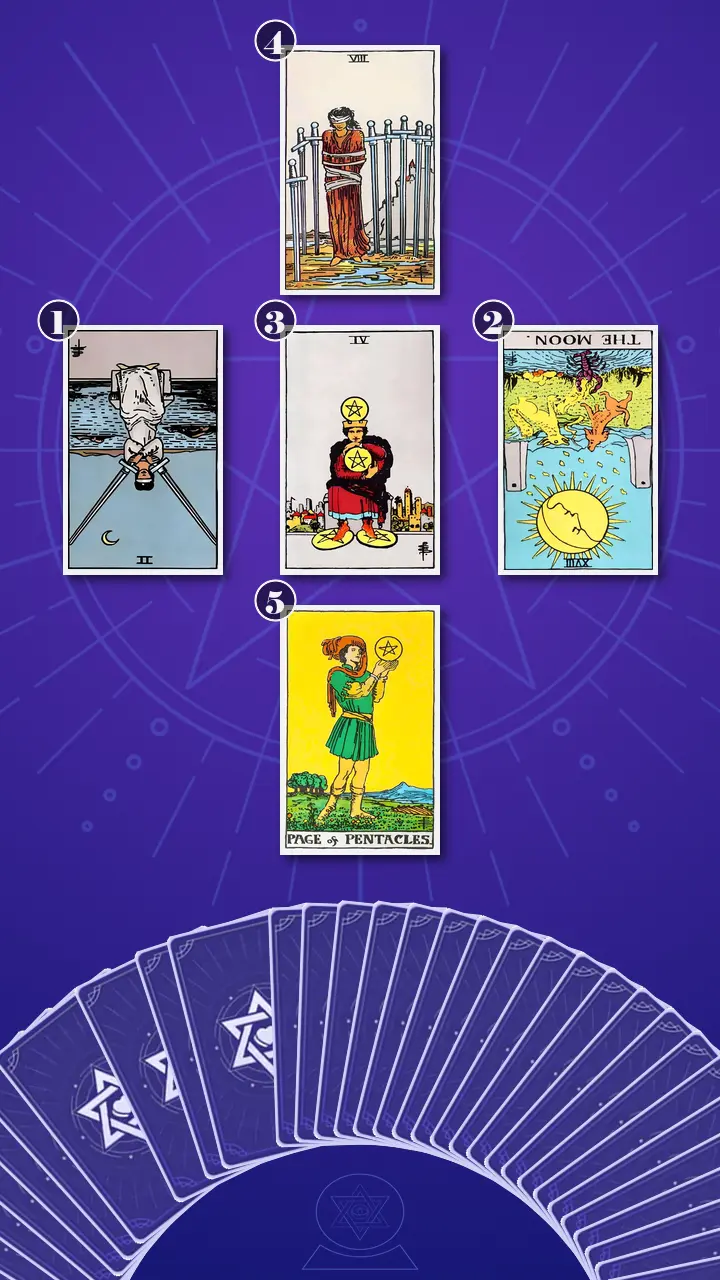
I chose the Relationship Spread · Context Edition, a five-card relationship tarot spread arranged like a crossroads. It was the smallest structure that could examine Jordan's conscious behavior, the reactions she was predicting, the belief underneath those predictions, the present stagnation, and one voluntary next step.
I also explained an ethical adjustment. The second position would not claim to reveal her partner's private thoughts or tell me what a therapist would do. It would show the assumptions Jordan was assigning to those people before either had responded. Tarot could make her decision pattern visible; it could not replace consent, communication, or firsthand evidence.
I placed the first two cards across from each other. The third sat at the center as the psychological foundation. The fourth rested above it, showing how that belief had become the current lock. The fifth waited beneath the center as a grounded, agency-based direction. For anyone wondering how tarot works in a relationship decision, this was my approach: I treated the images as an external decision map, interpreted the card meanings in context, and asked Jordan to test every insight against her lived experience.
Reading What Fear Had Added to the Map
Position 1: The Pause That Had Stopped Being Peaceful
I turned over the card representing Jordan's conscious posture toward trying couples therapy, especially her visible cycle of researching, drafting, and stopping before contact.
It was the Two of Swords, reversed.
I held the card toward the camera. The blindfolded figure tried to guard both directions at once, with two swords crossed tightly over the chest. Upright, that pause can preserve time for reflection. Reversed, the suspension had become unstable. I read it as blocked air tipping into excess: no decision moved, but thoughts kept multiplying around the blockage.
"This looks very close to the scene you gave me," I said. "Six therapist profiles open. Two names saved. One message drafted. You move between therapy might help us understand this and therapy might push us somewhere irreversible. Sending nothing protects you from both possibilities for the night, but the pause is no longer quiet. The tabs multiply, the draft returns, and the stalemate gets louder each week."
I heard the inner logic as clearly as the crossed swords: I want to know, but if I know, I may have to act. Jordan had been treating clarity and control as though only one could survive.
She gave a short laugh with no amusement in it. "That is painfully accurate. I keep calling it research because that sounds better than freezing." Her thumb rubbed the edge of her mug, then stopped.
"Research is not the enemy," I said. "It is a skill your job has trained well. The problem begins when research is asked to provide a guarantee that no profile can give. The pause protected you from an immediate surge of uncertainty. We can respect that protective purpose while admitting that it is no longer producing new information."
I asked what she had done in the seconds before closing her latest search. She answered without looking up: "I imagined sending the message, then imagined my partner asking what this meant for us. I could not answer that, so I decided I was not ready to send anything."
The card had exposed the first fusion: an inquiry had become mentally inseparable from explaining the entire future of the relationship.
Position 2: The Moon's Anxious Autocomplete
I next turned over the card representing Jordan's unverified assumptions about how her partner or a therapist might respond. Again, I was examining her forecast, not reading anyone else's mind.
It was The Moon, reversed.
I traced the narrow path winding between the two towers. It disappeared before the destination could be seen. Below it, the dog and wolf reacted while something unfamiliar rose from dark water. Reversed, the Moon's water had become internalized and difficult to distinguish from evidence. The emotional signal was real, but fear was overfilling every blank space around it.
Jordan told me that on Sunday night she had read a therapist's neutral description of a first couples session. The page mentioned identifying a recurring relationship cycle. Her mind immediately supplied a therapist taking sides, her partner disclosing something they could never unhear, and the appointment turning into a breakup conversation. None of those scenes appeared on the page, but each felt vivid enough to stop the inquiry.
"It is like anxious autocomplete," I said. "The intake page gives you an empty field, and your forecasting fills it with blame, forced disclosure, or separation. The page says, We identify recurring cycles. Your mind adds, The therapist will identify me as the problem. By the time you close the tab, the added sentence feels confirmed."
I thought of an algorithm trained only on dramatic TikTok and Reddit relationship stories. If every example in the feed ends with therapy either saving the relationship or ending it, the algorithm starts presenting those outliers as the complete range of outcomes. Jordan's mind had learned the same distorted feed.
"What if the therapist takes sides?" she asked.
"That is a valid concern to bring to an intake process," I said. "But right now it is a prediction. We can convert it into a checkable question: How do you work when partners enter with different perspectives or goals? That question can produce information. Replaying the feared scene cannot."
Her inhale stopped for a beat. Her gaze moved away from the screen as though she were rereading a memory, and then her jaw released slightly. "The website did not actually say any of what I imagined," she said.
"Exactly. Fear fills blank spaces quickly; that does not make its answers verified."
Position 3: The Security Grip at the Center
I turned over the central card, representing the limiting belief and control-based fear underneath Jordan's couples therapy hesitation.
It was the Four of Pentacles, upright.
The figure clutched one pentacle against the chest and pinned two beneath immobile feet. I read the upright earth energy here as excess conservation. Security had hardened into control, and control had reduced the space available for movement, exchange, or discovery.
I brought Jordan back to the evening after another sincere promise to revisit therapy when work was calmer. She and her partner had rinsed two mugs, checked the next day's calendars, and returned to their familiar sides of the sofa. Nothing visibly changed that night. Her shoulders dropped because the apartment, shared plans, routines, friendships, and four-year relationship all seemed to remain where she had left them.
"You are gripping the current arrangement like a lease you cannot risk renegotiating," I said. "The belief underneath the hesitation sounds like this: If I keep everything where it is, I cannot be the person who destabilized it."
Her fingers closed around the mug again. I saw the exact posture of the card reproduced on my screen.
"That feels awful to hear," she said quietly. "Because yes, I do feel responsible for what might happen if I bring this up again."
"I am not saying your wish for security is wrong," I replied. "Shared rent, routines, trust, and future plans are real. Wanting to protect them makes sense. I am asking us to notice the hidden cost of the grip: keeping the relationship unchanged also keeps the current pattern in place."
I asked what she was genuinely protecting during the last therapy conversation. After a long silence, she said, "The idea that we still had time to fix it privately. And maybe the idea that I could keep everything manageable if I chose the right moment."
The Four of Pentacles gave us the answer beneath the surface question. Jordan was not only afraid of therapy. She had equated no introduced change with no possible loss, even though postponement was already shaping the relationship.
Position 4: Four Screens Collapsed Into One Red Button
I turned over the card representing how that foundational belief had become the present Stagnation Lock through postponement and a narrowing sense of available choice.
It was the Eight of Swords, upright.
The blindfold returned, but now two crossed swords had expanded into an apparent enclosure of eight. The bindings looked convincing, yet they were loose, and open ground remained visible between the blades. I read this as air energy in excess: the mind had built such a complete model of possible consequences that the model itself now felt like a physical boundary.
"I want to borrow your product-design language," I told Jordan. "Your mind has taken four separate screens in a decision flow and collapsed them into one irreversible red button. The screens are: request information, attend one consultation, evaluate the fit, and decide whether to continue. Your current rule is, If I cannot guarantee what happens on screen four, I cannot risk opening screen one."
She leaned closer to the card. "That is exactly it. I have been trying to decide whether therapy will work before I even know whether someone has availability."
"An inquiry, a consultation, and ongoing therapy are three different yeses," I said. "Evaluation sits between them, and it receives its own yes or no as well. Consent does not roll downhill automatically. Agreeing to ask a question does not commit either of you to a session. Attending one session does not commit either of you to another."
I pointed to the openings between the swords. "The card does not minimize the stakes of your relationship. It corrects the architecture of the decision. You do not need a guaranteed exit from the fourth stage before you are allowed to consider the first."
I asked which choice was genuinely available now. Jordan stared at the card, then said, "I could ask what a first consultation involves. That is not the same as agreeing to do it."
For the first time in the reading, her next sentence was not about an imagined ending. It was about a present-tense option.
When the Page Held One Real Thing
Position 5: A Bounded Experiment, Not a Predicted Outcome
I turned over the final card, representing an agency-based, reviewable next step that could create clarity without predicting where Jordan's relationship would end.
It was the Page of Pentacles, upright, the key card of the spread.
The room seemed to quiet around its image. Even the rain against Jordan's window had thinned to separate taps. Unlike both blindfolded Swords figures, the Page looked directly at one pentacle held at a workable distance. The mountain remained in the background, but the Page was not trying to climb it, map it, or guarantee what waited beyond it. I read this as earth restored to balance: no longer gripping the status quo, but carefully studying one tangible possibility.
"This is beginner's mind," I said. "You and your partner could identify three fit questions, send one inquiry, and treat any consultation as a limited information-gathering experience. You could schedule a separate review afterward without making an advance promise about further sessions. The Page does not surrender control. She places control where it can actually function: in the question, the boundary, and the next consent point."
I used my Macro-Orbital Projection to zoom out from Jordan's latest unsent message and map the longer cycle: disconnection, difficult conversation, therapist search, catastrophic forecast, closed tabs, temporary relief, and the same disconnection returning. Seeing the orbit removed a layer of personal blame. Jordan was not uniquely incapable of making a relationship decision; she had entered a repeatable protective cycle. But naming the orbit also showed where she could alter it.
I then used Void Phase Identification to locate the threshold she had mistaken for a verdict. I described the void phase as the interval between recognizing that an old pattern is no longer working and choosing a new trajectory. It was not proof that the relationship was failing, and it did not guarantee that a breakthrough was waiting on a schedule. It simply gave uncertainty a more accurate role: a transitional space in which observation could happen before commitment.
I brought her back to the precise scale of the problem. At 11:20 p.m., six therapist tabs had glowed over a dark Toronto living room. She had added another name to Notes, reread the unsent message, felt the pressure across her chest, and locked the phone because one inquiry had expanded into a verdict.
The first appointment is not a verdict on the relationship; it is one real piece of information Jordan can examine, like the Page holding a single pentacle at eye level.
I let the sentence remain between us without immediately explaining it away.
I watched the insight travel through her in three distinct movements. First, she went completely still. Her breath paused, her fingers hovering above the mug as if even that small movement needed permission. Second, her pupils widened and her focus slipped past the camera. I could almost see her replaying the closed tabs, the deleted drafts, and every promise to wait for a calmer week. Her brow tightened. "But does that mean I have been making this worse? Was I wrong every time I stopped?" she asked, with a flash of anger under the words. I told her the old response had reduced pressure when she lacked a safer structure; understanding its cost did not require condemning the person who used it. Third, her fist slowly opened. Her shoulders dropped, her eyes reddened, and a long breath left her with a slight tremor. The relief was not clean or triumphant. It carried the brief dizziness of realizing that more agency also meant making one honest choice at a time.
"Now, with this new perspective, think back to last week," I said. "Was there a moment when this insight could have made you feel different?"
Jordan remembered her partner asking, "Could we at least find out what a first session is like?" She had heard a request to begin an entire therapy process. Looking at the Page, she could hear a smaller question: were they willing to gather one piece of information together?
"I do not have to know where this ends," she said. "I only have to decide what I am willing to learn next."
I marked that sentence as the real turning point. It was not certainty about couples therapy or the relationship's future. It was the first movement from fear-driven outcome control and therapy-threshold paralysis toward cautious curiosity, explicit consent, and agency grounded in firsthand evidence.
Three Yeses, One Pentacle, and a Review Point
I gathered the five cards into one coherent story. Jordan's analytical skill had helped her function in a demanding product-design role, but at the therapy threshold it had been recruited to eliminate emotional risk. The reversed Two of Swords showed the research-and-stop loop. The reversed Moon showed unverified forecasts filling the unknown. The Four of Pentacles revealed the belief beneath them: preserving the current arrangement meant preserving safety. The Eight of Swords showed the result, with several revocable choices compressed into a single trap. The Page of Pentacles restored the resource already available to her: practical curiosity focused on one real, bounded experience.
I named the cognitive blind spot directly. Postponement was not keeping the relationship untouched. It was preserving both the relationship and the unresolved cycle inside it. Her attempt to avoid losing control had allowed imagined outcomes to make the present decision in advance.
The transformation direction was equally direct: stop treating an inquiry, consultation, evaluation, and ongoing therapy as one irreversible relationship verdict. Give each stage its own question, consent point, and exit. Jordan did not need dramatic confidence; the spread contained no Wands demanding a bold leap. She needed flexible structure, firsthand information, and permission to remain a beginner.
I made the actionable advice deliberately small. None of it required Jordan to contact a therapist, share a private note, or persuade her partner before she chose to do so.
- The Seven-Minute Threshold Note On one evening this week, Jordan would set a seven-minute timer and divide a private Notes page into two columns: What I need before an inquiry and What can wait until after a consultation. She would limit the first column to three practical questions, such as fees, availability, and how a therapist handles first-session goals. If the note began expanding into ten scenarios, I asked her to stop at three. The note could remain private, and reaching the timer did not obligate her to take another step.
- The Three-Different-Yeses Ladder In FigJam or on paper, Jordan would draw four boxes: request information, book one consultation, evaluate fit, and choose whether to continue. Under each box, she would write the decision available there and one valid exit, such as ask another question, cancel within policy, decline to rebook, or pause. If she chose to show it to her partner, she could begin with: Could we discuss the first box without deciding the fourth one tonight? I reminded her that every box requires fresh consent from both partners. Either person can stop, and no one has to defend a no by producing a perfect reason.
- The One-Week Cosmic Redshift Observation For two minutes each evening, Jordan would log one redshift signal, meaning an interest, assumption, or urgency that seemed to be fading, and one blueshift signal, meaning a fact, question, or condition drawing closer to her attention. On day seven, she would convert the most repeated fear into one neutral provider question and use one practical, one process, and one interpersonal criterion to review a single profile. This was observation, not an omen. If the exercise became another comparison matrix, I asked her to return to one profile and one question. Sending an inquiry remained optional and would happen only with the consent and boundary language she and her partner chose.
I gave Jordan one possible boundary sentence for an inquiry: We are gathering information and have not decided about ongoing sessions. If they attended a consultation, I suggested a separate fifteen-minute review using three prompts: What felt useful? What felt off? What do we each want to decide next?
I was careful to leave the final authority where it belonged. The spread did not declare couples therapy right for them, promise that it would repair the relationship, or suggest that one provider deserved automatic trust. It clarified the belief organizing Jordan's paralysis and returned each decision to the people living with its consequences.
Eight Days Later: The Quiet Proof
Eight days later, I received a message from Jordan. She had made the four-box diagram and shown only that page to her partner. They discussed the first box without trying to settle the fourth. Together, they chose one provider who met their three criteria and sent an inquiry asking about availability and the structure of an initial consultation.
They had not booked a session yet. The provider had not even replied. What changed was smaller and more credible: the inquiry no longer felt like a hidden vote on whether the relationship should survive.
Jordan wrote that she slept through that night, then woke with What if this changes things? as her first thought. She smiled, opened the decision ladder, and saw that deciding again was still allowed.
I did not read that as a perfect ending. I read it as the first observable proof of her Journey to Clarity. She had moved from trying to control an unseen destination to defining the next consent point. Tarot had not moved her life for her; it had given her a visible structure against which she could recognize and use her own judgment.
If the word therapy tightens your chest because you want clarity while bracing against the possibility that clarity could take the future out of your hands, I hope you remember the Page holding one pentacle at eye level. You do not have to see the whole road before you are allowed to examine what is real and reachable now.
If your next step could be one question with its own review point, rather than a decision about the whole relationship, which single piece of information would you feel curious enough to hold up to the light?