From Grad-School Research Loops to One Bounded Career Test

The 11:38 PM Spreadsheet Spiral of Graduate-School Decision Paralysis
"You are a 27-year-old program coordinator in Toronto with a stable enough job, a growing spreadsheet about tuition and lost income, and a fresh wave of career-pivot anxiety every time a former classmate posts a graduate acceptance," I said. "Did I get close?"
Jordan (name changed for privacy) gave a small, startled laugh and settled deeper into the chair across from me. I pictured the scene they had described at 8:47 PM on a Tuesday: the fluorescent kitchen light, the kettle clicking off behind them, the laptop fan humming while a cool rectangle of screen-light fell across the counter. I could see their jaw tighten, their warm phone held face-down beside the keyboard, and their breath staying shallow as another graduate-program tab opened.
"I want a direction," Jordan said. "But I do not want to close every other door. What if I spend two years and still do not know what I am doing?" They had been rebuilding tuition, salary, debt, and lost-income comparisons whenever an application started to feel real. The uncertainty had the shape of a browser loading wheel behind their ribs: always spinning, never delivering the page.
I did not treat that caution as weakness. Tuition, rent, lost income, and possible student debt were real constraints, and I wanted those facts respected. "We are not asking the cards to choose your life," I told Jordan. "We are going to use them as an external thinking tool, so the hidden pattern has somewhere visible to land. Then we can hand the pen back to you. Our Journey to Clarity begins with finding one honest next question, not forcing a permanent answer."

A Compass on the Career Crossroads
I invited Jordan to put their phone on silent, take one slow breath, and name the question without trying to solve it. I shuffled slowly while they watched the cards move from one hand to the other. The small pause was a psychological threshold, a way to shift from frantic searching into deliberate attention, not a supernatural test.
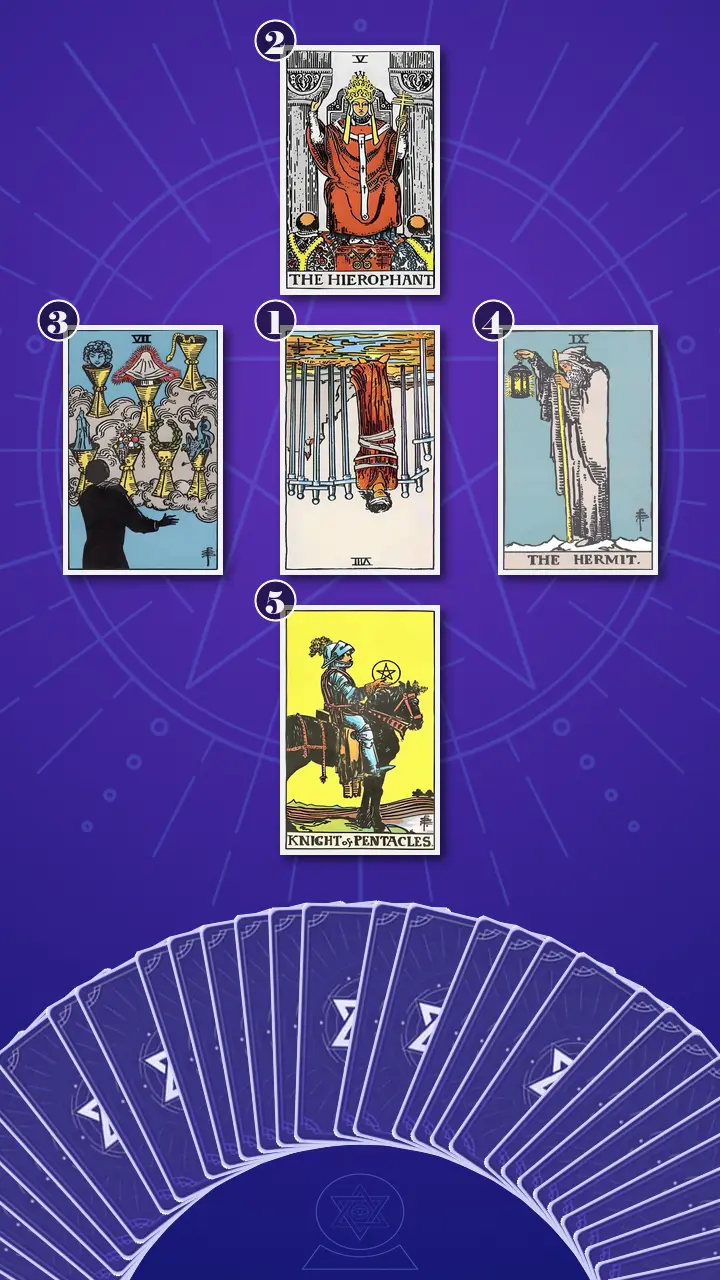
For this career-decision tarot reading, I chose the Decision Cross, a focused five-card tarot spread for reflecting on graduate school and career direction. I explained to Jordan, and to anyone reading along, that tarot works here as a symbolic decision map: each image gives an abstract concern a shape that can be examined, questioned, and compared with real evidence. The cards could not predict whether graduate school would be worthwhile. They could help separate the practical question from the identity question.
The center card would show the observable loop named in the diagnosis: reopening program pages, recalculating ROI, and circling instead of choosing. Above it, the crossing card would examine what grad school seemed to promise, including structure, legitimacy, training, and relief from defining a path alone. To the left, the root card would show the existential drift and competing imagined futures beneath the visible dilemma. To the right, a guidance card would point toward an internal criterion. Beneath everything, the final card would translate insight into a bounded, reversible experiment.
The Loop That Looked Like Planning
Position One: The Loop That Felt Like Research
"Now I am turning the card for the present situation and the observable loop at the center of your question," I said. "This position asks what your graduate-school research is doing for you in the moment, and which concrete action it keeps outside the frame."
The Eight of Swords, in reversed position. I pointed first to the blindfolded figure and the bound hands. In Jordan's life, the blindfold looked like the laptop surrounded by browser tabs: a tuition spreadsheet, a salary calculator, six program pages, and a dozen imagined consequences. At 11:38 PM, the tabs were supplying information, but they were also postponing the small test that might create firsthand evidence.
Reversed, the energy was not a dramatic escape and certainly not a command to reject every graduate program. I read it as a blockage beginning to loosen through recognition. Jordan had enough movement available to name three criteria and choose one low-cost step, but the first release had to be practical and partial. The risk on the other side was a reactive swing from paralysis into an unexamined commitment, as if rushing would prove freedom.
I used the inner sentence that had probably made the loop feel responsible: "I am not avoiding the decision; I am making sure I have enough information." Then I placed a second question beside it: "What would count as enough for one small test?" This is where I use my Safe-Choice Sabotage Recognition: I look for the option that sounds logical but is quietly functioning as a defense against the necessary inciting incident, the first real action that would let ordinary life answer back.
Jordan's breathing paused. Their fingers hovered over the edge of the card, their eyes moved to the invisible row of tabs, and a memory seemed to pass across their face before they gave a short, bitter laugh. "That is exactly what I do," they said. "I call it research, but I restart the decision whenever it gets close to a real date." I let the silence hold the recognition without turning it into shame. The Eight of Swords had not accused them; it had shown them the latch.
Position Two: The Map a Credential Seems to Offer
"Now I am turning the card that crosses the present loop," I said. "This position examines what graduate school seems to promise in the current ROI reckoning: structure, legitimacy, training, community, or relief from having to define the path alone."
The Hierophant, upright. The image gave the question a fairer hearing than a simple yes-or-no answer could. I brought Jordan into the graduate information session they had attended after work, when the curriculum PDF, cohort page, funding details, and career-outcomes section created a sudden sense of order. The crossed keys suggested access: a master's program could unlock instruction, mentorship, a professional network, and a credential.
I was careful not to dismiss formal education. A structured program can be valuable, especially when its teaching, community, and outcomes match a person's values and finances. But I asked Jordan to finish the sentence aloud: "This could give me ____, but I am asking it to also give me ____."
Jordan looked down at the keys printed near the Hierophant's feet. "This could give me training and community," they said, "but I am asking it to also give me a reason to trust my direction." Their shoulders dropped by a fraction. I watched relief become more precise. The institution might provide a useful map, but it could not decide what kind of ordinary Tuesday work Jordan wanted to live.
Position Three: The Futures Floating Just Out of Reach
"The third card takes us underneath the visible dilemma," I said. "This is the root of the existential drift and inner conflict that keep every possible future emotionally available while delaying firsthand evidence."
The Seven of Cups, upright. I saw Jordan's lunch-break ritual in the floating cups: a public-policy master's, a research-focused program, a professional certificate, and several saved assessment results. Each page carried a vivid future self. One promised status, another purpose, another security, another a clean reinvention. Because none had touched an ordinary workday, all of them could remain perfect.
The water energy was expansive, imaginative, and emotionally charged, but here it had become excess. Possibility can feel safer than participation. When a choice stayed inside a comparison sheet, Jordan could keep every door open and avoid the grief of not becoming every version of themselves. The hidden fear was not simply choosing the wrong degree; it was that regret would prove they lacked sound judgment and control.
"Which one of these cups contains an actionable value," I asked, "and which one is only an attractive story about who you might become?" Jordan's hands tightened together, then separated. Their gaze went unfocused as if they were scrolling through a private streaming queue of excellent futures. "I want a direction," they said quietly, "but I do not want to close every other door." I answered, "We do not have to close every door today. We do have to touch one piece of ground."
When the Hermit's Lantern Lit One Small Room
Position Four: The Question No Institution Could Answer
The room grew still when I reached the guidance position. Even the traffic outside seemed to recede behind the window, leaving the cards, the low radiator, and Jordan's careful breathing in the foreground.
"Now I am turning the card that identifies the internal criterion and source of clarity available to you," I said. "It does not ask you to withdraw from support. It asks what you can hear when peer timelines and program marketing go quiet."
The Hermit, upright. The raised lantern held a small star, not a floodlight. I explained that this was selective attention rather than isolation: one private question, one page of notes, and one distinction between borrowed status and lived energy. The Hermit invited Jordan to mute LinkedIn for one evening, put the phone on Do Not Disturb, and ask, "If nobody could see this choice, what part of the work would I still want to experience?"
I use Narrative Fork Analysis for moments like this. I laid out two competing plotlines without treating either as destiny. In the first, The Credential as Verdict, Jordan applies because the degree might make the whole future look coherent and certify that they are a sensible person. In the second, The Lantern and the Test, Jordan names a value, gathers lived evidence, and then evaluates graduate school with better information. The second plotline did not promise a perfect ending. It served the deeper character-growth arc because it let Jordan become an author of the decision rather than asking an institution to write the role.
I placed the familiar scene in front of us: "It is 11:38 PM in your Toronto apartment, the spreadsheet is open beside six graduate-program tabs, and your jaw tightens as you promise yourself that one more comparison will finally make the choice obvious."
You do not need a perfect ROI verdict to stop circling; like the Hermit's lantern, use one quiet question and one lived experiment to illuminate the next section of the path.
I let the sentence rest between us, then gave the reading's wider practice its full shape: "Grad school does not have to prove that you have a direction. One honest criterion and one reversible experiment can tell you more than another month of trying to make uncertainty disappear."
For a moment, Jordan's breath stopped. Their fingers hovered over the edge of the card, and the muscles beside their mouth tightened as if the sentence had landed too close. Their gaze lost focus; I could almost see the acceptance post, the unanswered application draft, and the spreadsheet formula glowing at 11:38 replaying behind their eyes. Then their attention returned to me. "But doesn't that mean I have been doing this wrong?" The question came out sharper than their earlier voice. I told them no: a strategy that once kept them safe did not become foolish because it had outlived its usefulness. Their clenched hand opened one finger at a time. Their shoulders lowered, their eyes shone, and a long, uneven exhale moved through their chest. Relief arrived with a thin edge of vertigo. Clarity offered a direction, but it also returned responsibility to the person choosing. "Now," I asked, "use this new perspective to remember: was there a moment last week when this insight could have made you feel differently?"
I did not ask Jordan to decide whether to enroll. I asked them to write three criteria within the next ten minutes, choose one low-cost evidence step for the week, and record what they noticed without grading it as a verdict on the future. They could stop, revise, or choose a different experiment at any point. That was the crossing I wanted to name: from restless comparison and certainty-seeking toward grounded curiosity, self-trust, and practical commitment.
The Pentacle on This Week's Calendar
Position Five: One Careful Step on Workable Ground
"The last card translates the insight into practical counsel," I said. "This position asks for a bounded next step that gathers evidence about values, cost, and lived fit without turning the action into a permanent verdict."
The Knight of Pentacles, upright. The horse stood still. The knight held one pentacle steadily, and the freshly ploughed field waited without demanding a dramatic leap. I connected the image to a short project, an informational conversation, or a skills-based task with a calendar date, a budget limit, and a brief review afterward. The point was not to choose an entire career. The point was to make contact with the ordinary details of one possible path.
I asked Jordan to track what happened before and after the test: how long their attention held, what kind of energy the task required, what it cost, and what practical constraint became clearer. "Not a life verdict," I said. "A data point." The phrase changed the scale of the problem. I watched Jordan open their calendar, hover over a blank evening, and stop trying to make the appointment mean more than it did.
I also showed them the spread's elemental movement. The Eight of Swords began with Air turned into tabs, calculations, and imagined consequences. The Seven of Cups expanded that thinking into emotionally vivid possible selves. The Hermit narrowed the field to one lantern-lit question. The Knight brought the reading into Earth: a date, a task, a cost, a result. The missing fire was not a lack of ambition. It was the small initiation Jordan had been waiting to feel certain enough to begin.
The Hallway of Brochures Opens: Finding Clarity Without a Verdict
I gathered the five cards into one story. The central Eight of Swords showed how Jordan's responsible-looking research had become a mental enclosure. The Hierophant showed why graduate school remained attractive: it could genuinely offer training, mentorship, community, and access. The Seven of Cups revealed the deeper pull of imagined future selves, where possibility multiplied faster than ordinary experience. The Hermit supplied a self-authored criterion, and the Knight of Pentacles gave that criterion somewhere to go.
The blind spot I could see was not a lack of intelligence or effort. It was the belief that certainty had to arrive before participation, and that keeping every door open was the same as keeping every future available. In practice, more rankings, salary estimates, and opinions were creating temporary safety while producing little evidence about the work itself. Jordan was asking a degree to answer an identity question.
The key shift was simple but not shallow: replace the search for a guaranteed path with a time-bounded comparison of one real-world experiment and one graduate-school information step, judged by personal values, financial reality, and lived energy. Graduate school could remain a serious option to evaluate. It did not have to carry the burden of proving that Jordan had a direction.
The One-Criterion Lantern and the Bounded Path Test
I gave Jordan three next steps. I kept them small because a useful plan should survive an ordinary Toronto week of rent transfers, work Slack messages, shared-apartment logistics, and limited energy.
- Write the One-Criterion LanternWithin the next 24 hours, open one notes page at the kitchen counter and set a 15-minute timer. Write three rough headings: work you would want to do repeatedly, cost or debt you can genuinely carry, and the kind of energy you want a normal week to leave you with.Keep each heading to one line. This is a comparison tool, not a contract, and you do not owe anyone a polished answer.
- Run One Bounded Path TestBy the end of this week, choose one field or program that represents one of your criteria and send a short message to someone doing related work. Ask for a 20-minute conversation about their ordinary week, including what takes most of their time, what program marketing leaves out, and what they would test before paying for formal training.Use a low-pressure message and give the conversation a clear start and end. You are gathering lived evidence, not asking for approval or making the option official.
- Make the Protagonist Pivot ActionWithin 24 hours of writing the criterion, choose one micro-action aligned with the plotline that feels most daunting yet most authentic: send the message, complete a 30-minute work sample, or attend one relevant class or information session. Afterward, record what held your attention, what drained you, and what constraint became clearer.Use my Protagonist Pivot Action as a creative mandate, not a dare. You can stop, revise, or choose another experiment. The only requirement is that the action creates contact with reality.
I reminded Jordan that an experiment could support graduate school, redirect attention toward work, or reveal that more information was needed. None of those outcomes would expose a fixed identity. A reversible decision can be responsible without being final, and a practical commitment can be a way of learning rather than a promise to stay forever.

A Week Later, the Door Was Still Open
A week later, I received a screenshot from Jordan. The three honest criteria sat at the top of the note, and a 20-minute conversation with a policy professional was on the calendar. That night, Jordan slept through. In the morning, "What if I am wrong?" arrived first; they smiled, made coffee, and kept the appointment.
I have always felt that our lives are films currently in production. When I stay with a client through a painful scene, my work is not to announce the ending. It is to help them see where the scene has become repetitive, find the next honest cut, and gently hand them the pen. The Decision Cross had not delivered Jordan's future. Jordan had used it to move from restless comparison and certainty-seeking toward grounded curiosity, self-trust, and practical commitment.
This is why I use a five-card Decision Cross tarot spread for reflecting on graduate school and career direction. It turns a vague question into values, financial constraints, lived evidence, and actionable next steps, while leaving the decision where it belongs: with the person who has to live the ordinary days that follow.
When choosing a path feels like choosing proof that you can trust yourself, I know the jaw can tighten, the hands can keep opening new tabs, and every unopened door can feel safer than the one you might actually enter. Being caught in that hallway does not make you behind or incapable; it means the decision has been carrying more than tuition and career fit.
If the next step did not have to settle your identity or close every other door, what small piece of real work would you feel curious enough to experience first, something you could place beside a single pentacle on this week's calendar: not a life verdict, but a data point?