The 11:47 p.m. Swipe That Still Felt Empty
I have seen how someone can manage a campaign dashboard all day yet reopen Hinge at 11:47 p.m. because one unanswered message makes the apartment too quiet. Casey (name changed for privacy), a 28-year-old hybrid marketing coordinator in Toronto, brought that exact contradiction to my table.
On Tuesday night, she had lain on her sofa with the unanswered message open and a second app loading under her thumb. The radiator clicked; the blue-white screen warmed her palm; her chest cinched tighter as a promised five minutes became forty. She barely remembered the profiles.
"I know another match will not fix this, but silence feels worse," she said. Her restless dissatisfaction sounded like drinking salt water beneath blue light: every swipe wet the mouth of hope and sharpened the thirst. I leaned in. "Wanting depth is not the problem. Let's map the loop and find where your choice can return."

Choosing the Switchback Map
I invited Casey to take one unforced breath and place her phone face down. I shuffled slowly while she held one question in mind: "Why do I keep swiping when dating apps leave me unfulfilled?" The small ritual was not mystical theatre. It was a transition from reacting to observing.
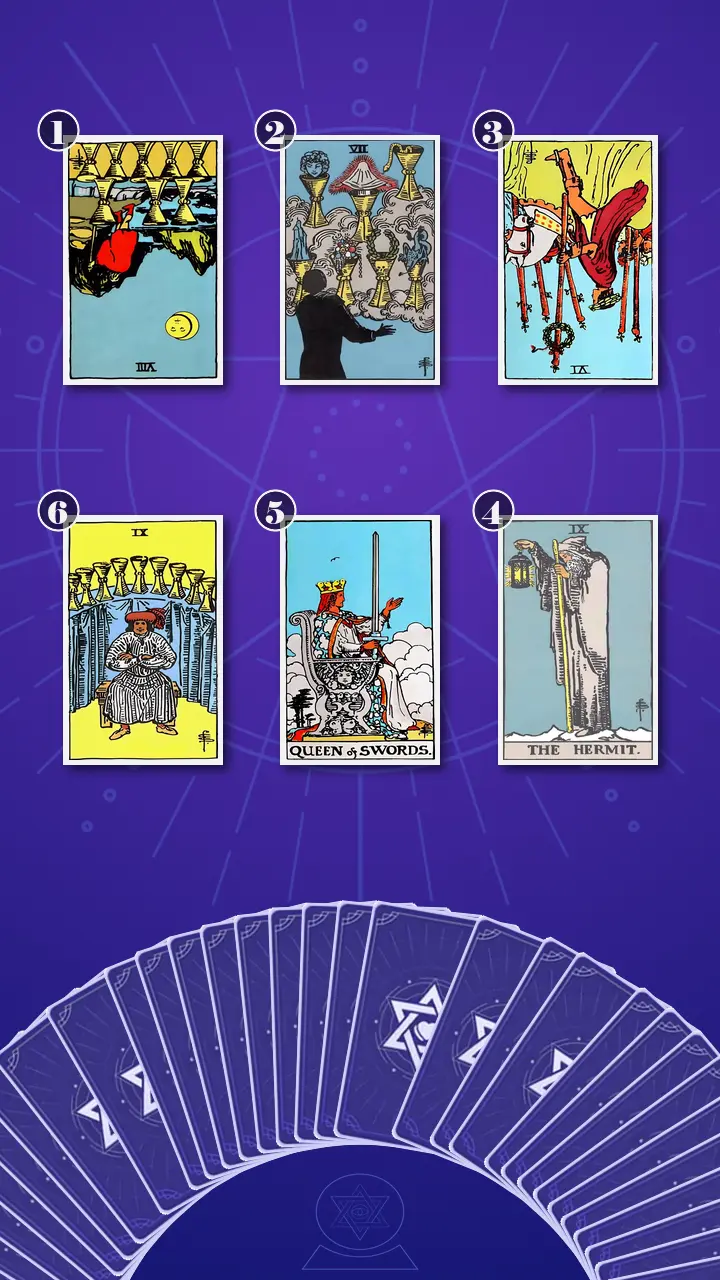
I chose the Transformation Path Grid · Context Edition, a six-card tarot spread for understanding and interrupting dating-app reassurance loops. For anyone wondering how tarot works in a question like this, I use card meanings in context as an external cognitive map. The cards do not predict who will text, whether a relationship will appear, or what Casey is destined to do. They place the parts of a feedback system where we can inspect them without shame.
This question needed a focused structure. A quiet inbox triggered discomfort; swiping offered a quick reward; the depletion afterward created another urge to check. The grid was compact enough to follow that whole circuit without burying Casey beneath unnecessary detail. I arranged three cards across the top, then three beneath them in reverse direction, like a switchback trail reaching the end of one route and returning with a different organizing principle.
I told her that the first position would show the visible close-and-reopen loop. The third would uncover the hidden reward beneath it. The fourth, the key turning point, would show how to interrupt the pattern without demanding that she delete every app or give up on dating.
The Cups That Kept Refilling With Maybe
Position 1: The Exit That Reopened Itself
I turned over the card representing the observable symptom of the reassurance loop: closing an app unfulfilled and reopening it to continue swiping. It was the Eight of Cups, in reversed position.
I pointed to the red-cloaked figure and the visible gap in the stacked cups. Upright, the figure walks away from an emotionally incomplete arrangement in search of something deeper. Reversed, the departure is blocked. The person knows the cups are not enough, yet the dark path beyond them feels harder than returning to what is familiar.
In Casey's life, the image was almost literal. At 11:47 p.m., she closed one app after the unanswered message left her flat. The dark home screen lasted only a few seconds before her thumb tapped the second icon. She called it a five-minute check, but leaving the profiles was not the difficult part. The difficult part was hearing the unmet longing once the options disappeared.
I described the reversal as blocked emotional movement, not weak willpower. Her desire for connection was trying to move toward depth, while the reassurance habit kept redirecting it toward another quick signal. Deleting every app in disgust would risk becoming the same reversal in a more dramatic costume: leave on Friday, feel exposed on Sunday, reinstall on Monday.
"Think about the minute between closing and reopening," I said. "What happens first in the room or in your body?"
Casey gave a short laugh with no brightness in it. "That is so accurate it is almost rude. The room gets louder even though nothing is making noise. Then my hand just does it." Her thumb rubbed the edge of her phone before she noticed and placed both hands in her lap.
I smiled gently. "Then we will make the accuracy useful, not punitive. The return makes sense when we understand what the silence is exposing." More options can feel like movement while keeping you in the same emotional place.
Position 2: The Infinite Profile Deck
I turned over the card representing the immediate blockage that made continued swiping feel promising: abundant options, imagined futures, and the fear of stopping one profile too soon. It was the Seven of Cups, upright.
A silhouetted figure faces seven cups floating in clouds, each holding a different glittering possibility. I told Casey that the imagination in this card was not inherently a problem. In excess, however, possibility expands faster than discernment. Every option remains emotionally vivid while no real person receives enough attention to become known.
I connected it to her TTC ride home. A hiking photo became an adventurous partner. A witty prompt became emotional intelligence. An impressive job title became imagined stability. She gave each profile three seconds, built a possible future, and moved on. Meanwhile, a person who had asked her a genuinely thoughtful question waited because answering would require presence rather than projection.
The profile deck was behaving like an algorithmic For You feed: the next item always looked capable of being more relevant, so stopping felt like forfeiting the best possibility. The Seven of Cups showed an excess of imagined Water and a shortage of reality-tested attention. "Maybe this one could be different, so I cannot stop yet" had become the operating system of the evening.
I used a lens I call Safe-Choice Sabotage Recognition. Casey had framed more profiles as better data, which sounded efficient and logical for a busy person in a big city. But the apparently safe choice protected her from the real inciting incident: pausing long enough to discover what she wanted, risking attention on one actual exchange, and accepting that discernment requires letting some possibilities go.
"Which recent profile became a whole relationship in your mind before the person had shown reciprocal interest?" I asked.
Her eyes shifted toward the window. After a moment, she mentioned a man whose profile included a cabin, a dog, and a line about therapy. "I basically gave him an entire personality," she said. Her fingers tightened around her sleeve and then released it. "I cannot even remember whether he matched with me."
The recognition stung because it separated possibility from presence. It also gave Casey a cleaner explanation for dating-app burnout: she was not failing to select the right future from an endless catalogue. She was spending finite attention on projected futures that had not yet earned it.
Position 3: When the Match Became a Verdict
I turned over the card representing the root reward beneath the behavior: matches and notifications being used as external evidence of desirability and worth. It was the Six of Wands, in reversed position.
I showed Casey the rider wearing a laurel wreath, elevated above a surrounding crowd. Upright, the card can hold healthy recognition and shared celebration. Reversed, the Fire of recognition is blocked or made unstable. Approval must keep arriving because the last round never settles into durable confidence.
I translated the crowd into an unseen digital audience. After an hour without a reply, Casey checked her likes, reviewed her profile photos, and started another swipe session. When a new match appeared, her chest briefly loosened even though she had no interest in messaging him. The app had not supplied intimacy. It had supplied a miniature public victory that answered, for a few seconds, "Am I still wanted?"
A match count had become a personal performance dashboard. Neutral platform activity was being asked to score something it was never designed to measure. I felt an old professional association click into place: metrics are useful only when they measure the outcome we actually care about. A notification can record platform activity. It cannot audit a person's beauty, lovability, or capacity for partnership.
I looked at Casey and said, "You may not want the match; you may want what the match seems to prove."
Her breath paused. She looked down at the phone as though the red badge had become visible through its dark screen. Then she pressed a palm lightly against her sternum. "An empty inbox can change how attractive I feel in about ten minutes," she said, her voice quieter. "Even if I did not like anyone I saw."
"That does not make you shallow," I replied. "It means the app found a fast route to a very human need to be recognized. Our task is to stop making a variable match count carry the full weight of that need."
When the Hermit's Lantern Replaced the Crowd
Position 4: The Pause That Changed the Plot
The rain against my window thinned until I could hear the room settle. My table lamp made one clean pool of light around the next card. I turned over the position representing the key interruption: a deliberate pause in which Casey could distinguish longing for reciprocal connection from the urge for immediate reassurance.
It was The Hermit, upright, the key card of the reading.
I made the lantern the visual centre. It does not illuminate the whole mountain or guarantee what waits beyond the next bend. It offers enough light for one honest step. The Hermit's upright energy is deliberate solitude in balance: inner authority, self-support, candid observation, and values-based discernment. This is solitude with a purpose, not isolation used as punishment.
I brought Casey back to 11:47 p.m.: one unanswered message, a second app loading, five minutes becoming forty. She had been trying to answer "Will I meet someone?" while each swipe was answering only "Can I make the silence stop for three seconds?"
Two Competing Plotlines
Because I experience lives as films still in production, I used my Narrative Fork Analysis. I placed two competing plotlines beside the Hermit. In the first, which I called The Endless Casting Call, Casey kept every profile visible. It felt safe because she never had to close the field of possibility, but the protagonist remained in the same blue-lit scene, scanning instead of connecting.
In the second plotline, The Lantern Pause, Casey put her phone in another room for ten minutes, sat at the kitchen table, and defined three observable signs of reciprocal connection: balanced curiosity, consistent follow-through, and respect for pace. She did not quit the apps. She simply refused to let the app establish the terms of the next scene.
"Which plotline actually serves the person you are trying to become?" I asked.
Casey looked at the reversed Six of Wands, then at the Hermit's small lantern. "The second one," she said. "It is also the one I keep avoiding."
I named the systemic turn as plainly as I could: The reassurance loop loosens when you define fulfillment before asking the app to prove your desirability.
You do not need another match to settle your worth; name what genuine connection feels like and let The Hermit's lantern, not the crowd's applause, guide the next swipe.
For one beat, Casey did not move. Her inhale stopped high in her chest, and her index finger hovered over the phone's edge as if an invisible notification had caught it. Then her gaze slipped past the cards; I watched a memory replay in the set of her jaw. Her pupils widened. Her mouth tightened, loosened, and her eyes turned glassy. She drew both shoulders inward and said, more sharply than before, "But doesn't that mean I have been doing it wrong this whole time?" I kept my voice level. "No. It means swiping has been doing a job for you. It softened a hard moment. We are only deciding whether it should keep that job." Her fist opened on the tabletop, one finger at a time. A breath left her with a small tremor, and her shoulders dropped. The release arrived beside something more exposed: the faint, dizzy blankness of realizing that a clear next choice would be hers, not the algorithm's. She gave one disbelieving laugh and wiped beneath one eye. "Okay," she said. "That is annoyingly kinder than what I have been telling myself."
I asked, "Now, using this new perspective, think back to last week. Was there a moment when this insight could have made you feel different?"
She remembered leaving a polite but empty Queen West date. Before she reached the streetcar stop, she had opened Bumble and felt her chest release when a match appeared. "I did not want him," she said. "I wanted the date not to mean anything about me."
I nodded. "With the lantern, that moment could have held a smaller question: Do I need another person on my screen, or do I need ten minutes to admit that the date disappointed me? You would not need to know your whole romantic future. You would only need enough light for that distinction."
I set a ten-minute timer and asked her to open Notes with three headings: "The urge," "What I want this notification to prove," and "What reciprocal connection would look like instead." One sentence under each was enough. She did not have to delete an app, decide whether to keep dating, or share the note with anyone. If the exercise felt too exposing, she could use the minimum version and name only the urge.
A pause is not giving up on dating; it is taking the app off self-worth duty. I told Casey that this was the first real movement from reassurance-driven doom swiping and metric-based self-worth to values-based discernment and grounded openness to reciprocal connection. It was not a solved life or a guaranteed relationship. It was the return of authorship at the exact moment the old loop usually took over.
The Sword, the Open Hand, and a Definition of Enough
Position 5: A Boundary That Did Not Lock the Door
I turned over the card representing the practical response: app boundaries, explicit relationship criteria, and a one-week experiment that could preserve openness without enabling automatic checking. It was the Queen of Swords, upright.
I traced the line of her vertical sword and then the gesture of her open hand. The paired symbols mattered. The sword makes distinctions; the hand remains receptive. Upright Air was balanced here through precise language, planned access, and honest decisions. Boundaries and curiosity did not have to cancel each other out.
In Casey's week, the Queen looked like two twenty-minute app sessions scheduled before late evening, a pinned note containing her reciprocity criteria, and a decision that consistently one-sided conversations could be addressed directly or archived. The app could remain one route to meeting people without remaining permanently available whenever a room became quiet.
"Look at your calendar," I said. "Which two windows would protect your sleep and attention? And what observable behaviour would tell you that a conversation no longer deserves all the effort you are supplying?"
Casey opened her calendar and chose Wednesday at 7:00 p.m. and Sunday at 5:30 p.m. Then she frowned. "This sounds sensible, but I do not want dating to feel like another campaign plan. What if someone messages outside the window?"
"The schedule is an attention budget, not a moral rule," I said. "You can reply to an active conversation or deal with a confirmed date. The boundary is for automatic checking, not for punishing spontaneity. You can stay open without staying endlessly available."
Her chin lifted slightly. She typed the two windows into her calendar and added a five-minute warning to each. The movement was ordinary, almost boring, which was precisely why I trusted it more than a dramatic midnight deletion.
Position 6: When One Good Exchange Could Be Enough
I turned over the card representing integration: evaluating dating through reciprocity, alignment, and felt satisfaction rather than attention volume. It was the Nine of Cups, upright.
I placed it near the Seven of Cups so Casey could see the contrast. The Seven held unstable possibilities in clouds. The Nine presented an orderly row of cups behind a seated figure who could look directly at what was present. The Water that had been scattered at the beginning was now contained. Satisfaction could be noticed, named, and allowed to be enough for the night.
In practical terms, Casey could finish a planned session and ask whether she felt respected, curious, and emotionally present. One reciprocal exchange could count as a satisfying session even if no new match appeared. Ending on time could count. Sending one thoughtful reply could count. Noticing that a conversation lacked mutual effort could count.
"Fulfillment is a quality check, not a notification count," I said. "After your next session, what result could matter even if the match number stays exactly the same?"
Casey thought of the message she had postponed answering. The person had remembered a detail from her profile and asked a specific follow-up question. "I could reply properly instead of looking for a faster spark," she said. Her shoulders lowered another fraction. "And I could stop after that without deciding I had wasted the session."
I agreed. The Nine of Cups did not promise that this conversation would become a relationship. It gave her a more honest measure of participation: Did the exchange contain mutual effort? Did she respect her own pace? Did she leave more present rather than more depleted?
The Rough Cut Became a Route
I gathered the six cards into one storyline. The past influence was not a fate the deck claimed to know; it was the accumulation of evenings Casey had already described, when silence began to feel like a verdict and checking became the fastest available relief. In the present, the reversed Eight of Cups showed the compulsive return. The Seven of Cups explained how imagined futures made that return look productive. The reversed Six of Wands exposed the hidden reward: recognition without intimacy. The Hermit restored distance, the Queen supplied language and limits, and the Nine offered an internally legible definition of satisfaction.
To my artist's eye, the spread looked like an editing timeline. The same painful scene had been left in the film too long because the next swipe kept promising a plot development. Casey's cognitive blind spot was mistaking more options for movement and platform response for evidence of personal worth. Her transformation was not from "using dating apps" to "never using dating apps." It was from opening them whenever reassurance was needed to entering them with a purpose, a time boundary, and observable standards for reciprocity.
I also pointed out the absence of Pentacles. The insight needed an embodied routine or it would remain a beautiful idea under a table lamp. Timers, notification settings, a phone placed in another room, and a brief post-session check were not glamorous. They were the practical ground beneath the Hermit's next step.
The Protagonist Pivot for the Next Seven Days
I translated the reading into three small experiments. I told Casey that none of them was a test of discipline, and she could revise any boundary after observing what it actually did. The cards had helped us identify the options; the decisions remained hers.
- The Protagonist Pivot Action Within the next 24 hours, choose one low-stakes 24-hour period, turn off dating-app notifications, and move the apps into a secondary folder instead of deleting them. When an urge arrives, wait ten minutes and record the trigger, what the notification is being asked to prove, and one non-app response available in that moment. Treat this as a creative experiment, not a permanent exit. The minimum version is one ten-minute pause and one word naming the urge. Keep any access needed for safety or a confirmed plan.
- The Three-Sign Reciprocity Filter Before the pause ends, pin a note that lists balanced curiosity, consistent follow-through, and respect for pace or boundaries. Consult it before extending a swipe session, continuing a chat, or investing further in someone. For one consistently one-sided conversation, send a direct, low-pressure check-in or archive it. Use the filter to observe behaviour, not to diagnose strangers. If three criteria feel like too much, keep one visible: balanced curiosity.
- The Planned Swipe Window and Enoughness Debrief Schedule two twenty-minute app sessions before 9:00 p.m., with a five-minute timer warning. After each session, answer three yes-or-no questions: Was effort reciprocal? Did I respect my pace? Do I feel more present rather than more depleted? Record one quality-based win, even if it is simply stopping on time. The windows are an attention budget, not a ban on an active conversation. The minimum version is one fifteen-minute session and one accurate word for how you feel afterward.
I asked Casey to read the plan once and remove anything that felt imposed. She kept all three experiments but changed the first pause from Saturday to Tuesday, when no date or social plan was pending. That small edit mattered. Autonomy was not the reward at the end of the exercise; it was the method.

A Week Later: The Quiet Proof
Six days later, I received a message from Casey. She had completed the 24-hour pause and noticed six separate moments when her hand reached automatically for the secondary folder. In her Notes app, the most revealing line was: "I want this badge to prove I have not fallen behind."
During her first planned window, she answered the thoughtful message she had been postponing and archived a chat in which she had carried every exchange. Neither action produced cinematic certainty. Both left her feeling more present than another forty minutes of scanning had.
Her final line held the bittersweet proof: "I slept through Tuesday night. My first thought in the morning was, What if I missed someone? Then I laughed, made coffee, and waited until my planned window."
I did not read that as the app loop being permanently solved. I read it as Casey recognising the urge without immediately obeying it. Tarot had not authored the change, earned her a partner, or delivered a verdict about her future. It had given her a storyboard clear enough to edit. She still held the pen.
That was our Journey to Clarity: not certainty about who might appear, but grounded evidence that Casey could want partnership without making every quiet inbox measure her desirability. The Hermit's lantern had shown only the next part of the path, and that was enough for her to take ownership of one evening.
When a room goes quiet and your chest tightens, one more swipe can feel like the only thing standing between you and the fear that nobody wanting you tonight means nobody will want you at all. If that is your scene, noticing what the swipe has been asked to prove means you are already looking at the script instead of merely repeating it.
If one quiet moment could belong to you before it belongs to the app, which signal would you ask the Hermit's lantern to find first: balanced curiosity, consistent follow-through, or respect for your pace?

Every reading at AceTarot is a journey to connect with inner wisdom and empower the path ahead. This reading shared here is a psychological mirror, not a private record—crafted to reflect universal emotional loops and help restore personal clarity. Please note that these insights do not replace professional psychological, medical, legal, or financial advice, and should not serve as the sole basis for major life decisions.
Learn more about our Journey to Clarity.
How did this insight land for you?
🫂 This Resonates Deeply
🌀 Living This Story
✨ Now I See Clearly
🌱 Seeing New Possibilities
🧰 Useful Framework
🔮 The Confirmation I Needed
💪 Feeling Empowered
🚀 Ready for My Next Step
Author Profile
AI Juniper Wilde
1056 readings | 537 reviews
“I’ve always felt our lives are films currently in production. As an artist, I know that when you feel stuck, it’s often because you’ve bravely stayed in a painful scene for just a little too long. I’m not here to coldly analyze you. I want to sit closely with you, look at those difficult moments with profound empathy, and gently hand you the pen so you have the courage to write your next beautiful act.”
In this Choice Tarot Reading :
Core Expertise
- Narrative Fork Analysis: Deconstructing your options as competing plotlines to see which genuinely serves your ultimate character growth arc.
- Safe-Choice Sabotage Recognition: Identifying when a seemingly logical option is merely a defense mechanism to avoid a necessary 'inciting incident'.
Service Features
- The Protagonist Pivot Action: A 24-hour creative mandate to execute one micro-action aligned with the most daunting, yet authentic, plotline, effectively breaking analysis paralysis.
Also specializes in :
Explore Related Patterns:
External ValidationCasey says that an empty inbox can change how attractive she feels within ten minutes, and her later note asks the notification badge to prove that she has not fallen behind. Because even an unwanted match produces relief, the platform's response has become a temporary verdict about personal desirability rather than a neutral record of app activity. When you outsource a self-evaluation to match counts, confidence must be renewed every time the metric changes. Separating what the app can measure from what it cannot measure helps you stop treating variable attention as evidence about your worth or capacity for partnership.
Option HoardingEvery next profile appears capable of being more relevant, so stopping feels to Casey like forfeiting the best possibility. Keeping the field open preserves imagined futures, but it also leaves a thoughtful existing message unanswered and prevents any one person from receiving enough attention to become known. Option hoarding converts uncertainty into continued searching: you keep every door psychologically open so that no imperfect choice has to become real. The cost is fragmented attention, and naming that tradeoff makes it possible to choose one reality-tested exchange without pretending it guarantees an outcome.
Reassurance SeekingAt 11:47 p.m., Casey closes one app after an unanswered message and opens another because the quiet feels harder to tolerate. A new match briefly loosens her chest even when she does not want the person, showing that the swipe is delivering short-term reassurance rather than the intimacy she consciously wants. When you use a new signal to settle what silence or disappointment seems to say about you, the behavior can continue after it stops being fulfilling. Recognizing the reassurance job of the swipe restores a choice point: you can identify what needs soothing before asking another match to answer it.
Safe-Choice SabotageCasey describes more profiles as better data, which makes continued scanning sound practical, while a person who has already shown thoughtful curiosity waits for a reply. The data-gathering frame protects her from the more vulnerable tasks of identifying what she wants, risking attention on one exchange, and allowing unused possibilities to close. A safe choice can become self-sabotaging when it reduces immediate exposure but blocks the desired outcome. When you see endless optimization as a defense rather than neutral efficiency, you can test whether the protected behavior is helping you approach connection or keeping connection permanently hypothetical.
Avoidance CopingAfter the unanswered message, Casey uses another app to make the silence stop for a few seconds. After the empty Queen West date, she opens Bumble before reaching the streetcar because she wants the disappointment not to mean anything about her. Swiping is therefore doing more than seeking a date; it is redirecting attention away from longing and post-date disappointment before those experiences can be named. When you identify the feeling being avoided, you can choose a response that actually processes the moment instead of repeatedly postponing it through new profiles.
Compulsive CheckingCasey's promised five-minute check becomes forty minutes, and she barely remembers the profiles by the end. She also closes one app only to open another within seconds, while the later experiment reveals six separate moments when her hand reaches for the app folder automatically. The repeated movement shows how checking can become a conditioned response to discomfort before conscious preference enters the sequence. When you can notice the reach as a learned loop rather than a command, a pause can be inserted between the trigger and the action without turning the process into a test of willpower.
Boundary DiscernmentCasey schedules two app windows, moves the apps into a secondary folder, and defines balanced curiosity, follow-through, and respect for pace as standards for further investment. She also keeps the schedule flexible enough to answer an active conversation, so the limit protects attention without turning openness into a rule violation. Boundary discernment separates access from automatic availability and receptivity from overinvestment. When your limit is built around purpose rather than punishment, you can revise it from evidence while still protecting the sleep, attention, and pace that endless checking had been consuming.
Reality TestingCasey recognizes that a notification records platform activity rather than beauty, lovability, or partnership capacity. She then compares conversations against observable behavior, replying to the person who remembered a detail and archiving the chat whose effort she had been carrying alone. Reality testing moves attention from what a profile might become to what an interaction is currently demonstrating. When you compare hopeful interpretations with concrete reciprocity, you do not have to eliminate imagination; you simply stop asking imagination to substitute for evidence.
Romantic ProjectionOn Casey's commute, a hiking photo becomes an adventurous partner, a witty prompt becomes emotional intelligence, and an impressive job title becomes stability. She later admits that she gave one profile an entire personality without remembering whether the person had even matched with her, while a real thoughtful message remained unanswered. Projection lets sparse cues carry the emotional intensity of a relationship before reciprocity has been demonstrated. When you notice the difference between what a profile displays and what your imagination supplies, attention can return to the slower evidence of curiosity, follow-through, and respect for pace.
Values-Based Decision MakingCasey replaces match volume with questions about reciprocity, pace, and whether she feels more present after a session. One thoughtful reply, ending on time, or recognizing one-sided effort can now count, and she changes the experiment's timing when another day better supports her own choice. Values-based decision making gives the app a defined role instead of allowing each notification to define success. When you decide what fulfilling participation looks like before the reward system activates, your behavior can serve connection, presence, and autonomy even when the match count does not move.
Reflective DistanceCasey places her phone face down, takes an unforced breath, and later writes separately about the urge, what she wants a notification to prove, and what reciprocal connection would look like. Six days later, she can observe repeated reaches toward the app folder without immediately obeying them. Reflective distance does not require you to suppress the urge or argue yourself out of wanting connection. It gives you enough space to see the impulse, the reassurance request beneath it, and the action available next as three distinct things rather than one automatic sequence.
Explore Related Struggles:
Metric-Compass FusionAfter an hour without a reply, Casey checks her likes, reviews her photos, and resumes swiping. A new match relaxes her chest even when she has no wish to message the person, while an empty inbox can alter how attractive she feels within ten minutes. Later, the sentence she records is not about meeting someone; it is about wanting a badge to prove she has not fallen behind. You lose a stable point of reference when platform activity is allowed to grade desirability, progress, and romantic possibility at once. A match can confirm that an app event occurred, but it cannot measure your capacity for partnership or tell you whether an exchange is reciprocal. Separating those measures restores a clearer compass: app data can inform a dating decision without becoming a verdict about your worth.
Reassurance LoopAt 11:47 p.m., Casey closes one app after an unanswered message and opens another before the quiet can fully register. Five intended minutes become forty, a new match loosens her chest for a moment, and the resulting depletion eventually sends her back for another check. The behavior keeps renewing the condition it temporarily softens. You can become caught here without actually wanting more profiles. The swipe is carrying the immediate job of interrupting silence and restoring a brief sense of being wanted, while your need for reciprocal connection remains outside the circuit. Seeing those as two different jobs gives you a point of choice: the urge can be acknowledged without allowing a variable notification to decide what happens next.
Value-Action SplitCasey says she wants depth, balanced curiosity, consistent follow-through, and respect for pace. Yet the person who asks a thoughtful question is left waiting while her attention moves through profiles that offer faster sparks and less immediate exposure. Her stated direction and her repeated allocation of attention are pulling against each other in plain view. You feel this split when an action keeps you active in dating but carries you away from the kind of participation you actually value. The issue is not a failure to want connection strongly enough; it is that immediate reassurance and meaningful reciprocity are competing for the same finite attention. Defining what counts as a worthwhile exchange allows your behavior to begin serving the relationship standard you have already named.
Projection-Connection SplitA cabin, a dog, and one line about therapy become an entire personality in Casey's imagination, even though she cannot remember whether the person matched with her. At the same time, someone who remembered a detail and asked a specific follow-up question waits for a reply. The projected relationship receives immediate emotional space while the available relationship evidence requires patience and presence. You become stranded between connection as imagined potential and connection as observable exchange. Projection offers a complete future without asking you to tolerate the slower uncertainty of knowing someone, but it cannot supply reciprocity. Returning attention to what a person has actually shown lets possibility remain open without allowing it to impersonate a bond that has not yet formed.
Abundance OverloadOn the TTC, a hiking photo becomes an adventurous partner, a witty prompt suggests emotional intelligence, and an impressive job title implies stability. Each profile remains vivid just long enough to compete with the next one, so stopping can feel like surrendering the best possibility before it appears. Forty minutes later, Casey barely remembers the people she viewed. You can have access to more options while losing access to your own discernment. When every possibility is kept emotionally alive, no single interaction receives enough reality-tested attention to become meaningful, and abundance begins functioning as pressure rather than freedom. Choosing what deserves another minute is not closing the door on connection; it is how your attention returns from the endless catalogue to the evidence in front of you.
Explore Related Emotions:
Defensive LonelinessCasey states the contradiction directly: another match will not fix the problem, but silence feels worse. After an unanswered message or a polite but empty date, she reaches for a new profile before the absence of reciprocal connection can fully register. Swiping gives you something to stand between yourself and the exposed feeling of wanting closeness that is not currently there. Defensive Loneliness names a loneliness that remains difficult to feel directly because digital activity keeps covering it with possibility, attention, and movement. Recognising the cover allows the underlying need for genuine contact to become clearer without turning that need into a personal failure.
Hollow RecognitionA new match makes Casey's chest loosen even when she does not want to speak to the person who matched with her. The badge functions like a miniature public victory, but it confirms platform activity rather than mutual interest, knowledge, or care. When a digital signal is asked to prove that you are attractive and wanted, recognition can arrive without making you feel genuinely seen. Hollow Recognition captures that emotionally empty form of validation: the signal registers, your body reacts, and the deeper need remains untouched. Separating visibility from intimacy gives you a clearer standard for what deserves emotional weight.
Mutuality HungerCasey has postponed answering someone who remembered a detail from her profile and asked a thoughtful follow-up question, even while she continues searching for a faster spark. Once she slows down, that specific exchange stands apart because it contains attention, memory, and an opening for reciprocal presence. What you are hungry for is not an unlimited supply of matches; it is balanced curiosity, reliable follow-through, and respect for your pace. Mutuality Hunger names the deep pull toward contact that can answer back and develop through shared effort. Letting that need become explicit gives you a standard for connection that match volume cannot imitate.
Not-Enough PanicAn empty inbox can change how attractive Casey feels in about ten minutes, and her later note says she wants the badge to prove she has not fallen behind. By the final reflection, nobody wanting her tonight has begun to imply that nobody will want her at all. That leap turns temporary silence into a verdict about your adequacy and romantic future. Not-Enough Panic names the urgent inner contraction that follows when variable app activity is allowed to measure whether you are desirable, current, or worthy of partnership. Seeing the measurement error does not dismiss the feeling; it returns the authority to define your worth somewhere more stable than a notification count.
Quiet Apartment AnxietyAt 11:47 p.m., one unanswered message makes Casey's apartment feel louder even though only the radiator is clicking. Her chest tightens, the dark home screen lasts a few seconds, and her thumb opens another app before she has had any uninterrupted time with the room. When quiet begins to feel like evidence that you are unwanted, more profiles can seem to provide immediate cover. Quiet Apartment Anxiety names that pressurised inner atmosphere: you are not simply bored and looking for entertainment; you are trying to stop the room from amplifying a relational uncertainty that has already reached your body.
Reassurance CrashAfter an hour without a reply, Casey checks her likes and starts another swipe session. A new match briefly loosens her chest even though she has no interest in messaging the person, showing that the immediate reward is bodily easing rather than meaningful connection. Because the signal does not address what you actually want, its effect disappears quickly and leaves the original uncertainty waiting underneath. Reassurance Crash describes that drop after a notification has delivered a few seconds of proof but no durable confidence, intimacy, or satisfaction. The urge returns because the previous dose of recognition never had enough substance to settle.
Earned SatisfactionDuring her planned window, Casey answers the thoughtful message she had postponed and archives a chat in which she supplied all the effort. Neither action produces certainty, but both leave her more present than another forty minutes of scanning, and she allows the session to end without demanding a new match. Earned Satisfaction appears when you can recognise quality-based completion in your own participation. One reciprocal exchange, one respected boundary, or one accurate decision that a conversation lacks mutual effort can be enough for the night. The satisfaction is grounded because it comes from observable alignment with your values, not from asking an unpredictable badge to decide whether the session counted.
Dating FOMOOn the TTC, Casey turns a hiking photo into an adventurous partner, a witty prompt into emotional intelligence, and a job title into stability before moving to the next profile. Each possibility remains vivid for only a few seconds, yet stopping feels like forfeiting the person who might finally be different. Dating FOMO emerges when you experience the unseen next option as potentially more valuable than the person or exchange already in front of you. The feeling keeps the field open but makes presence difficult, because every pause carries the threat of missing a better future. Naming that fear creates room to distinguish genuine curiosity from the pressure to exhaust every possibility.
Restless DissatisfactionA promised five-minute check becomes forty minutes, yet Casey barely remembers the profiles she viewed. The movement is continuous, but it does not produce contact, discernment, or a lasting sense that the evening contained anything meaningful. When each new possibility briefly activates hope without satisfying the wish beneath it, you can feel restless and depleted at the same time. Restless Dissatisfaction captures the psychological weather of staying in motion because stopping feels worse, even as the motion itself keeps sharpening the sense that something essential is still missing.
Grounded AgencyCasey chooses two app windows, adds a five-minute warning, archives a conversation she has been carrying alone, and waits until the planned time after noticing the morning urge. She keeps the apps and revises the experiment to suit her own week, so the structure remains a choice rather than a punishment. Grounded Agency is the felt sense that you can want partnership without surrendering your attention, pace, or standards to the platform. Each ordinary decision demonstrates that access to the app and obedience to the urge are different things. The feeling grows from evidence that you can shape the conditions of participation while remaining open to reciprocal connection.
Solitary ClarityCasey places the phone face down, takes one unforced breath, and later puts the device in another room for ten minutes. In that small interval, she can ask whether she needs another person on the screen or enough time to admit that a date disappointed her. Solitary Clarity develops when quiet is given a defined purpose and enough space to reveal distinctions. You do not have to solve your entire romantic future during the pause; you only need to notice what the urge is asking the app to prove. That observation allows solitude to become a usable vantage point instead of an empty room that must be filled immediately.
Explore Related Contexts:
Attention Economy TrapThe second app is already loading under Casey's thumb seconds after she closes the first, and she later compares the profile deck to a feed in which the next item always seems capable of being more relevant. When notifications are disabled and the apps are moved, she still catches six automatic reaches toward the secondary folder in one day. Permanent access, variable reply timing, visible badges, and an effectively infinite supply give the platform repeated opportunities to convert ordinary pauses into engagement. The absence of a natural endpoint means the system benefits when stopping remains less compelling than checking one more profile. Recognizing this architecture lets you stop treating every return as an isolated personal decision. You can define entry conditions, exit points, and protected periods that make the platform compete for your attention on terms you can inspect and revise.
Dating App Choice OverloadOn the TTC, Casey turns a hiking photo into an adventurous partnership, a witty prompt into emotional intelligence, and an impressive job title into stability. Each imagined future lasts only seconds before the next profile replaces it, while a person who asked a specific, thoughtful question waits for an answer. The endless deck makes every stopping point look like the possible loss of a better option. Because profiles offer compressed cues rather than tested behavior, possibility expands faster than discernment and the effort of choosing one real exchange becomes harder than continuing to browse. In this environment, you can remain active while making very little relational progress. Your leverage lies in deciding what evidence a possibility must earn before it receives more attention, allowing an actual exchange to compete fairly with the app's unlimited supply of imagined alternatives.
Dating App Performance LoopAfter an hour without a reply, Casey checks her likes, reviews her profile photos, and begins another swipe session. A new match briefly loosens the physical tension even though she has no interest in messaging him, and she later records that she wants the badge to prove she has not fallen behind. Visible counts turn dating participation into a performance dashboard. The platform can measure matches, replies, and engagement, but Casey is asking those unstable metrics to evaluate desirability and relationship prospects, which makes every quiet inbox resemble a fresh score. When platform activity can rapidly change how attractive you consider yourself, the external metric has acquired authority beyond what it can validly measure. Separating app response from evidence of mutual interest lets you evaluate the dating environment by what another person actually contributes, rather than by how often the dashboard lights up.
Dating App Reassurance LoopAt 11:47 p.m., Casey closes one app after an unanswered message and opens a second within seconds; the promised five-minute check runs to forty. She repeats the same move after a disappointing Queen West date, opening Bumble before she reaches the streetcar because a fresh match makes the outcome seem less personally significant. The apps provide a rapid, renewable signal at precisely the moments when silence or disappointment has no immediate external answer. Reopening becomes part of a feedback system in which platform activity temporarily substitutes for reciprocal contact, even though the substitution does not last. When this is your setting, you may be swiping not because another profile is likely to meet the need, but because the app has been assigned the short-term job of making an unanswered moment less absolute. Recognizing that job gives you room to distinguish connection-seeking from reassurance-seeking before the loop chooses the next action for you.