The 12:40 a.m. Future on Three Tabs
I have met plenty of twenty-something city professionals who can build a careful strategy deck at work, then start browsing shared flats after a perfect fourth date. I have learned that relationship escalation anxiety can sound remarkably like certainty.
Alex (name changed for privacy), a 28-year-old content strategist in Toronto, described exactly that split to me over coffee. At work, she could question assumptions and plan a campaign three months out. In new love, one unusually intimate evening could make the whole future feel visible at once.
At 12:40 a.m. after her fourth date with someone she had met on Hinge, she had sat cross-legged on her bed with three Toronto rental listings glowing beside a half-written message about deleting the apps and spending the holidays together. The radiator clicked against the silence. Cold streetlight leaked through the blinds, her work alarm was already set, and her phone felt hot in her palm each time the typing bubble appeared and vanished.
“When it feels this right, slowing down feels dishonest,” she told me. “I know it’s early, but I can already see the whole future.”
I heard the contradiction underneath her words. Alex wanted to secure a perfect-feeling connection before it could change, but securing it quickly would remove the very time she needed to discover whether it could hold ordinary routines, boundaries, disappointment, and disagreement. Her urgent longing sounded like a sparkler cupped in bare hands: beautiful and bright, but hot enough to make immediate action feel safer than simply holding it.
“I’m not going to tell you whether this relationship is destined to last,” I said. “That would take your authority away and pretend I know another person’s future. I want to help us tidy the facts, feelings, and unknowns so you can choose from steadier ground. Let’s make a map of the fog instead of forcing the fog to disappear tonight.”

Choosing the Switchback Map
I asked Alex to place both feet on the floor, take one unforced breath, and hold the question in mind while I shuffled. I treat that small ritual as a transition for attention, not as a supernatural test. It gives a racing mind somewhere specific to arrive.
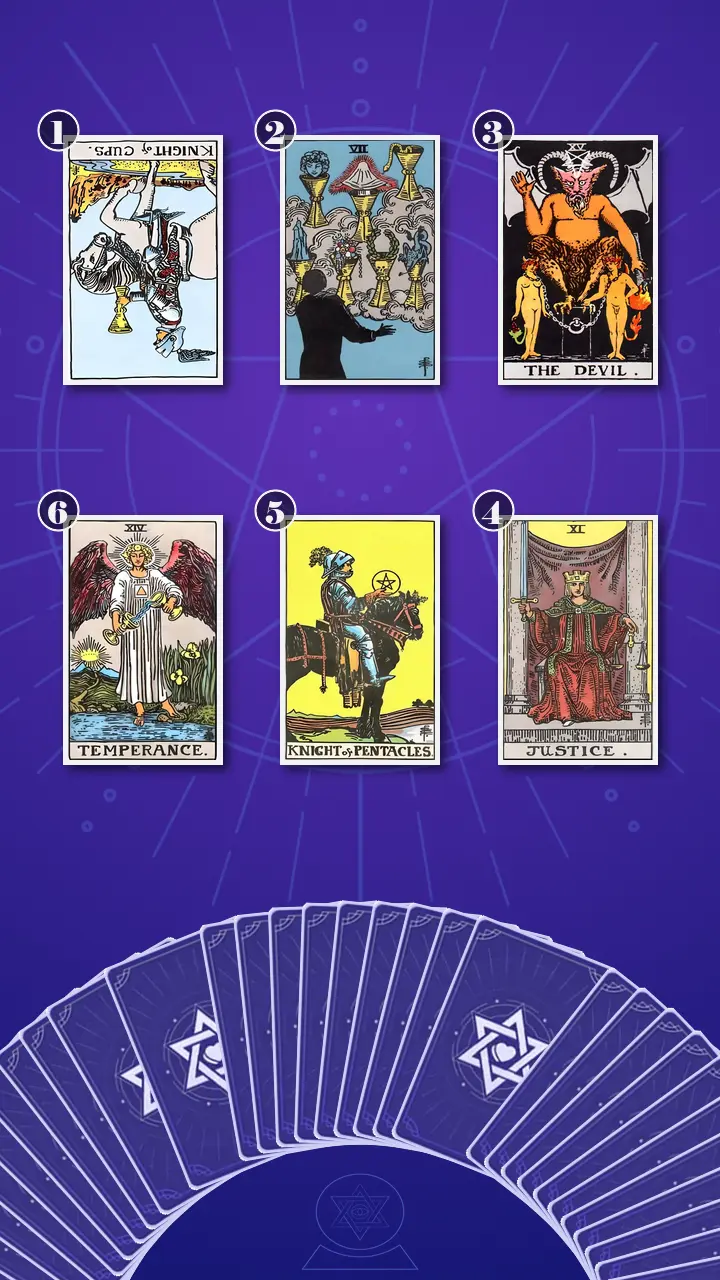
I chose the six-card Transformation Path Grid · Context Edition. For anyone wondering how tarot works in a relationship reading like this, I use the cards as an external decision map. They help me separate parts of a repeating pattern that can otherwise blur into one overwhelming feeling.
The upper row would show Alex’s visible rushing behaviour, the projection obscuring compatibility, and the deeper relief-seeking loop. The lower row would form the return path: the leverage point, a practical pacing method, and an integrated form of intimacy. The layout moved like a switchback trail, reaching the deepest part of the pattern before turning toward firmer ground. It was designed to examine Alex’s decision process, not predict the outcome of her relationship.
The Cup That Outran the Relationship
Position 1: The Offer Ahead of the Evidence
I turned over the card representing Alex’s observable commitment-rushing behaviour and the chaotic romantic momentum carrying it: the Knight of Cups, reversed.
I pointed to the cup held ahead of the rider’s armoured body. The romantic offer was already on display, while vulnerability, conflict style, and the unfinished terrain remained largely unseen. Reversed, the Knight showed an excess of romantic movement and a blockage in grounded observation. The feeling was not false; the proposed future had simply travelled farther than the relationship’s lived experience.
I brought Alex back to 12:40 a.m.: three rental tabs, a draft about deleting Hinge, the work alarm approaching, and the phone warm in her hand. The inner equation had become, If this feels this right, then waiting must mean I am risking it. “I want this” had quietly turned into “I need to secure this tonight.” It was a little like taking the emotional pace of Love Is Blind and applying it to a relationship that had not yet encountered an ordinary Tuesday.
Alex let out one short, bitter laugh. Her fingers tightened around her coffee cup before loosening again. “That’s so accurate it feels slightly brutal.”
“Accurate doesn’t have to mean condemning,” I said. “This Knight isn’t shaming your enthusiasm. He is asking whether emotional honesty and decision speed have accidentally become the same thing.”
Position 2: A Browser Full of Futures
I next opened the card representing the perceptual blockage, where an imagined complete relationship was being counted as present evidence: the Seven of Cups, upright.
The cups floated in a cloud, vivid but unsupported. I compared them to Alex’s growing collection of tabs and plans: a Montreal weekend, future concerts, neighbourhoods they might live in, meeting family, and a Notion board that visually resembled a relationship history before that history existed.
Imagination was in excess here, while comparison was underused. Chemistry, frequent messages, shared music, and one vulnerable conversation were real observations. But Alex’s mind had begun filling unknown fields through the logic, We both want children and hate loud bars, so we will probably agree about money, conflict, chores, privacy, and personal space.
“A shared future tab is not the same as shared evidence,” I told her. “Which detail can you picture most clearly, and what repeated behaviour have you actually observed that supports it?”
Alex looked away from the cards. Her eyes lost focus for a moment, as if she were scrolling through her own Notion page from memory. “I can picture the apartment,” she said. “I don’t know how they handle being told no.”
Position 3: The Chain Made of Relief
I turned to the card representing the deeper root of the loop: the attempt to secure belonging by making the connection binding. It was The Devil, upright.
I never present The Devil as proof that a relationship is doomed or that a person is powerless. I directed Alex to the loose chains around the figures. The card showed a compelling agreement with urgency, not a permanent prison. The blockage appeared in the repeated bargain: If I can create enough certainty, I can finally relax.
I asked her to remember the typing bubble disappearing. No reply yet. Maybe she should make her intentions clearer. Maybe she should suggest exclusivity, a trip, or another night together. Maybe then the tension beneath her ribs would stop pulling so tightly. Reassurance lowered the pressure briefly, but when the relief faded, a larger commitment seemed necessary.
“The rush is not only chasing love,” I said. “It is chasing relief.”
Alex’s breathing paused. Her thumb moved automatically toward the face of her phone and stopped above it. Then she set the phone facedown. “That’s the part I didn’t want to admit,” she said quietly. “Sometimes I’m not planning because I’m happy. I’m planning because I can’t stand not knowing.”
“That distinction gives you choice,” I replied. “A commitment can express love, but it cannot permanently regulate uncertainty. When you notice the relief being promised, the chain is already loose enough for you to pause.”
When Justice Put Time Back in the Room
Position 4: The Scale Before the Sword
I turned over the card representing the leverage point that could interrupt Alex’s rush by separating valid emotional intensity from the evidence needed for a major commitment. Justice, upright, faced us between two pillars, scales level in one hand and sword upright in the other.
The room seemed to become quieter. A pale strip of winter light moved across the table and stopped at the edge of the card, brightening the scales. I asked Alex to return mentally to 12:40 a.m.: the fourth date was over, the rental listings were open, the exclusivity message was half written, and waiting felt more dangerous than deciding. She had been trying to make one perfect decision that would eliminate every unknown.
Justice brought balanced Air into the emotional flood. The scales required comparison before the sword represented a decision. I translated them into a private phone note: Chemistry on one side; Repeated Behaviour on the other. Her feelings remained valid, but they no longer had to serve as evidence, judge, and final signature all at once.
I also used a lens I call Daily Friction Deconstruction. After twenty years of listening across coffee tables, I have watched dramatic relationship claims become much clearer when I strip them down to ordinary mechanics: sleep, punctuality, dishes, money, cancelled plans, private time, repair after irritation, and the way each person responds to a boundary. In Alex’s case, the most revealing fact was that there was not yet enough shared routine to deconstruct. That absence was not bad news. It was simply missing data.
A perfect feeling is not proof of a perfect relationship; place chemistry on one scale and repeated behavior on the other before Justice's sword finalizes a major commitment.
I left the sentence in the air. Alex’s breath stopped first, and her fingers remained suspended above the cup as though her body had missed the next instruction. Then her gaze shifted beyond me, replaying the late-night tabs, the friend plans she had nearly cancelled, and the messages she had treated as guarantees. Her jaw hardened before her eyes began to shine.
“But doesn’t that mean I was wrong about all of it?” she asked, with a flash of anger that sounded almost protective. “Like I made the whole thing up?”
“No,” I said. “Your attraction can be completely real. Your hope can be real. You were not wrong to feel deeply; you were asking the feeling to prove things it could not yet know. Justice is not punishing the heart. It is giving the heart a fair-sized job.”
Her shoulders lowered, but the release did not look instantly comfortable. She opened both hands on the table and let out a shaky breath, then sat very still in the strange blankness that can follow clarity. I could see the new responsibility arriving with the relief: if urgency was not a verdict, she would have to tolerate not knowing and decide what evidence mattered to her.
“Now, with this new perspective, think back to last week,” I invited. “Was there a moment when this insight could have made you feel different?”
Alex remembered nearly cancelling a confirmed Friday dinner because her new partner might have been free. “I could have kept the dinner,” she said. “Not to play it cool. Just because one possible date didn’t need to erase the rest of my life.”
I nodded. That was the first crossing from euphoric commitment urgency and future projection toward reality-based discernment: not feeling less, but trusting herself enough to let affection, boundaries, reliability, and practical compatibility become observable.
The Slow Road That Still Counts as Love
Position 5: The Ordinary-Tuesday Evidence Test
I opened the card representing the practical pacing behaviour that could carry Justice into daily life: the Knight of Pentacles, upright.
The horse stood still while the Knight examined the pentacle at eye level. I explained that this was balanced Earth energy. Stillness was not indifference or failed progress; it was active evaluation before increasing the cost and consequence of a choice.
In Alex’s life, that meant keeping Friday dinner with her friend, protecting the next work morning after a late date, and giving a major commitment impulse at least 72 hours before acting. It meant observing whether plans were confirmed, changes were communicated, a no was respected, and care remained present on uneventful days.
“Keeping your life is part of learning whether love fits it,” I said. “Keeping a plan is not withholding affection. It lets both of you see how the connection works in an ordinary week.”
Alex pressed her palm flat against the table, grounding herself in its weight. “That feels less romantic,” she admitted, “but also less like I’m auditioning for my own relationship.”
Position 6: Two Cups, Two Lives
I turned over the final card, representing the integrated state in which intimacy could deepen without immediate fusion: Temperance, upright.
I showed Alex the measured stream moving between two separate cups. The cups did not have to merge for exchange to continue. One foot remained in water and one on land, allowing feeling and practical reality to coexist.
Temperance was balanced emotional flow: two calendars sharing selected plans without one account taking ownership of the other; two homes, friendship circles, budgets, and nervous-system tempos exchanging closeness without being merged overnight. Alex could enjoy a long date, say she was excited, and add one shared plan while keeping an unassigned evening, her apartment routines, and access to her own support system.
“We can add one shared plan without turning every plan into ours,” Alex said, testing the sentence aloud.
I watched her shoulders drop. The warmth had not left her voice. That mattered. Slowing down no longer looked like emotional withdrawal; it looked like a container sturdy enough to keep feeling from flooding every decision.
A House Does Not Have to Be Built Around a Spark
I gathered the cards into one coherent story. The reversed Knight of Cups showed romantic momentum outrunning lived experience. The Seven of Cups multiplied that momentum into detailed but untested futures. The Devil revealed why the pattern repeated: escalation produced short-term relief, and that relief taught the nervous system to seek an even larger promise next time.
Justice interrupted the loop by separating the truth of Alex’s feelings from the separate question of commitment readiness. The Knight of Pentacles turned that distinction into pacing and observation. Temperance offered the destination: not coldness, delay for its own sake, or strategic distance, but closeness between two lives that remained capable of consent and independent choice.
I named Alex’s blind spot plainly. She had been treating imagined detail as accumulated evidence and treating doubt as disloyalty to the connection. The transformation was not from romantic to cynical. It was from trying to preserve a spark by immediately building a house around it to learning what kind of structure, if any, the relationship could support over time.
- Use the seven-minute Justice Scale Check. When an impulse to discuss exclusivity, book a major trip, cancel a plan, apply for a lease, relocate, or combine money appears, open a private note and write four headings: Proposed Commitment, What I Have Observed, What I Am Inferring, and What Saying Yes Would Change. Add one line under each, close the note without sending anything, and wait at least 72 hours before acting. If four headings feel clinical, use the minimum version: Feeling, Fact, Unknown. The note is for clarity, not for scoring or secretly testing the other person.
- Try the 24-Hour Micro-Boundary Reset. For the first 24 hours after an intense date or an anxiety-triggering slowdown, choose one non-negotiable boundary in your own space or time: no commitment messages from bed after 10 p.m., a phone charging outside arm’s reach overnight, or one previously scheduled two-hour block that stays yours. This is the first day of the longer 72-hour commitment buffer, not a tactic to provoke pursuit. Choose only one boundary. A small rule you can actually keep will reduce more friction than an elaborate system abandoned by morning.
- Keep one plan and observe one ordinary behaviour. Keep one existing friend, exercise, work, study, or solo plan this week even if the new partner becomes available. Then notice one practical piece of evidence: whether your plan is respected, changes are communicated, disappointment can be discussed, or a small promise is kept. In a calm moment, ask, “What pace would feel comfortable to you over the next month?” Do not turn the observation into a pass-fail test. Record what happened and remain curious. Either person is allowed to want a different pace.

Six Days Later: The Quiet Proof
Six days later, I received a message from Alex. She had kept Friday dinner with her friend instead of cancelling for a possible date. When a moving-in thought arrived that night, she wrote it in her private note, added three unknowns about chores, space, and conflict, and did not send anything.
“I still checked my phone twice in the cab,” she wrote. “But I didn’t reorganise my life to make the feeling stop.”
That night she slept through. Her first thought in the morning was still, What if slowing down ruins it? Then she made coffee, left the question unanswered, and went to work. Clearer, not invulnerable.
I did not see that as proof that tarot had changed her future. The cards had given structure to information Alex already carried in her body, calendar, browser history, and boundaries. She had made the pause. She had kept the plan. She remained the person deciding what came next.
For me, that was the real Journey to Clarity: not certainty about whether a new relationship would last, but grounded trust that Alex could enjoy what was real without forcing it to prove permanence. Closeness could grow without turning two lives into one emergency decision.
If a quiet hour without a reply makes your stomach tighten, it can feel as though you must choose between securing the whole future now and discovering that the belonging you felt was never yours to keep. I would invite you to remember Justice’s scales: your chemistry belongs there, fully acknowledged, but it does not have to carry the whole decision alone.
If your next big decision did not have to prove that the connection is real, what small piece of ordinary evidence would you be curious to place on the other side of the scale first?
Every reading at AceTarot is a journey to connect with inner wisdom and empower the path ahead. This reading shared here is a psychological mirror, not a private record—crafted to reflect universal emotional loops and help restore personal clarity. Please note that these insights do not replace professional psychological, medical, legal, or financial advice, and should not serve as the sole basis for major life decisions.
Learn more about our Journey to Clarity.
How did this insight land for you?
🫂 This Resonates Deeply
🌀 Living This Story
✨ Now I See Clearly
🌱 Seeing New Possibilities
🧰 Useful Framework
🔮 The Confirmation I Needed
💪 Feeling Empowered
🚀 Ready for My Next Step
Author Profile
 AI
AI Sophia Rossi
892 readings | 623 reviews
“For twenty years, I’ve listened to stories unfold over the warm aroma of coffee. I don’t believe life’s complexities always require grand theories to be solved; often, we just need a safe place to tidy up our reality. I don’t offer high-minded preaching—just grounded, heartfelt insights to help you regain your sense of control amidst the clutter of daily life.”
In this Love Tarot Reading :
Core Expertise
- Daily Friction Deconstruction: Stripping away dramatic accusations to locate the mundane, mechanical breakdowns in your shared daily routine.
- Emotional Clutter Sorting: Separating actual relationship incompatibility from the stress of household chores, fatigue, or external life pressure.
Service Features
- The 24-Hour Micro-Boundary Reset: A highly pragmatic exercise to establish one non-negotiable physical or time boundary in your shared space to instantly reduce friction.
Also specializes in :
Explore Related Patterns:
Anxious AttachmentA disappearing typing bubble increases Alex's urge to clarify intentions, increase contact, or secure a larger commitment. She fears that slowing down could ruin the relationship, and even a possible date begins to compete with a confirmed friendship plan. An anxious attachment strategy can make contact, labels, and future plans function as safety signals when a bond feels uncertain. You may then experience ordinary response gaps or different pacing as evidence that closeness is at risk, even when no rejection has occurred. This does not establish a diagnosis or make the connection unreal; it identifies a repeatable protection strategy in which binding the relationship is used to quiet anticipated loss.
Emotional ReasoningAlex's internal equation shifts from wanting the relationship to needing to secure it that night. Because the connection feels unusually right, slowing down begins to feel dishonest, risky, or disloyal to what she is experiencing. Emotional reasoning occurs when the intensity of a feeling is used as evidence about an external conclusion. You may be completely honest about your attraction while still asking that attraction to prove compatibility, readiness, and permanence that it cannot yet know. Separating the truth of the feeling from the readiness of the decision gives the emotion a fair role without making it the evidence, judge, and signature at once.
Future-Proofing TrapAlex wants to secure the connection before it can change and recognizes that she has been searching for one perfect decision that would eliminate every unknown. Shared housing, holidays, exclusivity, and merged plans therefore appear before the relationship has encountered routine friction or disagreement. The future-proofing trap turns commitment into an attempted defense against change. You may rush to build permanence around a powerful connection because a binding plan seems capable of protecting what currently feels perfect. The trap is that early commitment reduces the time available to learn what the relationship can actually support, so the strategy designed to create certainty can conceal the evidence needed for a grounded choice.
Reassurance SeekingWhen the typing bubble disappears, Alex's mind moves toward clearer intentions, exclusivity, a trip, or another night together. Each possible escalation promises to lower the tension created by the unanswered message, but the story states that the relief is temporary and that a larger commitment becomes attractive when the pressure returns. Reassurance seeking becomes a behavioral loop because short-term relief reinforces the action that produced it. You can start reaching for plans, labels, or proximity not only to express affection, but also to make uncertainty stop. A commitment may provide information about mutual intentions, but when its primary job is emotional regulation, it has to keep becoming larger to reproduce the same temporary sense of safety.
Romantic ProjectionAlex can picture the apartment, the Montreal weekend, future concerts, family meetings, and neighborhoods they might share, yet she cannot say how the other person responds to being told no. Her imagined relationship contains more detail than her observed relationship contains evidence. Romantic projection fills unknown areas of compatibility with material supplied by hope, chemistry, and your own preferred future. The vividness of that future can make it feel discovered rather than constructed, so inferred agreement about conflict, money, chores, or privacy starts carrying the weight of observed behavior. Recognizing the projection does not invalidate attraction; it returns the untested parts of the relationship to the category of unknown.
Uncertainty ToleranceSix days later, Alex notices another moving-in thought, writes it down, keeps dinner with her friend, and does not send it. The next morning, the fear that slowing down might ruin the relationship is still present, but she makes coffee and goes to work without forcing an answer. Uncertainty tolerance allows you to carry an unresolved question without converting discomfort into a major decision. The goal is not to become invulnerable or indifferent; it is to stop using commitment as compulsory self-soothing. When uncertainty can remain present alongside the rest of your life, time becomes available for mutual behavior, boundaries, and compatibility to provide real information.
Urgency BiasAt 12:40 a.m. after a fourth date, Alex has three rental listings open beside a message about deleting the apps and spending the holidays together. The relationship has not become more established during that late-night window, but the emotional pressure makes an immediate decision feel safer than continued observation. Urgency bias narrows the time horizon around a decision. When it is active, you can experience waiting as a threat to the connection rather than as a source of information, so acting now feels protective even when the commitment has major consequences. The pause restores choice by showing that emotional immediacy and actual decision deadlines are separate facts.
Reality TestingAlex places chemistry on one side of a written comparison and repeated behavior on the other. When the moving-in thought returns six days later, she records unknowns about chores, space, and conflict rather than allowing a detailed apartment image to count as evidence. Reality testing checks whether an interpretation is supported by observable information without dismissing the emotion that produced it. You can acknowledge that the attraction is real while asking what repeated behavior supports the proposed commitment and what remains inferred. That distinction reduces confirmation bias and gives compatibility time to become visible through ordinary interactions.
Self-AbandonmentAlex nearly cancels a confirmed dinner because her new partner might become available, while late-night rental browsing and commitment drafting press against sleep and the next work morning. The new connection is not merely being added to her life; its possible needs begin displacing plans and routines that already belong to her. Self-abandonment appears when you reduce your own space, commitments, or continuity to stabilize a relationship. The sacrifice can feel romantic because it offers immediate proof that the connection matters, but it also removes the independent life from which genuine consent and compatibility can be assessed. Keeping the dinner is therefore not strategic distance; it is evidence that affection does not require you to erase yourself.
Boundary DiscernmentAlex keeps the confirmed dinner with her friend instead of cancelling it for a possible date. She also reframes intimacy as selected exchange between two calendars, homes, friendship circles, budgets, and routines rather than immediate ownership of each other's time. Boundary discernment helps you distinguish closeness from fusion and availability from obligation. Keeping an existing plan does not make affection less sincere; it preserves the independent choice required for consent, reciprocity, and honest pacing. A connection that can accommodate a no, an unassigned evening, and a separate support system gains better evidence of compatibility than one protected from every boundary.
Reflective DistanceAlex writes the moving-in impulse in a private note, adds unknowns, and closes the note without sending a message. The headings Feeling, Fact, and Unknown give the thought a place to exist without allowing it to become an immediate external commitment. Reflective distance is the space between having an internal event and treating it as an instruction. You are not suppressing excitement or arguing yourself out of love; you are observing how emotion, inference, and action have become fused. Once they are visible as separate parts of a decision, you can choose deliberately instead of obeying the loudest part of the moment.
Explore Related Struggles:
Accelerated Intimacy TrapAt 12:40 a.m. after a fourth date, Alex has three rental listings open beside a half-written message about deleting Hinge and spending the holidays together. One intimate evening has already expanded into decisions about exclusivity, housing, and a shared future, even though the relationship has not yet moved through ordinary routines, boundaries, or disagreement. The feeling itself can be real while the pace still creates a trap. When slowing down seems likely to weaken the connection, you may feel pushed to secure intimacy before time can alter it, yet that acceleration removes the very experience needed to learn whether the bond can support a major commitment. The struggle lies in wanting to protect something promising through speed while needing time to discover what is actually being protected.
Certainty-Safety FusionWhen the typing bubble disappears, Alex considers making her intentions clearer through exclusivity, a trip, or another night together. Each stronger signal promises relief, but the pressure returns after reassurance fades, and the next commitment has to become larger to perform the same function. The relationship is being asked to eliminate uncertainty rather than simply develop within it. You can become caught between needing a guarantee in order to feel secure and needing real time, mutual choice, and repeated experience before any guarantee would be meaningful. Seeing that bargain clearly separates the desire for commitment from the demand that commitment permanently settle what remains unknown.
Urgency-Compass FusionAlex says that slowing down feels dishonest, and her late-night thought changes from wanting the relationship to needing to secure it immediately. With the work alarm already set and the relationship only four dates old, the intensity of the moment is allowed to determine both the direction and speed of a major choice. Urgency becomes more than a sensation here; it starts functioning as evidence that action is necessary. You may then experience a pause as betrayal, doubt as disloyalty, and immediate escalation as the only response consistent with sincere feeling. Recognizing urgency as information rather than a final verdict restores room for your values, boundaries, and observations to participate in the decision.
Attraction-Compatibility SplitAlex can picture the apartment clearly, but she cannot yet say how the other person responds to being told no. Chemistry, frequent messages, shared music, and one vulnerable conversation are genuine observations, yet they are also being asked to predict agreement about money, chores, conflict, privacy, and personal space. The friction is not between authentic attraction and false attraction. It is between what attraction can reveal and what long-term workability requires repeated behavior to establish. You can honor the strength of a connection without making it answer compatibility questions that have not yet occurred in real life; doing so keeps hope intact while giving practical evidence its own place.
Intimacy-Containment SplitAlex nearly cancels a confirmed dinner with a friend because her new partner might become available. At the same time, the imagined relationship is already spreading across housing, holidays, calendars, and routines, while keeping an existing plan feels less romantic to her. Closeness has too little room to remain close without becoming total. You may recognize the tension between wanting intimacy to matter and fearing that separate plans, homes, or rhythms make it less real. The struggle is not a need to feel less; it is the challenge of giving strong feeling a container in which two people can exchange care without either life being absorbed into the proof of the relationship.
Explore Related Emotions:
Ambiguity DreadThe typing bubble disappears while Alex sits in cold streetlight with the phone hot in her palm, her work alarm already set. A quiet interval without a reply expands beyond the screen until waiting feels more dangerous than proposing a future. You meet Ambiguity Dread when missing information acquires the emotional weight of an approaching loss. The uncertainty itself becomes the threat, and identifying that shift helps you separate what has actually happened from what the silence is being asked to mean.
Certainty HungerThe typing bubble appears and vanishes, and Alex immediately considers making her intentions clearer through exclusivity, a trip, or another night together. Chemistry, frequent messages, and shared preferences are pressed into service as answers to questions about conflict, money, privacy, and boundaries that have not yet been observed. You experience Certainty Hunger when the absence of an answer becomes harder to tolerate than the risk of deciding too soon. A larger promise starts to resemble solid ground, and recognising that hunger lets you ask whether the next commitment reflects shared readiness or an urgent need to know.
Good Partner PanicAlex says that slowing down feels dishonest, nearly cancels a confirmed dinner for a possible date, and treats doubt as if it betrays the connection. When she learns that her feelings cannot prove compatibility, her first protective response is to ask whether she was wrong about everything. You enter Good Partner Panic when pacing yourself seems capable of exposing you as insincere, withholding, or insufficiently committed. That fear can turn self-erasure into proof of affection; recognising it allows care, boundaries, and an independent calendar to coexist without becoming a verdict on how deeply you love.
Limerent RushAt 12:40 a.m., Alex has three Toronto rental listings open beside a draft about exclusivity and the holidays, all after a fourth date. Trips, concerts, neighbourhoods, and family meetings gather around one intimate evening until imagined history feels almost as substantial as lived experience. You enter a Limerent Rush when romantic intensity shortens the felt distance between wanting and committing. The future seems vividly available, and naming that rush restores the option to let desire remain real while time tests what the relationship can actually carry.
Reassurance CrashA reply, another date, or a sign of shared intention briefly settles Alex, but the next gap in contact reactivates the need for a stronger promise. Each answer is absorbed into a new question, so the imagined commitment has to become larger to produce the same temporary easing. You experience a Reassurance Crash in the drop between short-lived confirmation and the return of uncertainty. Naming that sequence makes the repetition observable, allowing you to distinguish a commitment you genuinely want from one being recruited to restore the feeling that just disappeared.
Relief HungerReassurance lowers the pressure beneath Alex's ribs for a short time, but when the easing fades she reaches for exclusivity, a trip, another night together, or a more consequential plan. She eventually names the distinction herself: sometimes she is planning because she cannot stand not knowing, not because she is simply happy. You encounter Relief Hunger when commitment is asked to regulate the strain beneath desire. The next promise feels soothing before it is evaluated, and seeing that second purpose gives you a chance to let the pressure settle without making the relationship responsible for eliminating it.
Cautious Self-TrustSix days later, Alex keeps Friday dinner, writes down the moving-in thought without sending it, sleeps through the night, makes coffee, and goes to work. She still checks her phone and still hears the question about whether slowing down could ruin the connection, but her calendar no longer has to obey it. You build Cautious Self-Trust through these small acts of non-erasure. It is not certainty that every choice will work; it is the steadier sense that you can remain present, protect your own life, and respond when more evidence exists.
Liberating UncertaintyAlex adds three unknowns about chores, space, and conflict to her private note, then leaves the moving-in thought unsent. The next morning, she lets the question remain unanswered and goes to work, allowing daily life to continue without a final verdict on the relationship. You meet Liberating Uncertainty when an open question stops functioning as an order to act. The unknown remains real, but it also becomes room for consent, observation, changing information, and a future that does not need to be forced into shape tonight.
Untethered ExcitementOne unusually intimate fourth date becomes three rental tabs, holiday plans, future concerts, and a half-written exclusivity message at 12:40 a.m. The speed of those images shows how quickly a real spark can make possibility feel emotionally present, even while the relationship has not yet reached an ordinary Tuesday. You do not have to distrust the warmth or reduce it to an illusion. Untethered Excitement names the buoyant inner lift that makes the future feel open in every direction; recognising it lets you enjoy its energy without assigning it the job of proving compatibility.
Cautious ReliefAlex loosens her grip on the cup, sets her phone facedown, and realises that she could have kept dinner with her friend without withholding affection. Her shoulders lower when pacing is reframed as a way to protect reality rather than a sign that the connection matters less. You encounter Cautious Relief when the pressure to prove love begins to lift, but the open space left behind still feels unfamiliar. The release is genuine and incomplete, giving you enough room to pause without pretending that uncertainty has disappeared.
Clarity ShockAlex's breath stops, her fingers remain suspended above the cup, and her eyes retrace the rental tabs, messages, and friend plans she nearly cancelled. Separating genuine attraction from sufficient evidence reorganises the meaning of those moments so quickly that her body briefly loses its familiar next move. You can experience accurate insight as disruption before it becomes useful. Clarity Shock names the exposed, momentarily unsteady feeling that arrives when an old equation stops working and your authority returns with the responsibility to choose differently.
Explore Related Contexts:
Premature Major CommitmentAfter the fourth date, Alex has three rental listings open beside a half-written message about deleting Hinge and spending the holidays together. Exclusivity, cohabitation, and shared-calendar decisions are entering the relationship at the same moment, even though the connection has not yet encountered an ordinary week. Those proposals carry consequences for housing, money, time, friendships, and personal space. The structural problem is therefore larger than romantic enthusiasm: a small amount of early evidence is being asked to authorise several high-impact commitments at once. You can recognise Premature Major Commitment when the proposed decision would reorganise more of your life than the relationship has had time to demonstrate it can support. Naming that mismatch preserves the reality of the attraction while returning authority over timing, evidence, and consequence to you.
Accelerated Intimacy PressureOne unusually intimate evening gives Alex a vivid line of sight to shared holidays, concerts, family meetings, neighbourhoods, and an apartment. Frequent messages, shared music, and one vulnerable conversation are real points of contact, but the relationship is being moved toward structural intimacy before those points have become a durable pattern. Accelerated pace changes the external demands placed on the connection. Both people may soon be expected to negotiate access, exclusivity, housing, calendars, and future plans before they have seen how the relationship handles disagreement, inconvenience, or a boundary. You can treat the pressure to escalate as information about pace rather than proof that immediate expansion is required. That distinction lets you keep participating in the connection while deciding which next step is proportionate to what has actually been shared.
Chemistry to Commitment TestAlex places chemistry on one side of a private decision scale and repeated behaviour on the other. The fourth date can remain unusually intimate and meaningful without automatically settling whether she should delete the apps, book a major trip, relocate, sign a lease, or combine money. The test concerns proportionality between available evidence and the consequences of the proposed commitment. Attraction answers whether the connection matters now; observed reliability, boundary respect, and practical compatibility answer whether a larger commitment is ready to alter both lives. You can honour the intensity of a new relationship without requiring it to certify its own permanence. The Chemistry to Commitment Test gives each major decision a fair-sized evidence threshold and keeps the final choice in your hands.
Commitment Criteria Black BoxAlex can picture the apartment in detail but cannot identify how the other person responds to a boundary. Shared music, frequent messages, compatible preferences, and one vulnerable conversation are available, while evidence about money, chores, conflict, privacy, and repair remains absent. Without explicit readiness criteria, chemistry is forced to perform several incompatible jobs: registering attraction, estimating compatibility, evaluating risk, and authorising the final decision. Major commitments then appear actionable even though the standard for saying yes has never been made visible. You regain leverage by defining what evidence the decision requires before the decision arrives. Clear criteria do not invalidate what you feel; they prevent an intense feeling from becoming the only available rule in a high-consequence choice.