Self-Help Choice Overload: One Seven-Day Test Toward Self-Trust

The 10:45 p.m. Notion Rewrite
If a persuasive morning-routine video can make three days of your own experience feel irrelevant, I have learned that you may be caught in a borrowed-certainty loop rather than a motivation problem.
I met Alex over video at 10:45 p.m. on a Tuesday. Blue laptop light filled their bedroom in a shared Toronto apartment. Headphones pressed faint red marks above their ears, and three routine videos sat open behind our call, each frozen on a different promise about how to become consistent. When Alex shifted their wrists, they mentioned that the laptop was warm against their skin. An untouched journal rested beside it.
The apartment radiator hissed through the wall. From somewhere down the hall came the muted clink of a roommate washing a mug. Alex was transferring unfinished tasks from last week's abandoned tracker into a newly downloaded Notion template, moving each item with the careful attention of someone handling evidence at a crime scene.
“Every method works until I have to trust myself inside it,” they told me. “I keep improving the plan instead of living it. Then I see someone with a better system, and suddenly my choice feels embarrassing.”
They wanted every new self-help plan to provide direction, yet each adoption weakened their trust in their own judgment. The confusion had a physical shape: it was like sitting in an editing suite with ten versions of the same film playing at once, every soundtrack turned up, while the one scene that mattered remained uncut on the floor. Their jaw stayed tight. Their fingers kept switching tabs even after our session had begun.
“It makes sense that research feels safer,” I said. “Your work rewards you for comparing options, testing systems, and finding flaws before they become expensive. That skill is useful. It is simply working overtime in a part of life where no external method can remove every uncertain moment.”
I told Alex that I was not going to choose the perfect routine for them or use tarot to predict which app would finally fix everything. I wanted us to identify the feedback loop that kept turning advice into borrowed authority. “Let us make a map of the fog,” I said, “then find one next move that still belongs to you.”
You keep improving the plan while the life it was meant to support waits.

Choosing the Switchback Map
I asked Alex to place both feet on the floor, take one unforced breath, and hold the consultation question in mind: “Why does every new self-help plan make me trust myself less?” I shuffled slowly. I use this brief pause as a transition from reacting to observing, not as a performance of mystery.
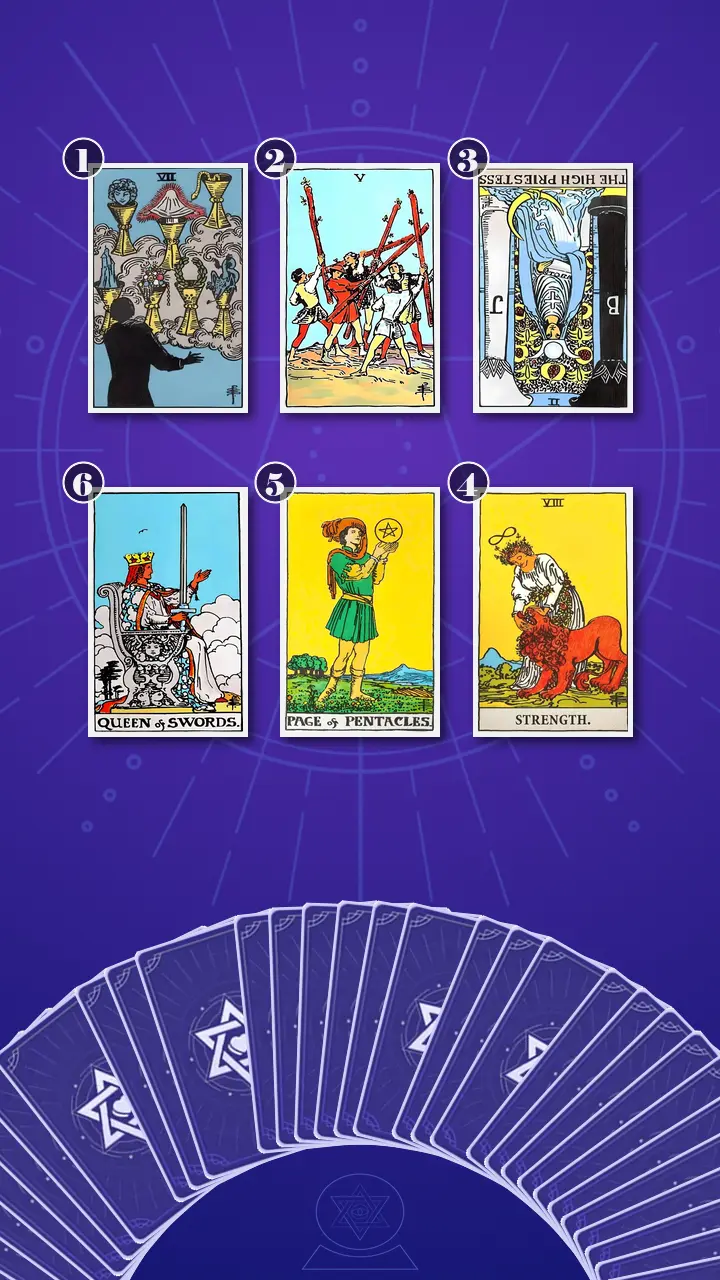
I chose the Transformation Path Grid · Context Edition, a six-card tarot spread arranged like a switchback path. For anyone wondering how tarot works in a question like this, I use the cards as structured prompts for examining a system: what can be seen, what keeps it running, what belief sits underneath it, and where a small intervention could change the pattern.
I chose this spread because Alex did not need six more plans to compare. A decision spread could have reinforced the idea that one correct system was waiting to be identified. A larger spread could have created more material without creating more clarity. This grid was the smallest map that could trace the complete loop from repeated restarting to a practical experiment and a boundary around future advice.
I placed the first three cards from left to right. They would show the observable symptom, the immediate maintenance loop, and the hidden condition beneath it. I placed the fourth directly under the third as the leverage point, then moved back across the lower row through practical action and integration. The layout reached the end of an unproductive route, changed level, and returned with a more grounded direction.
Tarot card meanings become useful through context. I was not asking, “What will happen to Alex?” I was asking, “What is happening now, and where does Alex still have agency?”
The Promises Floating Above the Desk
Position One: The Future Selves in Open Tabs
The first card I turned over represented the observable symptom: Alex repeatedly collected and replaced self-help plans while the goal underneath them remained untouched. It was the Seven of Cups, upright.
I pointed to the stationary figure facing seven cups suspended on clouds. Every cup offered something bright, veiled, or dramatic, but none of it was being held. “This looks like your Sunday reset,” I said. “You intend to write one journal entry, then open comparisons for five planners, three habit apps, and two creator routines. Each one advertises a more organized future identity. An hour later, the journal is untouched, and your original preference feels naive.”
I read the card's Water energy as excess: too many fluid possibilities and too much projection, with too little contact between imagination and lived evidence. Alex was not short on aspiration. They were standing at a distance from every option, comparing trailers for possible lives instead of watching one actual film long enough to know whether it moved them.
Alex gave a brief laugh that landed somewhere between recognition and defeat. “That is so accurate it is almost rude.” Their mouth lifted, but one hand covered the lower half of their face.
“The card is not calling you foolish,” I said. “Every cup is designed to be appealing. Your attention is responding normally to polished promises. The useful question is which option has evidence behind it, not which one creates the most exciting imagined version of you.”
Borrowed certainty feels productive, but it leaves no personal evidence behind.
Position Two: The Internal Meeting with No Chairperson
The next card represented the immediate maintenance loop: competing methods intensified Alex's inner conflict and consumed energy that could have supported action. I turned over the Five of Wands, upright.
Five figures raised their staves in different directions. I saw effort everywhere, but no shared construction. “This is the week when you try to obey a creator's strict morning schedule, a podcast's instruction to rest intuitively, an app's streak target, and a friend's time-blocking benchmark,” I said. “The plans do not cooperate. Your day becomes an internal meeting with no chairperson, and the ten-minute action at the center never begins.”
I read the Fire energy here as scattered excess. Alex had plenty of activation, but every borrowed rule was competing to define success. It was like five Slack channels assigning different priorities to the same afternoon while nobody retained ownership of the project. The conflict maintained the loop because any rule Alex broke could be interpreted as proof that they had chosen badly.
“At work, that kind of comparison makes me thorough,” Alex said. “At home, it makes brushing my teeth feel like it needs a research brief.”
I watched their shoulders drop half an inch as they said it. Naming the mismatch mattered. The same ability could be a professional strength in one setting and an exhausting defense in another. Alex did not need to lose their analytical mind; they needed to stop giving every piece of advice equal voting power.
Behind the Veil, the Answer Alex Had Already Given
Position Three: When Personal Evidence Is Ruled Inadmissible
The third card represented the deeper root and blind spot: Alex discounted personal judgment before it could become a trustworthy source of direction. I turned over The High Priestess, reversed.
The scroll in the High Priestess's hands was partly concealed, and a patterned veil hung behind her between black and white pillars. Reversed, I did not read her as an absence of intuition. I read her as blocked access to knowledge Alex already possessed.
“You sense that a short evening walk fits your actual energy,” I said, “but before committing, you open three videos and poll the group chat. The newest confident opinion replaces the criterion you had already formed. The inner sentence becomes: ‘I had an answer until someone more convincing gave me theirs.’”
Alex's breathing paused. Their fingers hovered above the trackpad, then curled slowly into the edge of their sleeve. Their eyes shifted away from the card as if replaying a recent conversation. Finally, they exhaled through their nose and said, “I asked three friends whether journaling at night counted. I already knew mornings made me miserable.”
Seeing the partially hidden scroll, I thought of raw footage left out of a final cut. The footage still exists; excluding it does not make it false. Alex's direct observations about energy, timing, and resistance were present, but their internal process kept treating those observations as inadmissible until an outside source confirmed them.
I used one of my diagnostic lenses, Internal Monologue Auditing, to listen for the genre of the story Alex was unconsciously narrating. Their inner voice had turned every low-stakes choice into a courtroom thriller: the wrong routine would expose a fatal flaw, a missed day would become decisive evidence, and the next expert would arrive as the witness who finally settled the case. That genre kept their nervous system waiting for a verdict instead of gathering information.
“The alternative is not to reject experts, friends, therapy, or genuinely useful advice,” I said. “That would only replace compliance with isolation. I want your first answer to be recorded before the outside voices enter, so the comparison does not erase the person doing the comparing.”
Alex nodded once, slowly. I could see recognition mixed with grief in their expression. Recovering an inner voice can feel relieving, but it can also reveal how often that voice has been interrupted.
When Strength Kept Her Hands Gentle
Position Four: The Pause Between the Video and the Link
The room seemed to become quieter when I reached the card directly beneath the reversed High Priestess. Even the radiator stopped hissing. This position represented the leverage point that could interrupt the loop by replacing forceful self-correction with patient self-command under uncertainty.
I turned over Strength, upright.
I directed Alex's attention to the woman's hands resting calmly at the lion's jaws. She was not fighting the animal, humiliating it, or pretending it had no appetite. She remained in relationship with its energy. I read Strength as balanced Fire: courage regulated through steadiness rather than another burst of control.
I named the scene precisely: it was 10:45 p.m.; the journal was untouched, three routine videos were open, and Alex was moving last week's tasks into a cleaner template. The setup looked productive, but their tight jaw knew the original goal had not moved.
In modern life, I saw the lion as the restless hand that reaches for another app when the current routine becomes boring. Strength did not demand that Alex stop feeling the impulse. It suggested that they could notice the tight chest, leave the persuasive link unopened, and complete two minutes of the practice they had already chosen. The significant event would not be perfect discipline. It would be remaining beside one decision while doubt stayed present.
I returned to Internal Monologue Auditing. Alex had been cutting every ordinary difficult day like a horror trailer: one missed journal entry, ominous music; one boring morning, a rapid montage of abandoned subscriptions; one new creator, a title card announcing that control had been lost. Strength changed the genre. She turned the scene into an observational documentary in which the facts could remain plain: “I missed Tuesday. I want to restart. I can notice the urge without putting it in charge.”
Stop treating doubt as proof that you need another system; guide one restless impulse with steady practice, as Strength's hands guide the lion.
I let the sentence remain between us for a moment. Then I added, “Self-trust is not the reward for finding a plan that removes doubt. It is the evidence you collect when one small choice remains yours, even while doubt is still in the room.”
First, Alex went completely still. Their breath stopped halfway in, and the fingers gripping their sleeve froze. Then their eyes lost focus as if the last few months were replaying behind them: the deleted trackers, the checkout screens, the Monday restarts that felt hopeful until Tuesday became ordinary. Their pupils widened, and moisture gathered along the lower lids. The grip on their sleeve loosened one finger at a time. Their shoulders descended, but the release brought a brief, almost dizzy blankness with it.
“But doesn't that mean I have been doing it wrong this whole time?” they asked. The question came out sharper than their earlier voice, with anger guarding something more tender underneath. I did not rush to turn that anger into a positive lesson.
“No,” I said. “It means you found a strategy that gave you relief when uncertainty felt threatening. It worked for a night, then charged you in self-trust. Recognizing the cost now does not make your earlier self foolish. It gives your present self more editing options.”
Alex pressed their lips together, looked down, and released a long breath that trembled at the end. Their jaw softened. Relief was there, but so was the new vulnerability of realizing that no perfect system would make the next choice for them.
I asked, “Now, using this new perspective, think back: was there a moment last week when this insight might have made you feel different?”
“Wednesday on the TTC,” Alex said after a pause. “I saw a video about a workout plan. My own plan had not failed. It had just become boring. I could have let the video stay unopened for one train ride.”
I heard the shift in that answer. Alex had moved one step from overloaded confusion and borrowed certainty toward cautious curiosity and grounded confidence built from observed experience. They were no longer asking which authority deserved control. They were noticing the exact moment when control could remain with them.
Doubt is a feeling to accompany, not an instruction to restart.
One Pentacle, One Week
Position Five: A Beta Test, Not a New Identity
The fifth card represented the practical action through which Alex could test the shift in daily life. I turned over the Page of Pentacles, upright.
The Page held one pentacle at eye level with both hands. The ground beneath them was cultivated and solid. I read the Earth energy as balanced, modest, and available: not a complete life system, but one tangible object of study.
“This looks like a three-line note on your phone,” I said. “‘Two minutes of journaling after dinner. Seven days. Notice how hard it is to begin.’ No new course. No redesigned dashboard. No promise that journaling is your identity now. A missed day remains part of the information, and you review the experiment only after it has had time to teach you something.”
A seven-day experiment is data, not a personality test.
I watched Alex open Notes during the session. Their thumb hovered above the blank page, then typed three short lines. “This does not have to become my identity,” they said, testing the words aloud. “It only has to teach me something.”
“Exactly,” I said. “The Page is a beginner, not a finished success story. The experiment can become smaller, change shape, or stop. Revision after evidence is discernment. Revision triggered only by the discomfort of uncertainty is the loop we are learning to notice.”
Position Six: The Queen at the Checkout Screen
The final card represented the perspective Alex could integrate after the experiment: advice would become optional input, evaluated through personal evidence and clear boundaries. I turned over the Queen of Swords, upright.
I contrasted the sword held vertically in one hand with the other hand extended openly toward the horizon. The sword established a criterion; the open hand remained receptive. I read her Air energy as balanced clarity rather than hyper-analysis.
“The next polished program can still contain something useful,” I said. “You check it against your current need, the evidence from your week, and the smallest possible test. You may save it, try one element, or decline it. Persuasive delivery no longer receives automatic authority.”
I offered Alex a sentence for the checkout screen: “Useful may still be useful, but it does not automatically outrank what I observed.”
Advice can have a seat without getting the deciding vote.
Alex glanced at the open routine tabs behind our call. They closed one, paused at the second, then closed that too. They left the third one open but moved it into a folder labelled “After Friday.” I liked that choice because it was neither automatic compliance nor rigid rejection. It was a boundary around timing.
The Seven-Day Evidence Loop
I drew the six cards together into one story. Alex's research skill and fear of wasting time had made polished possibilities feel safer than personal preference. The Seven of Cups showed the visible collecting. The Five of Wands revealed how incompatible rules fought for the same day. The reversed High Priestess exposed the deeper issue: Alex's own observations were being disqualified before they could become evidence. Strength restored gentle self-command, the Page of Pentacles grounded it in a bounded experiment, and the Queen of Swords turned the resulting evidence into a flexible standard.
The core loop was simple once I placed it in sequence: an ordinary difficult day triggered doubt; doubt triggered research; a new system provided novelty and borrowed certainty; the restart interrupted practice; interrupted practice produced evidence starvation; and the absence of evidence made Alex trust their next judgment even less.
Alex had been replacing the compass every time the needle wobbled, then interpreting the lack of distance travelled as proof that they could not navigate. Their cognitive blind spot was treating discomfort as evidence against the plan and revision as evidence against their character. The transformation was not from uncertainty to certainty. It was from adopting complete systems to running one self-chosen experiment, observing what happened, and revising without shame.
“But this could become another system I fail,” Alex said. “I can already feel myself trying to make the seven days perfect.”
“Then we make the test smaller,” I replied. “You are allowed to complete one minute, miss a day, change the timing, or stop. The purpose is not to obey my framework. The purpose is to let your own experience produce one piece of usable information.”
I introduced The Director's Cut of Self-Compassion, my mental editing technique for interrupting the punitive version of an imperfect scene. When the spiral began, Alex would call a quiet internal “cut” and separate three things: what the camera could have recorded, what feeling entered the scene, and what the next manageable shot could be. “I missed Tuesday” was footage. “I felt embarrassed and wanted novelty” was context. “I will open the journal for one minute tonight” was the next shot. “I can never trust myself” was an added voice-over, not an objective fact.
- Call Cut on the Restart Urge The next time a routine video, newsletter, or app triggers the urge to start over, set a two-minute phone timer before opening the link. Write, “I want to switch because...” and name the immediate feeling in one ordinary word. Then place the recommendation in an “After Friday” note while continuing the current practice for that evening. Tip: The minimum version is naming the urge and saving the link. This is a boundary around timing, not a ban on advice, and Alex remains free to revisit it later.
- Run One Seven-Day Evidence Loop In a plain phone note, choose one low-stakes practice: open the journal for two minutes after dinner. Add one personal success criterion, such as “I began with less negotiation” or “my shoulders felt less tense afterward.” Schedule a ten-minute review for day eight and ask only what helped, what got in the way, and what to keep, shrink, or drop. Tip: Success means collecting observations, not protecting a streak. A missed day is data, and the experiment can be revised or stopped at any time.
I made the ownership explicit before we ended. Tarot had not issued Alex a new command. The cards had helped us make a hidden feedback loop visible. Alex would decide what to test, what counted as useful, and whether any part of the experiment deserved another week.

A Week Later, the Quiet Proof
Eight days later, I received a message from Alex. They had journaled for two minutes on five evenings, missed Thursday, and resisted rebuilding the experiment on Friday. Their personal observation was unexpectedly plain: beginning felt easier when the journal stayed open on the kitchen table.
They had also watched the saved routine video after the review date. One suggestion was useful, so they borrowed that single element and ignored the rest. The course remained unpurchased. Advice had stayed available without becoming the director.
The next morning, Alex woke after a full night's sleep and still thought, “What if I picked wrong?” They stared at the ceiling for a moment, smiled at the familiar line, and opened the same journal anyway.
I did not read that message as proof that Alex had solved self-trust in seven days. I read it as quieter, sturdier evidence: an imperfect day had occurred, doubt had entered the room, and one choice had remained theirs. Their direction was beginning to develop through observed experience rather than borrowed certainty.
That was the real Journey to Clarity. I had held the cards and reflected the pattern, but Alex had gathered the evidence. The authority was never mine to keep.
If every imperfect day sends your hands back to the tabs, I hope you remember that the tightness in your jaw is not only about choosing a routine. It may be the fear that choosing for yourself will expose how little control you have. Noticing that fear without handing it the next scene already changes your position in the story.
If one small choice were allowed to remain yours for seven days, what would you be quietly curious to notice before anyone else gets to edit the scene?