The 7:12 a.m. Slack Trial
When Maya joined my screen from Toronto, I recognized the pattern before I laid a hand on the deck. I said, “If hybrid-office life has made a green status dot feel weirdly moral, and a plain ‘I’m taking a sick day’ feels too exposed, you’re in the exact loop this reading names.” She gave me a tired half-smile and said, “Yes. That’s exactly it.”
Then she handed me the scene that so many late-20s knowledge workers know in their bones. At 7:12 a.m. she was wrapped in a duvet on the sofa of her condo, winter-blue light flattening the room, laptop fan whirring, tea gone metallic and cold. She had typed, ‘I’m unwell and taking a sick day today,’ deleted it, added ‘I barely slept,’ then added, ‘I can check anything urgent if needed,’ while her jaw locked hard enough to throb. Her calendar beside it looked like a Tetris wall before 9 a.m.
What she brought me was overexplaining a sick-day Slack to prove legitimacy before taking basic rest at work. She wasn’t deciding whether she was sick. She was deciding how much evidence would make her sound responsible enough to be sick. The guilt in her sat like a courtroom clerk in her chest, riffling through papers and looking for one more exhibit before allowing the case to proceed.
“I know it should be a simple message,” she told me. “But I keep hearing how it might sound.” I told her that made complete sense in a text-heavy job where tone feels easy to misread and impossible to fully control. “The extra wording is usually smoke, not the fire,” I said. “So let’s not shame the coping strategy. Let’s draw a map through it, and see if we can get you to something that feels more like clarity than self-defense.”

Choosing the Compass: A Situation-Obstacle-Advice-Outcome Spread for Work Guilt
I asked her to set the imaginary Slack draft aside for a moment, put both feet on the floor, and take one slow breath while I shuffled. I do this not for theater, but for focus. A reading works best when the mind stops arguing long enough for the real pattern to show itself.
For her question, I chose a Situation-Obstacle-Advice-Outcome spread. When people ask me how tarot works with something as specific as sick-day anxiety or boundary-setting at work, this is exactly the kind of structure I trust: small, proportionate, and honest. Her problem was not which grand life decision to make. It was why one tiny workplace boundary had become mentally loaded enough to feel like a moral event. A minimal spread was the better instrument.
I told her I wanted the cards to move in a straight line, almost like watching one Slack draft travel from spiral to clarity to rest. The first position would show the symptom as it appears in real life. The second would reveal the hidden blockage underneath it. The third would offer the cleanest corrective stance. The fourth would show what integration looks like after the clearer message is sent.
That left-to-right sequence mattered to me. As an archaeologist, I have spent years reading a site by layers and transitions rather than by isolated fragments. This spread lets me do the same with a modern nervous system: first the visible debris, then the buried rule, then the tool that still works, then the structure that can stand.
Reading the Draft Box
Position 1: The Loop That Calls Itself Care
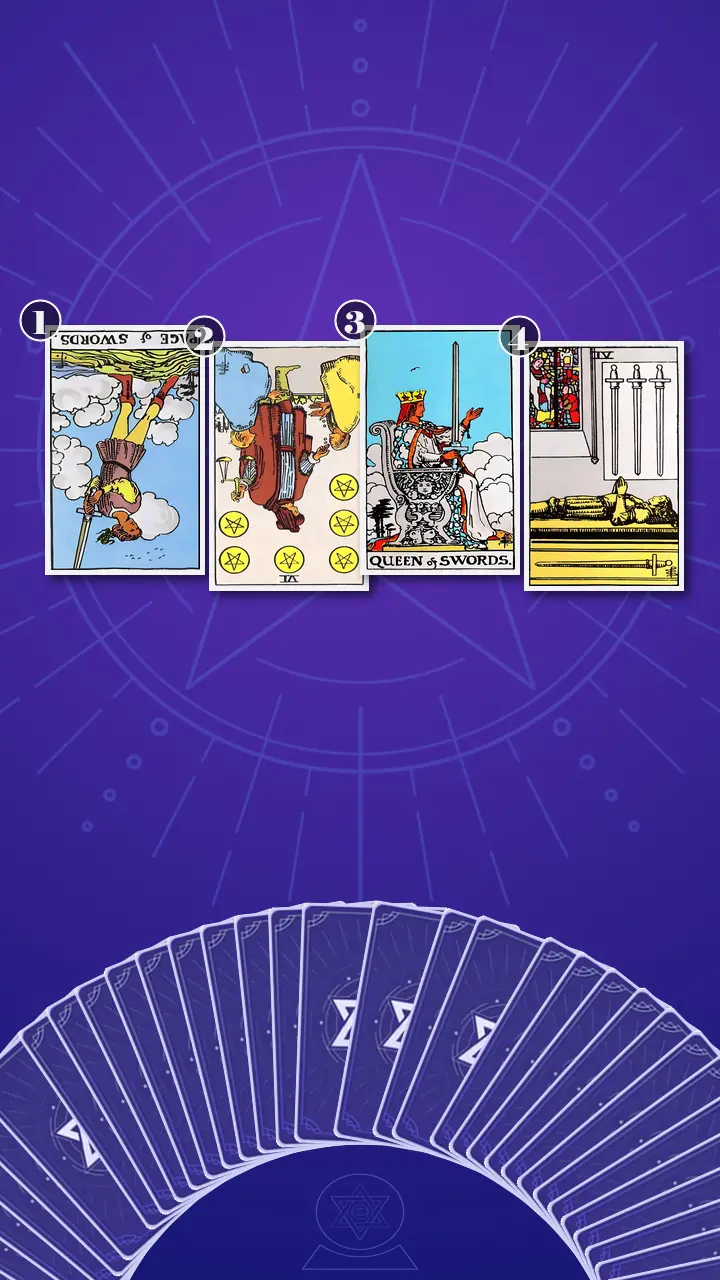
I turned over the first card and said, “This is the position that shows the concrete symptom behavior from your question: over-editing the sick-day message to pre-empt judgment.” The card was the Page of Swords, reversed.
The modern scene on the card was almost painfully exact: a half-finished Slack message sitting in the compose box while Maya keeps swapping direct language for softer wording, adding detail, then rereading the whole thing from an imagined manager’s point of view. It had the energy of typing as if every reply might be screenshotted to a group-chat jury. The real action was not communication. It was defensive editing.
In reversed form, the Page’s energy is both excess and blockage. There is too much anticipatory thought and not enough clean movement. The raised sword is already on alert before any real attack exists. The windswept sky is the nervous system when wording becomes a shield. In practical terms, the apology, the symptom list, the extra ‘happy to monitor anything urgent’ line are all trying to buy safety from a verdict that has not actually arrived.
“What is the extra wording trying to protect you from?” I asked. “Lazy?”
She let out a short laugh with real bitterness in it. “Okay,” she said, rubbing her forehead, “that is so accurate it’s a little rude.” Her fingers tapped her mug once, then stilled. That was the recognition I wanted: the moment the pattern stopped looking like personality and started looking like a loop.
Position 2: The Inner Performance Ledger
I moved to the second card. “This is the position that reveals the underlying obstacle and the fear that make a basic boundary feel unsafe to say plainly.” The card was the Six of Pentacles, reversed.
Here the whole problem dropped beneath the draft box. Before she even decided whether to take the day, Maya was running an invisible balance sheet: what she finished yesterday, what meetings she would miss, how inconvenient her absence might be, whether she had enough goodwill banked, whether high rent and fast-moving office culture meant she needed to look especially committed. Her body had a limit, but her mind kept acting as if rest needed approval before it counted.
The scales in the card make that almost embarrassingly visible. Seeing them, I had one of those quick professional flashbacks that still happen to me after years in archaeology: bronze trade weights in a museum drawer, precise to the gram, each one made to settle an argument about value. That is what her nervous system was doing. It was weighing her need as though care were a transaction and rest had to be earned. In this reversed earth energy, support comes with strings, and even one genuine sick day starts to feel like it has surge pricing.
“You don’t need better evidence,” I told her. “You need less internal litigation.”
She froze in three small stages. First her breath caught. Then her eyes drifted off-screen as if replaying half a dozen mornings at once. Then her shoulders lowered by a fraction. “Yes,” she said quietly. “I do an internal performance review before I even decide.”
When the Queen Lifted the Sword
Position 3: The Sentence That Did Not Beg
When I turned the third card toward the camera, even through a laptop screen the silence changed temperature. “This,” I said, “is the position that offers the antidote to the blind spot: the mindset and communication stance that interrupt the loop.” The card was the Queen of Swords, upright.
The modern life scenario was immediately clear. Maya copies a saved two-sentence script into Slack, removes the extra explanation, does not add ‘I can monitor anything urgent,’ and presses send anyway. The power here is not coldness. It is the adult voice that can state a limit clearly without turning it into a plea for approval. The sword is the fact. The open hand is the part that stays human without bargaining.
This is where I used a framework I call Skill Archaeology. In a dig, I do not manufacture an artifact; I uncover what has been there all along under later layers of dust and collapse. Maya did not need a new personality installed by noon. She already spends her workdays writing concise copy, organizing campaigns, and making information legible for other people. The overlooked talent was not clarity. It was self-authorization. The Queen was not teaching her how to write. She was unearthing her right to use her existing clarity on her own behalf.
You know that exact moment: blue morning light, Slack open, one truthful sentence typed out, and your body already asking for rest while your mind starts assembling evidence like you’re about to be cross-examined for needing a day off.
You do not need to turn your boundary into a courtroom argument; the Queen's upright sword asks for one clean truth and the self-respect to let it stand.
For a beat, she did not nod. Her mouth tightened first. Then she leaned back, almost angry, and said, “But if I do that, then I’ve been making a whole case for something basic.” I let that land. Outside my study window, rain tapped once against the glass and stopped, and the room suddenly felt sharper. “Yes,” I said. “And that does not make you foolish. It makes you adapted to a work culture that trains people to confuse constant availability with virtue. But adaptation is not identity.”
I watched the reaction move through her in layers. Her grip loosened from the mug. Her eyes brightened, not quite tears but close. Then a long breath left her chest as if it had been waiting several years for permission. After that exhale came the strange, honest part I often see at real breakthroughs: a split second of blankness, almost dizziness, because clarity also hands responsibility back to the self. “That shorter version scares me,” she said, softer now. “Not because it’s wrong. Because I can’t hide in it.”
“Exactly,” I replied. “A sick day is a boundary, not a closing argument. Brevity is not carelessness when the truth is already clear.” I told her that within ten minutes of our call, she could save one clean two-sentence script in Notes, label it ‘use as-is,’ and make the next hard moment easier than this one. Then I asked, “Now, with this new lens, think back to last week. Was there a moment when one clean sentence would have changed the whole temperature of your day?” She nodded slowly. “Thursday,” she said. “I would have rested instead of hovering.” That was the hinge: a move from guilt-laced hypervigilance and internal litigation toward self-authorized calm around work boundaries.
Position 4: The Offline Window
I turned to the final card. “This is the position that translates the shift into embodied follow-through: what integration looks like after the clearer message is sent.” The card was the Four of Swords, upright.
I told her this is where many people lose the plot. They send the sick-day message, but keep Slack on the phone, leave notifications on, and refresh for tone, reaction, or silence. The modern version of this card is simple: close Slack on both devices, turn off previews, put the phone out of reach, and let recovery be the actual task. Think less ‘working from bed’ montage, more real Do Not Disturb.
Here the energy is balanced and still. The resting figure matters because the body only believes a boundary when the environment agrees with it. If you stay half-available, your body still hears ‘not yet.’ Before she ever typed ‘reachable if urgent’ again, I asked her to use one of my practical filters, Relic Authentication: is there a genuine emergency process in this workplace, or is anxiety dressing itself up as urgency? If there is one real channel, choose it. If there isn’t, do not invent one out of guilt.
Maya gave the smallest, cleanest nod of the session. Even on screen I could see her jaw unclench. The card was not promising a perfect new self. It was offering a protected offline window long enough for her nervous system to believe the boundary she had already spoken.
From Finding Clarity to Actionable Advice
When I laid the whole line of cards together, the story became very clear. The Page of Swords reversed showed the visible symptom: overexplaining a sick-day Slack to pre-empt judgment. The Six of Pentacles reversed named the hidden engine beneath it: an inner worth ledger that makes rest feel earned, measured, and morally loaded. The Queen of Swords cut through that ledger with factual boundary-setting. The Four of Swords turned the insight into actual rest after sending. What looked like a wording problem was really a permission problem wearing polished message drafts as camouflage.
I told Maya that her main blind spot was assuming clear communication had to prevent anyone from ever forming a negative opinion. That is far too much labor to ask from one sentence. The transformation direction was simpler and harder at once: shift from proving you deserve time off to stating your limit clearly and letting that be enough. That is how tarot becomes useful here. It does not mystify the problem. It shows why a plain boundary feels dangerous, and then gives you the next steps.
Because I am an archaeologist by training, I rarely prescribe one heroic leap. Ancient builders moved impossible stones by leverage, sequencing, and repetition. I call this Megalith Transport. We do not need a whole new personality by Monday. We need three smaller stones moved in the right order.
- The No-Closing-Argument Script Save one two-sentence sick-day script in Notes this week: ‘I’m unwell and taking a sick day today. I’ll be offline and will follow up tomorrow.’ The next time you need it, paste it into Slack before opening other chats or rereading your calendar. If your first thought is ‘This sounds too blunt,’ treat that as the old loop asking for extra evidence. Use it unchanged once, just as an experiment.
- The Worth-Ledger Interrupt The next time you feel yourself tallying whether you have earned rest, open Notes and write two quick labels: ‘Actual limit’ and ‘Story I’m adding.’ Fill them with one factual line each. Example: ‘Actual limit: I’m sick and can’t work well today. Story I’m adding: I need to sound impressive enough to deserve rest.’ Keep it under twenty seconds. This is Tool Evolution, not homework. You are identifying a habit, not putting yourself on trial again.
- The Send-and-Step-Away Boundary After you send the message, log out of Slack on either desktop or mobile for one protected block of 45 to 90 minutes. Turn off banner previews or move the app off your home screen. If your workplace has a real emergency path, choose one channel only rather than staying vaguely reachable everywhere. If a full hour feels impossible, start with twenty minutes. Authenticate ‘urgent’ before you offer access; ambient anxiety is not an emergency process.
She looked at the list and then asked the kind of grounded question I always trust. “But what if I really can’t do ninety minutes offline because campaign stuff does blow up sometimes?” I appreciated that. Real boundaries live or die on logistics. So I cut the goal smaller. “Then do twenty first,” I told her. “One channel, one window, one experiment. We are not testing whether you can become a different person by lunchtime. We are testing whether your body can learn that ‘offline’ means something measurable.”

A Week Later: The Quiet Proof
A week later, I received a message from her that I could almost hear in her voice: “Used the script this morning. It felt like I’d forgotten a sentence. I wanted so badly to add ‘happy to check anything urgent,’ but I didn’t. Muted Slack for 45. Slept.”
That was the proof I had hoped for. Not a cinematic transformation. Not some radiant final state where work guilt never returned. Just a clean message, a wobble, an offline block, and a body finally allowed to cash the check the boundary had written. Later she admitted that when she woke up, her first thought was still, What if that sounded cold? Then she laughed, turned the phone face down again, and slid back under the duvet.
That is what this Journey to Clarity looked like in a Situation-Obstacle-Advice-Outcome reading: not certainty, but ownership; not perfection, but the first real evidence that one factual sentence can hold. It was a quiet movement from proving legitimacy to trusting a limit.
Sometimes the hardest part of taking a sick day is not being sick; it’s feeling your body ask for rest while your worth rushes in to cross-examine it.
If that tiny courtroom feels familiar, and one clean sentence were allowed to be enough, what boundary might you want to hear in your own voice this week?
This story is adapted from psychological research, written so that those in a similar struggle can see their own pattern in it — and find their next step clearly.These insights are not a substitute for professional psychological, medical, legal, or financial advice.
Learn more about our Journey to Clarity.
How did this insight land for you?
🫂 This Resonates Deeply
🌀 Living This Story
✨ Now I See Clearly
🌱 Seeing New Possibilities
🧰 Useful Framework
🔮 The Confirmation I Needed
💪 Feeling Empowered
🚀 Ready for My Next Step
Author Profile
 AI
AI“Having spent a lifetime at Cambridge and on archaeological digs, I’ve witnessed the rise and fall of countless civilizations. Please know that your current struggles are not a permanent fate, but merely a necessary fracture before rebuilding. I won't lecture you; instead, I invite you to sit with me in the ruins, using a patient, historical perspective to gently dust off the true, enduring value hidden beneath your temporary doubts.”
In this Career Tarot Reading :
Core Expertise
- Core Competency Excavation: Digging through the 'strata' of your past roles to uncover undervalued, highly transferable foundational skills.
- Career Epoch Analogies: Contextualizing your career plateau as the end of one professional era and the necessary foundation for the next.
Service Features
- The Resume Stratigraphy Review: A structured framework to rewrite your professional narrative, highlighting immutable assets over obsolete job titles.
Also specializes in :
Explore Related Patterns:
Boundary DiscernmentMaya's boundary becomes real in stages: she removes the 'reachable if urgent' clause, names the actual limit, separates it from the story that she needs to sound impressive, and then creates an offline window after sending. The change is not just wording; it is the environment beginning to match the stated limit. Boundary Discernment is the mechanism because she learns to tell the difference between a real work process and anxiety dressed up as urgency. That distinction matters. Without it, every possible ping becomes evidence that she should stay half-available, and the sick day remains psychologically porous. This pattern gives You a cleaner audit question: is this access genuinely required, or is guilt asking for a loophole? When the answer becomes visible, the boundary can stop being a performance and start becoming a structure your nervous system can trust.
Defensive OverexplainingMaya's first draft is already clear, but the moment it sits in Slack she starts adding exhibits: a sleep detail, a softer tone, and a promise to check anything urgent. The message stops being communication and becomes self-defense, built to prove she is not lazy before anyone has accused her of anything. That is the core mechanism of Defensive Overexplaining. The extra wording is not random anxiety; it is a protective strategy that tries to manage an imagined verdict by flooding the sentence with context. You can see the cognitive loop in how she rereads from a manager's point of view and treats possible misinterpretation as something she must neutralize in advance. The pattern matters because it makes a basic boundary feel unsafe unless it comes wrapped in evidence. In AceTarot's terms, the audit is not about shaming the draft; it shows how the draft became a shield, and why one factual sentence can feel more exposed than a full courtroom argument.
Guilt ConditioningMaya's guilt is described like a courtroom clerk in her chest, looking for one more exhibit before allowing the sick day to proceed. That image is not just emotional color; it captures how rest has become morally evaluated before it is allowed to exist. Guilt Conditioning is the learned rule underneath the Slack spiral. Her nervous system treats care as a transaction, weighing output, missed meetings, goodwill, and office expectations as if basic recovery must be earned. The result is a cognitive distortion where taking a sick day starts to feel like a character statement instead of a normal work boundary. This pattern is powerful because it makes self-care feel like misconduct unless it is overexplained. The useful pivot is not to argue with the guilt in more detail, but to notice when guilt is acting like evidence. Once you can separate the actual limit from the story added by guilt, the sentence can become shorter without becoming careless.
Permission SeekingMaya is not confused about whether she feels unwell; the story shows her calculating whether she has enough justification to say so plainly. She checks yesterday's output, missed meetings, office culture, and stored goodwill as if a sick day needs to pass an invisible approval process before it becomes legitimate. Permission Seeking shows up here as an internal authorization loop. Instead of letting the body's limit be sufficient information, her mind searches for a higher court that can certify the boundary as responsible enough. That is why the message feels loaded: the Slack draft is carrying the psychological job of getting permission, not simply informing work. The pattern is especially sharp because Maya already has the skill to write clearly. What is missing is not language ability; it is self-authorization. You start to reclaim clarity when the question shifts from 'Will this make me sound acceptable?' to 'What factual limit do I need to state?'
Productivity as SafetyMaya's first impulse is to make the sick day safer by keeping one hand on work: she adds that she can check anything urgent, considers campaign issues that might blow up, and has to be coached into one real channel instead of vague reachability everywhere. The boundary is there, but productivity keeps trying to sneak back in as proof of goodness. Productivity as Safety names the mechanism behind that move. Being available, useful, and responsive becomes a way to reduce exposure when rest feels risky. In the story, this is not ordinary professionalism; it is a coping strategy shaped by a work culture that treats constant availability as virtue. The pattern turns recovery into a negotiation with the office even after the sick-day message is sent. The clearer move is not dramatic rebellion; it is measurable distance. Closing Slack, turning off previews, and choosing one genuine emergency path teach the body that offline is not abandonment, it is the boundary doing its job.
Assertive CommunicationMaya's corrective action is concrete: she copies a two-sentence script, removes the extra explanation, does not add the urgent-checking line, and presses send anyway. The sentence stays factual, and the boundary does not ask to be emotionally approved before it is respected. Assertive Communication fits because the story is not asking her to become harsh or detached. It shows her using a clean limit with an adult voice: direct enough to be clear, human enough to remain professional, and brief enough not to become a plea. The defense mechanism is interrupted when the sentence stops trying to manage every possible reaction. For You, the insight is that brevity can be care when the truth is already clear. The pattern shift is from performing responsibility to communicating reality, which is why the shorter message scares Maya: it leaves less room to hide inside explanation and more room to stand behind the limit.
Explore Related Struggles:
Availability-Worth FusionThe moral weight lands on tiny access signals: the green Slack dot, the urge to add 'I can check anything urgent,' the fear that silence will read as laziness. Even while sick, Maya reaches for a line that keeps her available enough to remain recognizably responsible. When availability carries your worth, being offline feels less like recovery and more like a drop in status. You are not just choosing whether to answer messages; you are negotiating whether your value at work can survive a period of being unreachable. The struggle loosens when access becomes a work setting again, not a measure of character.
Clarity-Exposure SplitThe two-sentence script is technically well within Maya’s skill set; she writes concise copy and makes information legible for other people all day. What changes the temperature is using that same clarity on her own behalf, without the cushioning clause that says she can still monitor urgent work. The exposure comes from how little there is to hide behind. You can know the clean sentence is true and still feel the empty space where an apology, symptom list, or availability offer used to sit. This split names the moment when clarity stops being a communication skill and becomes a stand you have to occupy.
Inner Tribunal LockThe story puts a courtroom inside the draft box: guilt riffles through evidence, the imagined manager reads over her shoulder, and every sentence is prepared for a verdict that has not arrived. Maya is not simply editing; she is building a defense before anyone has accused her. That lock forms when the inner judge becomes faster than the real world. You keep producing exhibits: what you finished yesterday, what meetings you will miss, how much goodwill you have banked. The sick-day message becomes secondary to the trial, and clarity only returns when the case is allowed to close without one more argument.
Rest-Permission SplitAt 7:12 a.m., Maya’s body is already in the sick-day scene: duvet, cold tea, locked jaw, a calendar stacked before 9 a.m. The decision is not whether she is unwell; the draft turns into a test of how much proof must be attached before rest can count as legitimate. That is the split: one part of you recognizes a real limit, while another part treats that limit as a request that needs approval. You can end up spending your remaining energy making rest look earned, responsible, and inconvenience-proof, which keeps recovery waiting outside the door it was supposed to open.
Self-Editing ExhaustionMaya types the clean sentence, deletes it, adds sleep evidence, adds urgent availability, then rereads the whole draft from an imagined manager’s point of view. The Slack box becomes a place where communication stalls because every word has to defend itself before it can be sent. That kind of editing drains because it cannot finish its own job. You are trying to make a sentence immune to judgment, so each revision creates another possible angle to manage. The exhaustion is not from writing a message; it is from turning one factual boundary into a miniature public-relations campaign.
Monitoring-Safety FusionThe story does not end at pressing send, because the next pull is to keep Slack open, watch for tone, and refresh the silence for meaning. Maya’s follow-up proves the tension in a small way: she wanted to add the urgent line, muted Slack for 45 minutes, slept, and still woke with the thought that maybe she had sounded cold. Monitoring promises safety while quietly keeping work in the room. You may have stated the boundary, but if every device stays open, the body still receives the message that rest has not actually begun. The shift is practical and psychological at once: one channel if truly needed, otherwise an offline window long enough for the boundary to become real.
Explore Related Emotions:
Boundary GuiltMaya’s draft says she is taking a sick day, then tries to soften the boundary by offering to monitor anything urgent. You can see the limit forming and immediately being padded so it will not feel too sharp. Boundary Guilt is the discomfort that appears when a reasonable no still feels like a social debt. The guilt does not mean the boundary is wrong; it means the boundary is interrupting an old equation where being available equals being considerate. The clean sentence threatens that equation. It asks you to inform without bargaining, which can feel exposed when you are used to proving care by leaving a door open.
Evidence AnxietyMaya types “I’m unwell and taking a sick day today,” deletes it, adds that she barely slept, then adds that she can check anything urgent. You can see the message turning into a stack of exhibits, as if one factual sentence is not allowed to stand unless it arrives with proof attached. Evidence Anxiety lives in that extra layer of defense. The body already knows the limit, but the mind keeps searching for a good-enough excuse that will make the boundary seem responsible, legible, and safe from misread tone. The pressure is not about writing well. You are trying to satisfy an imagined standard of legitimacy before granting yourself basic rest, which makes the Slack draft feel less like communication and more like a case file.
Green Dot GuiltThe story names the green status dot as weirdly moral, and Maya’s sick-day draft still tries to keep a line of access open. You can feel how a tiny digital signal becomes a witness to whether she is being good enough at work. Green Dot Guilt is the guilt of being seen as offline, unavailable, or insufficiently responsive in a culture where presence gets mistaken for virtue. The icon is small, but the pressure around it is not. That is why the offer to check urgent items matters. You are not simply trying to be helpful; you are trying to keep the status of “responsible person” glowing even while your body is asking to go dark.
Permission AnxietyMaya already knows she is unwell, yet the draft keeps circling around whether the sick day is allowed to be stated plainly. You can hear the search for an invisible green light in the added details, the softened wording, and the offer to check urgent items. Permission Anxiety shows up when a clear limit does not feel valid until someone else’s imagined standards have signed off on it. The body has spoken, but the mind keeps asking whether the request sounds acceptable enough to proceed. That is why the shorter version scares her. It removes the hiding place where extra proof, apology, and availability can stand in for self-authorization.
Rest GuiltBefore Maya even sends the Slack, she is already weighing what she finished yesterday, what meetings she will miss, how inconvenient her absence might be, and whether she has enough goodwill banked. You are watching rest get moved out of the body and into an invisible accounting system. Rest Guilt is the feeling that recovery has to be morally earned. The sick day becomes less about being unwell and more about whether you have produced enough, helped enough, and sounded committed enough to deserve stopping. That is why the question feels bigger than one Slack message. The draft is carrying the old rule that rest must come with a receipt, and your body is left waiting while your worth tries to approve the request.
Verdict DreadMaya rereads the draft from an imagined manager’s point of view and writes as if every reply might be screenshotted to a group-chat jury. You can feel the verdict arriving before the message has even been sent. Verdict Dread is the inner weather of being pre-judged by an audience that may not actually be there. It makes every word carry the risk of sounding lazy, cold, dramatic, unreliable, or not committed enough. The Slack box becomes a hearing room because the real threat is not the sick day itself. It is the imagined moment where someone decides what your absence says about your character, and you try to edit that judgment before it exists.
Hypervigilant AnxietyAt 7:12 a.m., Maya is under a duvet with cold tea beside her, jaw locked, laptop fan whirring, and Slack open. No one has responded yet, but her body is already acting as if a response has to be survived. Hypervigilant Anxiety is the state of scanning for danger inside tone, timing, silence, and tiny workplace signals. It turns a message into a surveillance field where every phrase might create the wrong impression. The exhausting part is that the alertness looks like responsibility from the outside. Inside, it keeps you from landing anywhere: not fully working, not fully resting, and not fully trusting that one true sentence can carry the situation.
Quiet Self-RespectMaya copies a saved two-sentence script, removes the extra explanation, does not add “I can monitor anything urgent,” and presses send anyway. The power in that moment is not forceful or dramatic; it is the steadiness of letting the fact be enough. Quiet Self-Respect is the feeling of staying human without turning your limit into a plea. It keeps care in the message, but it stops asking the message to prevent every possible negative opinion. You are not becoming cold by being clear. You are letting your own clarity serve you with the same competence it usually gives everyone else.
Cautious Self-TrustA week later, Maya uses the script, resists adding “happy to check anything urgent,” mutes Slack for 45 minutes, and sleeps. When the old question returns, she laughs, turns the phone face down, and goes back under the duvet. Cautious Self-Trust is the first real evidence that the shorter sentence can hold, even when it still feels incomplete. It does not erase the old reflex; it gives you a counterexample you can return to. The trust here is careful because it is earned through one small experiment, not a sudden personality overhaul. You are learning that a boundary can feel wobbly and still be real.
Guilt-Free RestAfter the clearer message is sent, the story moves to closing Slack, turning off previews, putting the phone out of reach, and letting the recovery block become real. You can feel the boundary moving from words into the room. Guilt-Free Rest is not instant peace. It is the protected window where your body no longer has to keep proving that it deserves to stop. The important shift is environmental as much as emotional. When the devices stop inviting you back into half-availability, rest can stop being a performance and start becoming the actual task.
Explore Related Contexts:
Access as Proof PressureYou type a plain sick-day note, delete it, and keep adding qualifiers because the message is being treated like something that has to justify itself before it can count. The draft stops being a heads-up and starts acting like a proof packet. That is why the excuse feels necessary here. The workplace has made basic rest look conditional, so you are not negotiating illness as much as you are negotiating access to a legitimate off-ramp.