Three Vacancies Behind Gmail: From Interview Silence to Applying

The Loading Screen: Post-Interview Job-Search Paralysis
If every promising interview makes your application pipeline disappear, you may be treating a live lead like a job offer that has not arrived yet.
I met Alex (name changed for privacy), a twenty-seven-year-old digital marketing coordinator between contracts in Toronto, at 10:15 on a weekday morning. Gmail filled the foreground of their laptop; three well-matched roles waited behind it, along with a half-written cover letter. The laptop fan hummed against the apartment quiet, yesterday's coffee had gone cold beside the trackpad, and Alex's restless fingers kept returning to refresh.
After the second check showed no recruiter response, Alex closed the cover letter. “I know I should keep applying, but waiting feels more logical in the moment,” they said. “I keep treating an interview like a job offer that has not arrived yet. If I start applying elsewhere, it feels like admitting this one went badly.”
The feeling had the texture of a laptop frozen on one loading screen while every useful tab waited behind it: the whole job search was technically open, but nothing could move. Hope kept the interview emotionally alive, while a tight chest, warm palms, and a phone that seemed to pull their attention by a thread made sustained focus almost impossible.
I did not call the pause laziness or poor time management. I said, “It makes sense that waiting briefly protects you from another uncertain application. But an interview is a live lead, not a provisional offer. Let us look at the point where hope starts taking over your calendar. Our Journey to Clarity today is not about forcing an answer from an employer. It is about drawing a map back to the choices that are still yours.”

Choosing a Map for the Waiting
I asked Alex to take one slow breath and name the question without trying to solve it first. I shuffled gradually, using the sound and repetition to move us from inbox vigilance into focused observation. The cards were a way to externalize a pattern, not a prediction machine.
I chose the Situation-Obstacle-Advice-Outcome · Context Edition, a compact Contextualized Situation-Obstacle-Advice-Outcome tarot spread. It fits this question because the problem is a self-reinforcing system: an interview triggers waiting, waiting interrupts applications, and the shrinking pipeline makes the unanswered interview feel even more important. This is how tarot works in a grounded career reading: card meanings in context can make a feedback loop visible without claiming to know an employer's private intentions.
The first position would show the observable post-interview behavior, where applications stop and attention fixes itself on a response. The second would reveal the belief and feedback mechanism beneath the pause. The third would offer the clearest decision rule for separating facts from assumptions. The fourth was deliberately contextualized as a self-directed integration practice rather than a forecast about whether any employer would say yes.
I placed the four cards in a straight line, leaving a little more space before the third card. The left side would show what had held Alex in place; the wider gap would mark the lever; the final card would show what forward motion could look like in ordinary work blocks.
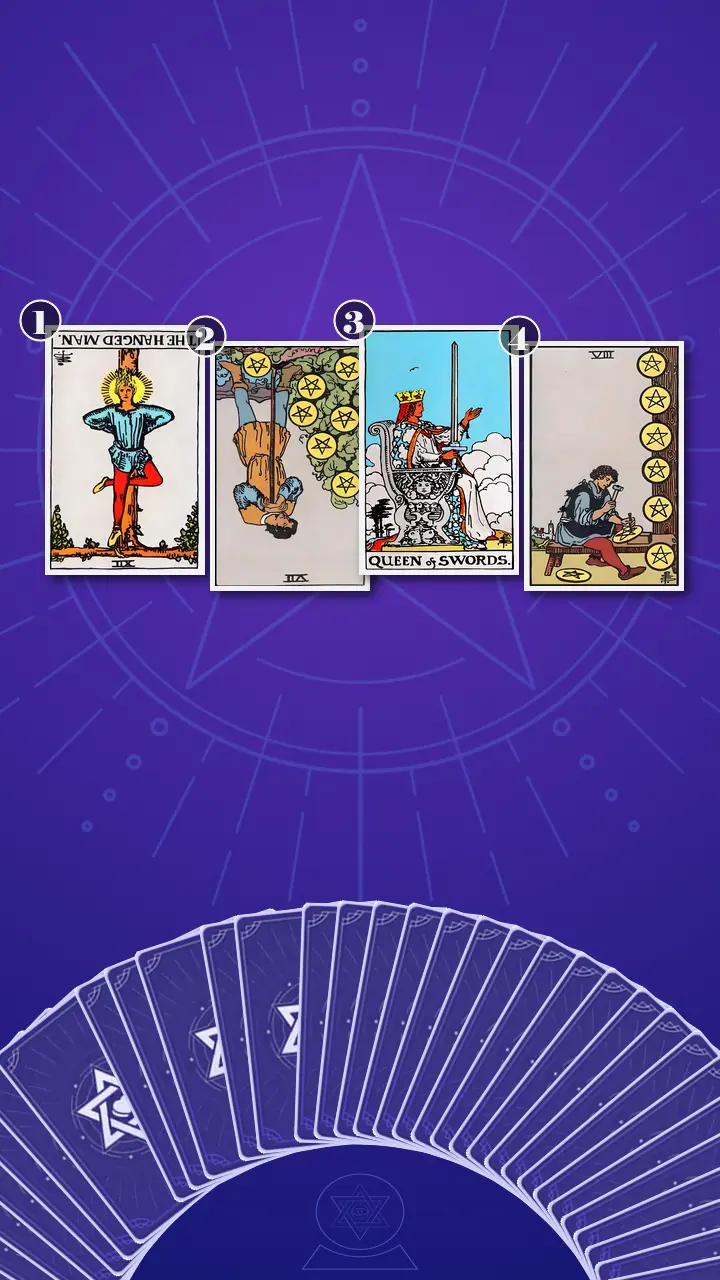
When the Inbox Became a Waiting Room
Position 1: The Hanged Man Reversed and the Day Held Open
I began with position 1, which shows the observable post-interview behavior identified in the diagnosis: applications stop and attention becomes fixed on waiting for a response.
The card was The Hanged Man, in reversed position. In the Rider-Waite-Smith image, the figure hangs by one foot from a living tree, with a halo around the inverted head. Upright, the suspension can create perspective. Reversed here, the pause had become unproductive stalling. The halo was not proof that waiting was wise; it represented the convincing rationale that made indefinite availability look strategic.
The modern scene was almost exact. This was Alex at 10:15 with Gmail in the foreground, three suitable Toronto roles behind it, and a half-written cover letter about to be closed. No new information was arriving, but Alex kept the day psychologically open for a recruiter, allowing a pending reply to suspend every action that would still make sense if the interview were temporarily removed from view.
I read the reversed energy as a blockage with an overcorrection risk. A useful pause had tipped into self-suspension. To make the waiting feel purposeful, Alex might send repeated follow-ups, remain constantly available, or leave every work block uncommitted in case contact came through. Those actions could consume the time needed for a new application while producing no additional evidence.
I asked, “If the pending response disappeared from consideration for one morning, what action would still make sense today?” The question was not designed to dismiss the opportunity. It separated a deliberate pause, which gathers information or prepares a next step, from indefinite availability, which only keeps the nervous system listening.
Alex gave a small, bitter laugh instead of nodding. “Damn, this is exactly what I do. I keep calling it strategic when I am actually stuck.” Their breath paused first, and their thumb hovered over the phone. Then their eyes moved to the three hidden job tabs as if replaying the moment they had closed them. Finally, the laugh left their chest, carrying recognition and a thin edge of embarrassment.
I kept my voice even. “You do not have to shame the strategy to change it. It was trying to protect hope and reduce effort at the same time. We are simply asking whether it still serves the life you want to keep moving.” Alex set the phone face down, though their hand remained close to it.
Position 2: The Seven of Pentacles Reversed and the One Campaign
I then turned to position 2, which reveals the belief and feedback mechanism beneath the pause: monitoring the return on one interview replaces continued investment in the wider search.
The card was The Seven of Pentacles, in reversed position. The image shows a worker leaning heavily on a tool and staring at pentacles growing on a vine. Reversed, the patient assessment of work becomes impatience, frustrated investment, and excessive attention to whether one effort will pay off. The worker is still involved, but their hands have stopped tending the field.
I translated it into Alex's professional language. It was like refreshing one marketing campaign dashboard while pausing every other campaign that could generate the next lead. “Maybe one more check will tell me whether the effort was worth it,” I said. “But checking the portal, rereading the recruiter's wording, and counting the days since the interview cannot cultivate a new opportunity. They only make the old one carry more weight.”
The Earth energy was contracted. Practical effort was available, but it had been diverted into outcome monitoring. Alex's saved vacancies approached their closing dates while the preferred role became a high-stakes emotional investment. The temporary relief of not starting another application protected hope for a few minutes; then the smaller pipeline made silence harder to tolerate, which created an even stronger reason to keep waiting.
Alex's gaze dropped to their hands. I watched their fingers move once across the edge of the notebook, then stop. Their face went quiet as they mentally counted the saved but unfinished applications. There was no dramatic revelation, only the brief sting of seeing that hope had been doing unpaid administrative work for an employer who had not asked Alex to stop searching.
I let that sting have room without turning it into a verdict. The card did not say the interview was doomed, and it did not assign a motive to the delayed response. It showed the cost of treating one uncertain return as the only meaningful measure of progress. “Keep the hope,” I said. “Take away its scheduling privileges.”
When the Queen of Swords Drew a Line Through the Silence
Position 3: The Queen of Swords, Upright and Clear
Before I turned the third card, the room seemed to narrow around the line of cards. The heater clicked once, and traffic hissed along the wet street below. The wider gap in the spread felt like a small bridge between watching and choosing.
I turned to position 3, which identifies the cognitive and behavioral lever that can resynchronize the cycle: separating known facts from assumptions and setting an application cadence independent of employer replies.
The card was The Queen of Swords, in upright position. Her sword rises vertically, clean and deliberate, while her other hand remains open. I read the upright Air as balance: discernment without emotional shutdown, openness without surrendering authority. The pending interview was a fact. The belief that applying elsewhere meant the interview had gone badly was an interpretation. The employer's silence could remain uncomfortable without becoming an instruction for Alex's calendar.
The modern scene was the moment Alex wrote in their notes: “Known fact: the interview happened and the response is delayed. Interpretation: applying elsewhere means it went badly.” From there, Alex could schedule one professional follow-up, close the employer portal, and return to a prewritten application block. The reply could still matter. It simply no longer had exclusive control of the day.
This was where I used my signature Tempo Misalignment Audit. After ten years of sound energy research, I have learned to listen for the difference between the rhythm a person wants to follow and the rhythm their actual capacity can support under pressure. Alex's ambition had not disappeared. Their psychological BPM was saying, “Keep your options open,” while their executive BPM had narrowed to refresh, interpret, and wait. That mismatch created the exact sensation of pushing against a wall: more mental effort, less forward movement.
I pointed to the Queen's sword. “The employer's communication rhythm and your job-search rhythm are two separate tracks. The work is not to force them into sync. The work is to stop letting their delay set your tempo.” As the spread's Antidote, the Queen brought discernment, emotional boundaries, factual thinking, and self-directed decision-making under uncertainty.
Then I gave Alex the line I wanted them to remember. Waiting for certainty is not the same as being strategic; raise the Queen's clear sword between the pending reply and today's decision, then complete the next application.
I let the sentence settle. The setup was still the same ordinary morning: It was 10:15 on a weekday, three suitable roles were open, the cover letter was half done, and the inbox owned the foreground. One refresh had become two; the document had closed, and “after lunch” had quietly become “after they reply.”
You do not need to decode the employer's silence before deciding that your job search will keep moving.
Alex's fingers froze above the phone, and their breathing stopped halfway in. Their mouth opened, but no answer came. Then their gaze went soft and unfocused, as if the screen had become a projector for every delayed reply, every replayed interview answer, and every afternoon lost to waiting. Their jaw tightened. “But doesn't this mean I was wrong about the interview?” they asked, with a flash of anger that was really grief for the hours spent trying to read an unreadable signal. I answered, “No. It means the opportunity can matter without becoming a verdict.” First came a short, disbelieving exhale. Then Alex's shoulders lowered, their closed hand loosened, and their eyes reddened at the edges. A quiet “Ah” moved through the room. Relief arrived with a little vertigo: if no answer had to arrive before movement, then movement belonged to Alex again.
I asked Alex to set a 10-minute timer and open a blank note with two headings: “Known facts” and “My next move.” Under the first, they would record only what the employer had actually said and whether the response date had passed. Under the second, they would choose one application task, such as adding three role-specific bullets to a cover letter. Nothing had to be submitted that day. If the exercise became too large, writing one sentence under each heading would still count as separating the employer's timeline from Alex's.
“Now,” I asked, “use this new perspective to remember last week. Was there a moment when knowing the difference between a pending reply and a pending decision could have changed what you did next?”
This was the first real crossing from anxious outcome-monitoring toward fact-based agency. It did not erase uncertainty. It gave uncertainty a smaller seat at the table.
The Hands That Started Moving Again
Position 4: The Eight of Pentacles and One Manageable Unit
I turned to position 4, which shows the non-predictive integration practice that can rebuild agency: completing small application tasks consistently while interviews remain pending.
The card was The Eight of Pentacles, in upright position. The craftsperson is using a tool on one pentacle while completed pieces stand in an orderly row nearby. This is not a promise of an offer. It is a picture of process-based progress: tailoring one resume bullet, drafting one cover-letter paragraph, completing one form section, and learning from each finished unit.
I connected the card to Alex using a 20-minute block to tailor three resume bullets for one saved Toronto role while the interview remained unresolved. The task did not require certainty, a recruiter's cooperation, or a sudden burst of confidence. It required a bounded beginning and a clear stopping point.
Here I used my second diagnostic lens, Execution Rhythm Calibration, to find the friction point where Alex's ambition had been out of sync with daily capacity. The answer was not a demand for thirty applications or constant productivity. Two small work blocks were more realistic than one heroic catch-up session, especially on a day when every notification pulled attention sideways.
Alex's shoulders relaxed as they pictured one resume bullet instead of the entire job search. Their hand moved from the phone to the notebook. “I do not have to solve the search,” they said. “I can finish this unit.” That was the Eight of Pentacles' quiet power: not dramatic momentum, but active hands replacing the posture of watching.
The Reply-Independent Rhythm
When I read the four cards together, the story was clear. Each promising interview had taught Alex's system to place the whole job search in an employer's waiting room. The Hanged Man reversed showed the visible suspension. The Seven of Pentacles reversed showed why it persisted: hope and frustration were being poured into measuring one past investment instead of tending the wider field. The Queen of Swords separated evidence from projection. The Eight of Pentacles turned that boundary into repeatable craft.
The cognitive blind spot was subtle: Alex had mistaken missing information for an instruction. Because the employer had not clarified what would happen next, Alex assumed no personal action could be sensible yet. But silence did not mean stop, just as a delayed notification did not mean the next application had become irrelevant.
The transformation direction was a shift from letting each employer's response set the application cadence to following a prewritten weekly schedule regardless of pending interviews. In the language of the emotional transformation, Alex was moving from anxious outcome-monitoring and employer-dependent waiting to fact-based agency and a steady, self-directed job-search rhythm. The pipeline could become moving again without pretending that every lead would become an offer.
I translated the Queen and the Eight into actionable advice through a three-day Syncopation Reset, my personal method for breaking a forced routine into smaller, more harmonious beats. I combined it with the Tempo Misalignment Audit and Execution Rhythm Calibration: first identify what belongs to the employer, then give Alex's own work a tempo that fits the energy available, then repeat one manageable unit. These were next steps, not tests of worth.
- Set the Follow-Up FenceOn the next weekday morning, open Notes before LinkedIn and create a two-column entry for the pending role labelled “Known facts” and “My next move.” Record only the employer's actual timeline in the first column, add one appropriate follow-up date to the phone calendar using that timeline plus a reasonable buffer, and choose two inbox windows, such as 11:30 a.m. and 4:30 p.m. Keep Gmail closed during one 20-minute application block.If a sentence requires mind-reading about tone, timing, or portal language, move it out of the facts column. The minimum version is one sentence in each column and one calendar reminder.
- Run the Three-Day Syncopation ResetFor the next three weekdays, use one small beat at a time. On day one, advance one saved Toronto role by tailoring three resume bullets for 20 minutes. On day two, draft one opening cover-letter paragraph or complete one application-form section. On day three, repeat whichever unit felt most workable and record it in Notion, Trello, or a plain spreadsheet. Continue the block even if an interview response is still pending.If 20 minutes feels too large, use the eight-minute version and stop when the timer ends. Record completed application units separately from employer replies so the week is measured by moves made, not responses received.
I reminded Alex that applying elsewhere was not a declaration that the preferred interview had failed. It was a way to keep options alive while facts remained incomplete. The Queen's boundary did not remove hope; it prevented hope from becoming the only administrator of the search.

A Week Later, the Quiet Proof
A few days later, I received a message from Alex. They had sent one concise follow-up on the calendar date, completed a 20-minute resume block before checking Gmail, and moved one saved role from “Saved” to “Applying” on their simple tracker. The employer's response was still outside Alex's control, but the morning no longer belonged entirely to it.
The change was clear but fragile: Alex slept through the night, yet woke with the familiar thought, “What if I am wrong?” This time they smiled, opened the saved role, and edited three bullets before checking the inbox.
I saw that as the first evidence of a moving pipeline, not a solved career. The cards had not summoned a reply or guaranteed an offer. They had worked as an objective cognitive tool, giving Alex a visible structure for facts, assumptions, boundaries, and practice. Alex, not the cards and not the employer, remained the author of the next move.
That is what finding clarity looked like in this reading: not perfect certainty, but enough room between a notification and a decision to choose a useful action. The journey moved from conditional agency to a process Alex could continue even when the process stayed unfinished.
When one unanswered interview makes your chest tighten every time the phone lights up, it can feel safer to freeze the rest of the search than to face how little control that employer's silence gives you. But noticing the freeze is already a change in position.
If that pending reply could stay meaningful without setting your pace, what small part of your own process might you feel curious about returning to: the Fact / Interpretation split, the next three-bullet edit, or one quiet beat in your reply-independent cadence?