Closing Three Records on Friday Before Month-End Panic Took Over

The Quiet Friday That Fed Month-End Panic
Alex, a 27-year-old non-binary junior operations coordinator in Toronto, could spend the quiet first half of the month colour-coding a recurring checklist, then feel their stomach drop when a manager asked for a progress update. That was the daily shape of crisis-activated self-management: awareness was present, but action waited for danger.
Alex joined my video consultation at 8:47 on the second Friday of the month. In the square of their Toronto kitchen, a close checklist glowed beside a half-finished takeaway container. I could hear the fridge hum beneath the laptop fan, and I watched their hand rest against a phone still warm from three answered Slack messages.
As Alex shared their screen, the pattern unfolded in real time. They knew the task. They reorganized the task. They waited for the task to become dangerous. The labels had changed from yellow to blue, the messages had been cleared, and the first twenty-minute item remained untouched.
“Apparently I can do a month of admin in three days,” Alex said. “But I cannot make myself do twenty minutes today. Why do I wait for month-end panic to manage my life?”
I heard the contradiction clearly: Alex wanted steady professional self-direction, yet kept borrowing authority from the calendar. During quiet weeks, their attention dispersed across lists and messages. Near month-end, dread became a notification badge lodged beneath the breastbone, silently pulsing until the jaw tightened, thoughts raced, and every unfinished obligation flashed red at once.
“I am tired of needing a crisis to feel responsible,” they said.
“I do not hear irresponsibility,” I replied. “I hear a start signal that has become painfully loud. At sixty-seven, after a lifetime of watching how bodies respond to strain, I have learned that a broken rhythm should not be mistaken for a broken character. Let us use the cards as a mirror and draw a map of this loop. The aim is not to predict your month. It is to help you find the point where choice can re-enter it.”

Choosing a Map for a Deadline-Driven Loop
I invited Alex to place both feet on the kitchen floor and take one unforced breath. I shuffled slowly, not as a supernatural performance, but as a deliberate transition from reacting to observing. The dry whisper of the cards briefly replaced the laptop fan.
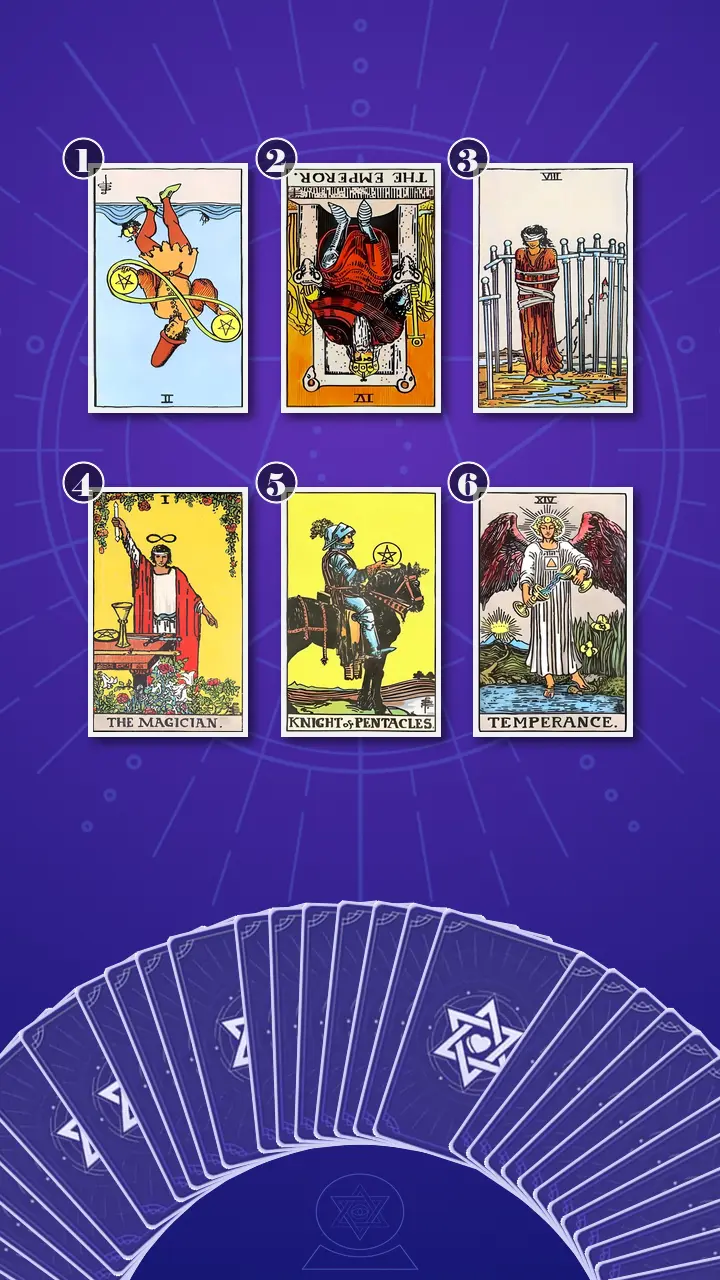
I chose the Transformation Path Grid · Context Edition, a six-position tarot spread designed to examine a repeating system. I want readers to understand why I chose it: Alex's problem was not a collection of unrelated flaws. It was a feedback loop. Low urgency enabled postponement; postponement created month-end panic; emergency completion then appeared to prove that panic was necessary.
A larger spread would have added more context without necessarily adding clarity. This compact grid let me follow the mechanism from symptom to blockage to root belief, then from catalyst to practical experiment to integration. That is how tarot works best in a consultation like this: card meanings in context become prompts for structured recognition, not fixed verdicts about fate.
I placed three cards across the top row and three beneath them, like a monthly workflow board being rewritten. The first position would reveal the visible overload. The second would show why Alex kept outsourcing structure to deadlines and manager prompts. The third would uncover the private fear beneath that dependence. The lower row would identify a self-directed catalyst, translate it into a repeatable Friday practice, and show what steadier pacing might feel like.
“The cards will not order you around,” I told Alex. “They will help us separate what panic has been doing for you, so you can decide which functions you want to reclaim.”
The Monthly Loop With No Landing Point
Position 1: Two of Pentacles Reversed and the Work That Keeps Circulating
“Now I am turning over the card that represents the observable problem,” I said. “It shows where routine work and life administration remain in motion but unfinished until month-end creates overload.”
I revealed the Two of Pentacles, reversed. I traced the infinity-shaped band linking the two pentacles. Around the figure, ships rose and fell on rough water. Upright, this card can describe adaptable juggling. Reversed, I read an excess of switching combined with a deficiency of stable rhythm. The activity is real, but it has no dependable landing point.
I brought the image directly back to Alex's second Friday. They had opened the recurring close checklist beside the takeaway container, changed the colour coding, answered three Slack messages, and closed the document without completing the first item. The task had moved between attention systems, but nothing had landed. Two weeks later, that same item would return as part of a late-night sprint.
“You are not lacking motion,” I said. “You are lacking a landing point. Moving the same task between Slack, a colour-coded Notion board, and Google Calendar is like changing TTC routes in the app while remaining on the same platform. The planning can be intelligent and still leave you exactly where you started.”
I asked which recurring task was most often moved without being closed. Alex stared at the screen for a moment, then gave a brief laugh that carried no amusement.
“The current-record updates,” they said. “And that is way too accurate. It almost feels cruel.”
I did not rush to soften the recognition. “Specific does not have to mean condemning. This card is describing a loop, not assigning a moral quality to you. Reorganizing gives you short-term relief because it creates movement without exposing your choice of a first step. That relief makes sense. We are simply checking what it costs later.”
Their thumb stopped scrolling over the edge of the phone. I saw recognition arrive alongside a thin, bitter smile.
Position 2: The Emperor Reversed and the Authority Outside the Door
“The next card represents the maintaining blockage,” I said. “It asks where you have outsourced structure and permission to deadlines, manager prompts, or other external signs of authority.”
I turned over The Emperor, reversed. The stone throne and rigid frontal posture showed authority experienced as fixed, intimidating, and external. I read the Emperor's energy here as a blockage: the capacity for self-command existed, but Alex did not yet trust it unless someone else activated it.
I described the familiar workplace comparison. Alex knew the monthly procedure. They had the checklist and access to the records. Yet the absence of a manager message felt like an absence of permission. When a dashboard turned overdue or a supervisor typed “Quick update?”, the work suddenly became official, important, and possible.
“The deadline has been acting like your manager,” I said. “It chooses the priority, grants permission, and forces a finish. That is a great deal of authority to give a date on a calendar.”
Alex leaned back, folding their arms before slowly unfolding them again.
“I want people to trust me to work independently,” they said. “But when nobody checks in, I keep thinking, ‘Maybe this is not the right thing to do yet.’”
“And beneath that?” I asked.
Their gaze shifted toward the dark window. “If I choose the first step myself and it is wrong, what will that say about me?”
That question exposed the tension between wanting autonomy and waiting for authority. I also cautioned Alex against the Emperor's other extreme. Reclaiming structure did not mean building a punitive hour-by-hour schedule or treating one disrupted Friday as failure. Self-authored authority had to include boundaries, adjustment, and the right to ask for clarification when ownership was genuinely unclear.
Position 3: The Eight of Swords and the Gap That Still Exists
“Now I am turning over the card that represents the root belief beneath the procrastination,” I said. “It asks what acting without external pressure might seem to prove about your control or professional competence.”
The third card was the Eight of Swords, upright. I pointed to the blindfold, the loose bindings, and, most importantly, the visible gap in the surrounding swords. I read Air as excessive here: thought had become so concentrated on choosing incorrectly that Alex's practical agency felt deficient. The blockage was not a literal absence of options. It was a narrow rule about what choosing meant.
In everyday terms, Alex could look at an open calendar and a familiar checklist yet treat both as unusable until another person identified the correct first move. The private rule was simple and punishing: “If I choose badly, I will prove I cannot manage this.” Month-end panic then removed the burden of choosing. When everything became urgent, any action was justified, so emergency activity could masquerade as the only safe way to begin.
“The visible gap matters,” I told them. “The card is not saying you are helpless. It is showing that you feel sealed inside a situation that still contains a reversible move. A first choice at work is not a final exam on your worth.”
I asked what Alex feared a calm, imperfect start might reveal. Their breath paused. Their fingers hovered over the takeaway lid. Their eyes lost focus as if an old progress meeting were replaying behind them, and then their shoulders lowered by a fraction.
“I think I would rather wait until the deadline makes the choice obvious than find out I picked the wrong thing on my own,” they said. “That is embarrassing to say out loud.”
“It is vulnerable, not embarrassing,” I replied. “Avoidance has been protecting you from a feared verdict. Once we can see that function, we can test the verdict without demanding that you redesign your whole personality.”
When the Magician Reclaimed the Start Signal
Position 4: One Tool Already in Hand
The fridge compressor in Alex's kitchen clicked off just as I reached for the lower-left card. The sudden quiet made the distance between us feel smaller.
“This position shows the transformational trigger,” I said. “It asks whether you can recognize that you already have enough knowledge and practical support to initiate one task without waiting for permission or panic.”
I revealed The Magician, upright. I read this card as focused initiative in balance: not infinite motivation, not perfect certainty, but the deliberate coordination of resources already available. The cup, pentacle, sword, and wand on the table became Alex's ordinary work kit: the recurring procedure, the source records, a calendar slot, and a twenty-minute timer.
“The Magician does not wait for every answer,” I said. “The Magician chooses one usable starting point. In your life, that looks like selecting one recurring responsibility, placing a twenty-minute block on the calendar, closing workplace chat, and beginning with the information already available. Nothing external has to grant permission, and uncertainty does not have to disappear.”
At this point, I used the lens I call Somatic Fatigue Diagnosis. When the mind argues, “I need pressure to perform,” I temporarily set the argument aside and listen to the body's record. Alex had described a tight jaw, racing attention, dry eyes, and restless energy during the deadline sprint, followed by heavy limbs and depleted concentration after submission. Their body was keeping a more honest timesheet than the story of heroic productivity.
“Panic can create focus by spending recovery in advance,” I explained. “The completion proves that you have capability. The jaw tension and heavy limbs reveal the cost of the start signal you have been using. Your body is not telling me that crisis makes you competent. It is telling me that crisis makes your competence expensive.”
To make the card concrete, I returned Alex to the second-Friday scene: the close checklist open beside takeaway, its colour coding polished, three chat notifications answered, and the first twenty-minute task untouched. Nothing felt urgent, so the work felt strangely unreal.
Panic is not your manager; place one task on the Magician's table, choose the tool already in your hand, and begin before urgency gives permission.
I let the sentence remain in the quiet kitchen for a few seconds.
“Panic is not proof that you are capable. It is only a loud start signal. You can choose one tool, one cue, and one small beginning before fear takes over the calendar.”
I watched Alex stop breathing for one beat. Their fingers, which had been worrying the paper rim of the takeaway container, froze in mid-turn. Their eyes left the card and went unfocused toward the dark kitchen window, as though the previous month-end were replaying in the glass. Then their pupils widened; colour rose along their cheekbones; their mouth tightened before their shoulders finally dropped. A small, shaky exhale became an almost angry laugh.
“But does that not mean I have been doing this wrong the whole time?”
I heard release and grief in the question, along with the new vulnerability of having a choice. “No,” I said. “It means panic became an effective emergency adaptation and then got promoted into a job it should never have held. Finishing under pressure was real capability. The suffering was not the credential.”
Their hands opened flat on the table. Their eyes reddened slightly, and the next breath came from lower in their chest. “Oh,” they said, very quietly. “Then I could start before I am scared.”
I let that settle, then asked, “Now, using this new perspective, can you recall one moment last week when this insight might have changed how you felt?”
Alex looked back at the shared checklist. “When I opened the records on Friday, I already knew the first three updates. I was not missing information. I was waiting for the task to feel official.”
I named the four tools again: procedure, records, calendar, timer. Not every answer, just one usable starting point. Alex read the sentence I had written beside the card: “I do not need permission to make the first move visible.”
This was the reading's central emotional crossing. Alex was moving from borrowed urgency and shame-driven overwork toward quiet self-direction. It was not certainty, and it was not a promise that starting would suddenly feel comfortable. It was the smaller, more consequential recognition that discomfort could accompany a self-authored beginning without controlling it.
Position 5: The Knight of Pentacles and the Ordinary Friday
“The fifth position translates agency into a concrete practice,” I said. “It shows a small recurring work block completed at a predictable time, whether or not anything feels urgent.”
I turned over the Knight of Pentacles, upright. The horse stood still while the Knight held one pentacle at eye level. I read Earth in balance: attention given steadily to one practical responsibility, without the excess of juggling or the deficiency of follow-through seen in the first card.
In Alex's daily life, this meant completing the same protected twenty-minute review every Friday, even when the inbox was quiet and no manager wanted a status update. The action was deliberately unglamorous: open the checklist, update the current records, leave a note for the next review, and stop when the timer ended if that was enough.
I contrasted it with the old loop. The same item had been moved among Slack, Notion, and Google Calendar until its digital trail looked productive. The Knight offered one physical sequence instead: close chat, open the source record, complete the first visible action. “This can count even if nobody is watching,” Alex said, testing the words aloud.
This was where I brought in my second diagnostic craft, Organic Routine Restructuring. I do not use it to impose an artificial productivity clock on a tired body. I use it to locate a repeatable window that respects biological capacity, paid working hours, and actual workload. A protected cue should work like a garden trellis: enough structure to support growth, with enough space for living conditions to change.
Looking at the cultivated field behind the Knight, I remembered Highland mornings when weather made a rigid timetable absurd. In seven generations of my family's healing work, steadiness never meant forcing every day to look identical. It meant returning to the necessary care after conditions changed.
“Choose a Friday window when your concentration is usually available,” I told Alex. “Do not schedule unpaid catch-up time to prove commitment. If Friday is disrupted, move the block to the next realistic twenty-minute opening. Returning is the rhythm. Perfect compliance is not.”
Alex rubbed their jaw once and then let their hand fall. “A recurring train, not an emergency rideshare,” they said.
“Exactly. Ordinary, predictable, and not dependent on drama.”
Position 6: Temperance and the Month That Can Breathe
“The final position represents integration,” I said. “It shows the steadier pacing that can replace the swing between disengagement and month-end overexertion.”
I revealed Temperance, upright. Water moved between two cups while one foot rested on land and the other touched water. I read this as balanced regulation: practical responsibility and changing capacity kept in conversation rather than forced into an all-or-nothing schedule.
For Alex, the modern life meaning was direct. Small pieces of close-related work could move through weekly review blocks, with room to adjust for a disrupted Friday or an unexpected request. Month-end could become a review point rather than the only reliable start signal. Effort could be transferred across the month instead of stored until the final three business days.
“Temperance does not promise a perfectly calm month,” I said. “It does not ask you to become a rigid productivity person. It asks what amount of work is repeatable without requiring either total disengagement or emergency intensity. Consistency can be quiet and still count.”
I asked Alex to imagine opening the checklist during a calm Friday, completing one defined block, and stopping without turning the result into a character verdict. I watched their shoulders settle against the chair. Their jaw did not fully unclench, but they noticed it and softened it deliberately.
“Month-end would still be busy,” they said. “But maybe it would not be the first time I had touched everything.”
“That is a credible form of clarity,” I replied. “Not a fantasy of total control. A different relationship with the first move.”
The Friday Rhythm That Left Room to Breathe
I gathered the six cards into one story. The Two of Pentacles showed familiar responsibilities circulating without landing. The Emperor reversed explained why the calendar and manager prompts had become substitute supervisors. The Eight of Swords uncovered the feared verdict beneath the delay: choosing the wrong first step might expose incompetence. The Magician answered with available tools and chosen initiative; the Knight turned that initiative into a modest routine; Temperance distributed effort without demanding perfection.
The two infinity symbols gave me the clearest summary. Around the Two of Pentacles, the looping band held unfinished demands in endless circulation. Above the Magician, the same shape belonged to conscious direction. Repetition itself was never the enemy. One kind of repetition preserved panic; another could build self-trust.
I named Alex's cognitive blind spot plainly. They had been treating emotional intensity as evidence that work was important, and exhausted completion as evidence that pressure was necessary. In reality, pressure had been doing three separate jobs: choosing the priority, granting permission, and forcing a finish. Those functions could be rebuilt as one chosen task, one personal definition of done, and one neutral cue.
“The key shift is small enough to test,” I said. “Instead of using month-end panic as your start signal, complete one protected twenty-minute review every Friday, even when nothing feels urgent. We are not solving your entire life in one session. We are gathering evidence that calm action can be legitimate.”
The Two-Part One-Tool Agency Experiment
- Choose the Friday Twenty-Minute Rhythm. Before the next workweek fills, place one neutral “Friday review” block on Google Calendar during paid working hours. Choose one recurring close or records task. Before opening Slack or Teams, write a one-sentence definition of done, such as: “Update the three current records and leave one note for the next review.” If Friday is disrupted, move the block to the next realistic twenty-minute window. Track whether you returned, not whether the week was perfect.
- Use the Grounding Disconnect Protocol, then make one reversible beginning. At the calendar cue, put both feet on the floor and lower the screen for ninety seconds. Notice three physical contacts, then focus on one natural texture or signal available to you: wood grain, a plant leaf, cool water, daylight, or the air near a window. Let three unforced exhales run slightly longer than the inhales, if that feels comfortable. Then close chat, set a five-to-twenty-minute timer, open the source record, and complete only the first visible action. If breath focus is uncomfortable, use contact points alone. Write down any question before seeking confirmation, make the smallest reversible choice, and keep a boundary around unclear ownership or unpaid extra work.
I explained that the Grounding Disconnect Protocol was not another task to perform perfectly. I use it as a brief physical bridge between accumulated environmental alertness and chosen attention. Its purpose was to help Alex hear the jaw, shoulders, hands, and breath before Slack or an overdue badge took command.
“After the block, record one factual line,” I said. “‘Started without a reminder.’ ‘Completed the first three records.’ ‘Paused because final approval belongs to someone else.’ Facts build self-trust more reliably than praise or punishment.”
Alex looked at the cards, then created a calendar block for the following Friday from 2:00 to 2:20. They named it simply: “Friday review.”
“That feels almost too small,” they said.
“Good,” I replied. “Small means you can collect information without making the experiment a referendum on your whole character. Your authority includes the right to adjust the size.”
A Week Later, the Quiet Proof
The following Friday, Alex sent me a screenshot at 2:23 PM. The calendar block had begun three minutes late. They had closed Teams, updated three records, and left one question for their manager because final approval was genuinely outside their role.
The message beneath the screenshot read: “I kept wanting to redesign the checklist. I put my feet down, opened the source file, and did the first update instead. Nobody reminded me. It was not exciting, but it happened.”
That evening, Alex ate takeaway at the same kitchen counter. The checklist was not finished, and Monday still held questions. But the first item had closed before it became dangerous. When “What if next Friday falls apart?” appeared, they did not turn it into a verdict.
I did not regard this as the cards fixing Alex's schedule. Tarot had provided an objective map of the feedback loop and language for the leverage point. Alex supplied the calendar block, the boundary, the physical pause, and the first completed record. The authority remained theirs.
For me, that was the true Journey to Clarity: not a dramatic transformation from chaos into perfect discipline, but the first movement from borrowed urgency and shame-driven overwork toward quiet self-direction, cautious pride, and steadier month-end energy.
If your calendar is quiet while your hands keep rearranging the same tasks, I hope you will remember that starting calmly can feel vulnerable precisely because it asks you to trust authority that is still becoming familiar. Simply noticing that tension means you are no longer entirely inside its old rhythm.
If one small Friday cue could belong to you before urgency arrives, which tool already sits on your Magician's table, and what would you quietly want to notice in your jaw, breath, or hands as you begin?