A Group-Chat Full Yes Became a Care Offer with a Limit Six Days Later
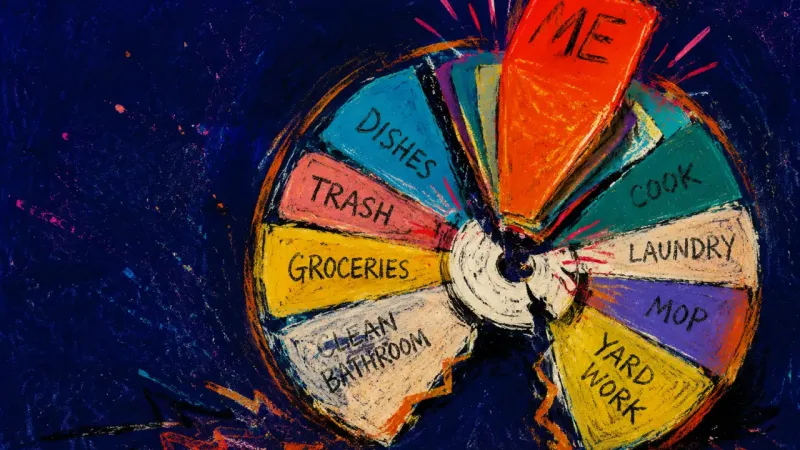
The 11:47 p.m. Proof-of-Care Shift
You might be the values-led friend who can write the caring group-chat reply faster than you can find your one free evening. I met that exact split in Jordan (name changed for privacy), a 27-year-old communications coordinator at a community arts nonprofit in Toronto. They cared deeply about their friends. They were also exhausted from treating every request as an audition for continued belonging.
“Tuesday, 11:47 p.m.,” Jordan told me. “Someone asked for help coordinating meals, rides, and check-ins. I typed that I could handle the whole rota, deleted it twice to make it sound warmer, then waited until I saw which replies were getting hearts before I sent it.”
As Jordan spoke from their shared apartment, the radiator clicked behind them and the blue-white group-chat screen warmed their palm. Their thumb kept reopening the thread. Their throat drew tight, their shoulders lifted toward their ears, and their fingers moved before the rest of their body had been consulted. Only after volunteering did they open Google Calendar and discover that they had given away their only free evening.
“I care,” they said, twisting the cuff of their sweatshirt. “But I hate that I’m calculating how my care will look. I can identify the correct response faster than I can identify my actual capacity. Why do I keep performing care to stay on the right side of my circle?”
Their social apprehension felt less like ordinary nerves and more like a seat-belt ratchet tightening one notch with every typing bubble, read receipt, and heart reaction. The care was sincere, but it was also being asked to function as social insurance. That is the painful ambiguity inside performative empathy: the feeling is real, while the visible certainty and availability are partly shaped by belonging anxiety.
“I’m not going to tell you whether your friends are secretly judging you,” I said. “The cards cannot give us access to anyone else’s private motives, and I won’t turn your circle into a villain. What we can examine is the pattern you are living inside: what happens in your body, what you offer, which assumptions enter the room, and where you still have choice. Let’s make a map of the fog and find the point where the pen returns to your hand.”

Choosing a Map for Friendship Boundaries
I asked Jordan to put their phone face down, take one unforced breath, and hold the question without polishing it. I shuffled slowly. I treat this small ritual as a transition of attention, not a supernatural performance. It gives the nervous system a moment to stop answering the group chat and begin listening inward.
I chose the Relationship Spread · Context Edition, a five-card relationship tarot spread for friendship boundaries, group dynamics, and belonging anxiety. A Celtic Cross would have introduced more layers than this question required, while a Shadow Spread could have placed too much emphasis on Jordan’s private psychology and too little on the relational loop. This spread was precise enough to examine Jordan’s contribution, the circle’s visible codes, the bond between them, the central blockage, and a constructive practice Jordan could control.
This is how tarot works in my practice: the spread does not predict whether a friendship will survive a boundary. It externalizes a pattern so we can inspect it without treating every feeling as a fact. Tarot card meanings in context become prompts for discernment, not verdicts handed down from outside the querent.
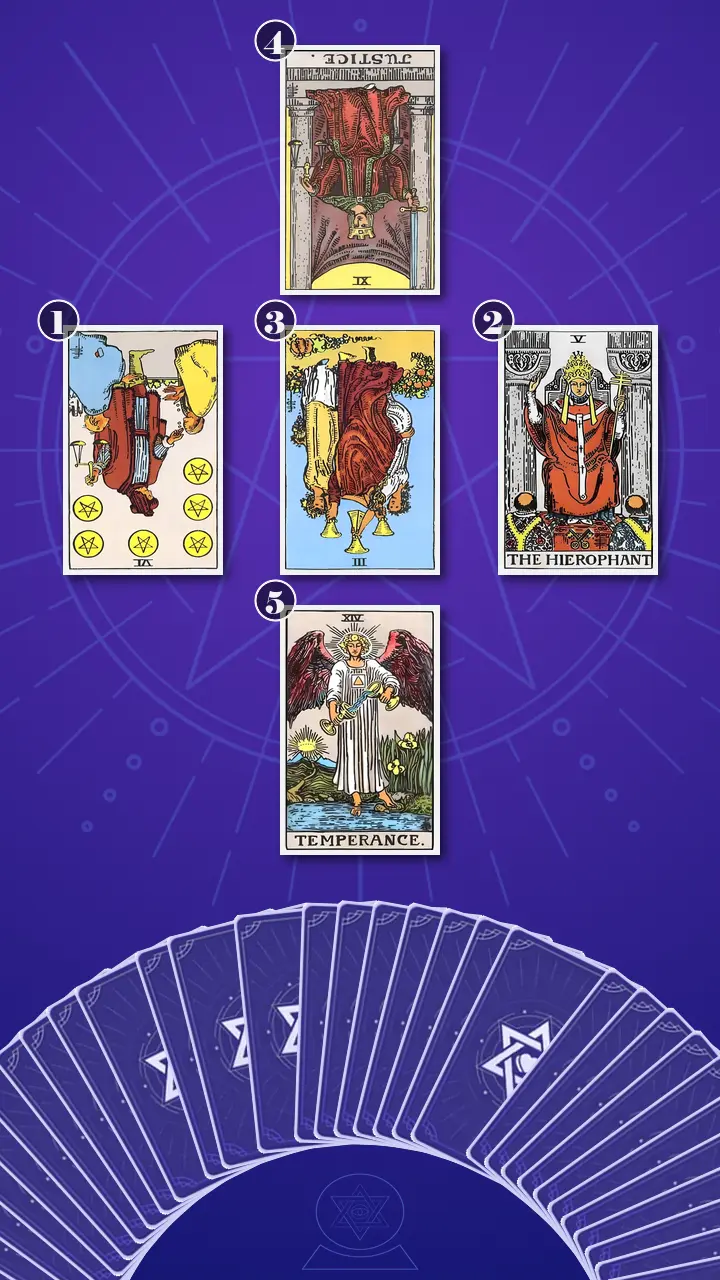
I laid the cards in a cross. The first card, on the left, would show Jordan’s rapid and visible giving. The second, on the right, would examine the shared care codes Jordan encountered in the circle. The third would sit between them as the unspoken approval-for-care contract. Above it, the fourth would reveal the judgment pressing on that bond. Below it, the fifth would ground the reading in a self-directed next step: one sincere act of care combined with one sustainable limit.
The layout looked like a bridge crossed by a plumb line. The horizontal cards described the relationship. The vertical cards tested whether that relationship could move from moral pressure toward balanced participation.
The Social Scale and the Unofficial Style Guide
Position 1: The Offer Made Before the Balance Check
The card I turned over first represented Jordan’s presenting behavior in the dynamic: giving quickly and visibly before checking capacity or genuine willingness. It was the Six of Pentacles, in reversed position.
I pointed to the giver holding scales above the exchange. Upright, the card can describe generosity, reciprocity, and awareness of how resources move between people. Reversed here, its Earth energy was blocked by a missing capacity check, while visible giving had moved into Excess. Time, money, and emotional labor were leaving Jordan’s hands before their own resources had entered the calculation.
“This is your 11:47 p.m. moment,” I said. “A request arrives for meals, rides, and check-ins. You volunteer to coordinate the whole rota and match the warmth of the replies receiving hearts. Only after sending do you open your calendar and bank balance. The offer briefly makes your social position feel safer, but the practical cost has not been weighed.”
I described the group chat as a payment screen on which Jordan submitted time, money, and emotional labor before checking the available balance. The private script beneath it sounded like this: If I answer quickly, they’ll know I care. If I pause, my silence may count against me.
“The card is not shaming generosity,” I added. “It is distinguishing generosity from care used as an approval payment. Before the next offer, the useful question is: would this action still matter to me if nobody could see it, react to it, or give me credit?”
Jordan gave one short, bitter laugh and looked at their recent messages. “That’s too accurate. Honestly, it’s almost rude.” Their smile stayed for half a second, then fell. “I sent an Interac e-Transfer last month before checking whether I had enough left for everything else. I genuinely wanted to help. I also wanted the receipt to exist.”
“Both can be true,” I said. “Mixed motives do not cancel the care. They tell us that the action is carrying more than one job.”
Position 2: The First Three Replies Become the Rulebook
The next card represented the circle’s shared care codes as Jordan perceived and encountered them, without claiming to reveal any individual member’s private intention. It was The Hierophant, upright.
The Hierophant can hold shared teachings, community standards, and a language through which people recognize common values. In Balance, that energy gives a group coherence. In Jordan’s pattern, it had become over-relied upon: the visible code was being asked to replace independent judgment.
I directed Jordan’s attention to the two acolytes facing a central teacher and the crossed keys at the teacher’s feet. “A morally charged discussion begins in the chat. The first few responses establish a recognizable tone, and you start treating them like an unofficial nonprofit communications guide. You remove the nuanced sentence, repeat the wording already receiving hearts, and confuse fluency in the circle’s shared language with having no permission to question one part of it.”
I thought of the style guides I had used in collaborative art projects. A good guide helps many people create something coherent. It becomes restrictive only when it starts making choices that still belong to the individual artist.
“Shared values do not require identical sentences,” I said. “I’m not asking you to reject the group’s ethics. I’m asking you to name one norm you genuinely endorse and one norm you need permission to examine.”
Jordan’s fingers stopped worrying the sweatshirt cuff. Their eyes moved away from the card as though they were replaying an old thread. “I believe we should show up materially, not just say the right thing,” they said. “But I don’t believe everyone has to make the same public statement before context is even clear. I say that sentence in my head. I almost never type it.”
Position 3: When Friendship Starts to Feel Scored
The central card represented the unspoken approval-for-care contract connecting Jordan and the circle: the felt equation between visible alignment and secure belonging. It was the Three of Cups, in reversed position.
I looked at the three raised cups forming a social circuit. Upright, the card celebrates friendship, mutual support, and shared joy. Reversed, its Water energy was experiencing Blockage through social positioning and Excess through over-involvement. Connection remained real, but participation had begun to feel monitored.
“A friend asks for support,” I said. “Several people respond publicly, hearts accumulate, and the exchange becomes a live display of mutual care. You scan the reactions, reshape your contribution around what is already being rewarded, and read a quieter response as a possible change in status. It’s like mistaking engagement metrics for a complete measure of relationship security.”
I let the silence sit for a moment before adding, “The community does not have to be fake for this pattern to hurt. Your friends may genuinely care for one another. The strain comes from feeling that every act must also protect your place inside the circle.”
Jordan’s breath caught first. Their hand hovered over the water glass without lifting it. Then their gaze went slightly unfocused, as if a side conversation had reopened in memory. Finally, they set the glass down and pressed one palm against their stomach.
“I want to be close to these people,” they said quietly. “I just don’t want every contribution scored. But if nobody is actually keeping score, then I’m the one doing it.”
“You are certainly carrying a scoreboard,” I replied. “We do not yet know how much of it comes from current interactions, earlier experiences, or your anticipation of what might happen. The next card can help us see what the scoreboard is measuring.”
When Justice Put One Evening on Trial
Position 4: The Internal Courtroom
The card I turned over above the center represented the principal blockage: binary moral judgment turning practical boundaries into identity verdicts. It was Justice, in reversed position.
The radiator clicked once and went quiet. A narrow shadow from my reading lamp crossed the card’s printed scales, making one side look heavier. Justice upright can represent accountability, truth, and proportion. Reversed here, its discerning Air energy was distorted into an overactive prosecution. The sword wanted a final sentence before the evidence was complete.
“Let’s use the Wednesday you gave away,” I said. “The fact is: your work was due, your energy was gone, and Wednesday was unavailable. The imagined verdict is: an unavailable person is uncaring. Those are not two pieces of the same category. One describes a schedule. The other tries to summarize your entire character.”
Jordan stared at the scales. I watched their jaw tighten as they followed the familiar prosecution: If I cannot justify this boundary perfectly, the boundary proves the charge.
“A boundary is information about an offer, not a verdict on your character,” I said.
Seeing Justice beside the earlier social cards brought one of my central tools to mind. I call it Typecasting Analysis. In film, typecasting happens when an actor becomes so associated with one role that every new script expects the same performance. In a social circle, the role may be the endlessly available caretaker, the person who always has the approved sentence, or the one who turns concern into logistics before anyone else has opened a calendar.
“Your cast role seems to be ‘the instantly aligned, highly capable caring person,’” I told Jordan. “That role may have earned real trust, and parts of it reflect genuine values. The restriction appears when one unavailable evening feels like breaking character in front of an audience.”
I paired that with Group Dynamic Rewriting, mapping only what we could observe: a request appears, early replies establish a tone, visible reactions reward certain forms of participation, and Jordan’s internal gatekeeper rushes to preserve their role. I did not need to claim that anyone had deliberately written this script. The important fact was that Jordan kept performing it even when nobody had explicitly demanded the next line.
“When care becomes evidence for the defence, generosity starts carrying the weight of a trial,” I said. “The scale is trying to weigh unlike things: available hours on one side and moral worth on the other.”
Jordan’s lips parted, but no words came out. Their fingers tightened around the cuff, their eyes shifted toward the blank wall, and then their shoulders dropped with a long breath from deep in the chest.
“Wait,” they said. “Not being free on Wednesday is information. It isn’t a complete account of my care.”
“Exactly. The goal is not to avoid accountability. It is to make accountability accurate enough to be useful.”
When Temperance Kept Both Cups in Circulation
Position 5: Compassion and Capacity in the Same Sentence
The final card represented the relationship’s constructive direction and Jordan’s self-directed practice: combine one sincere act of care with one clear, sustainable limit. This was the reading’s key card and its antidote. I turned over Temperance, upright.
The room seemed to widen around the image. I pointed to the stream moving between the angel’s two cups, one foot on solid ground and one in water. Temperance carries the energy of Balance: practical capacity and emotional presence, community participation and independent judgment, compassion and self-protection held in workable proportion.
“For the next request,” I said, “this card looks like waiting, checking time, money, and emotional bandwidth, then replying: ‘I can deliver dinner on Sunday and stay for twenty minutes; I can’t coordinate the rota this week.’ Both clauses are true. Neither has to cancel the other.”
I brought Jordan back to 11:47 p.m.: the chat lighting up, their hand reaching for a full yes before the calendar opened, and their throat tightening around the fear that a limit might be remembered. Their mind was still demanding moral certainty before permitting a measured response.
“You do not have to resolve every moral uncertainty before you are allowed to belong,” I said. “Care can be sincere, limited, and still left standing without becoming a verdict on who you are.”
Unanimous alignment is not proof of care; choose a measured offer and an honest limit, as Temperance keeps both cups in circulation without emptying either.
I stopped speaking and let the sentence remain between us.
Jordan’s breathing paused. Their pupils widened slightly, and their face went still before the meaning seemed to move beneath it. Their right hand, clenched against the chair, slowly opened finger by finger. Moisture gathered at the rims of their eyes, but relief did not arrive cleanly. “But doesn’t that mean I’ve been doing care wrong?” they asked, the words sharper than anything they had said so far. “Were all those yeses fake?” I heard anger first, then grief underneath it. I told them no: the care could be real and the survival strategy could still be costly. Insight was not a guilty verdict on their past. It was new information for the next scene. Their shoulders lowered again, followed by a shaky exhale and a brief, almost dizzy stillness, the kind that can appear when a familiar burden is removed and personal choice suddenly becomes visible. “So I have to decide what I mean,” they whispered. “That feels better. Also scarier.”
“Now, with this new perspective, think back to last week,” I said. “Was there a moment when this insight might have changed how the situation felt?”
Jordan returned to the Wednesday check-in. “I could have offered a twenty-minute call on Thursday instead,” they said. “I didn’t have to choose between taking the whole evening and disappearing.”
I set a private timer for no more than ten minutes and asked them to complete three lines: What matters to me here. What I can realistically sustain. My specific offer and honest limit. I made it clear that they did not have to send anything. If the exercise felt too exposing, they could stop after rating their capacity from zero to five. The purpose was to notice their own information, not to prove that they could hold a perfect boundary.
“Temperance does not ask you to care less; it asks you to stop emptying one cup to prove the other matters,” I said. “This is nuanced discernment, sustainable compassion, and tolerance for the possibility that someone may not interpret you exactly as you hope.”
I named the emotional movement plainly: from approval-driven performative care and boundary guilt to values-led, capacity-aware support with honest limits. It was not a leap into total confidence. It was the first shift from automatic public proof toward chosen care, made while some relational ambiguity remained.
Recasting the Role Without Leaving the Ensemble
I gathered the five cards into one continuous story. The Hierophant showed a meaningful shared culture with recognizable care codes. The reversed Six of Pentacles showed Jordan responding to those codes by giving before checking their resources. The reversed Three of Cups revealed the unspoken belonging contract created when visible participation began to feel like social protection. Justice reversed exposed the hidden engine: a practical limit was being prosecuted as evidence about Jordan’s identity. Temperance offered the missing resource, not withdrawal from community, but proportionate participation authored from within.
The two reversed scales had measured care twice. The Six of Pentacles asked what generosity might purchase socially. Justice asked what one decision supposedly proved morally. Temperance replaced both verdicts with flow: what can move toward another person without draining the source?
Jordan’s cognitive blind spot was not that they cared too much. It was the assumption that a boundary would deliver a complete and reliable verdict about their goodness, and that the circle’s visible response was the best available measure of belonging. The transformation direction was equally precise: pause before a public offer, include actual capacity in the decision, and pair one chosen act of care with one honest limit.
I told Jordan that finding clarity would require behavioral evidence, not another beautifully worded theory. We turned the reading into three small experiments.
- Use the Twenty-Minute Belonging Pause. For one non-emergency request in a Signal, WhatsApp, or iMessage thread this week, keep the chat closed for twenty minutes. In a pinned phone note, write one factual line under Time, Money, and Emotional Bandwidth before volunteering. If a reply is genuinely time-sensitive, send: “I saw this and need to check my capacity. I’ll reply by noon.” Tip: If twenty minutes feels too exposed, begin with two minutes and check only one resource category. A pause does not obligate you to offer anything.
- Make the Facts-Not-Verdicts Split. Choose one current care request and spend no more than ten minutes dividing a page into Facts and Identity Verdicts. Put the actual request, urgency, cost, calendar limits, and available energy under Facts. Circle any sentence claiming that one choice proves what kind of person you are, then leave that sentence out of the practical decision. Tip: Keep each column to three bullets and avoid labels such as selfish, loyal, bad, or caring in the Facts column. The minimum version is one fact and one verdict.
- Try the Recasting Exercise. At the next group request or gathering, intentionally break the established role of the endlessly available caretaker with one survivable choice. Send a two-clause reply such as, “I can drive them to Tuesday’s appointment; I can’t cover the return trip,” or skip one nonessential public response and choose one private action that fits your capacity. Tip: State the offer and limit once, without writing a legal brief about your character. Recasting is a small behavioral experiment, not a dramatic exit from the ensemble.
I asked Jordan to judge each experiment by a practical question: Could I repeat this form of care without resentment? That criterion did not guarantee approval, remove every difficult group dynamic, or settle what each relationship meant. It simply returned authorship to the person making the offer.

Six Days Later, the Quiet Proof
Six days later, I received a message from Jordan. A new meal request had appeared after 10 p.m. They had set a twenty-minute timer, checked the three headings in their pinned note, and replied the next morning: “I can deliver dinner on Sunday and stay for twenty minutes. I can’t coordinate the rota this week.”
The response received one heart and a simple “thank you.” Jordan admitted they checked the reaction count twice. They did not enlarge the offer. That night, they kept their free evening; the next morning, “What if they think I care less?” still appeared, but it no longer got to write the reply.
I did not see tarot perform magic or guarantee Jordan’s place in the circle. I saw the cards make an invisible script visible, and I saw Jordan choose a different line. That was the real Journey to Clarity: not certainty about everyone else’s judgment, but growing trust in their own values, limits, and capacity to participate honestly.
When the chat lights up and your throat tightens, it can feel as if one honest limit might move you from trusted insider to moral suspect, so your hands offer more than the rest of you can carry. If you recognize that moment, remember that noticing the role before you perform it means you are already holding the pen.
If care and capacity were allowed to share one Temperance sentence, what small, honest limit would you be curious to let stand while keeping both cups in circulation?