Cursor Over Publish: How One Progress Sample Kept the Future Open

The Cursor Over Publish
If you are a late-twenties freelance designer in Toronto with more research than portfolio links, you know how a routine request for something tangible can turn into portfolio perfectionism before the conversation has even ended.
At 10:40 p.m. on a Tuesday, I met Alex in their small Parkdale apartment. Two completed portfolio screens glowed in Figma while a twelve-week research plan filled the second monitor in Notion. A streetcar bell cut through the window, and the laptop fan warmed Alex's wrists as their cursor hovered over Publish. I watched their jaw lock. Instead of sharing the screens, they added another discovery phase and moved the release date into next month.
Alex looked at me and said, "I do have progress, but none of it feels important enough to show yet. Why does pressure to show results now feel like betraying my future?"
I could see the frustration in the raised shoulders, the heavy limbs, and the way their hand kept returning to the roadmap as if one more subtask might make the decision less dangerous. It was like tending a field while refusing to pick even one sample because every early harvest felt capable of damaging the whole season.
I told Alex, "You are not short on effort; you are short on a result small enough to trust. We are not here to force a launch or predict your career. We are here to make the pressure visible, distinguish a real structural pause from a fear loop, and draw a map toward clarity that leaves you in charge."
Choosing the Compass for a Career Crossroads
I asked Alex to put both feet on the floor, take three slower breaths, and name the question without trying to solve it. I shuffled while they listened to the rain against the glass. For me, this small ritual is a psychological transition: it gathers attention in one place so the cards can become an objective thinking tool rather than a source of fixed answers.
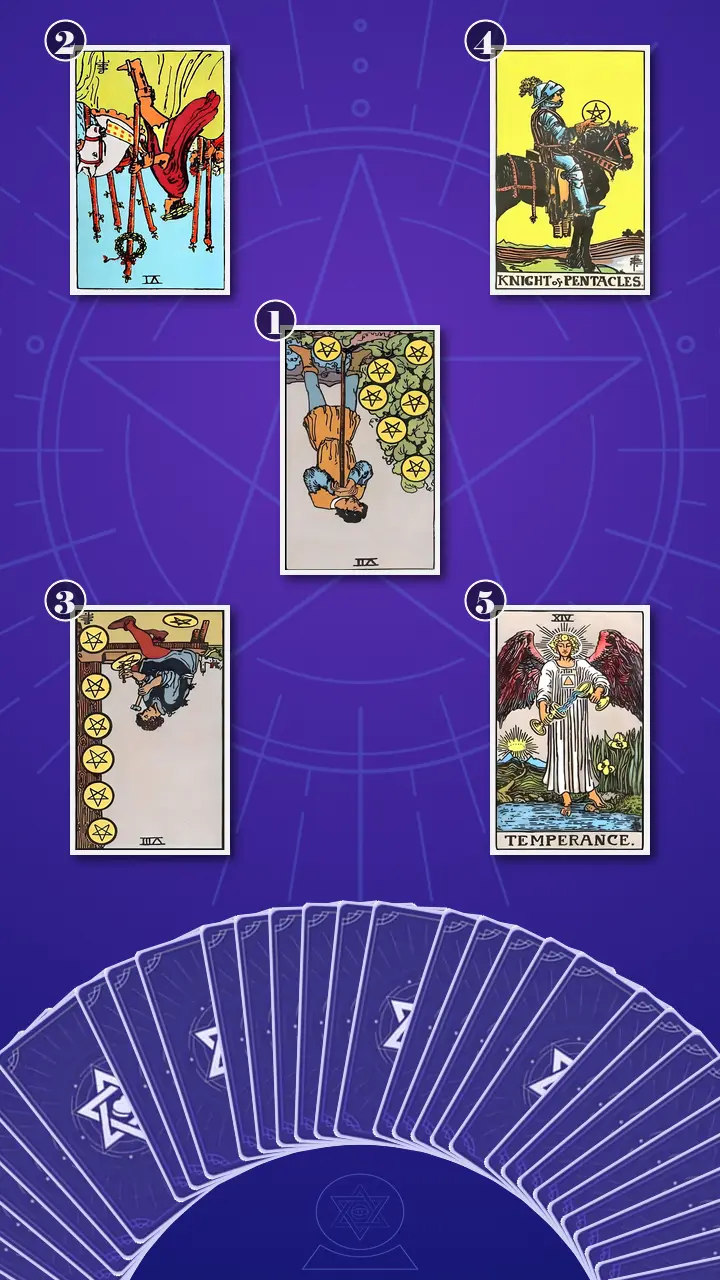
Today I used a five-card Decision Cross tarot spread. I explained to Alex, and to anyone reading along, that this spread is useful when the problem is a comparison between two legitimate priorities. It lets us examine the immediate-results path and the future-protective path side by side, then locate the point where those priorities can cooperate. It is the smallest structure here that can show motive, trade-off, practice, and integration without turning a career decision into an oversized story about destiny.
Card 1 would show the present symptom: why preparation keeps expanding when a shareable milestone comes within reach. Cards 2 and 3 would form the immediate-results branch, revealing the desire for recognition and the cost that urgency might impose on craft. Cards 4 and 5 would form the future-protective branch, showing how patience could become a repeatable practice and where a bounded result might support the deeper work. This is how tarot works in a grounded reading: the images give us a sequence for noticing patterns, while Alex decides what is accurate and what is useful.
The Harvest Already at Their Feet
Position 1: The Present Symptom and the Moved Release Date
I began at the centre of the cross. "Now turning over the card for the current symptom, the repeated preparation, is the Seven of Pentacles, in reversed position."
In the Decision Cross, this position portrays the present situation and Alex's current stance toward the choice. The Seven of Pentacles is traditionally about investment, assessment, patience, and waiting for work to bear fruit. Reversed, its Earth energy is blocked by impatience and mistrust of timing. That does not mean Alex has failed to work. It means the work has been made to wait for an impossible condition: the whole harvest must be ready before any single fruit can count.
The card's figure leans on a hoe beside a vine heavy with pentacles, while one pentacle already rests at the figure's feet. I connected that image to the two finished Figma screens in Alex's apartment. The screens were not the complete research-led portfolio, but they were a usable sample. In modern life, this is the exact moment when a finished prototype stays in draft because it does not yet carry the full case-study narrative.
I said, "This is the Notion page where every nearly finished task gains two new prerequisite tasks. It is also the moment when you look directly at completed work and tell yourself, It is real, but it is not enough. If it is not enough, showing it will cost me more than withholding it."
Alex gave a short, bitter laugh instead of nodding. "That is almost painfully accurate. It makes me sound like I am doing nothing."
I let the laugh have room. "It does not say you are doing nothing. It says the definition of finished has become so large that your effort cannot enter it. I am not going to ask you to pretend two screens are an entire portfolio. I want to ask a smaller question: what could these screens honestly demonstrate without being asked to represent your whole future?"
Alex's fingers tightened around the edge of the chair, then loosened. Their eyes moved from the card to the Figma window on their laptop. I could see the first crack in the defence: not agreement, exactly, but recognition of a specific fragment they had been withholding.
The pattern was delayed gratification turned into fulfillment stasis. Patience had stopped being a way of cultivating quality and had become a rule against receiving feedback, recognition, income, or completion. Every extra week of waiting made the next result carry more identity than it could hold.
The Wreath in the Imagined Crowd
Position 2: The Immediate-Results Path and the Need to Be Seen
I moved to the upper-left branch. "Now turning over the card for the immediate-results path, especially its need for recognition, credibility, and evidence, is the Six of Wands, in reversed position."
This position examines Option A: what Alex hopes public proof will secure and what kind of pressure that path asks them to carry. The Six of Wands normally speaks of recognition, visible achievement, confidence, and the public moment when effort is acknowledged. Reversed, its Fire is turned inward. The wish to be seen is legitimate, but it has become unstable, fed by comparison and the fear that a modest update will be read as a final professional verdict.
I brought the card into the Friday afternoon scene from the King West coworking space. Alex drafts a factual LinkedIn update about a completed research synthesis, then opens a peer's polished launch post and checks the reaction count. The familiar "I'm thrilled to announce" format makes their own three-line update look minor. They rewrite the opening six times and delete it, even though it accurately describes real progress. This is LinkedIn comparison fatigue making a progress note perform like an IPO.
"The immediate-results path is not wrong," I said. "You need client confidence. You need invoices paid. You need evidence that your practice exists. But the question is whether this update is meant to communicate useful evidence or secure a conclusive verdict of approval. Those are different jobs."
I asked, "When you imagine sending the update, whose response are you trying to control?"
Alex looked toward the window. Their shoulders rose slightly, and their mouth pulled into a small expression that held both embarrassment and relief. "Everyone, I guess. A client. A hiring manager. People who have already launched things. I want to be seen, but not if being seen means being reduced to this version."
I nodded. "That is a fair boundary. Visibility does not require surrendering the right to define the larger story. The card is not telling you to perform success. It is showing how much weight you have placed on one public signal."
The Workbench with Too Many Tabs
Position 3: The Craftsmanship Trade-Off Inside Urgency
I read the lower-left card. "Now turning over the card for the trade-off within the immediate-results path, where urgency may fragment attention or weaken craftsmanship, is the Eight of Pentacles, in reversed position."
The Eight of Pentacles represents focused apprenticeship, repetition, and technical care. Reversed, the craft energy becomes scattered. It can show empty repetition, rushed workmanship, or standards that have stopped serving mastery. In Alex's case, pressure for visible results does not create one clean deliverable. It creates four competing windows: the prototype, the case-study copy, the screenshot folder, and the personal site layout.
I described the Thursday evening I heard in Alex's account: a client asks for a progress link, the coffee beside the keyboard turns cold, and by 7:30 p.m. five assets are almost finished but none meets a defined completion threshold. The inner bargain sounds reasonable at first: "If I make the update big enough tonight, the delay will finally make sense." Then the workbench fills with almosts.
"The danger here is not that you care too much about quality," I said. "It is that the urgent need to prove progress makes the work imitate productivity. You switch between polishing screenshots, rewriting captions, adjusting tiny interface details, and reorganising files. The research-led practice you are protecting loses the deliberate rhythm that gives it value."
I tapped the row of pentacles on the card. "The row is ordered when the craftsperson can give one object enough attention. Reversed, it becomes a queue. A useful completion rule would be one artifact, one audience, and one definition of done. Not because your ambition is small, but because your attention is a material resource."
Alex glanced at the open tabs and exhaled through their nose. Their hand stopped reaching for the mouse. "I can see how I turn one delayed update into a weekend launch plan. Then I resent the plan for taking over my life."
"That resentment is information," I said. "It may be pointing to a system that asks for a dramatic sprint because it has not been given a trusted weekly unit."
The Pentacle That Could Be Carried
Position 4: The Future-Protective Path as Steady Cultivation
I returned to the centre and moved to the upper-right branch. "Now turning over the card for the future-protective path, understood as steady cultivation rather than indefinite postponement, is the Knight of Pentacles, upright."
This position examines Option B: the discipline and value Alex would choose by protecting the deeper practice. The Knight of Pentacles is reliable, methodical, and grounded in material reality. The horse is still. The pentacle is held steadily at eye level. Behind the rider, cultivated fields stretch across the landscape. This is not dramatic acceleration, and it is not a mystical instruction to wait forever. It is a repeatable cadence.
I translated the card into a practical Toronto week: Alex protects two research blocks, then reserves Friday afternoon for one accurately scoped portfolio artifact, such as an annotated user flow reviewed by one collaborator. The larger project remains open. Patience now includes a visible weekly completion instead of relying on an undefined someday when the entire portfolio will finally be ready.
"The Knight asks you to protect the future through scheduled evidence," I said. "A weekly unit is not the limit of what you can become. It is the unit you can carry without dropping the deeper work."
Alex sat back. Their shoulders lowered by a fraction, and their face lost the tight concentration it had held since the reading began. "That sounds almost too ordinary," they said.
"Ordinary is often what makes a practice sustainable," I replied. "The card is not promising a perfect pace. It is giving you a way to notice whether the pace is actually repeatable. If you miss one week, you do not create a debt that must be repaid with an all-nighter."
When Temperance Let the Future Drink
Position 5: The Bridge Between Proof and Potential
The room grew quiet when I turned the final card. Even the rain seemed to recede behind the glass. "Now turning over the card for how the future-protective path can integrate bounded present evidence with patient development is Temperance, upright. This is the bridge card in our Decision Cross."
Temperance shows moderation, proportion, and the intelligent combination of separate elements. Water moves between two cups. One foot stands on land and one in water. A path leads toward a radiant horizon. I connected that continuous stream to a weekly progress sample and the long-term portfolio: present evidence can send feedback, income, credibility, and confidence back into the deeper work. The sample does not have to consume the future in order to support it.
I said, "You have been treating visibility as if it removes value from the project. This card suggests a different question: what if a bounded share can return useful information to the project?"
At 10:40 p.m., the two screens were finished enough to show, but the cursor left Publish and returned to the roadmap. Another discovery phase appeared, the date moved again, and the future received more protection but no new contact with the world. Alex was caught between rushing a finished-looking result and withholding everything until it could carry an ideal identity.
You do not have to choose between forced harvest and endless waiting; combine one bounded proof with protected cultivation, as Temperance keeps value moving between two cups.
For a moment, Alex's thumb stopped above the laptop trackpad and their breath paused. Then their eyes lost focus, as though they were replaying the last client check-in, the deleted LinkedIn draft, and the two finished screens in sequence. Finally, a long breath moved up from their chest. Their jaw unclenched first, then their shoulders dropped, and the hand that had been gripping the chair opened slowly against their knee.
The relief did not arrive as a clean smile. Alex's eyes became bright, and their voice came out low and slightly unsteady. "But does that mean I was wrong before? I spent months protecting the future." I heard the grief underneath the question: the possibility that a useful new direction might also expose the cost of the old one.
"It means the strategy helped you survive a real pressure," I said. "It also became too absolute. You were never wrong for wanting depth. You were asking every small artifact to prove that depth forever, and no artifact can do that."
I invited Alex to look back at the previous week through this new lens. "Now, use this perspective to remember one moment when it might have felt different. Was it the client asking for a link, the banking notification beside the roadmap, or the instant you deleted the accurate update?"
I set a ten-minute timer and opened a blank note. Under the headings What this proves, What this does not prove, and What feedback could support next, Alex wrote one sentence for the two screens. We did not publish anything during the exercise. If their jaw, chest, or breathing had signalled that sharing felt too exposed, the note itself would have been enough. The choice remained theirs.
This was the first step from pressured frustration and fear of premature judgment toward grounded confidence in sustainable, visible progress. The future was not solved, and the uncertainty did not vanish. But the false choice had lost its authority. A milestone could be evidence without becoming a verdict.
A Map That Leaves the Future Open
When I placed the five cards together, I saw a coherent story. Alex had invested deeply in a research-led portfolio while working inside a freelance market that rewards quick prototypes and visible outputs. The Seven of Pentacles reversed showed accumulated work being disqualified until the total harvest was ready. The Six of Wands reversed showed the very real need for recognition becoming entangled with an imagined crowd of clients, peers, and hiring managers. The Eight of Pentacles reversed showed the cost: urgency scattered the work into a queue of almost-finished assets. The Knight of Pentacles offered a dependable unit of completion, and Temperance showed how that unit could circulate feedback back into the long-term practice.
I told Alex, "The problem is not an absence of effort or potential. It is the absence of a trusted unit of completion that connects long-term investment to present evidence. You have been tending a field while refusing to pick a sample. The sample is not the whole crop, and it is not a confession that the crop will never mature."
My first signature lens is Macro-Cycle Phase Identification. After a decade of guiding people through long cycles, I use it to locate the current phase objectively: cultivation, harvest, review, or transition. Alex's project was in a cultivation phase that still needed regular sampling. That distinction matters. A cultivation phase can explain why resistance exists, but it does not grant every postponement a free pass. I treat cycles as context, not commands.
My second lens is Systemic Friction Auditing. I asked what was actually creating resistance: uneven freelance income, clients who needed visible prototypes, a research process that produced fewer shareable artifacts, and professional feeds that displayed polished outcomes without their discarded drafts. No amount of hustle can override a genuine structural pause, but extra hustle also cannot repair a system that has never defined what completion means. The audit separated material constraints from the fear of being judged too early.
The cognitive blind spot was subtle: Alex believed a small result would take value away from future potential because other people might mistake the early version for the final one. The transformation direction was not from patience to speed. It was from withholding everything or forcing a full launch toward scheduling one bounded proof that directly supports the long-term work.
I gave Alex two small experiments. They were not tests of worth, and they were not promises that one post would transform a career. They were ways to create feedback without handing over authorship of the larger story.
- Build a Temperance Progress SampleBy Friday at 3:00 p.m., choose one completed fragment, such as two interface screens or one research synthesis slide. Place it in a clearly titled Figma page called "Progress Sample: Not Final," then send it by email or Slack to one relevant person with three lines: what is complete, what is still open, and what single kind of feedback would help the long-term project. After sending it, spend five minutes in Notion recording what the response clarified, what can be reinvested, and what will not change the project's direction.Set a twenty-minute preparation limit before opening Figma. If two screens feel too exposed, send one screenshot privately to one trusted peer. The recipient is responding to a fragment, not judging your total ability or future direction.
- Use the Orbital Sync ProtocolFor the next seventy-two hours, pause any new discovery phase, all-nighter, or release-date rewrite that is being used only to quiet pressure. Keep contractual client commitments, invoices, and necessary communication intact. Then create a recurring fifteen-minute Friday calendar block labelled "Carry One Pentacle." Protect two research blocks before it, select one visible artifact, and write one completion rule such as "Done means one annotated flow reviewed by one collaborator." Do not expand that rule mid-session.Measure whether the unit was carried through, not how impressive it looked beside a peer's launch. The minimum version is a five-minute Friday selection plus a private archive entry. Missing one week does not create a debt that requires an oversized sprint.
That seventy-two-hour pause is my Orbital Sync Protocol: a deliberate way to align psychological expectations with the actual phase and conditions of the work. It is not a command to disappear or ignore reality. It is a short interval for stopping forced actions long enough to ask which next move creates useful circulation rather than temporary relief.
I wrote the boundary at the top of Alex's note: "Show the fragment; keep the right to define the larger story." Then I added the practical sequence: one artifact, one audience, one question. The future stays open.

Friday's Quiet Receipt
Five days later, I received a message from Alex: "Sent one annotated flow. Got one useful question." They had slept through the night, then woken with the familiar thought, What if I am wrong? This time, they smiled, opened the calendar, and kept the research block.
The portfolio was not finished. The rent was not suddenly irrelevant. The comparison feed still existed, and the next client request could still tighten a jaw. But one small result had moved through the system and returned something valuable: specific feedback, a clearer next step, and proof that visibility did not have to close the future.
That was Alex's Journey to Clarity. The cards did not make the decision, and I did not make it for them. The Decision Cross made the competing needs visible; Alex chose the boundary, the pace, and the next artifact. The querent remained the person steering the present and shaping the future.
When your jaw tightens over another progress request, the choice can feel cruel: show a smaller version and risk being mistaken for it, or keep protecting a future that no one, including you, gets to touch.
A milestone can be evidence without becoming a verdict. If one small result could be an ingredient rather than a verdict, what tiny piece might you allow to exist this week?