When a Portfolio Never Feels Finished: One Submission Redefines Ready

The 8:15 p.m. Portfolio That Never Felt Finished
Jordan was a junior product designer in Toronto with enough case-study material to apply, but every promising job alert became a fresh portfolio audit before the form reached Submit. When our video consultation began at 8:15 on a Tuesday evening, their screen share showed the whole loop in one browser window: a suitable product-design role, a completed portfolio field, and a Figma tab reopened over one uneven case-study heading.
The radiator clicked through Jordan's microphone. Their laptop fan hummed beneath a Spotify focus playlist that had already reached its final track, and the blue-white screen light caught the tired skin beneath their eyes. Jordan rubbed the top of one shoulder while moving the cursor between type styles.
"I opened the role to apply," they said. "Then I pasted the link, saw that heading, and thought I should fix it first. Now I've changed three headings, recropped a thumbnail, and rewritten part of an old case study. The application is still sitting there."
I had heard versions of this pattern before, but Jordan's version was painfully specific. They meant to take an outward action, but once the possibility of evaluation appeared, they moved into a private, editable task because one more revision felt safer than being seen now. It was perfectionism-driven application paralysis disguised as quality control.
"My portfolio is almost ready," Jordan said, giving me a small, exhausted smile. "Which somehow means I still can't send it."
I watched their shoulders rise as the cursor passed over the application tab. Their apprehension felt like carrying a glass filled exactly to the rim across a crowded room: every step toward Submit seemed capable of exposing the smallest tremor. They wanted to apply now, but they also feared that applying before the portfolio felt finished would weaken how the work represented them.
"I don't think the hours you spent editing were fake work," I said. "Editing can be real work and still be the wrong work for this moment. I also don't think a tarot reading should tell you whether an employer will respond. What I can do is help us examine the pattern that takes over when visibility gets close. Let's make a map of the loop, then find one place where you can choose a different beat."
Choosing a Compass for the Moving Finish Line
I invited Jordan to close Figma, place both feet on the floor, and take one unforced breath while holding the consultation question in mind: "Why do I keep delaying applications until my portfolio feels finished?" I shuffled slowly, using the motion as a practical transition from reacting to observing. Nothing about the preparation was meant to summon a fixed answer. It simply gave Jordan's attention somewhere stable to land.
I chose a classic five-card Shadow Spread. I use this spread when a visible habit keeps repeating even though the person consciously wants a different result. It is especially useful for understanding application avoidance disguised as quality control because it follows one focused sequence: the behaviour we can see, the fear beneath it, the way that fear protects itself, the resource being underused, and the action that can integrate the insight.
For this reading, I placed the first card at the centre to show the portfolio-editing bottleneck. The second would sit above it and reveal the recognition fear beneath the delay. The third would show how withholding applications creates immediate safety. The fourth, on the right, would identify the resource capable of interrupting the loop. The fifth would ground that resource in a repeatable application practice.
I explained that this is how tarot works in my consultations: card meanings become useful only when placed in context and tested against lived experience. The cards could give us an objective structure for reflection, but Jordan would decide which interpretation fit, which boundary mattered, and what action to take. The spread was a compass, not a command.
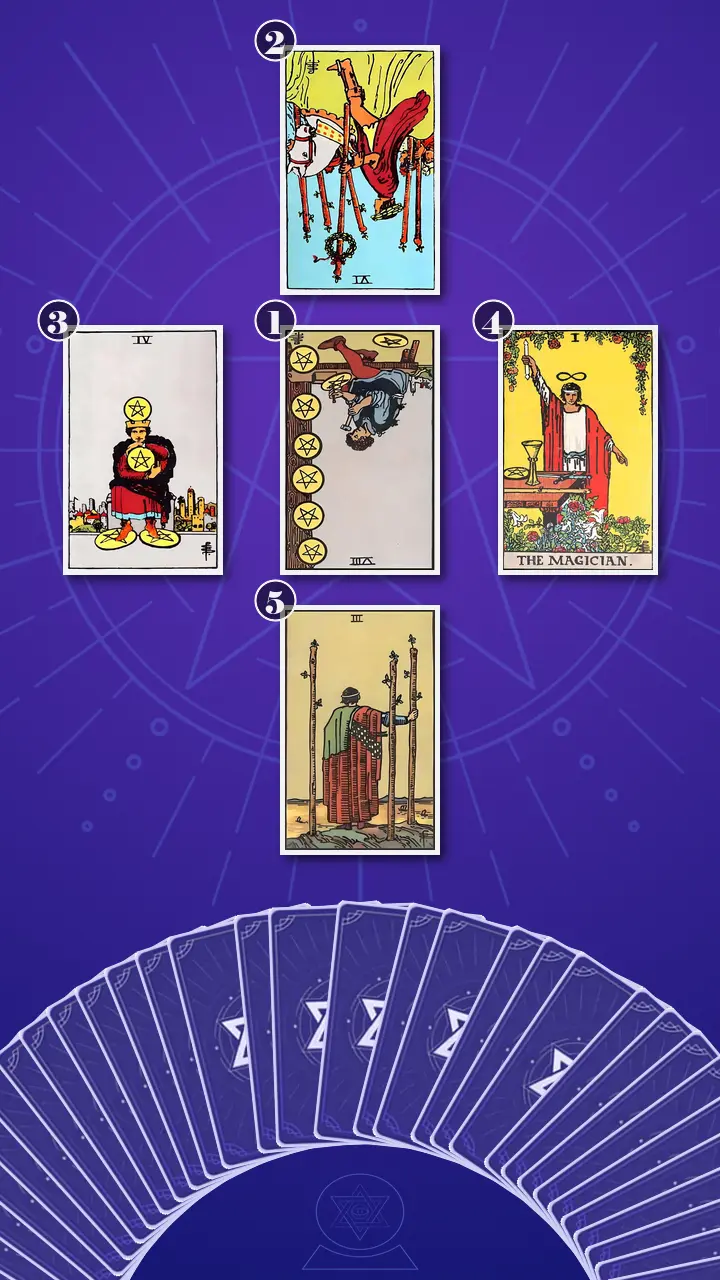
Reading the Workbench
The Repeated Edit: Eight of Pentacles Reversed
I turned the card representing Jordan's visible behaviour: revising the portfolio instead of pressing Submit, and the stagnant energy created by a moving finish line. It was the Eight of Pentacles, reversed.
In the traditional image, a craftsperson bends over one pentacle while a row of completed pieces already hangs nearby. The work is real. The skill is real. Yet the distant town remains beyond the workbench. Reversed, the card showed Earth energy in excess within one narrow channel: attention to detail had become so concentrated that craft was no longer serving movement. Useful diligence had crossed into blockage.
I pointed back to Jordan's screen. At 8:15, they had opened a suitable role, noticed one uneven heading, and spent the application block changing type, image crops, and wording. Completed case studies remained visible in the portfolio navigation, but one detail led to another. The inner logic sounded responsible: This edit is legitimate, so the delay must be legitimate too.
"The finish line moves whenever visibility gets close," I said. "That doesn't make your standards wrong. It means the definition of finished is changing in response to exposure, not only in response to design quality."
Jordan gave a short laugh, but there was no amusement in it. Their fingers froze above the trackpad; their gaze drifted from the card to the open application as if replaying several identical evenings; then a long breath left their chest and their shoulders dropped by half an inch.
"That's too accurate," they said. "Kind of brutal."
"Then let's slow it down," I replied. "The card is not accusing you of being lazy or unserious. It is showing skilled labour performing a protective job. The question is whether that job is the one you intended to do tonight."
I asked Jordan to name the smallest portfolio detail that had most recently displaced a real application. They looked at the heading on-screen and said, "Literally that. It was readable. I just didn't like the rhythm of the line break."
I nodded. "That distinction matters. A broken link would affect the application. A disliked line break might belong in an optional-later list. The card asks us to separate required craft from craft used as cover."
The Crowd in the Phone Screen: Six of Wands Reversed
I turned the card representing the underlying fear that an imperfect presentation would fail to secure recognition and might expose insufficient professional worth. It was the Six of Wands, reversed.
The upright card depicts a laurel-crowned rider moving through a watching crowd. Reversed, its Fire energy was deficient and turned inward. The healthy wish to be respected had become a demand to secure respect before taking the risk of visibility. Jordan was asking the portfolio to guarantee the audience's response before the audience had even seen it.
I asked whether something had recently intensified the flaw-scanning. Jordan told me about Monday morning on TTC Line 1. Between station stops, a former classmate's LinkedIn post had appeared: a new design role, a polished profile, hundreds of congratulatory reactions. As the train braked into Bloor-Yonge, Jordan had opened their own portfolio and started removing wording that suddenly seemed too junior.
"Their public profile looked complete," Jordan said. "Mine looked like a draft."
I watched their jaw tighten. Their breath paused; their eyes lost focus for a second as the commute replayed; then they looked back at me with a quieter expression. The desire beneath the comparison was not shallow. Jordan wanted their work to be recognised. The problem was that somebody else's edited announcement had become the admission standard for Jordan's unfinished private process.
"A LinkedIn launch post is the final frame of somebody else's sequence," I said. "You were comparing it with your live Figma file and treating the difference in presentation as a difference in worth. That is like requiring five-star reviews before listing the product."
I asked, "When your cursor gets near Submit, what exact verdict are you trying to prevent? That the work looks junior, inconsistent, unclear, unimpressive, or something else?"
Jordan was silent before answering. "That they'll see the weak point and decide I'm not as good as I think I am."
"That fear explains why one heading suddenly carries so much weight," I said. "It stops being a heading. It becomes a witness in a trial about your entire professional value. No layout detail can safely carry that assignment."
The Pass Held at the Gate: Four of Pentacles Upright
I turned the card representing the protective strategy: withholding applications to preserve control and gain temporary relief from evaluation. It was the Four of Pentacles, upright.
The figure in this card presses one pentacle against the chest while two more pin the feet in place. In a different context, that conservation could be balanced and wise. Here, control had become excessive. The same completed work Jordan was protecting also prevented movement toward the hiring context it was created to serve.
I connected the image to Jordan's crowded Saved column and nearly empty Applied column in Notion. The roles remained possible because they had not been submitted. The case studies remained perfectly editable because no recruiter had interpreted them. For one more evening, nobody could misread the work, reject it, or decide what it said about Jordan.
"It is like gripping a transit pass so tightly that you can't tap it at the gate," I said. "You preserve the balance, but you also prevent the journey."
Jordan's hand closed around their mug, tightened, and then loosened. "As long as I haven't sent anything, I can tell myself the right version would have worked."
"Yes," I said. "Withholding protects that possibility. I want to say the next part carefully: you are not protecting the portfolio; you are protecting yourself from an answer. That protection makes sense in the short term. It also guarantees that no real answer, including a neutral or encouraging one, can arrive."
I did not ask Jordan to abandon discernment or apply indiscriminately. Control has legitimate uses, especially when a role is unsafe, exploitative, discriminatory, or plainly misaligned. The card was asking a narrower question: when the role is suitable and the essential evidence works, what is the current grip costing?
When the Magician Opened the Table
On Jordan's side of the call, the radiator stopped clicking. The sudden quiet made the room feel wider as I turned the card representing the lesson and reclaimed resource within the shadow: the shift from complete polish to resourceful agency.
It was The Magician, upright.
The four suit tools were already arranged on the Magician's table. I translated them into Jordan's actual working materials: two strong case studies, a functioning portfolio link, role-specific language, product judgment, and the ability to discuss design trade-offs once a conversation began. The card carried balanced, integrated energy. Nothing on the table claimed to be a finished identity. Each tool was simply available for purposeful use.
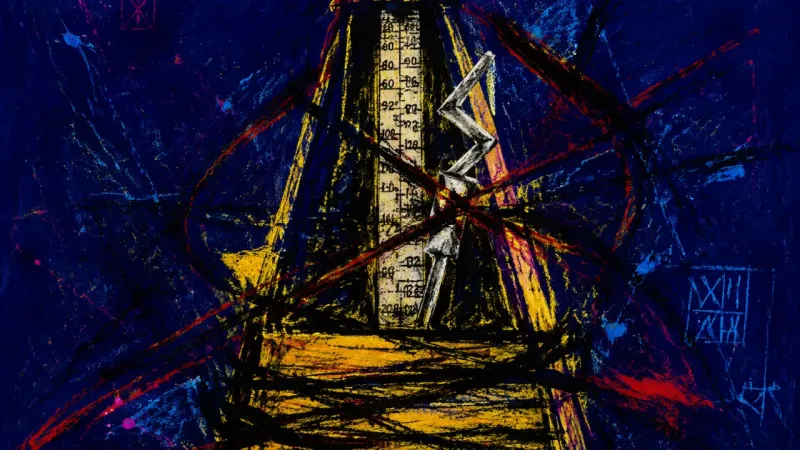
My mind flashed to the sound waveforms I had studied over ten years of sound energy research. I was not looking at a lack of ambition. I was looking at ambition and daily execution running at incompatible tempos. Jordan's wish to apply moved at one psychological BPM, while the approach of evaluation triggered a frantic second tempo made of headings, crops, rewrites, and feedback requests.
I call this a Tempo Misalignment Audit. I listened for the point where the intended rhythm broke: the portfolio field appeared, Jordan's shoulders rose, and a bounded application became an unbounded redesign session. In musical terms, Submit was supposed to be the downbeat. Optional edits had become elaborate fills that never resolved into the next measure.
The Execution Rhythm Calibration was equally clear. Jordan did not need more total capacity; they needed a stopping rule at the exact friction point where ambition became exposure. Their workflow had behaved like a software product trapped in perpetual beta: one more UI fix always appeared before launch, so no actual user behaviour could inform the roadmap.
I brought Jordan back to the scene we had started with. At 8:15 p.m., the saved role was still open while they resized a case-study heading in Figma. The radiator clicked, the screen burned their eyes, and the application felt one tiny edit away, just as it had the previous week.
You are not waiting for one final tool to make you legitimate; use what is already on the Magician's table and turn present ability into a real submission.
I let the sentence remain between us without filling the silence.
For a beat, Jordan stopped breathing. Their eyebrows drew together, their pupils widened slightly, and one hand stayed suspended above the keyboard. Then their fingers curled into their palm as the meaning began to settle. "But doesn't that mean I've spent months solving the wrong problem?" they asked, their voice suddenly sharper. The anger lasted only a second before grief moved underneath it; their eyes shone, and they looked away from the screen. I waited while their fist slowly opened. Their shoulders descended, followed by a shaky exhale that sounded almost like a laugh. The relief was visible, but so was the brief dizziness of having a clearer path and therefore a real choice. "I don't know whether that feels freeing or terrifying," they said. I told them both responses could be honest. The previous work was not wasted; it had built the tools on the table. It simply did not need to remain the price of admission forever.
"Now, using this new perspective, think back to last week," I said. "Was there a moment when this insight could have made the situation feel different?"
Jordan remembered Sunday afternoon at a Queen West cafe. Four job tabs had been open behind the portfolio editor while rain tapped the window and the espresso grinder cut through their headphones. They had spent nearly an hour recropping one thumbnail.
"Two of the case studies already matched the role," they said slowly. "The link worked. I could have explained the rest in the application."
"Exactly," I said. "Your portfolio does not have to prove your complete professional worth; it only has to provide enough relevant evidence for this application to move forward. Your portfolio is evidence, not a final verdict on your professional worth."
I named the movement I could see beginning. This was not instant confidence, and it was not a promise of recognition. It was the first step from apprehensive flaw-scanning and protective withholding toward resourceful agency, evidence-led learning, and steadier self-trust. Jordan was moving from waiting for readiness to feel complete toward choosing a bounded definition of ready for one honest use.
The Ships Beyond the Workbench: Three of Wands Upright
I turned the final card, representing practical integration through a fixed readiness standard, a small submission batch, and revisions informed by real rather than imagined feedback. It was the Three of Wands, upright.
The figure stands above open water while ships are already moving beyond the point of origin. This was Fire in a balanced, outward form. The Magician had arranged available resources around one intention; the Three of Wands allowed the resulting work to leave the private workspace and enter a wider field.
I translated the card into a simple scene: Jordan would send one or two suitable applications with the current portfolio, record the dates in a small tracker, and schedule a later review. Responses, recruiter questions, and even silence could become limited pieces of information. None would be permitted to stand as a complete measurement of Jordan's worth.
"Once an application leaves your workbench, you cannot control every interpretation," I said. "But you can observe what actually happens. Let real feedback outrank imagined flaws."
Jordan sat forward. I saw them open their Notion tracker, then stop before adding another portfolio task. "I could move one role from Saved to Applied and review the evidence next week," they said. Their voice still held caution, but curiosity had entered it too.
"That's the card's invitation," I replied. "Not a huge launch. Not guaranteed success. One bounded release, followed by observation."
The Application-Ready Floor
I read the spread as one continuous system. The reversed Eight of Pentacles showed genuine skill trapped in repetitive refinement. The reversed Six of Wands revealed why the repetition intensified whenever Jordan might be seen: an imperfect artefact felt capable of exposing insufficient worth. The Four of Pentacles then turned withholding into a form of immediate control. The Magician reclaimed the portfolio as a tool, and the Three of Wands placed that tool in motion where actual information could finally reach it.
The central conflict was never quality versus carelessness. It was the desire to submit credible work now versus the hope that enough private polish could remove the vulnerability of public evaluation. Jordan had kept the shop window permanently under construction so nobody could judge the display. The construction was real, but the shop could not perform its purpose while the door remained closed.
I identified the cognitive blind spot plainly: Jordan had been treating the discomfort of visibility as evidence that the portfolio was objectively unready. Because discomfort increased near Submit, the definition of done gained a new checkbox whenever the previous one was completed. No amount of unbounded editing could satisfy a standard generated by exposure itself.
The transformation direction was practical. Applications and portfolio revisions could proceed in parallel. A fixed Application-Ready Floor would replace felt readiness, and one bounded submission would use the strongest evidence currently available. Later revisions could respond to broken links, unclear questions, repeated role requirements, or other observable signals instead of an imagined audience's every possible criticism.
Jordan raised a practical concern. "What if I notice something genuinely broken during the check? I'm worried I'll use the rule to rush past a real issue."
"Then the rule needs categories, not denial," I said. "Access failures, inaccurate facts, confidentiality risks, and role-relevance problems can override the cap. Aesthetic preferences and broad redesign ideas go into an optional-later list. A boundary should improve judgment, not silence it."
I shaped the next steps around my Syncopation Reset, a three-day tempo adjustment experiment. The purpose was not to force Jordan into a hustle rhythm. It was to break one overwhelming application session into smaller beats that their actual daily capacity could hold.
- Day One: Run the 10-Minute Portfolio Deployment Check.On one weekday evening, open one suitable saved role and create a three-item Application-Ready Floor in Notes or Notion: two relevant case studies are live and readable, all required links work, and the application includes role-specific context. Name which two case studies already support the role, then paste the current portfolio link into the form before opening Figma.If the check produces redesign ideas, place them in a parking-lot note. For the minimum version, check one link and name one case study that already supports the role.
- Day Two: Give the Current Evidence One Defined Job.In the application document, spend 15 minutes writing three sentences: name the role, connect one current project to a stated responsibility, and identify one contribution Jordan could discuss in an interview. If the three-item floor is met and the role remains suitable, submit within that session even while optional visual changes remain parked.A genuine accessibility, accuracy, confidentiality, or safety concern can pause submission. Otherwise, use the stopping question: "Useful for this application, or optional for later?"
- Day Three: Move the Role to Sent and Schedule the Evidence Review.Record the role, date sent, response status, and any useful questions in a simple tracker. Schedule one 20-minute review for seven days later, when portfolio changes may be considered only from observed issues or recurring role requirements. Then close the editor and take a short walk or make tea before checking email again.Use a batch of one if two applications feel too exposed. No response is limited hiring-process data, not a complete evaluation of professional worth.
"This is rhythm calibration, not a personality transplant," I told Jordan. "The aim is not to become someone who never feels exposed. The aim is to make one chosen action possible even when that feeling appears."

A Week Later, One Role in the Sent Column
Six days later, I received a short message from Jordan. They had run the Portfolio Deployment Check on one role, pasted the link before opening Figma, written the three-sentence introduction, and submitted. Their Notion tracker now had one entry in the Applied column.
There was no dramatic announcement and no instant promise of a new job. Jordan had noticed an optional spacing issue ten minutes after submitting and felt the old urge to interpret it as a disaster. Instead, they added it to the parking-lot note and kept the scheduled review date.
That night, Jordan slept through until morning. Their first thought was still, What if I got it wrong? They told me they smiled, made coffee, and left Figma closed.
I considered that the quiet proof of our Journey to Clarity. The reading had not removed uncertainty or manufactured an outcome. It had made the internal rhythm audible enough for Jordan to choose a different beat. The cards supplied a map; Jordan established the readiness floor, pressed Submit, and allowed present ability to enter the real world.
I keep returning to the moment when Jordan's cursor approached Submit and their shoulders climbed toward their ears. When work matters deeply, fixing one more heading can feel safer than letting it be seen before it can guarantee professional worth. If that happens to you, noticing the rhythm change is already a meaningful first beat. You do not have to solve your whole career to recognise which task is asking for your agency today.
If your portfolio only had to support one honest application rather than prove your entire professional value, which tool already waiting on your Magician's table could you let speak today?