Placing an Entryway Tray: From Rental Limbo to Cautious Belonging

The Waiting-Room Apartment and the Boxed-Up Life
If you are a late-twenties hybrid worker in a high-rent city who has lived beside the same unpacked art for two lease cycles, your rental permanence anxiety may look less like indecision and more like waiting for permission to live there.
At 10:14 on a Saturday morning in a Toronto one-bedroom, Maya (name changed for privacy) knelt beside a storage box and held two framed photos against the bare living-room wall. The radiator clicked behind her, her cold coffee tasted bitter on the sill, and her phone grew warm in her hand while she compared removable hanging strips. I watched her shoulders creep upward as she asked herself, "But what if I am packing again in six months?"
Maya told me she worked as a hybrid marketing coordinator and spent several weekdays in the same apartment she had never fully allowed herself to inhabit. The artwork stayed boxed, useful purchases remained in online carts, and the entryway was still a small pile of keys and mail. "I keep acting like my real life starts at the next address," she said. "I want this place to feel like home, but I keep postponing the choices that would make it feel like home. What if I spend the money and then have to move again?"
The longing in her had the texture of a low electrical hum under the floorboards: never loud enough to demand attention, never absent enough to let her rest. Each unfinished corner tightened her shoulders and quietly told her that she was failing to settle, while the thought of caring for a temporary home made her feel as if she were taking a risk she could not reverse.
I am Esmeralda Glen, and at sixty-seven, as the seventh generation of a Highland healing family, I have learned to respect both uncertainty and the body's need for a place to land. I said, "I hear the conflict. You are not short on ideas, and you are not careless with money. You are trying to protect yourself from wasted effort while living inside the cost of that protection. We will not force a decision about your lease today. We will use the cards as a mirror, draw a map of the pattern, and look for one form of comfort you can choose without pretending this address is permanent."

Choosing a Map for Finding Clarity
I asked Maya to put her phone face down, feel both feet against the floor, and name the question she wanted the reading to hold: why did she keep postponing making her rental feel like home? She took three unhurried breaths while I shuffled. The preparation was not a test of mystical concentration. It was a small transition out of browser tabs, lease calculations, and the pressure to solve everything at once.
For this reading, I chose the Transformation Path Grid · Context Edition, a six-card Transformation Path Grid tarot reading for deferred comfort and rental belonging. I chose it because Maya's question was not simply whether she should buy a lamp. It was about a feedback loop: uncertainty about the rental led to delayed decorating, the delay kept the apartment impersonal, and the impersonal room seemed to prove that investing in rentals was pointless. This layout lets me examine the loop as a system without turning a card into a prediction.
This is one grounded way of understanding how tarot works. The cards do not decide whether Maya renews her lease, promise a particular home, or replace a budget and a tenancy agreement. They organize attention. The first card shows the visible manifestation gap, the second identifies the immediate blockage, and the third reveals the rule underneath it. The lower row offers a catalyst, a practical experiment, and an integrated capacity. In other words, the spread moves from "What is happening?" to "What keeps it happening?" and then to "What could I test in ordinary life?"
I laid the cards in two rows of three, with the upper row moving from left to right and the lower row returning across the room in a switchback. I described it to Maya as a compact floor plan: the upper rooms contained the postponement system, and the lower rooms were where the space could become inhabitable. The route would take us from the current state to the blockage, the root rule, the key trigger, the action plan, and finally a form of belonging that did not depend on guaranteed tenure.
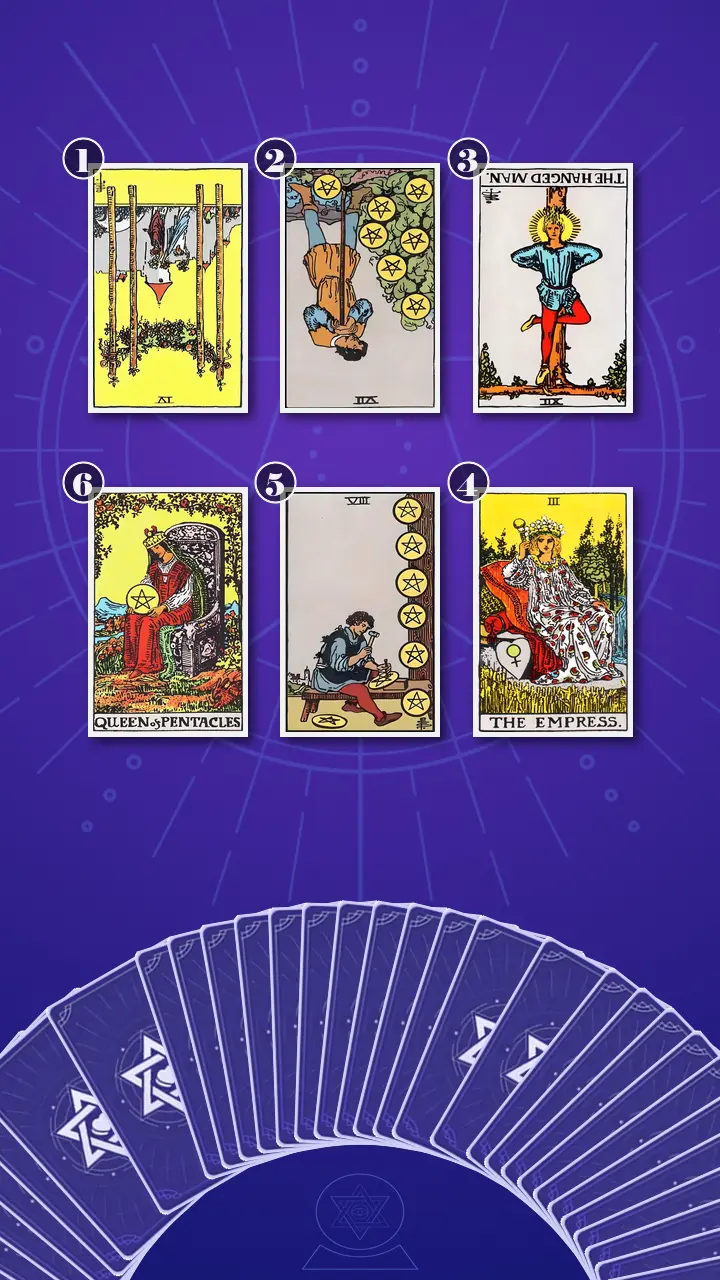
Reading the Rooms We Keep Waiting to Enter
Position 1: The Threshold She Would Not Cross
I said, "The card now turned is the one representing the present, observable manifestation gap: the rental is functional, but visibly unfinished because you keep postponing unpacking, decorating, and welcoming rituals."
I turned over the Four of Wands, in reversed position. In the Rider-Waite-Smith image, a flowered garland hangs between four upright staffs, and two figures raise bouquets beneath it. The structure for welcome is already there. Reversed, the fire of celebration and arrival is interrupted. The card does not say that Maya lacks taste or that her apartment is objectively inadequate. It shows a threshold that could be used but has not been fully crossed.
I connected it to the scene I had just witnessed. She could host a friend, work in the living room, and move through every functional zone, yet the framed photos remained in their box and the entryway had no intentional place to rest her keys. When a friend visited, Maya apologized for the bare room. "I want this place to welcome me," she said, "but making it welcoming feels too much like claiming it."
The reversed energy here is a blockage of present-tense habitation. She has shelter, furniture, and enough ideas to begin, but the gestures that turn a usable apartment into an inhabited home stay suspended. This is the visible gap between wanting warmth and withholding the small actions that produce it. The distant buildings in the card felt especially precise to me: home was visible as an idea, while Maya kept herself just outside the celebration.
Maya did not nod. She gave a short, rueful laugh and rubbed the edge of the cardboard box with her thumb. "That is almost rude," she said. "I really do say sorry for the room before anyone has even sat down." I let the laugh stand. There was no shame to extract from it. I only asked, "When you come home after work, which exact corner fails to give your body somewhere to land?"
Position 2: The Return-on-Investment Trap
I said, "The next card represents the immediate delayed-gratification blockage: you require a guaranteed long-term return before allowing modest present comfort."
The card was the Seven of Pentacles, in reversed position. The worker in the image leans heavily on a tool while staring at an unfinished harvest. Upright, the card can describe patient investment and assessment. Reversed, patient assessment has become restless calculation. The growing vine is not empty, but the worker cannot experience its value because the final harvest date is unknown.
I translated the image into the browser Maya had described to me: twelve tabs for portable lamps, washable rugs, no-drill hooks, resale listings, delivery fees, and moving costs. She might find a lamp within budget, then calculate its cost per month under three possible move dates, compare eight alternatives, read a Reddit thread about renter-friendly lighting, and close every tab. The harsh ceiling light would remain above her chair. Her useful caution would have quietly become another uncomfortable evening.
I told her, "Cost-conscious is a boundary; endless calculation is a holding pattern." The distinction mattered. I was not asking her to ignore rent pressure, buy a whole decor scheme, or treat a modest purchase as a moral referendum. I was pointing to the exact moment when the demand for portability, affordability, durability, usefulness, and aesthetic perfection became impossible for any ordinary object to satisfy.
Maya's chest tightened before her expression changed. Her hand moved toward her phone and stopped above it, as if an abandoned shopping tab were still glowing there. "I really do turn every small comfort into a return-on-investment problem," she said. Her voice carried frustration, but also relief at having a name for the mechanism. I watched her write a single line in her notes: "Present usefulness versus guaranteed future return."
Position 3: The Loading Screen That Never Reaches 100%
I said, "This card represents the underlying root: the rule that treats the current lease as a holding period that does not yet deserve your full participation."
I turned over The Hanged Man, in reversed position. The suspended figure has an illuminated head and a calm face, but his body remains fixed to a living wooden beam. A pause can offer perspective. Reversed, the pause has overstayed its purpose and become a lifestyle rule. Maya already understood that the bare apartment affected her mood, yet the understanding had never reached her hands.
I used the loading-screen analogy because I had heard the same sentence underneath every postponed task: "Once I know whether I am staying, then I can unpack the photos. Once I know the rent, then I can fix the lighting. Once I know the next address, then I can make a reading corner." The lease renewal had become a loading bar that had to reach 100 percent before ordinary life could begin.
"Waiting is useful when it creates new information," I said. "But if the lease decision is not changing and the same tasks remain deferred, waiting is no longer neutral. It is maintaining the distance between you and your current life."
I felt an old professional association rise in me then. Across sixty-seven lived seasons, I have watched people mistake stillness for safety simply because movement carries visible risk. A winter pause can protect a field, but a pause that never returns anything new is no longer rest. The body often notices this before the mind approves it: the lifted shoulders, the jaw that stays locked, the cold floor crossed without a comfortable landing place.
Maya became quiet and set her phone aside. Her eyes moved from the suspended figure to the framed photos beside her chair. "The lease decision has become permission," she said slowly. "I keep waiting for it to tell me whether I am allowed to participate in my own life." I did not rush to soften the sentence. The recognition had to be hers.
When The Empress Turned Care Into Permission
Position 4: The Care Already Available
The room grew still when I reached beneath the top row. I said, "This is the key trigger: the resource that can challenge the fear of wasted investment by legitimizing embodied care inside the space that exists now."
I turned over The Empress, in upright position. Wheat surrounds her cushioned seat. Water moves beside dense greenery. Nothing in the image is waiting for ownership papers before it becomes nourishing. The Empress is not a command to spend more. She is present-tense care, sensory support, creative resourcefulness, and permission to receive comfort while life is still in progress.
Here I used my Somatic Fatigue Diagnosis, a personal analysis lens that bypasses mental rationalization and listens to the body's burnout signals and physical friction in its daily environment. I asked Maya to compare two questions. The first was, "What will this item be worth if I move in six months?" The second was, "What is my body meeting every evening right now?" The answer was immediate: harsh overhead light, cold feet, nowhere to set a drink, work clutter in view, and a chair that could support rest but was usually covered with laundry.
I said, "The body is not asking you to prove that you will stay. It is reporting what would help you function tonight. Maybe this is not about whether the apartment deserves care. Maybe it is about what your body needs while you live here." The Empress moved the reading from status display to sensory support, from permanent ownership to current nourishment. One lamp, one soft washable textile, one cleared surface, or one meaningful object could be a response to a real need without becoming a promise about the lease.
It was Saturday morning: two frames were resting against the wall, removable-strip reviews were open on Maya's phone, and she was already calculating a future move. The room could feel warmer that day, but uncertainty kept sending everything back into the box. She was caught between "I must know I am staying before I put in effort" and the quieter evidence of her own shoulders asking for one kinder evening.
You do not have to earn comfort through permanence; practice care now, as The Empress turns the environment already around her into a place that sustains life.
I let the sentence settle, then added the wider frame: You do not have to prove an address will last before you let it support the life already happening inside it.
Her breath stopped halfway through an inhale. For one second, her fingers hovered above the edge of the card and her eyes fixed on the garland. Then her gaze went soft and distant, as if the bare wall, the lease email, and every closed tab were replaying in a silent strip. A small flare of resistance crossed her face. "But if I let myself care now, doesn't that mean I was wrong to wait?" Her jaw tightened, then her shoulders dropped by a fraction. She opened her hands, which she had been pressing into her knees, and released a breath that sounded almost like a laugh. Her eyes shone, but she did not look frightened. She looked at the frame in the box as if it were an available choice, not a test. Her voice came low and uneven: "Maybe my body doesn't need a guarantee. Maybe it needs one kinder evening."
I asked, "Now use this new view to remember last week. Was there a moment when this insight could have made the evening feel different?" Maya looked toward the lamp she had been avoiding and gave a small, uncertain smile.
I named the crossing carefully: from detached longing and rental permanence anxiety toward grounded belonging through present-tense care. It was not a leap, and it did not settle the renewal question. It was the first move from withholding comfort until housing felt permanent to allowing one reversible act to answer the life already taking place inside the rental. Belonging can be practiced without being promised.
The Craft of One Finished Corner
Position 5: The One-Corner Definition of Done
I said, "This card represents the action plan: translating present-tense care into one low-cost, reversible home-making task completed each week."
The card was the Eight of Pentacles, in upright position. An artisan works on one pentacle while completed examples hang nearby. The image is deliberately ordinary. It does not promise a dramatic makeover. It shows that skill and satisfaction can develop through bounded work that is visible, countable, and repeated.
I connected it to Maya's project board and calendar. Her apartment did not need a full rebrand, a perfect Pinterest mood board, or a weekend of expensive purchases. She could place a thirty-minute appointment on Saturday titled "Hang one print" or "Make the entryway usable" instead of "Work on apartment." The difference was more than wording. The first task had one owner, one stopping point, and one definition of done.
"Do not redesign the apartment; finish one supportive corner," I said. "Let completion teach you more than another hour of browsing." The upright earth energy gave her a way to move without pretending the future was known. The work could be zero-dollar, lease-safe, removable, and useful for the next six evenings.
At this point I brought in my Organic Routine Restructuring approach. Rather than building a lifestyle around an artificial social-media clock or an imagined perfect Saturday, I asked Maya to build a small rhythm around her biological needs: a place to decompress after work, a surface for an evening drink, better light during hybrid workdays, and a realistic amount of energy for a Saturday morning. The home-making practice would support her life instead of becoming another performance she could fail.
Maya opened her calendar. Her thumb hovered, then entered "Display one framed photo, 30 minutes, zero dollars." She did not add a second task. I watched her stop before the familiar all-at-once response could take over, and I felt the reading become practical.
The Steward Who Can Move With Her
Position 6: Belonging as Portable Stewardship
I said, "This final card represents the integrated outcome: the capacity to balance financial limits with repeatable stewardship and experience belonging without requiring permanence."
I turned over the Queen of Pentacles, in upright position. She cradles the pentacle within a flourishing but bounded enclosure. Her comfort is not careless abundance, and her caution is not deprivation. She uses what she has with attention. The garden has limits, yet it is alive inside them.
For Maya, this was not a prediction that the apartment would finally become perfect or that the next lease would be secure. It was an image of a skill she could carry between addresses: choosing portable, useful objects when they meet a real repeated need; keeping a realistic budget; following landlord rules; and letting familiar objects and routines become visible without interpreting them as a promise to stay forever.
I said, "The question is no longer whether this address is permanent enough to deserve your life. The question is whether your space, within its actual limits, supports the hours you are already spending there. A temporary address still contains permanent hours of your life."
Maya looked down at the Queen holding the pentacle close. Her face did not brighten into certainty. Instead, her expression became steadier, with a trace of grief for the months she had spent living beside unopened boxes. "I want to feel settled without pretending this place is permanent," she said. That was the integrated direction: cautious ownership rather than denial, care without overcorrection, and grounded belonging as something she could practice rather than wait to receive.
From a Lease Question to a Lived-In Practice
When I placed all six cards together, the story was clear. The reversed Four of Wands showed the unused threshold: the apartment could welcome Maya, but her objects and rituals stayed outside it. The reversed Seven of Pentacles showed the stalled return calculation: every lamp, rug, or shelf had to justify itself against an unknowable moving date. The reversed Hanged Man showed the deeper rule that kept the present on hold. Then The Empress restored sensory care, the Eight of Pentacles turned that care into bounded practice, and the Queen of Pentacles integrated it into portable stewardship.
The cognitive blind spot was not that Maya cared too much about money or that she needed to become more decisive. It was that she was asking a small purchase to solve an unanswerable housing question. She had made comfort wait for certainty, then used the absence of comfort as evidence that the rental was not worth inhabiting. Tarot made the loop observable, which gave her a point of choice. The key shift was simple: move from withholding comfort until housing feels permanent to completing one low-cost, reversible home-making task each week.
Before we chose the first task, I offered Maya my Grounding Disconnect Protocol. I asked her to stand by the window, or sit with her feet supported if standing was not comfortable, notice one tree, patch of sky, or living plant, and feel three points of contact with the floor or chair. She pressed and released her toes, loosened her jaw, shook out her hands, and took a longer exhale. The nature-based practice was a physical way to discharge the day's accumulated pressure before asking herself to make a choice. It was not a ritual that guaranteed motivation. It was a gentle interruption to nervous-system overactivation.
I wrote down three options and reminded her that a smaller version was still a valid version. Nothing required debt, property damage, forced positivity, or pretending that rent pressure was imaginary.
- Run the ten-minute sensory friction checkTonight, stand or sit in the room you use most and name one physical problem your body notices: glare, cold feet, nowhere to set a drink, work clutter in sight, or a missing place for keys. Use something already in the apartment to address it for the next six evenings by moving a lamp, laying out a stored blanket, repurposing a tray, or clearing one surface. Take one before-and-after photo for your own reference.Keep the budget at zero and stop when ten minutes ends. If ten minutes feels like too much, use the two-minute version and move one object. Adapt the practice to your accessibility needs.
- Book one thirty-minute home practiceAdd one appointment to this week's calendar with a finished result, such as "Hang one print" or "Make the entryway usable." Before it begins, place only the required tools together: removable strips, a measuring tape, a cloth, and the single object involved. Use lease-compliant, removable methods, or choose a freestanding alternative when the wall or lease terms are unclear.Write a one-sentence definition of done and stop when the task is complete. Do not let one frame become a gallery-wall project. Record the next idea in one line and leave it for another week.
- Use the portable stewardship filterIf a purchase still seems useful, give it fifteen minutes and write three lines: what immediate need it serves, how often you will use it this week, and how you could move it later. Check one local secondhand source such as Facebook Marketplace, Kijiji, a neighbourhood Buy Nothing group, or a charity shop, and keep your chosen spending limit firm.An item only needs to be needed often, affordable now, lease-safe, and reasonably movable. Borrowing, improvising, postponing, or buying nothing are all legitimate choices when the object does not meet a real need.

A Week Later, the Quiet Proof
Six days later, I received a message from Maya with a photo of her entryway. She had moved a small tray she already owned beside the door, placed a postcard she liked on it, and made room for her keys. "It took four minutes," she wrote. "I came home after a long day and the corner looked like it was expecting me." The rest of the apartment was still unfinished. The framed photos were not all on the wall, and the lease question remained open.
She also told me that she had slept a full night after completing the first task, but woke with the familiar thought, "What if I get this wrong?" This time, she smiled at it. The uncertainty had returned without taking the whole room with it.
I did not tell Maya that the cards had fixed her apartment. I told her that they had helped her see a pattern clearly enough to choose where to interrupt it. The reading had been a mirror and a practical map, but Maya remained the person with the hands, the budget, the lease, and the authority to decide what her life needed next. Finding clarity did not require certainty. It required one honest act of care that let the present become visible.
When every bare wall makes your shoulders tighten, it can feel as though you must choose between caring for the life you have now and protecting yourself from the pain of knowing it may not stay. If this address did not have to prove it was permanent, what is one small, lease-safe way you might let it support you this week, perhaps by unboxing one photo, moving one lamp, or clearing one surface?