Career Opportunity FOMO at 9:40 p.m.
A peer’s “thrilled to announce” promotion post had turned what should have been a quiet Thursday into career opportunity FOMO by the time Jordan (name changed for privacy), a 28-year-old UX researcher, sat across from me.
As Jordan described the previous evening, I could see the scene almost frame by frame. At 9:40 p.m., they had been standing beside the cloakroom of a Shoreditch event space with their jacket folded over one arm and the last convenient Tube glowing on a phone warmed by constant use. Bass vibrated through the floor. Glasses clinked behind the bar, and the room smelled of wine, citrus, and damp coats.
Then a new circle formed near the bar. Jordan locked their phone, ordered another sparkling water, and introduced themself again.
“I’d already hit my limit,” they told me. “But every time I leave early, I wonder whether the useful conversation happened ten minutes later. I call it investing in my future, but my body experiences it as another shift.”
I watched their jaw tighten as they spoke. Their shoulders had crept toward their ears as if their body were still bracing against the venue’s noise. The apprehensive urgency felt like a Tube-door warning tone lodged in the nervous system: go now, go now, go now, while the mind kept insisting that the career express might be the next arrival.
“What future payoff keeps me networking past my social limit?” Jordan asked. “I want a career network, not a second unpaid job.”
“Your social limit is data, not a verdict on your ambition,” I said. “I’m not going to tell you that networking is meaningless, or that leaving one event will magically solve the pressure. I want us to identify what another introduction is promising you, what fear makes that promise compelling, and what kind of networking rhythm you could actually maintain. Let’s draw a map through the fog.”
Choosing the Corridor: The Four-Card Shadow Spread
I asked Jordan to place both feet on the floor, take one unforced breath, and say the question once without trying to improve it. I shuffled slowly. I use this brief pause as a transition for attention, not as a mystical test or a demand that anyone suspend critical thinking.
I chose a four-card Shadow Spread. Jordan was not comparing two defined career options, so a decision spread would have forced the wrong structure onto the question. A larger Celtic Cross would have added situational layers without necessarily clarifying the compact reward-and-fear loop already visible in their behavior.
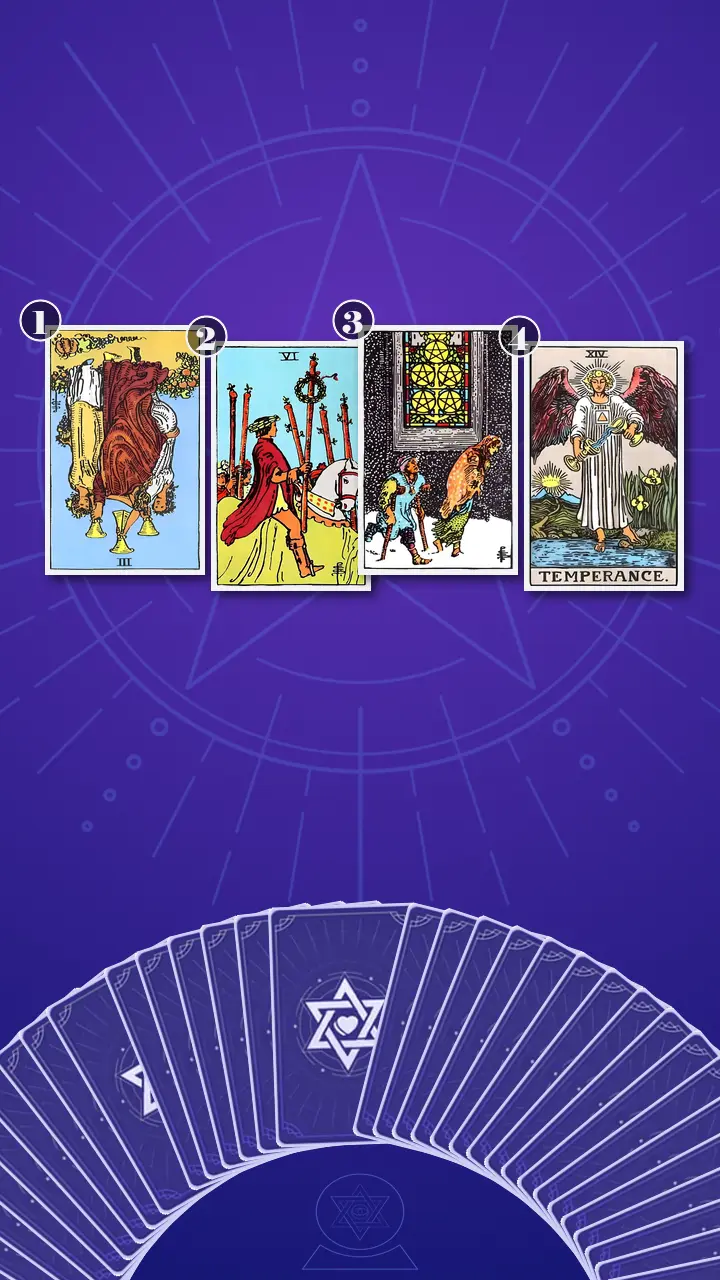
The Shadow Spread was the smallest map that could hold the whole pattern. The first position would show the presenting shadow: the observable moment when networking became overextension. The second would reveal the hidden reward that made the extra effort feel worthwhile. The third would expose the protected fear beneath that reward. The final position would offer integration, preserving Jordan’s ambition while giving it a sustainable form.
I placed the cards in a horizontal line. To me, the arrangement looked like a corridor running from a crowded professional room toward a clearly chosen exit. The middle cards would form the psychological pressure point: recognition on one side, exclusion on the other.
This is how tarot works at its most useful in my practice. I do not treat cards as verdicts about what will happen. I use their images as an objective cognitive tool, giving a recurring pattern enough distance and structure that the person in front of me can examine it, challenge it, and decide what to do next.
Reading the Room After Connection Has Ended
Position 1: The Three of Cups Reversed and Social Saturation
I turned over the card representing the presenting shadow, the visible behavior through which the deeper pattern had been showing itself. It was the Three of Cups, reversed.
Upright, the three raised cups can evoke reciprocal celebration and nourishing community. Reversed, I saw abundance tipping into excess. The close circle of dancers became another cluster to penetrate. The raised cups became half-finished drinks held by people who had already repeated their introductions several times. Social Water was still moving, but its relational function had become blocked.
I brought the image back to Jordan’s 9:40 p.m. scene. Their jacket was already over one arm, and the last convenient Tube was on their screen. Another group formed, so they put the phone away and introduced themself again. Forty-five minutes later, several new LinkedIn contacts had been added, but the details had blurred. Physical attendance had continued after reciprocal attention had run out.
“The card is not accusing you of being performative,” I said. “It is showing the precise moment when professional diligence stops producing relational presence. The inner sentence sounds like: ‘I know I’m done, but leaving would mean admitting that enough has to be enough.’”
Jordan gave a short laugh that carried no amusement. Their fingers tightened around the edge of their mug, then released it.
“That is so accurate it’s almost rude,” they said. “I can hear myself repeating my own job title while barely taking in the other person’s name.”
“Accuracy is not an accusation,” I replied. “The protective part of this pattern is trying to help your career. We’re examining whether its method still works. At the last event you stayed at too long, what exact moment told you that you had stopped connecting and started proving that you were still trying?”
Jordan looked down at the card. “When I realized I was asking questions I’d already asked someone else. I knew I wasn’t curious anymore. I was just trying to remain in circulation.”
I also named the reversal’s overcorrection risk. The answer was not to decline every gathering, mute every Luma tab, or disappear from professional communities for a month. That would turn the same all-or-nothing rhythm in the opposite direction. The card was asking for proportion, not exile.
Position 2: The Six of Wands and the Promise of Being Remembered
I turned over the card representing the hidden reward, the future payoff that made present depletion feel like a rational investment. The Six of Wands appeared upright.
I pointed to the elevated rider wearing a laurel wreath while the crowd walked below. In its balanced form, this Fire energy supports earned confidence, recognition, and the pleasure of having work acknowledged. In Jordan’s loop, however, the energy was being overrecruited. Visibility had begun carrying a job it could not reliably perform: guaranteeing future relevance.
Jordan recalled an organizer recognizing their agency halfway through a recent panel and mentioning one of the team’s research posts. Although Jordan had already felt tired, their spine had straightened. The room had suddenly looked full of possibility again. The moment resembled a LinkedIn victory procession in real time: the modern hope of being tagged, thanked, recommended, or remembered when a role, speaking invitation, or collaboration appeared.
“If they remember me now, maybe I’ll be considered later,” Jordan said quietly.
I nodded. “Recognition is the payoff. Not shallow attention, and not vanity. You’re seeking reassurance that your work and your potential will still exist in someone else’s mind after you leave the room. The difficulty begins when LinkedIn-style visibility becomes a proxy metric for career security. The number can rise without telling you whether a relationship has formed.”
Jordan sat a little straighter, as though naming the reward had returned some logic to a behavior they had been treating as a personal failure.
“When you imagine the ideal result of one more conversation,” I asked, “what happens next? Does someone remember your name, recommend you, invite you to speak, or confirm that your career is moving?”
“They remember me when something comes up,” Jordan said immediately. “I’m not invisible when the decision gets made.”
Position 3: The Five of Pentacles Outside the Lit Window
I turned over the card representing the protected fear, the outcome that Jordan’s over-networking was trying to prevent. It was the Five of Pentacles, upright.
I contrasted the two figures moving through snow with the illuminated stained-glass window above them. The Earth energy here had contracted into a blockage. An ordinary absence was being translated into professional scarcity, as if every room Jordan did not enter became a warm interior where access was being distributed without them.
I asked about a Saturday mixer Jordan had skipped. They remembered seeing a LinkedIn carousel the next morning. A peer was standing beside a respected design leader. Jordan had zoomed in, checked both profiles, and immediately imagined referrals, invitations, and private career conversations taking place beyond their reach.
No decisive opportunity had been identified. Still, the bright phone screen had functioned like the Five of Pentacles’ window, making imagined inclusion visible while casting Jordan as the person left on the cold London pavement outside.
“This card does not predict exclusion,” I said. “It shows how the possibility of exclusion can make every invitation feel professionally unaffordable to decline. What concrete evidence did that photo provide that leaving or skipping the event had harmed your career?”
Jordan’s breath caught. Their gaze shifted from the card to the rain ticking against my window, as if they were replaying the photo and testing it against the question.
“None,” they said. “It showed that they were in the same picture. I built the rest.”
I placed the Six of Wands and Five of Pentacles side by side. One image promised elevation within the crowd; the other threatened life outside the illuminated room. Together, they formed a reward-threat pincer that made even an unproductive conversation feel safer than departure.
“The fantasy is not one more contact; it is control over being remembered,” I said. “And visibility that consumes your follow-up capacity is not the same as access.”
Jordan pressed a palm lightly against their chest. Their jaw had tightened again, but their voice was steadier.
“So I keep trying to buy future inclusion with present energy,” they said.
“Yes,” I replied. “Not because your ambition is wrong, but because possibility has been allowed to impersonate evidence.”
When Temperance Found the Right Tempo
Position 4: A Sustainable Pour
The room grew quieter as I reached the final card. Even the rain against the window seemed to settle into a slower pattern. I turned over the card representing integration, the practice capable of honoring both Jordan’s career ambition and their social capacity. Temperance appeared upright.
I drew Jordan’s attention to the controlled stream between the two cups. Nothing in the image rejected movement, ambition, or exchange. The figure simply refused to empty the entire supply at once. One foot rested on stone and one in water, holding practical career goals and internal capacity inside the same decision.
I translated the image into Jordan’s next event: one purpose written in Notes, a 9:15 p.m. departure alarm, and one person selected for a thoughtful follow-up. When a new circle formed at 9:12, the familiar fear could still appear. The change would be that the alarm marked completion rather than failure, preserving enough attention for the connection to continue the next morning.
At 9:40 p.m., Jordan’s jacket had already been over one arm and the last Tube had been open on their screen, but a new circle formed by the bar. Their shoulders rose around the thought: what if the conversation that matters begins after I leave?
I told Jordan that this was where I would use what I call a Tempo Misalignment Audit. During ten years of sound energy research, I learned to listen for the moment when effort stops moving with capacity and begins pushing against it. Jordan’s ambition was running at the fast BPM of an imagined career breakthrough, while their executive capacity after a day of client calls had already slowed toward recovery. The feeling of pushing against a wall was not proof that they lacked commitment. It was evidence that two internal tempos had fallen out of sync under pressure.
Temperance did not ask Jordan to lower their ambitions. It offered balance through measured ambition, selective engagement, respect for internal capacity, and consistent visibility. The payoff was not one more contact. It was the feeling that staying visible might keep the future under control. I asked whether a connection Jordan could sustain might create more real access than a room they could outlast.
You do not have to drain every cup to earn a future place; choose a sustainable measure and let Temperance's steady pour turn fewer encounters into connections you can actually maintain.
Jordan went completely still. First, their breathing paused and their fingers hovered above the table, caught between reaching for the card and pulling away. Then their pupils widened slightly and their gaze lost focus. I could see memory moving behind their expression: late trains, half-written follow-ups, canceled dinners, and mornings spent rereading basic Slack messages. Their eyes reddened before their shoulders finally dropped. The hand that had been curled beside the mug opened slowly against the tabletop.
Relief did not arrive alone. Jordan’s mouth tightened, and their first words came out sharper than before. “But doesn’t that mean I got all those nights wrong?”
I let the question settle. “It means those nights gave you information,” I said. “You were responding to a real career need with the best strategy you had. Clarity creates responsibility for the next choice; it does not require you to punish the person who made the previous ones.” Jordan exhaled with a slight tremor. Their face softened, but for a moment they looked almost dizzy, as if putting down the burden of exhaustive visibility had also removed a familiar handrail.
“Now, using this new perspective, think back to last week,” I said. “Was there one moment when this insight could have made you feel different?”
Jordan returned to the Thursday event. “At the cloakroom,” they said. “I still would have wondered who arrived later. But I might have felt disappointed instead of irresponsible. Those aren’t the same thing.”
That distinction mattered. Discomfort could be carried without being obeyed. Leaving on schedule did not need to feel effortless before it could become a valid choice.
I invited Jordan to open a note on their phone and create three lines: “Purpose:”, “Leave at:”, and “Follow up with:”. They gave each line one answer for the next event. I offered “leave after 30 minutes” as the minimum version for a low-capacity day and made the terms explicit: this was a private experiment, not a rule Jordan owed me, the cards, or anyone at the venue. They could revise it, skip it, or stop if it increased pressure.
I then used my Execution Rhythm Calibration lens to identify the actual friction points. The first occurred before the event, when a vague RSVP let every attendee become potentially essential. The second arrived at the departure alarm, when a planned boundary turned into a fresh debate. The third appeared the next morning, when depleted attention made meaningful follow-up harder than accepting another invitation.
“I can want access and still choose a measure I can repeat,” Jordan said, reading the three lines back to me.
I heard the shift in their phrasing. This was not instant certainty. It was the first movement from apprehensive urgency and exhaustive visibility-seeking toward grounded confidence in a sustainable networking rhythm. A network they could maintain mattered more than a room they could outlast.
The Three-Line Score for One-Purpose, One-Exit Networking
I brought the four cards back into one story. An unclear next career step, a calendar full of London industry events, and repeated LinkedIn comparison had taught Jordan to treat visibility as career insurance. The Three of Cups reversed showed the visible cost: social participation continued after connection quality had declined. The Six of Wands revealed what that cost was trying to purchase: recognition and future relevance. The Five of Pentacles exposed the fear beneath the purchase: being outside the room when access was distributed. Temperance restored choice by setting ambition to a rhythm Jordan could repeat.
The cognitive blind spot was not a failure to understand their social battery. Jordan already knew when they were done. The blind spot was treating every possible contact as equally consequential and treating absence as evidence of exclusion. Because no card from the Swords suit appeared, I also noted the missing Air function: explicit criteria, boundary language, and a definition of “done” chosen before the room could move it.
The direction of change was therefore practical. Jordan did not need more motivation or a promise that no opportunity would ever be missed. They needed one clear event purpose, a predetermined departure time, and one relevant follow-up target. That structure would turn networking from an endless possibility scan into a bounded practice.
I shaped the next steps into my Syncopation Reset, a three-day tempo adjustment experiment. In music, syncopation changes where emphasis lands. Here, I wanted to move the emphasis away from staying longest and place it on choosing, completing, and maintaining. The three active days could surround the next event without needing to be consecutive.
- Day 1: Write the event’s acceptance criteria. Spend five minutes adding three lines to the calendar entry: one purpose for attending, one departure time, and one person or type of person worth following up with. A workable purpose might be, “Ask one in-house researcher how they moved from agency work.” Wait-list or decline an event whose only purpose is “someone important might be there.” If one purpose feels too narrow, keep one optional second question in reserve. The purpose filters attention; it is not an obligation to perform.
- Day 2: Let the alarm mean “Event complete.” Before leaving home or the office, set a departure alarm labeled “Event complete.” For the final five minutes, move toward the cloakroom instead of starting another circuit. At the alarm, use one exit line: “I have an early start, but I’m glad we spoke. Can I connect with you tomorrow?” Allow one preselected exception: finish the conversation already underway for up to ten minutes. On a low-capacity day, a 30-minute attendance window is enough.
- Day 3: Spend the reserved beat on one real connection. Protect ten minutes the next morning before accepting another invitation. Send one message naming a specific detail from the conversation, why it stayed with you, and one low-pressure next step. Remove anyone you cannot remember without reconstructing the exchange from their profile. A three-sentence note counts. A reply is neither guaranteed nor required; the aim is maintainable attention, not a new performance metric.
“Leaving on time can be the completed plan, not the lost opportunity,” I told Jordan. The Syncopation Reset was not designed to make career uncertainty disappear in three days. It was designed to generate better evidence: whether fewer, more focused encounters left enough energy for genuine follow-up and a life outside professional visibility.

A Week Later: The Quiet Proof of Finding Clarity
A week later, I received a message from Jordan. They had attended one UX workshop with a single question in Notes and a 9:15 p.m. “Event complete” alarm. At 9:12, a new group had formed near the bar and an organizer had greeted a late arrival. Jordan’s stomach had dipped exactly as expected.
They left anyway.
Jordan told me that the walk to the station had felt lighter but strangely exposed. They had slept through the night, although their first waking thought was, “What if I missed someone?” This time, they smiled at the thought, made tea, and sent a four-sentence follow-up while they could still remember the conversation.
The person’s eventual response was pleasant, but I did not treat it as the proof. The proof was that Jordan had completed the plan without making their departure dependent on an unknowable future. They had preserved enough attention to act on the connection they had already made.
I never saw Temperance as the force that changed Jordan’s career. The card gave us a clean image for the pattern, but Jordan chose the purpose, set the alarm, tolerated the discomfort, walked to the Tube, and wrote the message. Tarot provided a map. The ownership of the journey remained with them.
I would leave the same emotional anchor with anyone whose jaw is tight while their coat is already over one arm: staying for one more introduction can feel like the only way to stop a future career door from closing without you. Noticing that you are trying to buy certainty with another lap of the room already means you are no longer standing at the beginning of the pattern.
So I ask you: if leaving on time could count as completion, what is the smallest sign of genuine connection you would choose to carry between Temperance’s two cups: one remembered detail, one mutual question, or one follow-up you still have the energy to send?
Every reading at AceTarot is a journey to connect with inner wisdom and empower the path ahead. This reading shared here is a psychological mirror, not a private record—crafted to reflect universal emotional loops and help restore personal clarity. Please note that these insights do not replace professional psychological, medical, legal, or financial advice, and should not serve as the sole basis for major life decisions.
Learn more about our Journey to Clarity.
How did this insight land for you?
🫂 This Resonates Deeply
🌀 Living This Story
✨ Now I See Clearly
🌱 Seeing New Possibilities
🧰 Useful Framework
🔮 The Confirmation I Needed
💪 Feeling Empowered
🚀 Ready for My Next Step
Author Profile
 AI
AI Alison Melody
996 readings | 597 reviews
“Through ten years of sound energy research, I’ve found that when we struggle, it's usually just our internal rhythm falling out of sync under pressure. I know firsthand the frustrating helplessness of wanting to move forward but feeling paralyzed. Without overwhelming theories, I want to be the soothing background track that helps you recalibrate, turning your heavy burdens back into a light, effortless, and harmonious melody.”
In this Timing Tarot Reading :
Core Expertise
- Tempo Misalignment Audit: Decoding the feeling of 'pushing against a wall' as a fundamental disruption in your psychological and executive BPM.
- Execution Rhythm Calibration: Identifying the specific friction points where your ambition is out of sync with your daily capacity.
Service Features
- The Syncopation Reset: A 3-day tempo adjustment experiment, breaking a forced routine into smaller, harmonious beats to restore effortless momentum.
Also specializes in :
Explore Related Patterns:
External ValidationAn organizer recognizes Jordan's agency and mentions the team's research, and Jordan's tired posture immediately changes. The moment supplies more than ordinary professional encouragement. It briefly reassures Jordan that their work has entered someone else's memory and may still be present when a future opportunity appears. When you rely on that recognition to confirm future relevance, visibility becomes a proxy for career security. Another introduction then promises another chance to be remembered, even after reciprocal attention has ended. The pattern is not a sign of vanity; it shows how external acknowledgment can be recruited to settle an internal question that no networking room can answer permanently.
FOMOEvery early departure leaves Jordan wondering whether the useful conversation happened ten minutes later. At 9:40 p.m., a newly formed circle turns a nearly completed exit into another introduction, and even after Jordan successfully leaves the later workshop, the first waking thought asks whether someone important was missed. When you respond to an unpredictable opportunity schedule, there is no naturally convincing endpoint. The next person, group, or arrival can always be imagined as the consequential one, so leaving feels less like completion and more like forfeiture. FOMO keeps the possibility scan active by making the absence of evidence feel urgent rather than neutral, which is why another conversation can seem safer than accepting that some opportunities will remain unknowable.
Future-Proofing TrapJordan calls the extra networking time an investment in the future even while their body experiences it as another shift. The promised return is future inclusion, but the immediate results include blurred contacts, half-written follow-ups, late trains, canceled dinners, and depleted attention the next morning. When you try to future-proof your career through exhaustive visibility, additional effort offers a temporary feeling that exclusion is being prevented. The defense is compelling because it converts an unknowable career future into something you can do right now. It becomes a trap when the insurance strategy consumes the exact attention needed to sustain real relationships, allowing speculative access to undermine concrete follow-through.
Scarcity MindsetAfter skipping a mixer, Jordan sees a peer beside a respected design leader and imagines referrals, invitations, and private conversations taking place beyond the frame. No identifiable opportunity has been lost, yet the image turns an ordinary absence into a scene where limited career access may be distributed without them. When you view professional access through scarcity, every room can appear to contain a finite opportunity that absence might permanently surrender. Attention then overvalues hypothetical connections and discounts the connection already made, the capacity already spent, and the lack of concrete evidence. The resulting behavior is protective but costly because staying in circulation feels necessary even when the exchange has stopped producing mutual attention.
Boundary DiscernmentJordan's jacket, the last convenient Tube, and the loss of genuine curiosity all communicate that the event has reached its useful endpoint. Previously, a new group could reopen the decision and make a known limit negotiable. At the later workshop, Jordan gives that limit a concrete form through one purpose, a departure alarm, and one follow-up target. When you treat internal capacity as decision data, a boundary no longer has to wait for complete emotional comfort. You can notice the pull of the new circle, feel disappointed about what might happen later, and still let the planned departure stand. The deeper shift is from repeatedly defending your limit inside the room to defining what completion means before the room begins bargaining with it.
Strategic VisibilityForty-five extra minutes at the earlier event produce several new contacts whose details blur, while the later workshop is approached with one written question and a defined ending. Leaving on time preserves enough attention for Jordan to remember a specific exchange and send a four-sentence follow-up the next morning. When you measure visibility by the continuity you can maintain rather than the room you can outlast, professional presence becomes selective instead of exhaustive. The mechanism redirects effort from collecting possible access to developing an actual connection. You remain visible, but visibility is no longer purchased by sacrificing the attention required to make the encounter meaningful.
Uncertainty ToleranceAt 9:12, a new group forms and Jordan's stomach dips, but they still leave when the alarm marks the event complete. The next morning, the thought "What if I missed someone?" returns. Jordan notices it without using the unanswered question to reverse the decision they already made. When you tolerate uncertainty, you do not have to prove that nothing valuable happened after you left. You allow disappointment and possibility to exist without turning either into a command. That capacity loosens the link between an unknowable future and present overextension, so a valid choice can remain valid even when certainty never arrives.
Explore Related Struggles:
Future-Proofing ParalysisEvery time Jordan prepares to leave, the next ten minutes acquire special power: the useful conversation might begin, the relevant person might arrive, or someone might remember them when a later decision is made. Because none of these outcomes can be checked before departure, one more circuit of the room always appears defensible. A present choice cannot feel complete when you require it to protect you from every future opportunity you might miss. The effort is no longer purchasing a known career result; it is being used to reduce uncertainty about whether you will still matter after leaving the room. Jordan interrupts that structure by deciding what completion means before the event can keep moving it. The future remains unknowable, but it no longer receives unlimited authority over how much present energy must be spent.
Scarcity Compass LockAfter skipping a Saturday mixer, Jordan sees a peer standing beside a respected design leader, zooms in, checks both profiles, and fills the unseen space with referrals, invitations, and private career conversations. The photograph confirms only shared presence, but it begins directing Jordan's next decision as though it documented lost access. When absence is entered as evidence of exclusion, every room you miss can look like the room where scarce opportunity was distributed. Relevance and quality become harder to use as guides because the possibility of being outside carries more weight than the evidence available inside. Jordan's admission that they built the rest around the photograph restores a usable distinction between what happened and what was imagined. That distinction does not guarantee that no opportunity will be missed; it allows your choices to be guided by concrete relevance instead of an endlessly expanding map of possible exclusion.
Capacity-Obligation FusionJordan knows exactly when their social limit has been reached, yet the arrival of another group turns a prepared departure into a new test of professional commitment. At the cloakroom, leaving does not register as the completion of a plan; it risks feeling like proof that they did not do enough. When you cannot respond to a capacity signal without questioning your ambition, a limit stops functioning as information and becomes an obligation debate. Staying then carries the meaning of responsibility, while leaving carries the weight of a possible career failure that cannot be verified. Jordan later distinguishes disappointment from irresponsibility after leaving on schedule. That distinction opens the lock: you can acknowledge the cost of missing an unknown possibility without treating self-overextension as the price of being serious about your future.
Recognition-Progress SplitAn organizer recognizes Jordan's agency during a panel, and their posture changes even though they were already tired. The room immediately looks full of possibility because being recognized appears to place their work inside someone else's future memory. The payoff you are reaching for in this structure is not empty attention. It is the hope that being remembered now will become a recommendation, invitation, collaboration, or proof of movement later. Recognition is real, but it cannot carry all of those outcomes or confirm that progress has occurred. That gap keeps each visible moment open for interpretation and makes another introduction feel potentially decisive. Clarity comes from allowing recognition to be meaningful without requiring it to serve as the sole evidence that your career is advancing.
Visibility-Connection SplitForty-five minutes after Jordan first prepares to leave, several new LinkedIn contacts have been added, but the conversations have blurred together. They can still repeat their title and ask another question, yet they are barely taking in names and know they are no longer curious. You can therefore remain visible in a room after you have stopped being relationally present in it. The friction comes from using continued exposure to pursue a network while that same exposure reduces the attention required to create a memorable exchange. The result is a split between being seen and forming something that can continue after the event. Jordan's focused follow-up the next morning shows the practical distinction: a connection is sustained through retained attention, not merely through how long you remain in circulation.
Capacity MisalignmentAt 9:40 p.m., Jordan's jacket is already over one arm and the last convenient Tube is glowing on their phone, yet a new circle sends them back into another introduction. Their tightened jaw, raised shoulders, recycled questions, and fading curiosity show that professional effort is continuing after usable social attention has slowed. When you keep moving at the speed of an imagined breakthrough while your available capacity is already asking for recovery, ambition and energy stop informing each other. The struggle is not whether you care enough about your career; it is finding a form of effort that does not require your body to keep financing a pace it cannot repeat. Jordan's later departure alarm creates a point of completion and preserves enough attention for one specific follow-up. That scene locates the available agency: capacity can shape the form of ambition without becoming a verdict against it.
Systemic DepletionJordan remembers late trains, half-written follow-ups, canceled dinners, and mornings spent rereading basic Slack messages. The extra time in the room does not end at the cloakroom; it continues as reduced attention across the connections, plans, and work that follow. The system depletes itself because the effort intended to create future access consumes the resource needed to convert an existing encounter into a real relationship. You keep adding networking input while the capacity for memory, curiosity, follow-through, and ordinary recovery continues to fall. Leaving the later workshop at the planned time preserves enough attention for a four-sentence message the next morning. That outcome makes the structural cost visible and measurable: sustainable access depends not only on entering rooms, but also on retaining enough of yourself to carry a connection beyond them.
Explore Related Emotions:
Career FOMOAt 9:40 p.m., Jordan already has their jacket over one arm and the last convenient Tube on their phone, yet a newly formed group pulls them back into another introduction. The group contains no identified opportunity, but its timing makes departure feel professionally consequential. Career FOMO is the inner weather created when every unseen conversation can be imagined as the one that changes what happens next. You may know that your attention is finished while still feeling that leaving could place a future role, referral, or collaboration permanently beyond reach.
Certainty HungerJordan describes investing present energy so that future inclusion might remain under control. Each new group reopens the departure decision because the important conversation could always begin ten minutes later, beyond any endpoint chosen in advance. Another introduction is promising more than connection. It offers a temporary sense that an unknowable career future can be managed through sufficient presence, so you keep reaching for certainty even when the room cannot provide evidence about what will happen next.
Fear of Being ForgottenWhen an organizer recognizes Jordan's agency and mentions the team's research, their tired spine straightens and the room becomes usable again. Jordan then names the desired result without hesitation: someone remembers them when an opportunity appears, so they are not invisible when the decision is made. The sought-after payoff is not merely attention in the present. You are trying to secure a place in another person's future memory, which makes every departure feel as though your professional existence could fade the moment you leave the room.
Grounded ConfidenceAt the next workshop, Jordan arrives with one question in Notes and a 9:15 p.m. completion alarm. A new group forms at 9:12 and their stomach dips, but they leave, sleep through the night, and send a specific follow-up while the conversation is still clear. The steadiness comes from completing a chosen process rather than controlling who might arrive later. You build confidence through evidence that ambition can survive a boundary and that a connection you can maintain may carry more professional value than a room you can merely outlast.
Social Exclusion DreadAfter skipping a Saturday mixer, Jordan sees a peer photographed beside a respected design leader, zooms in, and checks both profiles. The image contains no confirmed referral or invitation, yet it expands into a complete private world of access being exchanged beyond Jordan's reach. The bright screen turns ordinary absence into the sensation of standing outside a lit room while consequential relationships form inside. You can experience leaving or declining as exclusion before anyone has actually excluded you, making continued attendance feel safer than the unsupported story your absence might trigger.
Visibility ReliefAn organizer recognizes Jordan's agency and mentions the team's research halfway through a panel, and Jordan's spine straightens despite their earlier depletion. The room immediately looks more open because their work has been noticed without another round of self-introduction. Being accurately seen offers a brief release from the effort of proving continued relevance. You can feel professionally present in another person's mind, allowing recognition to carry some of the connection beyond the room instead of requiring your body to remain there indefinitely.
Boundary GuiltAt the cloakroom, Jordan already knows that reciprocal attention has ended, but leaving would require them to accept that enough has to be enough. Even a predetermined alarm can become a fresh argument about whether departure proves insufficient ambition. When a limit is treated as a verdict on commitment, acting on it produces self-reproach rather than simple disappointment. You may accurately read your capacity and still feel irresponsible for protecting it, which allows guilt to keep the evening open after its real purpose has been completed.
Cautious Self-TrustAt 9:12, Jordan sees a new group form and feels the expected drop in their stomach, yet they continue toward the cloakroom when the alarm sounds. The next morning still brings the thought that someone might have been missed, but Jordan makes tea and follows up with the person they actually met. Self-trust develops here without perfect certainty or effortless departure. You let discomfort remain present while allowing your own limit and prior decision to guide the action, creating a careful form of trust that does not depend on eliminating every possible regret.
Social BurnoutForty-five minutes after Jordan first reaches for their jacket, more LinkedIn contacts have been added, but names and conversation details have begun to blur. Late trains, half-written follow-ups, canceled dinners, and slowed mornings show that the event continues drawing from capacity needed elsewhere. When physical attendance carries on after curiosity and reciprocal attention have ended, social participation starts to feel like labor without usable connection. You may still be speaking and exchanging details while internally experiencing the flat, depleted aftermath of having stayed available beyond your limit.
Clarity ShockJordan goes completely still when the payoff is named, their breath pauses, and memories of late trains, canceled dinners, and half-written follow-ups move across their expression. Their shoulders eventually drop, but the first spoken response is a sharp question about whether all those previous nights were wrong. A precise insight can release pressure while also disrupting the explanation that made past effort feel necessary. You may feel opened and exposed at the same time when an old strategy stops looking inevitable, because clarity returns choice before it provides complete familiarity.
Explore Related Contexts:
Access as Proof PressureAn organizer recognizes Jordan's agency and remembers a research post, immediately restoring the sense that the room contains career possibility. Jordan then names the hoped-for return directly: if people remember them now, perhaps they will be considered when a role, recommendation, speaking invitation, or collaboration appears later. The external pressure comes from treating visible recognition as proof of continuing access. You remain in circulation because being seen appears to secure a place in future decisions that are currently invisible and outside your control. The useful audit is therefore not whether recognition matters, but whether a given interaction has created a relationship that can carry access after the room empties.
Career Opportunity FOMOA peer's promotion post turns an ordinary Thursday into another professional attendance decision, and a later carousel showing someone beside a respected design leader makes a skipped mixer look consequential. No specific opening, referral, or invitation is visible, yet each image supplies enough possibility to keep another event or conversation in play. You are dealing with Career Opportunity FOMO when an unclear career path allows every room to resemble a potential distribution point for future access. The promised payoff is not one identifiable opportunity; it is protection against the possibility that your next opening might appear ten minutes after you leave. Recognizing that distinction lets you ask which events contain evidence of relevance and which are being elevated by uncertainty alone.
Hustle Culture TrapAt 9:40 p.m., Jordan already has a jacket over one arm and the last convenient Tube open on the phone, but a new group forms and another introduction begins. After a day of client calls, professional participation continues until the body experiences networking as another unpaid shift. The structural pressure is an ambition standard with no stable completion point: one more person could always be useful, and leaving could always be interpreted as insufficient effort. You are caught in the Hustle Culture Trap when career diligence is measured by how much capacity you can surrender rather than by whether the effort produces a maintainable connection. Naming that standard makes it possible to assess the return instead of automatically extending the shift.
LinkedIn Performance LoopThe promotion announcement appears before Jordan's Thursday event, while a LinkedIn carousel after the skipped Saturday mixer shows a peer standing beside an industry leader. Jordan checks both profiles and supplies the unseen outcomes: referrals, private conversations, invitations, and greater professional relevance. LinkedIn makes proximity and recognition highly visible while leaving the actual strength of those connections undisclosed. You can then be pushed to answer someone else's curated evidence with more attendance, more introductions, and a larger contact count. The loop becomes clearer when you separate what the platform proves from what it merely makes easy to imagine.