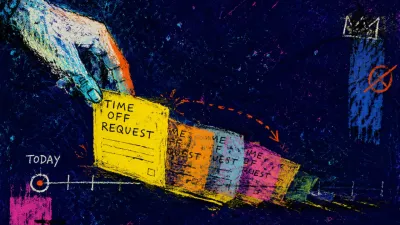
Closing the Friday PTO Tab, Then Letting One PTO Hold Stay Put
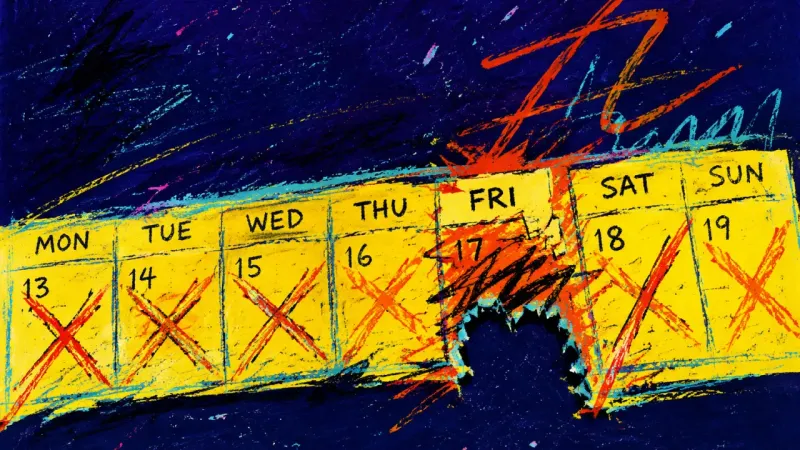
The Friday PTO Tab That Never Became Leave
I recognized the pattern as soon as Jordan described it. At 29, she could coordinate launches, handoffs, meetings, and short-turnaround requests for a hybrid technology company in Toronto, yet she froze at the one task meant to protect her own capacity: choosing a PTO date before burnout chose it for her. She had opened the leave portal three Fridays in a row without submitting anything. This was reactive-rest procrastination, not a lack of available leave.
She brought me into one of those Fridays. It was 4:45 p.m. at the small desk in her condo. The laptop fan whirred beneath a six-week Outlook view, and late-afternoon traffic pressed against the closed window. Jordan clicked through one possible date after another. Every week contained a launch, a check-in, a handoff, or a meeting that someone might have to move. Her eyes stung. Her shoulders sank. Then she closed the portal and answered two more Slack messages.
“I keep waiting for a week that doesn’t inconvenience anyone,” she told me. “By the time I book a day off, I’m too tired to enjoy it.”
I could see the weight in the way she sat, as though gravity had been turned up in her limbs while an invisible metronome kept tapping behind her jaw. She wanted to choose restorative time off while she still had energy, but she waited until exhaustion made the choice feel defensible. Under the tiredness sat apprehension about falling behind, guilt about asking anyone to adjust, and a private irritation that no future week ever stayed clear.
“You are not forgetting to rest,” I said. “You are waiting for exhaustion to make rest defensible. I don’t want the cards to tell you when you are allowed to stop. I want us to see the rule that keeps moving permission out of reach. Let’s draw a map through the fog and find where your choice can re-enter the system.”

Choosing the Switchback Map
I invited Jordan to put both feet on the floor, take one slow breath, and hold a single question in mind: “Why do I wait until I’m depleted to plan time off?” I shuffled slowly, using the movement as a transition from replaying the workweek to examining it. There was nothing supernatural she had to perform. The pause simply helped us focus.
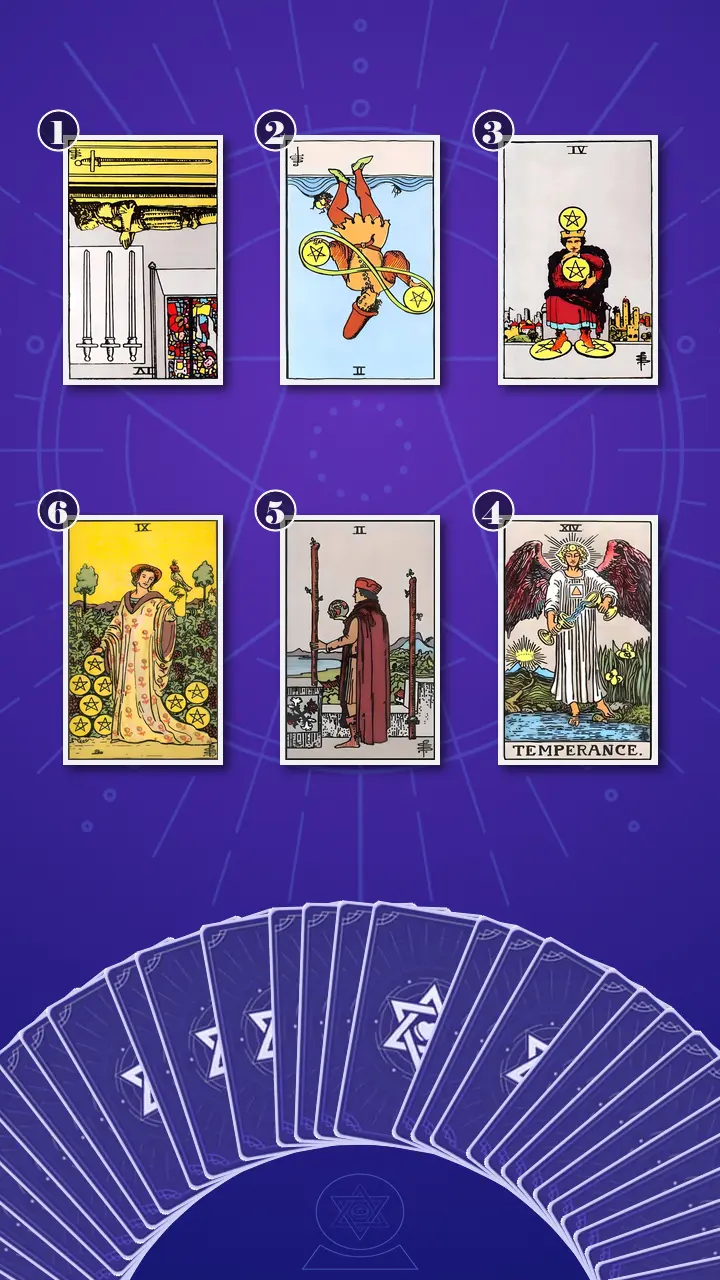
I chose the Transformation Path Grid (6) · Context Edition. For anyone wondering how tarot works in a situation like this, I use the cards as a structured mirror, not as an authority issuing predictions. A simple decision spread would have treated Jordan’s problem as a choice between taking leave and not taking it. That was not the real issue. She already knew she needed regular breaks. What she could not see clearly was the six-link system that kept knowledge from becoming action.
The upper row would trace the visible symptom, the scheduling behaviour maintaining it, and the fear beneath that behaviour. The lower row would return through the catalyst, the practical experiment, and the integrated possibility. Laid out in two rows of three, the spread resembled a switchback path: we would follow the old pattern to its deepest point, turn, and come back through a different sequence of choices.
I told Jordan that the first card would show why rest became an emergency response. The second and third would reveal how calendar conflict scanning protected her sense of control. The fourth, our pivotal card, would show what could interrupt the cycle. The last two would turn that insight into date-first PTO planning and a more inhabitable experience of time away.
The Old Rhythm: Rest After Collapse
Position 1: Four of Swords Reversed and the Body That Finally Stops
“The card I’m turning now represents the observable problem,” I said, “the way you postpone PTO until your energy is depleted and rest becomes urgent.” I revealed the Four of Swords, in reversed position.
I pointed to the recumbent figure beneath the suspended swords. In Jordan’s life, the image became painfully literal: she reached Friday afternoon with stinging eyes and heavy limbs, opened the leave portal, and still could not authorize a pause because unfinished work remained mentally overhead. She closed the tab, kept working, and eventually took a last-minute day only after her concentration and patience had collapsed.
The reversed air energy showed a blockage in deliberate recovery. Her body could stop, but only after the decision had been taken away from her. Her mind stayed available to work even when her Slack status did not. I asked her to remember her most recent reactive PTO day.
“Winter light through the blinds,” she said. “Laundry thumping in the next room. I stayed under the duvet until almost noon, but my brain was listing everything I’d need to fix when I logged back in.”
I gave voice to the sentence inside the card: “I finally stopped, but I arrived here too empty to feel off.” Chosen restoration had become emergency recovery. She was physically absent from work, yet mentally standing just outside its door.
Jordan let out one brief laugh, but there was no amusement in it. “That is accurate enough to be rude,” she said. Her thumb stopped rubbing the rim of her mug, and her gaze dropped to the card. I did not rush to soften the recognition. I told her the card was not accusing her of failing at self-care. It was showing us how late the threshold had been placed.
Position 2: Two of Pentacles Reversed in the Calendar Tetris Loop
“The next position shows the active scheduling behaviour that keeps your intention from becoming a submitted request.” I turned over the Two of Pentacles, in reversed position.
I asked Jordan to picture Sunday at 8:38 p.m., standing at her kitchen counter while reheated pasta cooled beside her. The refrigerator hummed. Streetcar brakes hissed outside. She dragged a tentative Friday off across Outlook, noticed a project check-in, imagined three messages that might arrive, checked who else was away, and deleted the hold.
The Two of Pentacles normally carries adaptable coordination. Reversed, that energy had moved into excess and instability. Jordan treated every meeting, deadline, possible escalation, and colleague absence as a ball that had to remain airborne before she could protect one date. Planning leave became calendar Tetris with new pieces arriving from Slack, email, and the project board. She was waiting for the screen to empty, even though the game was designed to keep sending pieces.
“I can take leave after I solve this variable, and this one, and the next one,” I said, translating the loop. “But Outlook’s Scheduling Assistant can display conflicts. It cannot decide what deserves priority.”
Jordan’s jaw tightened. Her eyes shifted to the recurring Friday meeting she had mentioned earlier. “That one gets me every time,” she said. “It could move. I just hate being the reason it has to.”
I reflected the distinction back to her. A fixed constraint and an ordinary inconvenience were not the same thing. Her conflict scanning had been treating them as equal. Postponement reduced the tension for a few minutes, but it also guaranteed that the next date would arrive with more work attached to it.
Position 3: Four of Pentacles and the Safety of an Unused Day
“The third position reveals what the delay is trying to protect,” I said. I turned the Four of Pentacles, upright.
The figure held one pentacle against the chest, pinned two beneath the feet, and balanced the fourth above the head. I saw containment occupying feeling, movement, and thought. In Jordan’s modern-life version of the card, she was on a crowded Line 1 train, seeing a colleague’s scheduled out-of-office status and checking her own unused PTO balance. Wet coats pressed around her. The wheels shrieked through a curve. Her hand tightened around the phone as the thought arrived: “If I use those days now, what if I need them more later?”
The upright earth energy was not inherently negative. It wanted security and continuity. In Jordan’s pattern, however, it had become an excess of containment. Unused PTO and uncommitted weeks felt like an emergency reserve. Keeping them untouched gave her a short-lived sense of control, even as work claimed those open dates one request at a time.
“An open calendar is not always flexibility,” I told her. “Sometimes it is unclaimed time waiting to be claimed by work.”
Her breathing paused. Her eyes lost focus for a moment, as though she were replaying every out-of-office notice that had made her feel both envious and less able to leave. Then her fingers loosened around the mug.
“I treat PTO like emergency savings I’m not allowed to spend,” she said quietly.
“And what does keeping it untouched protect you from?” I asked.
“Finding out I planned badly,” she said. “Or that I’m not as in control as I look.”
I let that answer stand without judgment. Her strategy made emotional sense. An unpredictable workload had taught her that open space could feel safer than commitment. The blind spot was that unused flexibility was not producing security. It was postponing recovery until the least flexible moment possible.
When Temperance Started the Water Moving
Position 4: The Measured Refill
Rain began tapping softly against Jordan’s condo window as I moved to the lower row. The first three cards had shown a body held still beneath thoughts, an unstable loop, and resources gripped in place. The room seemed to quiet when I turned the card representing the catalyst, the shift from emergency recovery to replenishment before depletion.
It was Temperance, upright.
I pointed to the uninterrupted stream flowing between the two cups. Unlike the pentacles in the previous card, the resource was useful because it moved. One foot rested on solid ground and one in water, which I read as practical coordination held alongside emotional permission. Temperance did not ask Jordan to pretend work had no constraints. It introduced balance through measured circulation, allowing rest to enter the system while work was still manageable.
This was where I used my Somatic Rhythm Mapping lens. I asked Jordan to map the sequence in her body without turning it into a moral verdict: first the jaw tightened when she opened the calendar; then her shoulders lowered as she found conflicts; then the restless pulse at her temples appeared; finally her limbs became heavy enough that stopping felt unavoidable. I heard a tempo mismatch in her daily architecture. Work occupied one long, accelerating measure, while recovery entered only as a sudden forced silence.
In my years of sound and rhythm research, I have often noticed that harmony is not created by holding every note indefinitely. It comes from timing, release, and enough space for one sound to answer another. I thought of an audio mix in which every channel had been kept open at full volume. The solution would not be to wait for the speakers to fail. It would be to rebalance the track while it was still playing.
Jordan was still caught in the demand for the right decision: she wanted one date that would inconvenience no one, preserve every buffer, and prove she remained in control. Each calendar scan looked responsible, but closing the portal quietly handed the final decision to exhaustion.
You do not have to reach empty to make rest legitimate; plan a measured refill while capacity remains, as Temperance pours between the cups before either one runs dry.
I let the sentence remain between us for a few seconds. Then I translated it as directly as I could: Rest does not need exhaustion as evidence. The responsible shift is to regulate your capacity while you still have enough of it to choose.
Jordan’s inhale stopped midway. Her right hand froze above the mug, fingers slightly curled. Then her gaze moved away from the camera, not blank but searching, as if the Friday portal, the Sunday calendar, and the reactive day beneath the duvet were replaying at once. Her eyebrows drew together. Her eyes brightened, but the first emotion into her voice was anger. “But if that’s true, I’ve been making myself prove it,” she said. “Doesn’t that mean I’ve been doing this wrong for years?” Her shoulders remained high even as her hand slowly opened. I waited until the question had fully landed. “It means an old strategy was trying to help you feel safe,” I said. “It worked briefly, and now its cost is visible. You do not have to shame yourself for using it before you could see the loop.” She looked back at me. A long breath left her chest, her shoulders dropped, and a small, uncertain laugh followed. “That somehow feels worse and better,” she said. Clarity can arrive that way: relief, then a moment of dizziness when choice and responsibility return.
“Now, using this new perspective, think back to last week,” I invited her. “Was there a moment when this insight could have changed how the situation felt?”
She remembered Thursday evening in the nearly empty downtown office. Fluorescent lights had buzzed above her while she moved a reminder called “Book time off” to the following week and completed a minor status update instead. “I thought the tension meant I needed more information,” she said. “Maybe it meant I was acting before the emergency, and that felt unfamiliar.”
That distinction was the first meaningful step in her emotional transformation: from waiting for burnout to justify time off toward trusting proactive rest as routine capacity maintenance. The discomfort of booking early did not prove that the choice was irresponsible. It showed that she was changing the rhythm before depletion could take over.
Fixing One Point on the Future
Position 5: Two of Wands and the Calendar Anchor
“The fifth position turns the new perspective into one observable action,” I said. I revealed the Two of Wands, upright.
The figure held a globe while one wand stood fixed to the wall. I translated the card into Jordan’s project-operations language: one future half-day or full day would become the fixed milestone, while meetings, handoffs, and deadlines became surrounding dependencies. She did not need perfect knowledge of the next six weeks. She needed one bounded commitment real enough for the rest of the system to recognize.
The fire energy here was directed and available. It was neither frantic nor blocked. The card asked for foresight with limits: look ahead, choose one good-enough date, and let ordinary coordination happen around it.
I used my Execution Block Dismantling framework to identify the dissonant chord at the start of Jordan’s process. She opened Outlook’s conflict view before establishing any boundary. That meant the first action always invited the calendar to argue against her. We reversed the entry sequence.
“Choose the date first,” I said. “Make coordination a task, not a permission test.”
Jordan leaned closer to the spread. “So I don’t clear the work and then earn the date,” she said. “I choose an acceptable date, then make a finite list of what actually needs moving.”
“Exactly,” I said. Her existing planning skills were not the enemy. They simply needed a fixed reference point. The spread’s repeated Twos showed two forms of coordination: reactive juggling in the reversed Two of Pentacles, and intentional foresight in the upright Two of Wands. Jordan did not need a new personality. She needed to redirect a skill she already used every day.
Position 6: Nine of Pentacles and a Day That Feels Like Her Own
“The last position shows what can be cultivated when this practice becomes repeatable,” I said. I turned the Nine of Pentacles, upright.
I described a planned morning off that began with enough energy for choice. Jordan might make a slow breakfast, walk by the lake, visit the Art Gallery of Ontario, or leave the first hour completely unscheduled. She would not have to turn the day into an optimized wellness routine. More importantly, she would not spend every hour trying to climb back to basic functioning.
The earth energy had returned, but its expression was now balanced and mature. In the Four of Pentacles, resources were technically possessed but locked in place. In the Nine, they were integrated into a cultivated environment. The hooded falcon suggested that capability remained intact even when it was not constantly deployed. Jordan could step away without becoming less competent.
Her posture softened as I spoke. “I’d like to have enough energy to decide whether I want to go out,” she said. “On my last day off, the decision was already no. I just slept and did laundry.”
“The goal is not a perfect day off,” I told her. “It is a break that begins before you disappear inside the need to recover.”
I was careful not to present the Nine of Pentacles as a promise that one booked half-day would solve burnout, workload design, or every practical constraint. It showed an integrated possibility, not a guaranteed outcome. The card asked whether advance boundaries could give Jordan more autonomy inside the time she already had.
Turning the Reading Into a New Tempo
When I read the spread as a complete story, the logic was clear. Jordan’s body had learned to stop only after her mind could no longer maintain the pace. Calendar conflict scanning then kept every responsibility moving, while unused PTO was held as protection against future uncertainty. The more tightly she tried to preserve control, the less usable her time became. Temperance changed the pattern by replacing holding with circulation. The Two of Wands added one chosen calendar anchor, and the Nine of Pentacles showed what planned rest might feel like when it began with some capacity still available.
The two Fours revealed two versions of stability: immobility and cultivation. The two Twos revealed two versions of planning: endless juggling and deliberate choice. Even the elemental movement supported the same story. Trapped air and overloaded earth gave way to flowing water, directed fire, and earth that could finally sustain enjoyment. The card meanings in context did not say Jordan lacked discipline. They showed that her disciplined attention had been recruited into maintaining the postponement loop.
I named the cognitive blind spot directly: she had been treating ordinary inconvenience as evidence that leave was impossible. Keeping every date open felt like control, but it gave every new work request first access to her future time. The transformation direction was therefore not “be less responsible.” It was to define responsibility more accurately: protect a modest break while energy remained, separate fixed constraints from flexible coordination, and allow work to acknowledge a boundary she had chosen.
The Three-Day Frictionless Tempo Calibration
To make the insight usable, I built Jordan a Frictionless Tempo Calibration, a three-day micro-habit sequence designed to lower the starting friction without turning PTO planning into another exhausting project. Rest does not need depletion as proof, so each action had to be small enough to begin before urgency supplied the adrenaline.
- Day 1: Hear the Current TempoAt 4:30 p.m. on Friday, Jordan would open a 10-minute calendar event named “Capacity check: protect time before urgent.” Before opening email, Slack, or the project board, she would rate the next month’s expected capacity as low, medium, or high. The rating would determine whether she protected a half-day or full day, not whether rest was legitimate.Keep the energy budget at 10 minutes. If the full exercise feels heavy, the minimum version is writing down two possible dates and closing the calendar.
- Day 2: Place the Good-Enough AnchorJordan would choose one week at least four weeks ahead containing ordinary inconvenience but no genuinely immovable event. She would place a provisional half-day or full-day hold before reorganizing anything, then leave it in the calendar for 10 minutes. Only legal, contractual, launch-critical, or truly fixed obligations could disqualify the first date; flexible meetings would remain flexible.The hold is an experiment, not a vow. She retains the choice to revise it if a real constraint appears, and she does not owe unlimited extra work in exchange for taking leave.
- Day 3: Coordinate Without Reopening PermissionJordan would send one concise message to the relevant teammate or manager: “I am planning to take [date] off. Is there any fixed dependency I should account for before I submit it?” She would then create a 15-minute handoff list with only three headings: fixed deadlines, handoff owner, and message to send. She would submit the request before trying to clear the entire surrounding workload.When forecasting starts to expand, return to the three headings. Anything else belongs in a later handoff review, not in the decision about whether the date is allowed to exist.
I reminded Jordan that workplace conditions matter. If planned leave regularly produced retaliation, impossible coverage demands, or an unsafe workload, the cards would not turn those structural problems into personal failure. The exercise was meant to test where she had agency, not make her absorb every consequence alone. She could pause, reduce the experiment to a provisional half-day, or choose two dates to discuss with her manager. The boundary remained hers.
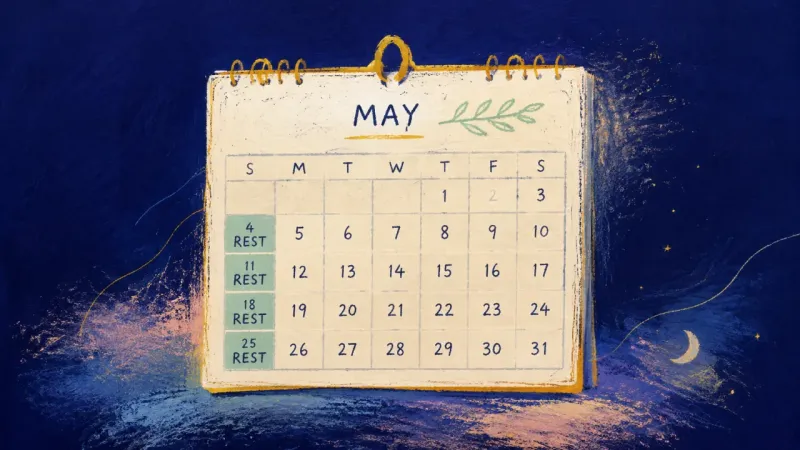
One Week Later, the Hold Stayed Put
Seven days later, I received a short message from Jordan. She had placed a Friday half-day five weeks ahead in the leave calendar before opening Slack. A recurring project check-in was already sitting there. Instead of deleting the hold, she moved the meeting, sent the coverage question, and submitted the request before she could build an airtight case against herself.
“It still felt weirdly dramatic,” she wrote. “But the date survived the afternoon.”
That evening, she slept through the night. Her first thought the next morning was still, “What if something lands that week?” She noticed her jaw beginning to tighten, smiled at the familiar rhythm, and left the approved date alone. The change was clear but still tender. She had not solved her entire relationship with work. She had created one piece of evidence that ordinary coordination could happen around her absence.
I did not credit the cards with booking the leave. Tarot had made the hidden rule visible; Jordan had challenged it, chosen a date, sent the message, and tolerated the discomfort of not controlling every future variable. That was the quiet proof of our Journey to Clarity: not certainty, but a small return of authorship.
I know that when your shoulders are already heavy and the leave calendar is still open on your screen, it can feel as though you must choose between protecting your capacity and proving you can keep everything under control. But noticing that struggle is already a change in tempo. The calendar is no longer the only voice in the room.
If rest did not need a crisis to make it legitimate, what small piece of future time could become your first measured refill, protected while you still have enough energy to choose it?