Career FOMO Moved Her Sunday Walk, Then a Pause Protected It

The 10:47 p.m. Yes: Career FOMO After Dark
At 10:47 on a Tuesday night, I met Maya, a 29-year-old product marketing manager joining me by video from her Toronto condo. A half-watched show cast blue light across the sofa behind her. Her tea had gone cold, a streetcar bell sounded below, and the phone in her hand was still warm from rereading a manager’s message about an optional stretch project.
She had planned to log off. Then the “quick visibility opportunity” arrived, and within minutes she had dragged her Sunday walk into the vague territory of next week and typed, “I’d love to help.” Saying “Let me check” had felt more dangerous than being tired.
“Why do I say yes to every career opportunity instead of resting?” she asked me. “I keep calling it ambition even when I’m too tired to think clearly. Every opportunity feels optional until someone else takes it.”
I watched her unlock her jaw and then tighten it again. Her fingers kept waking the phone screen even though the message had already been answered. The restless urgency moved through her like a laptop fan running beneath twenty open browser tabs: not dramatic enough to force a shutdown, but constant enough to make everything else slower.
This was career FOMO reinforced by productivity-based self-worth. Maya might genuinely want some of these opportunities, but the relief she felt after being chosen was arriving before she had assessed the work. Her calendar showed the cost later, when sleep, movement, friendships, and unstructured time became the only blocks flexible enough to move.
“I’m not here to tell you that ambition is the problem,” I said. “Some of these offers may be excellent. I want us to work out when your yes comes from actual interest and when it comes from the fear that slowing down will make you less valuable. Let’s draw a map of that difference.”

Choosing the Shadow Map Beneath an Overbooked Week
I invited Maya to place both feet on the floor and take one unforced breath while holding the question in mind. I shuffled slowly, using the small ritual as a transition from reacting to observing. Nothing supernatural was required; the point was to give her attention somewhere to land.
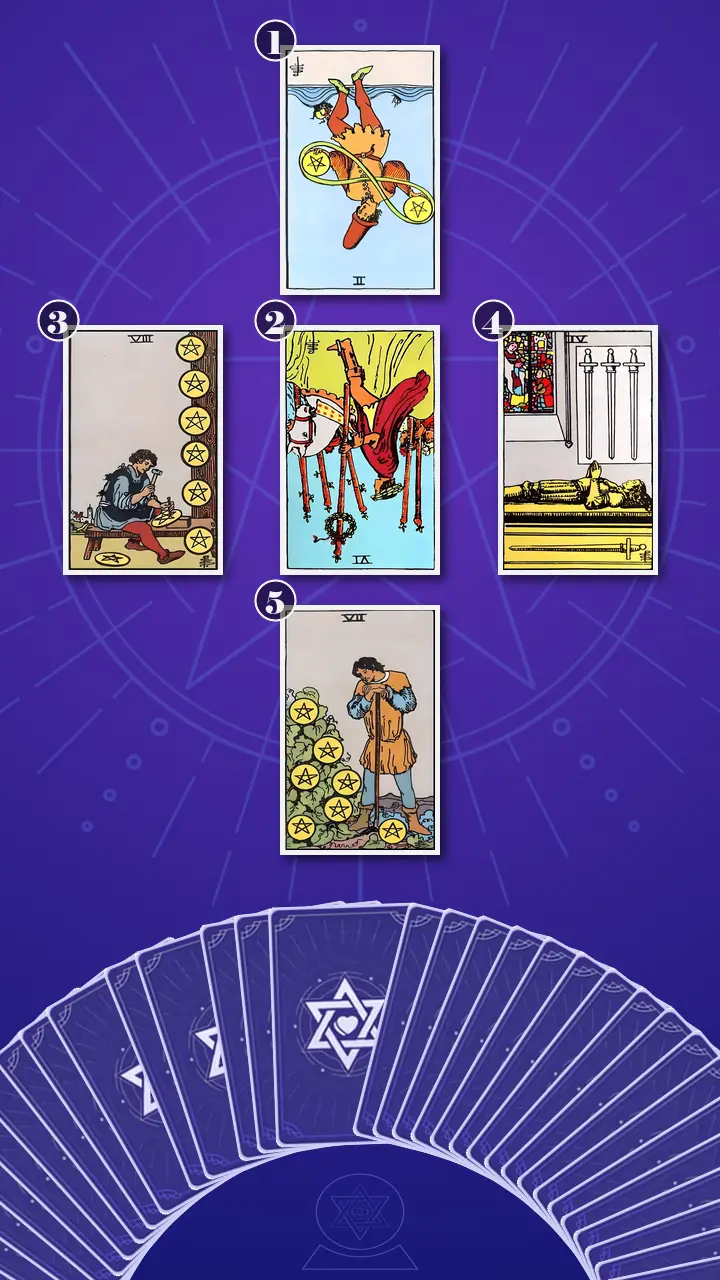
I chose The Shadow Spread · Context Edition, a five-card spread designed to examine a repeating pattern as a system. Through a Jungian psychological lens, I do not treat the shadow as something sinister. It is often a strategy that once protected us, then kept operating after its cost became greater than its benefit.
For readers wondering how tarot works in a career reading, I use the cards as structured prompts, not fixed predictions. A ten-card spread would have introduced more future and outcome material than Maya’s question needed. This smaller cross could trace one precise chain: visible behaviour, hidden root, protective payoff, integrating counterforce, and grounded action.
The first position would show Maya’s automatic overcommitment in daily life. The central card would uncover why visibility felt connected to worth. The cards to either side would contrast the familiar relief of working harder with the less familiar clarity of deliberate rest. The final position would turn that contrast into a practical boundary for her next opportunity.
I laid the cards in a cross that resembled a signpost: overload at the top, the hidden fear in the centre, productive coping to the left, restorative distance to the right, and selective investment below. I explained that the spread would not decide which opportunities she should take. It would help her see what had been deciding before she consciously entered the conversation.
Reading the Loop That Kept Calling Itself Ambition
Position One: The Calendar Tetris Nobody Wins
“The card I’m turning over now represents the visible symptom: accepting opportunities before checking capacity and moving recovery time to make them fit,” I said. “It is the Two of Pentacles, reversed.”
The infinity-shaped cord around the two pentacles looked like the recurring route of the same few calendar blocks. In Maya’s week, the Sunday walk moved first. A quiet evening followed. Sleep was pushed later. The calendar appeared flexible, but the board never became larger.
I brought her back to 10:47 p.m. She had dragged her walk into next week while Tuesday, Wednesday, and Thursday were already full. Then she had opened Notion to redesign the workload, telling herself, “It’s only one more thing. I can move the walk, finish the deck later, and rest after the next deadline.” The reversed Two of Pentacles was that exact attempt to solve insufficient capacity through better juggling.
In energetic terms, practical adaptability had moved into excess and blockage. Maya was skilled at rearranging finite resources, but that skill was being asked to perform an impossible task: create time by hiding the cost. Each new yes was funded by something already on her calendar.
“Think of the last optional request you accepted quickly,” I said. “Which personal block disappeared after the yes?”
Maya gave a small, bitter laugh. “That’s a little too accurate. Almost rude.” Her hand stopped above her phone, her gaze shifted toward the paused television, and then she exhaled through her nose. “It’s usually the walk. Or dinner with a friend, because I can tell myself we’ll reschedule.”
I did not ask her to create a stricter schedule. That would have risked turning recovery into another colour-coded performance category. The card’s invitation was simpler: protect one recovery block and require new work to reveal what it would replace.
Position Two: The Crowd Inside the LinkedIn Feed
“The next card represents the hidden root: the fear that reduced visibility or momentum would mean reduced worth,” I said. “It is the Six of Wands, reversed.”
The traditional image shows a laurel-crowned rider elevated above a watching crowd. Reversed, the recognition is difficult to internalise. Applause may arrive, but it does not remain long enough to become stable self-trust.
I asked Maya about a panel invitation she had considered delaying. She told me that, minutes later, she had opened LinkedIn and seen a former colleague’s promotion post beginning with the familiar “I’m thrilled to share.” She immediately reopened the panel message. Nothing about the panel’s content, timing, or value had changed. What changed was the private story attached to someone else’s public success.
“The thought was, ‘If she’s moving and I’m resting, maybe I’m falling behind,’” Maya said. “And then it became, ‘Maybe I’m not as capable as people think.’”
The card showed reversed fire as a blockage in self-recognition. Instead of letting ambition express desire and direction, Maya was using continued selection as evidence that she still mattered. LinkedIn had become a live performance dashboard where quiet competence disappeared from the metrics. Every comparison click trained both the feed and her attention to deliver more evidence that everyone else was ahead.
This was where I introduced one of my core diagnostic lenses: Imposter Syndrome Auditing. I use it to separate objective professional competence from the subconscious fear of being exposed as less capable than others believe. It is an audit, not a diagnosis. I look for evidence, assumptions, and the point where one has been mistaken for the other.
“Your evidence ledger includes years of experience, successful launches, trust from colleagues, and the fact that people ask for you because you have delivered before,” I told her. “The exposure story says all of that will vanish if you are not immediately available. Those are not equivalent forms of information.”
I thought of conversations I had encountered while travelling across cultures. Ambition wears different accents, but the underlying bargain can sound remarkably similar: keep producing, and perhaps nobody will question your place. The Six of Wands reversed asked Maya to inspect that bargain rather than obey it.
“Visibility can confirm that people noticed you,” I said. “It cannot decide what you are worth. Would you still want the panel if there were no promotion, praise, post, or public proof attached to it?”
Her breath paused. Her thumb pressed into the side of her phone, and her eyes lost focus as though she were replaying the invitation without its imagined audience. “I’d still like the topic,” she said eventually, “but I wouldn’t sacrifice Sunday for it.”
Position Three: Why More Work Feels Safe First
“The third card represents the short-term protective payoff: what overwork gives you before it takes recovery away,” I said. “It is the Eight of Pentacles, upright.”
The craftsperson on the card repeats a precise task while the town remains in the distance. I translated that image into Maya’s late-night work rhythm: the cursor moving, slide titles aligning, campaign assets becoming orderly, and Slack notifications disappearing one by one. At 11:36 p.m., polishing a presentation could provide a clean burst of competence even while her shoulders ached.
“I may not know whether this opportunity matters,” I said, voicing the pattern back to her, “but I know how to work hard.”
She nodded before I finished the sentence.
The Eight of Pentacles carried balanced, constructive earth energy on its own. Maya’s diligence was real, and I was careful not to shame it. The complication was that genuine craft had been recruited to protect her from uncertainty. A measurable task felt safer than asking whether the task deserved another evening. Competence explained why overwork felt safe before it felt expensive.
“This card is not asking you to become less skilled or less committed,” I said. “It is asking whether execution has started before evaluation. You keep opening the production sprint before reviewing the brief.”
Maya rubbed the base of her neck. “Doing the work calms me down,” she said. “Then I’m exhausted, but at least I’ve proved I can do it.”
That sentence exposed the self-reinforcing loop without turning it into a moral failing. An invitation created uncertainty. An immediate yes produced relief. Focused labour produced competence. Lost recovery reduced discernment. The resulting mental fog then looked like evidence that she needed to work harder. The strategy was understandable precisely because it worked in the short term.
When the Four of Swords Put Urgency on Hold
Position Four: The Message That Could Wait Overnight
The room seemed to become quieter as I moved across the central card. Through Maya’s microphone, I heard one streetcar bell and then a pocket of stillness.
“This position represents the integrating counterforce: deliberate rest that creates enough mental distance to distinguish desire from urgency,” I said. “The card is the Four of Swords, upright.”
The resting figure lay beneath three suspended swords. I asked Maya to imagine those swords as the message, the possible opportunity, and the fear that someone else might be chosen. None of them had disappeared. The figure simply refused to treat their presence as a command for immediate action.
In modern life, this looked like receiving an opportunity at night, sending a short holding reply, and leaving the phone outside the bedroom. The request still existed. Competition had not been magically removed. What changed was the authority given to urgency. By morning, Maya could notice whether interest remained and what the work would actually cost.
Upright air entered the spread here as balance: perspective, mental quiet, and a protected interval between information and commitment. I told her, “Rest does not stall your career; it gives you enough distance to choose an opportunity instead of letting urgency choose for you.”
I then brought the Imposter Syndrome Audit directly into the Four of Swords. The pause would become an audit window with three columns: Competence Already Evidenced, Fear of Exposure, and Decision-Relevant Facts. Her proven ability belonged in the first column. “They’ll discover I’m not ambitious if I wait” belonged in the second. Deadlines, workload, compensation, learning value, and displaced recovery belonged in the third. The separation prevented a subconscious fear from presenting itself as objective career data.
At that point, I could see Maya caught between two familiar thoughts: “I must make the right decision immediately” and “If I wait, they will ask someone else.” The first made speed look responsible; the second made exhaustion look cheaper than uncertainty.
You do not have to earn stillness by exhausting every option; choose a deliberate pause, like the resting figure beneath the three suspended swords, and let clarity decide what deserves your next yes.
For a moment, Maya did not breathe. Her fingers froze around the phone, and her pupils widened slightly as her attention moved away from the screen. Then her brow tightened. “But doesn’t that mean I made all those choices for the wrong reason?” she asked, sharper than before. I heard anger first, then grief beneath it: the sting of recognising how many evenings had been traded away.
“No,” I said. “It means you found a strategy that protected your sense of relevance, and now you can see its full cost. We are not putting your past decisions on trial. We are updating the criterion for the next one.”
Her gaze went unfocused as if memories were replaying in sequence: the late-Friday Slack requests, the postponed dinners, the PTO email checks. Her grip loosened. Her shoulders dropped a fraction, then more. A long breath left her chest, but the release was followed by a small, unsteady pause. Clarity had removed the old excuse, and I could see the new vulnerability in having to choose.
“Now, with this new perspective, was there a moment last week when this insight might have made you feel differently?” I asked.
“Friday,” she said quietly. “The director’s message came at 4:52. I replied before I even opened next week. If I’d waited, I think I would’ve realised I wanted the visibility, not the assignment.”
I asked her to open a phone note for a seven-minute Opportunity Pause. She wrote the invitation at the top and added three prompts: “What value could this add?”, “What capacity do I actually have?”, and “What recovery time would it displace?” I explicitly asked her not to decide during the exercise. The point was observation, not another performance test.
I offered a holding reply: “Thanks for thinking of me. Can I check my current commitments and confirm tomorrow?” I also told her that she controlled the duration. A real deadline, contractual duty, or financial need might require a shorter window. If seven minutes added pressure, she could wait ten minutes with notifications closed. A pause was not a no; it was where her actual answer got a chance to appear.
I named the crossing I had just witnessed: from restless urgency, productivity guilt, and fear-driven overcommitment toward deliberate, capacity-aware confidence. It was not complete confidence, and I did not pretend it was. It was the first willingness to let present capacity carry more authority than imagined future regret.
Position Five: The Seven-Before-Eight Review
“The final card represents the practical recovery boundary: pausing to assess existing investments before the next yes,” I said. “It is the Seven of Pentacles, upright.”
The figure on the card leans on a tool and studies what is already growing. The posture mattered. The spread had moved from frantic juggling, to horizontal stillness, to an upright evaluative pause. Progress no longer meant constant motion. It meant knowing when movement was justified.
I asked Maya to list her current projects and write one actual return beside each: skill, income, relationship, visibility, or genuine interest. Then we considered a new freelance introduction she had been tempted to accept. She identified the Sunday recovery block that would fund it and noticed that the work duplicated experience she already had.
This was the Seven of Pentacles meaning in context: a quarterly portfolio review applied to time and attention. Upright earth returned in a balanced form. Instead of asking, “Can I fit this in?” Maya could ask, “What is already growing, what is it costing, and does the new request add something I actually value?”
The numerical movement from the Eight back to the Seven was not regression. It corrected her habit of moving directly into production. Review the brief before opening another sprint. Evaluate before investing. Do not ask only whether you can do it; ask what will pay for it.
No Major Arcana card had arrived to announce a dramatic fate, and I found that fitting. This reading was built from ordinary choices: a delayed reply, an honest look at capacity, a protected walk, and a selective no. The cards could reveal the structure, but Maya remained the person authorised to change it.
A One-Screen Route from Insight to Action
I gathered the five cards into one coherent story. The reversed Two of Pentacles showed Maya treating finite capacity like endless calendar Tetris. The reversed Six of Wands revealed the hidden equation beneath it: visibility had become temporary proof of worth. The Eight of Pentacles explained why the cycle remained persuasive, because real competence made additional work calming before it became costly. The Four of Swords introduced enough air and distance to question the automatic yes. The Seven of Pentacles then grounded that clarity in patient evaluation.
The central blind spot was not simply poor time management. Maya had assumed that the relief following an immediate yes proved the opportunity was right. In reality, the relief often came from ending the fear of being overlooked. She had also excluded two valid sources of career information: what she genuinely wanted and how depleted she actually felt. The absence of Cups in the spread made that omission especially visible to me.
The transformation direction was clear: move from answering through imagined regret to checking value, capacity, and recovery cost. Rest would stop being a reward earned after exhaustion and become part of career judgment itself.
Maya raised a practical objection. “I can’t always take twenty-four hours. Sometimes they really do need an answer.”
“Then don’t turn twenty-four hours into a rigid rule,” I said. “Use the longest honest pause the situation permits. It may be overnight, seven minutes, or three breaths before opening your calendar. The purpose is not to perform stillness correctly. It is to interrupt the belief that receiving a request obliges you to answer from urgency.”
- The Protected Opportunity Pause Save this reply as a phone shortcut: “Thanks for thinking of me. I want to check my current commitments before I answer. Can I confirm by tomorrow?” Use it for one optional project, introduction, or event this week, then place the phone outside the bedroom or switch on Do Not Disturb. If an overnight pause is not practical, close notifications for ten minutes and take three slow breaths before replying. Name the first pressure thought in five words or fewer.
- The Value-Capacity-Recovery Check Create one phone note with three lines: “Value this adds,” “Capacity I actually have,” and “Recovery block it replaces.” Spend no more than seven minutes on it before the next optional yes. Identify the exact calendar block that would fund the work; unnamed future time does not count. Keep the check to one screen. If even three lines feel like another productivity system, answer only: “What recovery time would this displace?”
- The Competence Anchoring Exercise Before evaluating a highly visible opportunity, spend five minutes recording three verifiable achievements. For each one, name the skill you used and the observable result. Then ask: “Would I want this invitation if nobody saw me accept it?” Use evidence, not praise: “Led a launch that met its target” is an anchor; “My director seemed impressed” is external validation. The exercise supports judgment without requiring you to stop caring about recognition.
I asked Maya to protect one 60-minute Sunday walk by marking it unavailable, not free. She could shorten it, change the route, or come home early. She did not have to optimise the walk, track it, or fill it with a career podcast. Its purpose was simply to remain unfunded by optional work.
These were experiments, not commandments. Their value would come from what Maya observed: whether urgency changed after ten minutes, whether an opportunity still appealed without public visibility, and whether clearer recovery improved the quality of her yes. Tarot had provided a cognitive map; she would decide which path to test.

One Week Later: The Quiet Proof
Six days later, I received a message from Maya. Another invitation had arrived after work, this time for an industry roundtable. She used the holding reply, left the phone outside her bedroom, and completed the three-line check the next morning. The event offered visibility, but little new learning, and it would have consumed the weekend she needed before a major launch.
She declined without writing a paragraph of apology.
She slept through the night after sending the holding reply. Her first thought in the morning was still, “What if they choose someone else?” She told me she laughed, checked her note, and waited until lunch anyway.
That Sunday, she took the postponed walk. She admitted that her hand reached for LinkedIn twice and that the first twenty minutes felt strangely empty. The sky over Toronto remained grey, and the career question was not permanently solved. But the walk stayed where she had put it. For the first time in months, recovery had not been treated as the most disposable item in the week.
I did not credit the cards with making her decision. The spread had shown her the system: invitation, fear, immediate yes, relief, displaced recovery, reduced clarity, and more effort. Maya supplied the authorship when she interrupted that sequence. Her calendar contained one fewer opportunity, but the commitment she had protected was deliberate and fully hers.
I left the reading with a quieter definition of clarity. It was not certainty that declining could never have consequences. It was Maya’s growing ability to tolerate that uncertainty without using exhaustion to purchase temporary relief.
When an empty evening makes your jaw tighten and your hand reach for the phone, I know the hardest part may not be doing less. It may be fearing that, without another visible yes, your worth will become harder to see. Noticing that bargain already places you somewhere beyond the beginning.
I will leave you with the question I left beside Maya’s Four of Swords: if one opportunity could remain beneath those suspended swords until tomorrow, what might your body, your calendar, and your quieter preferences tell you about the capacity behind your next yes?