Does Understanding Require Agreement?
Explore Compassion-Endorsement Fusion, related tarot cards, and Tarot Card Reading Insights on caring without treating agreement as proof of care.

Compassion-endorsement Fusion
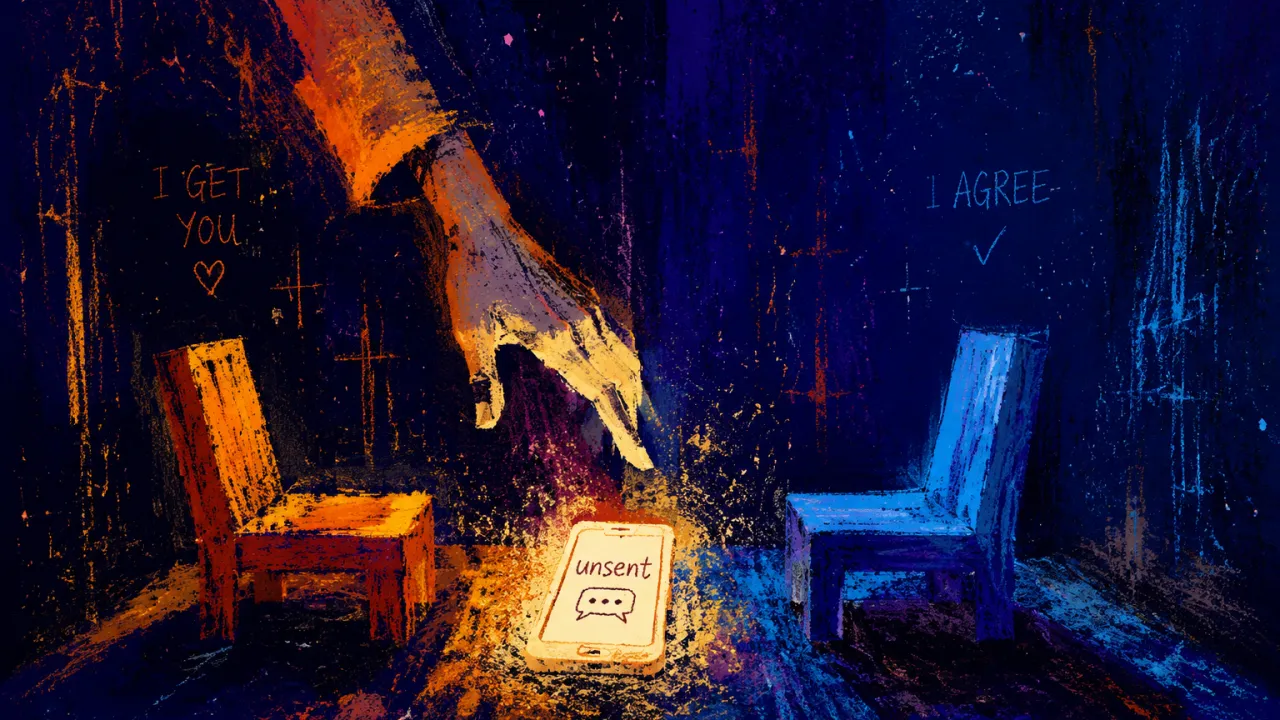
What does this feel like?
Compassion-Endorsement Fusion begins in the second before you answer a message from someone who has let you down. You can see why they made the choice, what they were afraid of, what they did not know, and the moment you understand it, a second pressure arrives: now you feel you have to say it was okay. You type, “I get it,” then stare at the words because what you mean is “I see how it happened,” while what they may hear is “I agree with what you did.” When you try to add a boundary or say you disagree, your stomach tightens, your shoulders lift, and an inner voice asks whether you are being cold, unfair, dramatic, or disloyal. In conversations, you keep translating your own position into softer language until it is barely there; you nod at the explanation, then go quiet about the impact. You may spend the walk home replaying every sentence, wondering whether compassion only counts when it comes with approval, and whether holding your own view makes you less kind. The cost is a life where your understanding stays wide enough to hold everyone else’s context, while your own judgment is made smaller to keep the connection undisturbed, much like the figure on Justice, seated between two pillars with scales in one hand and a sword in the other, holding mercy and discernment in the same still frame.
What's pulling at you?
You are trying to keep two different things intact at once: the ability to understand why someone acted, and the right to decide whether what they did works for you. Because those two acts have become fused, disagreement feels like a withdrawal of care, while agreement requires you to set aside the part of you that noticed the cost.
How It Shows Up?
- Someone sends you a long explanation for why they cancelled on you again, and before you notice your own reaction, you are composing a reply that reassures them. Your thumb hovers over the screen; your chest feels tight and your shoulders draw upward as you type, “I understand,” then delete the sentence that would have said, “I still need consistency.” The unsent message sits in the blue light with the stillness of Two of Swords, and the pause can remain a pause without forcing care and agreement into the same sentence.
- During a group project or shared task, someone explains why they missed their part, and you immediately begin building the case for them in your head. You hear yourself say, “That makes sense,” while your shoulders stay raised and your fingers press hard against the edge of your laptop; the explanation has been acknowledged, but the missed work still has consequences. By the end, you have volunteered to absorb the unfinished piece because saying “I understand” has started to feel too close to saying “I’ll handle it.” The weight can be named without being added to your shoulders.
- At dinner, a friend says something you cannot agree with, then gives a personal reason for believing it. You soften your face, nod, and start searching for the most compassionate response, while your jaw tightens and your breathing becomes shallow; you are listening carefully and disappearing from the exchange at the same time. When everyone moves on, you can still feel the sentence you did not say sitting behind your ribs, like a Justice scale held perfectly level but never allowed to settle. Your position can exist before you decide how much of it to share.
- Your partner or close friend calls to talk through a conflict, and you spend the first ten minutes naming all the reasons their reaction made sense. By the time they ask what you think, your stomach has tightened, your hands are cold, and the words in your mouth have been edited into something harmless: “I just want you to feel supported.” You leave the call knowing you offered understanding but never answered whether you agree, a suspended moment with the quiet of The Hanged Man. It is possible for the conversation to end without your own answer being settled.
- At 1:47 a.m., you open your notes app and write two columns: “why I get it” and “what I can’t accept,” then keep moving sentences from one side to the other. Your eyes ache from the screen, your chest feels crowded, and each time the second column becomes clearer, a wave of guilt sends you back to explaining the first. The room is quiet, but your mind keeps the scales moving, as though kindness must win every round. You may let both columns remain on the page without making either one cancel the other.
Compassion-endorsement Fusion in Tarot Cards
Compassion-Endorsement Fusion appears in the gap between understanding someone’s reasons and giving up your own position, especially when your chest tightens before you say what you think. An existential and structural framework makes that gap visible without turning compassion into agreement. The cards below mirror the stillness, weighing, and suspended judgment already present here. Here are the Tarot Cards that reflect this outline.
Compassion-endorsement Fusion in Tarot Card Reading Insights
Others have brought Compassion-Endorsement Fusion into readings too, especially when they could explain another person’s reasons but could not state their own position. Here are Tarot Reading Insights from those sessions.

A Group Chat Became a Breakup Jury; One Boundary Changed the Question
Topic:Friendship Tarot Reading
Struggle:Triangulated Belonging
Context:Friendship Loyalty Test

Two Friends, Two Private Chats at 11:40 p.m.—A Boundary, Not a Verdict
Topic:Friendship Tarot Reading
Struggle:Boundary Ambiguity Lock
Context:Direct Communication Trial