Productive Procrastination: How One Study Block Began to Count

The 8:10 p.m. Portal Glow: When Productive Procrastination Feels Safer
I sometimes meet a university student on academic probation in Toronto, paying city rent while trying to rebuild their grades, who finds that the second the course portal shows every overdue assignment at once, productive procrastination feels safer than opening one. That was how Alex arrived for our video session on a Tuesday night.
At 8:10 p.m., I could see Alex at the small kitchen table in their rental, a space that also had to serve as a study area and somewhere to decompress. The course portal cast a blue-white glow across their face. Through the microphone, I heard the refrigerator humming behind them; beside the laptop, cold tea sat untouched next to three color-coded pens and a blank notebook. When three overdue items loaded on-screen, their hand drifted toward their phone before they seemed to notice it moving.
“I said I was going to use tonight to get back on track,” Alex told me. “Then I saw everything at once. I rewrote tomorrow's schedule, checked the class chat, cleaned the table, and now I still haven't opened the chapter. Why do I keep avoiding study when this matters so much?”
They had captured the contradiction precisely: they wanted to restore their academic standing and feel like a capable student again, yet any task that might reveal how far behind they were had begun to feel dangerous. Alex described the dread as wet concrete setting around their ribs while the portal waited for an answer. Their restless fingers kept looking for an exit, and every small act of preparation seemed to offer one.
“I keep making plans for the student I wish I already was,” they said. “A twenty-minute session feels pointless when I'm this far behind. I want to catch up, but I keep waiting for a version of me who isn't afraid to begin.”
I let the silence sit for a moment before I answered. “I don't want to use tarot to predict whether you will recover, what your grades will be, or whether you belong at university. That would turn this reading into one more verdict. I want us to make the loop visible: what happens, what relief it gives you, what fear it protects, and where you still have a workable choice. Let's draw a map through the fog without pretending the map controls where you go.”

Choosing the Compass: The Five-Card Shadow Spread
I asked Alex to place both feet on the floor, let one ordinary breath leave their body, and hold the consultation question in mind. I shuffled slowly on my side of the screen. I treat this small ritual as a transition of attention, not a supernatural test: it helps separate the problem as lived from the problem as repeatedly rehearsed in the mind.
I chose The Shadow Spread. For anyone wondering how tarot works in a consultation like this, I use the cards as an organized reflective tool. Card meanings in context can separate a tangled experience into observable parts, making it easier to test an interpretation against real life rather than accept it on authority.
This spread suited Alex's question because their study avoidance was cyclical. Anticipated failure triggered delay; delay provided immediate relief; less work was completed; then the next study session carried more pressure. A larger spread would have added more information than this focused problem needed. These five positions were enough to trace the visible behavior, the protective payoff, the root fear, the capacity that could interrupt the loop, and the smallest action through which change could become visible.
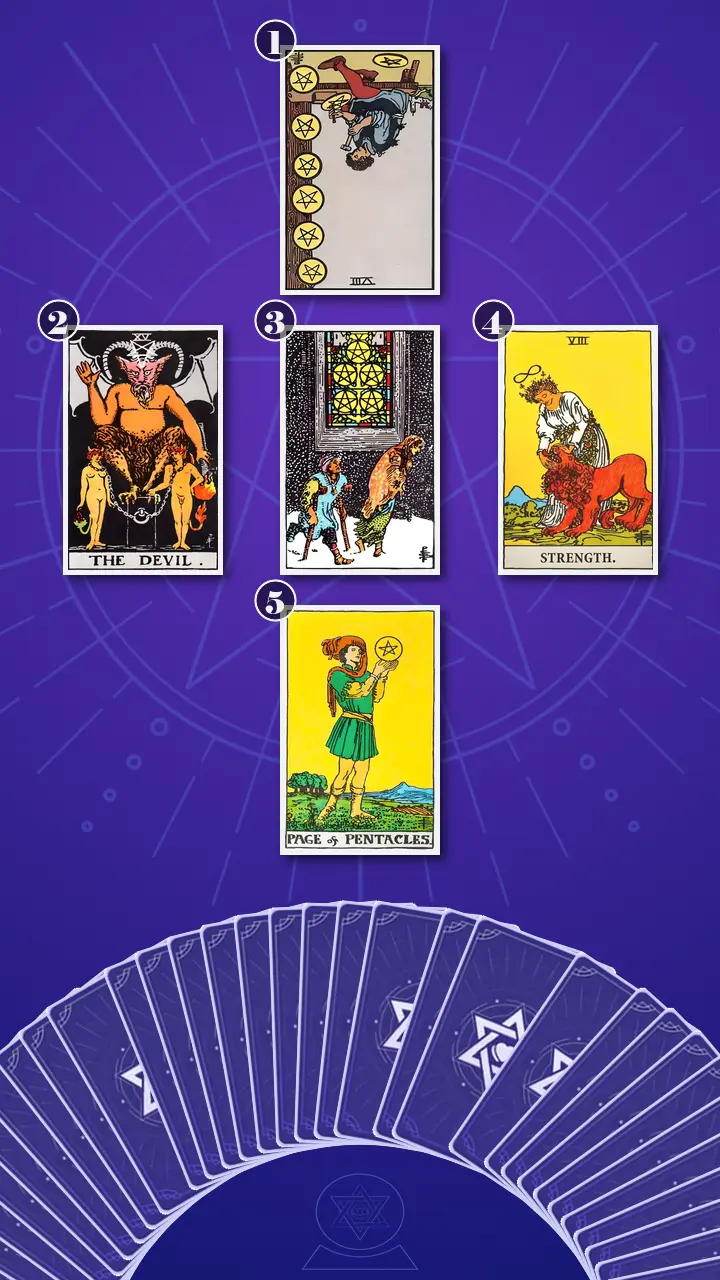
I placed the first card at the top for the behavior Alex could already see. To the left, I placed the card for the relief that kept rewarding it. The center held the fear beneath both. To the right would be the integrating resource, and below the center, one grounded practice. The arrangement looked like a knot at a crossroads with a single stepping-stone leading out.
Reading the Loop Where It Begins
Position 1: The Workbench Covered in Preparation
I turned over the card representing the visible study-avoidance behavior: preparation, task switching, and delay replacing direct contact with coursework. It was the Eight of Pentacles, reversed.
In the Rider-Waite-Smith image, the craftsperson bends over one pentacle while a row of completed pieces records the rhythm of repeated practice. Reversed, that rhythm is disrupted. I read the energy here as a Blockage: effort exists, but it cannot accumulate into completed work. There is an Excess of setup and a Deficiency of sustained contact with the task itself.
I described Alex's Tuesday night back to them. At 8:10, they had opened one overdue assignment and immediately zoomed out to the whole portal. They aligned three pens, rebuilt tomorrow's timetable, formatted empty note headings, and checked the group chat until 9:00. The desk looked prepared. Alex felt academically occupied. Yet no reading section, practice question, rough paragraph, or other assessable output existed at the end.
“Preparation can look productive while still protecting you from the work,” I said. “The practical question is not whether an activity looks responsible. It is whether anything academically usable exists after you do it.”
I asked what Alex usually told themselves during the first three minutes after opening an assignment.
“Once I fix the timetable, then I can focus,” they said. “Then it's, once the desk is clear. Then I need all the readings downloaded. Then I should check whether anyone posted an update.”
Alex gave a brief laugh, but there was no amusement in it. Their mouth tightened at one corner. “That's so accurate it's almost brutal. I do this and call it studying.”
“The accuracy belongs to your observation, not to the card judging you,” I replied. “The Eight does not say you lack ability or care. In fact, all that preparation may show how much the outcome matters. It shows us where useful effort is being redirected before it reaches the part that can feel evaluative.”
Position 2: The Relief That Sends Its Bill Tomorrow
I turned over the card representing the immediate protective payoff that sustained procrastination: temporary distance from possible academic failure and shame. It was The Devil, upright.
I directed Alex's attention away from the dramatic figure and toward the loose chains around the two people below it. I do not read The Devil here as an outside force, a moral defect, or a warning that something terrible is destined to happen. I read it as an Excess of short-term reward that narrows attention until a repeated behavior begins to feel compulsory.
The modern version was already warm in Alex's hand. They would meet a difficult paragraph, feel pressure rise in their chest, and switch almost automatically to messages, short videos, or another planning tool. For twenty-five minutes, the pressure would fall. Afterwards, the sentence would arrive: “I have no discipline.” A behavior chosen for relief had started being used as evidence about identity.
I told Alex the loop worked like a recommendation algorithm trained on one signal: when study discomfort appeared, it served the fastest available escape. Each click was small and understandable, but autoplay kept running until the original intention felt far away. The loose chain represented the brief point at which the pattern could be noticed. It did not imply that interruption would always feel easy.
“I know this makes tomorrow worse,” Alex said, looking down at their phone, “but right then it means I don't have to find out whether I can still do the work.”
Their thumb stopped on the edge of the screen. They turned the phone face down, not theatrically, just enough to acknowledge what it had been offering.
“The relief is real; so is the bill it sends to tomorrow,” I said. “Seeing the payoff does not excuse the cost, but it does make the pattern understandable and interruptible. You are not defective. You have been making repeated, fast choices for distance from a moment that feels loaded with shame.”
Position 3: The Lit Window Beside the Snow
I turned over the card representing the underlying fear connecting academic probation to worth, belonging, and the possibility of being unable to recover. It was the Five of Pentacles, upright.
Two figures move through snow in the card while an illuminated window glows beside them. In Alex's life, that image resembled an “Academic Standing Review” email open beside an unread adviser message or booking link. Their stomach would drop, and they would close both tabs because asking one procedural question might make the setback feel official.
I stated the boundary plainly. “This card does not predict expulsion, exclusion, financial loss, or failure. It reflects the fear of being left outside stability and support. I read its energy as a perceived Deficiency: when shame becomes loud, available options can become difficult to see or approach, even while they remain visible.”
I asked Alex what conclusion the overdue list seemed ready to prove.
Their breathing paused first. Their gaze moved away from me and settled on the portal as if they were replaying several mornings at once. Then their shoulders drew inward, and a long exhale left their chest.
“That maybe I don't belong here anymore,” they said. “That if I ask for help, someone will see how bad it is. And if the degree takes longer, there's more tuition, more rent, all of it. Every assignment starts feeling like a test of whether I deserve to stay.”
“You are not only avoiding an assignment; you are avoiding the verdict you fear it might deliver,” I said. “That interpretation may fit this pattern, but I want you to decide whether it fits you. The Five is showing a possible reason ordinary time management advice has not reached the center of the problem.”
Alex nodded slowly. “It fits. Planning lets me pretend the verdict hasn't happened yet.”
I could see the reading move below the surface of productivity. The problem was no longer simply a missing schedule. The schedule had become a shield between Alex and a feared loss of belonging.
When Strength Kept the Difficult Tab Open
Position 4: A Gentle Hand Beside the Escape Urge
A streetcar bell sounded below Alex's window as I reached for the card on the right. Then the refrigerator stopped humming, and the sudden quiet seemed to clear a space around the center of the spread.
I turned over the card representing the key capacity that could interrupt the split between Alex's wish to recover and their wish for immediate relief: staying compassionately present with discomfort while beginning a bounded task. It was Strength, upright, the bridge card of the reading.
I focused on the woman's calm hands resting at the lion's open mouth. There is no violent contest in the image. Strength does not eliminate instinct or humiliate it into submission. I read the energy as Balance: compassionate self-command, tolerance for one proportionate dose of discomfort, and steady courage expressed through a choice small enough to remain credible.
I brought Alex back to 8:10 p.m.: the portal open, three pens aligned, and tomorrow's plan undergoing another rewrite. The assignment title tightens their chest; the cursor angles toward another tab, and the promised comeback contracts into a negotiation with the phone.
The urge to escape is not proof that you cannot recover; rebuild self-trust by holding that urge gently, as Strength holds the lion, while completing the next bounded task.
I left the sentence alone for a few seconds.
At that point I reached for one of my most practical lenses, Academic ROI Auditing. I normally use it to evaluate the strategic yield of a degree, a major pivot, or a high-investment research direction. Here, I compressed the audit to twenty minutes. I separated the emotional size of the assignment from the actual return of the next action. Forty-five minutes spent perfecting a timetable might feel substantial while producing no new academic information. One rough answer, one marked paragraph, or two lines of an adviser email could yield evidence about comprehension, difficulty, or the next decision.
A memory from my Wall Street years surfaced briefly. On a trading floor, uncertainty could tempt people to keep adjusting the dashboard because adjusting the dashboard felt more controllable than testing the position. I had learned that more analysis was not automatically more information. I saw the same distinction here, without reducing Alex's education to a balance sheet: the useful return was direct contact with reality in a dose they could choose.
You do not have to feel ready before you begin; self-trust is the small proof you build while the urge to escape is still in the room.
Alex went still. Their inhale stopped halfway, and their fingers remained suspended above the blank notebook. Their pupils widened, then their eyebrows pulled together as resistance arrived before relief. “But doesn't that mean I've been choosing this the whole time?” they asked, their voice suddenly sharper. “Like all the wasted weeks are just on me?” I answered carefully: “No. It means a protective response became fast and familiar. Recoverable agency is not the same as retroactive blame. I am interested in the next point of choice, not prosecuting the last semester.” Their gaze lost focus as if the Sunday-night calendar, the TTC scroll, and the unread email were replaying behind their eyes. Then their grip loosened. Their shoulders lowered by a fraction, their eyes shone, and a wavering breath left them with a quiet “Oh.” I could also see a brief blankness follow, the slight vertigo of realizing that a smaller path was genuinely theirs to choose. I asked, “Now, using this new perspective, think back to last week: was there a moment when this insight could have made you feel different?”
“Sunday,” Alex said after a pause. “I had the article open. I hit one paragraph I didn't understand and rebuilt the whole week instead. I thought I needed to feel capable before I continued. Maybe I only needed to leave the paragraph open for another minute.”
“Exactly,” I said. “An urge can be present without being in charge. You can keep the page open for one slow breath, attempt the first visible action, and still retain the right to stop. Strength is not forcing a six-hour comeback through a nervous system that is already objecting. It is changing who makes the next small decision.”
I named the emotional movement I could see beginning. This was not a leap from academic probation to guaranteed recovery. It was a first step from contracted dread and shame-driven avoidance to cautious self-trust and steadier academic engagement. The shift was from waiting for fear to disappear to discovering that discomfort could remain present without controlling whether one bounded task began.
Position 5: The One Pentacle That Counts
I turned over the final card, representing the smallest observable practice for getting back on track: one defined study output completed within a sustainable time boundary. It was the Page of Pentacles, upright.
The Page holds one pentacle at eye level while cultivated fields and distant mountains remain outside the immediate point of focus. I read this as balanced earth energy returning after the blocked rhythm of the reversed Eight. The backlog still exists, but it does not need to fit inside the current task. The Page enters as an apprentice, not as a defendant required to prove total worth.
I asked Alex to name one output that could fit inside twenty minutes without becoming a disguised demand for an entire productive night.
They looked at the portal and said, “Read pages twelve to fourteen and write three useful notes. Not perfect notes. Just three things I understand.”
“Write that on paper before you open the portal,” I said. “Open only the relevant tab. Set a twenty-minute timer. When it rings, you may stop. If twenty minutes already feels loaded, use five. The purpose is not to erase the backlog. It is to create one factual piece of evidence that you began while the urge to leave was present.”
I watched Alex write the output on a sticky note. Their first instinct appeared in the sentence, “A small session cannot fix everything.” Then they crossed out nothing and added beneath it, “It does not have to fix everything to count.”
Strength had kept the lion in relationship rather than combat. The Page gave that relationship somewhere practical to go. Getting back on track is evidence collected in small units, not a verdict delivered in one night.
The One-Pentacle Recovery Plan: Actionable Advice for the Next 48 Hours
Across the spread, I could now tell Alex a coherent story about why this kept happening. The old influence was not a lack of ambition but repeated attempts to make academic recovery safe before touching the work. In the present, the reversed Eight showed useful effort displaced into planning. The Devil revealed the immediate payoff: distance from possible failure. The Five exposed what made that relief so valuable, the fear that difficulty might become a verdict about belonging, money, or worth. Strength restored a choice without demanding emotional perfection, and the Page converted that choice into one measurable piece of study.
The core image I offered was the one Alex had been living each evening: standing outside a locked study room while polishing the key. A cleaner key, a better Notion template, or a more ambitious timetable could not reveal whether the door would open. Only one proportionate attempt at the lock could produce new information.
I named the cognitive blind spot directly. Alex had been interpreting a small study session as evidence of how little it could repair, rather than evidence of their capacity to return. They had also mistaken the automatic reach for relief as proof of a fixed identity. The transformation direction was therefore not “become more disciplined overnight.” It was to stop waiting for readiness, complete one scheduled twenty-minute output, and record the observable facts as evidence of reliability.
I adapted my Research Sunk-Cost Audit to keep this plan strategic. I asked Alex to stop framing every session as repayment for all previously lost time. Lost time mattered, but it did not get a vote over the next task. The audit used three live questions: What can still affect the academic outcome? What procedural information is missing? What is the smallest action that produces useful evidence now? That kept the next steps rigorous without making them punitive.
- The Urge-and-Open-Page Check.At the next planned study block at the kitchen table, Alex would keep the assignment visible and say or type, “The urge to leave is here.” They would take one slow exhale, place the phone face down for sixty seconds, and complete the smallest visible action, such as reading the question or typing one rough sentence, before deciding whether to continue.Tip: One breath is the minimum version. If the discomfort becomes overwhelming, Alex can pause or stop without treating the pause as a verdict.
- The One-Pentacle Study Block.Before opening the portal, Alex would write one output on paper: “Read pages 12-14 and write three useful notes.” They would open only the relevant tab, set a twenty-minute timer, and work solely on that output. Afterwards, they would add one factual line to a phone note titled “Study Evidence”: “Tuesday: 20 minutes, pages 12-14, three notes.”Tip: Five minutes, one paragraph, or one rough note still counts. Stopping when the timer rings is allowed, and no catch-up penalty is owed later.
- The Support-Window Email.Using my Institutional Resource Leverage lens, I asked Alex to treat adviser access as a source of decision information, not a referendum on belonging. Within forty-eight hours, they would draft three sentences: “I'm currently reviewing my options while on academic probation. Could you tell me the next relevant deadline and one support route for this course? I'm available at these two times.” Sending it would remain a separate decision.Tip: The minimum version is saving the draft or opening the booking page. Alex decides what to disclose and can decline advice that does not respect their boundaries.
I emphasized that none of these actions guaranteed a grade, a policy outcome, or a complete academic recovery. They were experiments designed to gather reality-based evidence. Alex remained free to adjust the task, seek appropriate support, change direction, or stop. The cards had clarified the pattern; they had not taken ownership of the decision.

A Week Later: The Quiet Proof of Finding Clarity
Six days later, I received a message from Alex. It did not announce a dramatic productivity transformation. It read: “I did pages twelve to fourteen. The first five minutes were awful, and I kept wanting to check the group chat. I left the tab open, finished three notes, and stopped at twenty. I also saved the adviser email draft.”
Below that, Alex had pasted the factual entry from their phone: “Tuesday: 20 minutes, pages 12-14, three notes.” There was no grade beside it and no verdict about whether they were a good student. That absence mattered. The entry was allowed to remain evidence of an action rather than become another instrument of judgment.
That night, they slept through. Their first thought the next morning was, “What if I still fail?” They told me they smiled, read the factual entry again, and let the uncertainty stay unanswered.
I did not mistake one completed block for a solved degree. I saw something smaller and more credible: Alex had remained with discomfort long enough to make one choice that matched what they valued. The tarot had supplied an objective structure for seeing the loop, but Alex had kept the page open, written the notes, and begun collecting the evidence. The agency was theirs.
I have come to think that clarity in a moment like this is not the portal becoming harmless or the entire academic future resolving at once. It is recognizing that when the screen loads and the chest tightens, one unfinished assignment may be trying to impersonate a much larger verdict about whether a person still belongs and deserves the second chance they want.
I leave the same question with you: if you did not have to prove the whole comeback tonight, which one piece of coursework could you hold like the Page's single pentacle for twenty minutes, while Strength keeps a gentle hand beside the urge to close the tab?