Researching Other Majors Instead of Studying: Testing the Work

The Quercus Tab That Felt Like a Contract
I recognized the pattern as soon as the call connected: a second-year Toronto student with a part-time campus job opening Quercus at night, seeing unfinished major-specific readings, and suddenly needing to redesign her entire future instead of starting the coursework.
At 9:10 p.m. on a Tuesday, Maya (name changed for privacy) joined me from the kitchen of her shared apartment. The radiator ticked through her microphone, her laptop fan hummed, and the blue-white screen light sharpened the tired shadows beneath her eyes. At my request, she shared her screen, opened a required reading, highlighted the first sentence, and then moved her cursor toward three tabs comparing adjacent majors.
Her phone was warm in her palm from scrolling through LinkedIn internship announcements. “Every assignment feels like another vote for a decision I’m not sure I meant to make,” she said. “I want evidence, but I’m scared of what the evidence might say.” I watched the muscles around her mouth tighten. The dread seemed to work like a ratchet behind her ribs: every time Quercus loaded, it clicked one notch tighter.
She wanted to complete the coursework and give the major a fair chance. She also feared that genuine effort would carry her farther into a choice she had made too soon. “You want room to examine the major without feeling that opening a PDF signs away your right to change direction,” I said. “I don’t hear laziness in that. I hear a protective pattern that has become expensive. Let’s give it a clear shape, then find one move that returns control to you.”
Choosing the Compass: The Shadow Spread
I asked Maya to place both feet on the floor, close the comparison tabs for the duration of the reading, and take one unforced breath. I shuffled while she held a precise question in mind: “Why do I keep avoiding coursework after choosing my major too soon?” The brief pause was not a supernatural ritual. I used it as a transition from reacting to observing.
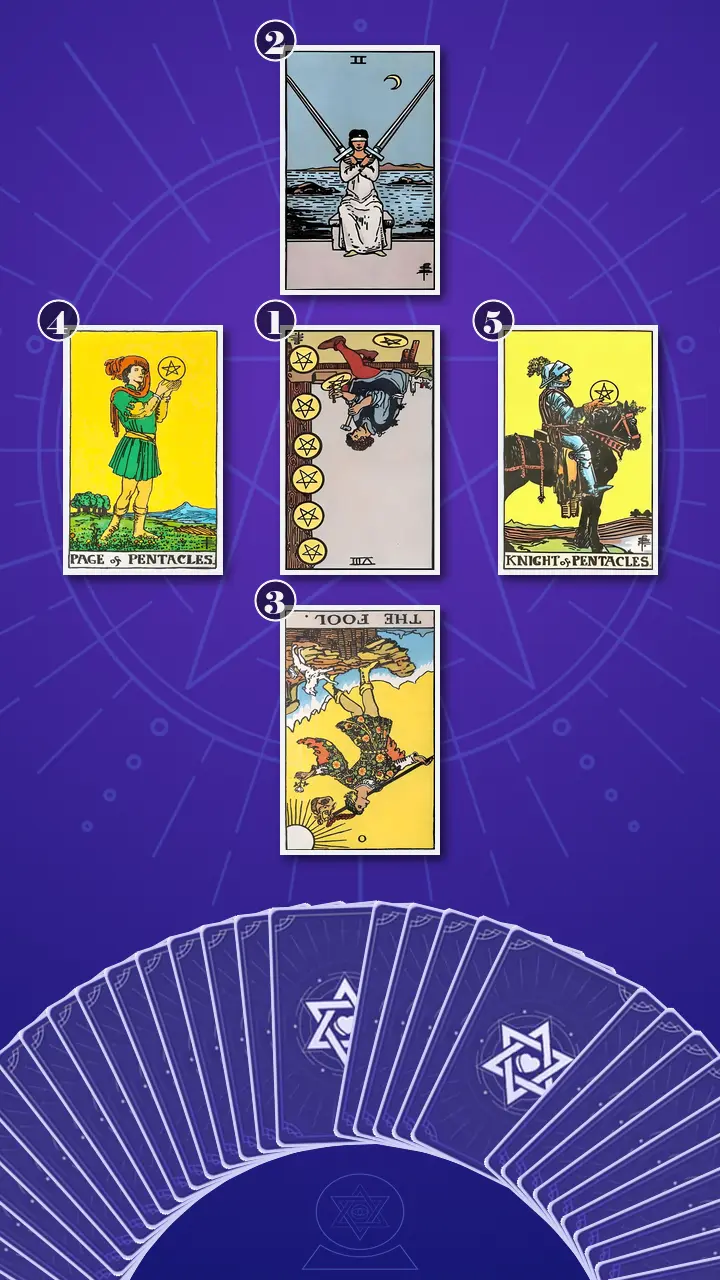
I chose The Shadow Spread, a five-position inner excavation tarot spread. For readers wondering how tarot works in my practice, I do not use the cards to predict whether someone must stay in a major or leave it. I use the images as an external map for examining a pattern that is difficult to see while living inside it. Card meanings in context help us separate visible behavior, the belief activating it, the fear being protected, the resource available, and the practical method of integration.
This spread was more useful than a larger Celtic Cross because Maya was not asking for an academic forecast. She needed to understand why ordinary coursework had acquired the emotional weight of a permanent career decision. The center would show the avoidance as it appeared on her screen and in her body. The card above it would reveal the belief that made beginning feel dangerous. The card below would expose the fear under that belief. The final horizontal line would move from a transforming resource to repeatable next steps.
I arranged the cards like a compass: one at the center, one above, one below, one to the left, and one to the right. The vertical line would take us beneath the behavior. The horizontal line would turn what we found into a workable direction.
Where the Hammer Kept Missing the Work
Position 1: The Finished-Looking Plan and the Untouched Page
I began at the center, with the position showing the concrete coursework avoidance and the contracted effort that currently made the problem visible. The card was the Eight of Pentacles, in reversed position.
In the Rider-Waite-Smith image, an artisan raises a hammer over a workbench while completed pentacles line the space beside him. Upright, the image often speaks of craft developing through repetition. Reversed, the tools remain available, but the motion is interrupted. I read its Earth energy as blocked rather than absent. Maya was capable of effort; her effort was being diverted before it could settle into practice.
The modern scene was already open in front of us. Maya had the laptop, reading, notes, rubric, and carefully rebuilt study planner ready on the kitchen table. When an imperfect first step made her question the major, she edited folders, checked formatting, moved blocks in Google Calendar, and researched better study systems. Preparation looked productive, but contact with the actual craft kept stopping.
“A perfect catch-up plan can still be a way of not beginning,” I said. “The card isn’t calling you undisciplined. It is showing us the exact moment productive energy gets rerouted into self-evaluation.”
I used my Study Environment Auditing lens and asked her to show me the whole screen. Seven course tabs, a Notion semester dashboard, two calendars, a Pomodoro video, and a half-open Reddit thread were all competing for the same narrow strip of attention. The problem was not that any single tool was bad. Together, they were quietly charging rent for every glance. Before Maya could read a paragraph, her limited psychological bandwidth had already been divided among twenty possible actions.
She let out a small laugh, but there was no amusement in it. “That is so accurate it’s kind of brutal.” Her fingers tightened around the phone before she placed it face down.
“Accuracy is only useful if it creates options,” I replied. “I’m not interested in using a card to shame you. I want to locate the interruption closely enough that you can change what happens in the next five minutes.”
I also named the card’s overcorrection risk. A six-hour catch-up session might briefly look like redemption, but exhaustion could make Quercus even harder to open the following day. The Eight was not asking for a heroic rescue. It was asking for one honest repetition.
Position 2: The Belief Guarding the Two Open Windows
I moved to the card above the center, representing the triggering belief that doing coursework equals further commitment to a major that may have been chosen too soon. The card was the Two of Swords, upright.
The blindfolded figure held two swords crossed over her chest. Water moved behind her, but the body remained guarded and still. I saw Air energy being used defensively: analysis was not expanding Maya’s view; it was freezing the exchange between thought and experience. The assignment stayed on one screen, alternative majors stayed on another, and neither was allowed to update the other.
I returned to the Quercus scene. One assignment tab sat beside three major-comparison tabs. “The inner script sounds something like this,” I said. “If I start, then I am committing; if I wait, I can still decide.”
Maya’s jaw set. Her gaze dropped from my camera to the blindfold on the card. After a few seconds, she pressed one hand against the center of her chest and said, “Yes. Researching makes me feel like I still have options.”
“That relief is real,” I said. “It makes sense that your nervous system reaches for it. The cost is that the relief depends on keeping new evidence out. Avoidance preserves the feeling of an open decision while reducing the information available to make that decision well.”
I asked her what exact sentence appeared before she switched tabs. She answered without looking up: “If I do this properly, I’m proving I chose this.”
The Two of Swords was the central blockage. Maya had been trying to solve an Earth question about lived study experience almost entirely through Air: more comparisons, more scenarios, more retrospective analysis. Her mind wanted certainty before experience, while the decision itself required experience before certainty could become more precise.
Position 3: The Beginning Replayed as a Mistake
I turned to the card beneath the center, representing the underlying fear that honest engagement could prove the original choice was poorly judged and weaken Maya’s sense of control over her future. The card was The Fool, in reversed position.
The traveler’s foot hovered near a cliff edge while a small dog called attention to the immediate terrain. The bundle on the traveler’s shoulder was light. No beginning could contain complete information about the whole route. In reversal, however, the Explorer’s energy was inhibited. Maya was not simply cautious about the next assignment; she was replaying her first-year declaration as evidence that she had been reckless.
Opening the next reading had begun to feel like walking farther along a route she might not want. One confusing term became retrospective proof that she had chosen without enough judgment. I was careful with the distinction: The Fool reversed did not confirm that the major was wrong. It showed how regret could make a revisable beginning feel irreversible.
“You may have begun with limited information,” I said, “but this next contact with the work is not a permanent verdict.”
Maya’s breath left slowly. Her shoulders remained high, but her hands stopped moving. “If I try properly and still hate it, I lose my excuse,” she said. “Then I have to admit I got it wrong.”
“You might discover a poor fit,” I replied, “or you might discover that unclear instructions, deadline panic, exhaustion after your shift, or studying alone is shaping the experience. We do not know yet. That is why contact matters. And if the evidence eventually supports changing majors, revising your direction would not erase your judgment. It would demonstrate that your judgment can respond to new information.”
I also warned against turning regret into an equally premature exit. Abandoning a module after one difficult week could reproduce the same demand for instant certainty in the opposite direction. The careful alternative was neither forced loyalty nor sudden escape. It was a smaller, better-observed beginning.
When the Page Held Up One Honest Piece of Evidence
Position 4: Grounded Curiosity as the Antidote
The radiator in Maya’s kitchen clicked off, and the room became quiet enough for me to hear the faint fan inside her laptop. I turned over the card representing the key shift from assignments as verdicts to one bounded task as an evidence-gathering learning experiment. The card was the Page of Pentacles, upright.
The Page stood in a cultivated landscape and held one pentacle at eye level. I placed the image beside the Two of Swords. One figure covered her eyes to preserve a stalemate; the other examined one concrete object with patient attention. Upright Earth had returned, now as balanced curiosity, teachability, and direct observation.
I told Maya that the Page was the spread’s antidote. She did not need a finished vocational identity before she could become a student of her own experience. She could give one reading or problem set ten focused minutes, then observe what held her attention, what confused her, and what conditions affected the work. The Page did not ask the task to prove the major right. The Page asked what the task actually revealed.
I brought her back to 9:10 p.m.: Quercus open, one sentence highlighted, forty minutes spent rebuilding the planner, and the untouched page still waiting. The comparison had brought real relief, yet it had also prevented the only experience that could update her picture of the major.
A study session is evidence, not a loyalty oath. You do not have to prove that your first choice was right before you are allowed to learn from it.
I let the sentence sit between us.
You do not need to prove that your first choice was right; you need to examine one real piece of learning with the Page's focused gaze and let evidence rebuild self-trust.
For one beat, Maya froze. Her inhale stopped halfway, and her fingers hovered above the trackpad as if the next click had lost its usual meaning. Then her eyes widened slightly and slipped out of focus; I could see her replaying evenings of untouched readings, rushed submissions, and immaculate calendars. Her brow pulled tight. “But doesn’t that mean I’ve been doing this wrong for months?” she asked, sharper than before. The anger arrived first, protecting a sudden sting of grief. I waited. Her eyes grew wet, her shoulders dropped by an inch, and the hand that had been curled against her sweatshirt slowly opened. She released a shaky breath that sounded partly relieved and partly unsteady. “If the assignment isn’t a vote,” she said more quietly, “then I can find out. But then I’m responsible for actually looking.” The clarity had removed one burden and revealed another: agency can feel like open space before it feels like freedom.
“Now, using this new perspective, think back to last week,” I said. “Was there a moment when this insight could have made the experience feel different?”
She remembered a case study she had abandoned after encountering an unfamiliar term. Before switching tabs, she had been interested in the example for several minutes. “I didn’t hate the topic,” she said. “I hated not understanding the instructions, and then I made that mean something about the whole major.”
I told her that this distinction was the first movement from identity-threatened dread toward grounded curiosity. It was not certainty, and it did not need to be. Maya had separated three questions that had been fused together: what the work felt like, what made it difficult, and what she wanted to do about the major later.
This was where I brought in Syllabus Deconstruction, the diagnostic method I use when a deadline has absorbed the emotional weight of an entire future. I stripped the assignment of its identity-level language and reduced it to mechanical actions: open page four, read one paragraph, underline two claims, write three rough sentences, stop when the timer ends. The point was not to make the major seem smaller than it was. The point was to stop one Tuesday-night paragraph from impersonating a lifelong contract.
As I looked at the Page, I thought of two decades of conversations held over cooling cups of coffee. Clarity had rarely arrived as a grand theory. More often, I had watched it appear when one frightening future was returned to one ordinary, observable task.
“So the sentence before you begin becomes: ‘I am not defending my major; I am noticing what happens when I actually meet the material,’” I said.
Maya nodded once. Her face still held the vulnerability of someone who had lost a familiar excuse, but the movement toward the card was unmistakable. She leaned closer to inspect the pentacle instead of leaning back from the screen.
The Knight Who Would Not Sprint
Position 5: A Repeatable Rhythm Without Permanent Loyalty
I turned over the final card, representing the practical method that could create evidence while preserving Maya’s freedom to reconsider the major later. The card was the Knight of Pentacles, upright.
The Knight sat on a stationary dark horse and held the pentacle steadily in both hands. Worked fields stretched behind him. Unlike a dramatic rider charging toward an outcome, this Knight valued method, defined effort, and a pace calm enough to notice what was happening.
I read the card as balanced Earth energy. The Page offered one focused observation; the Knight repeated the conditions until a pattern became visible. In Maya’s life, that meant two manageable study blocks around classes and her campus shift, each with one finish line and a real stopping boundary. She would review several sessions together instead of making a verdict about academic fit after one difficult evening.
“This is not a six-hour backlog rescue,” I said. “It is a recurring twenty-five-minute sample. One assignment tab. One notebook. One defined task. At the end, you stop or continue by choice.”
Maya looked toward her color-coded calendar. “Twenty-five minutes feels almost insulting compared with everything I’m behind on.”
I welcomed the objection because it exposed the all-or-nothing rule beneath the plan. “Then the Knight gives us useful information already. Your mind only recognizes effort if it is large enough to hurt. We’re replacing that rule. The block is not meant to erase the backlog. It is meant to produce a reliable sample without costing you sleep, meals, work, or the next day’s capacity.”
I traced the spread’s full movement for her. Earth began blocked in the reversed Eight of Pentacles. Air froze it through the Two of Swords. The Fool reversed showed the mistrusted beginning beneath the stalemate. Upright Earth returned through the Page’s close attention and matured through the Knight’s routine. The cards had not selected an academic destination. They had shown Maya how to gather better information for a decision that remained hers.
A Bridge Inspection, Not a Border Crossing
I read the spread as one coherent story. Maya had declared her major with limited information, then turned ordinary beginner difficulty into a trial of her past judgment. Because starting felt like further commitment, planning and comparison offered temporary relief. That delay reduced practice, increased deadline pressure, and produced rushed work, which then looked like evidence that the major or her judgment could not be trusted. The loop protected her from one frightening result while quietly manufacturing less reliable evidence.
The core metaphor I gave her was a bridge inspection. She had been refusing to test the bridge because an unsettling report felt more frightening than remaining on the same bank. But avoiding the inspection did not preserve freedom; it preserved uncertainty. A bounded coursework experiment would let her test one section without obliging her to cross the whole bridge.
Her cognitive blind spot was the belief that engagement meant endorsement. It did not. Completing one assignment could not retroactively prove that declaring the major was wise, and it could not legally or morally bind her to the subject. It could only provide data about interest, difficulty, skill, support, timing, and fit.
The transformation direction was therefore precise: stop treating each assignment as a verdict and let repeated, bounded contact become evidence. I wanted the next steps to remain small enough for Maya to begin while uncomfortable, not only on a rare evening when she felt perfectly motivated.
The No-Verdict Coursework Experiment
- Run the Desktop Reset Ritual.Before Tuesday’s study block at the kitchen table or Robarts Library, spend exactly 15 minutes clearing the physical and digital field. Leave one assignment tab, one notebook, water, and the required file visible. Put the phone on Do Not Disturb and move major-comparison tabs into a closed window.Stop at 15 minutes even if the setup is imperfect. The reset serves the coursework; it does not become a new redesign project.
- Schedule one 10-minute evidence block.Place it in Google Calendar at a realistic time between class, commuting, and the campus shift. Write a neutral finish line in advance, such as “read pages 4–6 and underline two points,” “solve one problem,” or “draft three imperfect sentences.” Stop when the timer ends unless continuing feels like a genuine choice.If 10 minutes makes the pressure spike, use five minutes or one paragraph. Small contact still produces information, and it does not require staying in the major.
- Build a Page-to-Knight evidence log.After each block, write one short observation under three headings: interest, difficulty, and conditions. Repeat the experiment twice this week, then spend five minutes reviewing the entries together. Choose one practical follow-up, such as asking a teaching assistant about an unclear term or trying a different study location.Keep every note descriptive. Do not make one mood, grade, or rushed submission carry the meaning of your whole future.
I asked Maya to repeat the boundary in her own words. “I’m testing the experience, not promising the major,” she said. The sentence was not dramatic, but it was usable. That mattered more.

A Week Later: One Line of Real Evidence
Six days later, I received a message from Maya. She had done the Desktop Reset Ritual at the kitchen table, set a 10-minute timer, and written three rough sentences for the case study. She continued for another eight minutes by choice. Her evidence log read: “Interest: the example was better than I expected. Difficulty: I did not understand the prompt. Conditions: starting was easier without the comparison tabs.”
She had not decided whether to change majors. Instead, she had emailed her teaching assistant with one specific question and scheduled a second block for Saturday morning. The coursework had started giving her finer-grained information than “right major” or “wrong major.”
A week later, Maya wrote that she had slept through the night after sending the question. In the morning, “What if I’m still wrong?” arrived first. This time, she smiled, opened her evidence log, and made coffee.
I did not see the reading as proof that tarot had solved Maya’s academic future. The cards had helped us externalize a loop, but Maya created the change by closing the extra tabs, meeting one real piece of learning, and recording what happened. Her journey to clarity began with practical self-trust, not certainty.
If every paragraph makes your chest tighten because finishing might confirm that you chose too soon, I want you to remember that avoiding the page can feel safer while keeping the same fear alive. Noticing that bargain means you are already looking beyond the blindfold.
If one small piece of coursework were allowed to speak only about this moment, rather than pronounce on your entire future, what could you hold at the Page’s eye level long enough to notice?