A 25-Minute Block Treated Coursework as Data, Not a Degree Verdict

The 7:40 p.m. Major-Regret Spiral
If you are a second-year student who opens the course portal on Sunday night and somehow ends up rebuilding a Notion dashboard instead of writing, the pattern I saw in Jordan (name changed for privacy) may feel uncomfortably familiar.
When our video consultation began, Jordan was sitting at a narrow desk in their shared Toronto apartment. Brightspace glowed on one side of the screen, three alternative-program pages were pinned on the other, and a color-coded Notion board occupied the space between them. I could hear the desk lamp buzzing through their microphone. Jordan took a sip from yesterday's coffee, grimaced at its cold metallic taste, and kept moving their hands from trackpad to keyboard without typing into the assignment document.
They had meant to draft one section, but before that section could become real, they renamed six files, adjusted three status labels, and checked a classmate's LinkedIn internship post. They had meant to gather evidence through the coursework, but before the coursework could reveal anything, they searched for a better major, a cleaner plan, and a version of themselves who had apparently chosen correctly at eighteen. The document itself still contained only a title.
“Why do I keep delaying coursework in a major I chose too soon?” Jordan asked. “I want to finish responsibly, especially because switching could mean more tuition and another semester. But every assignment feels like a vote for a future I'm not sure I want. If I start and still hate it, I lose my excuse.”
I watched their shoulders rise until they nearly touched their ears. The dread was not an empty lack of motivation; it sat across their back like a rain-soaked winter coat they could not remove indoors. Their restless hands kept searching for a side door while the blank page stood in front of them like a courtroom witness box.
“I'm not here to tell you whether to stay or switch,” I said. “Both choices remain yours. What I can do is help us separate the assignment from the verdict attached to it. Let's draw a map of the fog and find out what this delay has been trying to protect.”
I offered the distinction that would guide the whole consultation: Jordan was not only delaying the task; they were delaying the meaning attached to starting it. The behavior looked like a time-management problem, but the timing told a deeper story. The planning, comparison, and productive-looking organization arrived precisely when direct contact with the course might produce evidence about whether the major still fit.

Choosing a Campus Signpost in the Fog
I asked Jordan to place both feet on the floor, take one unforced breath, and state the question without trying to make it sound more decisive. As I shuffled, I explained that the pause was simply a transition from scrolling and reacting into sustained attention. The cards did not need theatrical mystery to be useful.
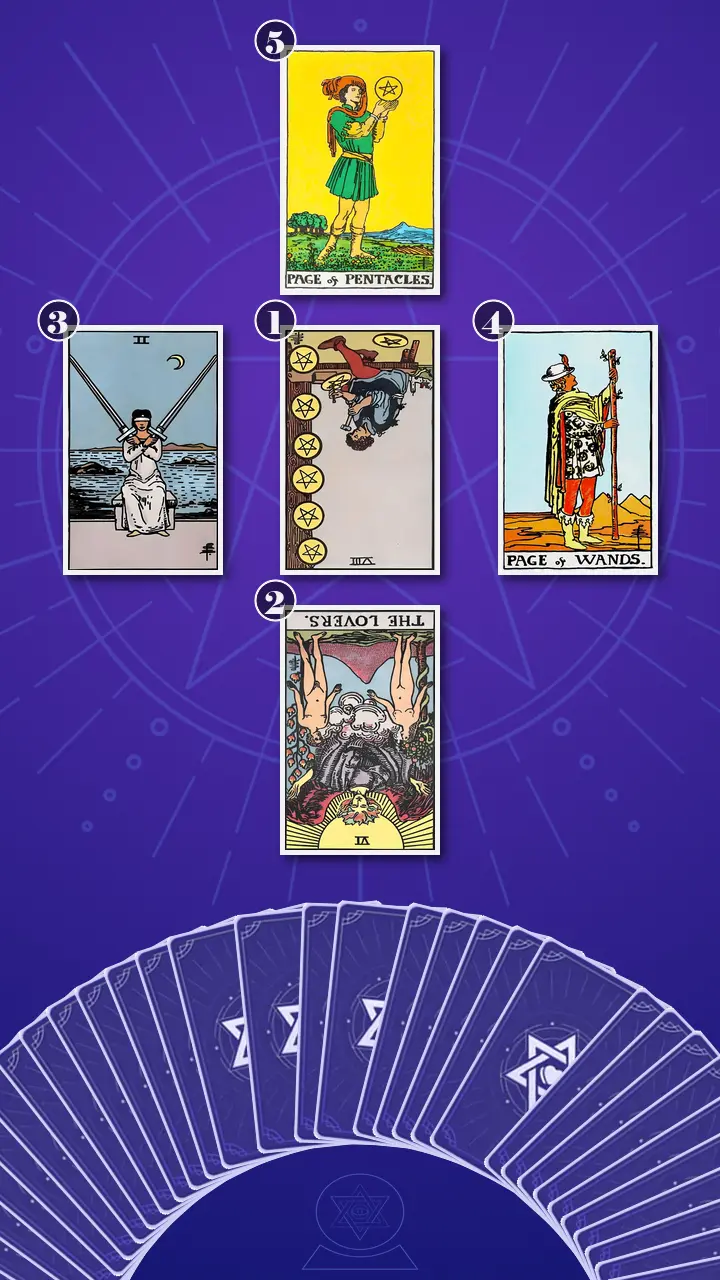
I chose a five-card Shadow Spread. I use this spread when a visible habit is being maintained by an underlying belief and a protective function. A three-card line would have compressed Jordan's values conflict and their defensive stalemate into one issue. A Celtic Cross would have introduced more future-facing material than this focused question required.
For anyone wondering how tarot works in a consultation like this, I do not treat the cards as a prediction engine or a substitute for academic advising. I use card meanings in context as an external cognitive map. The images make a pattern visible enough that the querent can question it, test it, and decide what to do with it.
I placed Position 1 in the center for the observable procrastination pattern. Position 2 went below it for the belief at the root of that pattern. Position 3 sat to the left for what the delay was protecting. Position 4 went to the right for the resource that could restore movement, and Position 5 rose above the center for practical integration. The cross looked like a campus signpost: the current problem held between two directions, with a grounded route rising from reflection into action.
“The spread will not identify one correct major,” I told Jordan. “It can show us why evidence has become so difficult to collect, what changes when we lower the stakes, and which next step might produce cleaner information.”
The Workbench That Never Reached the Work
Position 1: Productive Procrastination at the Center
“Now I'm turning over the card that represents the observable procrastination pattern: opening coursework but replacing substantive work with organization, comparison, or a deadline-driven rush.”
I turned over the Eight of Pentacles, reversed.
In the upright image, a craftsperson bends over one pentacle at a time. Completed pieces form an orderly vertical row, while the town remains at a distance. It is an image of apprenticeship: skill developing through repeated contact with real material. Reversed, that steady earth energy becomes blocked. The workbench stays busy, but the actual practice is displaced by setup, overcorrection, and inconsistent bursts of effort.
I pointed back to Jordan's Sunday evening. Brightspace had been open since 7:40 p.m., but forty minutes went into formatting headings, color-coding the Notion board, and collecting sources. The activity looked diligent. The assignment still held only a title. That gap between building a convincing workbench and tolerating rough repetition was the reversed Eight of Pentacles in contemporary student life.
“The first thought is, ‘Once the setup is right, I'll be able to start,’” I said. “Then a quieter thought arrives: ‘But if I start badly, maybe that says something about the major.’ Looking organized gives you temporary relief from making genuine contact. It also deprives you of the very evidence you say you need.”
Jordan gave a short laugh, but there was no amusement in it. Their fingers stopped on the trackpad, curled toward their palm, and then loosened again. “That's so accurate it's almost brutal,” they said. “I can spend an hour making the assignment feel manageable without doing the one thing that would make it smaller.”
“Accurate does not mean condemning,” I replied. “This card is not calling you lazy. It is showing us that the task has been overloaded. When one paragraph is forced to answer a question about your entire future, polishing the container can feel safer than touching the evidence.”
I also named the reversal's overcorrection risk. Jordan often responded to the lost evening with an all-night perfectionistic sprint. That could produce a submission, but it left them exhausted and revealed almost nothing about how the subject felt under normal conditions. More discipline applied to a distorted test would only produce more distorted data.
Position 2: The Choice Made Before the Stops Were Visible
“Now I'm turning over the card that represents the root belief: that serious engagement could confirm you chose this major before you understood your own values.”
The second card was The Lovers, reversed.
I centered the image of the red-winged angel, the two figures, and the mountain rising between them. Upright Lovers energy links conscious choice with values and lived alignment. Reversed, that communication is disrupted. Commitment starts serving identity consistency rather than present truth. The question shifts from “Can I force myself to commit?” to “Does this commitment reflect what matters to me now?”
I compared Jordan's major to a transit route selected before they had visited most of the stops. Reconsidering the route did not prove the original selection was dishonest or foolish. It meant the rider now possessed information that was unavailable at the starting station.
On Jordan's screen, the conflict appeared as constant switching between the current assignment and alternative degree pages. “If I stay, I might waste more time,” I said, reflecting their inner argument. “If I reconsider, I have to admit the first choice was incomplete. So the current major gets judged by the identity it was supposed to secure, while the alternatives get judged as escape routes. Neither is being compared calmly with your present values and daily experience.”
The reversed energy was a blockage between values and commitment, not proof that the major was wrong. I made that boundary explicit. Tarot could not supply the correct program, and one dull module could not establish misalignment any more than one exciting lecture could establish lifelong fit.
Jordan's chest lifted with a shallow breath. Their gaze left the cards and settled somewhere beyond the screen, as if they were replaying the moment they submitted their original university application. After several seconds, they pressed a hand flat against the desk.
“I think I've been trying to defend the person who chose it,” they said. “Changing my mind feels like saying that version of me failed.”
“You do not have to defend an old choice to examine your current one,” I said. “That earlier choice can have been reasonable with the information you had, and it can still deserve a fresh review now. Staying, switching, or remaining undecided are all available. The useful question is what you currently want from a field of study and what your completed experiences actually show.”
Position 3: Two Pinned Tabs and No New Evidence
“Now I'm turning over the card that represents the protective function of delaying: keeping both staying and switching untested so neither verdict has to be faced.”
The third card was the Two of Swords, upright.
I traced the blindfold and the two blades crossed over the seated figure's chest. The sea behind the figure was still, and a crescent moon hung above it. This was upright air energy functioning in excess: analysis had become a closed defensive structure. Thought was holding two possibilities apart while emotional information remained outside the decision.
I translated the crossed swords into the two browser tabs Jordan kept pinned indefinitely. One held the unfinished assignment; the other held an alternative program. As long as both remained open but untested, staying and switching were psychologically available. The arrangement felt like freedom, yet neither tab could generate new information.
When I worked on Wall Street, I saw how easily a hedge could be mistaken for a strategy. Holding opposite exposures could reduce immediate discomfort, but it did not create a thesis or define the next decision point. Jordan's pinned tabs were functioning as a psychological hedge. They reduced the emotional exposure of choosing while quietly charging interest in lost time, depleted work, and worsening decision fatigue.
“As long as I don't fully try, I don't have to know what trying would reveal,” Jordan said.
Their breath paused. One finger hovered above the trackpad without landing. Their eyes went unfocused as the familiar 11:52 p.m. deadline scene appeared to replay behind them: blue laptop light, a hot phone beside their wrist, shoulders lifted, and no time left to wonder whether the subject was dull, difficult, badly designed, or simply buried under fear. Then a low “Oh” left their chest, and their jaw released by a fraction.
“Urgency can produce a submission; it cannot produce clean evidence about fit,” I said. “The sprint protects you from reflection because there is no time left to interpret what the work means. But that also means your strongest evidence about the major has been collected under panic conditions.”
No Cups card appeared in the spread, so I deliberately invited the missing emotional language. “Before we call this a productivity issue, what feelings are being compressed into the word ‘resistance’?”
Jordan named regret first, then disappointment, then curiosity so quietly I almost missed it. That last word mattered. The Two of Swords had shown the blockage, but it had also revealed what the defense was preserving: the possibility that direct experience might change the story in either direction.
When the Page of Wands Opened the Road
Position 4: The Experiment Already in Hand
The desk lamp stopped buzzing just before I turned the next card, leaving the room unexpectedly quiet. A streetcar bell sounded from somewhere beyond Jordan's window, clean and brief, as if the city itself had marked a change of direction.
“Now I'm turning over the card that represents the transformative resource: the quality that can move you from demanding certainty to approaching coursework and alternatives with bounded curiosity.”
I revealed the Page of Wands, upright.
The Page stood in an open landscape, studying a single budding staff. They did not hold a finished map, a guaranteed destination, or a contract binding them to the road. Upright fire was available here in balance: enough energy to investigate one live question, without the excess that would force an impulsive withdrawal or the deficiency that would keep the experiment theoretical.
I connected the image directly to one assignment section and one 25-minute block. Jordan did not need to use the task to defend the major or prepare an immediate exit. They could observe what became more interesting after direct contact, what remained flat, what stretched a developing skill, and what felt heavy because of the identity pressure attached to it. The Page changed the assignment from a referendum into field research.
This was where I brought in my Academic ROI Auditing lens. I explained that return on investment was not limited to salary forecasts or whether a degree could be made to “pay off.” In an academic decision, I audit strategic yield across several dimensions: usable learning, sustained curiosity, tolerance for the field's ordinary tasks, transferable skill, financial cost, and the quality of information produced by the next action.
A panicked six-hour sprint had low information yield because deadline adrenaline contaminated every signal. A bounded block under ordinary conditions had higher diagnostic value, even if it produced only two rough paragraphs. I remembered noisy price movements from my trading years: no credible analyst would treat one distorted print as a complete valuation. Jordan had been trying to value an entire degree using work sessions conducted at emotional market close.
I reflected the setup back to them slowly: “At 7:40 on Sunday, the portal is open, the Notion board is getting prettier, and three alternative-program tabs are multiplying. Your shoulders feel heavier because the blank document seems to be asking for a decision about your whole future.”
The next assignment does not have to prove your major right or wrong; it only has to give you one honest piece of evidence.
You do not need to prove this major is forever; approach the next honest experiment like the Page studying the budding wand already in their hands.
I stopped speaking. The quiet held long enough for the street noise to return around us.
Jordan froze first. Their breath stopped halfway in, and their right hand remained suspended above the desk. Then their pupils widened and their gaze slipped out of focus, as if several Sunday nights were being replayed at once. Color rose along their cheeks. Their fingers tightened into a fist, and for a moment the reaction was not relief but anger. “But doesn't that mean I've been doing this wrong the whole time?” they asked, their voice suddenly sharper. “Doesn't it mean I wasted all those nights trying to force certainty?”
I did not rush to turn the anger into a positive lesson. “It means the strategy protected you from information that felt dangerous,” I said. “Protection is not the same as stupidity, and recognizing its cost does not erase why you needed it. You are responsible for the next experiment, not for having possessed perfect self-knowledge before you had the experience to build it.”
Their eyes reddened at the edges. Their fist opened one finger at a time, their shoulders sank, and a trembling breath left them. Relief arrived, but it carried a new vulnerability. “If I collect real evidence,” they said more softly, “I might have to do something with it.”
“Eventually, you may choose a response,” I said. “But evidence does not impose a deadline on your identity. Today it asks only for honest observation. You remain free to stay, switch, seek advising, collect more information, or pause when you need to.”
I invited the next layer immediately. “Now, using this new perspective, think back to last week. Was there a moment when this insight could have made the experience feel different?”
Jordan looked toward the unfinished assignment. “Thursday night,” they said. “I kept asking whether the whole course was worth it. I could have asked whether the first section became more interesting after I understood the model. That would have been answerable.”
“Exactly,” I said. “What if this block only has to tell you one thing? Curiosity asks for a sample, not a lifelong promise. You are allowed to investigate this without promising to stay.”
I named the transition clearly. This was the first movement from deadline-driven dread and immobilizing uncertainty to grounded confidence built through bounded curiosity and firsthand evidence. It was not certainty, and it did not guarantee that Jordan would enjoy the work. It was the return of a capacity the stalemate had obscured: the ability to learn something before deciding what that learning must mean.
The Pentacle Held at Eye Level
Position 5: One Task, Four Lines, Ordinary Conditions
“Now I'm turning over the card that represents practical integration: completing one limited piece of work under ordinary conditions and recording what it reveals about interest, skill, and fit.”
The final card was the Page of Pentacles, upright.
I focused on the Page holding one pentacle at eye level while standing in a cultivated green field. The distant mountain remained, but the Page was not trying to climb it in one leap. Upright earth appeared here in balance: patient attention, practical learning, and a willingness to let repeated observations accumulate.
The sequence had brought us from the reversed Eight's overloaded workbench to the Two of Swords' blindfold, then to two Pages who each studied one object. Jordan's capacity for focus had never disappeared. The psychological meaning of the object had changed. Coursework first appeared as repetitive proof of identity; now it could become material that was small enough to handle and specific enough to teach.
I translated the pentacle into one document, one timer, and one four-line note. After completing a named section under ordinary conditions, Jordan would record what happened under four labels: topic, skill level, task design, and pressure attached to the major. A difficult block could then be examined without collapsing every signal into “wrong degree.”
“The topic might hold your attention while the required skill remains frustrating,” I explained. “The task design might be dull even though the wider subject still matters to you. Or the subject may repeatedly feel lifeless after genuine contact. Every result is information, but no single result has to carry the conclusion.”
Jordan opened the notes app on their phone and typed the four labels without choosing a template. They read them twice, then took a screenshot of the Page of Pentacles beside the note.
“I can finish one defined piece and still remain free to review the larger choice,” they said.
“Yes,” I replied. “An assignment can be data without being a verdict.”
Turning the Reading into Clean Evidence
I gathered the five cards into one coherent story. Jordan had chosen a major before sustained, independent coursework made its daily reality visible. As the work became more demanding, each assignment started carrying the weight of that earlier choice. The reversed Eight of Pentacles showed the resulting productive procrastination. The reversed Lovers revealed the values conflict beneath it. The Two of Swords showed why the pattern persisted: delaying preserved both staying and switching as untested possibilities. The Page of Wands restored curiosity, and the Page of Pentacles gave that curiosity a practical container.
The cognitive blind spot was simple but consequential: Jordan believed they needed evidence that the major was worth further effort before engaging with the coursework, even though firsthand engagement was one of the few ways to gather trustworthy evidence. They were also judging fit through late-night sprints that could not separate topic interest, skill difficulty, assignment design, and identity pressure.
The transformation direction was therefore not “commit harder” or “switch immediately.” It was a shift from treating every assignment as proof that the major had to be right to using one bounded work block and a brief interest log as evidence about fit. Completing coursework responsibly and reviewing the major honestly did not have to be opposing goals.
I then adapted my Research Sunk-Cost Audit for Jordan's degree-choice question. A sunk-cost audit does not dismiss the money, credits, time, and effort already invested. Those consequences are materially real, especially for a student balancing café shifts, rent, a PRESTO balance, and tuition. The framework prevents past investment from impersonating future evidence. It separates what has already been spent, what each available path may cost from this point forward, and what information is still missing before a responsible review.
“We are not calculating whether your past deserves to be defended,” I said. “We are identifying which next action has the best information return while keeping the decision in your hands.”
The Next Seven Days
- Run the Verdict-Free 25-Minute Fit Test.Before the next coursework session, write one field-test question at the top of the document, such as: “Does this topic become more interesting after I understand the first concept?” At a desk, library seat, or quiet café table, set a 25-minute phone timer and work on one named section. When it ends, complete this sentence: “Direct contact made me more curious about, less interested in, or still unsure about...”During the timer, do not edit Notion, check LinkedIn, research another program, or polish the opening paragraph. If 25 minutes feels inaccessible, use five minutes and write two rough sentences or solve one problem.
- Keep a Four-Line Interest Log.Create one plain phone note titled “Assignment-as-Data” with four labels: topic, skill level, task design, and pressure attached to the major. Immediately after an ordinary work block, write one sentence under each label. On Friday, read no more than three entries and circle only the observations that repeat.Do not build a database or score your character. If four lines feel like too much, write only: “The hardest part was...” and “The most alive part was...”
- Complete a Ten-Minute Research Sunk-Cost Audit.Divide one page into three headings: Past Investment, Forward Costs, and Missing Evidence. Acknowledge existing credits and tuition under the first heading without using them as a command. Under Forward Costs, note questions about transfer credits, timelines, and fees that require current institutional information. Under Missing Evidence, list three qualities you want from a field of study and one concrete completed-class example for each. Bring the page to an optional academic-advising conversation as a discussion aid.Do not decide whether to stay or switch on audit day. Leave uncertain cells blank, verify practical details with the relevant university office, and let the page identify your next question rather than manufacture a conclusion.
I reminded Jordan that none of these actions was a test of worth, seriousness, or willpower. They could stop if the exercise became too activating, modify it around work shifts or access needs, and choose when enough evidence had accumulated. Actionable advice should reduce friction and restore agency, not create another standard against which to fail.

A Week Later, the Quiet Proof
Six days later, I received a message from Jordan. Attached was a screenshot of an unpolished document with two complete paragraphs and a plain phone note. There were no color-coded databases in sight.
“I did the block before opening Notion,” they wrote. “The first ten minutes were awful. Then the model got more interesting once I understood it. My log says: topic, curious; skill, stretched; task design, dull; major pressure, very high. That's not an answer, but it's more useful than ‘I hate everything.’”
Jordan also booked an academic-advising appointment from the café break room after a shift. They did not book it as an announcement that they were leaving. They brought the three-value page and two practical questions about credits and timelines, allowing institutional resources to become information rather than authority over the choice.
That night they slept through until morning. Their first thought was still, “What if I choose wrong?” This time, they told me, they smiled at the thought and opened the four-line log before opening another degree page.
I did not interpret that week as proof that Jordan should remain in the major. I saw it as something smaller and more reliable: they had made genuine contact with the work under ordinary conditions and retained their freedom to interpret what they found. The cards had supplied an objective map; Jordan had generated the evidence and taken the action.
That was the real Journey to Clarity. Clarity did not arrive as a perfect career forecast. It appeared as ownership: the ability to complete a bounded task, name separate sources of friction, use mentors and university resources deliberately, and review an old choice without treating revision as failure.
If an ordinary assignment makes your shoulders lock because finishing feels like defending your past while starting feels like risking your future, I want you to remember the Page holding one budding wand. Merely noticing that the task has been carrying a verdict means you are no longer standing at the original starting point.
If your next assignment did not have to prove your major right or wrong, what single “budding wand” already on your screen could you test for five honest minutes?