Fourteen Study Tabs Gave Way to Three Rough Lines in Eight Minutes

The 10:40 p.m. Academic Hoarding Loop
If you are doing a master's degree while working part-time in an expensive city, you may know this version of preparation procrastination: the assignment opens, your jaw tightens, and five minutes later you are searching for the complete guide instead of writing the first rough line.
At 10:40 p.m. on a Tuesday, Jordan appeared on my screen from a small Toronto apartment near a streetcar line. With their permission, they shared a desktop split between a blank assignment document and fourteen study tabs. They renamed a Notion folder while streetcar brakes squealed below, a half-finished mug of tea cooled beside the keyboard, and blue screen light sharpened the tired red around their eyes.
The cursor kept blinking under the assignment title. Nothing followed it.
"I keep preparing to study instead of studying," Jordan said. "Every resource looks like it might be clearer than the one I already have. I want to use what I've saved, but the second I might actually find out what I don't know, I think I need one more course or a better sequence first."
I heard the contradiction clearly: Jordan wanted to learn by using the material already collected, yet felt driven to collect more before beginning. The apprehension had become physical, like an uncloseable browser alert running through their body. Their jaw stayed locked, their shoulders hovered above their natural resting place, and every open tab seemed to warn that one wrong choice could waste the evening.
A full resource library can still leave the first paragraph empty. Once the assignment had exposed uncertainty, searching, comparing, and reorganising produced a quick lift of control. Then the evening disappeared, the backlog grew, and guilt arrived with enough force to inspire an even more elaborate plan for tomorrow. This was preparation-as-procrastination in an academic hoarding loop, not a lack of intelligence or seriousness.
"I don't read this as laziness," I told Jordan. "The collecting is doing a real job. It gives you a brief sense that the uncertainty is manageable. We can respect why that protection developed while still asking whether it is costing more than it gives you now. Let's make a map of the loop, then find one place where you can choose differently without having to overhaul your life."
Choosing the Ladder Through the Fog
I asked Jordan to put both feet on the floor, take one unforced breath, and hold a narrower question in mind: "Why does collecting another resource feel safer than using one I already have?" I shuffled slowly. I use this pause as a transition out of autopilot, not as a performance of mystery.
I chose the Four-Layer Insight Ladder · Context Edition, a four-card study-procrastination spread arranged like a vertical ladder. Years of travelling across cultures have taught me that people often do not need one louder answer. They need a structure that helps them hear what they already sense but cannot yet organise.
For anyone wondering how tarot works in a consultation like this, I treat the cards as reflective symbols rather than predictions. They place a pattern outside the person, where we can examine it without turning it into a verdict about character. The cards would not tell Jordan which course was objectively best or guarantee an academic result. They would help us distinguish observable behaviour, the belief sustaining it, the point where agency could return, and the practice that could make that agency tangible.
This spread suited Jordan's question because the problem was a self-reinforcing system. Resource discovery created temporary relief; relief postponed practice; postponed practice enlarged the backlog; and the larger backlog made another search feel necessary. A larger spread would have added information when the useful task was to make this one loop visible.
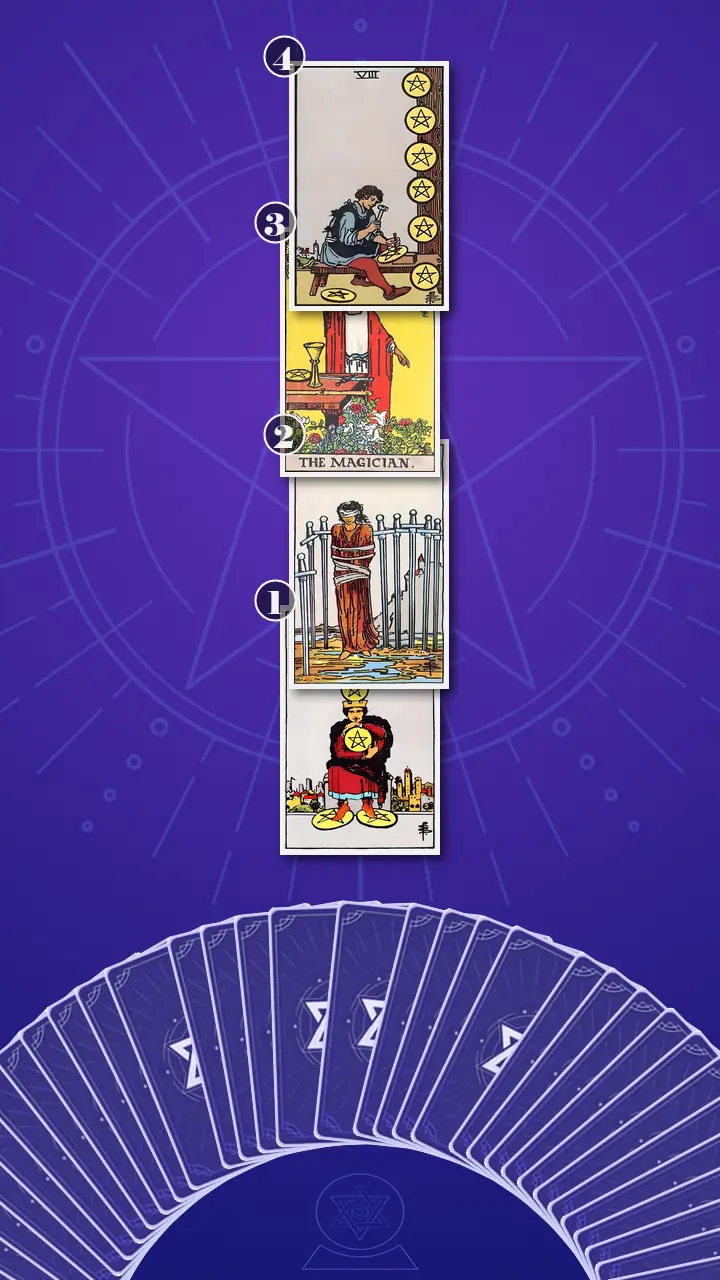
I explained the four positions before turning anything over. The bottom card would reveal the presenting behaviour: saving, organising, and protecting study resources while postponing their use. The second would uncover the readiness rule beneath that behaviour. The third would identify the leverage point that could turn existing resources into tools for one chosen act of learning. The final card would show how to ground that shift through repeatable practice.
"Think of it as climbing out of a storage basement toward a working studio," I said. "The cards are the map. You still decide whether, when, and how to climb."
Reading the Lower Rungs Where Preparation Stops Moving
Position 1: The Dashboard Held Too Tightly
The first card I turned over occupied the position that reveals the presenting behaviour in which Jordan saves, organises, and protects study resources while postponing their use. It was the Four of Pentacles, upright.
I pointed to the figure's closed posture. One pentacle occupied the crown, another was pressed against the chest, and two were pinned beneath the feet. I saw Jordan's resource library in that arrangement: study material filling their mental bandwidth, providing emotional reassurance, and restricting the very movement it was supposed to support.
In Jordan's modern-life version of the card, every promising article, recorded lecture, template, and course remained visible in a carefully maintained dashboard. Removing an item felt like losing protection; choosing one felt like testing whether it was enough. The collection looked organised and briefly restored control, but maintaining it consumed the evening intended for the first exercise. The resources had shifted from tools into academic insurance.
The upright Earth energy of the card was present in excess and contraction. Jordan had plenty of material structure, but preservation had become so dominant that nothing could circulate through use. This did not make organisation inherently bad. It showed that a useful skill had crossed the point where it served learning and begun to block it.
I gave voice to the loop I saw: "If I keep this, I haven't lost the option. If I choose it, I might discover it isn't enough."
Jordan let out a short, bitter laugh. Their thumb stopped against the rim of the cold mug, their gaze settled on the coin under the figure's feet, and then their shoulders dropped by a fraction.
"That is so accurate it feels a little cruel," they said.
"Then let's make an important distinction," I replied. "The card is describing a protective strategy, not accusing you of being a certain kind of person. You do not need to delete your library or shame yourself for building it. I only want to know which part of it could become an active workspace today instead of something that must stay complete and untouched."
I asked which organised space had the least completed work attached to it. Jordan named a Notion database called "Methods - Core." It contained forty-seven links, three overlapping course outlines, and no notes from an attempted practice question.
Position 2: When Fourteen Options Become Walls
The next card I turned over represented the underlying rule that Jordan must achieve complete readiness or choose the best resource before practice is allowed. It was the Eight of Swords, upright.
I drew Jordan's attention to the blindfold, the loose bindings, and the swords standing around the figure. In context, the blindfold resembled comparison without direct testing. The bindings reflected a rule that felt compulsory but had never been challenged. The surrounding blades looked remarkably like competing tabs crowding both the screen and the mind.
I brought us back to 10:40 p.m. The assignment was still blank while fourteen explanations glowed beside it. Jordan experienced those options as a trap because choosing one might waste scarce time or expose an unfilled gap. They treated "I must be fully prepared first" as though it were an external academic requirement, even though closing thirteen tabs and testing one lesson remained available.
The Air energy here was excessive and blocked. Analysis kept circling inside a closed system, generating comparisons but no evidence. The more Jordan tried to think their way into complete safety, the less direct information they had about the assignment, the resource, or the specific gap.
"The tabs are options, but your readiness rule turns them into walls," I said. "The private sentence sounds like: I could begin, but not until I know which option is safest."
Jordan's jaw tightened again. Their eyes shifted away from the card and held on the blank document, as if the past few deadline weeks were replaying there.
This was where I used what I call Draft Paralysis Deconstruction. I do not try to defeat perfectionism by calling it irrational. I ask what potential criticism it is trying to prevent. Through a Jungian psychological lens, I often find a vigilant inner protector standing behind the polished planning system, convinced that an imperfect first attempt will expose the whole self to judgment.
"Whose reaction becomes possible when you write the rough paragraph?" I asked.
"My supervisor's, eventually," Jordan said. "And my classmates'. They think I'm the organised one. I share all the good links. If I start and the paragraph is bad, I lose the excuse that I just hadn't found the right material yet."
I watched their fingers curl around the mug and then slowly loosen. The answer carried recognition and grief at the same time. The collecting had not simply been consuming time; it had been preserving an identity in which Jordan's ability remained untested and therefore uninjured.
"The loose bindings matter," I said. "They do not mean you should just get over it. They mean the readiness rule can be examined rather than automatically obeyed. A rough paragraph can reveal where your understanding is today without being allowed to define your intelligence, your future, or your worth."
When the Magician Closed Thirteen Tabs
Position 3: The One-Tool Workbench
For a few seconds, the street below went quiet. Even the laptop fan seemed to recede. I turned over the card representing the leverage point that converts existing resources from symbols of preparedness into tools for one chosen act of learning.
It was The Magician, upright, the only Major Arcana card in the spread and its central catalyst.
I showed Jordan the four suit emblems already arranged on the table. The cup, sword, wand, and pentacle were present before the Magician began. The raised wand and downward-pointing hand connected intention to material action, while the infinity sign suggested a capacity renewed through use rather than an inventory that had to be completed first.
In Jordan's life, the card looked like closing the resource marketplace, placing one already-saved tutorial beside one real practice problem, and deciding what eight or twenty-five minutes would produce before starting. Jordan did not need total control over every knowledge gap. Practical control could begin with using one available tool, noticing the exact gap that appeared, and choosing the next move from evidence.
The card brought the elements into balance. The trapped Air of comparison could now serve a specific question. Fire, previously dormant, could initiate one bounded attempt. Earth could hold the timer and the visible output. Water could acknowledge the discomfort without needing to soothe it through another save. The Magician's energy was focused agency, not forced productivity.
I could see the old logic still running: the assignment was blank, fourteen tabs glowed beside it, and Jordan's jaw tightened as though choosing one imperfect explanation would make every missing piece visible at once. Renaming a folder still offered the faster hit of control.
Readiness is not another item to collect; it is built by choosing one tool, placing it on the Magician's table, and using it.
I let the sentence sit between us.
Jordan's breath stopped first. Their index finger hovered above the trackpad without clicking, and their eyes widened slightly before losing focus, as though they were replaying every night when a new tutorial had felt like rescue. Then their brows drew together. Their shoulders remained high, but the anger reached their voice before the relief did.
"But doesn't that mean I've been doing it wrong this whole time?" they asked. The last word came out thin and unsteady. Their hand closed into a fist beside the mug, opened again, and rested flat on the desk. A flush moved across their face. Then they exhaled from somewhere deep in the chest, their eyes shining with both recognition and the exposed feeling of having nowhere left to hide behind the perfect system.
"It means you found a strategy that reduced uncertainty for a while," I said. "It also means the strategy now has a cost you can see. Recognition is not a prosecution of your past self. It is information your present self can use."
I invited them immediately: "Now, using this new perspective, think back to last week. Was there a moment when this insight could have made you feel differently?"
Jordan remembered a ninety-minute study window before a research-assistant shift. A difficult question had exposed a gap, so they spent the first eight minutes comparing two course syllabi, then another forty reading reviews. The available hour disappeared without either explanation being tested.
I drew two small rectangles on my notepad. In the first, eight minutes of comparison left no output. In the second, eight minutes with one imperfect resource could leave a rough sentence, an attempted calculation, or one precise question. The same amount of time, the same capacity for repetition, but a different direction.
"I don't have to choose the resource forever," Jordan said slowly. "I only have to find out what it can do."
That was the shift. Every comparison click had been training Jordan's personal algorithm to serve more preparation at the first sign of uncertainty. The Magician did not demand another productivity app. It offered an update to the operating rule: close the app marketplace long enough to use the software already installed.
I flashed back to the first imperfect exchanges I had made while travelling in places where I did not yet know the language well. No phrasebook had ever delivered fluency in advance. Capacity became trustworthy only after I used what I had, listened to the response, and adjusted. The Magician carried the same practical wisdom.
I then applied my Performance Anxiety Decoupling lens. I separated three things that Jordan's fear had fused together: the quality of one attempt, a mentor's eventual evaluation, and Jordan's core self-worth. A rough paragraph belonged only in the first category. Feedback, if and when it came, belonged in the second. Neither category had jurisdiction over the third.
"This is a test of the tool and your current understanding," I said. "It is not a verdict on your ability. Readiness is not the resource you find before practice; it is the evidence that practice leaves behind."
The practical answer was now visible: use one already-saved resource for one defined practice task before searching, then evaluate it through visible attempts. This was the first movement from apprehensive, control-seeking preparation toward grounded confidence built through imperfect repetition. Jordan still looked vulnerable, but the problem had become smaller. It had edges. It had a timer. It had an exit.
Position 4: The Attempt That Leaves a Mark
The final card I turned over occupied the position that defines the practical integration step: use one saved resource for a limited practice task and evaluate it through completed repetitions. It was the Eight of Pentacles, upright.
I pointed to the craftsperson engraving one pentacle while completed pieces remained visible nearby. The figure was not researching every possible engraving method or trying to prove mastery in a single sitting. Attention was on the piece currently touching the workbench.
In Jordan's modern-life version, this meant choosing one saved resource, working with it for twenty-five minutes, and recording the exercise, paragraph, or retrieval round completed. Jordan could return to the same method for several bounded attempts before deciding whether something else was needed. The resource would be judged by the work it supported, not by its title, length, reviews, or promise of completeness.
Earth had returned, but now it was balanced and productive. In the Four of Pentacles, Earth had meant storage, control, and immobility. Here, it meant a visible page, a completed repetition, and feedback the body could trust. The spread was not asking Jordan to become more disciplined. It showed that Jordan already repeated behaviours with enormous consistency. The choice was whether to repeat comparison or repeat contact with the work.
The two Eights made that contrast unusually clear. Eight minutes could disappear into comparing syllabi, or eight minutes could leave three rough lines and one exact question. Repetition was not the enemy. Direction mattered.
"This session doesn't need to prove mastery," I told Jordan. "It only needs to leave one piece of work behind. Count attempts, not tabs."
Jordan looked at the blank assignment again. Their shoulders lowered, then rose slightly with a new wave of caution.
"One ugly paragraph sounds possible," they said. "Not comfortable. But possible."
I considered that an honest form of clarity. Real agency rarely arrives as cinematic confidence. Sometimes it sounds like a person naming one uncomfortable action they are willing to test.
Turning the Storage Unit into a Workbench
I gathered the four cards into one story. Under deadline pressure, Jordan had learned to clutch resources because possession produced a quick sense of safety. The Eight of Swords revealed the private rule beneath the behaviour: practice was unavailable until complete readiness had been installed. The Magician challenged the blind spot that another tool was missing, while the Eight of Pentacles showed what had actually been absent: directed use repeated often enough to leave evidence.
The visual progression moved from clutching, to laying tools out, to crafting. Jordan did not need to destroy the library. They needed to change its function. The collection could stop being a storage unit for possible future selves and become a workbench for the task already open.
I named the cognitive blind spot directly: Jordan had been treating the discomfort of beginning as evidence that the current resource was inadequate. Sometimes a resource really is inaccessible, misleading, irrelevant, or incomplete, and replacing it is sensible. But discomfort alone could not establish that. Only a bounded attempt could reveal whether the tool helped, where it failed, and what kind of support was actually needed next.
The transformation direction was therefore modest and precise: move from acquiring the best possible study system to completing one practice task with one already-saved resource before adding anything new. The goal was not to feel completely ready. It was to build practical self-trust by meeting one gap when it appeared.
Jordan raised a realistic objection before I offered the next steps.
"What if I hit a real gap after two minutes?" they asked. "I can't waste the only study block I have pretending a bad resource works."
"Then we do not turn the boundary into a ban," I said. "You will make the gap specific before searching. If the resource is clearly unusable, you can replace it deliberately. The point is not to trap you with one tool. It is to give direct experience a chance to inform the next choice."
The Eight-Minute Evidence Test
- Run the Inner-Critic Mute Protocol.At the next study session, open the assignment first and place one already-saved, relevant resource beside it. Take ninety seconds to write the critic's prediction, such as "If this paragraph is rough, it proves I am behind." Under it, write: "This attempt reports my current understanding; it does not grade my worth." Choose one output, such as question 1 attempted or 100 rough words, and use the resource for eight minutes before opening any new search.If eight minutes feels too exposing, use two minutes or write one deliberately rough sentence. You may stop, continue, adapt, or replace the resource when the timer ends.
- Create an attempts-completed ledger.For seven days, use a sticky note, phone note, or plain three-column table labelled "Date," "Attempt completed," and "What it revealed." Record the physical trace after each block: words drafted, problems attempted, points recalled, or annotations written. Review the resource only after several bounded attempts, using the evidence it produced.Do not turn the tracker into another Notion project. No formulas, tags, covers, streaks, or catch-up rules. One honest entry is enough to begin.
I added one boundary beneath both actions: any urge to tutorial-hop could go into a simple "Search after practice" note. Jordan would write the exact failed step, such as "I cannot explain why this variable is controlled," instead of launching a broad search for the complete research-methods course. Air could still ask questions, but the questions would now serve the work.
"Do not ask which resource looks complete," I said. "Ask what this one helps you do."

A Week Later, Three Rough Lines
Six days later, I received a message from Jordan. They had opened the assignment first, dragged one saved tutorial beside it, and set an eight-minute timer. Their first attempt produced three awkward lines and one exact question. Instead of searching for another full course, they searched only for the missing concept.
They also sent me a screenshot of a plain phone note. It held three entries, no colour coding, and no productivity template. One entry read: "112 rough words. Revealed that I understand the argument but need one source for the method."
Jordan told me they slept through the night after drafting those words, then woke with the old question, "What if I chose wrong?" The thought still arrived. This time, they smiled, opened the same resource, and tested it again.
I did not mistake that moment for a total transformation. The apprehension had not vanished, and the resource library was still crowded. What had changed was Jordan's relationship to the first wave of discomfort. They had moved from seeking imagined readiness toward building grounded confidence through visible repetition.
The cards did not close thirteen tabs, write three lines, or decide which resource deserved another session. Jordan did those things. Tarot gave us a structured mirror and a language for the pattern; Jordan remained the author of every next step.
If the blank document makes your jaw lock and one more perfect explanation feels safer than the good-enough resource already open, I hope you remember this: noticing the Collector reach for academic insurance is already a return of choice. Your library does not need to disappear. One shelf only needs to become a workbench.
So the next time readiness fails to arrive first, which already-saved tool will you place on your own Magician's table for one small, real, eight-minute test?