From Course Hoarding to Grounded Practice: One Lesson, One Output
When Course Hoarding Looks Like Progress
If you are a junior designer in Toronto with a half-finished Figma file, twenty saved classes, and a Sunday afternoon disappearing into syllabus comparisons, your version of tutorial hell may look impressively organised.
That was how Jordan, a twenty-eight-year-old non-binary junior product designer, appeared at my table. At 3:42 p.m., their condo kitchen held three course tabs behind a half-built user flow, a Notion database labelled Learning Queue, and an untouched notebook catching the blue edge of the monitor. The kettle clicked off. The radiator ticked. Jordan's fingers moved between browser tabs while the unfinished frame waited for one actual design decision.
I watched their shoulders rise toward their ears and their hand hover over another course-sale email. The new syllabus promised a cleaner foundation in information architecture. For a few seconds, saving it gave Jordan the feeling of having secured the future. Then the Figma file remained unchanged, and the relief settled into a familiar weight beneath their ribs.
'Why do I keep saving courses instead of using what I learn?' Jordan asked. 'I am not procrastinating because I am learning. I just need one course that explains it properly.' They wanted to use what they already knew, but applying it before they felt ready seemed to place their self-worth on a screen where somebody else could evaluate it.
Their anxiety did not look abstract to me. It looked like a browser window that kept reopening inside their body: tight shoulders, restless fingers, a heavy stomach whenever a rough first attempt might become visible. I knew that physical grammar from my own years on Wall Street, where uncertainty could sit beside a person long after the office lights went out. 'I believe you,' I said. 'The relief from saving is real. So is the cost when the work never gets a chance to teach you anything. Let us draw a map through the loop and see what belongs to knowledge, what belongs to fear, and what choice is still yours today.'

A Ladder Instead of Another Library
I invited Jordan to put both feet on the floor, take three unhurried breaths, and name the practical question beneath the urge to find another resource. I shuffled slowly while they focused on the half-finished flow. I treated the shuffling as a transition into attention, not as a way to hand their decisions over to something outside them.
'Today I am using the Four-Layer Insight Ladder · Context Edition,' I explained. 'It is a linear four-card spread designed for a self-reinforcing loop rather than a choice between external options. This question is not really asking which career path or course is objectively correct. It is asking how saving becomes a substitute for practice, what rule keeps that substitution alive, what interrupts it, and how the interruption can become repeatable.'
That is also how tarot works most usefully here: the cards give us an organised set of images and questions, while the evidence comes from Jordan's actual behaviour, body, deadlines, boundaries, and experiments. The first position would show the presenting loop, the visible act of saving courses and postponing use. The second would reveal the underlying mechanism, including the readiness rule and the fear beneath it. The central position would hold the transformation bridge. The final card would point toward action and integration, where insight has to meet an ordinary week.
I placed four cards in a gently ascending line, from a locked storage room toward a small workbench. I told Jordan that the cards could not predict whether a portfolio project would succeed or decide what they should buy. They could help us inspect the sequence with enough clarity to let Jordan, not the spread, choose the next move.
Reading the Map from Storage to Practice
The Keeper of Future Competence
'Now the card I am turning represents the presenting loop: the observable habit of saving courses, expanding the resource queue, postponing practical use, and taking short-term relief from holding resources.'
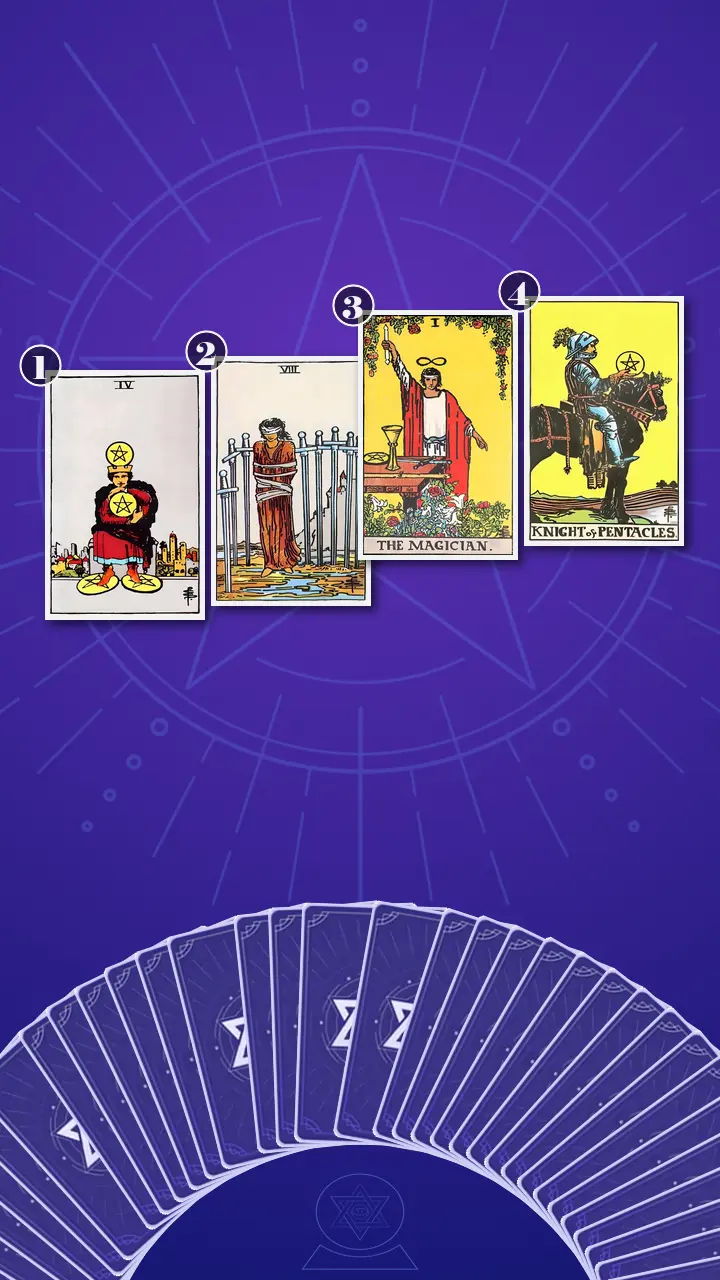
I turned over the Four of Pentacles, upright. In the Rider-Waite-Smith image, the seated figure holds four coins close to the head and chest, with another coin beneath each foot. The whole posture is organised around keeping resources contained. In card meanings in context, I read this as an excess of earth energy: conservation has become so strong that it blocks circulation.
'On Sunday afternoon,' I said, 'you have a half-finished prototype open, but you spend the next forty minutes labelling saved courses by topic, price, and priority. The organised library gives you a temporary sense that your future competence is secure. No knowledge is risked on a concrete design decision, though. This is the moment possession starts impersonating progress.'
I pointed to the coin against the figure's chest. 'The courses are not only information. You keep them close as intellectual and emotional security. As long as a lesson is saved, it has not yet failed to help you. The unopened resource remains full of possibility. The trouble is that a savings account for future competence cannot fund the project it was meant to support if nothing is ever withdrawn.'
Jordan gave a short, bitter laugh and glanced at the Notion queue. 'That is uncomfortably specific. It sounds like I am doing something productive and avoiding the one thing that could prove whether I learned anything.'
'That distinction matters,' I said. 'I am not calling the learning fake. Saving gives you control for ten minutes. It also keeps practice evidence out of reach. A saved course preserves the possibility that you are capable; practice gives you evidence.'
Jordan's mouth tightened, then softened. Their thumb traced the edge of the phone without opening it. I asked which one resource already in the queue could support a small application this week, and I watched their eyes move from the course list back to the unfinished Figma frame.
The Rule That Said Wait
'Now the card I am turning represents the underlying mechanism: the Inner Conflict and Repetition Compulsion that make more information feel safer than application, especially when an imperfect result seems capable of threatening self-worth.'
The Eight of Swords, upright appeared next. I drew Jordan's attention to the gray blindfold, the bindings around the figure, and the swords forming a partial enclosure. The landscape beyond the figure remains open, but the restriction feels complete from inside it. I read the upright air energy as a blockage: thought has narrowed into a rule against beginning.
'At 7:18 p.m. on Tuesday,' I said, 'a Slack message asks for a rough user flow by morning. You open the file, notice one ambiguous step, and search for a more comprehensive information architecture course. Your jaw tightens as the thought arrives: if you cannot do this cleanly, you must have missed something important.'
I laid one finger near the gap between the swords. 'The brief allows a first pass and revision. The internal rule does not. It says, I am allowed to begin only when I cannot be exposed as basic. That is a self-written access rule, not a fact established by the task. It turns ordinary beginner uncertainty into a ban on starting.'
I asked, 'What exact requirement was written in the brief, and what requirement did your mind add? Was your manager asking for expertise, or asking for something they could respond to?'
Jordan's breath stopped for a beat. Their jaw worked once. Then their gaze lost focus, as if the Tuesday monitor glare, the Slack notification, and the blank first frame were replaying behind the card. 'They asked for rough,' they said. 'I heard, show us whether you are actually good enough.'
I let the silence remain kind and specific. The Eight of Swords did not mean Jordan was trapped forever, and it did not mean the workplace context was irrelevant. It showed the difference between an external constraint and an untested assumption. A small reversible decision, one scope question, or one rough frame could create information that another broad syllabus could not.
Jordan's hands had been clenched around the pen. I saw the fingers loosen, though the shoulders stayed high. The fear had not disappeared. It had become identifiable, which gave us something more workable than a vague sense of being behind.
When the Magician Put Every Tool on the Table
The Bridge from Potential to Practice
The room changed when I reached for the third card. The kettle had gone quiet, the radiator's ticking seemed farther away, and the blue monitor light fell across the table like a narrow stage. I told Jordan that this was the central transformation bridge, the point where the loop could be interrupted through deliberate use of what was already present.
'Now the card I am turning represents the key transformation: the shift from collecting certainty to using available knowledge, directly challenging the belief that readiness must come before practice.'
It was The Magician, upright. The figure's raised wand and lowered hand create a clear movement from idea into form. On the table sit a cup, sword, pentacle, and wand, each tool visible and within reach. I read this upright energy as focused agency and integration. Nothing new has been acquired. What changes is the arrangement, the attention, and the willingness to use one tool before asking for another.
'Jordan, you close the marketplace, open one lesson you already own, and write one target above the Figma file: make a rough three-screen flow in eight minutes. The result may be basic. That is precisely why it is useful. It becomes evidence about what you can already do and which question is genuinely unresolved.'
At this point I used the diagnostic lens I call Pseudo-Growth Eradication. The name is deliberately blunt. I strip away self-help fluff and audit the actual return and execution rate of a personal development effort. A saved course may return relief, possibility, and a beautifully organised queue. If it produces no exercise, draft, question, revision, or conversation, its practical execution rate is currently zero. That is not a verdict on Jordan. It is a clean observation about the sequence.
I followed it with my Potential Actionability Assessment. I asked what one existing lesson could produce, where that output could be made, and what evidence would exist when the time box ended. The abstract upgrade was no longer become a better designer. It became one rough flow, one defined question, and one note about what happened.
For a moment, I remembered a lesson from my old Wall Street life: an immaculate model sitting unopened on a terminal had no decision value until it met live information. I do not use that memory to turn a human life into a spreadsheet. I use it to separate activity from evidence and to protect people from unnecessary friction. Practice is not a referendum. It is contact with reality.
At 3:42 on Sunday, the kettle clicks off while the half-finished Figma flow sits behind three course tabs. Jordan's shoulders tighten at the next project step, and the new syllabus offers instant relief: productivity without exposure. The old belief rises again, promising that one more course will finally make starting safe.
Stop treating another saved course as proof of preparation and start translating one existing lesson into a small, imperfect act, like The Magician placing every available tool on the table and using what is already there.
For one full breath, Jordan's thumb froze above the trackpad and the muscles at their jaw held still. Their eyes lost focus, as if a week of saved tabs were replaying behind the monitor: the Slack brief, the polished LinkedIn case study, the untouched prototype. Then their mouth tightened. 'But does that mean I was wrong about all that learning?' The question carried heat, not failure. I told them no: the courses were not worthless, but the sequence had become a shield. Their fingers curled around the pen, released it, and returned to the keyboard. An uneven breath moved through their chest. Their shoulders lowered, followed by a small, almost dizzy pause, the blankness that arrives when a familiar defense has no immediate job. I suggested an eight-minute test: close the marketplace, choose one existing lesson, and name one output, such as one frame, three bullets, or five questions. At the end, record what the attempt revealed. Keep it private unless sharing is freely chosen, and stop if it feels unhelpful or too exposed. The point was contact, not performance.
I asked, 'Now, use this new lens to remember last week. Was there a moment when this insight could have made you feel different?'
Jordan looked toward the unfinished flow. 'When I saw the LinkedIn case study on the train,' they said. 'I compared their edited ending with my untested beginning, then bought another story-telling class. I could have opened my own file and found out what the next question actually was.'
'That is the first crossing,' I said. 'You are moving from anxious certainty-collecting and protected potential toward curiosity-led application and grounded self-trust built from repeated evidence. The Magician does not promise mastery. The card offers a different order of operations: use, observe, then study the gap that the work itself reveals.'
The Quiet Discipline of One Pentacle
The Practitioner Who Stops Scanning
'Now the card I am turning represents action and integration: the small, repeatable practice that lets you build evidence through completion before adding another course.'
The final card was the Knight of Pentacles, upright. His horse is still. He holds one pentacle directly in front of him, and cultivated furrows extend across the field. I read this upright earth energy as balance: patience without paralysis, consistency without a dramatic reinvention, and attention placed on one workable task.
'This is the opposite of another productivity montage,' I said. 'On Tuesday at 7:00 p.m. and Saturday at 11:00 a.m., you make one named exercise for twenty-five minutes. You finish the defined container before adding to the queue. Then you record what the attempt showed. The point is not intensity. It is dependable contact with the work.'
I described the course translation directly. One lesson becomes one rough prototype. One prototype produces one observation. One observation tells Jordan whether a genuine gap exists. The Knight asks them to stop scanning the horizon for the perfect instructor and give one field enough repeated attention to become familiar.
Jordan opened their calendar and hovered over Tuesday evening. 'It only has to be small enough to finish and useful enough to teach me something,' they said, testing the sentence rather than claiming to believe it completely.
I noticed the change in their posture. The shoulders did not drop all the way, and the phone still sat close by, ready to offer another syllabus. But Jordan wrote Tuesday and Saturday into the calendar, then placed the phone face down. The choice was modest. It was also visible.
The Draft Is Not a Verdict
I gathered the four cards into one short story. The Four of Pentacles showed why the saving habit felt intelligent: holding courses close protected the possibility of competence and offered immediate control. The Eight of Swords revealed how that protection hardened into an inner rule: the practical task had to wait until every risk of looking basic had disappeared. The Magician opened the table by asking what existing knowledge could make now. The Knight of Pentacles gave that opening a pace slow enough to become believable.
The loop was not a character flaw. A difficult assignment triggered the thought, I need one more course. Saving, buying, or reorganising a resource brought temporary relief. No practice evidence accumulated, so the task stayed unfamiliar and exposed. That unfamiliarity then appeared to confirm the original belief. I could see why Jordan had mistaken preparation for progress without asking them to shame themselves for needing protection.
The cognitive blind spot was the assumption that feeling ready was an objective measurement of readiness. Jordan had also been comparing other people's edited LinkedIn outcomes with their own unedited beginning, then trying to buy or organise their way across a gap that practice, feedback, and revision were better suited to close.
The transformation direction was clear and limited: choose one existing lesson, translate it into a small time-boxed application, observe the result, and use that evidence to decide whether targeted study is actually needed. This did not mean courses were bad, that rest was avoidance, or that every person should share unfinished work publicly. A private experiment, a smaller version, a scope question, or a deliberate stop could all be valid depending on safety, time, accessibility, workplace conditions, and capacity.
The One-Tool Workbench
I converted the reading into two low-pressure experiments. I called the first the One-Tool Workbench, and I explained that the second would use my Evolution KPI Framework. The word KPI can sound cold, so I defined it carefully: the metric would track contact with a chosen practice, never Jordan's worth, talent, or career outcome.
- Make one rough artifactOn Wednesday evening, at the same kitchen table where course browsing usually begins, choose one lesson already saved and write one output on a sticky note, such as Make a three-screen onboarding flow in Figma. Close the course marketplace tabs, set an eight-minute timer, and make the roughest recognisable version. When time ends, record three lines in the project file: what worked, what remained unclear, and the one question practice produced. Jordan may show the early experiment to one trusted colleague, or keep it entirely private.When the urge for a better lesson appears, place its link in a temporary later note without opening it. One frame, three bullets, or five questions made in two minutes counts as the minimum version. Sharing is optional, and Jordan can stop if the exercise feels unhelpful or too exposed.
- Run the Evolution KPI FrameworkFor thirty days, schedule two named practice blocks each week, such as Tuesday at 7:00 p.m. and Saturday at 11:00 a.m. Use twenty-five minutes when possible, or ten when necessary. During each block, pause course marketplaces and tutorial feeds, complete one defined design application, and add one row to a three-column evidence log labelled attempt, what it showed, and next adjustment. Before saving a new course, complete one application first.Measure completed practice contacts, not hours consumed, polish, public feedback, or streak perfection. A screenshot can count as evidence. The thirty-day challenge is a revisable experiment, not a permanent ban or a moral obligation; Jordan can reduce, pause, or end it whenever their context requires.
Jordan asked what to do when the first draft looked embarrassingly basic after eight minutes. 'Call it data,' I said. 'The draft is not a verdict on your worth. It is the next piece of information. If it reveals a real gap, you can choose a focused course, ask a colleague a precise question, or take a proper break. Study becomes more useful when the work has told you what to study.'
I also reminded Jordan that difficult working conditions, unrealistic deadlines, inaccessible training, financial pressure, burnout, or unsafe feedback environments could not be solved by a timer. The reading was a bounded tool for the portion of the loop within their control. It was not permission for a manager, an algorithm, or a productivity system to demand more from them.

The Quiet Proof of Practice
Four days later, I received a message from Jordan with a screenshot. They had made three rough Figma screens from one saved lesson, written what worked and what did not, and added a question about the empty state to their evidence log. They had chosen to send the early experiment to one trusted colleague with the label early experiment. The reply had not solved the project. It had given Jordan one specific revision instead of another abstract reason to keep searching.
That night, Jordan slept a full night. At breakfast, the first thought was still, 'What if I am wrong?' They smiled, reopened the file, and wrote one next adjustment. The question remained, but it no longer controlled the first click.
I held the four cards in my hands and saw the journey for what it was: not a supernatural rescue and not a promise of instant confidence. The spread had made the loop observable. Jordan had made the choice. Their self-trust could now grow from repeated evidence, one ordinary attempt at a time.
When the cursor hovers over 'Start project' and your stomach drops, it can feel safer to protect the idea that you might be capable than to risk seeing one ordinary first attempt on the screen.
If one rough attempt could be treated as information rather than a verdict, what tiny thing might you feel curious to place on the workbench first?