When "Quality Control" Became Avoidance: Returning to the Brief

The 10:40 p.m. Paper Resubmission Loop
“You said you would submit after breakfast, but final_revised.docx is open again at 10:40 p.m.,” I reflected to Maya (name changed for privacy), a 28-year-old doctoral researcher balancing part-time teaching, London rent, and a revise-and-resubmit that had been nearly finished for weeks.
Across our video call, I could see the submission portal open beside her manuscript on a narrow flatshare desk. The radiator clicked behind her, a flatmate’s kettle hissed through the wall, and the laptop’s heat had left two pink marks beneath her wrists. Maya changed one sentence that already answered a reviewer, followed the edit into three related paragraphs, then closed the portal as her jaw locked.
“I keep calling it quality control, but the deadline keeps moving,” she said. “What am I avoiding by delaying a resubmission I keep rewriting?”
I heard the contradiction clearly: Maya wanted to complete the paper and regain momentum, but stopping would make the work visible to evaluation. It would also remove the paper as an explanation for why she still felt uncertain about what came next. The pressure inside her looked like standing between closing Tube doors while repeatedly repacking the same carry-on: every adjustment felt responsible, but boarding would make the next destination real.
“I’m not going to use the cards to predict whether the paper will be accepted,” I told her. “That outcome isn’t mine to promise. I want to help us separate useful revision from the edits that temporarily make the finish line feel less exposed. Let’s draw a map of the loop and see where your choice returns to you.”
Choosing the Shadow Spread as Our Map
I asked Maya to place both feet on the floor, unclench her hands if that felt comfortable, and take one ordinary breath while holding the question in mind. I shuffled slowly. I treat this small ritual as an attention shift, not a supernatural test: it helps us stop reacting long enough to observe the pattern.
I chose the five-position Shadow Spread because Maya’s question was not simply, “Should I submit?” It was, “What does the delay protect me from?” For anyone wondering how tarot works in a consultation like this, I use the cards as an external pattern map. Their symbols let us examine behaviour, fear, short-term protection, integration, and next steps without pretending that the deck can overrule evidence or personal agency.
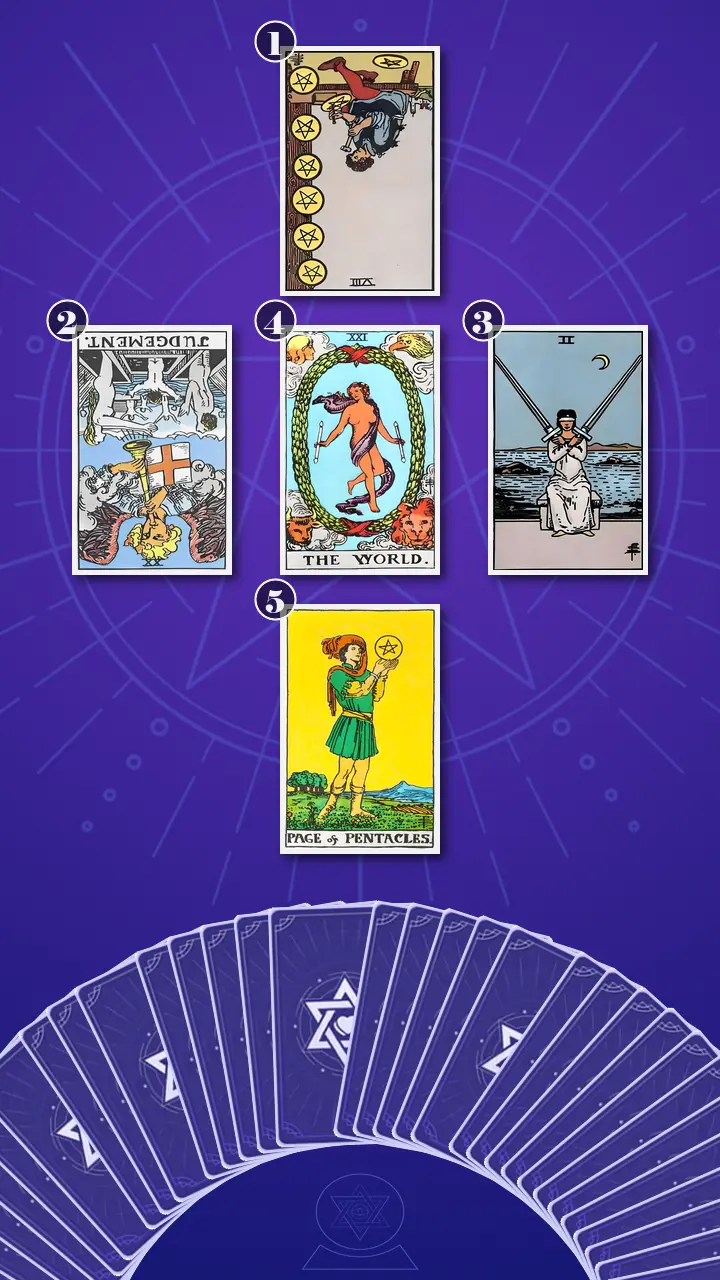
I arranged the cards in a compact cross, like a lock opening into a short downward path. The first position would show the visible rewriting loop. The second and third would uncover the fear beneath it and the benefit Maya received from keeping the paper revisable. The central fourth card would offer the integrating resource, and the final card would translate that insight into one observable action.
Reading the Loop Behind “One More Edit”
Position 1: Eight of Pentacles Reversed and the Craft That Cannot Stop
I turned over the card representing the visible resubmission loop: repeated rewriting, expanded scope, and missed upload dates. It was the Eight of Pentacles, reversed.
I pointed to the artisan bent over one pentacle while a row of completed pentacles hung behind him. At 10:40 p.m., Maya had reopened an already-responsive paragraph, replaced several adequate phrases, created a new consistency question, checked three related sections, and closed the portal. The reversed card did not criticise her skill. It showed skilled labour losing contact with its actual brief.
The earth energy here was blocked by excess. Maya had plenty of diligence but too little recognition of completion. Each optional improvement became mandatory as soon as she noticed it. Her revision process had begun to behave like an algorithm trained on one signal: whenever editing reduced discomfort, it recommended more editing. Productive-looking was no longer reliably progress-producing.
In my sound-work practice, I call this a Focus Disruption Audit. The most disruptive chord was not the kettle, her teaching load, or even LinkedIn’s latest “thrilled to announce” post. It was the moment the objective reviewer task ended. With no technical problem left to solve, exposure entered the room, and another edit restored a familiar rhythm of competence.
Maya did not nod. She gave a short laugh that carried no amusement, pressed her tongue against the inside of her cheek, and looked away from the screen. “That’s so accurate it’s almost cruel,” she said. I told her the distinction was meant to protect her diligence, not shame it. An edit could be technically defensible and still function as avoidance when it no longer served the requested outcome.
Position 2: Judgement Reversed and the Email That Became a Verdict
I turned over the card representing the avoided fear beneath the rewriting: that submission would invite evaluation without resolving Maya’s larger uncertainty about worth and direction. It was Judgement, reversed.
The angel’s trumpet gave me a precise image for what happened when Maya’s supervisor sent a plain email asking for a resubmission date. They asked for X: a date. Maya’s mind heard Y: “Prove that you belong here, that this paper is good enough, and that you know where your life is going.” With the portal open, one awkward sentence could start to feel like evidence that she was not a real scholar, so asking another peer or restructuring the argument seemed safer.
Judgement reversed showed a blockage in honest self-review. The practical call to complete had passed through an inner amplifier and become self-condemnation. I thought of a microphone pushed too close to a speaker: the original message was still present, but feedback had made its volume and scale unrecognisable.
“A submission can evaluate a document. It cannot certify a life,” I said. Maya’s breathing paused. Her gaze settled on the trumpet, then softened as she replayed the supervisor email. “They really did just ask for a date,” she said quietly. That did not erase the tightness in her chest, but it separated a logistical request from the identity trial her mind had built around it.
Position 3: Two of Swords and the Safety of Keeping It Revisable
I turned over the card representing the protective payoff that maintained the procrastination: keeping the work editable preserved temporary control and suspended both judgement and the next decision. It was the Two of Swords, upright.
I translated the blindfold and crossed swords into Maya’s 11:07 p.m. portal scene. The correct files were ready and her cursor hovered over Upload. Then she remembered a possible transition problem, returned to Word, and felt briefly safer. If the paper stayed in draft, criticism remained hypothetical. Completion also remained hypothetical, which meant she did not yet have to confront postdoctoral applications, alternatives to academia, or the possibility that finishing one paper might not cure the wider drift.
Upright air can create a useful pause. Here it had hardened into an excess of guarded thinking and a deficiency of emotional acknowledgement. The sinking feeling stayed behind the screen like the card’s moonlit water, while citation checks stood guard at the front. I did not ask Maya to hate that protection. It had offered real short-term relief. I asked what it cost to keep paying for that relief with another evening of suspension.
Her fingers tightened around her mug, then loosened. She stared at the upload tab and said, “If it stays a draft, the worst outcome can’t answer back. And I can keep saying the paper is why I haven’t decided what comes next.” Naming the benefit made the loop less mysterious. It also made her briefly sad, because the delay had not been pointless; it had been protection with an increasingly expensive subscription.
When The World Drew a Boundary Around Enough
Position 4: The World as the Antidote to Endless Revision
The radiator stopped clicking just as I turned over the card representing the key integration: defining completion as a bounded revision cycle rather than proof of a perfect paper, identity, or future. The room seemed to acquire a cleaner silence. At the centre of the spread was The World, upright.
I showed Maya the green wreath surrounding the moving figure. The wreath was both an edge and a passage. In her resubmission, it could hold three visible conditions: every reviewer request had a response, the manuscript and response letter agreed, and no known factual or submission error remained. Optional improvements, guaranteed approval, a permanent career identity, and total emotional safety belonged outside that boundary.
My Cognitive Tempo Calibration lens gave me the language I needed. Maya’s natural rhythm had not failed because she was lazy or incapable of focus. The task had lost its cadence. Each time she approached the final bar, the definition of done added another measure, so her nervous system never received a credible signal that the piece could resolve. The World supplied that missing bar line. The dancing figure could move because a boundary existed, not because every future note had already been written.
I brought her back to the exact loop: the portal beside final_revised.docx, one adequate sentence becoming three paragraphs, a few minutes of control, then the familiar drop when the deadline moved again. She had been waiting for an identity-safe feeling before permitting a procedural ending, but no manuscript could produce that kind of safety.
Ready enough is not a feeling you wait for. It is a boundary you choose so the work can become information instead of a verdict on who you are.
I let the sentence settle before giving her the central message of the card.
You do not need a flawless manuscript to deserve movement; choose a clear endpoint, step through The World's wreath, and let submission turn the loop into learning.
For one beat, Maya stopped moving. Her breath caught, her pupils widened, and the fingers rubbing the edge of her sleeve stayed suspended. Then her gaze shifted beyond the card, unfocused, and I watched recognition move across her face as if she were replaying the Sunday deadline, the cold takeaway, and the optional document search. Her eyes brightened, but her first response was not relief. “But doesn’t that mean I’ve been doing this wrong for months?” she asked, sharper than before. I told her no: the rewriting had protected her from exposure when she needed protection, but a strategy could be understandable and still have expired. Her fist slowly opened. She released a shaky breath, and her shoulders dropped, followed by a faint, almost dizzy pause. Without the next edit, there was suddenly empty space and responsibility. I asked, “Now, using this new perspective, can you think back to last week? Was there a moment when this insight could have made the experience feel different?” She nodded once. “Sunday. I could have put the transition outside the wreath and stopped.”
I named the movement I had just witnessed. This was not certainty, and it was not a promise that criticism would disappear. It was the first step from apprehensive, identity-protective rewriting toward bounded completion, self-trust, and curiosity about feedback. Maya was not declaring the paper perfect. She was considering the possibility that this requested cycle could be complete.
Position 5: Page of Pentacles and One Learnable Next Step
I turned over the card representing the grounded next step: using explicit ready-enough criteria, completing one bounded review, and treating resubmission as a learning action. It was the Page of Pentacles, upright.
The Page held one pentacle steadily at eye level instead of juggling every possible improvement. I translated that into one upload folder containing only the manuscript, response letter, and required form; one 20-minute calendar appointment; and one responsive version. Maya could work from the agreed checklist rather than collect more opinions or settle her entire professional identity inside the document.
This was earth energy restored to balance. The spread had begun with effort scattered across endless refinements and ended with attention concentrated on one concrete learning object. “One file, one brief, one learnable next step,” Maya said, testing the words. I saw her open her calendar, but I reminded her that scheduling was her choice, not a command from the cards. Tarot had clarified the pattern. It could not press Upload for her.
Drawing the Ready-Enough Wreath
I read the full spread back to Maya as one coherent story. Her diligence had become blocked earth in the reversed Eight of Pentacles. Judgement revealed why the work could not conclude: document review had been amplified into an imagined verdict on belonging. The Two of Swords showed the real benefit of delay, preserving control while criticism and the next career question remained hypothetical. The World introduced the boundary that could end one cycle without answering every future question, and the Page returned her attention to a practical learning step.
Her cognitive blind spot was not an inability to see flaws. It was treating the brief drop in discomfort after an edit as proof that the edit had been necessary. She was also confusing “I can improve this” with “this revision requires improvement.” The key shift was from editing until the work felt identity-safe to verifying explicit criteria within a time-bounded final review.
I shaped the actionable advice through my Syncopated Study Session. Instead of one overwhelming command to finish, I gave the process three distinct micro-beats: define, review, release. The rhythm mattered because each beat had its own job and endpoint. Optional edits could no longer sneak back into the manuscript by disguising themselves as part of the same measure.
- The Boundary Beat Before opening the manuscript, set a 10-minute timer and write three yes-or-no checks: every reviewer request has a visible response; the manuscript and response letter agree; no known factual or submission error remains. Add one line for what the submission can help you learn and one for what it cannot decide about your worth. Tip: If three criteria feel like too much, write one required criterion and one optional improvement that belongs outside the wreath. Do not edit during this beat.
- The One-Pass Wreath Book one 45-minute final pass at a specific place, such as a university library desk at 2:00 p.m. Keep the reviewer letter and checklist beside the manuscript. Record unrequested improvements in an optional-later note instead of changing the file. Tip: A missing requirement, factual error, accessibility need, or submission-rule problem is a valid reason to pause. A newly visible stylistic preference is not automatically part of this revision cycle.
- The Release Beat Put the manuscript, response letter, and required form in one dated folder. Within the following 24 hours, book a 20-minute upload appointment, close Word before opening the portal, and work only with those files. Tip: If the portal triggers another editing urge, name the concrete error or place the thought in the optional-later note. Discomfort may accompany the upload without becoming an editing criterion.
I told Maya that the plan was a stopping rule, not a pressure tactic. She could postpone, adapt, or seek support if capacity, access, or a genuine error required it. The purpose was to make the choice observable and hers. Completion turns the draft from a hiding place into information, but only the person doing the work can decide when to cross that boundary.

A Quiet Green Ring Two Days Later
Two days later, Maya sent me a screenshot of the portal’s green confirmation ring. She had uploaded from a quiet library desk, then sat alone with vending-machine tea. The next morning, her first thought was, “What if I was wrong?” This time, she smiled and opened no file.
The paper’s reception was still unknown, and her wider career direction had not resolved overnight. That was precisely why the screenshot mattered. Our Journey to Clarity had not produced a flawless future. Maya had completed one learning cycle without asking it to certify her worth, and the movement belonged to her, not to the deck.
I know that when a cursor hovers over Upload and a jaw tightens, keeping the work editable can feel safer than letting one finished document be seen. When part of us fears that its reception will say something final about who we are, even a responsive manuscript can feel like an unfinished song. Simply hearing the difference between document feedback and an identity verdict already changes the rhythm.
If your work only had to complete one honest learning cycle, what is the smallest definition of done that would let you draw the wreath and play the final bar?